
Grow Electricity Cost 2026: What One Indoor Grow Really Costs
A data study for all 50 US states, Canada and Europe: 318 kWh per grow with LED, twice as much with HPS. At the US average rate that is about $57 per grow, from $40 in North Dakota to $139 in Hawaii.
Grow electricity cost: the results at a glance
How much electricity an indoor grow uses comes down to three things: the wattage of your light, the number of light hours and how long your exhaust and circulation fans run. We modeled a typical 2.6 × 2.6 ft (80 × 80 cm) tent in four versions: LED or HPS, each with photoperiod strains and with autoflowers. The math is the same as in our grow light electricity cost calculator, and every assumption is listed in the methodology.
With a 200 W LED, a photoperiod grow (4 weeks veg, 9 weeks flower) uses about 318 kWh. At the US residential average of 18.04 cents per kWh (EIA, last 12 months), that is $57.28 per grow, or roughly $19 a month. The same grow under a 400 W HPS with ballast uses 640 kWh and costs $115.47.
Two results surprise many growers. First, autoflowers do not save electricity. They finish about two weeks sooner, but they get 18 hours of light every day instead of 12 in flower. That adds up to 333 kWh instead of 318, and 363 kWh on 20/4. Second, exhaust and circulation fans run around the clock and account for about one fifth of an LED setup's total use.
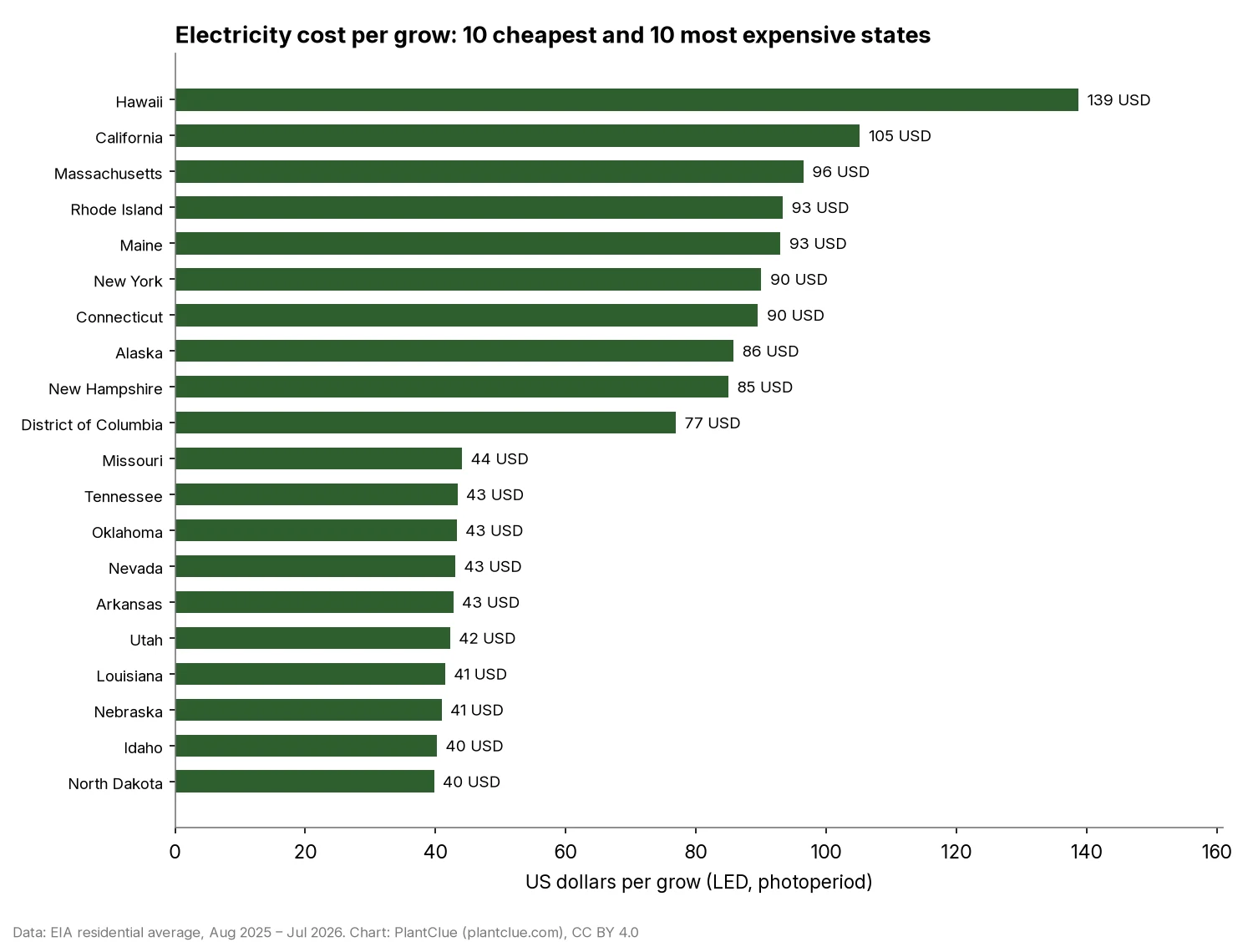
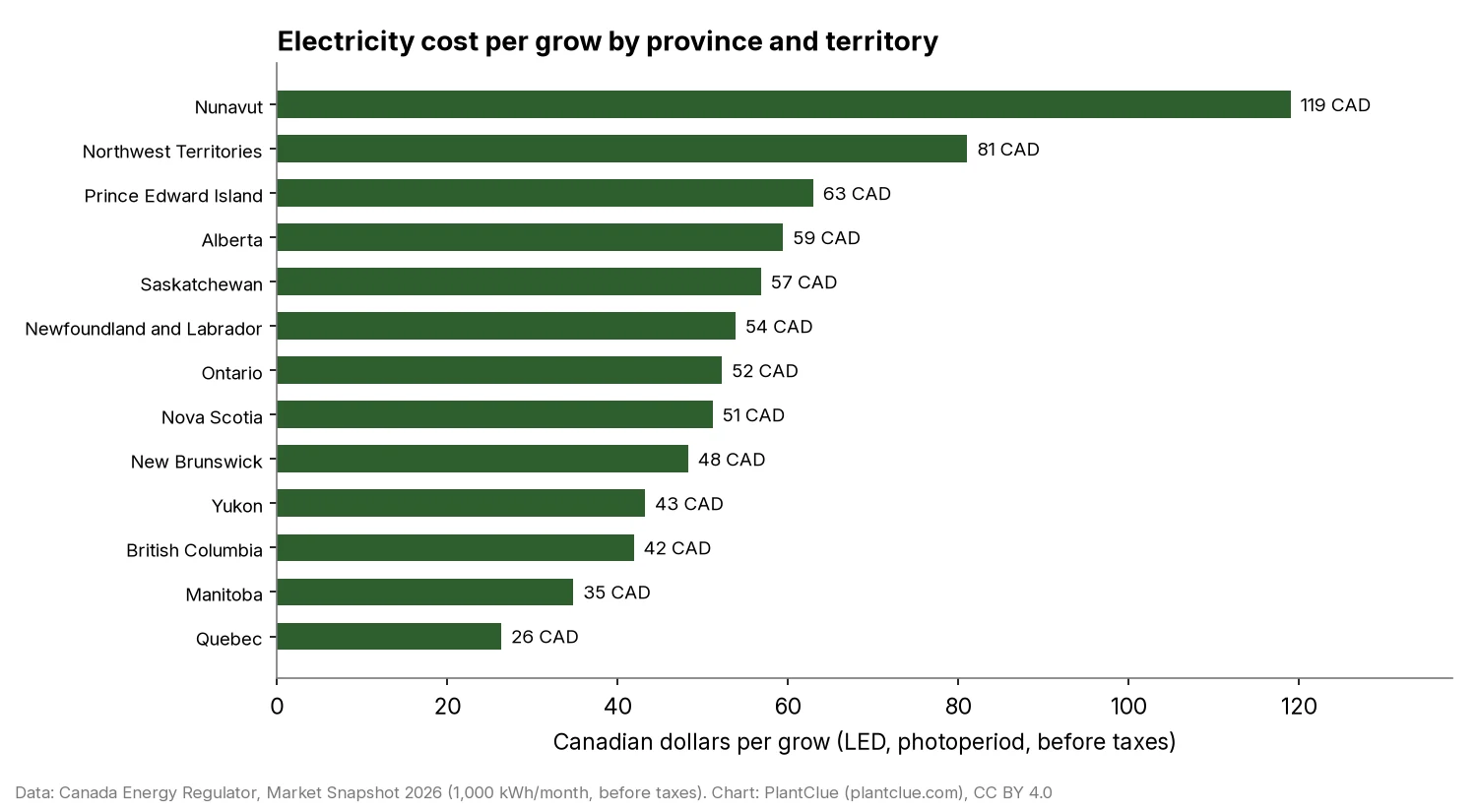
Where you live matters as much as your light. The same LED grow costs $40 in North Dakota and Idaho, about $51 in Texas, $90 in New York, $105 in California and $139 in Hawaii. In Canada, the provincial median is CA$52 (before taxes), from CA$26 in Quebec to CA$119 in Nunavut.

"Your light is the biggest lever, your exhaust fan the second. An EC fan that slows down at night saves more power over a grow than most people think. Run your own setup through the calculator before you buy."
LED or HPS, photoperiod or autoflower: electricity use per grow
All four versions run in the same 2.6 × 2.6 ft tent. Costs are for one complete grow at the US residential average rate.
| Setup | Length | kWh per grow | Cost (US average) | Per month |
|---|---|---|---|---|
| LED, photoperiod | 13 weeks (4 × 18/6, 9 × 12/12) | 318 | $57.28 | $18.88 |
| HPS, photoperiod | 13 weeks (4 × 18/6, 9 × 12/12) | 640 | $115.47 | $38.07 |
| LED, autoflower | 11 weeks (18/6) | 333 | $60.01 | $23.38 |
| HPS, autoflower | 11 weeks (18/6) | 679 | $122.52 | $47.73 |
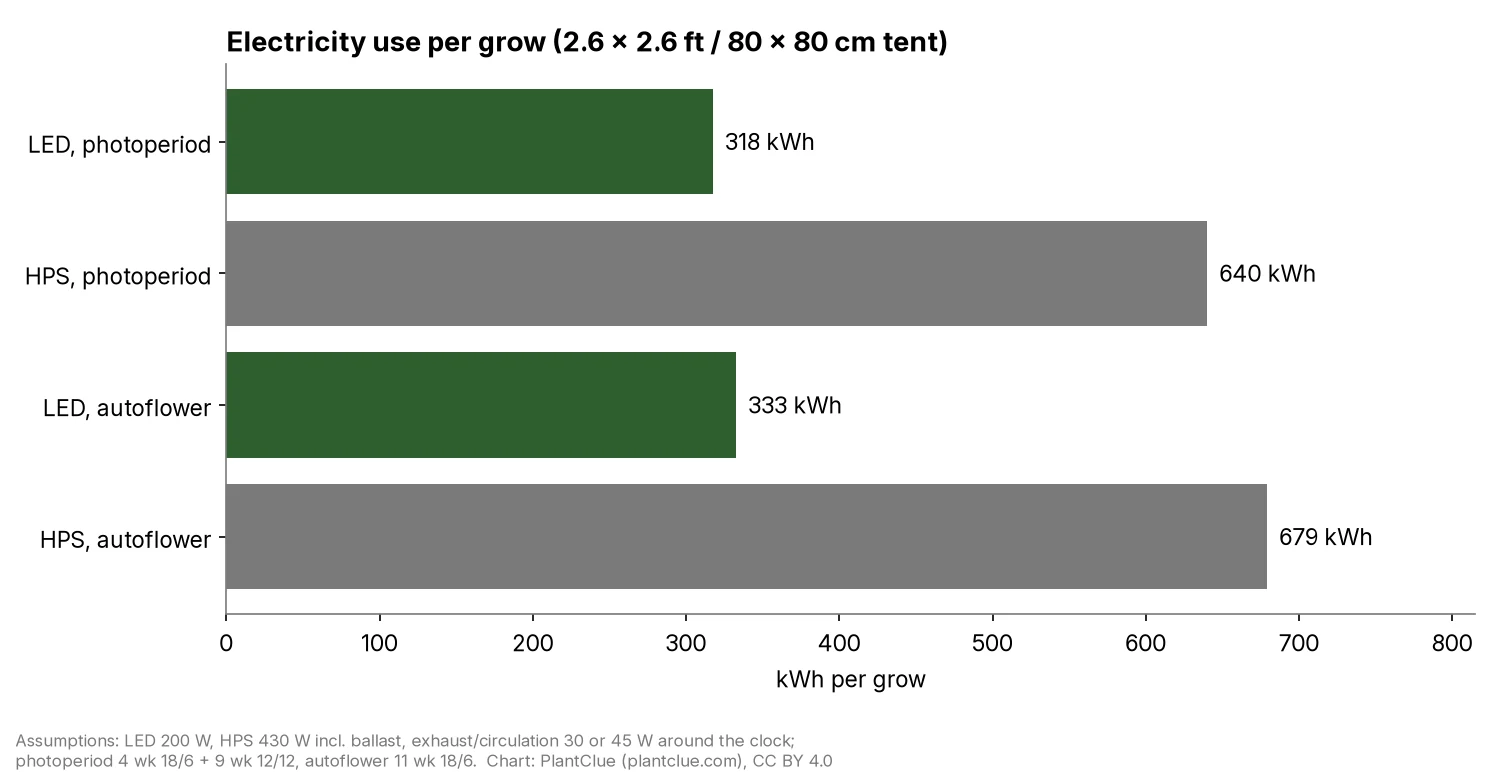
Why HPS uses so much more: a 400 W HPS draws about 430 W with its ballast and produces so much heat that the exhaust has to work harder. The LED still delivers more light, about 540 µmol/s per the manufacturer versus about 440 µmol/s for an older 400 W HPS based on published measurements. Read the full comparison in LED vs. HPS for cannabis.
Grow electricity cost by state: the cheapest and the most expensive
Residential rates differ by more than three times across the US. Hawaii and California sit at the top, while the Plains and Mountain states are the cheapest places to run a tent.
| State | Residential rate | LED grow | HPS grow |
|---|---|---|---|
| North Dakota (cheapest) | 12.53 ¢/kWh | $39.79 | $80.20 |
| Texas | 16.00 ¢/kWh | $50.80 | $102.41 |
| Florida | 15.41 ¢/kWh | $48.93 | $98.64 |
| Colorado | 16.55 ¢/kWh | $52.55 | $105.93 |
| Michigan | 21.00 ¢/kWh | $66.68 | $134.42 |
| New York | 28.36 ¢/kWh | $90.05 | $181.53 |
| California | 33.13 ¢/kWh | $105.19 | $212.06 |
| Hawaii (most expensive) | 43.70 ¢/kWh | $138.76 | $279.71 |
| US average | 18.04 ¢/kWh | $57.28 | $115.47 |
Rates are state averages for households. Your utility plan may be higher or lower, especially with time-of-use pricing. Use your own rate in the electricity cost calculator.
Canada by province and the comparison with Europe
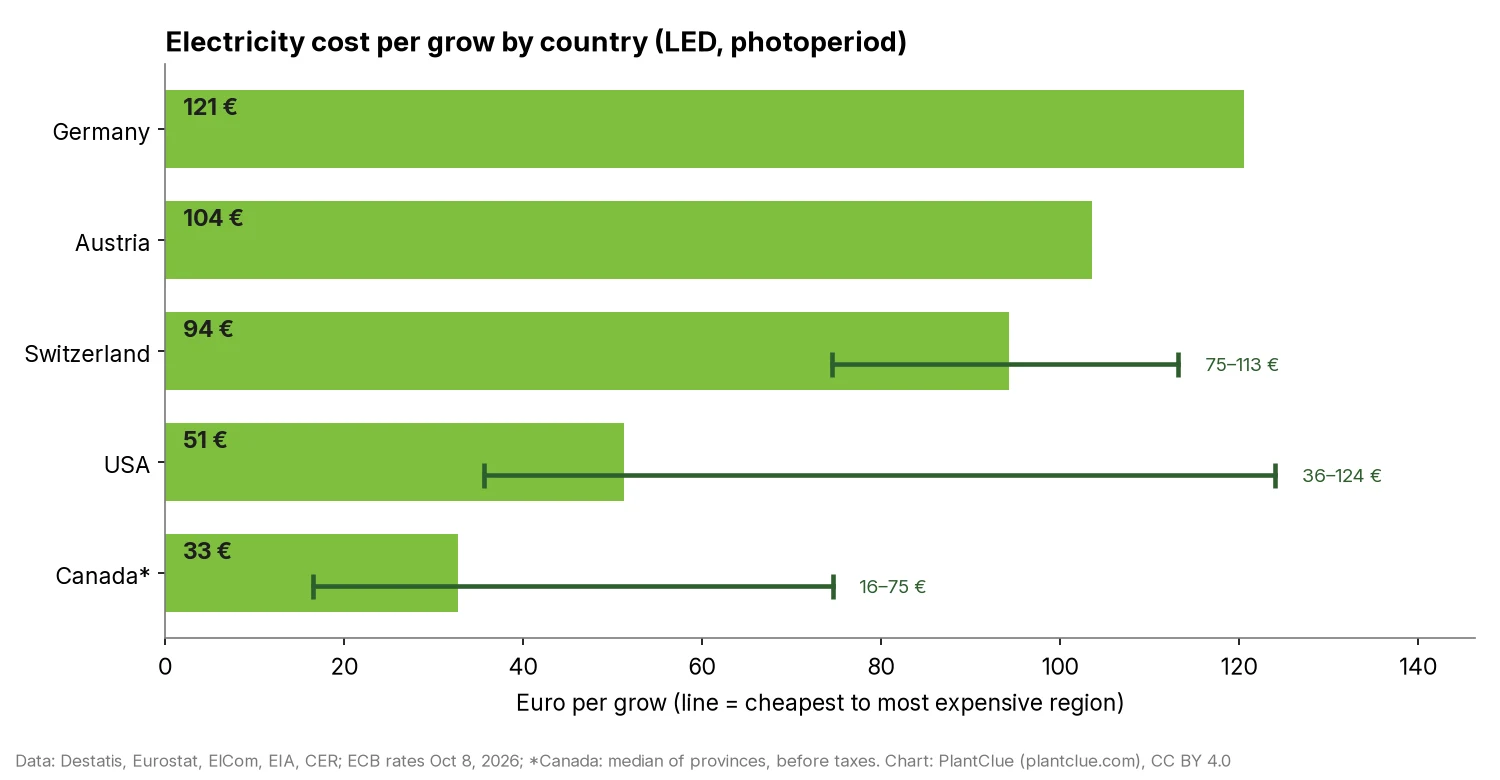
Hydro power keeps Quebec and Manitoba at the bottom of the Canadian ranking, while the northern territories pay the most. Compared in euros, North American growers pay far less than growers in Germany, Austria or Switzerland.
What does a whole grow cost? Cost per gram and per ounce
Electricity is only part of the bill. For an example with three autoflowers in a 2.6 × 2.6 ft tent we add up electricity, supplies and equipment. Assumptions: 135 g (4.76 oz) dry harvest per grow (about 0.7 g per watt, a good run), supplies $196 per grow (seeds, soil, nutrients, water, share of the carbon filter) and $783 one-time equipment (tent, LED, exhaust with filter, circulation fan, accessories), converted from the European example at the ECB rate and rounded. Electricity: $60.01 for the LED autoflower grow at the US average rate.
| Grows | Total cost incl. equipment | Total harvest | Cost per gram | Cost per ounce |
|---|---|---|---|---|
| 1 | $1,039.01 | 135 g (4.8 oz) | $7.70 | $218.19 |
| 2 | $1,295.02 | 270 g (9.5 oz) | $4.80 | $135.97 |
| 3 | $1,551.03 | 405 g (14.3 oz) | $3.83 | $108.57 |
| 4 | $1,807.04 | 540 g (19.0 oz) | $3.35 | $94.87 |
| 8 | $2,831.08 | 1,080 g (38.1 oz) | $2.62 | $74.31 |
Without equipment, each grow costs $256.01, or $1.90 per gram. Yield is the biggest lever: at 90 g it is $2.84 per gram, at 180 g $1.42. This example is not a yield guarantee; time, learning curve and failed runs are not included. Run your own electricity numbers in the electricity cost calculator. The full example with all tables is available as a PDF download.
How to lower your grow electricity cost
The four levers, sorted by their impact in our model.
- LED instead of HPS
Cuts use in half with the same or more light. At the US average that saves about $58 per grow. See our best LED grow lights.
- Control your exhaust
Fans run 24 hours a day. An EC fan with a temperature or humidity controller slows down at night and saves power.
- Check your light hours
18/6 instead of 20/4 for autoflowers saves about 8% of the electricity. A reliable timer keeps the light from running longer than planned.
- Know your rate
Your price per kWh decides the bill. With time-of-use plans, running the light at night is often cheaper.
How we calculated
Formula: kWh per day = (light wattage × light hours + wattage of 24-hour devices × 24) ÷ 1,000. Cost = kWh × rate. This is exactly the math of our calculator, and we cross-checked the results against its code.
Setup (2.6 × 2.6 ft / 80 × 80 cm tent): LED 200 W, the wattage class for this tent size in our LED comparison (e.g. 2.7 µmol/J per the manufacturer). HPS 400 W, assumed 430 W at the wall with ballast. For the light output of older HPS fixtures we used the measured 1.02 µmol/J for mogul-base HPS from Nelson & Bugbee (2014). Exhaust (4-inch EC fan, about 20 W on average per manufacturer data) plus circulation (about 10 W) equals 30 W around the clock; 45 W for HPS because of the extra heat.
Timing: photoperiod 4 weeks veg on 18/6 and 9 weeks flower on 12/12 (91 days). Autoflower 11 weeks on 18/6 (77 days). Not included: heating, AC, dehumidifier, pumps and drying.
Rates (as of October 8, 2026): USA: U.S. Energy Information Administration, average residential price by state, mean of August 2025 to July 2026. Canada: Canada Energy Regulator, average residential price at 1,000 kWh per month, before taxes. Germany: Destatis table 61243-0001; Austria: Eurostat nrg_pc_204; Switzerland: ElCom median by canton, 2026. Euro conversion: ECB reference rates of October 8, 2026.
Limits: Country figures come from different statistics and are only partly comparable. Canada is shown before taxes. Individual households often pay different rates, and fixed monthly charges are not included. We left out yield on purpose because it depends heavily on strain, experience and setup.
All charts in this study are licensed under CC BY 4.0. You may use them freely as long as you credit "Source: PlantClue (plantclue.com)" with a link to this page. A short version is available as a PDF download.
Frequently asked questions about grow electricity cost
How much does electricity cost for one indoor grow?
One grow in a 2.6 × 2.6 ft tent with a 200 W LED uses about 318 kWh. At the US residential average of 18.04 cents per kWh that is about $57. Depending on your state it ranges from about $40 to $139.
How much electricity does an LED save compared to HPS?
In our model the LED cuts use in half: 318 instead of 640 kWh per grow. That comes from the lower wattage and from the exhaust having less heat to remove. At the US average that is about $58 less per grow.
Do autoflowers use less electricity?
No. Autoflowers finish after about 11 instead of 13 weeks, but they get 18 or 20 hours of light every day. On 18/6 an LED grow uses 333 kWh, on 20/4 363 kWh, which is more than a photoperiod grow at 318 kWh.
How much electricity do grow tent fans use?
Exhaust and circulation fans run around the clock. At 30 W combined they use about 66 kWh over one grow, roughly one fifth of the total for an LED setup.
Which state is the cheapest for growing indoors?
Based on average residential rates, North Dakota, Idaho, Nebraska, Louisiana and Utah are the cheapest, at about $40 to $42 per LED grow. Hawaii and California are the most expensive at about $139 and $105.
What does one gram from a home grow cost?
In our example with three autoflowers (135 g, LED, US average rate), each grow costs $256.01 without equipment, about $1.90 per gram. Including $783 of equipment, the first grow comes to $7.70 per gram, and $2.62 over eight grows.
Can I use the charts?
Yes. All charts are licensed under CC BY 4.0. You may use them freely, including commercially, as long as you credit "Source: PlantClue (plantclue.com)" with a link to this study.
