

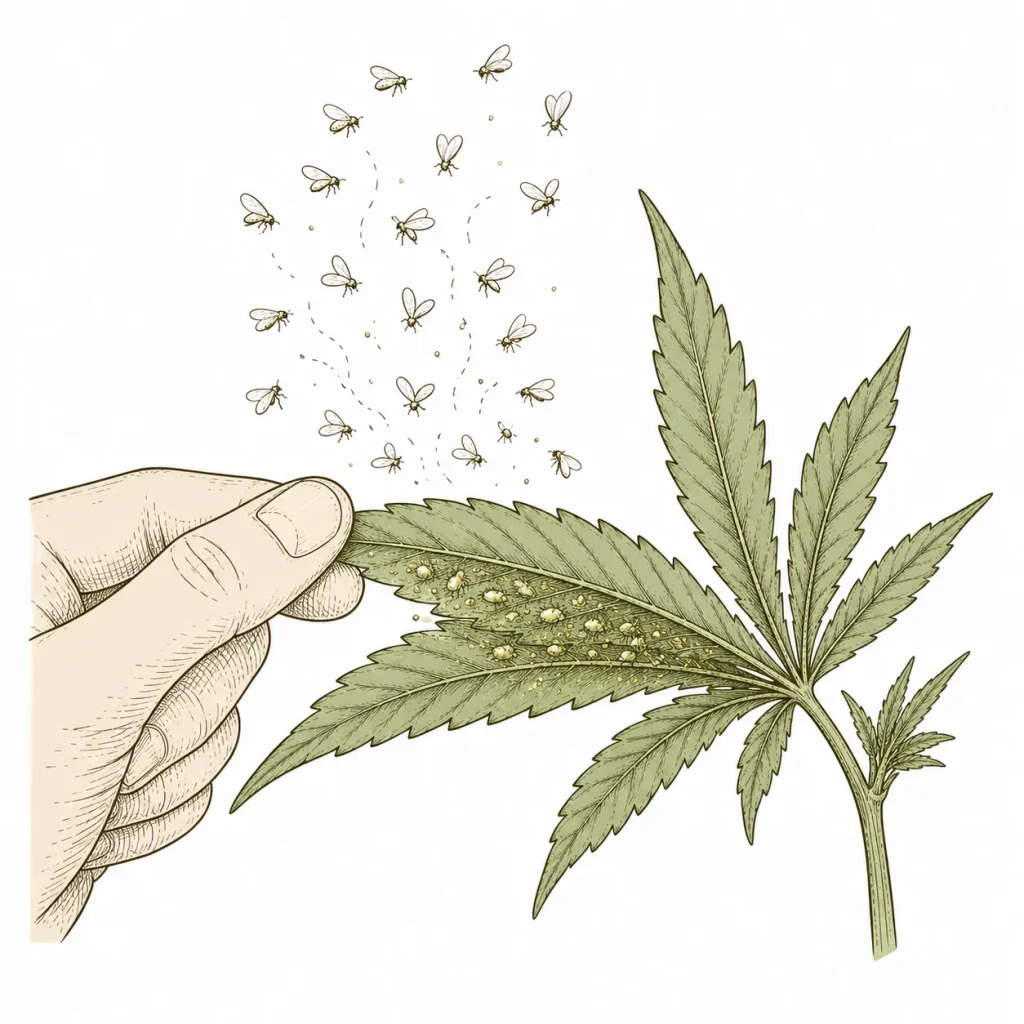
Getting rid of whiteflies on cannabis is one of the most important steps if you want to finish a successful grow, because this tiny pest can do serious damage in very little time. Whiteflies suck the sap out of your cannabis plants, weaken them for the long haul and leave behind sticky residue where mold can take hold. They spread especially fast outdoors and in poorly ventilated grow tents, so catching them early is key. This guide walks you through everything you need to know about whiteflies, from a reliable diagnosis to proven home remedies to effective biological and chemical control strategies.
What Are Whiteflies and Why Do They Attack Cannabis?
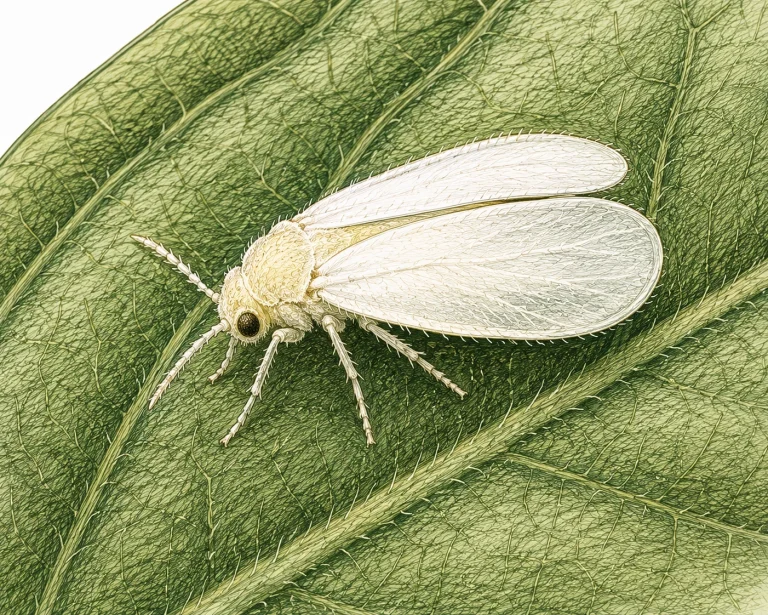
Despite the name, the whitefly is neither a true moth nor a true fly. It belongs to the family Aleyrodidae, close relatives of aphids and scale insects. The species that matter most for cannabis are the greenhouse whitefly (Trialeurodes vaporariorum) and the silverleaf whitefly, also called sweetpotato whitefly (Bemisia tabaci). Adults of both species are only 0.04–0.12 in (1–3 mm) long and covered in a white, waxy powder that gives them their typical look. A classic sign of an infestation: you shake the leaves and a little white cloud rises up. Those are the startled adults.
Cannabis is a particularly attractive host for whiteflies because its sap is rich in sugars and amino acids. Females prefer to lay their eggs on the undersides of leaves, where they’re protected from direct sunlight and rain. A single female can lay up to 400 eggs within four weeks. Under ideal conditions, meaning temperatures between 70 and 86 °F (21–30 °C) and high humidity, one generation can go from egg to nymph to adult in just two to three weeks. That means a small starting population can explode into a full-blown infestation within a few weeks.
- Adults: white to yellowish, 0.04–0.12 in (1–3 mm), dusty, powdery coating
- Eggs: oval, yellowish-green, laid on leaf undersides in circular patterns
- Nymphs: flat, oval, greenish and translucent, barely visible
- Generation time: every 2–3 weeks in warm temperatures
- Preferred temperature: 70–86 °F (21–30 °C)
- Most at risk: indoor grows and greenhouses with poor air circulation
How to Identify Whiteflies on Cannabis: Signs of Infestation and Damage
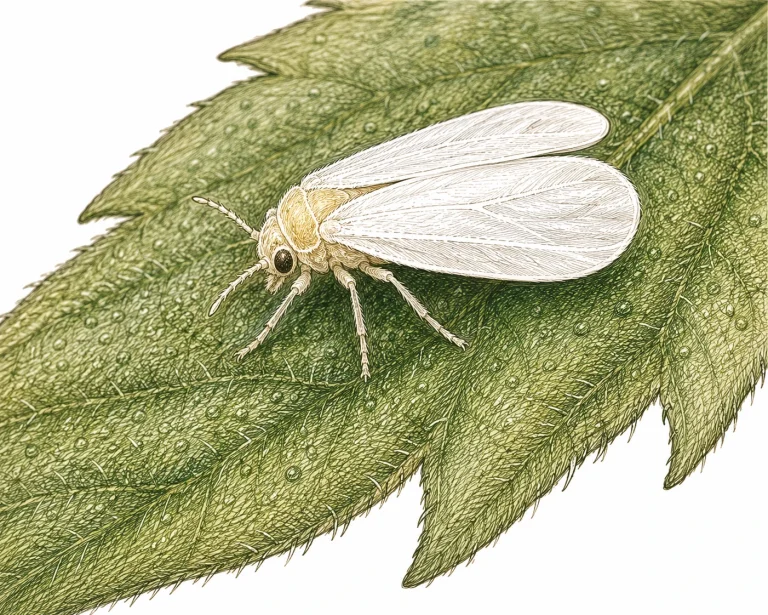
Before you can get rid of whiteflies on cannabis, you need to be sure that’s what you’re dealing with. The main sign is small, whitish-yellow spots on the upper side of the leaves, caused by the pests sucking out the sap. These spots often start as tiny dots and, in a heavy infestation, spread into larger yellowed patches. The Plant Diagnosis overview on PlantClue has a detailed comparison table that helps you tell feeding damage apart from nutrient deficiencies, because yellow leaves can have lots of causes.
Flip a few leaves over and check the undersides: with whiteflies, you’ll find oval, yellowish-green eggs, often arranged in circles or half-circles. Next to them you’ll see flat, almost transparent nymphs that barely move. Another dead giveaway is sticky honeydew, which whiteflies excrete as waste. This honeydew coats leaves and buds with a shiny film and is the perfect breeding ground for sooty mold, a black, soot-like layer that settles on the leaves. Secondary mold infections like this can put the harvest of an entire plant at risk.
With a heavy infestation, your cannabis plants can show symptoms like stunted growth, yellowing leaves and early leaf drop. Weakened plants are also more vulnerable to other stress factors such as nutrient deficiencies or additional pests. So if your plant suddenly stops growing well or starts dropping leaves, it always pays to take a close look at the leaf undersides.
- Small yellowish feeding spots on the upper leaf surface
- Eggs and nymphs visible on the leaf undersides
- Sticky honeydew on leaves and stems
- Black sooty mold growing on the honeydew as a secondary infection
- White cloud when you shake the plant (adults take flight)
- Overall weak growth and early leaf drop in heavy infestations
How to Get Rid of Whiteflies on Cannabis: Biological Methods
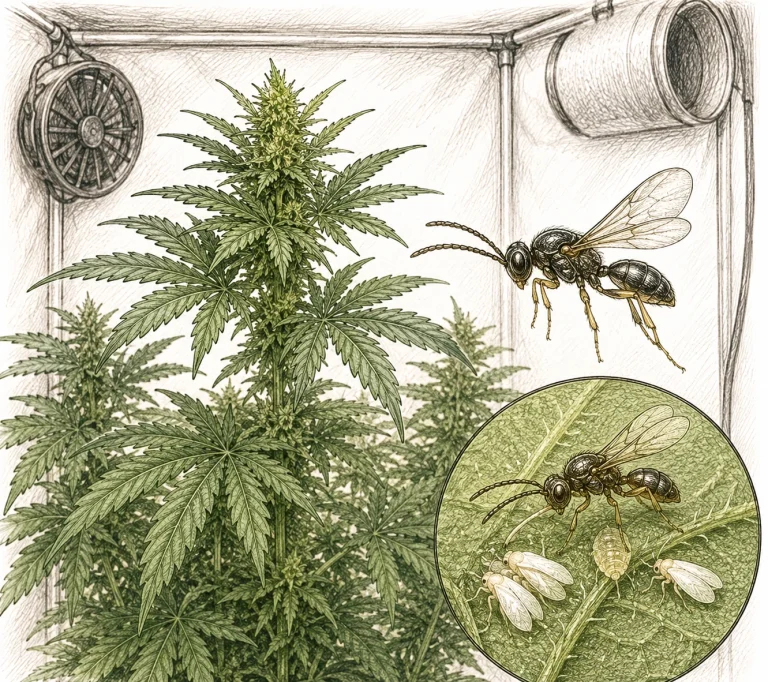
When you’re fighting whiteflies on cannabis, biological methods should be your first choice. They’re gentle on your plants, leave no residue and help restore the natural balance in your grow. Your most effective biological weapon is beneficial insects, especially the parasitic wasp Encarsia formosa (German). This tiny wasp lays its eggs inside whitefly nymphs. The wasp larvae then kill the nymphs from the inside. You can buy Encarsia formosa at garden centers and from online suppliers of biological pest control. It usually comes on cards with parasitized pupae that you hang in your grow. For best results, release a new batch every one to two weeks for as long as the infestation lasts.
Another highly effective beneficial is Amblyseius swirskii, a predatory mite that feeds on whitefly eggs and nymphs, among other things. Predatory mites are especially handy because they stay active even when pest numbers are low, so you can use them preventively. Along with beneficial insects, neem oil sprays have a solid track record. Neem oil contains azadirachtin, which disrupts the whitefly’s hormone system and slows down its development and reproduction. Mix 5 ml of neem oil into 1 qt (1 L) of lukewarm water with a drop of dish soap as an emulsifier, then spray generously on the undersides of all leaves. Repeat every five to seven days for at least three weeks to catch every generation.
Insecticidal soap (potassium soap) also kills whiteflies on contact. It dissolves the insects’ waxy coating and dries them out. Spray the diluted soap solution (1–2 % concentration) directly onto the insects. Because insecticidal soap only works on direct contact and breaks down quickly, you’ll need several treatments at short intervals here too. Never apply neem oil or insecticidal soap under direct light or at high temperatures – this can burn your leaves.
- Encarsia formosa: parasitic wasp that parasitizes nymphs – most effective when you catch the infestation early
- Amblyseius swirskii: predatory mite that eats eggs and nymphs, also works preventively
- Neem oil (5 ml per qt / 1 L): disrupts development, repeat every 5–7 days
- Insecticidal soap (1–2 %): kills on contact, apply several times
- Garlic spray: 5 crushed garlic cloves in 1 qt (1 L) of water, helps keep whiteflies away
- Yellow sticky traps: catch adults, reduce the population and work as a monitoring tool
How to Get Rid of Whiteflies on Cannabis: Chemical and Mechanical Methods

If biological methods aren’t enough or the infestation is already severe, you may need to bring in chemical or physical controls. Pyrethrin-based insecticides work well against whiteflies. Pyrethrins are natural compounds from chrysanthemum flowers and are considered biodegradable. They attack the insects’ nervous system and kill adults and nymphs on contact. Important: steer clear of synthetic pyrethroids (such as permethrin) when growing cannabis. They last much longer and can leave residues in your buds.
Spinosad is another biological active ingredient. It’s produced by bacteria (Saccharopolyspora spinosa) and is very effective against whiteflies. It attacks the insects’ nervous system and keeps working for a few days after it dries on the leaves. When you use spinosad, apply it at dusk or with the lights off, because it’s toxic to bees. Once your plants start flowering, it’s best to skip sprays completely and rely only on beneficial insects so you don’t risk residues in your buds.
On the mechanical side, wiping the undersides of the leaves with a damp cloth takes work, but it’s very effective in small grows. Remove heavily infested leaves that already show serious damage and throw them out with your household trash – not in the compost. Yellow sticky traps catch adult whiteflies and help you reduce the population and keep an eye on the infestation. Hang the traps just above the canopy, where the bugs fly around the most. Keep in mind that sticky traps alone won’t wipe out an infestation – use them as one part of an integrated pest management (IPM) plan.
- Pyrethrin (natural): kills on contact, biodegradable – don’t spray during flowering
- Spinosad: highly effective, apply only in the evening (toxic to bees), penetrates the leaf tissue
- Synthetic pyrethroids: AVOID – can leave persistent residues in buds
- Wiping the undersides of leaves by hand in small grows
- Removing and safely disposing of heavily infested leaves
- Yellow sticky traps: monitoring and reducing the adult population
Preventing Whiteflies: How to Protect Your Cannabis Grow for Good
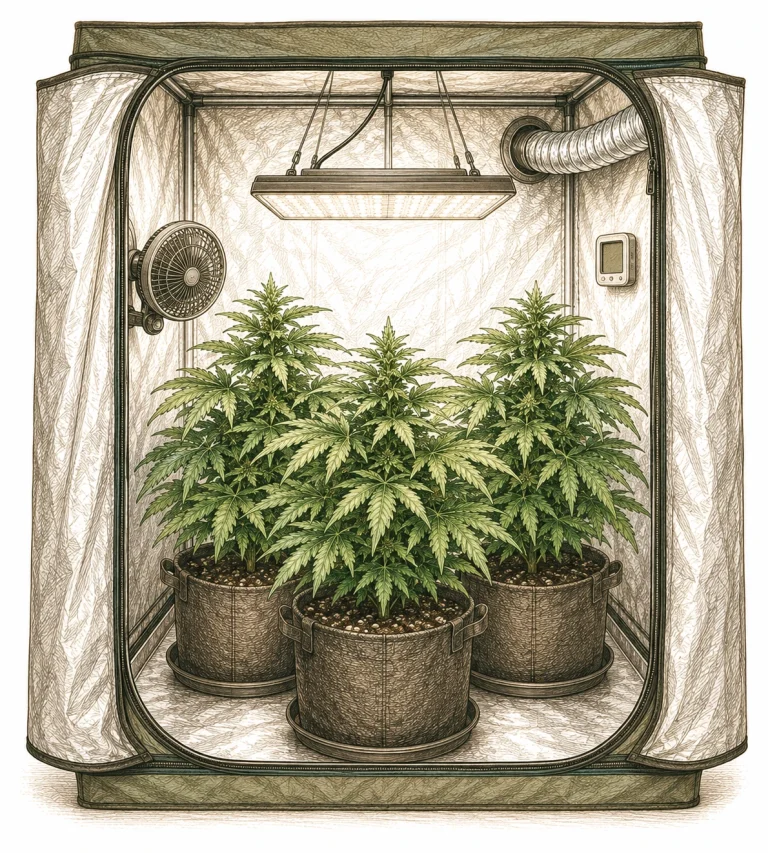
The best way to deal with whiteflies on cannabis is to never let a big infestation happen in the first place. Prevention starts with your grow climate. Whiteflies love warm, humid, stuffy conditions. Keep the air moving with enough fans, and keep humidity (relative humidity, RH) below 60 % in the vegetative stage and below 50 % in the flowering stage. A properly dialed-in pH in your water and balanced feeding also keep your plants strong and resilient. Stressed plants are always more vulnerable to pests.
Indoors, hygiene is everything. Clean your grow space thoroughly after every run, disinfect all surfaces and swap out the growing medium. After an infestation, release predatory mites like Amblyseius cucumeris or Amblyseius swirskii as a preventive step before you bring in new plants. Outdoors, get your plants from trusted sources and always quarantine new plants for a week before they join the rest of your garden. Check the undersides of the leaves on every plant at least twice a week so you can catch an infestation early.
Yellow sticky traps belong in every grow as a permanent monitoring tool. As soon as you spot the first adult whiteflies on the traps, you can step in with biological controls before things get out of hand. Keep in mind that whiteflies often hitch a ride on contaminated gear, clothing or plant cuttings. Ideally, change clothes before entering your grow room or wear dedicated coveralls. Some growers also use companion plants like basil or lavender, whose essential oils are said to repel whiteflies. It’s an interesting approach, even though the science behind it is still thin.
- Keep humidity below 60 % (veg) and 50 % (flower)
- Make sure you have good air circulation with fans
- Keep pH and feeding in the optimal range
- Always quarantine new plants for 7 days
- Clean and disinfect your grow space thoroughly after every run
- Use yellow sticky traps for ongoing monitoring
- Release predatory mites like Amblyseius swirskii as prevention
- Check leaf undersides at least twice a week
Fighting Whiteflies on Cannabis During Flowering: What’s Still Safe to Use?

Flowering is the trickiest time to fight whiteflies on cannabis, because chemical sprays now carry a high risk of leaving residue on your buds. As a rule of thumb, skip all sprays from the second week of flowering on whenever you can. Instead, beneficial insects like Encarsia formosa or Amblyseius swirskii are your go-to option. They target the pest directly without contaminating your buds. If you notice honeydew deposits on the buds that could lead to mold, gently dab the affected areas with a soft, damp cloth.
If the infestation during flowering gets so bad that the plant is in real danger, you can use a diluted insecticidal soap (potassium soap) solution (0.5 % max) as a last resort. Spot-apply it only to the undersides of the leaves, never directly on the buds. Do these emergency treatments only at night or with the lights off, and make sure you ventilate well afterward. In severe cases, also consider whether an early harvest might make more sense than nursing a heavily contaminated plant. Use the Plant Diagnosis overview on PlantClue to look at your situation as a whole and make the right call.
One often underrated step during flowering is consistently removing heavily infested lower leaves (the ones you’d strip when lollipopping), since they contribute very little to photosynthesis anyway. This can cut down the whitefly population significantly and improves airflow in the lower part of the plant at the same time. Good nutrition is especially important in flower. Read up on common nutrient deficiencies in cannabis, which can show up more often when a pest infestation stresses your plants.
- From week 2 of flowering: no more sprays on buds
- Beneficial insects (Encarsia formosa, Amblyseius swirskii) are the safest option in flower
- Insecticidal soap 0.5 % max, spot-applied to leaf undersides only, never on buds
- Always treat at night or with the lights off
- Remove heavily infested lower leaves (reduces the population and improves airflow)
- With an extreme infestation: consider an early harvest
- Gently dab honeydew deposits off buds with a damp cloth
Whiteflies vs. Other Pests: How to Tell Them Apart
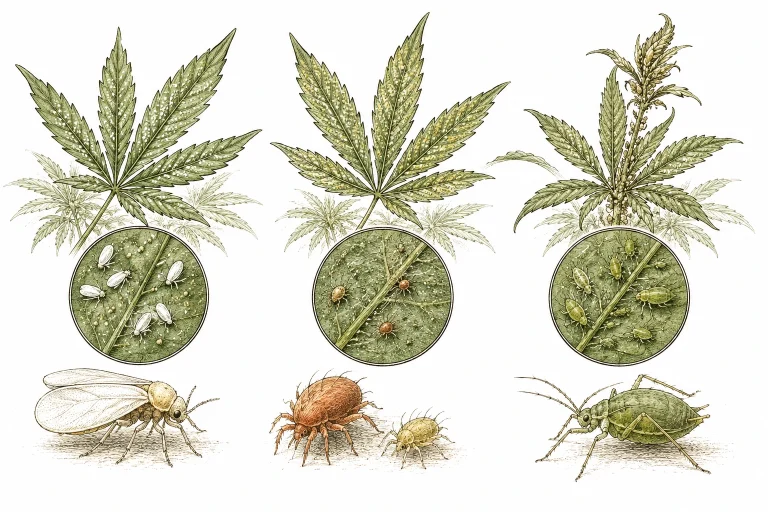
A common mistake when fighting whiteflies on cannabis is confusing them with other pests. Early on, the damage can look very similar. Spider mites also leave tiny yellowish feeding spots on the leaves. But they’re much smaller (0.01–0.02 in / 0.3–0.5 mm). In heavy infestations they spin fine webbing on the leaves. And unlike whiteflies, they don’t fly up when you touch the plant. Aphids are sap-sucking pests too, and they also produce honeydew. But they’re usually green, black or brown, and much bigger than whitefly nymphs.
Thrips cause similar pale spots on the leaves. The giveaway: they leave silvery, shiny streaks and tiny black specks of frass on the leaf surface. Thrips are long, slim and very fast, while whitefly nymphs are flat and barely move. To be really sure, check the undersides of the leaves with a magnifying loupe or a USB microscope. The oval nymphs and the eggs laid in little circles are unmistakable signs of whiteflies. A careful diagnosis is the foundation of effective treatment. Using the wrong product on the wrong pest costs you time and money and doesn’t solve the problem.
Not sure what you’re dealing with? Take a look at our complete pest overview for cannabis growers. It compares all the common pests side by side, with photos and descriptions. A quick, accurate diagnosis is always the first step toward a treatment that works.
- Spider mites: don’t fly up, fine webbing, smaller than whiteflies
- Aphids: bigger, colored (green/black/brown), don’t fly up
- Thrips: silvery streaks, black frass specks, long and slim
- Whiteflies: white cloud when you shake the plant, oval nymphs on leaf undersides, eggs laid in circles
- Diagnosis tip: use a loupe or USB microscope on the leaf undersides
- Sure sign: honeydew + sticky leaves + tiny white insects = whiteflies
For a general game plan against sap-sucking pests, check out our article on pest control.
Frequently Asked Questions
How do I spot whiteflies on my cannabis plant?
The surest sign is a white cloud of tiny insects that rises when you shake the plant. Also check the undersides of the leaves. There you’ll find oval, yellowish-green eggs laid in circular patterns and flat, translucent nymphs. Sticky honeydew and yellowish feeding spots on the tops of the leaves are other typical signs.
What works best against whiteflies on cannabis?
The most effective overall approach combines beneficial insects (Encarsia formosa, a parasitic wasp, or Amblyseius swirskii, a predatory mite) with regular neem oil sprays (19 ml/gal / 5 ml/L of water) every 5–7 days. In the flowering stage, stick to beneficial insects only, so you don’t leave residue on your buds.
Can I still spray against whiteflies during flowering?
From the second week of flowering on, you shouldn’t spray anything onto the buds. Use beneficial insects like Encarsia formosa instead. Spot-treating the leaf undersides with heavily diluted insecticidal (potassium) soap (0.5% max) is a last resort for emergencies only – never directly on the buds. Always treat at night or with the lights off.
How fast do whiteflies multiply?
At temperatures between 70 and 86 °F (21–30 °C), whiteflies can go from egg to adult in just 2–3 weeks. A single female can lay up to 400 eggs. That means a small infestation can explode into a massive plague within a few weeks – so acting early is essential.
Are whiteflies a problem in outdoor grows too?
Yes, whiteflies can become a problem in outdoor growing too, especially during hot summers with little air movement. Outdoors, though, natural predators like ladybugs and hoverflies help keep them in check. As prevention, use yellow sticky traps and check the leaf undersides regularly. If you do get an infestation, neem oil is a safe choice outdoors.
Can I fight whiteflies with home remedies?
Yes, several home remedies can help to some degree. Garlic spray (5 crushed cloves in 1 qt / 1 L of water) works as a repellent. An insecticidal soap solution (1–2% soap in water) kills insects on direct contact. Neem oil from the garden center (19 ml/gal / 5 ml/L) disrupts their development over time. You need to apply these remedies regularly and repeatedly to hit every generation.
How do I prevent a new infestation after treatment?
Once you’ve knocked out the infestation, clean and disinfect your grow space thoroughly. Then release predatory mites as a preventive measure before you bring in any new plants. Always quarantine new plants for one week. Keep humidity low, make sure you have good ventilation, and use yellow sticky traps as a permanent early-warning system.
For more on natural beneficial insects in plant protection, check out the Bavarian State Institute for Viticulture and Horticulture (LWG, German).
Want to learn about other common cannabis pests? Head over to our Pests hub.
The Bottom Line
Getting rid of whiteflies on cannabis is far from impossible – as long as you act fast and with a plan. The keys are catching them early by regularly checking the leaf undersides and using an integrated approach that combines beneficial insects, neem oil and good hygiene. In the vegetative stage, every option is on the table. In flower, stick to gentle methods like parasitic wasps so you don’t put your harvest at risk. With consistent prevention – a stable climate, a clean grow space and regular monitoring – you can keep whiteflies from coming back and give your cannabis plants the best possible growing conditions.
