

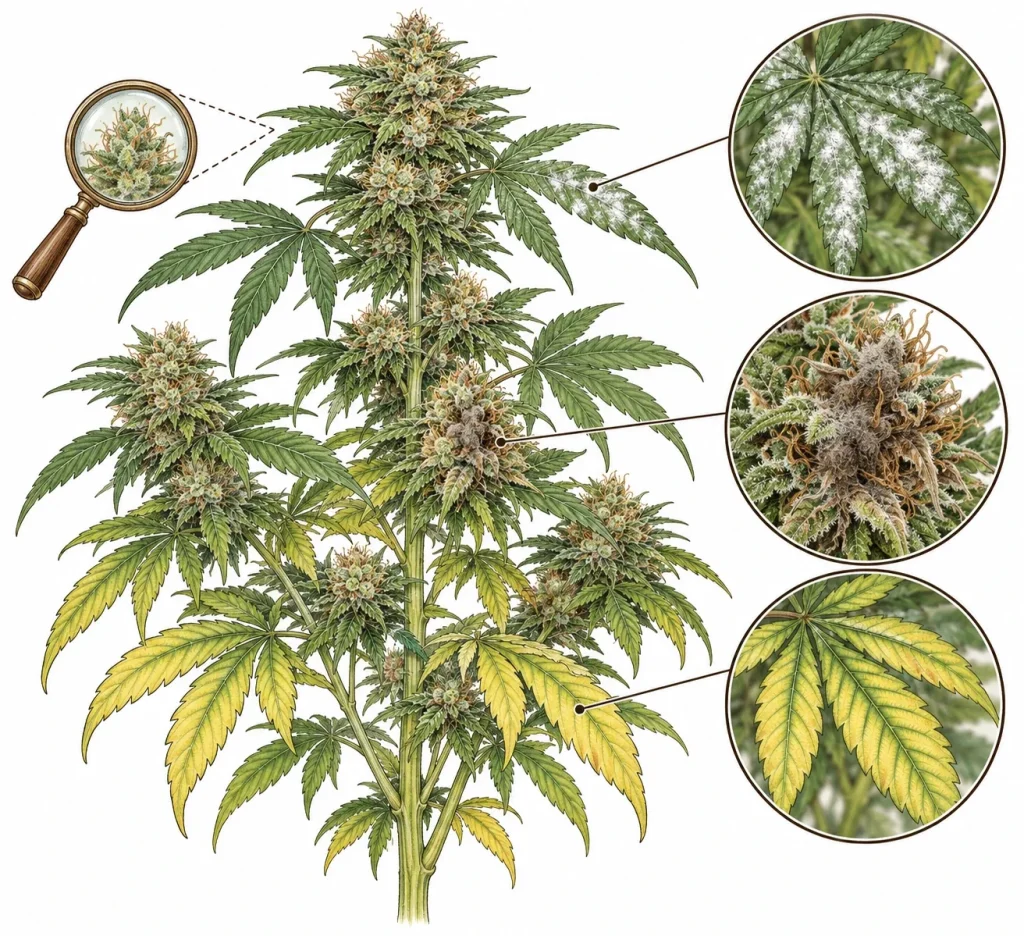
Spotting cannabis diseases is one of the most important skills you can build as a grower. The sooner you see a problem, the easier it is to fix. Fungal infections, pests or nutrient deficiencies: many problems show up on the leaves first, and with a little know-how you can pin them down with confidence. In this guide, you’ll learn the most common diseases and types of damage, how to recognize their typical symptoms, and exactly what to do about them. To help you save precious time and protect your harvest, PlantClue lays out everything you need in a clear, practical way, from the first diagnosis to the right treatment. Want to dig deeper? Our Plant Diagnosis overview shows all the key symptoms at a glance.
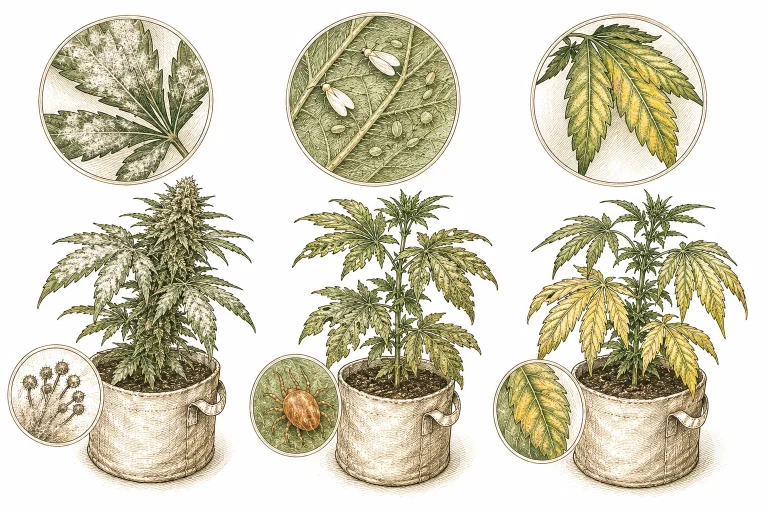
Why Spotting Cannabis Diseases Early Matters So Much
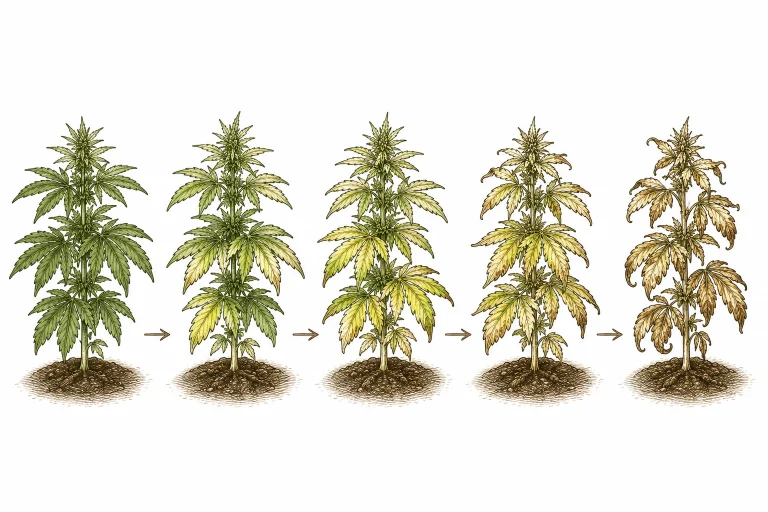
Cannabis plants are sensitive to stress, poor conditions and attacks by fungi or pests. What starts out looking like a minor issue (a few yellow leaves, a white spot, slight discoloration) can turn into a serious infestation within days and put the whole plant at risk. If you don’t act at this stage, you risk more than a smaller yield. In the worst case, you could lose your entire harvest.
The key is checking your plants regularly. Look under the leaves every day, inspect stems and soil, and watch for changes in color, texture or growth pattern. This guide teaches you to tell the most common diseases apart and respond with the right fix, without wasting time on the wrong remedy.
Important: many symptoms look alike. Yellow leaves can point to a nutrient deficiency, the wrong pH or overwatering, or to the start of a pest problem. That’s why a thorough diagnosis should always come first, before you reach for any treatment.
- Early detection helps prevent losing your entire harvest
- Check leaves, stems and soil every day
- Identify symptoms correctly before you treat
- Tell apart similar symptoms with different causes
How to Identify and Fight Fungal Diseases in Cannabis
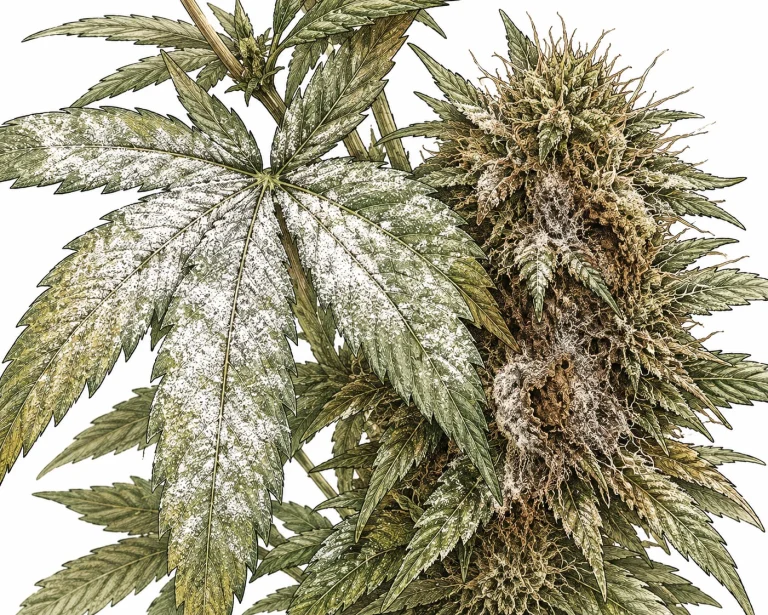
Fungi are among the most common and most dangerous diseases in a cannabis grow. They spread fast, especially with high humidity and poor ventilation. For more on beneficial insects and pest prevention in the garden, check out LWG Bayern (German). The key fungal diseases you should know are powdery mildew, downy mildew and bud rot (botrytis, gray mold). Each one has a distinct look, and once you know the differences, you can respond right away with the right treatment.
Powdery mildew shows up as a white, flour-like coating on the top of the leaves. At first you can wipe it off easily, but it tends to come back quickly if you don’t treat it consistently. Powdery mildew typically develops in warm temperatures with moderate humidity, which is exactly when many growers think their humidity is already low enough. As the infection spreads, affected leaves can turn yellow and die off.
Downy mildew, on the other hand, first appears as yellowish, oily-looking spots on the top of the leaves, while a gray to purple fuzzy growth forms on the underside. It thrives in cool, damp conditions and is harder to beat than powdery mildew. Bud rot (botrytis) is especially feared during the flowering stage: it attacks the buds first, shows up as gray, fluffy mold and can destroy entire buds within a few days. Remove and dispose of infected bud material immediately.
To prevent all fungal diseases: keep humidity below 50% during the flowering stage, make sure you have good ventilation and remove dead leaves consistently. For powdery mildew, baking soda solutions or dedicated plant protection products based on potassium bicarbonate can help. There’s no chemical cure for botrytis. Prevention and quickly removing infected areas are your only real options.
- Powdery mildew: white coating on top of the leaves, shows up in warm conditions with moderate humidity
- Downy mildew: yellow spots on top, gray fuzz underneath, shows up in cool, wet conditions
- Bud rot (botrytis, gray mold): gray mold on the buds. Remove affected parts right away
- Prevention: keep humidity (RH) below 50%, ensure good ventilation, and avoid standing moisture
- Never compost infected leaves or buds. Bag them and toss them in the trash
How to Spot and Fight Cannabis Pests
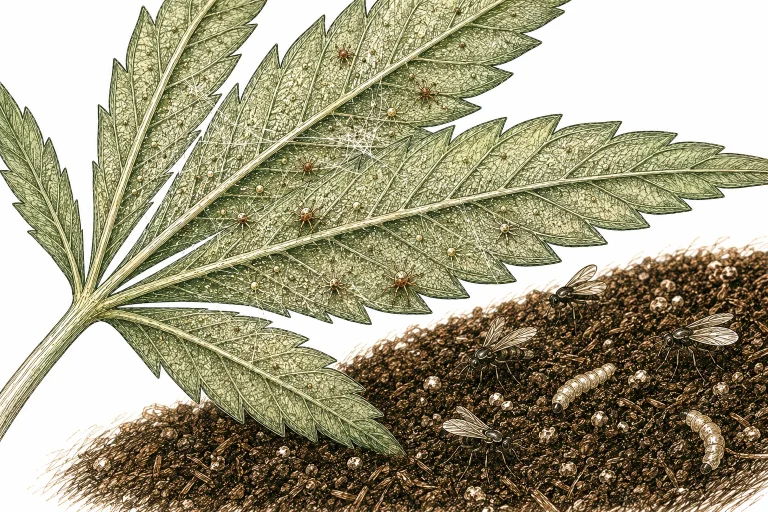
Pests are another big problem in a cannabis grow. The most common culprits are spider mites, fungus gnats, aphids, thrips and whiteflies. All of them weaken your plant by sucking sap, chewing tissue or attacking the roots. Same rule as with mold: the earlier you catch it, the easier it is to fix.
You can spot spider mites by tiny white or yellowish dots on the leaves. Those are their feeding marks. In a heavy infestation, fine webbing forms on the underside of the leaves. Spider mites love dry, warm air and multiply incredibly fast. What to do: raise the humidity, remove infested leaves, spray neem oil or release predatory mites as a biological control.
Fungus gnats usually show up as small black flies buzzing around the soil. The adults aren’t the real threat. Their larvae are: they live in the soil, feed on roots and can seriously damage young plants. You’ll know you have them if you see tiny black specks on the soil surface or your plant looks droopy even though you’re caring for it correctly. What to do: let the soil dry out well between waterings, hang yellow sticky traps and add beneficial nematodes to the soil.
Thrips leave silvery-white streaks on the leaves along with tiny black droppings. You’ll usually need a magnifying glass to see them clearly. Aphids form colonies on growing tips and leaf undersides and leave behind sticky honeydew. Whiteflies are easy to identify: touch the plant and a cloud of tiny white flies takes off. Against all sap-sucking pests, neem oil, insecticidal soap or organic pyrethrin-based sprays have a solid track record.
- Spider mites: white dots on leaves, webbing on leaf undersides
- Fungus gnats: black flies around the soil, larvae damage the roots
- Thrips: silvery streaks and black droppings on leaves
- Aphids: colonies on growing tips, sticky honeydew
- Whiteflies: tiny white insects fly up when you touch the plant
- Neem oil, insecticidal soap and beneficial nematodes are the most effective organic options
Spotting Cannabis Problems: Nutrient Deficiencies and pH Issues
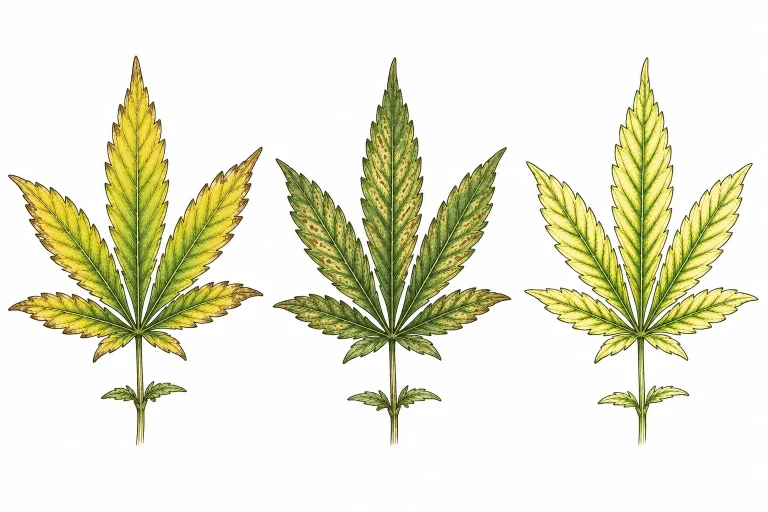
Not every problem with your plant comes from fungi or pests. Often the real cause is a nutrient deficiency or the wrong pH in your growing medium. These issues can be harder to pin down because the symptoms can look a lot like fungal diseases or pest damage. The golden rule: check your pH first, before you start adding more nutrients.
Nitrogen deficiency shows up as even yellowing of the lower, older leaves. The plant starts pulling nitrogen out of old leaves to feed the new ones. Calcium deficiency shows up as dark green to brown spots on middle and newer leaves, often with curled leaf edges. For a deep dive, check out our guide on calcium deficiency in cannabis.
Iron deficiency causes a typical interveinal chlorosis: new leaves turn pale yellow to white while the veins stay green. Magnesium deficiency looks similar, but it hits the middle to older leaves and shows the same yellowing between the veins. With phosphorus deficiency, leaves turn dark green to purple, especially on the underside.
In most cases, nutrient deficiency symptoms don’t mean you’re feeding too little. They’re often caused by the wrong pH, which blocks uptake. A pH outside the ideal range (6.0 to 7.0 in soil) can keep your plant from absorbing the nutrients that are already there. For background on nutrient availability in soil, see the Julius Kühn Institute (in German). So before you add more nutrients, always check the pH first of your water and growing medium. Overwatering can also trigger deficiency symptoms because the roots can’t do their job properly. Learn more in our article on how to water cannabis the right way.
- Nitrogen deficiency: even yellowing that moves from the bottom of the plant up
- Calcium deficiency: brown spots on young and middle leaves
- Iron deficiency: interveinal chlorosis on young leaves, veins stay green
- Magnesium deficiency: interveinal chlorosis on older leaves
- Phosphorus deficiency: dark, purplish leaf discoloration
- Check your pH before you raise your nutrient dose
How to Spot and Fix Root Diseases in Cannabis
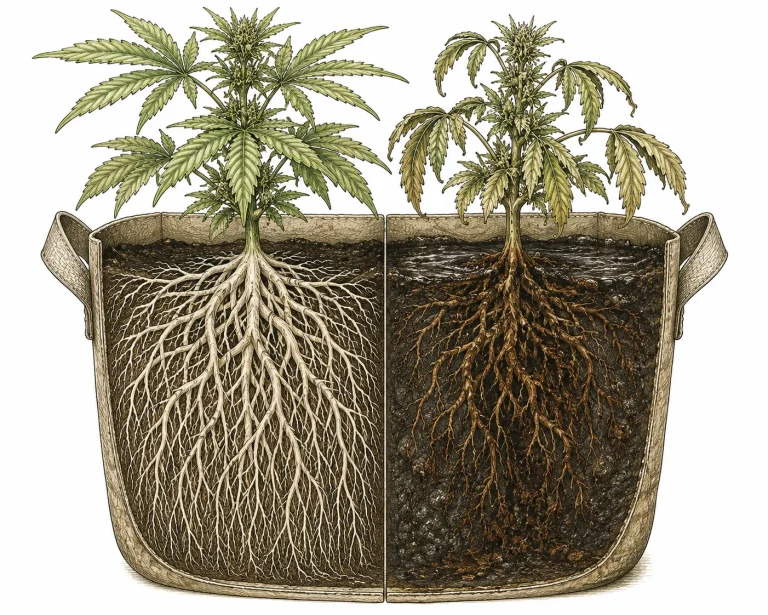
Root diseases are especially sneaky. They start out of sight and often only show up once the damage is well underway. The most common root disease in cannabis is pythium root rot, a water mold that thrives in soggy growing medium and a poorly aerated root zone. Infected roots turn brown to black and get mushy. The plant looks wilted and droopy even though the soil is wet. That’s a classic warning sign.
Other root problems can come from compacted growing medium, pots that are too big or too small, and chronic overwatering. When roots can’t get oxygen, they die off and can no longer fight off pathogens. To check, you can gently slide the plant out of its pot and look at the roots directly. Healthy roots are white to cream-colored, firm, and form a dense web.
To treat root rot, start by cutting back on moisture and trimming away infected roots. Trichoderma products are a proven biological option, since this beneficial fungus works against pythium. To prevent it, make sure you have good drainage, let the growing medium dry out enough between waterings, and go with breathable pots like fabric pots. New growers in particular tend to overwater. If you’re not sure when to water, a cannabis watering guide is the best place to start.
- Pythium root rot: brown, mushy roots in waterlogged growing medium
- Symptom: the plant looks wilted even though the soil is wet
- Diagnosis: gently take the plant out of its pot
- Healthy roots: white, firm, dense web
- Treatment: reduce moisture, remove infected roots, use trichoderma
- Prevention: good drainage, fabric pots, controlled watering
Environmental Damage vs. Real Cannabis Diseases: How to Tell Them Apart
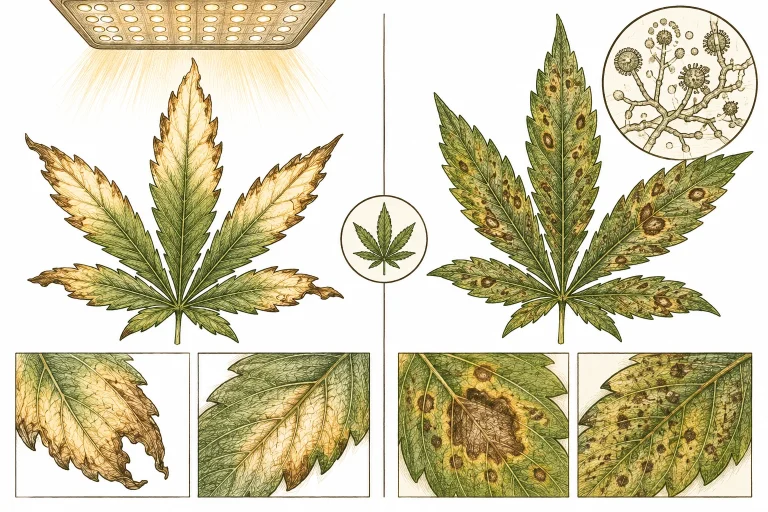
Not every discoloration, deformity, or bit of damage on your plant is an actual disease. Many symptoms come from poor environmental conditions: too much heat, too little light, light burn from LEDs hung too close, big temperature swings, or humidity that’s too high or too low. These stress symptoms can look a lot like fungal diseases or nutrient deficiencies.
You can recognize light burn because the damage only shows up on the top leaves closest to the lamp. The leaf tips and edges turn yellow to brown, while the lower leaves stay healthy. Heat stress makes leaves curl and cup upward, similar to some nutrient deficiency symptoms. If that looks familiar, read up on what’s behind leaf curling.
Cold stress shows up as violet to purple discoloration on leaves and stems, caused by anthocyanin buildup. In some strains this color is genetic and harmless. In others it’s a warning sign. High humidity without any fungus can lead to soft, watery leaves that become especially vulnerable to real fungal diseases. Air that’s too dry, on the other hand, can invite pests, especially spider mites.
The golden rule: if a symptom hits the whole plant evenly or a specific generation of leaves, an environmental cause is often more likely than fungus or pests. Spotty, irregular patterns on individual leaves point more toward fungi, pests, or local nutrient issues. Take a close look at which leaves are affected – young or old, top or bottom. That’s often the key clue.
- Light burn: damage only on the top leaves near the lamp
- Heat stress: leaves curl upward, especially at the growing tips
- Cold stress: violet discoloration on leaves and stems
- Even symptoms across the whole plant: more likely an environmental cause
- Spotty, irregular patterns: more likely fungi or pests
- Which leaves are affected? Young or old, top or bottom?
How to Spot Cannabis Diseases: Quick Diagnosis in 5 Steps
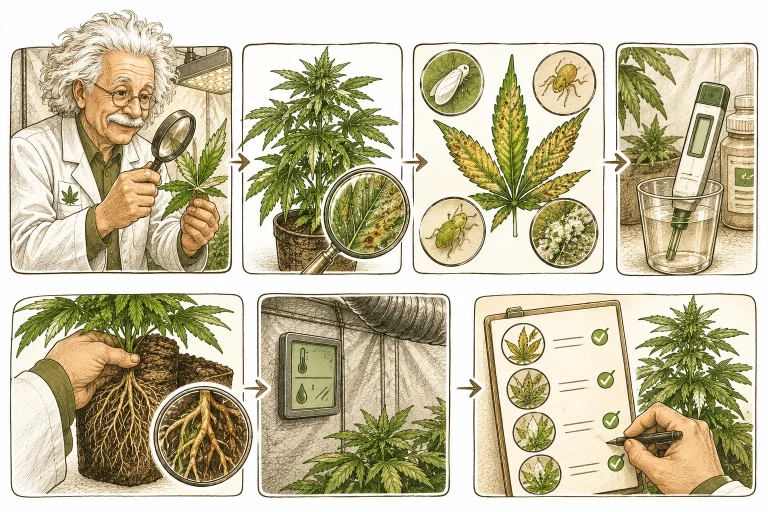
When you spot a problem on your plant, a structured approach helps you find the right cause. These 5 steps have proven themselves in real grows. They help you diagnose with confidence, even as a beginner, without losing valuable time.
Step 1: Look closely. Which parts of the plant are affected? Old leaves or new growth? The top or the bottom of the plant? One plant or several? Step 2: Check your environment. What are your temperature, humidity and ventilation like? How long and how intense is your light running? Are there any direct heat sources?
Step 3: Measure your pH. In most cases, the wrong pH is the real cause behind what looks like a nutrient deficiency. Test your input water and, if you can, your runoff. Step 4: Inspect leaves, stems and soil carefully. Use a magnifying loupe to check the undersides of the leaves, look at the nodes where stems branch off, and check the soil for signs of pests. Step 5: Compare with known symptoms. Our plant diagnosis overview on PlantClue helps you pin down what you’re seeing.
Only start treating once you’ve gone through all five steps. If you act first and diagnose later, you risk using the wrong fix and making the problem worse. Also, keep a record of what you see. Photos and notes help you track how things develop and react faster on your next grow.
- Step 1: Observe – which plant parts, which leaves (old or new)?
- Step 2: Check your environment – temperature, humidity, light
- Step 3: Measure pH – check your input water and runoff
- Step 4: Inspect leaves, stems and soil carefully
- Step 5: Compare with known symptoms, then treat
- Take photos and keep notes for future grows
Frequently Asked Questions
How can I tell if my cannabis plant is sick?
Early signs of a sick plant include discolored leaves (yellow, brown, purple), unusual spots, deformed growth, curling or drooping leaves, and visible mold or webbing. Check leaves, stems and soil every day so you catch problems early.
What is the most common cannabis disease?
Some of the most common problems are powdery mildew, bud rot (botrytis, gray mold), spider mites, fungus gnat larvae and nutrient deficiencies caused by the wrong pH. In indoor grows especially, fungi and pests tend to spread when ventilation is poor and humidity runs too high.
Can I still save a sick cannabis plant?
In many cases, yes – if you react early enough. Fungal diseases like powdery mildew can be treated with the right products, and nutrient deficiencies can often be fixed by correcting pH and adjusting your feeding. Severe botrytis infections or advanced root rot are much harder to save and call for immediate action.
How do I tell a nutrient deficiency from a fungal disease?
A nutrient deficiency usually shows up evenly on certain leaves (older leaves with nitrogen deficiency, new growth with calcium or iron deficiency) and without any visible coating or webbing. Fungal diseases leave telltale signs: a white powdery coating (powdery mildew), blotchy patterns or fuzzy mold. Always measure your pH first before you treat anything.
What helps against pests on cannabis?
Neem oil, insecticidal soap and pyrethrin products are proven options against sap-sucking insects like spider mites, thrips and aphids. For fungus gnat larvae, beneficial nematodes in the soil work well, along with letting the growing medium dry out between waterings. Yellow sticky traps catch adult fungus gnats and help you keep an eye on the infestation.
How often should I check my plants for diseases?
Ideally every day, but at least every time you water. Pay special attention to the undersides of the leaves, where pests like spider mites and thrips love to hide. A quick daily check with a magnifying glass is enough to catch problems early and act fast.
There are two special cases you should know about: HLVd (hop latent viroid), a pathogen that is showing up in more and more grows, and unusual stress symptoms such as training stress after LST or topping.
The Bottom Line
Spotting cannabis diseases isn’t rocket science – all it takes is a little practice, regular check-ins and knowing the key symptoms. Fungus, pests, nutrient deficiencies or environmental stress: with a structured diagnosis, you can track down the cause quickly and respond in a targeted way without losing valuable time. Keep in mind that many problems can be prevented from the start with the right conditions – correct pH, good ventilation and controlled watering. Use our Plant Diagnosis overview on PlantClue as your go-to reference to confidently pin down even unfamiliar symptoms and protect your harvest.
