

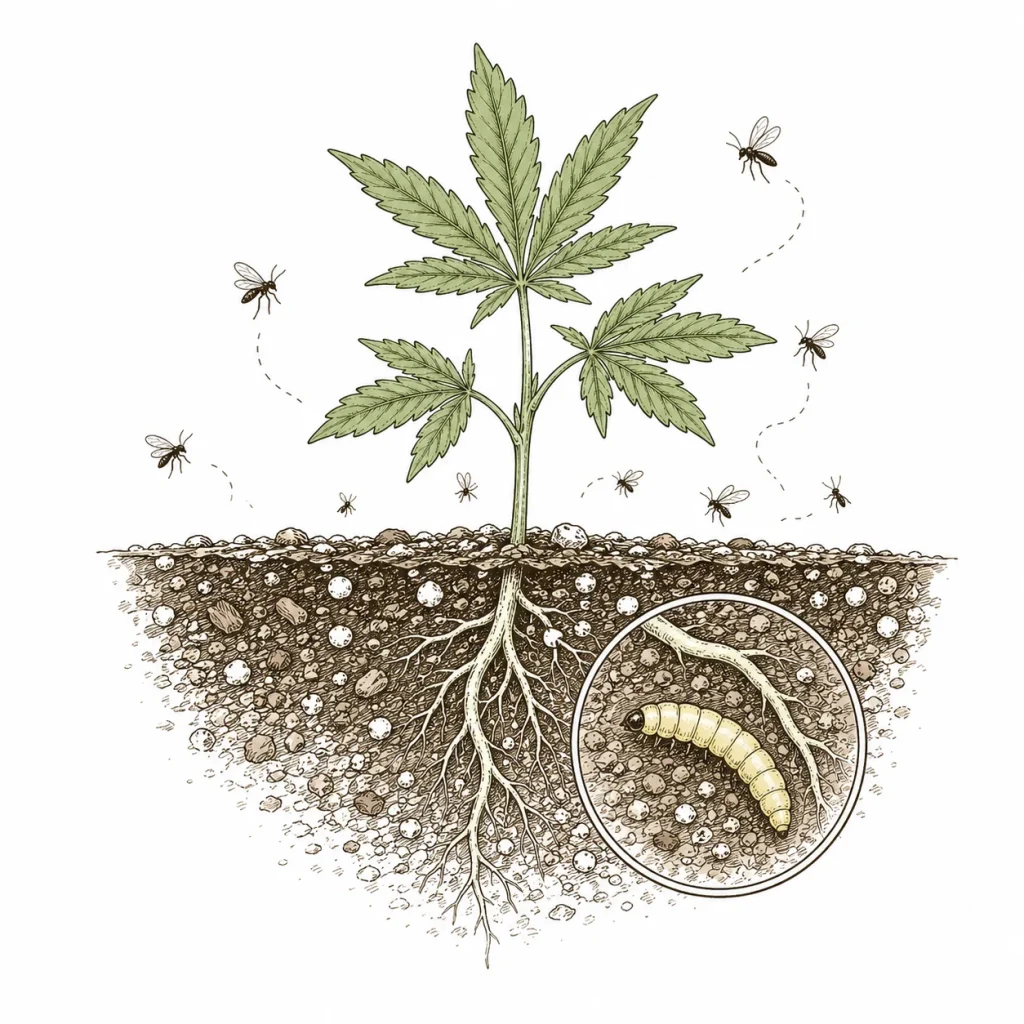
Getting rid of fungus gnat larvae on cannabis is one of the most common challenges indoor growers face. These tiny pests can do a lot of damage out of sight before you even notice anything. The little black flies buzzing around your growing medium are just the tip of the iceberg. The real threat hides in the soil, where the larvae chew on your cannabis plant’s roots. If you spot the signs early and act consistently, you can still save your grow and keep the next infestation away. In this article from PlantClue, you’ll learn step by step how to identify fungus gnats with confidence, fix what’s causing them and protect your plants for the long haul.
What are fungus gnat larvae, and why are they so dangerous for cannabis?
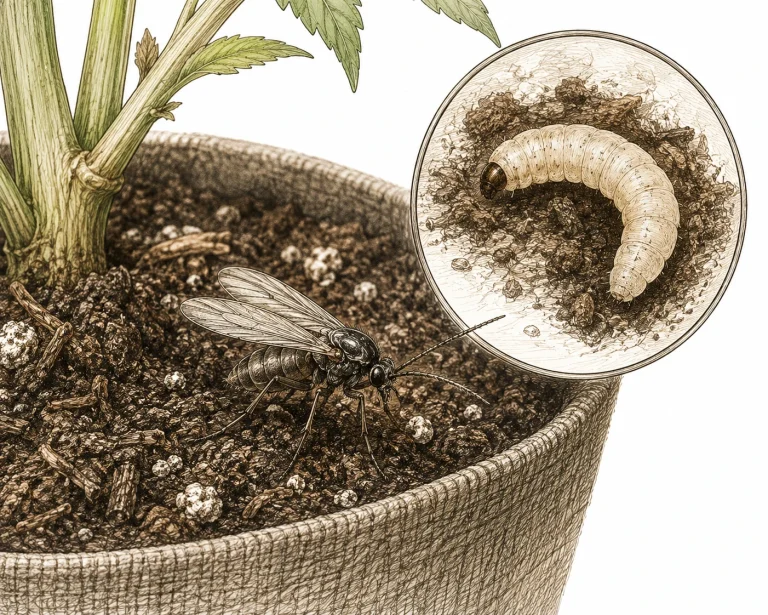
Fungus gnats, known to scientists as Sciaridae, are small black flies about 0.08–0.16 in (2–4 mm) long. Their long legs and distinctive wing veins set them apart from other small flies if you take a close look. The adults themselves are mostly harmless to your cannabis plant. They feed on organic matter on the surface of the growing medium and lay their eggs there. The real problem shows up one generation later.
Fungus gnat larvae are see-through to creamy white, have a striking black head and grow up to about 0.3 in (7 mm) long. They live underground in the growing medium and naturally feed on decaying plant matter and fungal threads – that’s where the name “fungus gnats” comes from. In crowded pots or during a heavy infestation, though, they actively attack the delicate feeder roots and even the main root of your cannabis plant. Open wounds on the roots don’t just stress the plant directly. They also open the door to dangerous secondary infections from fungi like pythium or fusarium.
Moderate to heavy larval damage can hit plant growth hard within just a few days. Seedlings and clones are most at risk, because their root systems aren’t developed enough yet to make up for lost roots. Older, established plants can handle a moderate infestation better, but they’ll also show clear signs of stress when the numbers get high. Fungus gnats multiply fast: one female can lay up to 200 eggs, and the whole life cycle takes just three to four weeks at normal room temperature. That’s why acting consistently is a must.
- Adult fungus gnat: 0.08–0.16 in (2–4 mm), black, long legs, Y-shaped wing veins
- Larvae: creamy white, black head, up to 0.3 in (7 mm) long, live in the growing medium
- Life cycle: about 3–4 weeks at room temperature
- Females lay up to 200 eggs right into moist growing medium
- Larvae eat root tips, feeder roots and, in heavy infestations, even main roots
- Wounded roots invite fungal infections like pythium
Getting rid of fungus gnat larvae on cannabis: how to spot the symptoms
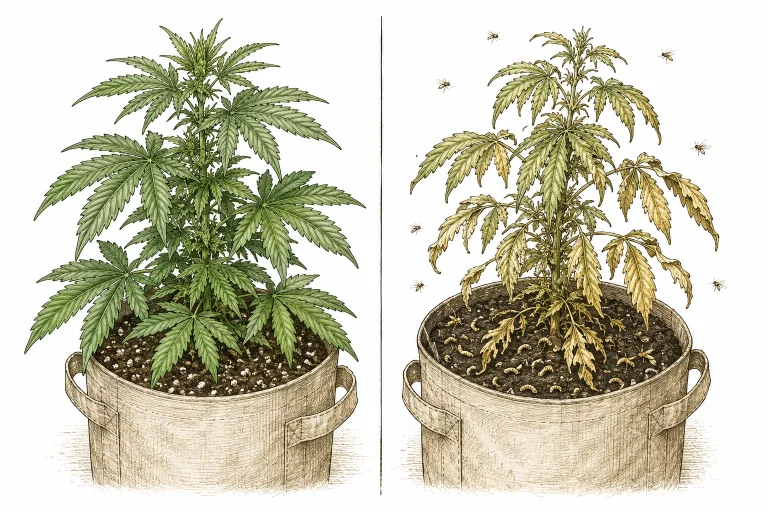
The first and most obvious sign of a fungus gnat infestation is small, slow-flying black flies hovering right above the soil surface or on the walls of your grow tent. They don’t fly fast and straight like other flies. Instead, they tumble around in a lazy, clumsy way – a reliable way to tell them apart. You’ll often see them startle when you water, flutter around for a moment and then settle back down.
Larval damage on your cannabis plant can look a lot like other problems at first glance. Your plants droop even though the growing medium is moist enough – a classic sign of root stress. The leaves lose their firmness and hang down for no obvious reason. At the same time, the lower leaves may start turning yellow, which looks like a nutrient deficiency but won’t clear up with feeding. Growth slows down noticeably or stops completely.
A reliable way to confirm it is the toothpick test: push a toothpick or wooden skewer about 2 in (5 cm) deep into your growing medium and pull it out after one or two days. If small white larvae are clinging to it, you’ve got an infestation. You can also hang yellow sticky traps just above the soil surface. Fungus gnats caught on the sticky surface show you that they’re there and give you a rough idea of how bad the infestation is. If you count more than ten gnats on one trap within a single day, you’re already dealing with a serious infestation.
Also check the roots whenever you can. Healthy cannabis roots are white to light beige and firm. Larvae damage and the fungal infections that often follow can turn them brown and mushy, and they may smell bad. If you spot this kind of damage while transplanting or checking the roots, act right away.
- Sluggish black flies hovering over the growing medium, usually visible when you water
- Drooping leaves even though the medium is moist enough
- Lower leaves turning yellow with no obvious nutrient deficiency
- Growth slows way down or stalls completely
- Stick test: white larvae on a wooden skewer pushed into the medium
- Yellow sticky traps placed just above the soil show how bad the infestation is
- Brown, mushy roots in severe cases
The Most Common Causes: Why Do I Have Fungus Gnats?
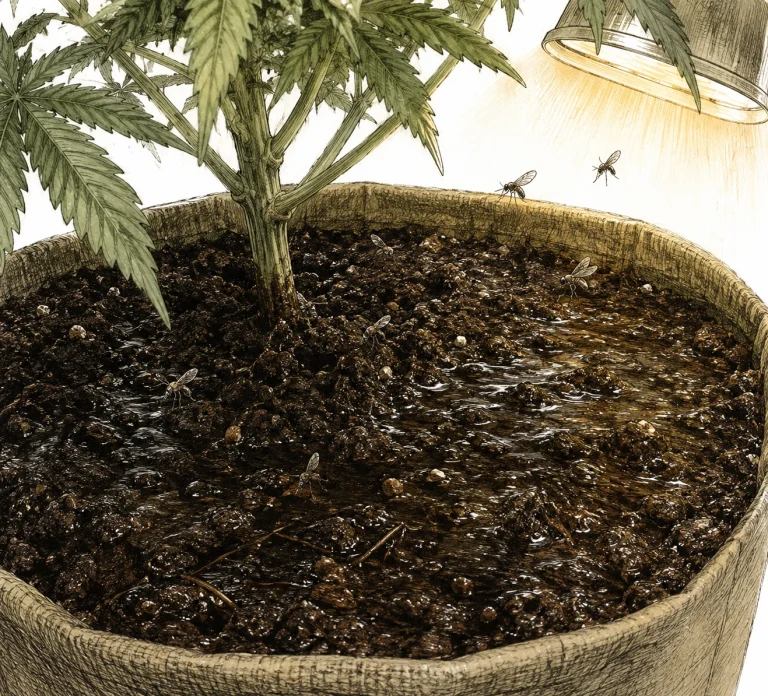
By far the most common cause of a fungus gnat infestation is watering too often or too heavily. Fungus gnats love warm, moist growing medium for laying their eggs. If the top inch or so of your medium never really gets a chance to dry out, you’re handing them the perfect breeding ground. That’s why watering cannabis the right way is one of the most important prevention steps of all: always let the surface of the medium dry out noticeably between waterings before you water again.
A second common source is contaminated growing medium. Cheap or long-stored soils can already contain eggs or larvae that grow into a full-blown infestation within a few weeks after you open the bag. High-quality, freshly produced media in sealed packaging cut this risk a lot. You can also bring fungus gnats in with new plants from the garden center – always inspect any plants you buy carefully before they go into your grow tent.
Organic growing media and organic growing methods also give fungus gnats more to eat than mineral-based soils, since the higher share of organic matter feeds the larvae. That doesn’t mean you should give up on growing organic – but you should make fungus gnat prevention part of your regular plant checks. High temperatures in the grow room also speed up their life cycle and can turn a small problem into a massive infestation within weeks.
- Watering too often keeps the surface of the medium constantly moist
- Contaminated or poorly stored growing medium with eggs or larvae
- Gnats brought in with plants bought at the garden center
- A high share of organic matter in the medium gives larvae more food
- High room temperatures speed up the breeding cycle
- Poor ventilation raises humidity and encourages egg-laying
How to Get Rid of Fungus Gnat Larvae in Cannabis: The Best Methods at a Glance
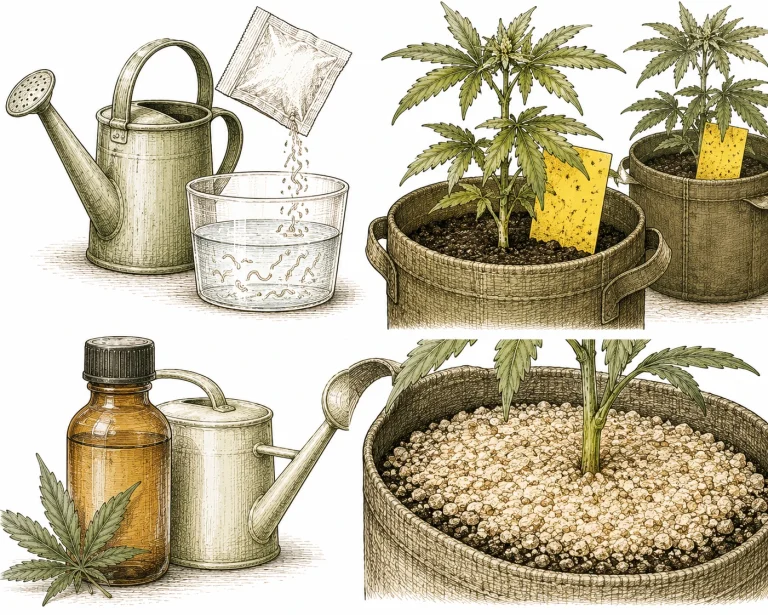
Getting rid of fungus gnat larvae in cannabis takes a combination of measures, because a single product usually only hits one life stage – either the flying adults or the larvae in the growing medium. That’s why an integrated approach that targets every life stage at the same time works best.
The first and most urgent step is fixing how you water. Let the top 1–2 in (3–5 cm) of your growing medium dry out completely before you water again. This won’t kill larvae that are already there, but it stops the adults from laying eggs right away and keeps new larvae from hatching. Without a constantly moist surface, their breeding cycle can collapse within a few weeks.
To go after the larvae in the medium directly, beneficial nematodes (German) of the species Steinernema feltiae are the gentlest and at the same time most effective option. You mix these tiny roundworms into water and pour them into the medium, where they actively hunt down and kill fungus gnat larvae without harming plants, people or pets. Many growers add soil-dwelling predatory mites of the species Hypoaspis miles (German), which also eat fungus gnat pupae. You can get beneficial nematodes at garden centers and online, and manufacturers usually recommend applying them two to three times, two weeks apart. Important: store them in the fridge and use them before the expiration date.
Another highly effective biological option is Bacillus thuringiensis var. israelensis, or BTi for short – a naturally occurring soil bacterium that kills insect larvae. Growers know it under product names like Gnatrol or as mosquito bits (e.g. Aquatic Nature Mosquito Bits). You also apply BTi as a soil drench, and it’s safe for people and plants. Experienced growers consider the combo of beneficial nematodes and BTi especially reliable.
To deal with the flying adults, use yellow sticky traps placed just above the surface of your growing medium. They cut down the number of females that can lay new eggs and double as a monitoring tool. A top layer of quartz sand or Hydroton pebbles on the medium (about 0.5–1 in (1–2 cm) thick) physically blocks egg-laying. Fungus gnats need moist, organic material to lay their eggs, and dry sand doesn’t give them that.
For stubborn or very heavy infestations, you can step up to azadirachtin (neem extract) as a soil drench or spray. Neem is plant-based, disrupts the hormone system of insects and has low toxicity for mammals. Just don’t use neem products in the late flowering stage, because residues can affect the quality of your harvest. As a rule, it’s best to avoid synthetic insecticides when growing cannabis.
- Change your watering habits right away: always let the medium dry out
- Beneficial nematodes (Steinernema feltiae): biological larvae control in the medium
- BTi (Bacillus thuringiensis israelensis): bacterial soil drench against larvae
- Yellow sticky traps: catch adults and monitor the infestation
- Quartz sand or Hydroton as a top layer: blocks egg-laying
- Neem soil drench: for heavy infestations, not in late flower
- Combining several methods always works better than relying on just one
Step-by-Step Plan: How to Get Rid of Fungus Gnat Larvae in Cannabis
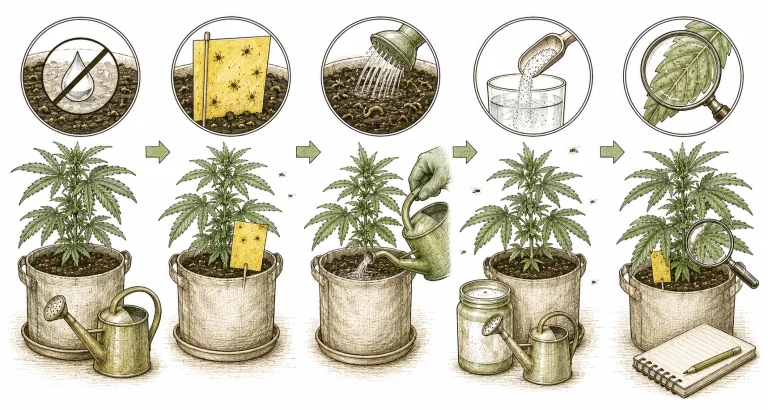
Once you’ve spotted an infestation, a structured approach is key. Start right away, even if you only suspect gnats. Fungus gnat populations grow exponentially, and every day you wait can mean thousands more eggs.
Week 1: Switch your watering to a “dry-dry-wet” rhythm right away. Let the top 1–2 in (3–5 cm) of the medium dry out completely between waterings. Hang yellow sticky traps just above the medium – at least one per pot. Order beneficial nematodes and BTi products now so they arrive fast. Cover the surface of the medium with a 0.75 in (2 cm) layer of quartz sand or perlite, as long as you don’t block any air holes.
Week 2: Apply the first round of nematodes as soon as they arrive. Mix them into lukewarm, chlorine-free water as directed and pour the whole solution evenly into the medium. At the same time, start BTi drenches as a backup. Swap out full sticky traps and check whether the number of trapped adults is going down.
Week 4: Repeat the nematode application two weeks after the first. The fungus gnat life cycle takes three to four weeks, so you need to break at least two full generations to reliably end the infestation. Do the stick test again to see if any larvae are left. Keep going with BTi.
Week 6 and beyond: Stick with your corrected watering rhythm and keep yellow sticky traps in the tent for good as a monitoring tool. If no new adults show up on the traps after six weeks and the stick test comes back negative, you’ve beaten the infestation. Keep up your new watering habits anyway – gnats can come back any time if the medium stays wet for long periods again.
- Day 1: Adjust your watering rhythm, hang sticky traps, place your order
- Week 2: First nematode application + start BTi, swap sticky traps
- Week 4: Second nematode application, repeat the stick test
- Week 6: Check whether the infestation is gone – keep monitoring
- Ongoing: Keep your watering habits, check regularly for new gnats
Fighting Fungus Gnat Larvae in Cannabis: Prevention for the Future
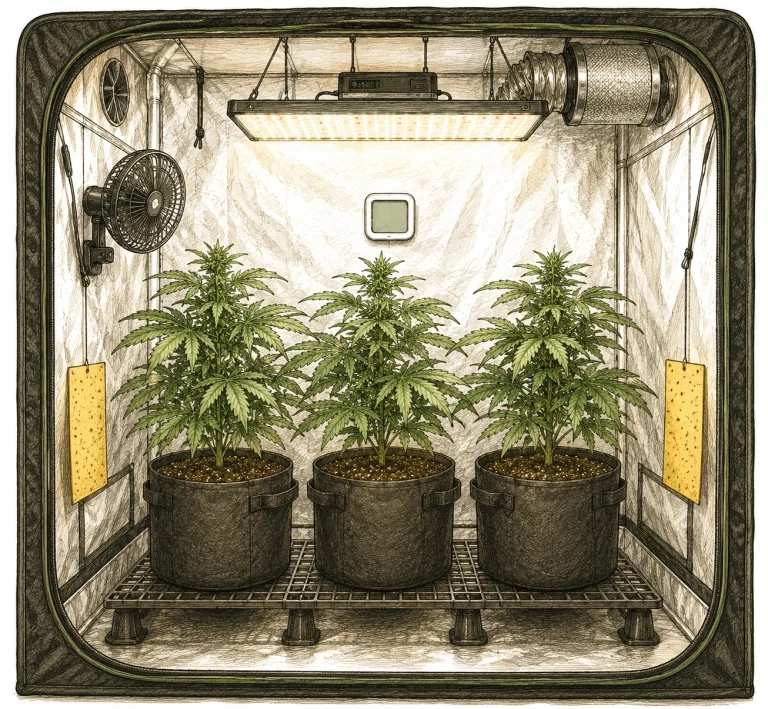
Anyone who’s dealt with fungus gnats knows: prevention is a lot easier than getting rid of them. Your most important prevention tool is still your watering. Always let the medium dry out enough between waterings and check regularly with the finger test: push your finger 2 in (5 cm) into the soil – if it’s still moist there, hold off on watering. The right pH of your feed water also plays a big role in root health. A stable pH helps prevent nutrient lockout and keeps roots tough against pest damage.
Always buy your growing medium fresh, in sealed bags, from sources you trust. Never use contaminated old medium or medium stored outdoors without pasteurizing it first. Always quarantine new plants from a store and watch them for at least a week before bringing them into your grow room.
Keep your grow room clean: remove dead leaves and other organic debris right away, because fungus gnats feed on it. Regular airing out and keeping your humidity (relative humidity, RH) in check also lower the risk. One yellow sticky trap per pot, left in place for good, costs next to nothing and tells you at all times whether gnats are around. The earlier you spot fungus gnats, the easier they are to beat, so constant monitoring really pays off.
- Fix your watering routine for good: let the growing medium dry out between waterings
- Only use fresh, sealed growing medium from trusted sources
- Always quarantine new plants for a week and keep an eye on them
- Remove dead leaves and organic debris from your grow room right away
- Keep yellow sticky traps in place as an early warning system
- Check the roots regularly whenever you transplant
- Make sure your grow room has good air exchange and the right humidity
Fungus Gnats or Other Pests? How to Tell the Difference
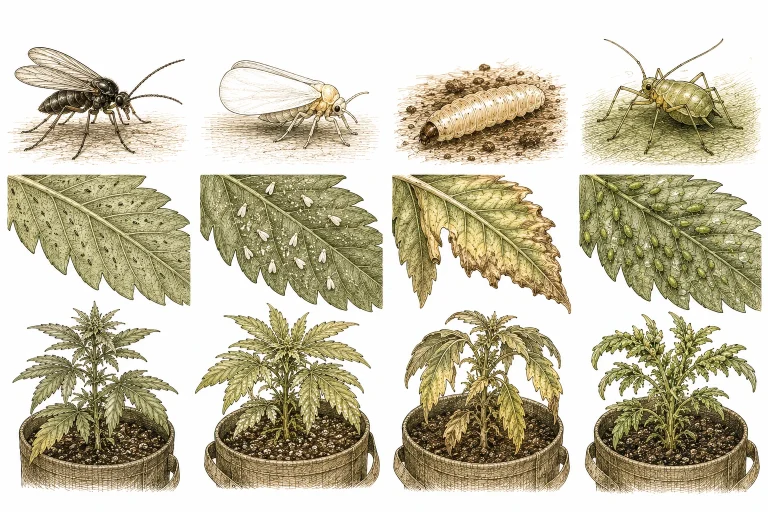
Not every little fly in your grow tent is a fungus gnat. The most common mix-up is with whiteflies (Trialeurodes vaporariorum). They are much lighter, almost white, and prefer to suck on the leaves instead of living in the soil. Whiteflies take off in big clouds when you touch the plant, while fungus gnats tend to buzz lazily above the growing medium. Fungus gnat larvae can also be mistaken for other soil critters. Truly helpful soil dwellers like springtails (Collembola) are smaller, white to gray, and jump when you disturb the growing medium.
Not sure if you are dealing with fungus gnats? A simple checklist helps. Black, sluggish flying insects? Growing medium that is always wet? Larvae with black heads in the skewer test? Plant symptoms like wilting even though the soil is moist? If you answer yes to three or more of these, a fungus gnat infestation is very likely. For a full look at all possible pests and diseases, check out the pest overview on PlantClue.
A common mistake is treating only the symptoms without fixing the cause. If you only go after the flying adults with sticky traps, the population can take several weeks to collapse, because the larvae in the growing medium keep producing new generations in the meantime. On the flip side, beneficial nematodes alone won’t help if you keep watering every day and create perfect egg-laying conditions. Only a combined approach gets you lasting results.
- Fungus gnat: black, sluggish, 0.08–0.16 in (2–4 mm), on the growing medium, larvae in the soil
- Whiteflies: light/white, take off in clouds when touched, suck on leaves
- Springtails: small, white, jumping – helpful, not pests
- Fungus gnat larvae: white/see-through with a black head, in the growing medium
- Diagnosis checklist: flies + moisture + larvae found + plant symptoms
For how to handle pests in general, read our article on pest control. Besides fungus gnats, wet growing medium also invites algae. If the larvae are moving right on the roots instead of in the growing medium, also check for root aphids.
Frequently Asked Questions
How long does it take to get rid of fungus gnats on cannabis for good?
If you stick with beneficial nematodes, BTi and better watering habits, an infestation is usually beaten in four to six weeks. The full fungus gnat life cycle takes three to four weeks, so you need to break at least two cycles. Patience and consistency are key – if you slack off after the first signs of improvement, you risk a comeback.
Are fungus gnats dangerous to people or pets?
No, fungus gnats are completely harmless to people and pets. They don’t bite and don’t spread diseases. The larvae only damage plant roots and organic material in the growing medium. Still, you should fight an infestation consistently, because it can seriously hurt your cannabis harvest.
Can I get rid of fungus gnats with baking soda or vinegar?
Home remedies like these don’t work well against fungus gnats. Vinegar traps can lure in a few adults, but they don’t touch the larvae in the growing medium – and those are the real problem. Bacillus thuringiensis (BTi) and beneficial nematodes are the proven, scientifically backed biological methods, and both are affordable these days.
Do I have to replace all the growing medium if I have fungus gnats?
With a normal infestation, swapping out all the growing medium isn’t necessary and would only stress your plant more. It only makes sense if the roots are already badly damaged and hit by secondary fungal infections, meaning a very severe infestation. In most cases, fixing your watering plus beneficial nematodes and BTi is all you need.
Do beneficial nematodes work during the flowering stage?
Yes. You can safely use beneficial nematodes (Steinernema feltiae) at every stage of growth, including flowering. They’re completely safe for plants, people and pets, and they leave no residue on your harvest. Still, start treatment as early as you can to keep stress on your plants low as harvest gets closer.
Do yellow sticky traps really help against fungus gnats?
Yellow sticky traps alone won’t end an infestation. They only cut down the number of adults, and with that the number of new eggs being laid. As part of a combined control plan, though, they’re a must: they show you how bad the infestation is, slow down reproduction and help you track whether your treatment is working.
For more in-depth background on using beneficial insects for plant protection, check out the Bavarian State Institute for Viticulture and Horticulture (LWG, German).
The Bottom Line
Beating fungus gnat larvae in your cannabis grow isn’t about luck. It’s about knowing what to do and sticking with it. The hidden larvae in the growing medium are the real threat to your plant. Spot them early and fight them with biological tools like beneficial nematodes and BTi, and you can usually save your whole grow. Your most important prevention tool is still smart watering: if the top of your growing medium isn’t constantly wet, fungus gnats have a hard time breeding. Combine several methods, check on your grow regularly and use the Plant Diagnosis overview on PlantClue whenever you’re unsure about a symptom. Your plants will thank you.
