

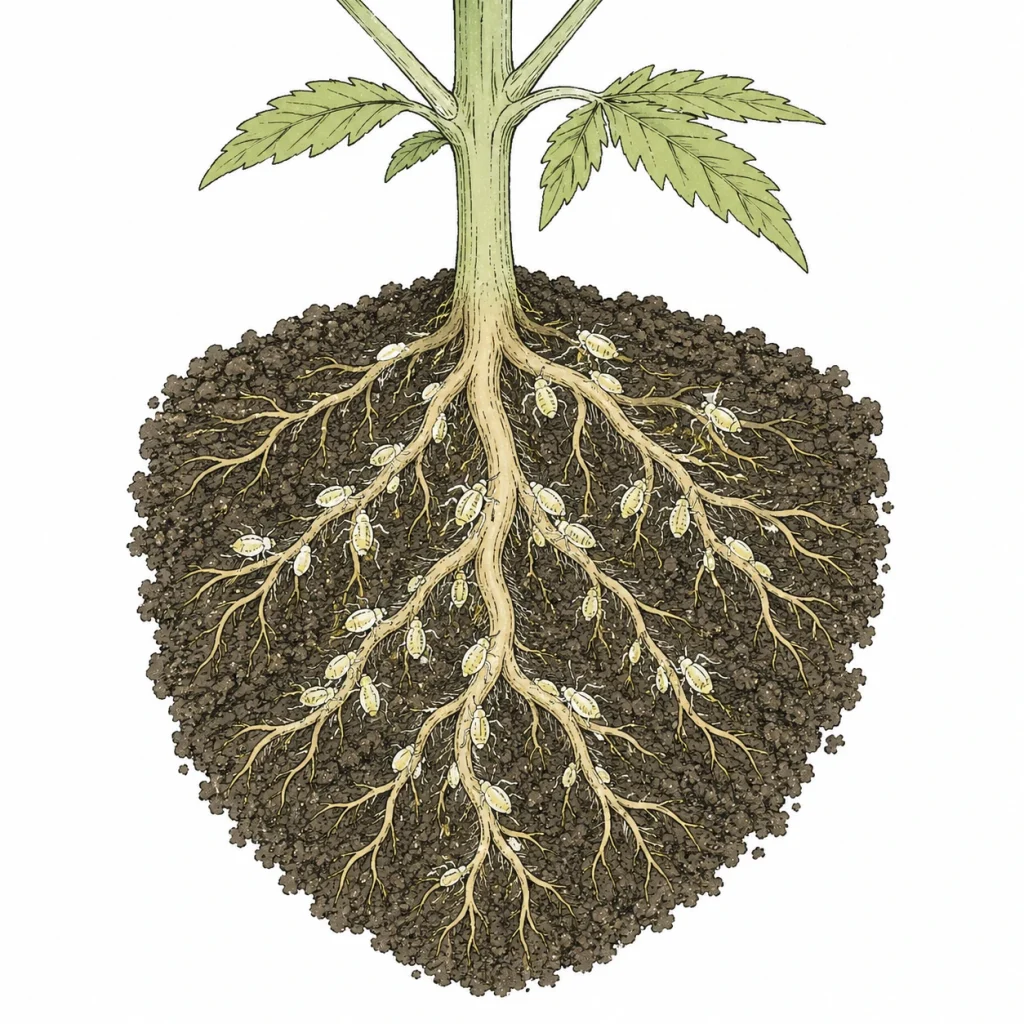
Spotting root aphids on cannabis is one of the toughest jobs in growing, because the infestation plays out unseen below the soil while the plant slowly declines above ground. If you know the typical warning signs, you can still step in in time and save your harvest. In this article, we explain everything you need to know about root aphids — from a reliable diagnosis to effective control. Read on and protect your plants before it’s too late.
How to Spot Root Aphids on Cannabis: The Key Symptoms
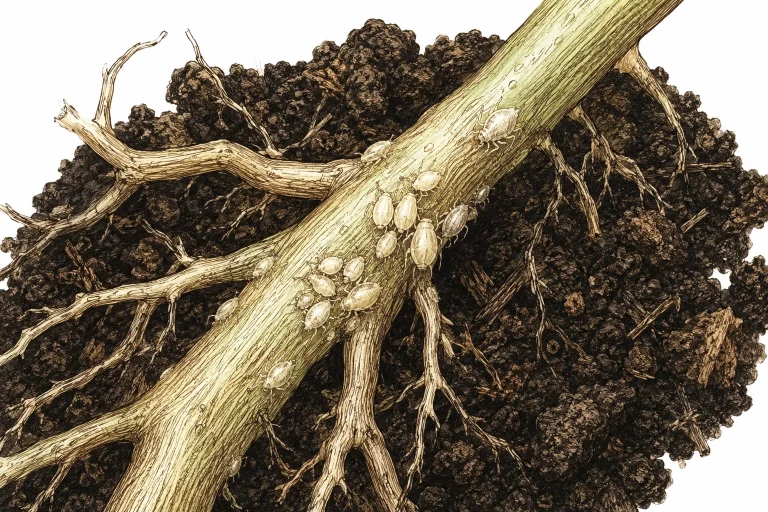
The sneaky thing about root aphids is that all visible symptoms initially look like a nutrient deficiency or overwatering. The plant looks dull, droops slightly and shows yellowing leaves — even though watering and feeding seem to be fine. If you don’t take a targeted look inside the pot, you’ll miss the actual pest below the soil.
The most reliable diagnosis comes from checking the roots directly. Carefully lift the plant out of its pot or shine a flashlight into the drainage holes. Tiny whitish to yellowish insects about 0.02 to 0.04 in (0.5 to 1 mm) in size, moving slowly on the roots, are a clear sign. Often you’ll also see a whitish, waxy coating in the growing medium just below the surface — that’s wax secreted by the aphids.
Typical warning signs above ground are: sudden wilting despite moist growing medium, slow or stalled growth, pale or yellow leaves without any obvious nutrient deficiency and generally weak plant vigor. Especially in the flowering stage yields can drop dramatically when root aphids go unnoticed. Also compare the symptoms with our overview of yellow cannabis leaves – all causes to reliably rule out other causes.
- Wilting despite enough moisture in the growing medium
- Yellowing leaves without a classic nutrient deficiency
- Slowed or stalled growth
- Whitish waxy coating on the surface of the growing medium or on the pot walls
- Tiny white or yellowish insects visible on the roots
- Brown, chewed-up or slimy root tips
- Sharp drop in yield during the flowering stage
Which Root Aphids Attack Cannabis: Species and Biology
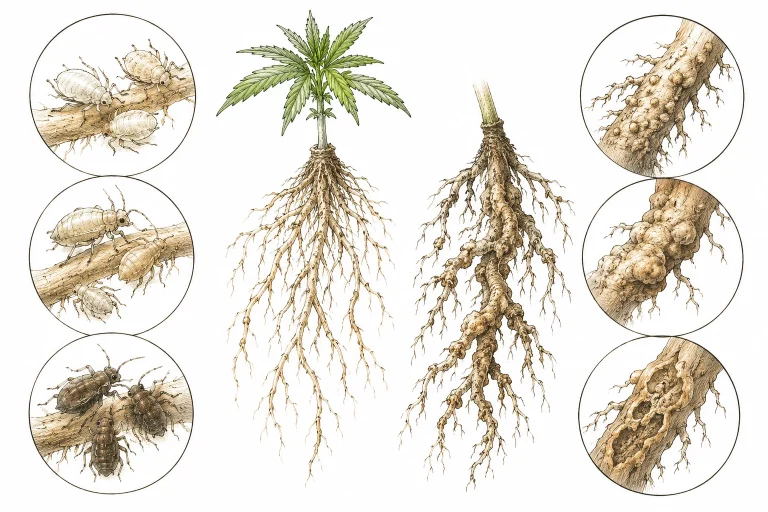
In cannabis growing, one species matters most: the rice root aphid (Rhopalosiphum rufiabdominale), usually just called the root aphid. Grape phylloxera (Phylloxera), which is associated with grapevines, and the genera Pemphigus and Prociphilus attack other plant families and play only a minor role on cannabis. On top of that, there are the larvae of fungus gnats (Sciaridae), which strictly speaking aren’t true aphids but cause similar damage to the roots and often show up together with true root aphids. Among growers, the term “root aphid” is often used loosely for all soil-dwelling sap-sucking pests.
True root aphids suck sap directly from the fine root hairs and inject saliva that damages the root cells and makes the tissue die off. A single female can produce hundreds of offspring within a few weeks, which then spread throughout the whole pot. In warm, dry growing medium at temperatures above 68 °F (20 °C), they multiply especially fast.
Root aphids also survive longer dry periods in a kind of dormant state and can be brought into your grow via contaminated growing medium, tools or clones. That’s why quarantine for new plants and clean work habits are so crucial. Even high-quality growing media can occasionally be infested if they weren’t produced under sterile conditions.
- Most relevant species: rice root aphid (Rhopalosiphum rufiabdominale)
- Sciaridae larvae (fungus gnat larvae) cause similar root damage
- Especially fast reproduction at temperatures above 68 °F (20 °C) and in dry growing medium
- Brought in via contaminated growing medium, clones or tools
- Survive in a dormant state even in dry conditions
- Suck sap from fine root hairs and destroy root tissue
Causes and Risk Factors: Why Root Aphids Attack Your Cannabis Plant
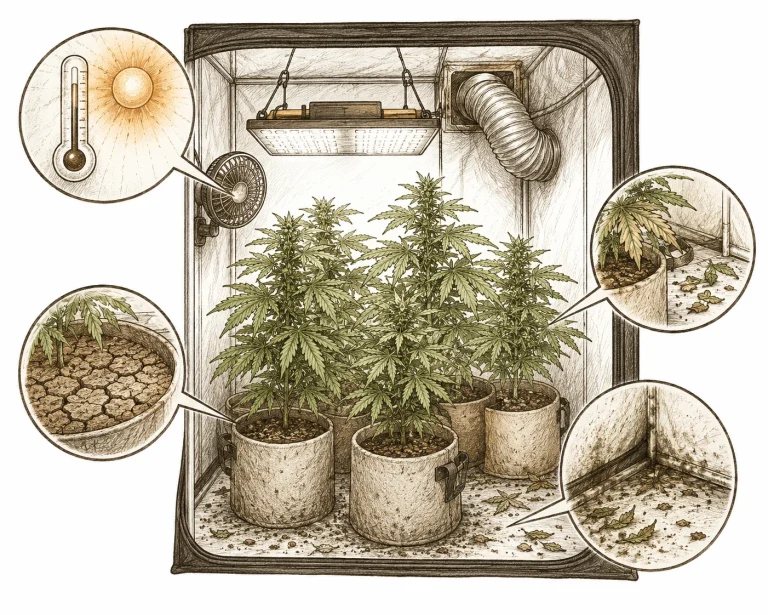
Root aphids thrive under certain conditions that many growers create without meaning to. Root zone temperatures that are too warm, above 72 °F (22 °C), are one of the biggest risk factors, because they speed up the pests’ reproduction considerably. At the same time, growing medium that’s too dry encourages them to spread, since wet conditions slow the aphids down. So aim for even moisture levels — our guide on watering cannabis the right way will help you.
Another common way in is new clones or mother plants that go straight into the grow without quarantine. Used growing medium, unsterilized pots and contaminated tools can also bring in root aphids. Outdoor plants are at even greater risk because of direct contact with the ground, since root aphids also live in natural soil.
Weak plants that are already stressed by nutrient problems or pH mistakes get infested more easily and are less able to fight back. A stable pH between 6.0 and 7.0 in soil and between 5.5 and 6.5 in hydroponics is essential for healthy roots. Read our article on pH for cannabis for specific target values and tips on correcting it.
- Root zone temperatures above 72 °F (22 °C) strongly promote reproduction
- Contaminated clones or mother plants without quarantine
- Used or unsterilized growing medium
- Tools and pots that haven’t been disinfected
- Growing medium that’s too dry speeds up their spread
- Plants weakened by nutrient or pH problems
- Direct contact with the ground in outdoor growing
How to Get Rid of Root Aphids on Cannabis: Immediate Steps for an Active Infestation
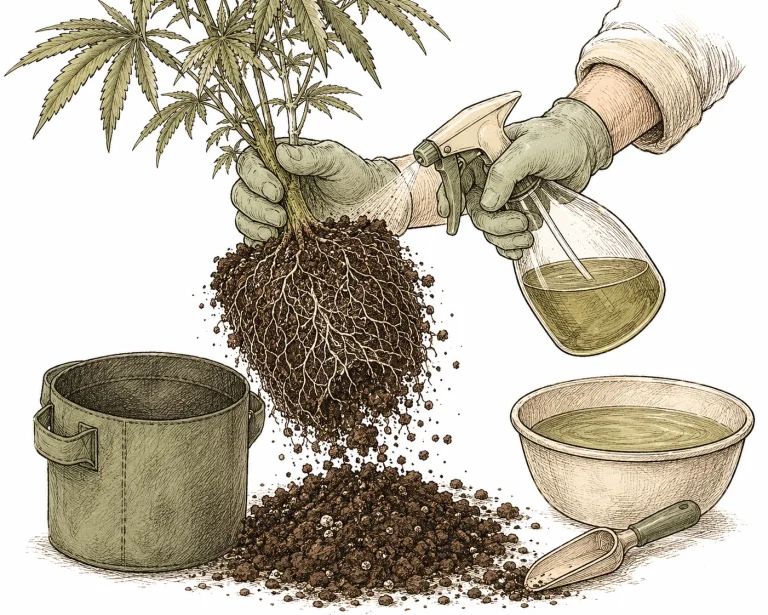
Once you’ve confirmed root aphids, every hour counts. Isolate the infested plant from the rest of your grow right away to prevent them from spreading. Take the plant out of its pot, shake as much growing medium off the roots as possible and dispose of all the contaminated medium in sealed bags outside your grow area. Disinfect the pot thoroughly with hydrogen peroxide (3% solution) or an alcohol spray.
There are several proven methods for treating the roots directly. A root dip in a neem oil solution (2 ml of neem per quart, or 1 L, of water with a little emulsifier) effectively kills the aphids and protects the roots at the same time. Alternatively, you can drench with a pyrethrin-based insecticide that’s approved for use in the root zone. A hydrogen peroxide solution (3 ml of H2O2 per quart, or 1 L, of water) used as irrigation water kills pests in the growing medium and also improves the oxygen supply to the roots.
Beneficial roundworms (entomopathogenic nematodes (German)) of the species Steinernema feltiae or Heterorhabditis bacteriophora are very effective biologically. These microscopic roundworms actively enter root aphids and their larvae and kill them from the inside. They’re completely harmless to plants and people and can be used both preventively and as a treatment. After treatment, repot the plant into fresh, sterile growing medium. For severe cases, a repeat treatment after 7 to 10 days is recommended.
- Isolate the infested plant from the rest right away
- Remove all old growing medium and dispose of it safely
- Disinfect the pot with hydrogen peroxide or alcohol
- Apply a neem oil root dip or drench
- Use entomopathogenic nematodes (Steinernema feltiae)
- Use a hydrogen peroxide solution (3 ml per quart / 1 L) as irrigation water
- Repot into fresh, sterile growing medium
- Repeat the treatment after 7 to 10 days
Natural and Biological Control Methods in Detail
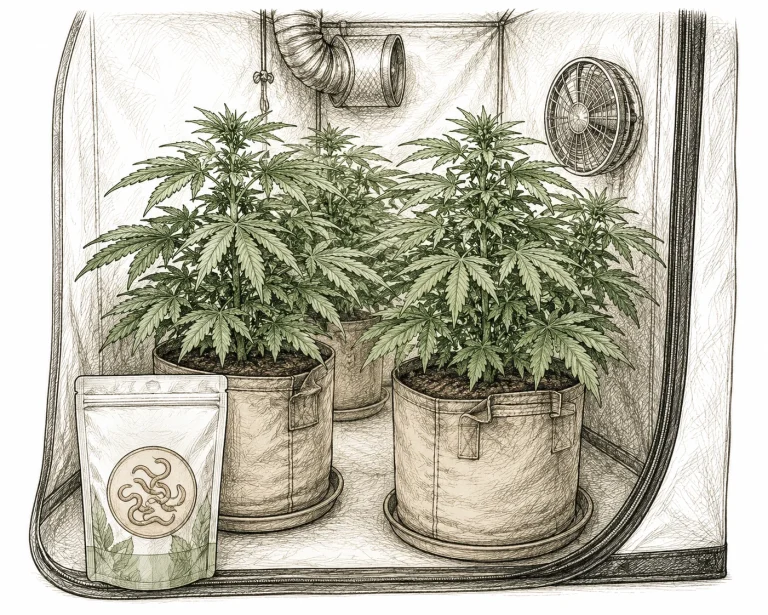
Entomopathogenic nematodes are the best biological weapon against root aphids and are considered the gold standard among experienced growers. You can get them at garden centers or from specialty mail-order suppliers as granules or powder to mix with water. The ideal application temperature is between 54 and 77 °F (12 and 25 °C), with sufficiently moist growing medium. Pour the nematode solution evenly into the growing medium and make sure it doesn’t dry out over the next 48 hours, since nematodes need moisture to move around.
Neem oil is another highly effective option and contains the active ingredient azadirachtin, which disrupts insects’ hormone balance and interrupts their reproduction. Applied as a drench with 2 to 3 ml of cold-pressed neem oil per quart (1 L) of water and a plant-based emulsifier, it soaks into the growing medium and hits root aphids where they live. Several treatments one week apart are needed for full effect.
Silica supplements in your irrigation water strengthen the root cell walls and make them more resistant to sap-sucking damage. Diatomaceous earth, worked into the top layer of the growing medium, acts as a physical barrier against crawling pests. Combining several of these methods gives you the best results — both for fighting an active infestation and for long-term prevention.
- Steinernema feltiae: the most effective nematode species against root aphids
- Apply at 54 to 77 °F (12 to 25 °C); keep the growing medium moist
- Neem oil solution: 2 to 3 ml per quart (1 L) of water as a drench
- Repeat treatments every 7 days for full effect
- Silica supplements strengthen root cell walls
- Diatomaceous earth as a physical barrier in the growing medium
- Combine several methods for the best results
Getting Rid of Root Aphids on Cannabis: Chemical Products as a Last Resort
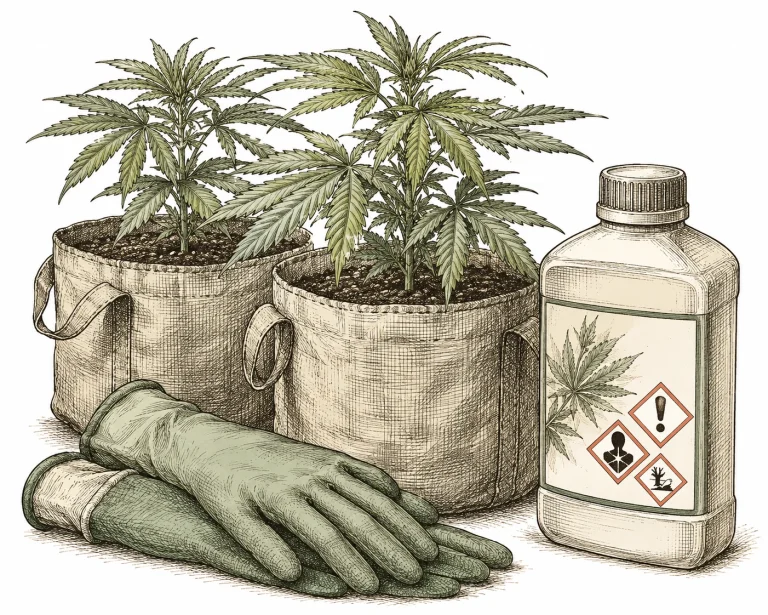
If biological measures aren’t enough or the infestation is very heavy, chemical insecticides can be used. When you grow at home, you’re responsible for what you apply — check the rules where you live, use only approved products and strictly follow the waiting periods before harvest. Pyrethrins, derived from chrysanthemums, are considered a comparatively natural option and are available as soil drenches or treatments for the growing medium.
Systemic insecticides, which are absorbed through the roots and spread throughout the whole plant, are especially problematic in cannabis growing, since residues can remain in the buds and the harvested material. Avoid chemical treatments completely during the flowering stage. If using them is unavoidable, limit it to the vegetative stage and replace all of the growing medium afterward.
Products containing imidacloprid, which are still partly available to home gardeners, should be avoided because of their persistence and broad-spectrum effect on beneficial insects. Carefully checking the label and whether the product is safe for edible crops is a must. When in doubt, completely replacing the growing medium combined with biological methods is safer and more effective in the long run than chemical treatments.
- Pyrethrins as a fairly natural chemical option for soil application
- Systemic insecticides only in the vegetative stage, never during flowering
- Avoid imidacloprid products because of persistence and harm to beneficials
- Strictly follow the waiting periods stated by the manufacturer
- Completely replace the growing medium after a chemical treatment
- Keep the residue problem in buds in mind — when in doubt, skip the chemicals
Spotting Root Aphids on Cannabis and Preventing Them Long Term
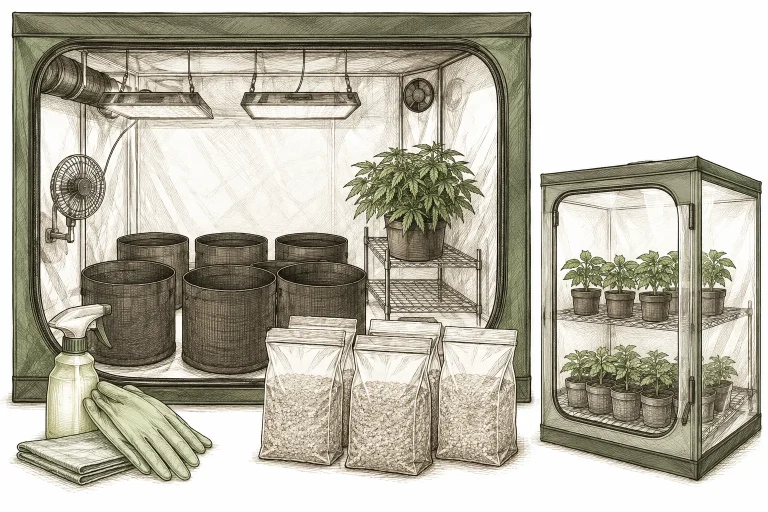
When it comes to root aphids, prevention is much more effective than treatment. The most important step is strict quarantine for all new clones and mother plants — watch them in a separate area for at least two weeks before they go into your main grow. During that time, regularly check the roots through the pot walls or when repotting.
Choose growing media from reputable sources and always use fresh, sterile material for clones and young plants. Thoroughly clean and disinfect pots and tools after every grow cycle. Nematodes can be added to the growing medium preventively once per grow cycle — a very effective measure that significantly reduces the need for pesticides. Problems with calcium deficiency in cannabis or other nutrient deficiencies weaken the plants even more and make them more vulnerable, so a balanced feeding program is also part of prevention.
Keep root zone temperatures below 72 °F (22 °C) by insulating pots from warm surfaces or using pot saucers with an air cushion. Mycorrhizal products and trichoderma build a healthy microbiome in the growing medium and significantly strengthen the roots’ natural defenses. If you want a complete overview of all growing topics, our Plant Diagnosis hub brings all the key resources together in one place.
- Keep new clones in quarantine for at least 2 weeks
- Completely disinfect pots and tools after every cycle
- Use only fresh, sterile growing medium from reputable sources
- Use nematodes preventively once per cycle
- Keep the root zone temperature below 72 °F (22 °C)
- Use mycorrhizal fungi and trichoderma for a strong root microbiome
- Strengthen plants with balanced feeding
- Plan regular root checks when repotting
Root Aphids vs. Other Root Problems: How to Tell Them Apart
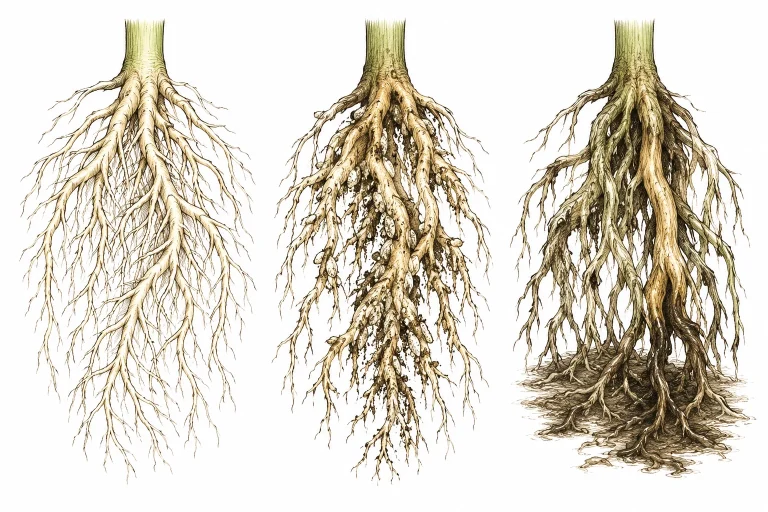
Not every root problem is caused by root aphids. Pythium and other root rot fungi cause similar symptoms — brown, slimy roots and wilting plants — but you can tell them apart by their typical rotten smell and the lack of visible insects. With root aphids, the roots usually don’t smell, and the damage looks dry and chewed off rather than slimy and wet.
Overwatering also leads to wilting and yellowish leaves, but the roots are light-colored and feel waterlogged, with no visible pests. A simple test: lift the plant out of its pot and examine the roots directly. Moving insects on the roots rule out other causes of the damage and confirm the infestation. If you’re unsure about the cause, also take a look at our guide to cannabis nutrient burn, since stress-related symptoms often look similar.
Fungus gnat larvae (Sciaridae) also cause root damage and are often confused with root aphids. The difference: fungus gnat larvae are larger (0.12 to 0.2 in, or 3 to 5 mm), white with a black head and move actively through the growing medium, while adult fungus gnats are visible as small black flies. Both pests can show up together and respond to similar treatments, so a combined treatment can make sense.
- Pythium / root rot: slimy, foul-smelling roots, no visible insects
- Overwatering: light-colored, waterlogged roots with no feeding damage or insects
- Fungus gnat larvae: larger (0.12–0.2 in / 3–5 mm), black head, visible flies
- Root aphids: tiny white insects (under 0.04 in / 1 mm), dry feeding marks, no smell
- Nutrient deficiency: no insects, symptoms start on the leaves, not the roots
- Confirm the diagnosis by examining the roots directly after lifting the plant out
As the Julius Kühn Institute (German) points out, the targeted use of beneficials such as nematodes is one of the core building blocks of biological plant protection in greenhouse and ornamental plant production.
White, jumping critters in the growing medium, on the other hand, are usually harmless springtails rather than root aphids — an important difference for choosing the right treatment.
Root-Knot Nematodes: When Nematodes Are Pests Instead of Beneficials
The nematodes recommended above against root aphids and fungus gnat larvae (usually the species Steinernema feltiae) are purely beneficial and don’t attack cannabis roots. But there are also plant-parasitic nematodes of the genus Meloidogyne, commonly called root-knot nematodes. They attack the roots themselves and cause very different symptoms.
Typical signs of a root-knot nematode infestation are small, knobby swellings (galls) right on the roots, combined with stalled growth and wilting despite adequate watering — similar to root aphids from the outside, but without any visible insects. When you lift the plant out, you can feel the galls: small, bead-like swellings instead of the smooth surface of healthy roots.
- Root aphids: tiny white insects visible, dry feeding marks
- Root-knot nematodes: no visible insects, knobby galls on the roots themselves
- Beneficial nematodes in your irrigation water don’t work against root-knot nematodes, since they’re a different species with a different biology
In indoor grows with sterile growing medium, root-knot nematodes are rare, since they usually get brought in with contaminated garden soil. When growing outdoors in reused soil, the risk is higher. Don’t reuse affected growing medium; switching to fresh, sterile medium prevents reinfection.
Frequently Asked Questions
How can I reliably spot root aphids on cannabis?
The most reliable method is to lift the plant out of its pot and examine the roots directly. Tiny whitish to yellowish insects under 0.04 in (1 mm) that move slowly, along with a whitish waxy coating in the growing medium, are clear signs. Above ground, an infested plant shows wilting, yellowing and stalled growth despite good care.
What are the best treatments for root aphids on cannabis?
Entomopathogenic nematodes of the species Steinernema feltiae are considered the most effective biological option and are safe for plants and people. A neem oil solution applied as a drench works very well as a supplement. Hydrogen peroxide (3 ml per quart, or 1 L, of water) used as irrigation water kills pests in the growing medium. For severe cases, completely replacing the growing medium combined with repeated nematode applications is recommended.
Can root aphids destroy my entire harvest?
Yes, with a heavy infestation that’s detected too late, the damage can be significant. Root aphids destroy the root hairs and cut off water and nutrient uptake, which leads to massive yield losses. The earlier you step in, the better your chances of success. Damage discovered during the flowering stage is harder to make up for, while plants in early growth stages can still be saved quite well.
How do root aphids get into my grow?
The most common ways in are contaminated clones or mother plants without quarantine, used or non-sterile growing medium and tools and pots that haven’t been disinfected. Outdoor growing carries a higher risk because of contact with the ground. Some batches of store-bought growing medium can occasionally contain eggs or aphids too.
How long does it take to get rid of root aphids?
If you act immediately and consistently, successful control usually takes two to four weeks with several rounds of treatment. Nematodes need about 7 to 14 days to take full effect. Neem oil applications are repeated weekly. Completely replacing the growing medium right after you find them significantly shortens the time it takes.
Are root aphids more common in outdoor cannabis grows?
Outdoor plants are at greater risk because of direct contact with the ground, since root aphids also occur naturally in garden soil. In indoor grows, on the other hand, the risk from contaminated equipment and clones is manageable. For outdoor grows, mulch layers, a nematode treatment at the start of the season and choosing well-draining, sandy soils that don’t stay waterlogged help prevent them.
Conclusion
Spotting and getting rid of root aphids on cannabis takes fast action and the right mix of methods — the earlier you catch the infestation, the better the chances that your plant will fully recover. Biological options like entomopathogenic nematodes and neem oil are your first choice, backed up by replacing the growing medium right away and consistent hygiene. Prevention through quarantine, sterile growing medium and regular root checks is the most effective protection in the long run. With the right knowledge, you’ll always stay one step ahead of pests.
