

Spotting scale insects on cannabis is a real challenge for many home growers. These pests are masters of disguise, and you often won’t notice them until the infestation is well underway. Scale insects suck the sap from your cannabis plants and weaken them over time. That can mean slower growth, smaller yields and, in the worst case, a dead plant. If you check your plants closely and use the plant diagnosis overview regularly, you can stop an early infestation in time. In this article, you’ll learn everything you need to know about scale on cannabis: the first warning signs, the causes and proven ways to get rid of them.
How to Spot Scale Insects on Cannabis: Key Symptoms
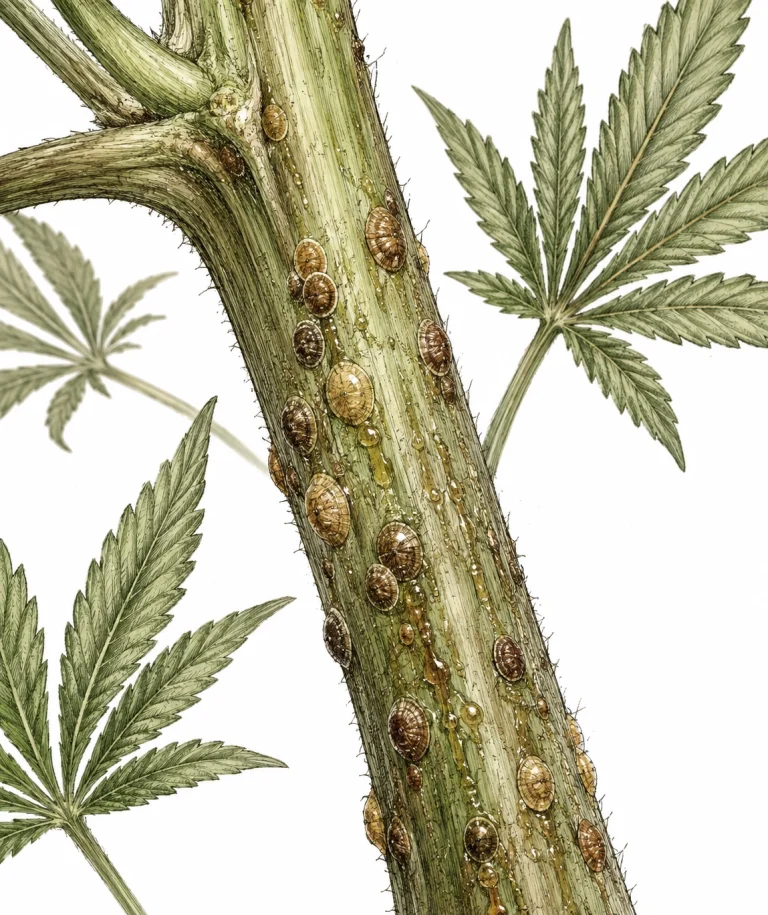
Scale insects belong to the superfamily Coccoidea, which includes several hundred species. On cannabis, the main culprits are soft scales (Coccidae) and armored scales (Diaspididae). Their trademark is a hard or waxy protective shell. Under this shield, they’re safe from predators and insecticides. That shell is exactly what makes them so tough to beat.
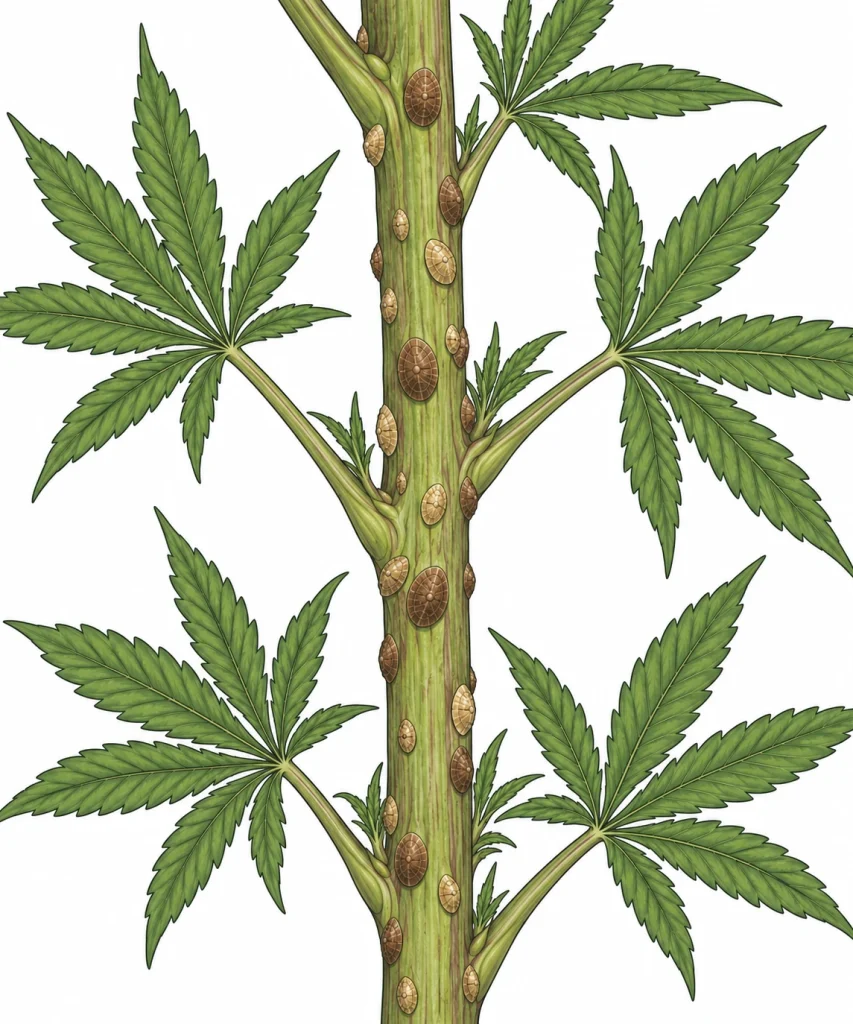
The first and most obvious symptom of scale is small, raised spots on stems, branches and leaf stalks. Depending on the species, these bumps can be brown, beige, white or yellowish. They look like tiny scales or shields stuck to the plant. Unlike fungal spots, you can scrape them off with your fingernail. Another telltale sign is honeydew: a sticky, sugary substance the scale insects excrete, which collects on leaves and the growing medium. Honeydew is a sure sign of scale. It’s also the perfect breeding ground for sooty mold, which further limits the plant’s photosynthesis.
Other signs include yellowing or dropping leaves, stunted growth and a generally weak-looking plant. With a heavy infestation, whole branches can die off. If you notice yellow leaves on your plants, keep scale on your list of possible causes, especially if you also see sticky residue.
- Small, scaly bumps on stems and leaf stalks (brown, beige or white)
- Sticky, shiny residue (honeydew) on leaves and in the growing medium
- Black sooty mold on sticky surfaces
- Yellowing, wilting or dropping leaves
- Slowed or stalled growth
- Individual branches dying off in heavy infestations
- Ants on the plant (ants “farm” scale insects for their honeydew)
Causes: How Do Scale Insects Get onto Your Cannabis Plants?
Scale insects can reach your cannabis plants in several ways. Indoors, they often hitch a ride in contaminated growing medium, potting soil from the garden center or tools you’ve used on infested plants. Fresh clones from someone else’s grow room are another classic entry point. The larvae, called crawlers, are tiny and barely visible. They actively crawl from plant to plant and can latch onto your hands, clothes or equipment.
Outdoors, natural sources like wind, birds or nearby plants usually bring scale insects to your cannabis. Weakened plants that are already stressed are most at risk, whether that stress comes from nutrient deficiencies, poor watering or less-than-ideal conditions. An unbalanced pH can disrupt nutrient uptake and lower the plant’s resistance, which makes pest problems more likely.
Temperature is another factor many growers underestimate. Scale insects multiply fast in the heat. A grow room that constantly runs above 79 °F (26 °C) with poor air circulation offers ideal conditions for a population explosion. On top of that, overly humid conditions combined with warm temps can help secondary fungi like sooty mold spread like wildfire.
- Contaminated growing medium or soil at planting
- Infested clones from other growers
- Transfer via tools, hands or clothing
- Wind and animals as natural carriers outdoors
- Plants weakened by nutrient deficiencies or the wrong pH
- High temperatures and poor air circulation in the grow room
- Ants that actively protect and spread scale insects
Getting Rid of Scale on Cannabis: First Steps for an Active Infestation

Found scale insects on your cannabis plants? Then it’s time to act fast. Step one is removing them by hand: use a soft toothbrush or a cotton swab dipped in isopropyl alcohol (70 percent) to rub the scale off stems and leaves. This works very well for light to moderate infestations because it breaks right through the bugs’ protective shell. Work carefully, and don’t forget the undersides of the leaves and the spots where branches meet the stem.
Next, treat your plants with neem oil or a potassium soap product (also called insecticidal soap). Neem oil contains azadirachtin, which disrupts the insects’ molting and reproduction. Mix about 5 ml neem oil and 2 ml liquid insecticidal soap into 1 qt (1 L) of water. Spray the whole plant thoroughly, especially the branch joints and leaf undersides. Repeat every three to five days, at least three to four times in a row, so you also catch freshly hatched crawlers. Important: don’t spray your plants under strong, direct grow lights, or you can end up with leaf burn.
For stubborn cases, or if neem oil isn’t enough, organic insecticides based on pyrethrin are a good option. Pyrethrin is a natural insecticide made from chrysanthemum flowers and is widely used on food crops. Spinetoram and spinosad, both made through bacterial fermentation, also work against scale. Since you’ll be consuming your harvest, treat chemical systemic insecticides only as an absolute last resort, and only early in the vegetative stage.
- Isolate infested branches or separate heavily infested plants from the rest
- Remove scale by hand with isopropyl alcohol and cotton swabs
- Spray neem oil every 3 to 5 days, at least 3 to 4 times
- Use an insecticidal soap solution as a backup or alternative
- Use organic insecticides based on pyrethrin or spinosad for heavy infestations
- Wipe off honeydew residue with a damp cloth to prevent sooty mold
- Disinfect your tools thoroughly after every treatment
Beneficial Insects: Natural Enemies of Scale
If you want a sustainable, chemical-free solution, beneficial insects are a great choice for indoor grows. Parasitic wasps of the genera Metaphycus and Coccophagus are especially effective against scale. They parasitize both young and adult scale insects by laying their eggs in or on the pests’ bodies. The hatching wasp larvae then eat the scale from the inside out. These beneficials are well established in professional crop protection and available from specialized suppliers.
Predatory bugs of the genera Anthocoris or Orius can also help keep scale populations in check, and so can lacewing larvae (Chrysoperla carnea). These generalists don’t just eat scale, they also go after aphids and spider mites. That makes them valuable allies in an integrated pest management (IPM) plan. Beneficial insects make the most sense during the vegetative stage, when chemical treatments are still possible but you’d rather avoid them.
If you grow outdoors, it pays to shape your garden in favor of beneficials: ladybugs, lacewings and parasitic wasps are natural enemies of scale and love to settle in areas full of flowers. Stay away from broad-spectrum pesticides there, since they wipe out beneficials just as fast as pests.
Using beneficial insects instead of broad-spectrum pesticides is also recommended as an effective integrated pest management strategy by the Bavarian State Institute for Viticulture and Horticulture.
- Buy and release parasitic wasps (Metaphycus helvolus) specifically against scale
- Use lacewing larvae (Chrysoperla carnea) as all-round generalists
- Add predatory bugs (Anthocoris nemorum) for a broader range of beneficials
- Attract ladybugs to your outdoor grow
- Don’t combine broad-spectrum pesticides with beneficial insects
How to Spot Scale on Cannabis and Prevent It in the Future
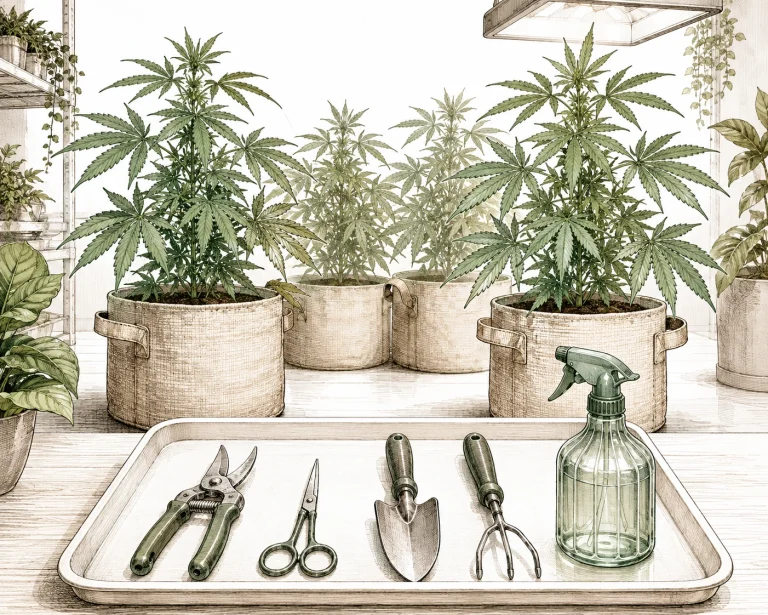
When it comes to scale, prevention matters at least as much as treatment. Your best defense is strict hygiene: disinfect pots, tools and growing media thoroughly before every grow cycle. Clones and young plants from outside sources should always go through a quarantine of at least one to two weeks before they enter your main grow room. Use a separate, clearly sectioned-off area for this.
Plant stress is one of the biggest risk factors. Strong, healthy plants fight off pests much better than stressed ones. So give your plants the best conditions you can: proper watering, balanced feeding and a stable pH. Overfeeding weakens the plant too, so always keep an eye on your nutrient doses. Our page on cannabis nutrient burn has helpful tips on keeping your feeding in balance.
Regular visual checks are the key, backed up by yellow sticky traps (German) around your pots that show a new infestation early. Inspect your plants at least twice a week with a magnifying glass. Focus on stems, leaf stalks and the undersides of leaves. If you catch an infestation early, your chances of stopping it with little effort are much better. Also keep a simple grow journal. Note anything unusual, every treatment and how your plants respond. That way you can spot patterns and act early.
- Quarantine clones and young plants for at least 1 to 2 weeks
- Disinfect pots, growing medium and tools before every grow cycle
- Keep growing conditions dialed in: balanced pH, the right moisture level, good air circulation
- Do regular visual checks with a magnifying glass, especially on stems and leaf undersides
- Take ants on your plants seriously as a warning sign
- Keep a grow journal so you can spot patterns early
- Place sticky traps around your pots to monitor pest activity
Scale Insects vs. Other Pests: How to Tell Them Apart
Scale insects often get mistaken for other pests or plant problems. Spider mites leave fine webbing and tiny dots on the leaves. They don’t form scaly bumps on stems, though. Mealybugs (mealybugs) are related to scale, but they look completely different. They’re covered in a white, cottony wax and usually sit in stem joints or leaf axils. Thrips cause silvery spots and deformed leaves, but they look nothing like scale insects.
Fungal diseases like sooty mold or bud rot (botrytis) can cause similar discoloration. But they’re usually soft, fuzzy or powdery, and you can’t pick out individual insects. Not sure what you’re dealing with? Use the Plant Diagnosis overview on PlantClue to narrow down your problem. Another way to tell them apart: scale insects are firmly attached and only come off when you scrape them. Other insects run away when you touch them. Scale insects just stay put.
Pinning down the exact scale species matters less for treatment than spotting the infestation fast. Soft scale or armored scale: the steps are mostly the same. Armored scale can be more resistant to sprays because of its hard shell, so it usually needs more thorough mechanical removal first.
- Scale insects: firm, scaly bumps on stems, they don’t run away
- Mealybugs: white waxy fluff, usually in leaf axils
- Spider mites: fine webbing, tiny dots on leaves
- Thrips: silvery spots, deformed leaves, no sticky residue
- Sooty mold (secondary problem): black, powdery, growing on sticky honeydew
For a full overview of all cannabis pests, check out our pests guide.
Frequently Asked Questions
What do scale insects on cannabis look like?
Scale insects show up as small, oval, scaly bumps on stems, leaf stalks and branches. Depending on the species, they can be brown, tan, white or yellowish. They’re firmly attached and only come off when you scrape them. Sticky honeydew on nearby leaves is often another clear giveaway.
Are scale insects dangerous for cannabis?
Yes, an untreated scale infestation can do serious damage. The insects suck plant sap, weaken your plant over time and can cut growth and yield considerably. Their honeydew also feeds sooty mold, which blocks photosynthesis. In a heavy infestation, whole branches can die off.
Can I use neem oil against scale insects?
Yes, neem oil works well against scale, especially against the young crawlers. Mix it into an emulsion with insecticidal soap and water, and reapply every 3 to 5 days. With armored scale and its hard shell, it’s a good idea to remove the insects mechanically with isopropyl alcohol first, so the neem oil can do its job better.
How do I prevent scale insects from coming back?
The best prevention is strict quarantine for new plants, disinfecting tools and growing medium, and regular visual checks with a magnifying glass. Healthy, well-fed plants with a dialed-in pH are much more resistant to pests than stressed plants.
Which beneficial insects help against scale on cannabis?
Parasitic wasps of the genus Metaphycus are the most effective beneficial insects against scale. Lacewing larvae and predatory bugs can help too. Outdoors, ladybugs are natural enemies. Beneficial insects work best during the vegetative stage, and you shouldn’t combine them with broad-spectrum pesticides.
Are scale insects on cannabis dangerous to humans?
No, scale insects on cannabis aren’t directly harmful to people. Still, take a close look at any harvest that had a heavy scale infestation or developed sooty mold. As a rule, don’t smoke or consume buds with visible mold or fungal growth.
Bottom Line
Spotting and fighting scale insects on cannabis takes attention, consistent action and, above all, patience. Once you know the telltale signs — shell-like bumps, honeydew and weakened plants — you can step in early and prevent bigger damage. Combining manual removal, organic sprays with neem oil or insecticidal soap and the targeted use of beneficial insects is the most effective strategy against this stubborn pest. In the long run, strict hygiene, quarantine and optimal growing conditions are your most reliable protection against a new infestation.
