

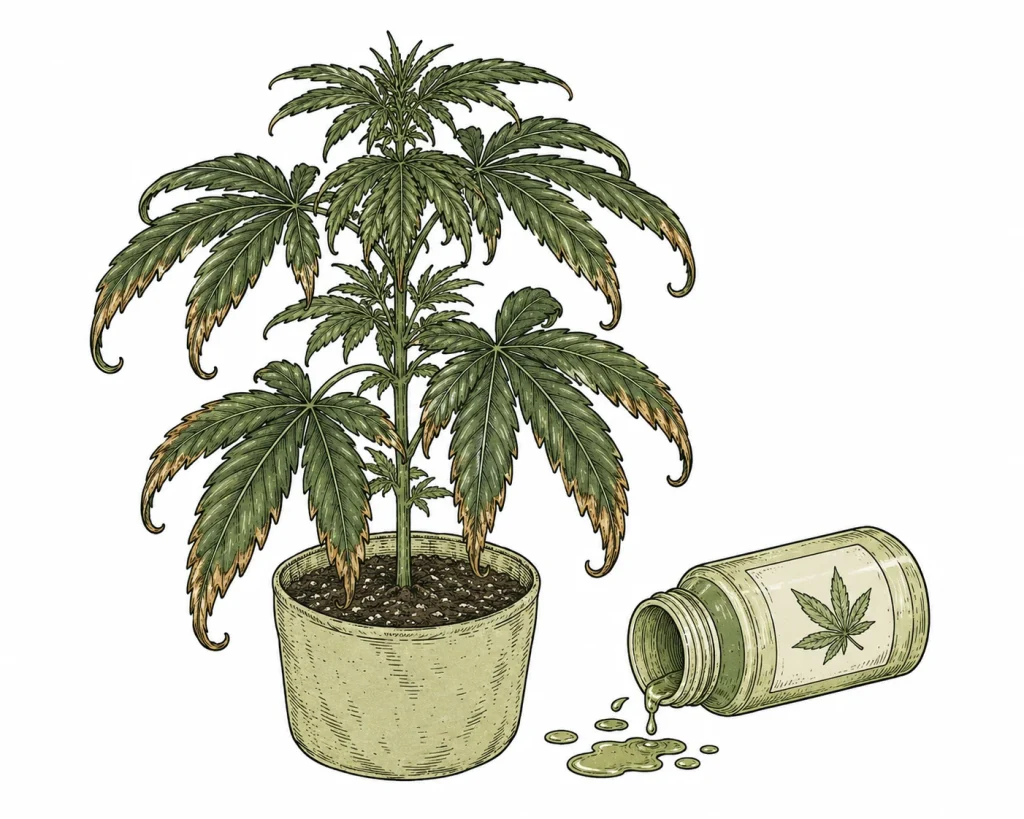
Cannabis nutrient burn — also known among home growers as overfeeding or “nute burn” — is one of the most common problems in growing and hits beginners especially hard. Many growers mean well and give their plants too many nutrients, hoping for faster growth.
But that can do exactly the opposite: the plant gets stressed, growth slows down and typical damage appears.
If you’re just starting out, our guide to growing cannabis indoors also helps you avoid typical mistakes right from the start.
In this article, you’ll learn how to reliably spot cannabis nutrient burn, what causes it and how to get your plants back on track quickly.
What is cannabis nutrient burn?
Cannabis nutrient burn — also known as overfeeding — happens when the plant gets more nutrients than it can process. Excess salts build up in the growing medium and interfere with water and nutrient uptake — even if there are technically enough nutrients available, the plant can no longer use them properly.
Nitrogen overfeeding is especially harmful because nitrogen is in almost every nutrient product and causes symptoms right away when the dose is too high. Cannabis is generally hungrier for nutrients in the vegetative stage than in flowering — a fact many growers overlook, which often leads to overfeeding during flowering.
Typical symptoms of nutrient burn
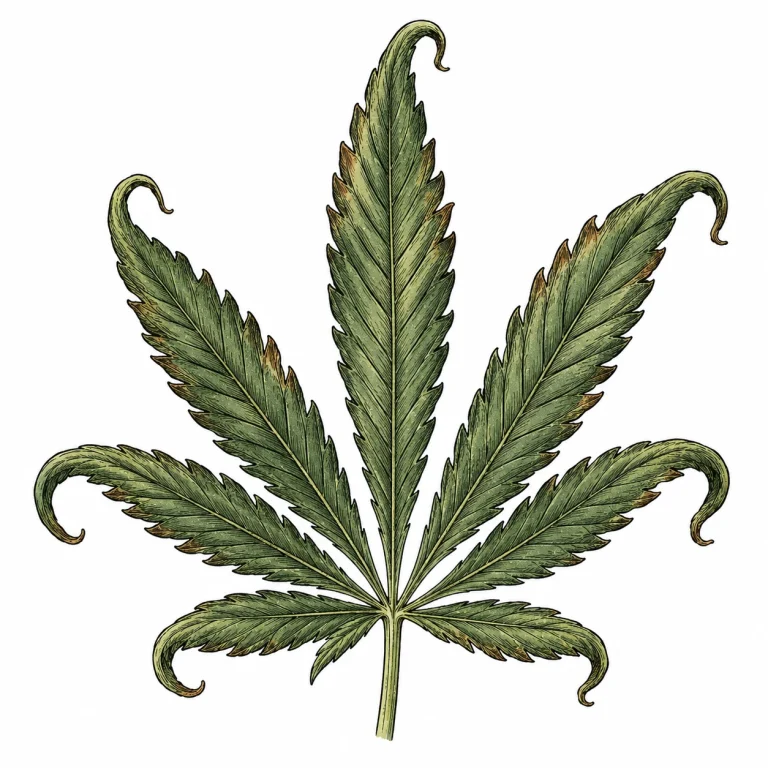
| Symptom | Affected area | Stage |
|---|---|---|
| Dark green, glossy leaves | Whole plant | Veg & flowering |
| Clawing (leaf tips curl downward) | Leaf tips | Veg |
| Burnt, brown leaf edges | Leaf edges | Veg & flowering |
| Slowed or stalled growth | New shoots | Veg |
| Wilting despite enough water | Whole plant | Veg & flowering |
A common sign of overfeeding is dark green leaves that often look glossy. On top of that, the leaf tips can curl downward, which is known as “clawing” — typical of nitrogen toxicity.
Burnt leaf tips and edges are also typical. In advanced cases, growth can slow down dramatically and the plant looks weakened overall.
Easy to mix up — it could also be a nutrient deficiency
Nutrient burn and nutrient deficiencies are often confused because both make stress visible — but in opposite directions: nutrient burn shows dark green, burnt leaves, while a deficiency shows pale, yellow or discolored leaves. The key question: did you recently feed or raise the dose? Then nutrient burn is more likely. Yellow leaves without any recent feeding point more toward a deficiency.
If you see yellow leaves, read our guide to yellow cannabis leaves first — it covers all the causes at a glance.
EC as an early warning system: EC (electrical conductivity) measures the salt concentration in the growing medium. For cannabis: 400–600 ppm (0.8–1.2 mS/cm) in the vegetative stage, 600–1,000 ppm (1.2–2.0 mS/cm) in flowering — readings above 1,250 ppm (2.5 mS/cm) are a clear warning sign of nutrient burn, often before any visible symptoms show up. Always measure the runoff after watering, not the growing medium directly. (ppm values use the 500 scale.)
Ad / affiliate link: With an 8-in-1 soil tester, you can measure EC, pH and nutrient levels directly — so you catch nutrient burn before visible damage appears. You can find it here on Amazon. *As an Amazon Associate, we earn from qualifying purchases.
The most common causes of nutrient burn
| Cause | How common | Telltale sign |
|---|---|---|
| Nutrient dose too high | Very common | Clawing shortly after feeding |
| Pre-fertilized soil + extra nutrients | Common | Symptoms already in week 1–2 |
| Feeding too often without a break | Common | Gradual decline |
| Wrong pH → nutrient buildup | Common | Symptoms despite a normal dose |
| Mineral nutrients too concentrated | Rare | Fast, strong reaction within 24 hours |
As the Julius Kühn Institute — Soil Fertility (in German) explains, nutrient buildup in the soil is often caused by excessive salt concentrations — this affects nitrogen, potassium and phosphorus alike and leads to root damage even before visible symptoms appear. You’ll find all the key nutrients and how they interact explained in our Nutrients hub.
Not all nutrient burn is the same: Nitrogen toxicity (N toxicity) is the most common form and shows up as clawing and dark green leaves. Potassium toxicity, by contrast, shows up as brown, burnt leaf edges that look deceptively similar to potassium deficiency. Phosphorus toxicity is rarer, but can cause dark spots and block other micronutrients; magnesium toxicity can also happen and shows up mainly as brown leaf tips. Important: always measure EC instead of relying on looks alone.
How to fix cannabis nutrient burn
- Stop feeding immediately
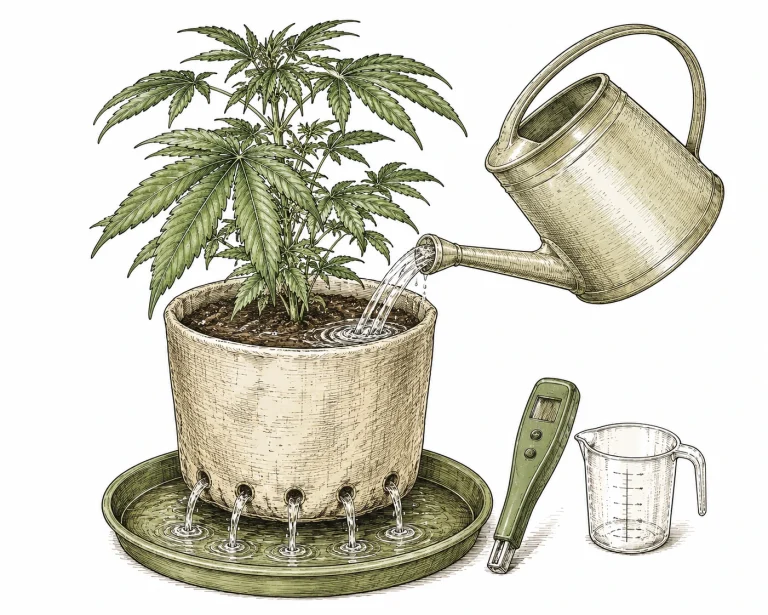
Stop all feeding right away. Give your plant only pH-adjusted water for at least 3–5 days so the growing medium can recover. - Flushing — rinse out the growing medium
Water your growing medium with 2–3 times the pot volume (pH 6.0–6.5). This washes excess salt buildup away from the roots. By the end, the runoff should be clear and odorless. - Let the growing medium dry out completely
After flushing, wait until the soil has dried out completely before you water again. Too much moisture slows down root recovery even more. - Check and correct the pH
Measure the pH of your water and adjust it to 6.0–6.5 (soil) or 5.5–6.5 (coco/hydro). The wrong pH blocks nutrient uptake even after flushing. - Restart at half the nutrient dose
After the first healthy new growth (about 7–10 days), you can restart at 50% of the normal dose. Increase the amount only gradually. Watering properly is especially important during this phase. - Check the result
After 10–14 days, new leaves should grow in a normal green again without clawing. Leaves that are already damaged won’t fully recover — that’s normal and not a setback.
How to prevent nutrient burn
- Start at 25–50% of the manufacturer’s recommended dose and only increase it if your plants look clearly healthy
- Feed no more than every 7 days — based on how your plant looks, not on the calendar
- Check the EC of your runoff before every feeding: above 1,000 ppm (2.0 mS/cm) → take a break
- In flowering, use nutrients with reduced nitrogen (e.g. NPK 1-3-2)
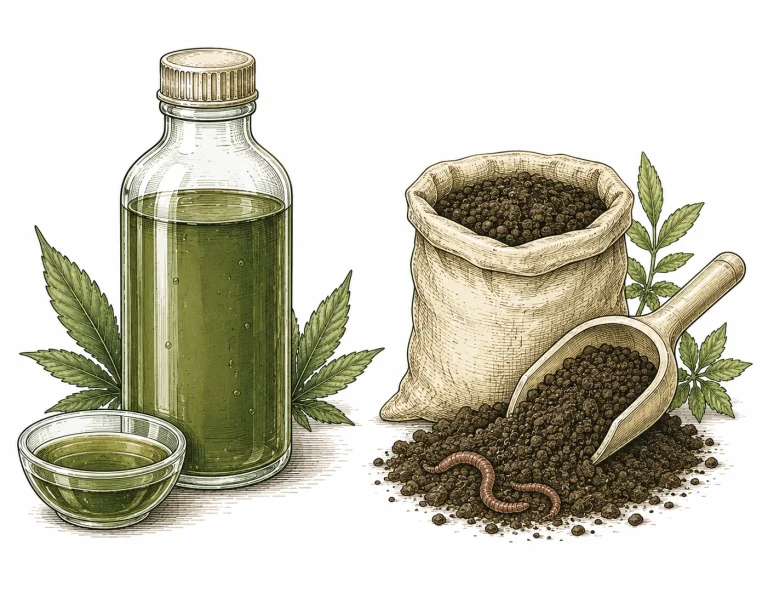
- Organic instead of mineral nutrients: slow nutrient release makes nutrient burn practically impossible
If you work with organic nutrients, you have a natural advantage here: organic nutrients release their nutrients slowly and give the plant more time to take them up. That makes nutrient burn much harder to cause than with mineral nutrients, which are available in the growing medium right away.
Nutrient burn vs. nutrient deficiency
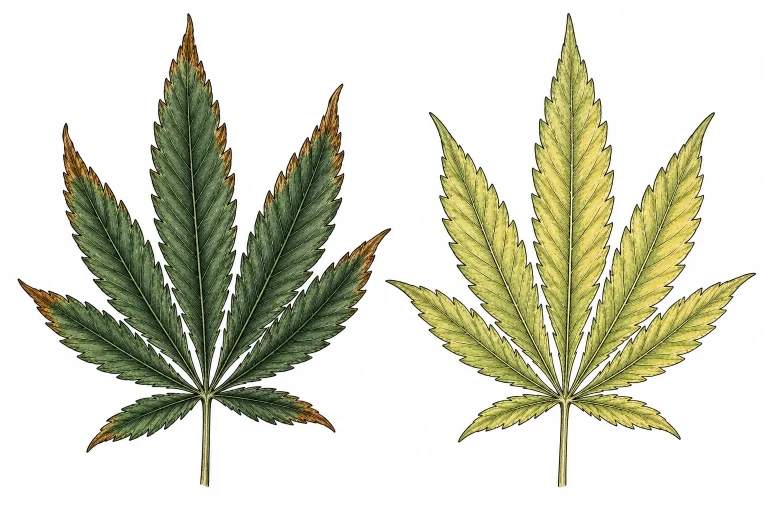
Nutrient burn and nutrient deficiencies can show similar symptoms and are often confused. While nutrient burn leads to dark leaves and burnt tips, a deficiency usually shows up as pale or yellow leaves.
Specific nutrient problems such as calcium deficiency in cannabis can also cause similar symptoms and should be considered in your diagnosis. You’ll find a complete overview in our cannabis nutrient deficiency chart.
What happens in the soil when you overfeed?
With cannabis nutrient burn, excess nutrients build up in the growing medium as salts. This salt buildup can put heavy stress on the plant’s roots and block water uptake.
In severe cases, the osmotic flow reverses: water gets pulled out of the root cells instead of into them — the plant dries out from the inside even though the growing medium is moist. That explains wilting despite enough watering.
What role does pH play in nutrient burn?
| Growing medium | Optimal pH | If it’s off |
|---|---|---|
| Soil | 6.0–7.0 | Nutrient buildup, lockout |
| Coco | 5.5–6.5 | Calcium/magnesium lockout |
| Hydroponics | 5.5–6.5 | Immediate nutrient problems |
If the pH is outside the optimal range, certain nutrients can’t be taken up and build up in the growing medium — what’s known as nutrient lockout. Paradoxically, this means nutrient burn and a deficiency can happen at the same time. Learn more in our guide to pH for cannabis.
When does nutrient burn become dangerous?
Not every case of nutrient burn is an emergency right away — but there are clear levels of severity:
- Level 1 — Mild: Clawing, dark green leaves without burning. Pausing feeding is enough; the plant recovers within a week.
- Level 2 — Moderate: Burnt leaf edges, slowed growth. Flush right away and plan on 2–3 weeks of recovery time.
- Level 3 — Severe: Wilting despite water, visible root damage (brown roots). Critical — recovery takes weeks, and in flowering you risk losing your harvest.
Nutrient burn is especially dangerous in the flowering stage: from around week 6–8 of flowering, cannabis barely needs any nitrogen. If you keep going with full-strength grow nutrients here, you risk not only leaf damage but also lower-quality buds and flavor problems in the finished product.
How long does it take to recover from nutrient burn?
Recovery time depends heavily on how early you catch the problem. In mild cases, the plant stabilizes within 5–7 days.
With more severe nutrient burn, it can take 2–4 weeks before new, healthy foliage appears. Leaves that are already damaged won’t regenerate — that’s normal. The focus is on healthy new growth. Don’t confuse this corrective measure with the routine flushing before harvest, which is a standard part of harvesting regardless of nutrient burn.
Exactly which symptoms appear depends heavily on which nutrient is in excess: Nitrogen toxicity shows up as dark green leaves that claw downward, zinc toxicity and manganese toxicity often block each other and the uptake of other micronutrients, iron toxicity usually happens when the pH is too low, and boron toxicity is one of the most dangerous overdoses because flushing can barely reverse it. To learn how to find the right dose in general, read how to dose cannabis nutrients correctly.
Cannabis nutrient burn FAQ
How fast does cannabis nutrient burn show up after feeding?
With mineral nutrients, the first symptoms can appear after just 12–24 hours because the nutrients are available in the growing medium right away. With organic nutrients, it often takes 3–5 days before symptoms become visible.
Can I still save an overfed cannabis plant?
In most cases, yes — as long as there’s no severe root damage. Stop feeding right away, flush and keep giving pH-adjusted water. Even heavily overfed plants often recover visibly within 2–3 weeks.
How often should I feed cannabis to avoid nutrient burn?
Feed no more than every 7 days and keep an eye on how the plant is doing. Only feed during active growth or when the plant clearly needs it — not by the calendar. Keep the EC of your runoff below 1,000 ppm (2.0 mS/cm).
Does flushing really help with cannabis nutrient burn?
Yes — flushing is the most effective first-aid measure. Running 2–3 times the pot volume of pH-adjusted water (6.0–6.5) through the pot washes salt buildup out of the growing medium. After flushing, the runoff should be noticeably clearer than at the start.
What is the difference between nutrient burn and nutrient deficiency in cannabis?
Nutrient burn shows dark green, glossy leaves with burnt tips and clawing. A nutrient deficiency shows pale, yellow or discolored leaves — often starting on old or new leaves depending on which nutrient is missing. Did you recently raise the nutrient dose? Then nutrient burn is more likely.
Is overfeeding hemp the same as cannabis nutrient burn?
Yes — hemp and cannabis are the same plant. Overfed hemp and cannabis nutrient burn describe exactly the same problem: too many nutrients for the plant, with identical symptoms and the same treatment.
To keep an eye on your feeding amounts in the future, grab an EC meter from our Recommended Gear.
Conclusion
Cannabis nutrient burn is a typical beginner problem, but in most cases it’s easy to fix. The key is to spot the symptoms early and react fast — the symptom table above helps you tell them apart with confidence.
With the right dose, regular pH checks and a little experience, you can reliably prevent nutrient burn. If you’re unsure about the symptoms, our Plant Diagnosis hub helps you narrow down the exact cause.
