

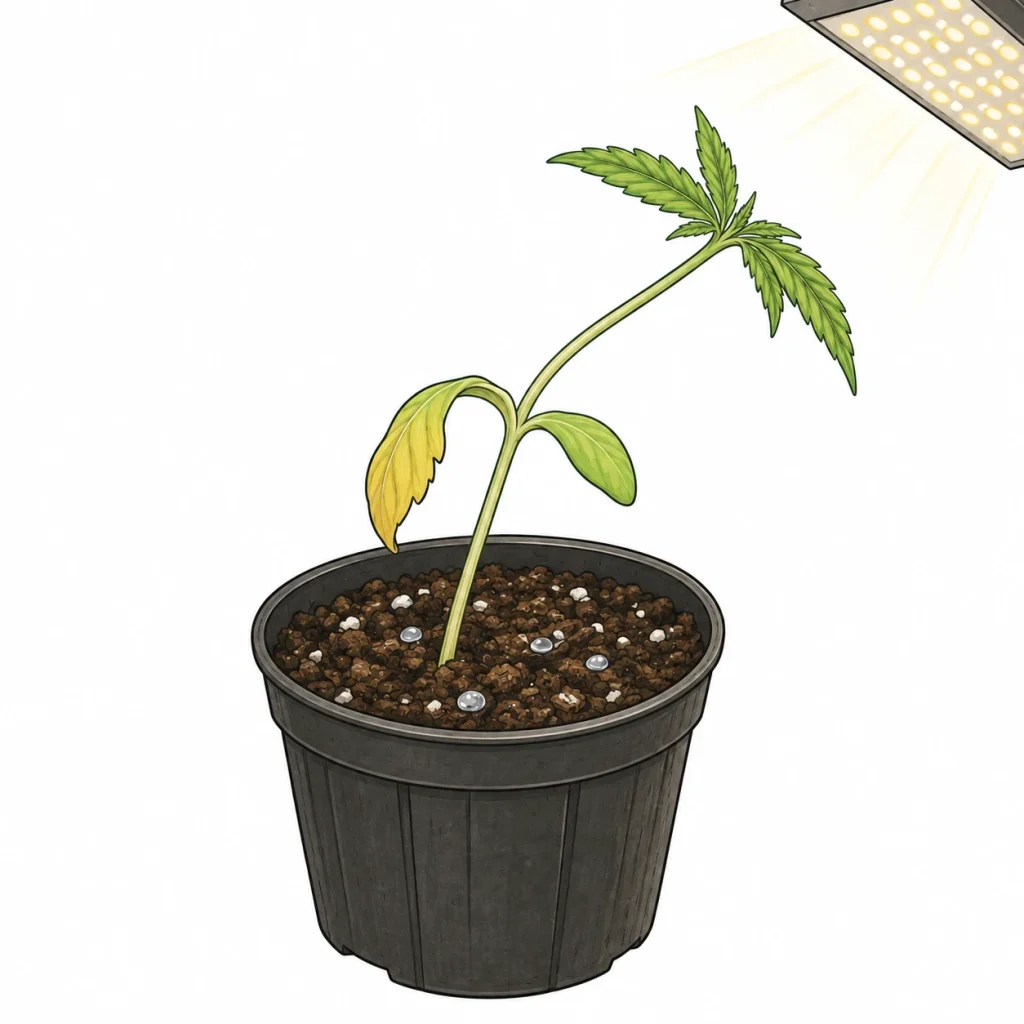
If you want to spot cannabis seedling problems before they turn into serious damage, the first days and weeks matter most. The seedling stage is the most vulnerable time in your plant’s life. Small mistakes with light, water or nutrients can quickly cause lasting setbacks. The reason lies in the physiology of germination (German): in the first weeks, your plant puts all its energy into building roots and its metabolism, which makes it especially sensitive to stress. The good news? Your young plant sends clear signals when something’s off. In this guide, you’ll learn how to read the most common symptoms with confidence and fix them fast. You’ll find all other diagnosis topics in the Plant Diagnosis overview on PlantClue.
How to Spot Cannabis Seedling Problems: The Most Common Symptoms at a Glance
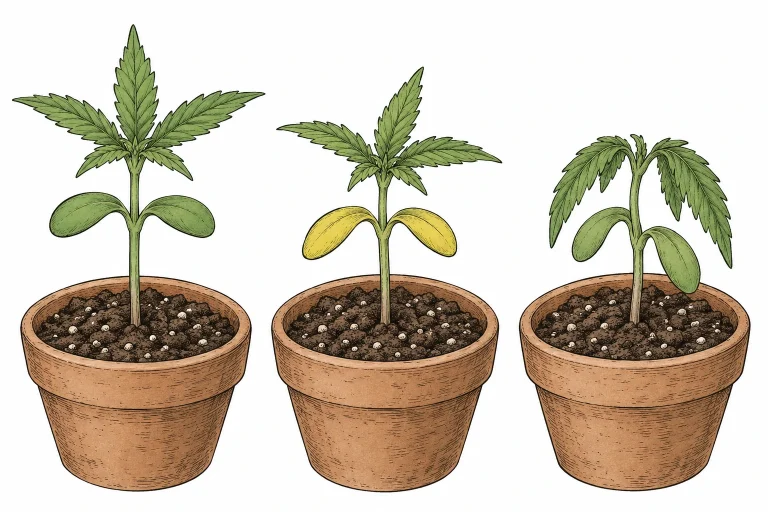
Before you can diagnose specific problems, it helps to get a feel for what a healthy seedling looks like. This article assumes your seed has already sprouted. If it hasn’t, the problem lies in germination itself. A healthy cannabis seedling has vibrant green seed leaves (cotyledons), upright leaves and visible new growth within the first week. The stem is sturdy, and the leaves have a slight sheen with no discoloration or deformities.
As soon as you notice anything unusual – drooping leaves, odd colors, stalled growth or curled leaf tips – act quickly. The most common problem areas with seedlings are overwatering or underwatering, the wrong pH, lighting issues, nutrient deficiencies or toxicities, and temperature or humidity problems. In the sections below, we’ll walk through each of these step by step.
- Drooping, wilted leaves – usually overwatering or underwatering
- Yellow cotyledons or first leaves – nutrient deficiency or pH problem
- Very long, thin stem – not enough light (stretching / leggy seedlings)
- Brown or burnt leaf tips – nutrient burn or heat stress
- Deformed, twisted leaves – pH-related nutrient lockout or pests
- No growth after day 5 – a stress factor is holding back development
Overwatering and Underwatering: The Most Common Mistake With Cannabis Seedlings
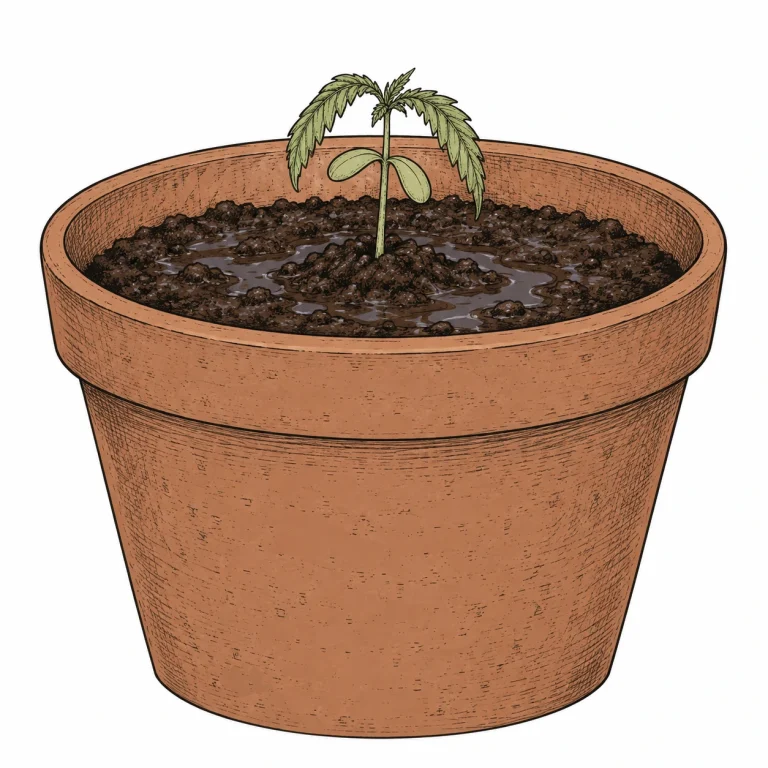
Overwatering is by far the most common mistake beginners make with cannabis seedlings. The problem: the roots don’t get enough oxygen. When the soil stays wet all the time, the fine roots can’t breathe, and the plant starts to “drown.” Oddly enough, the result looks just like underwatering – the leaves droop. The key difference: with overwatering, the soil feels heavy and soggy. With underwatering, it’s bone-dry and light.
The go-to trick for seedlings is the “lift test”: pick up your pot. If it feels heavy, don’t water. If it feels light as a feather, it’s time to water. Especially at the seedling stage, less is more. For solid watering habits, check out our in-depth article on how to water cannabis properly. In the first few days, seedlings often need just a few milliliters of water around the stem – no need to soak the whole pot.
- Overwatering: leaves droop, soil feels heavy and wet, possibly mold on the surface
- Underwatering: leaves droop and look thin and wrinkly, soil feels very light and dry
- Tip: Only water when the top layer of soil, about 1 in (2–3 cm), is dry
- Small pot = dries out faster = lower risk of overwatering
- Never water seedlings with cold water – room temperature is ideal
Wrong pH: When Nutrients Can’t Reach Your Plant
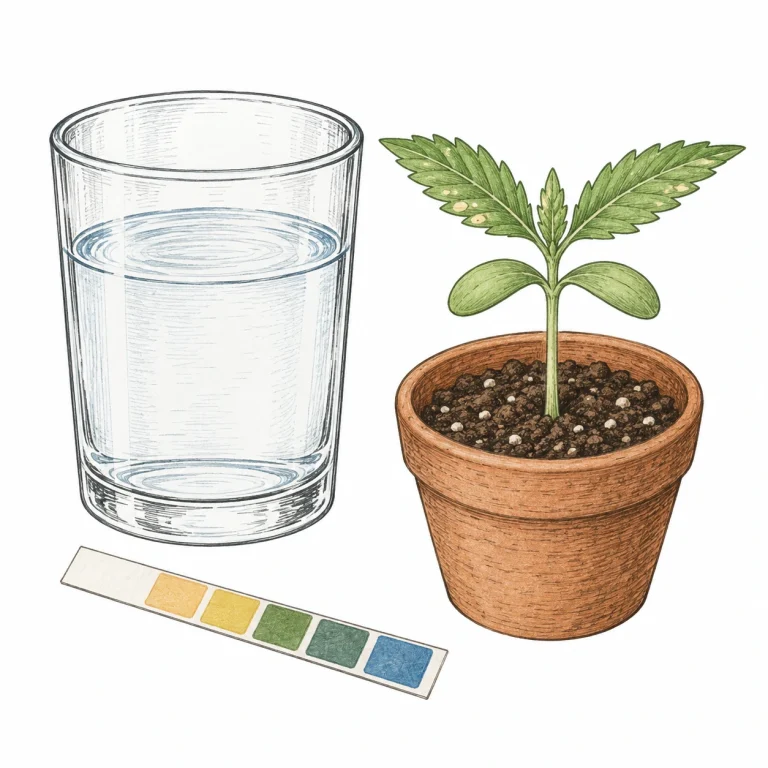
The wrong pH is the hidden cause behind many problems that look like a nutrient deficiency at first glance. In soil, cannabis seedlings need a pH of 6.0 to 7.0, ideally around 6.5. In hydroponics or coco coir, the sweet spot is 5.5 to 6.5. If the pH falls outside this range, certain nutrients become unavailable to the roots – even if they’re present in the growing medium. This is called nutrient lockout.
Symptoms of a pH problem look a lot like a classic nutrient deficiency: pale or yellow areas between the leaf veins, discoloration along the leaf edges or overall fading of the plant. So before you add any nutrients, always check the pH of your water and your growing medium first. Our article on pH for cannabis explains in detail how to measure and adjust pH correctly.
- Soil: optimal pH 6.0–7.0 (sweet spot: 6.5)
- Coco/hydro: optimal pH 5.5–6.5
- Typical symptoms: interveinal chlorosis, burnt leaf edges, overall fading or bleaching
- Fix: Adjust the pH of your water and flush the growing medium if needed
- A cheap pH pen is all you need as a beginner
Spotting Cannabis Seedling Problems Caused by Low Light and Heat Stress
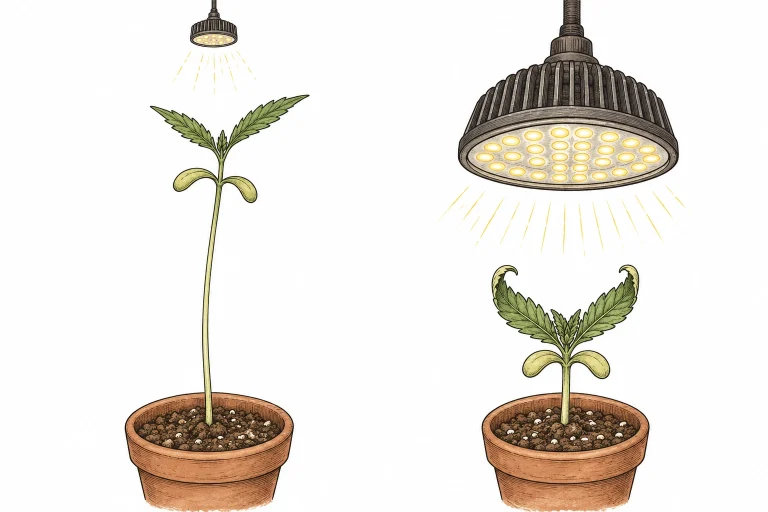
Light is one of the trickiest things to get right with cannabis seedlings. Too little light causes stretching (etiolation): The plant shoots up too fast, and the stem gets thin and floppy. Growers call these leggy seedlings. Our article Leggy, Stretched Cannabis Seedlings covers every cause, the right light distance and how to save a seedling that has already stretched.
Too much light or a lamp hung too close, on the other hand, can cause heat stress. The leaf edges start curling upward (tacoing), the margins burn brown, and the plant looks dried out, even when it has plenty of water. The right light height depends on your lamp: LEDs can often hang closer than HPS lights, which give off more radiant heat. As a general rule for seedlings: 18–24 hours of light per day, with enough distance to the light source.
- Low light: long, thin stem, big gaps between leaf pairs
- Heat stress: curled leaves (tacoing), brown leaf tips, dried-out look
- Light burn: white or yellow spots right under the lamp
- LED: about 16–24 in (40–60 cm) distance for seedlings (check your manufacturer’s specs)
- Seedling light cycle: 18/6 or 20/4 hours light/dark
Nutrient Problems in Seedlings: Deficiencies and Nutrient Burn
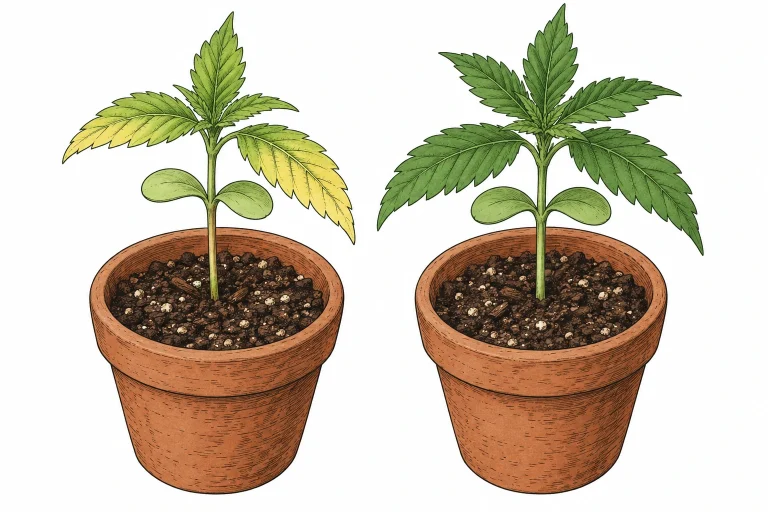
Nutrient problems in seedlings often come from well-meant but heavy-handed feeding. Fresh seed-starting soil usually holds enough nutrients for the first 2–4 weeks. If you feed on top of that, you risk nutrient burn. You can spot it by brown, burnt leaf tips and edges and leaves that curl downward (the so-called claw). In the worst case, the roots burn and the plant may not recover. Learn more in our article on cannabis nutrient burn.
True nutrient deficiencies are less common in seedlings. They usually show up only after week three or four, once the soil’s nutrient reserves run low. The most common deficiencies in young plants are nitrogen (N), magnesium (Mg) and calcium (Ca). Nitrogen deficiency shows up as general yellowing that starts on the older, lower leaves. Potassium or calcium deficiency shows up as spots or dead patches. For calcium deficiency, check out our dedicated article on calcium deficiency in cannabis.
Rule of thumb: Start with heavily diluted nutrients in week three at the earliest. Use about 25 % of the dose recommended on the bottle. Only raise the dose once your seedling responds well. A simple EC (electrical conductivity) meter (German) helps you check the actual nutrient strength of your water instead of relying only on the label.
- Nutrient burn: brown leaf tips, the claw, dark green leaves, root damage
- Nitrogen deficiency: yellowing from the bottom up, older leaves hit first
- Magnesium deficiency: yellow patches between green veins (interveinal chlorosis)
- Calcium deficiency: brown spots, deformed new leaves
- Rule of thumb: Do NOT feed for the first 2–4 weeks in fresh seed-starting soil
Temperature, Humidity and Root Fungi as Other Causes
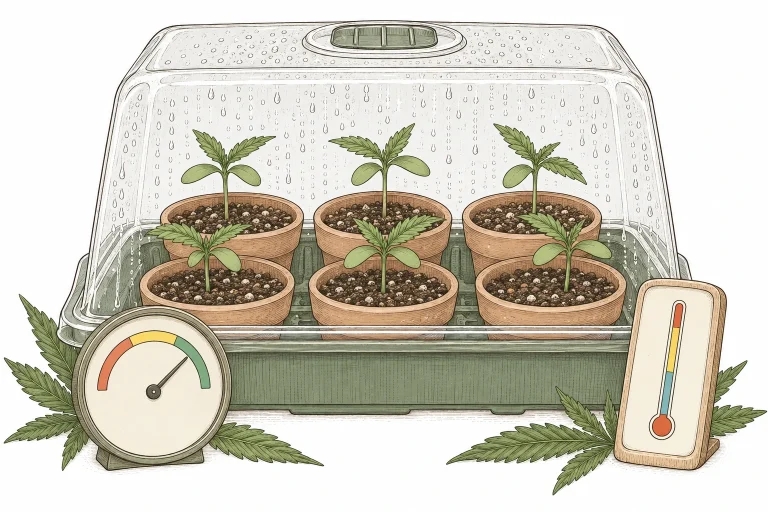
Cannabis seedlings depend heavily on their environment. The ideal temperature for seedlings is 68–79 °F (20–26 °C). Too cold (below 59 °F / 15 °C) slows their metabolism way down: Growth stalls, and the leaves turn dark green and leathery. Too warm (above 86 °F / 30 °C) can cause heat stress and faster moisture loss. During the seedling stage, aim for 60–70 % relative humidity (RH). Many growers use a humidity dome or an upside-down clear container as a mini greenhouse to create a moist microclimate.
If a seedling suddenly collapses even though your watering and light are on point, and the stem turns soft or brown at the soil line, damping-off is the most likely culprit. It’s a fungal infection that attacks the stem right at the soil surface. Affected plants usually can’t be saved. Our article Cannabis Seedling Falling Over explains in detail how to spot damping-off, which pathogens cause it and how to prevent it.
- Ideal seedling temperature: 68–79 °F (20–26 °C) during the day, no lower than 64 °F (18 °C) at night
- Ideal humidity: 60–70% RH during the seedling stage
- Damping-off: the stem turns soft or brown at the soil line and the plant topples over
- Preventing fungal problems: sterile growing medium, good air circulation, no waterlogged soil
- Using a humidity dome: yes, but air it out daily to keep mold from forming
Step-by-Step Diagnosis: How to Tackle Cannabis Seedling Problems
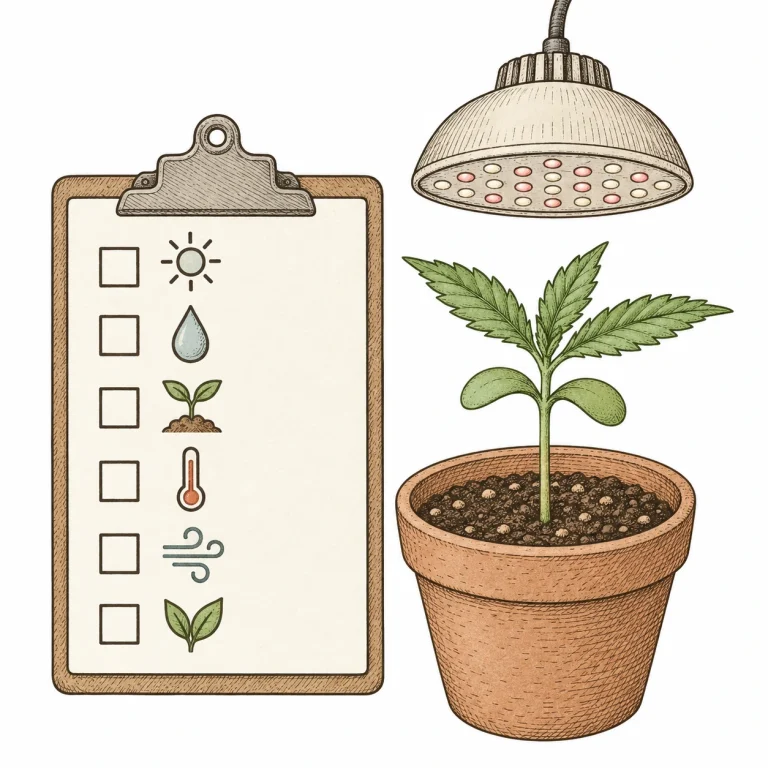
When you spot a problem with your seedling, a systematic approach matters more than acting fast. A lot of growers make the same mistake: they make one diagnosis and immediately change several things at once – new nutrients, new growing medium, a different light. That makes it impossible to tell later what actually helped. Go step by step instead: check the basics first (water, pH, light), and only then move on to the more advanced factors.
The seedling stage usually lasts 1–3 weeks, depending on genetics and growing conditions. Patience is a big asset during this time. Not every slightly droopy plant is an emergency. Check on your seedlings daily, jot down quick notes if needed, and only step in once you’re confident you’ve pinned down the problem. For a complete overview of indoor growing from start to finish, check out the Cannabis Indoor Grow Guide.
- Step 1: Measure the pH of your water (target: 6.0–7.0 in soil)
- Step 2: Check soil moisture (lift test, finger test)
- Step 3: Check the light distance and the temperature under the light
- Step 4: Check room temperature and humidity
- Step 5: Note down your last feeding and pause nutrients if needed
- Step 6: Inspect the roots (brown/slimy = fungus, white = healthy)
Common Mix-Ups: Symptoms That Look Alike
Before you dig deeper, a rough first sort helps: if your seedling falls over completely and the stem turns soft or brown at the soil line, the culprit is usually damping-off or overwatering. If it’s growing tall and thin but still standing upright, you’re dealing with leggy seedlings from too little light. If the leaves change color but growth itself looks fine, the problem usually comes down to nutrients or pH.
One of the biggest challenges in diagnosing cannabis seedlings is that many symptoms look very similar. Yellow leaves can come from nitrogen deficiency, pH-related nutrient lockout, overwatering, cold, or the cotyledons dying off naturally. Drooping leaves can mean overwatering or underwatering. Curling leaves can point to heat stress, wind stress, or pests. If you find yellow leaves on your plant and aren’t sure what’s behind them, our article on causes of yellow cannabis leaves can help.
A key rule of thumb: on healthy plants, the seed leaves (cotyledons) turn yellow and drop off naturally after 2–4 weeks – that’s not a sign of trouble. It becomes a problem when the first true leaves (the serrated ones) turn yellow or get deformed. So always pay attention to WHICH leaves are affected: old, lower leaves first = mobile nutrients like nitrogen or phosphorus. New, upper leaves first = immobile nutrients like calcium, iron, or zinc.
- Cotyledons turn yellow after 2–4 weeks: NORMAL, no action needed
- True leaves turn yellow: time to act – find the cause
- Yellowing at the bottom: mobile nutrients (N, P, K, Mg) – often a deficiency
- Yellowing at the top: immobile nutrients (Ca, Fe, Zn) – often a pH problem
- Evenly pale: too little light or the soil’s nutrients are used up
Frequently Asked Questions
How long does the cannabis seedling stage last?
The seedling stage usually lasts 1–3 weeks. It ends once the plant has developed 3–5 pairs of true leaves and the roots start to fill out the pot. Under ideal conditions (72–77 °F (22–25 °C), 65% RH, 18 hours of light), this stage moves along quickly.
Do I need to feed my cannabis seedling?
In the first 2–4 weeks, you usually don’t need any nutrients as long as you’re using fresh seedling soil with a light nutrient charge. Feeding too early is one of the most common seedling mistakes and can easily lead to nutrient burn. Only once the growing medium is depleted or signs of deficiency show up should you start with a very low dose (25% of the recommended amount).
Why isn’t my cannabis seedling growing?
Stunted growth can have many causes: soil that’s too wet or too dry, the wrong pH, temperatures that are too low, too little light, or root problems. Work through the basic parameters systematically – pH and moisture first, then light and temperature. Often a single fix is enough to get growth going again.
What does it mean when my seedling’s leaves curl upward?
Leaves curling upward (known as tacoing) are usually a sign of heat stress. The plant shrinks its leaf surface to protect itself. Check the distance to your lamp and the temperature right under the light. A small fan pointed at your plants can help move the air and carry heat away.
How do I spot damping-off in my cannabis seedling?
With damping-off, your seedling’s stem looks soft, dark or pinched right at the soil line. The plant suddenly flops over, even though it looked healthy before. Unfortunately, damping-off usually can’t be cured once it hits. Prevent it with a sterile growing medium, good air circulation, no overwatering and humidity that isn’t too high.
Are yellow cotyledons a problem?
Not necessarily. Cotyledons (the small, round first leaves) naturally turn yellow and drop off after 2–4 weeks as the plant shifts its energy to the true leaves. Only step in and look for the cause if the true, serrated leaves start yellowing.
Bottom Line
Spotting cannabis seedling problems is a skill you’ll pick up fast with a little practice and the right basics. The most common causes – watering mistakes, pH issues, lighting errors and nutrient burn – are easy to fix once you catch them early. The key is a systematic approach: check the basics first, then act. The sooner you spot a problem, the less time you lose during this crucial early growth and the healthier your plant heads into the vegetative stage.
