

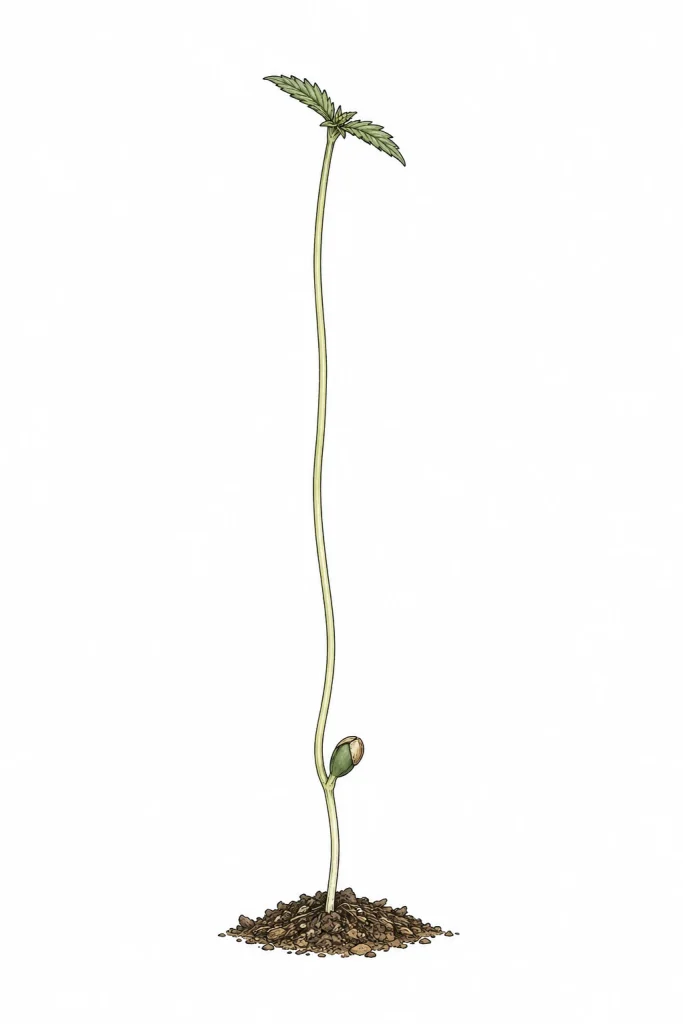
If your cannabis seedling looks leggy and etiolated, meaning it’s growing unusually tall, thin and floppy, that’s a clear warning sign you should take seriously. Etiolation means the plant stretches to reach more light. It’s a classic survival response to poor conditions. The result is weak, wobbly seedlings that can tip over, snap or never grow into healthy plants unless you step in fast. In this article you’ll learn why cannabis seedlings get leggy and stretched, what you can do right away and how to raise strong, healthy seedlings from now on.
What Etiolated Means: When Your Cannabis Seedling Gets Leggy
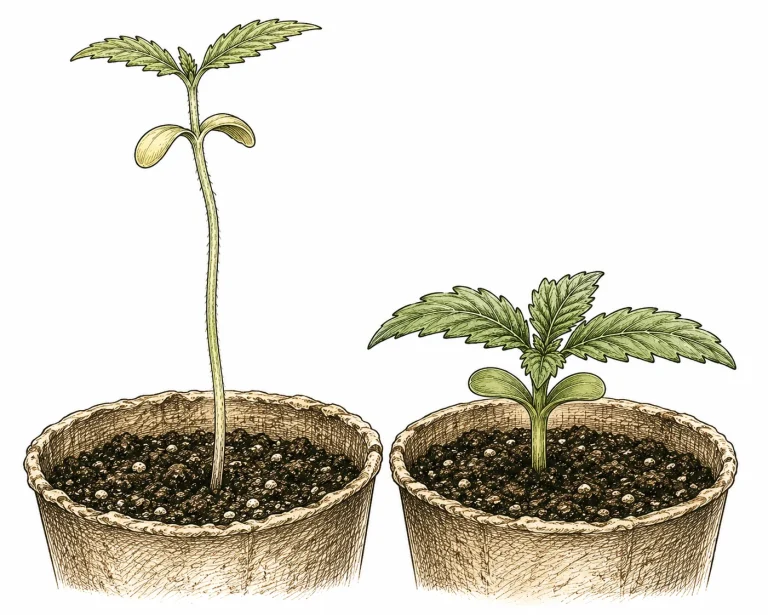
Etiolation is a botanical term for excessive stretching in plants that don’t get enough light. When a cannabis seedling grows leggy and etiolated, it produces more auxin than normal. Auxin is a growth hormone that drives cell elongation. The result is a long, thin stem with big gaps between the nodes that can barely carry the weight of the leaves.
Healthy cannabis seedlings have a short, sturdy stem with tight internode spacing. An etiolated seedling, on the other hand, can shoot up so much in just two to three days that it can no longer hold itself upright and falls over. As soon as you see your seedling showing more than about 1 in (2–3 cm) of bare stem without leaves, take action right away. If your seedling suddenly flops over without stretching first, the cause is more likely damping-off or another problem. You’ll find how to tell them apart in our article on that topic.
Here’s the key thing to understand: stretching isn’t a nutrient problem and it isn’t a sign of disease. It’s a direct reaction to the growing environment, mostly to too little light or a badly positioned light. The good news? Seedlings that have just started stretching can usually be saved if you act in time.
- Long, thin stem with little substance
- Big gaps between the nodes (internodes)
- Seed leaves (cotyledons) droop limply
- Seedling tips over or can’t support itself
- Pale, light green color due to reduced chlorophyll production
- Weak root growth compared to stem length
The Most Common Causes of a Leggy Cannabis Seedling
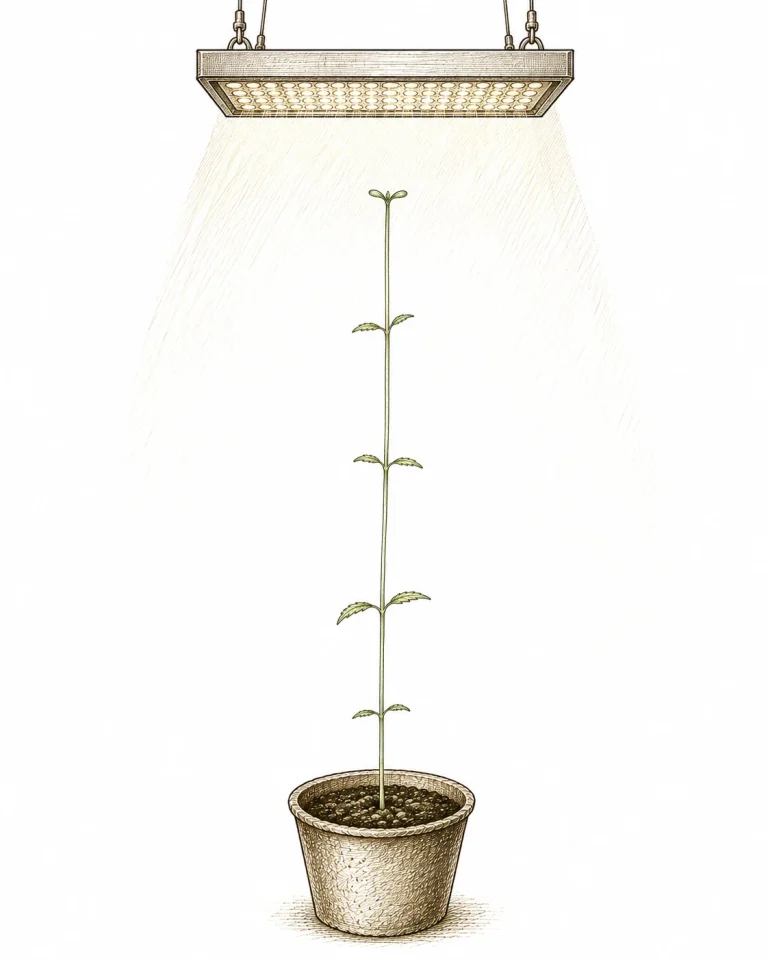
By far the most common cause of a leggy cannabis seedling is not enough light or the wrong light distance. When the lamp is too far from the seedlings, the plant senses there isn’t enough light and starts stretching toward the source. This happens a lot with LED grow lights, because many beginners hang them too high out of fear of heat damage. Seedlings need different distances than mature plants: usually 12 to 18 in (30 to 45 cm) for powerful LEDs, and closer for weaker lights.
Another common cause is using a light source that’s simply not up to the job. Regular incandescent bulbs, weak CFLs or a windowsill in winter just don’t deliver enough light intensity for cannabis seedlings. Seedlings need enough light with the right spectrum from their very first days. Blue light in particular promotes compact growth.
Light duration matters too: if seedlings get less than 18 hours of light per day, stretching can set in. In spring, when the days are still short, cannabis seedlings started on a windowsill for outdoor growing often turn leggy, because the glass cuts light intensity a lot and there aren’t enough hours of sunshine yet. Finally, planting the seed at the wrong depth can leave a long white stem section above the soil that should really be underground. Strictly speaking, though, that’s not true etiolation.
Quick recap of the most common causes: light too far away, wrong or too weak light source, too few hours of light, wrong spot (windowsill), seed planted too deep or too shallow. Also check out our Plant Diagnosis overview to rule out other problems with your plant step by step.
- Light too far away – the most common problem in indoor growing
- Wrong light source (incandescent bulb, weak CFL)
- Too few hours of light (under 18 h/day for seedlings)
- Windowsill in fall/winter with low light intensity
- Light from one side only without turning the plants enough
- Seed planted too shallow, so the stem grows above the soil
Leggy, Etiolated Cannabis Seedling: Quick Fixes at a Glance
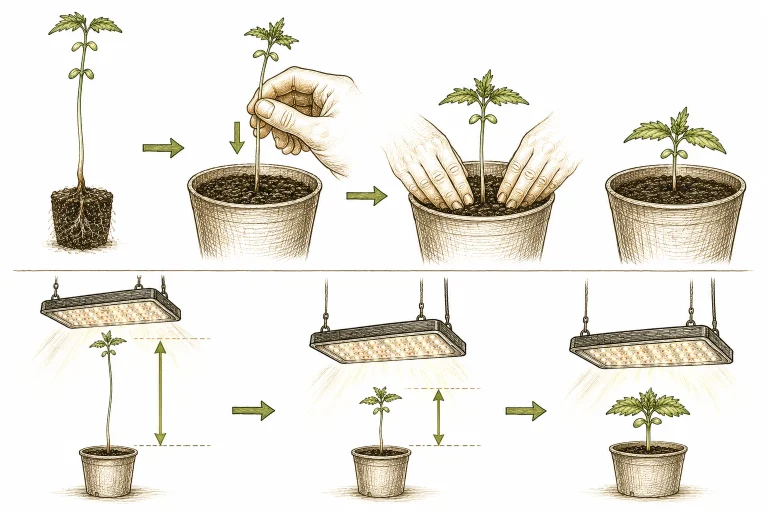
If your cannabis seedling has turned out tall, thin and leggy, there are several quick fixes that work. First things first: bring the light closer. Hang your lamp at the recommended height for seedlings and check the intensity with a PAR meter, or at least by watching how your plants react. To start, 200 to 400 µmol/m²/s PPFD is plenty. More light at this early stage can often do more harm than good.
One of the most effective rescue moves is replanting the seedling deeper. If the stem has already stretched, simply set the seedling lower in the soil so most of that long stem ends up below the surface. Cannabis easily grows new roots from buried stem sections, which can actually make the plant sturdier. Press the soil down only lightly and keep the spot where the stem leaves the soil clean.
For extra support, push a small stick or toothpick into the soil next to the seedling and loosely tie the stem to it until it gets stronger. A gentle breeze from a small fan also works really well. Moving air prompts the plant to build more supportive tissue in the stem. The principle behind this is called thigmomorphogenesis: mechanical stress makes the stem stronger.
If your seedling is so long and weak that it can’t hold itself up anymore, a small collar of loose growing medium right around the base of the stem can help. Add some moist medium around the stem and shape a little mound that keeps the plant upright. Always combine this with the right lamp height so the problem doesn’t come back.
- Move the lamp to the right height right away (12–18 in (30–45 cm) for LEDs)
- Replant the seedling deeper and bury part of the stem
- Push a small stick into the soil next to the plant for support
- Use a fan for a gentle breeze to strengthen the stem
- Build a collar of growing medium around the base of the stem
- Switch the light cycle to 18/6 or 20/4
Leggy Cannabis Seedlings: The Right Lighting for Healthy Seedlings
Want to learn more about the ideal light spectrum? Check out How to Use the Right Cannabis Light Spectrum and Light Duration.
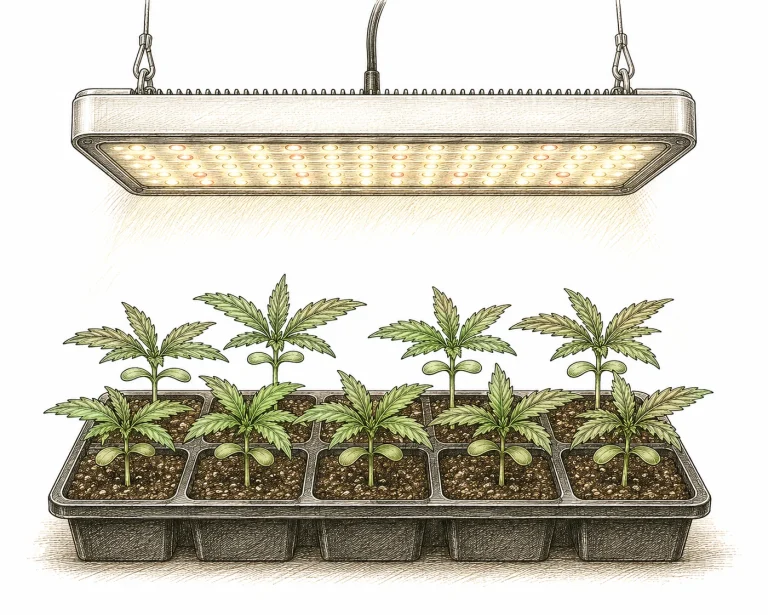
To prevent leggy cannabis seedlings, choosing the right lighting is key. Full-spectrum LEDs, T5 fluorescent tubes or CMH lamps all work especially well for seedlings. Make sure there’s enough blue light (400 to 500 nm). Blue light promotes compact growth and short internodes. The Bavarian State Institute for Viticulture and Horticulture (LWG) confirms this effect for ornamental plants, too. Warm light sources with a high share of red light can lead to stretched growth.
The right lamp distance for cannabis seedlings depends on the type and wattage of your light. A good rule of thumb: high-wattage LEDs (200 W and up) should hang 16 to 24 in (40 to 60 cm) above your seedlings. Weaker LEDs or T5 fluorescent tubes can go much closer, at 4 to 8 in (10 to 20 cm). Your best tool for checking is a cheap lux meter app on your phone or a real PAR meter.
As for light duration: cannabis seedlings do well with 18 to 20 hours of light per day. An 18/6 schedule (18 h light, 6 h dark) is the most commonly recommended standard. Some growers even prefer 20/4 for the first two weeks. Running your lights 24 hours a day isn’t recommended, since plants also need a dark period for their metabolic processes. Check out our complete indoor growing guide to plan the best lighting for every growth stage.
One factor growers often underestimate is even light coverage. If the light only comes from one side, like when you start seedlings on a windowsill, the seedling will lean toward the light. Turn your pots 90 to 180 degrees every day if you don’t have a light source shining evenly from above. This prevents sideways stretching and keeps your plants growing straight.
- Full-spectrum LEDs or T5 fluorescent tubes are ideal for seedlings
- High share of blue light (400–500 nm) for compact growth
- LED distance: 16–24 in (40–60 cm) for strong lights, 4–8 in (10–20 cm) for weak ones
- 18/6 or 20/4 light cycle for the best seedling growth
- Turn your pots daily if the light comes from one side
- Aim for a PAR value of 200–400 µmol/m²/s for seedlings
Growing Medium, Watering and Other Factors Behind Leggy Seedlings
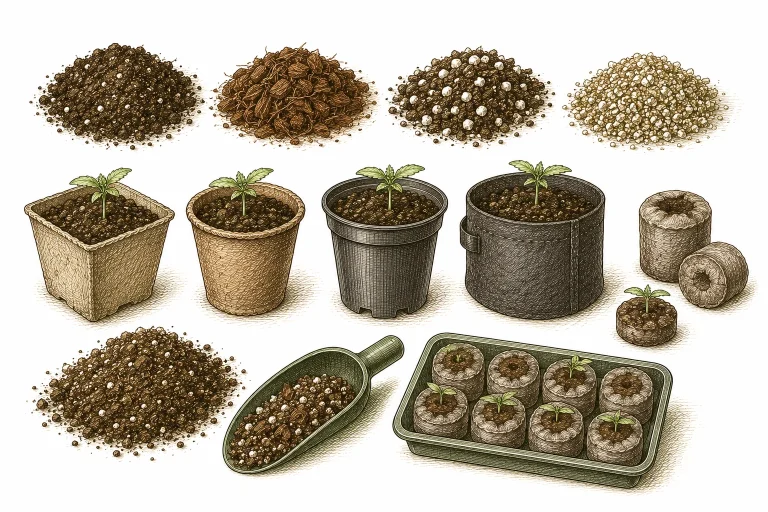
Lighting isn’t the only factor. Your growing medium and watering also play a role in seedling growth. A medium that’s too heavy, compacted or wet holds back root development. Your seedlings can stay weak even under good light. Use a light, fluffy seedling mix with plenty of air space. A dedicated seed-starting mix or low-nutrient starter mix is ideal, because seedlings barely need any added nutrients during their first two weeks.
Watering is another critical point. Too much water is one of the most common mistakes with cannabis seedlings. Waterlogged soil starves the roots of oxygen and invites fungal diseases like pythium root rot. Water your seedlings sparingly and evenly. The medium should be slightly moist, but never soggy. Wait until the top layer of soil has dried out a little before you water again. We explain how to water cannabis the right way and avoid common beginner mistakes in detail in a separate article.
Pot size also affects seedling development. Pots that are too big can lead to overwatering, because the medium stays wet for too long. Start with small pots or seedling pots of about 3.5 to 17 fl oz (0.1 to 0.5 L) and transplant only once the roots have filled the pot. On the other hand, pots that are too small can limit growth and cause root stress, which can also hold your plants back indirectly.
Temperature and humidity matter too. Seedlings do best at 72 to 82 °F (22 to 28 °C) and 60 to 70% relative humidity (RH). Temperatures that are too low slow down their metabolism, while temperatures that are too high can encourage stretching. Also check the pH of your water: for soil, the sweet spot is 6.0 to 7.0. You’ll find more about pH in cannabis and how to dial it in correctly in our in-depth guide.
- Use a light seedling mix with good drainage
- Keep nutrients low in your starter mix – seedlings barely need any extra feeding
- Water sparingly and avoid waterlogged soil at all costs
- Use starter pots of 3.5 to 17 fl oz (0.1 to 0.5 L) for seedlings
- Temperature: 72–82 °F (22–28 °C), humidity: 60–70%
- Water pH: 6.0–7.0 for soil
Prevention: How to Avoid Leggy Cannabis Seedlings
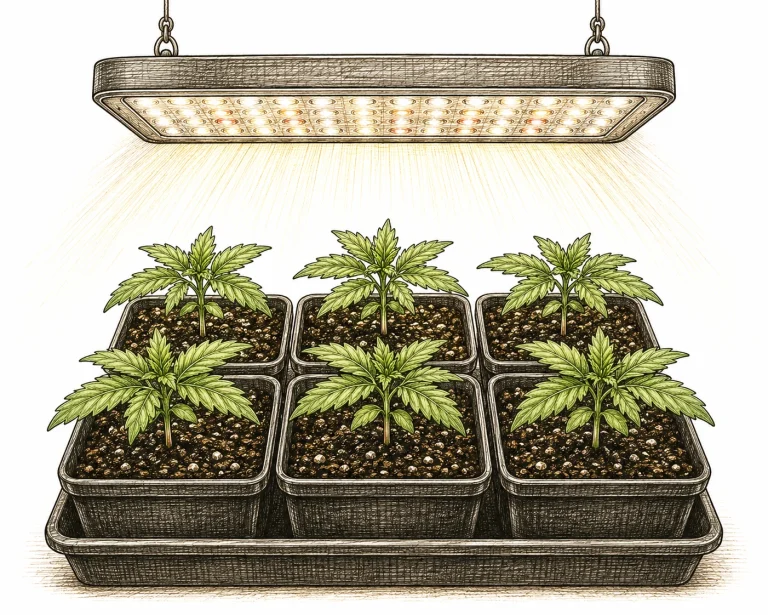
Prevention is your best defense against leggy cannabis seedlings. Before you germinate your first seeds, make sure your setup is dialed in. Hang your light at the right distance from the start. Check the light intensity with an affordable meter or an app before your seedlings pop up. Many experienced growers recommend moving the light into position a few hours before you expect the seedlings to break the surface.
Another helpful tip: use a humidity dome or a mini greenhouse cover (German) for the first few days. These small plastic domes keep humidity and warmth steady, and if you pick a clear one, the light gets through easily. Once the first seedling appears, take the dome off gradually so your plants can adjust to the surrounding air.
Keep a simple grow journal. Note your seedlings’ condition, the light distance, the temperature and your watering every day. This helps you spot problems fast and avoid them in future grows. After just a few grows, you’ll get a feel for what healthy seedlings should look like and when you need to step in. Also keep in mind that different genetics react differently to light. Some sativa-dominant strains naturally stretch more than indica-dominant ones.
If you keep fighting leggy seedlings and can’t get the problem under control despite all these steps, check out our detailed Plant Diagnosis overview on PlantClue to work through every possible cause step by step. Sometimes the problem comes from a combination of several factors that add up to poor conditions.
- Set your light to the correct distance before germination
- Use a humidity dome for steady humidity and temperature
- Keep a grow journal to spot problems quickly
- Consider genetics – sativas stretch more than indicas
- Keep meters for light, temperature and pH on hand
- Test and fine-tune your full setup before the grow
For a complete overview of typical seedling issues, see our article on seedling problems. If you also notice unusually thin stems, read on there as well.
Frequently Asked Questions
Why is my cannabis seedling growing so tall and thin?
A tall, skinny cannabis seedling almost always means it isn’t getting enough light, or your light is hanging too far away. The plant stretches toward the light. This survival mechanism is called etiolation. To fix it, move your light closer: 12–18 in (30–45 cm) for a strong LED. Then bump the light cycle up to 18–20 hours a day.
Can I still save a leggy cannabis seedling?
Yes. In most cases, a stretched seedling is easy to save. The best fix is to replant it deeper so part of the long stem sits below the soil. Cannabis grows new roots along buried stem sections. You also need to correct your light distance right away so the stretching stops.
How far should the light be from cannabis seedlings?
That depends on your light. Strong LEDs (200W+) should hang 16–24 in (40–60 cm) above the seedlings. Weaker LEDs and T5 tubes can go as close as 4–10 in (10–25 cm). A PAR meter lets you check: seedlings need 200–400 µmol/m²/s of PPFD (photosynthetic photon flux density). Too little light can cause stretching, too much can cause light burn.
How long does it take a stretched seedling to recover?
Once you fix the light and replant deeper if needed, a stretched seedling should show sturdier growth within 3 to 7 days. New growth will be more compact. The part of the stem that already stretched stays long, but the new nodes should be spaced normally.
Can overwatering also cause a leggy seedling?
Only indirectly. Overwatering damages the roots and blocks nutrient uptake, which weakens seedlings in general. But the main cause of stretching is always too little light. Get both right: good light AND light watering, so your seedlings can develop at their best.
Should I feed stretched seedlings nutrients right away?
No. Seedlings don’t need extra nutrients for the first two weeks. Feeding too early can even hurt them and lead to nutrient burn. A good seed-starting soil holds enough nutrients for the first few weeks. Focus on light, water and the right temperature – those are what really matter for healthy seedlings.
The Bottom Line
A leggy, stretched cannabis seedling is one of the most common problems when you start plants. The good news: it’s also one of the easiest to fix. In almost every case, lighting is to blame. That usually means too little light, the wrong distance or an unsuitable light source. With the right quick fixes, like replanting deeper and correcting the light distance, you can still save most stretched seedlings. Want to avoid this next time? Check your grow setup carefully before your next run. Go for a suitable grow light, the correct hanging height and a solid 18/6 light cycle.
