

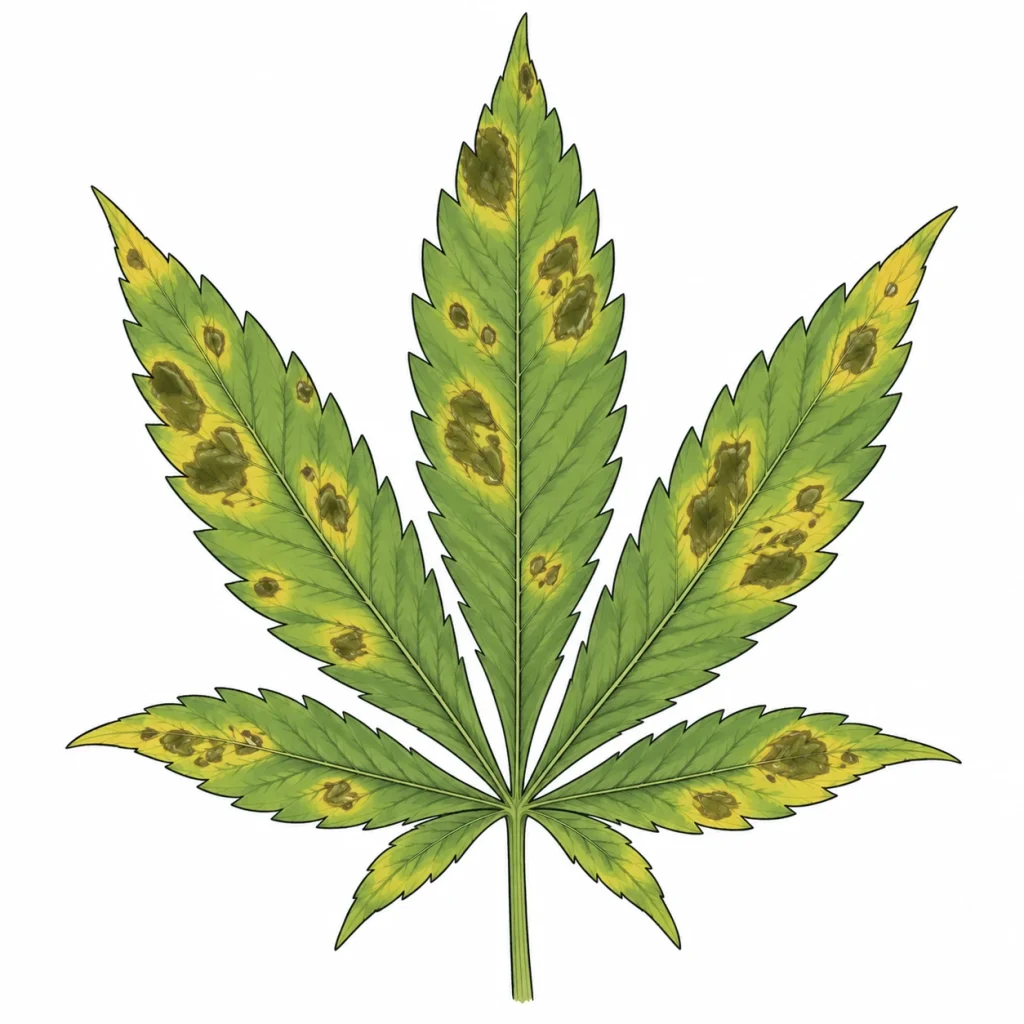
Bacterial leaf spot on cannabis is one of the sneakiest problems you can run into. At first it looks like a nutrient deficiency or a fungal disease, so many growers only realize late what they’re really dealing with: an active bacterial infection. Infected plants show irregular, water-soaked spots. Once temperature and humidity line up, these spots can spread across leaves and stems fast. If you don’t know the pattern, you can lose valuable time on the wrong fixes. In this article, you’ll learn how to spot bacterial leaf spot with confidence, which pathogens cause it, and which steps can still save your plant. You’ll find every other cause of leaf changes in our big Cannabis Plant Diagnosis Hub.
What Is Bacterial Leaf Spot on Cannabis – and Why Is It So Dangerous?
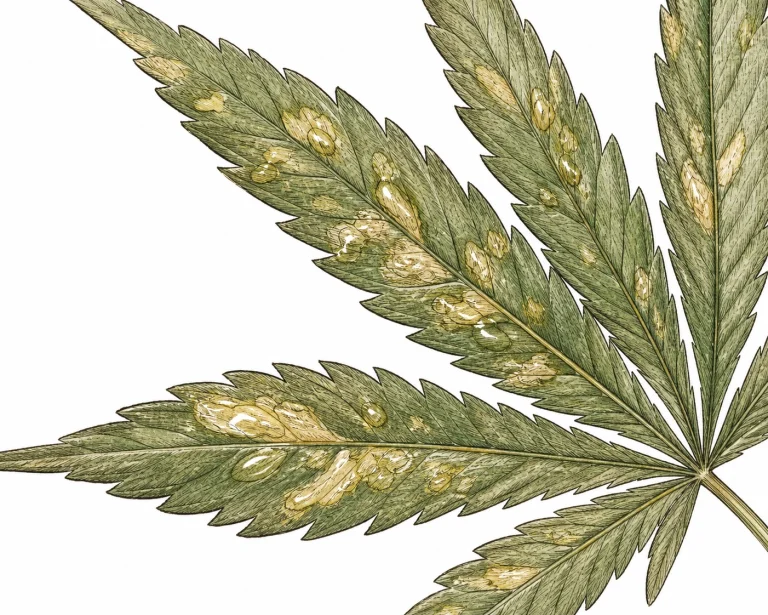
Bacterial diseases in cannabis are mainly caused by Pseudomonas syringae, Xanthomonas campestris and Erwinia species. These bacteria live in almost every garden and greenhouse soil. They usually only do serious damage when the plant’s defenses are weakened or conditions favor infection. Unlike fungal diseases, bacterial pathogens don’t form visible spore structures like white fuzz or dark dots – and that makes diagnosis a lot harder.
Bacterial leaf spot gets especially dangerous because bacteria enter through the plant’s natural openings: stomata, tiny wounds from insect damage, cuts from training, or mechanical injuries from careless handling. Once inside the plant tissue, the pathogens move through the vascular system. Within a few days, an infection on a few leaves can turn into systemic wilt. This so-called bacterial wilt blocks the plant’s water-conducting vessels, which can cause a rapid collapse even though the roots look healthy.
Poor watering habits are another factor that favors bacterial infections. Standing water on leaves and constantly high humidity (RH) above 70 % create ideal conditions for bacterial growth. If you haven’t mastered watering cannabis the right way yet, foliar spraying or watering at the wrong time can create exactly the damp conditions bacteria love.
- Common pathogens: Pseudomonas syringae, Xanthomonas campestris, Erwinia species
- Entry through stomata, wounds and pruning cuts
- No visible spore structures – often mistaken for fungi or deficiencies
- Bacterial wilt blocks the vascular system and can cause a sudden collapse
- Humidity above 70 % and wet leaves are the main triggers
How to Spot Bacterial Leaf Spot on Cannabis: The Typical Symptoms in Detail
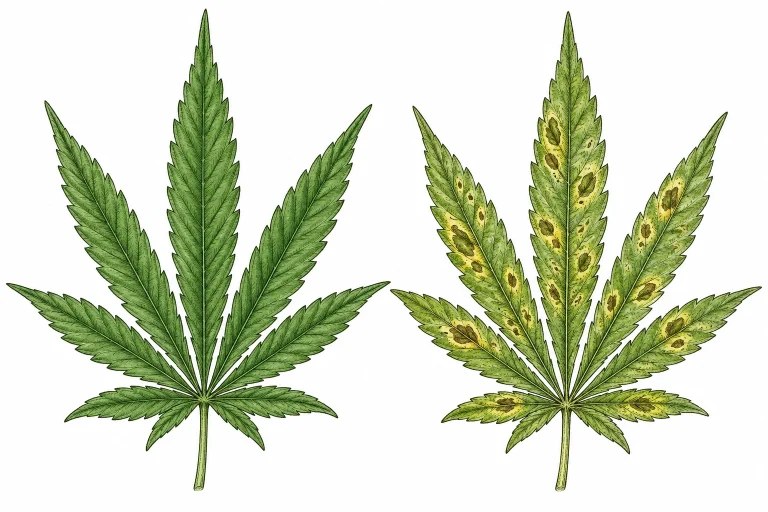
The key symptom of bacterial leaf spot on cannabis is water-soaked, greasy-looking spots that appear almost translucent under direct light. Fungal diseases like septoria leaf spot or alternaria usually cause round, clearly defined spots. Bacterial lesions, on the other hand, are irregular and often bordered by the leaf veins. That’s because bacteria destroy the tissue between the veins but spare the veins themselves at first. This angular, “vein-bound” shape is a strong clue.
As the infection progresses, the spots change from pale green and water-soaked to yellow-brown and finally dark brown or black. In the end, you can get black spots that look a lot like other causes of dark leaves. The border to healthy tissue often shows a typical yellow halo – similar to a nutrient deficiency, which is why bacterial infections are often misread. If you see this pattern and also notice yellow cannabis leaves, take a close look at the shape of the spots.
In damp conditions or in the morning after the dark period, you can sometimes see slimy, shiny ooze on the lesions. This is bacterial slime, and it dries into a whitish crust once things dry out. It’s an almost sure sign of a bacterial infection. At the same time, affected stems often show signs of a vascular infection: when you cut them open, they’re brown inside, and the plant starts to wilt even though it gets enough water.
In early stages, the spots are often only 1/32 to 1/8 in (1–3 mm) across and easy to miss. If the lower or middle leaves get hit first, it can look like a normal deficiency working its way up from the bottom. Bacterial leaf spot only moves to the top of your suspect list once the spots grow fast, look water-soaked and don’t follow a clear progression pattern like deficiency symptoms do.
- Water-soaked, oily-looking, translucent spots in the early stage
- Angular lesions bordered by leaf veins (a classic sign of bacteria)
- A yellow halo around brown-black spots
- Slimy, shiny ooze when it’s humid, a white crust when it’s dry
- Brown discoloration inside the stem with a vascular infection
- Wilting even though you’re watering enough
Main Causes: Why Do Bacteria Attack Your Cannabis Plant?
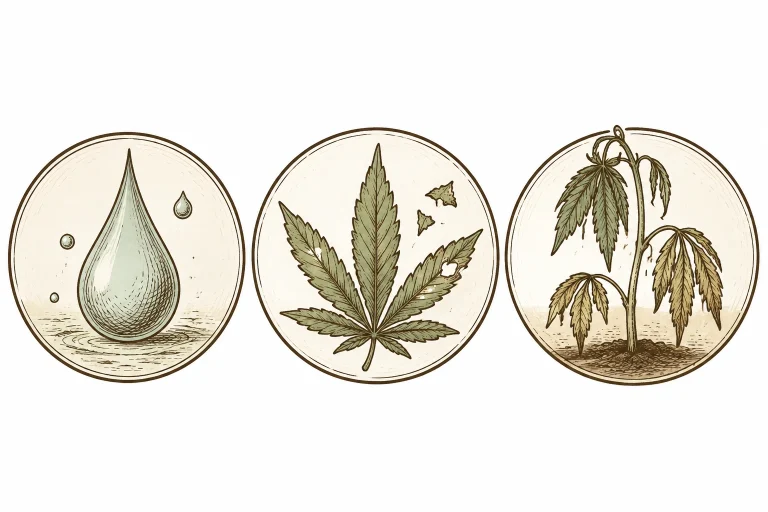
Constantly high humidity is by far the most common cause of bacterial leaf spot in indoor growing. When the relative humidity (RH) in your grow tent sits above 65–70 % and there isn’t enough air movement, bacteria can spread across leaf surfaces shockingly fast. A big one to watch: misting the leaves with a spray bottle, which a lot of beginner tutorials still recommend. Every droplet sitting on a leaf is an open invitation for bacteria.
Wounds and injuries are the second big risk factor. Topping, LST, FIMing and defoliation all leave open cuts. If you don’t keep your tools clean and disinfected, those cuts become a direct entry point for Pseudomonas and friends. Pests like thrips, spider mites and others also leave tiny wounds that bacteria can slip through. So if you’re fighting an active pest problem, your plants automatically carry a higher risk of secondary bacterial infections.
Plants weakened by poor feeding, overwatering or underwatering, and pH swings are much more vulnerable to bacteria. A pH outside the ideal range blocks nutrient uptake, weakens the plant’s defenses and makes it harder to fight off infections. Want to make sure your plant is getting what it needs? Use the article on pH for cannabis as your baseline check.
Contaminated tools, unsterilized soil and infected water from natural sources are other ways bacteria get in, and indoor growers often underestimate them. Bacteria can survive on pruning shears, in leftover growing medium and in reservoirs, especially if you don’t clean them regularly. A single infected clone can contaminate your whole grow tent if you skip basic hygiene.
- Humidity above 65–70 % without enough air circulation
- Wet leaves from foliar spraying or morning watering
- Open wounds from training without disinfecting
- Secondary infection after a pest attack (thrips, mites)
- Plants weakened by pH mistakes or nutrient problems
- Contaminated tools, growing medium or irrigation water
How to Treat Bacterial Leaf Spot on Cannabis: Immediate Steps and Control
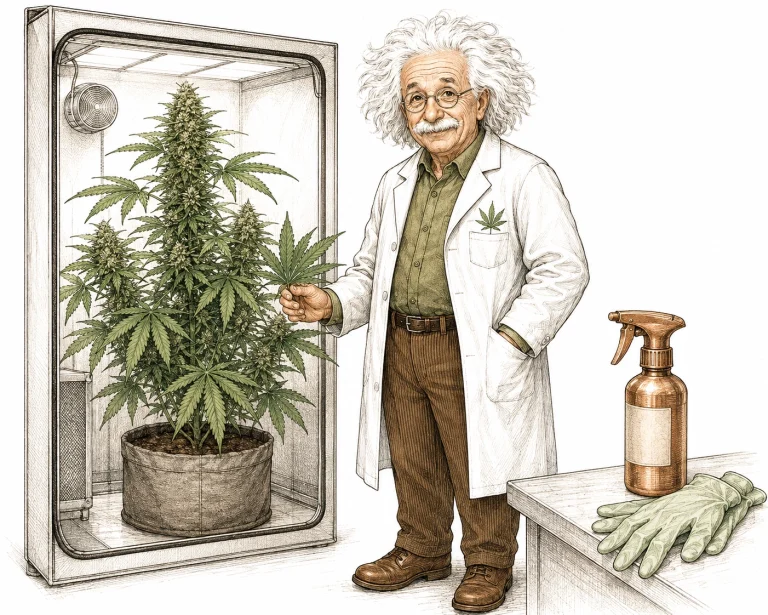
The first and most important step when you confirm or suspect a bacterial infection: isolate the affected plant right away. Move it away from your other plants, boost air circulation with extra fans and drop the humidity below 50 %. Remove all heavily infected leaves with clean, disinfected tools (70 % isopropyl alcohol on blades and scissors) and get the trimmings out of your grow space immediately. Let the cut spots dry and keep the leaves dry at all times.
Copper-based products like copper hydroxide or Bordeaux mixture are considered the most effective organic-friendly option against bacterial leaf spot on cannabis. Copper reliably slows bacterial growth and is easy to find for home gardeners. Always follow the label and check local rules before using it. Important: copper products work by contact on the leaf surface. They don’t penetrate tissue that’s already infected, so they protect healthy tissue but can’t heal damaged areas. That’s why you should apply them early and repeat every 5–7 days.
As an alternative or add-on, products based on Bacillus subtilis or Bacillus amyloliquefaciens work well. These beneficial microbes produce compounds that slow bacterial growth, and you can apply them as a foliar spray or through your irrigation water. They’re especially effective combined with copper, since the two work in different ways. Hydrogen peroxide solutions (3 %) can also serve as a quick first response to cut down the bacterial load on leaf surfaces.
Once bacterial wilt has turned systemic and reached the plant’s vascular tissue, home remedies and biological products usually can’t stop it anymore. If a plant keeps wilting despite treatment, the inside of the stem is brown and several shoots are affected, the plant is often lost. Remove it to protect the plants around it. Then clean your whole grow tent thoroughly with hydrogen peroxide or a diluted vinegar solution.
- Isolate the affected plant right away
- Remove infected leaves with disinfected tools
- Drop humidity below 50 % and boost air circulation
- Apply copper hydroxide or Bordeaux mixture as a contact barrier
- Add Bacillus subtilis as a biological foliar spray
- Use 3 % hydrogen peroxide on the leaf surface as a quick first response
- Systemic wilt: remove the plant and disinfect your grow tent
Preventing Bacterial Leaf Spot on Cannabis: Long-Term Prevention in Your Grow
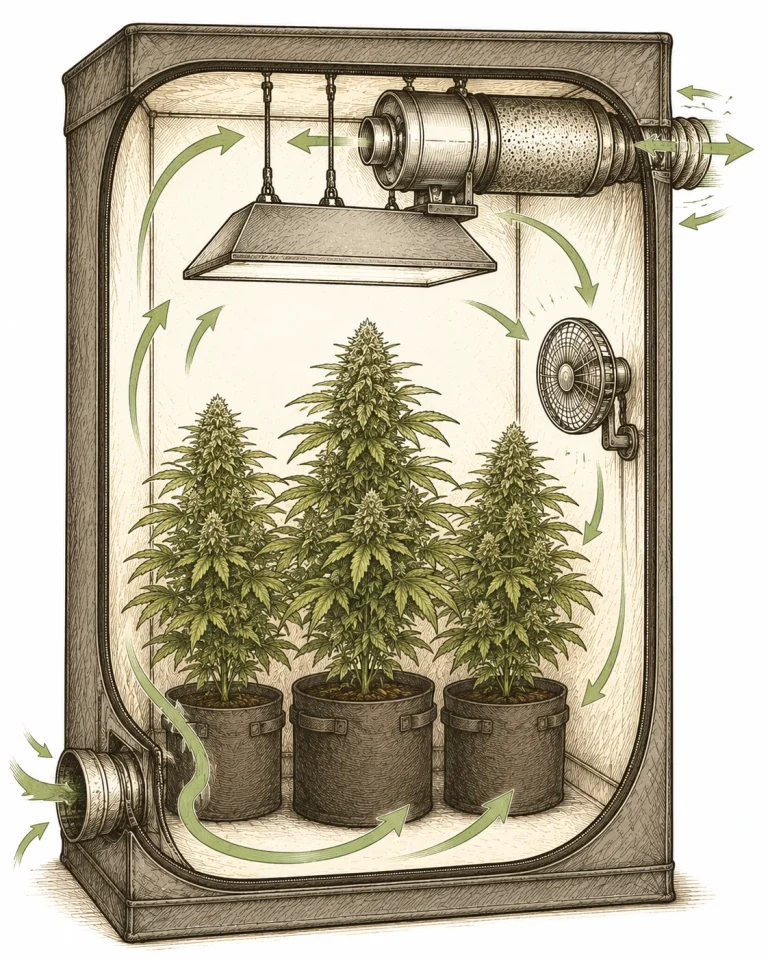
Prevention works far better than any treatment. It all starts with moisture control: keep relative humidity (RH) between 40–70 % in the vegetative stage and between 45–55 % in the flowering stage. Get a reliable hygrometer and make sure you have enough air movement with circulation fans and an exhaust fan. Active ventilation matters most at night, when temps drop and humidity climbs.
Clean habits in your grow aren’t overkill. They’re a must. Disinfect your pruning shears before and after every plant, and clean pots, saucers and the floor of your grow tent regularly. Don’t water over the leaves. Always aim the water straight at the soil – the guide How to Water Cannabis the Right Way walks you through it step by step. Don’t let puddles sit on the tent floor.
Strengthen your plants’ natural defenses with balanced feeding and the right pH. A plant fighting calcium deficiency or other nutrient deficiencies will be more vulnerable to bacteria than a well-fed one. Calcium plays a special role here: it strengthens the plant’s cell walls and improves its physical barrier against invaders. Add Cal-Mag as needed, especially if you use reverse osmosis (RO) water or very soft tap water.
If you use clones, check them carefully for signs of infection before they go into your grow tent. Quarantine new plants for 7–14 days in a separate spot. Pick a sterile, quality-controlled growing medium and skip open garden soil, which can carry a wide range of bacteria and other pathogens. Mother plants and seeds from shady sources can also bring bacteria in with them.
The Bavarian State Institute for Viticulture and Horticulture (LWG) also points out that good hygiene and avoiding waterlogged soil are among the most effective ways to prevent bacterial plant diseases.
- Humidity: keep veg at 40–70 % and flowering at 45–55 %
- Run active ventilation at night to cut moisture risks
- Disinfect tools with isopropyl alcohol before and after use
- Never water over the leaves, only at the root zone
- Check pH and nutrient supply regularly
- Add calcium for stronger cell walls
- Quarantine new clones and plants for 7–14 days
- Use sterile growing media only
Telling It Apart from Other Cannabis Problems: Bacteria vs. Fungi vs. Deficiencies
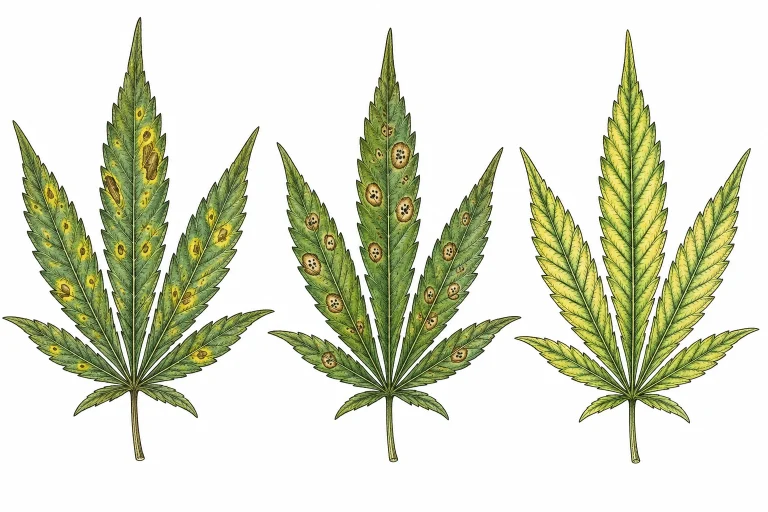
The biggest challenge in diagnosing bacterial leaf spot on cannabis is that it’s easy to mistake for fungal diseases and nutrient deficiencies. Fungal diseases like alternaria or septoria leaf spot cause similar-looking spots, but they differ in key details: fungal spots often show concentric rings, form visible spore masses (dark dots, fuzz) and tend to be rounder. Bacterial spots, on the other hand, are angular, look water-soaked or greasy and never form mycelium or spore clusters.
To tell them apart from nutrient deficiencies, use this rule of thumb: deficiencies develop slowly and evenly, following a pattern set by the plant’s physiology – potassium deficiency starts at the leaf edges, magnesium deficiency between the veins, and so on. Bacterial spots show up suddenly, in random places, grow fast and have that typical water-soaked, translucent edge early on. If you’re not sure which one you’re dealing with, a detailed timeline of how the symptoms developed can help a lot.
How the plant responds to treatment also tells you a lot. If you suspect a nutrient deficiency and feed accordingly, but see no improvement within 3–5 days, or things even get worse, that points to an infection. In that case, check for cannabis nutrient burn as an alternative cause and rule it out before you blame bacteria. If the conditions fit (high humidity, poor airflow, fresh wounds), a bacterial infection is a likely suspect.
- Bacteria: angular, water-soaked spots bounded by leaf veins, with no spore masses
- Fungi: round to irregular spots with mycelium, spore dots or fuzz
- Nutrient deficiencies: slow, even progression that follows a typical pattern on the plant
- Bacterial spots spread fast and don’t respond to feeding
- Ooze (slime or a white crust) is almost always a sign of bacteria
Dry spot edges instead of water-soaked ones point more toward a fungal infection like cladosporium or anthracnose.
Frequently Asked Questions
How can I spot bacterial leaf spot on cannabis at a glance?
The clearest sign is water-soaked, greasy-looking, angular spots bounded by the leaf veins. Early on, they look almost translucent. Later, they turn brown to black with a yellow halo. In humid conditions, you may see slimy ooze. Unlike fungal spots, they show no mycelium or spore masses.
Can bacterial leaf spot on cannabis be cured?
If you catch it early and it’s limited to a few leaves, you can usually stop it with copper sprays, Bacillus subtilis and strict humidity control. Once the infection is systemic, meaning it has reached the stem’s vascular tissue, the plant usually can’t be saved. Remove it to protect your other plants.
What works best against bacterial leaf spot?
Copper hydroxide (for example as Bordeaux mixture) has a proven track record as a contact bactericide, along with biological products based on Bacillus subtilis. You can combine the two. Hydrogen peroxide (3 %) works as a quick first response. Antibiotics aren’t a realistic option for home growers and are hard to get anyway.
Can I still use my harvest if the plant had bacterial leaf spot?
If only a few leaves were affected and the buds look healthy, with no discoloration and no slimy ooze, the harvest is generally usable. If the infection was systemic, with brown stems and wilting buds, you should toss the harvest. Bacterial toxins and damaged tissue can hurt both quality and safety.
Why does bacterial leaf spot show up so often after training?
Topping, LST (low stress training) and defoliation leave open wounds, and those are direct entry points for bacteria. If your tools aren’t disinfected or the humidity stays high after you work on the plant, the risk of infection can rise sharply. Always use sterile tools and cover fresh cuts with colloidal silver or cinnamon.
How do I tell bacterial leaf spot apart from fusarium wilt?
Fusarium is a fungal disease that mainly attacks the roots and the base of the stem, so the plant wilts from the bottom up. Bacterial leaf spot starts on the leaves with its typical water-soaked spots. If you slice the stem open, fusarium shows a reddish-brown discoloration, while bacteria tend to leave a diffuse brown color without a clear red tint.
Bacterial and fungal leaf spots often look alike, so it pays to compare them with septoria leaf spot and Alternaria to pin down the cause.
The Bottom Line
Bacterial leaf spot is a serious threat to your grow, but it’s manageable if you catch it early. The key is a fast diagnosis based on the typical water-soaked, greasy, vein-bordered spots, followed by quick action: isolate the plant, lower the humidity and apply copper sprays. In the long run, your best insurance against bacterial infections is solid prevention: clean work habits, good climate control and strong, well-fed plants. Not sure about your diagnosis? Use the Cannabis Plant Diagnosis Hub to narrow down every possible cause step by step.
