

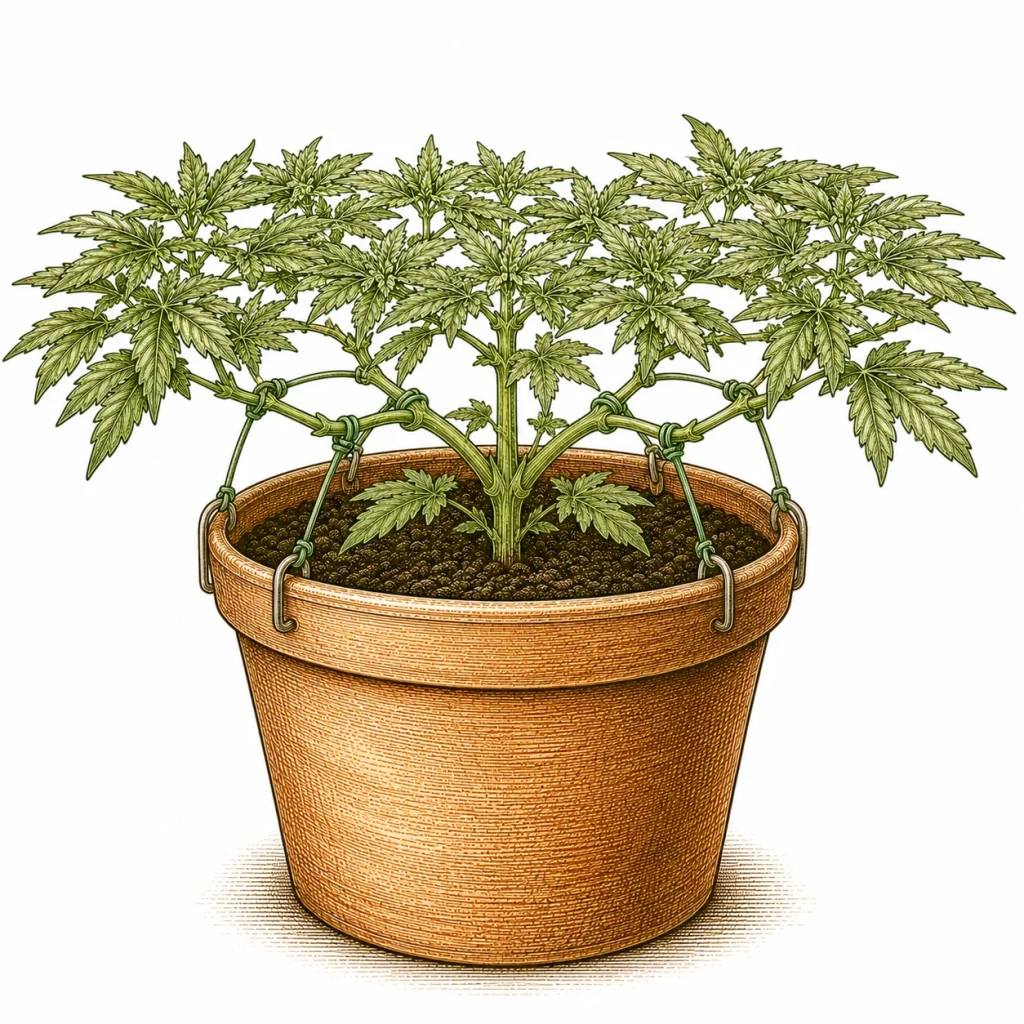
Cannabis LST (low stress training) is one of the most effective and gentlest ways to significantly increase your plants’ yield without cutting them or causing lasting damage. By bending and tying down the branches, you create an even canopy so every bud site gets the best possible light. Cannabis LST is the ideal first training technique for beginners in particular, because the risk of stressing the plant stays minimal — according to the Bavarian State Institute for Viticulture and Horticulture (LWG, German source), plant shoots tolerate gentle bending much better than cuts, and mistakes are easy to correct. In this guide, you’ll learn everything you need for successful low stress training — from the materials you need and the right timing to common mistakes.
What is cannabis LST (low stress training) and why is it worth it?
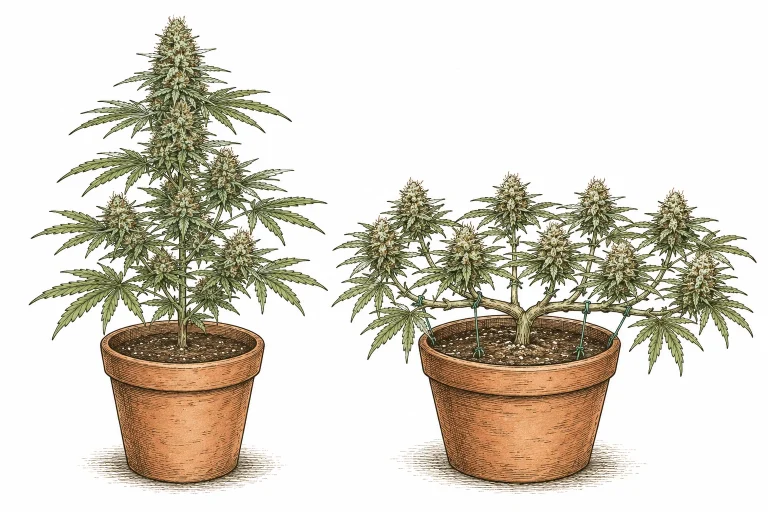
Cannabis naturally grows in a pyramid-like shape: the main stem, also called the main cola, towers over all the side branches. This apical dominance means the hormone auxin favors the main stem, while the lower branches stay in the shade and only produce weak, small buds. The result is a single dominant cola, while the plant’s yield potential is nowhere near fully used.
With cannabis LST, you interrupt this natural growth pattern by gently bending the main stem to the side and tying it to the rim of the pot with hooks or wire. This frees up the side branches, which now get just as much direct light as the former main stem. The plant responds with stronger growth on all shoots and forms a flat, even canopy. The result: instead of one big cola, you get many equally strong bud sites, which increases your total yield considerably.
Another advantage of cannabis LST over high stress techniques like topping or FIMing is recovery time. Since you don’t have to cut through any part of the plant, there are no open wounds and hardly any recovery time. The plant can keep growing in veg without any noticeable pause. That’s why cannabis LST is often the preferred training technique, especially for autoflowering strains, which have no time for long recovery breaks.
- More bud sites thanks to even light distribution
- No cutting, no open wounds, minimal stress
- Ideal for autoflowering strains
- Control over the plant’s height and width
- Can be combined with SCROG, topping and other techniques
- Easy to learn and low risk, even for beginners
What materials do you need for cannabis low stress training?
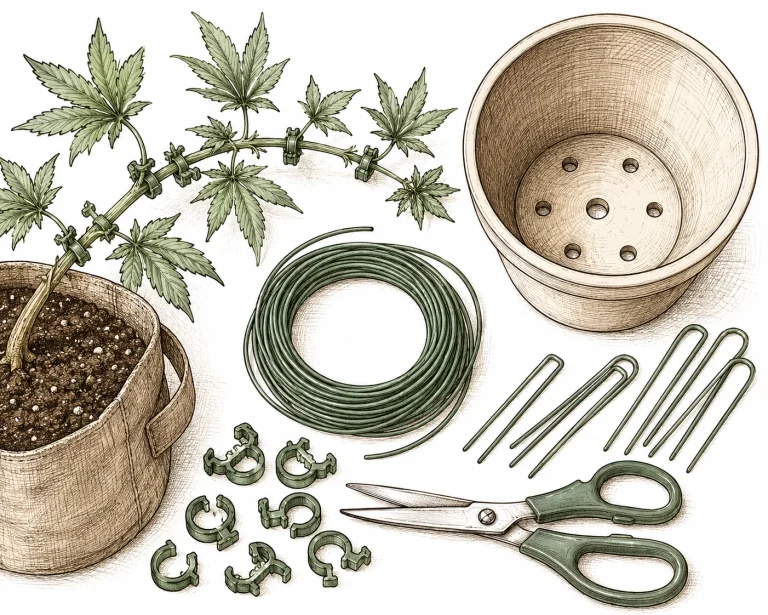
The great thing about cannabis LST is that you don’t need any expensive specialty tools. A few inexpensive materials from a garden center or hardware store are basically all it takes. The most important thing is soft ties that won’t cut into the branches. Hard wire or string without a protective coating can damage the outer layer of the stems and cause unwanted injuries.
Proven options are coated garden wire, plastic plant clips (German) or soft hook-and-loop plant ties. Some growers also use fishing line or twine, as long as it’s soft enough. You need anchor points on the rim of the pot: if you drill evenly spaced holes around the rim, you can hook the ties right there without putting the plant at risk. Alternatively, you can buy special LST pots with built-in eyelets.
Scissors or a scalpel for occasional corrections also come in handy, plus a ruler or a good eye to keep the canopy in check. So to get started with cannabis LST, a basic kit that costs very little is all you need. If you want to upgrade later and use a SCROG screen, cannabis LST is the perfect first step to shape the plant early on.
- Soft coated garden wire or plant clips
- Hook-and-loop ties or soft twine
- Pot with holes or eyelets around the rim
- Optional: scissors for small corrections
- Fishing line as a cheap alternative
- Special LST pots with built-in eyelets
The right timing: when should you start LST?
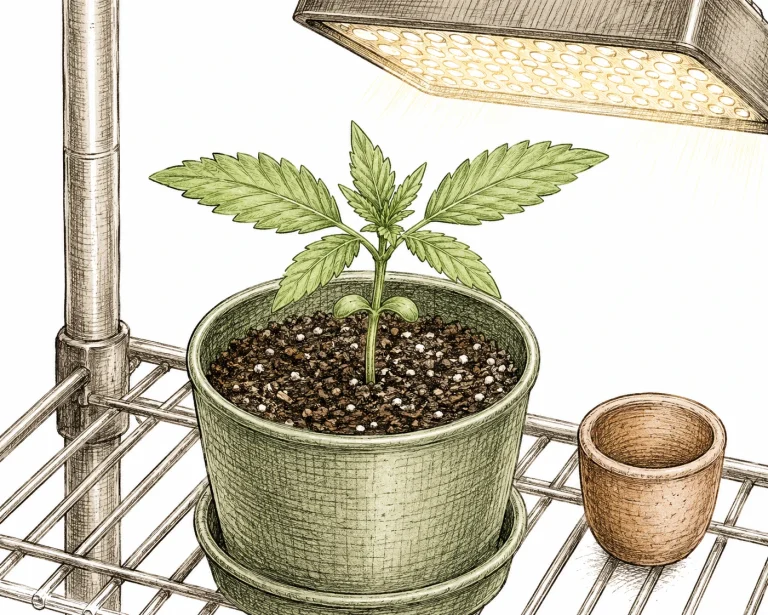
Timing is crucial with cannabis LST. Start too early, and the shoots are so thin and fragile that they snap easily when you bend them. Start too late, and the stems have already turned woody and can hardly be bent without cracking. The ideal window opens once the plant has developed three to five nodes and the main stem is about 4–6 in (10–15 cm) long. That’s usually the case in the second to third week of veg.
With photoperiod strains, you have the entire vegetative stage to do LST and fine-tune it. Over several weeks, you can keep tying down new shoots and optimizing the canopy. With autoflowering strains, the window is tighter because the plant automatically switches to flowering after just a few weeks. Here, you should start LST in the second week of veg at the latest and work quickly.
An important note: never start LST right after transplanting or any other stressful step. Give the plant two to three days to recover before you start training. Also make sure the plant is healthy and vigorous. If a plant is already showing deficiency symptoms or its pH is off, you should stabilize it first before you train it.
- Ideal start: three to five nodes
- The main stem should be 4–6 in (10–15 cm) long
- Autos: start in the second week of veg at the latest
- Not right after transplanting or other stressful steps
- Only use on healthy, vigorous plants
- Photoperiod strains give you more leeway
Cannabis LST step by step: how to do it right

Step 1 – Preparation: Make sure your plant is well watered. A dry growing medium makes the shoots more brittle and increases the risk of breakage. Also check whether the pot already has holes around the rim, or drill five to eight evenly spaced holes around the top edge of the pot. That gives you enough anchor points for different shoots.
Step 2 – Bend the main stem: Gently grab the main stem below the growing tip and bend it slowly and evenly to one side. Never bend it with a jerk; use constant, gentle pressure. The stem should end up at an angle of about 90 degrees to its original growth direction. Secure it with a hook or wire to the nearest hole in the rim of the pot and make sure it doesn’t kink.
Step 3 – Free up the side branches: Once the main stem is tied down, the side branches will reach upward and try to fill the gap. Watch the plant closely over the next few days. As soon as a side branch reaches or exceeds the height of the main stem, bend it to the side and tie it down as well. The goal is to create an even, flat canopy where all the shoot tips are at the same height.
Step 4 – Regular checks: LST isn’t a one-time job but an ongoing process. Check your plant every day and adjust the ties as needed. If one shoot grows faster than the others, bend it a little further outward. Loose ties can come undone and should be replaced right away. Over time, you’ll learn to predict which way your plant will grow and can step in exactly where needed.
Transition to flowering: When you switch to 12/12 light (with photoperiod strains), the plant will go through one last growth spurt, the so-called flower stretch. During this phase, you may need to step in again and tie down new shoots. After two to three weeks of flowering, the shoots have usually hardened enough that you can gradually remove the LST ties, because the plant keeps its shape.
- Water the plant well before LST
- Bend shoots slowly and evenly, never with a jerk
- Tie down to the rim of the pot with soft materials
- Keep all shoot tips at the same height
- Check daily and adjust the ties
- Step in again during the flower stretch
Cannabis LST (low stress training) for autoflowering strains
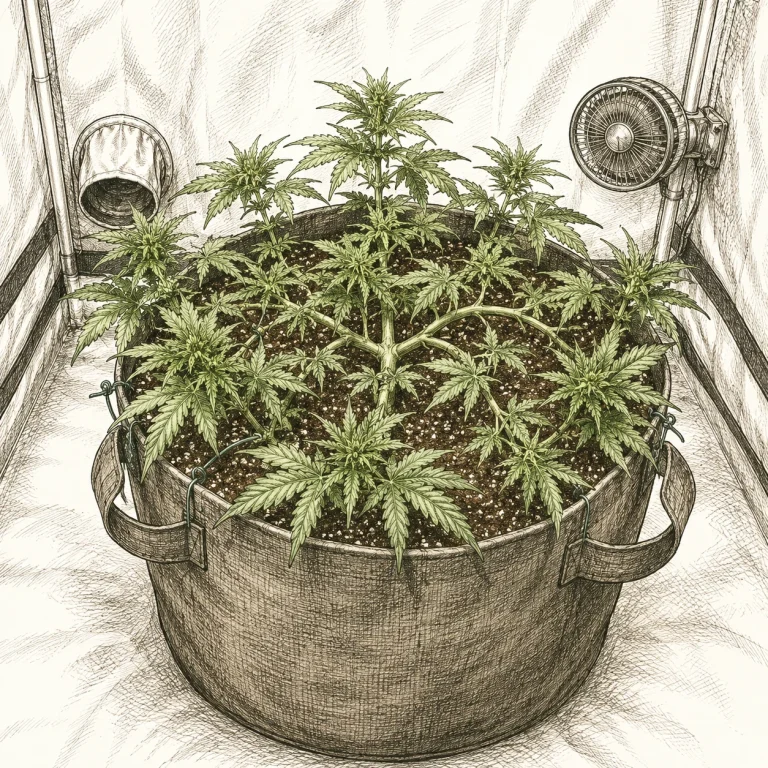
Autoflowering strains make special demands when it comes to cannabis LST, because they switch to flowering after a genetically fixed time, regardless of the light cycle. The window for training is usually only three to five weeks. Every day of delay caused by stress can directly affect yield, which is why gentle LST is clearly preferred here over invasive high stress techniques.
With autoflowering plants, start even earlier than with photoperiod strains, as soon as the third node is visible. Gently bend the main stem to the side and tie it down. Work in small steps and never bend too aggressively, since autos have less time to recover. Some experienced growers start lightly bending autoflowering strains as early as week two after germination.
An important trick with autos: use the final pot from the start to avoid transplanting, which costs valuable time. Pots of at least 3–4 gal (11–15 L) are recommended for good autos. Also pay special attention to balanced watering, because too much moisture or the wrong amount of nutrients can quickly stress autoflowering plants. Knowing how to water cannabis properly and maintain the right moisture level is just as important as the training itself.
- Training window for autos: only three to five weeks
- Starting from the third node is recommended
- Never bend aggressively; use small, gentle steps
- Grow in the final pot from the start
- At least 3–4 gal (11–15 L) pot size for autoflowering strains
- Pay special attention to consistent watering
Combining LST: low stress training with other techniques
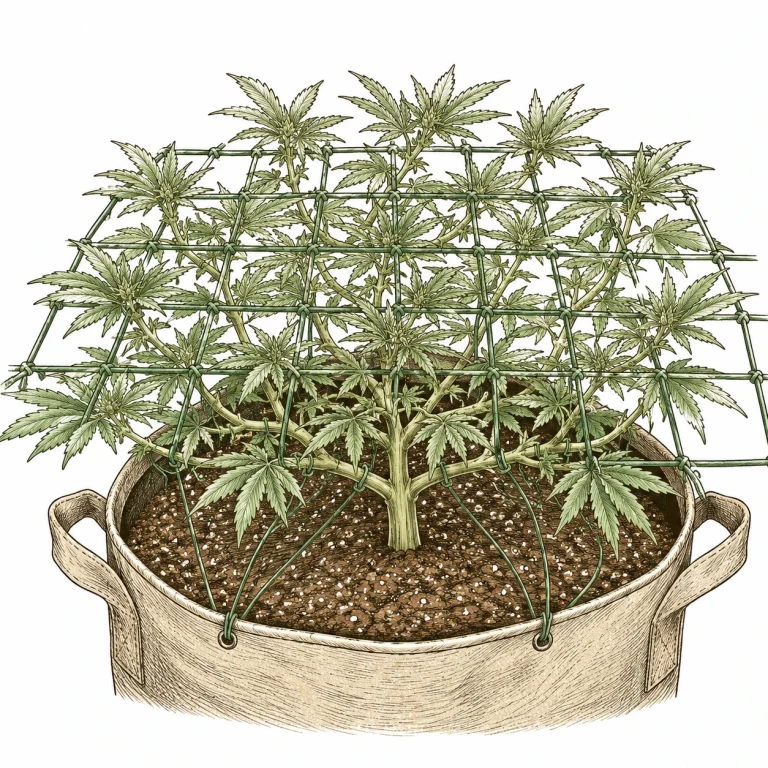
Cannabis LST reaches its full potential when you combine it with complementary techniques. The most common and most effective combination is LST with a SCROG (screen of green) net. You first train the plant with LST and keep it flat, while the screen later takes over spreading out the shoots evenly and serves as extra support for heavy buds. This combination significantly maximizes light use. You’ll find everything about the SCROG method in our article Cannabis SCROG: Screen of Green for Maximum Yield.
Another popular combination is LST together with topping. With topping, you remove the growing tip once, which creates two equal main colas. You then spread these apart with LST and tie them down, which widens the canopy even further. The key is to give the plant enough time to recover after topping before you start LST. Three to five days are usually enough.
LST also combines well with cannabis lollipopping — while LST optimizes the top of the canopy, lollipopping removes the weak lower shoots and leaves that will never get enough light. This channels all of the plant’s energy into the top bud sites. This triple combination of LST, topping and lollipopping is especially popular with advanced indoor growers.
- LST + SCROG: maximum light use and support for buds
- LST + topping: more main colas through a targeted cut
- LST + lollipopping: energy focused on the top bud sites
- Always plan recovery time after high stress techniques
- Combinations also work for beginners once they’ve succeeded with LST
- Document every technique so you learn from each grow
Common cannabis LST mistakes and how to avoid them
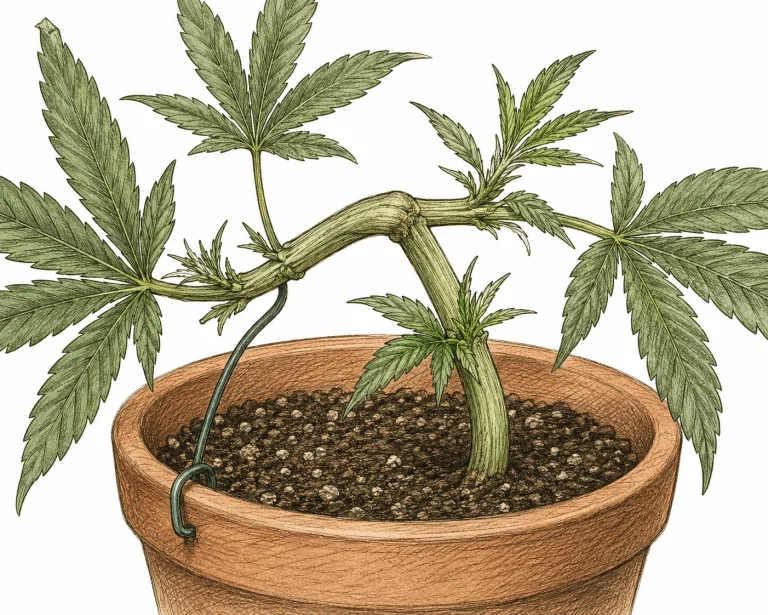
The most common mistake with cannabis LST is bending too aggressively. Many beginners try to force the shoot into the desired position all at once, which can cause micro-cracks or even kink the stem. Instead, spread the bending over several days: on day one, bend it 20 to 30 degrees, on day two a little further, until you reach the position you want. A dry growing medium increases the risk of breakage — so always water the plant shortly before an LST session.
Another common mistake is neglecting the plant after training. Many growers bend once and then forget about regular checks. But LST is a dynamic process: the plant keeps growing, ties can loosen, and new shoots need constant adjusting. Plan five to ten minutes a day to check your plant and make adjustments.
Choosing the wrong material is also a critical mistake. Hard, uncoated metal wire can cut through the soft shoots like a knife as the plant grows. Only use soft, flexible material. Also check that your ties aren’t too tight — there should always be some room for the stems to thicken. If you notice a tie cutting in, remove it right away and replace it with a looser one.
Sometimes symptoms like yellow leaves or stunted growth show up after LST that have nothing to do with the training but with care mistakes. In that case, first check the pH of your water and growing medium, because the wrong pH can block nutrient uptake. Cannabis nutrient burn can also cause similar symptoms. So carefully distinguish between stress from training and stress from care mistakes.
- Never bend too aggressively all at once
- Spread the bending over several days
- Don’t forget daily checks and adjustments
- Only use soft, coated material
- Don’t tie too tightly
- Don’t blame care mistakes on the training
LST in outdoor growing: what’s different and tips
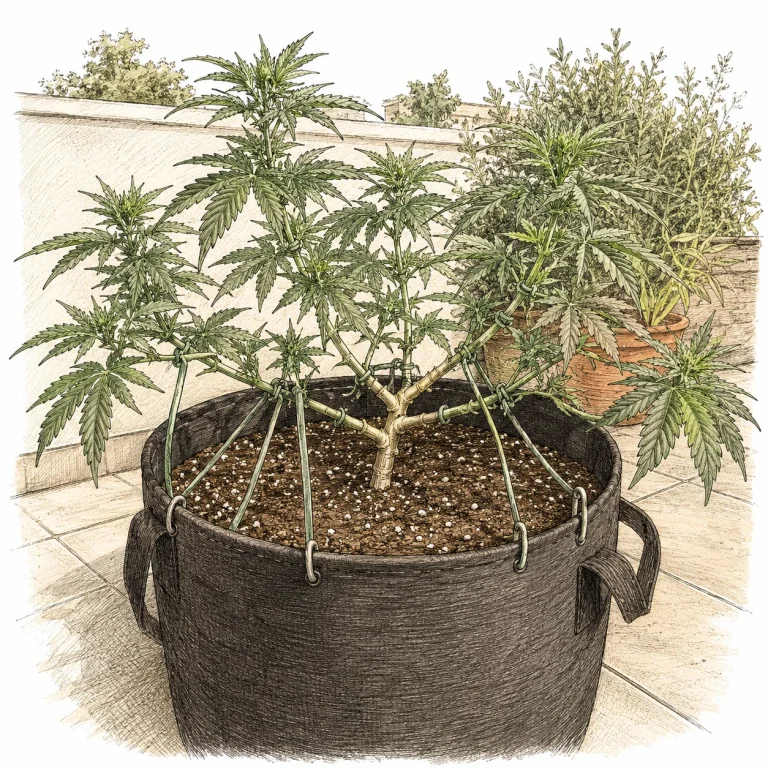
Cannabis LST doesn’t just work indoors — it’s also an excellent method in outdoor growing for getting big, lush plants. Outdoors, plants benefit from natural sunlight that hits them from all sides, so the focus of outdoor LST is a little different: it’s less about maximum light use and more about controlling plant height and encouraging a bushy structure.
Especially with outdoor plants, which can get very large over the summer, LST helps keep the plant below a critical visibility height. By repeatedly bending the main stem and all strong side branches to the side, the plant stays flat and wide instead of tall and conspicuous. This not only protects your privacy but also makes the plant more resistant to strong wind and rain.
In outdoor growing, you should choose sturdier ties, because wind can loosen them. Use stronger wire or stakes driven deep into the ground. Check the ties after every storm or strong wind and replace them if needed. Also keep in mind that outdoor plants usually develop thicker stems, which makes bending harder beyond a certain age — so start as early as possible outdoors too.
- Outdoor LST focuses more on plant height than on light
- Keep the plant bushy and low for more discretion
- Choose sturdier ties for windy locations
- Check the ties after storms and rain
- Start early, since outdoor stems turn woody quickly
- A flat growth shape improves wind resistance
LST combines well with other techniques: for clones, you can also use monster cropping, and for a symmetrical canopy structure, try mainlining.
Combined with dense planting, LST is also a great fit for a sea of green-style grow.
Frequently asked questions
When can I start cannabis LST?
The best time to start cannabis LST (low stress training) is when the plant has developed three to five nodes and the main stem is about 4–6 in (10–15 cm) long. That’s usually in the second to third week of the vegetative stage. With autoflowering strains, you should start as early as possible because the window is much shorter.
Can I use LST on autoflowering strains?
Yes. Cannabis LST is actually especially well suited to autoflowering strains because it doesn’t require any invasive cuts and doesn’t send the plant into a long recovery period. With autos, start early, from the third node, and work in small, gentle steps to make the most of the short vegetative period.
How often do I need to check and adjust LST?
LST isn’t a one-time job but an ongoing process. Ideally, check your plant every day and adjust ties and bends as needed. New shoots grow quickly and need to be tied down regularly. Plan on about five to ten minutes a day for LST maintenance, especially during active vegetative growth.
What’s the best material for LST?
The best options are soft, coated garden wire, plastic plant clips or hook-and-loop plant ties. These materials are soft enough not to strangle the stems, yet sturdy enough to hold the bend over time. Avoid hard, uncoated metal wire, which can cut into the outer layer of the stem and damage the plant.
What’s the difference between LST and topping?
LST (low stress training) is a low-stress technique where you bend and tie down branches without cutting the plant. Topping, on the other hand, is a high stress training (HST) technique where you deliberately cut off the growing tip to create two equal main colas. Both techniques promote bushy growth and more bud sites, but LST is lower risk and especially well suited to beginners and autoflowering strains.
When can I remove the LST ties?
You can usually remove the LST ties two to three weeks after the start of the flowering stage. By then, the stems have hardened enough to hold their shape without support. Remove the ties gradually and watch whether the plant holds its position before you release all of them at once.
Can I combine LST with other techniques?
Yes, cannabis LST combines very well with other techniques. The most popular combinations are LST + SCROG, LST + topping and LST + lollipopping. Each combination has its own advantages and boosts yield in a different way. If you’re a beginner, master LST on its own first before adding other techniques.
Conclusion
Cannabis LST (low stress training) is the ideal starter technique for anyone who wants to maximize their yield without exposing their plant to the risk of invasive cuts. With inexpensive materials, a little patience and daily attention, you can turn a pyramid-shaped plant into a wide, even canopy with lots of strong bud sites. Whether you’re a beginner or an experienced grower, growing indoors or outdoors, with photoperiod or autoflowering strains — LST is easy to adapt and combines well with other techniques. Start early, work gently and keep an eye on your plant every day, and cannabis LST will help you get a lot more out of your grow.
