

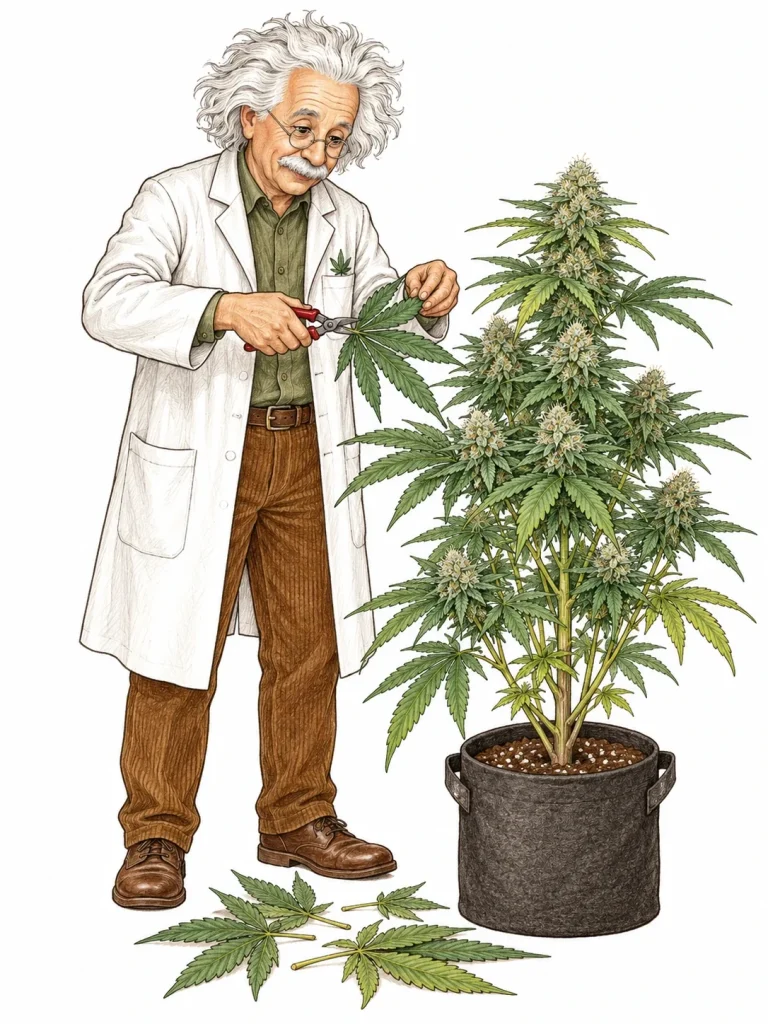
Removing leaves through cannabis defoliation – also known among growers as stripping or de-leafing – sounds counterintuitive at first: why would you deliberately take leaf mass away from a healthy plant? The answer lies in targeted light distribution and redirecting energy: if you strategically remove excess fan leaves, you send more light to the bud sites and improve airflow in the canopy. Vineyards also treat targeted leaf removal as a key step toward healthy, well-lit fruit, but “in moderation”, as the vine protection service of the Bavarian State Institute for Viticulture and Horticulture (LWG, in German) points out. Used correctly, cannabis defoliation is one of the most effective high-yield techniques in indoor growing. In this article, you’ll learn when, how and on which plants the technique makes sense – and which mistakes you should definitely avoid.
What is cannabis defoliation and how does it work?
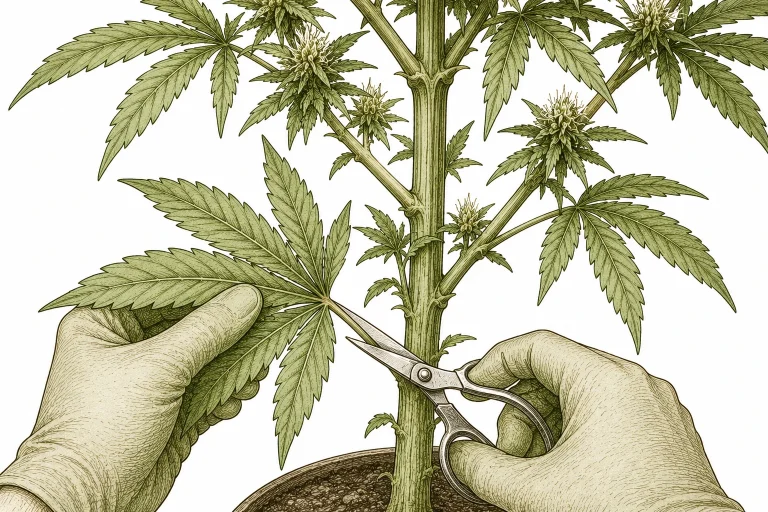
Cannabis defoliation is the targeted, manual removal of leaves from the cannabis plant. Unlike natural leaf loss from aging or disease, you intervene on purpose here to force the plant to use light and resources more efficiently. The technique belongs to the high stress training methods (HST), because it is a direct mechanical intervention in the plant’s structure.
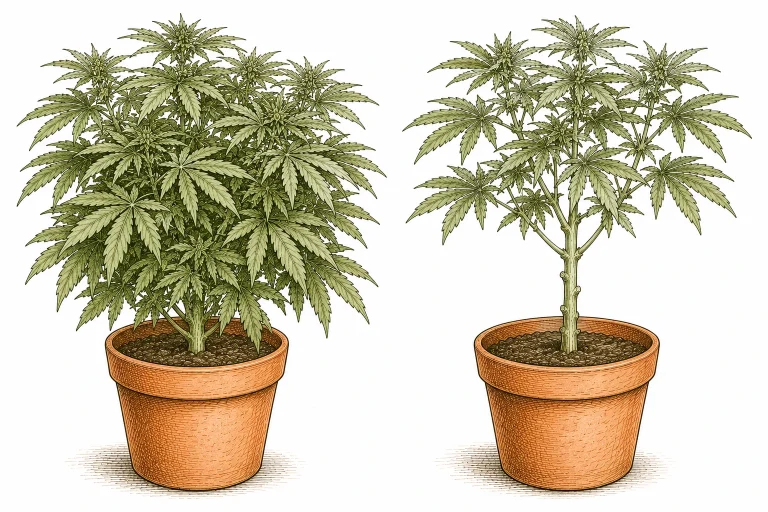
The basic principle is simple: large fan leaves – the characteristic hand-shaped cannabis leaves – act as the plant’s energy factories. They carry out photosynthesis and supply carbohydrates. At the same time, though, they can also block light from other parts of the plant. By strategically removing selected leaves, you give the bud sites and side shoots underneath free access to light and air circulation. The plant responds by channeling its energy directly into bud development.
It’s important to distinguish cannabis defoliation from lollipopping . With lollipopping , you specifically remove the lowest, poorly lit shoots of the plant to create a clear stem. With cannabis defoliation, on the other hand, leaves are selectively thinned out throughout the entire canopy, regardless of their height. The two techniques can be combined, though, and complement each other very well in advanced indoor growing.
Cannabis defoliation also shouldn’t be confused with natural senescence, in which older or damaged leaves die off on their own. If you notice that your leaves are showing unusual discoloration or dying off without you actively intervening, it could be a nutrient deficiency or another problem that should be diagnosed first.
- Cannabis defoliation = targeted removal of fan leaves to maximize yield
- Belongs to the high stress training (HST) category
- Goal: more light for bud sites and better air circulation
- Difference from lollipopping: leaves are removed throughout the whole canopy, not just at the bottom
- Can be combined with other techniques like SCROG or LST
Cannabis defoliation: the right time to remove leaves
With cannabis defoliation, timing decides whether the measure succeeds or fails. Done too early, you harm the plant more than you help it, because seedlings and very young plants urgently need their leaf mass for photosynthesis. Too late in flowering, aggressive cannabis defoliation can put the plant under considerable stress and even reduce the yield.
The first recommended time is in the late vegetative stage, typically once the plant has developed 4 to 6 nodes and is well established. At this point, the plant is robust enough to handle the stress and still has enough time to recover before flowering starts. Moderate cannabis defoliation here lays the foundation for even light exposure at all growth points.
The second classic time to defoliate is the first week of flowering, right after switching to the 12/12 light cycle. In the first two weeks of flowering – often called the “stretch” – the plant is still growing vigorously in height and forming new bud sites. Targeted defoliation at the start of this stretch can massively improve light penetration and make sure more bud sites benefit from the energy. Many experienced growers combine this method with the Cannabis Growing Techniques: LST, Topping, SCROG & More overview for a complete training program.
A third possible time is the third week of flowering. At this point, however, defoliation should be much more restrained. Only a few leaves that are really in the way should be removed. From the fourth to fifth week of flowering on, defoliation is generally not recommended, because the plant is focusing all its energy on ripening the buds and an intervention now would do more harm than good. Autoflowering strains are especially sensitive because of their short life span and need a particularly careful approach.
- First defoliation: late vegetative stage, from 4–6 nodes
- Second defoliation: first to second week of flowering, during the stretch
- Third defoliation: third week of flowering – only minimal and selective
- From the fourth week of flowering: no more defoliation recommended
- Autoflowers: only very careful, minimal defoliation
Step by step: how to defoliate correctly
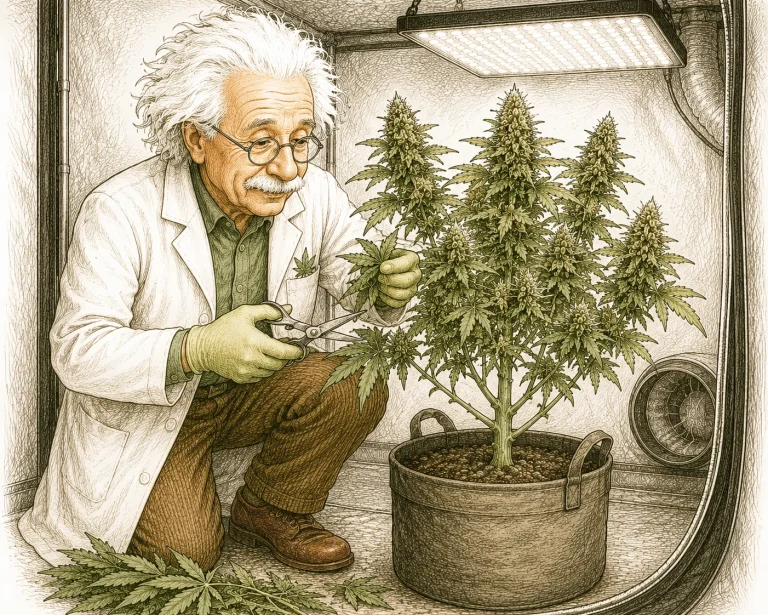
Before you start defoliating, preparation and tools are key. Only use sterile, sharp scissors or scalpels. Dull tools crush the tissue, which encourages infections. Clean your tools with 70% isopropyl alcohol and ideally wear clean gloves. The plant should be well watered and well fed – a weakened plant handles the stress much worse. Also check the pH and nutrient supply before you start.
Start by taking a thorough look at the plant. Identify the fan leaves that block light from other parts of the plant. Large leaves sitting directly above bud sites and completely shading them are especially relevant. Leaves pressing against other leaves and blocking air circulation are good candidates too. Leaves that are still well lit and don’t shade other parts, on the other hand, should be left alone.
Remove the leaves you’ve identified with a clean cut right at the leaf stem (petiole), as close to the main stem or side shoot as possible. Don’t leave a long petiole stub, because it can rot. Never remove more than 20 to 30 percent of the total leaf mass per session. Too aggressive an intervention puts the plant under extreme stress and can lead to stalled growth, hermaphroditism or a significantly reduced yield. After defoliating, provide optimal conditions: good ventilation and the right temperature and humidity.
In the first 24 to 48 hours after defoliation, the plant may droop a bit or let its remaining leaves hang. That’s a normal stress reaction. Give the plant time to recover and avoid any other interventions during this period. Watch the plant closely: if it hasn’t recovered after two to three days or shows signs of disease, rethink your technique and make sure all other growing conditions are right.
- Use sterile, sharp tools – clean scissors or scalpel with isopropyl alcohol
- Only remove shading fan leaves, leave well-lit leaves in place
- Remove no more than 20–30% of the leaf mass per session
- Cut right at the petiole – don’t leave a long stub
- After defoliation: plan 48 hours of recovery time
- Provide optimal environmental conditions after the intervention
Cannabis defoliation: benefits and risks at a glance
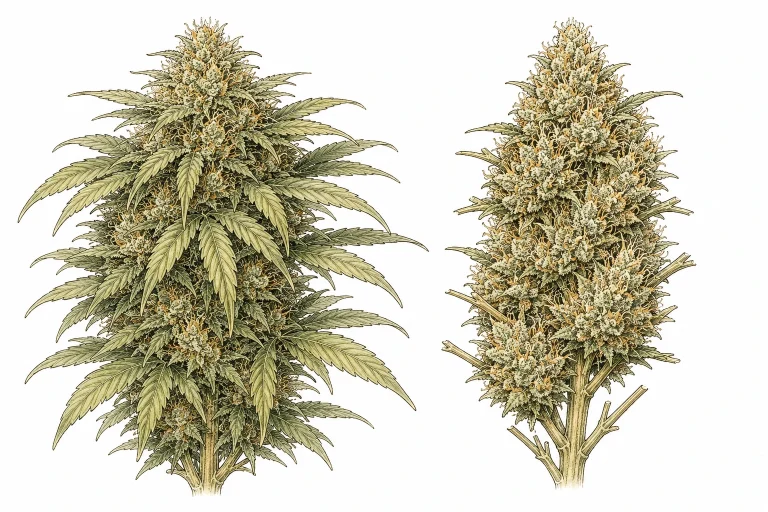
When done right, removing leaves through cannabis defoliation offers considerable benefits. The most obvious one is better light penetration: when fan leaves no longer shade the bud sites underneath, those sites can absorb more light and grow into full, dense colas. Studies and reports from the indoor grow community show that skillfully done defoliation can increase the total yield by 10 to 30 percent, depending on the strain and growing conditions.
Another important benefit is better air circulation inside the plant structure. Dense leaf mass creates warm, humid microclimates in which mold and fungal diseases like bud rot (botrytis, gray mold) thrive. Thinning out the leaves lets air move through the plant better, which reduces humidity and significantly lowers the risk of fungal infection. Especially in late flowering, when the buds are dense and vulnerable, this is a decisive safety factor.
The risks of defoliation shouldn’t be underestimated, though. The biggest mistake is over-defoliation – removing too many leaves at once. Leaves are the plant’s energy factories; without enough leaf mass, the plant can’t carry out enough photosynthesis and becomes significantly weaker. This can lead to slower growth, yield losses and, in extreme cases, even to hermaphroditism. Working without sterile tools is another common mistake – open cuts are entry points for bacteria and fungi. If you notice your plant developing nutrient problems after defoliation, you could be dealing with nutrient burn due to the plant’s changed uptake capacity.
In general, defoliation is better suited to indica-dominant strains and hybrids with a dense leaf structure than to sativa-dominant plants, which naturally grow more open. Autoflowering strains are especially sensitive to HST methods because of their genetically fixed, short life span. With them, defoliation – if at all – should be limited to the absolute minimum and only done in the vegetative stage. For beginners, a gradual approach is generally recommended: start by removing just a few leaves that are really in the way and watch the plant’s reaction closely.
- Benefits: 10–30% more yield possible thanks to better light penetration
- Benefits: better air circulation reduces the risk of mold
- Benefits: more energy for bud development instead of maintaining leaves
- Risks: over-defoliation weakens the plant considerably
- Risks: risk of infection from working with unsterile tools
- Risks: autoflowers and sativas are more sensitive than indicas
- Beginners: remove less and watch the reaction
Combining defoliation with other training techniques
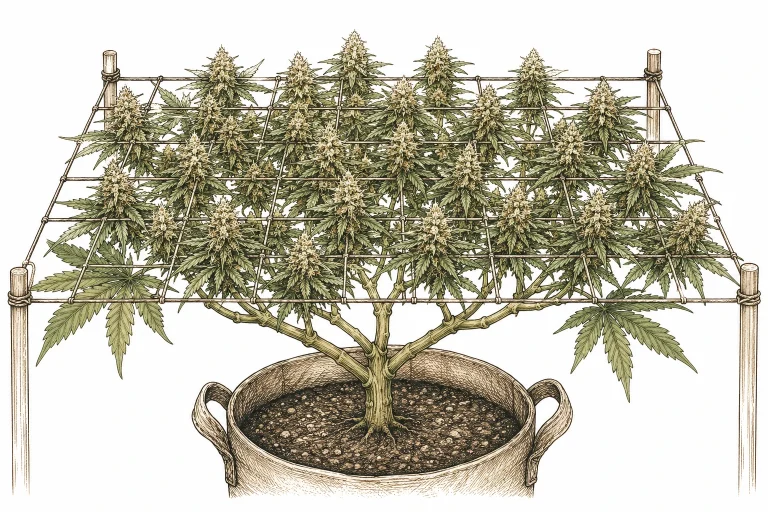
Cannabis defoliation reaches its full potential when it’s part of a comprehensive training plan. A particularly effective combination is defoliation with SCROG (screen of green). With SCROG, the shoots are guided through a horizontal net to create an even, flat bud zone. Targeted defoliation then removes the leaves below the net, while the bud sites above the net get optimal light. This combination maximizes both light use and usable yield per square foot.
Defoliation also pairs very well with LST (low stress training) too. With LST, branches are bent and tied down to make the canopy flat and wide. Defoliation afterward then exposes the areas created by bending. While LST itself is a low-stress method, combining it with defoliation means moderately more stress – the plant should always be able to recover fully between the individual steps.
If you’ve shaped your plant into a bushy form with many main colas through topping or FIMing, defoliation makes particular sense. A heavily branched plant inevitably develops a dense inner leaf structure in which the lower bud sites get hardly any light. Regular, moderate defoliation keeps this inner zone open and makes sure all the main colas you’ve developed can grow equally well.
Always plan your defoliation sessions in line with your feeding schedule. A freshly defoliated plant needs all available resources for regeneration. Make sure the pH is right, watering is optimal and the nutrient supply is balanced. If you see signs of calcium deficiency or other nutrient problems, fix them first before you start defoliating – a stressed plant handles additional stress very poorly.
- SCROG + defoliation: remove leaves below the net for maximum light use
- LST + defoliation: bend and tie down first, then thin out the exposed zones
- Topping/FIMing + defoliation: keep dense inner zones open for even cola development
- Always allow the plant to recover fully between steps
- Make sure nutrient supply and pH are right before defoliating
Defoliation is often combined with other techniques like monster cropping or FIM. Targeted leaf removal also helps after revegetation to bring the plant back into vegetative growth.
Stripping too aggressively can put extra strain on the plant – you can read how to recognize and avoid real training stress in our separate article.
Frequently asked questions
How many leaves can I remove at once when defoliating?
As a rule of thumb: never remove more than 20 to 30 percent of the total leaf mass in a single session. On a mature plant, that often means 5 to 15 leaves, depending on size and strain. It’s better to be a bit more cautious and reassess after 3 to 5 days whether more leaves should come off.
Can I defoliate autoflowering strains?
Autoflowering strains are more sensitive to stress than photoperiod strains, because their life span is genetically fixed and they have less time to recover. If you do defoliate autoflowers, limit yourself to a few leaves that are really in the way and only do it in the vegetative stage. Aggressive defoliation on autos is strongly discouraged.
When is the best time to defoliate during the flowering stage?
The best time in the flowering stage is the first to second week of flowering, during the so-called stretch. In this phase, the plant is still actively growing and can handle the stress well. From the third week of flowering on, only intervene minimally, and from the fourth week on not at all – the plant now needs all its energy for ripening the buds.
What happens if I remove too many leaves at once?
Over-defoliation causes considerable stress. The plant can no longer carry out enough photosynthesis, which can lead to slower growth, lower yield and, in extreme cases, hermaphroditism. The plant can also become more susceptible to pests and diseases. If you’ve removed too much, give the plant optimal conditions and plenty of recovery time.
Should I defoliate during the day or just before the dark period?
Ideally, defoliate shortly before the dark period begins. That gives the plant the entire dark period to seal the cuts and start regenerating before the next light period starts. Avoid defoliating right after the lights come on, because the plant is already actively photosynthesizing then.
Does defoliation make sense for outdoor growing too?
Yes, defoliation can also be used in outdoor growing, but it’s less common. Outdoors, plants benefit from diffuse light coming from different angles, so shading is less critical than in indoor growing with a single light source. In outdoor growing, defoliation mainly makes sense to improve air circulation in very bushy plants and lower the risk of mold.
Is “stripping” cannabis the same as defoliation?
Yes – “stripping” or “de-leafing” is simply growers’ slang for the technical term “defoliation.” Both mean the same thing: the targeted, manual removal of individual fan leaves so that lower bud sites get more light and air circulation. Whether you search for “stripping cannabis in flower” or “cannabis defoliation” – the timing and method in this article apply to both terms equally.
Conclusion
Removing leaves through cannabis defoliation is a powerful technique that, used correctly, can significantly increase your yield and improve the quality of your harvest. The key is the right dose – take less at once and watch the plant closely. With the right timing, sterile tools and a well-fed plant as your starting point, you’ll quickly see positive results. Combine defoliation with other training techniques like SCROG or LST for a complete optimization plan.
