

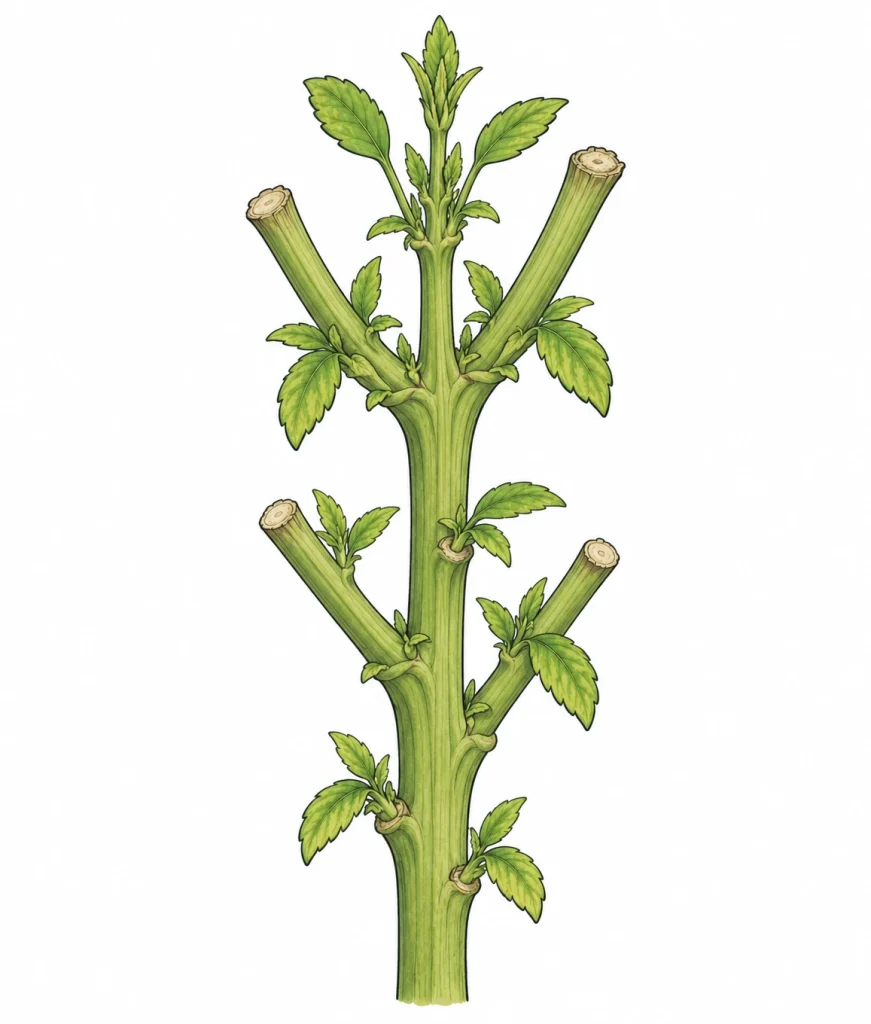
Cannabis revegetation, or reveg for short, is the process of pushing a cannabis plant back from the flowering stage into the vegetative stage on purpose. That might sound unusual at first. Most growers harvest their plant and then start over with fresh seeds or clones. But reveg opens up some interesting options: you can use a genetically valuable phenotype again and again without the hassle of taking clones. In this article, you’ll learn how cannabis revegetation works, when it makes sense and what you really need to watch out for.
What Exactly Is Cannabis Revegetation (Reveg)?
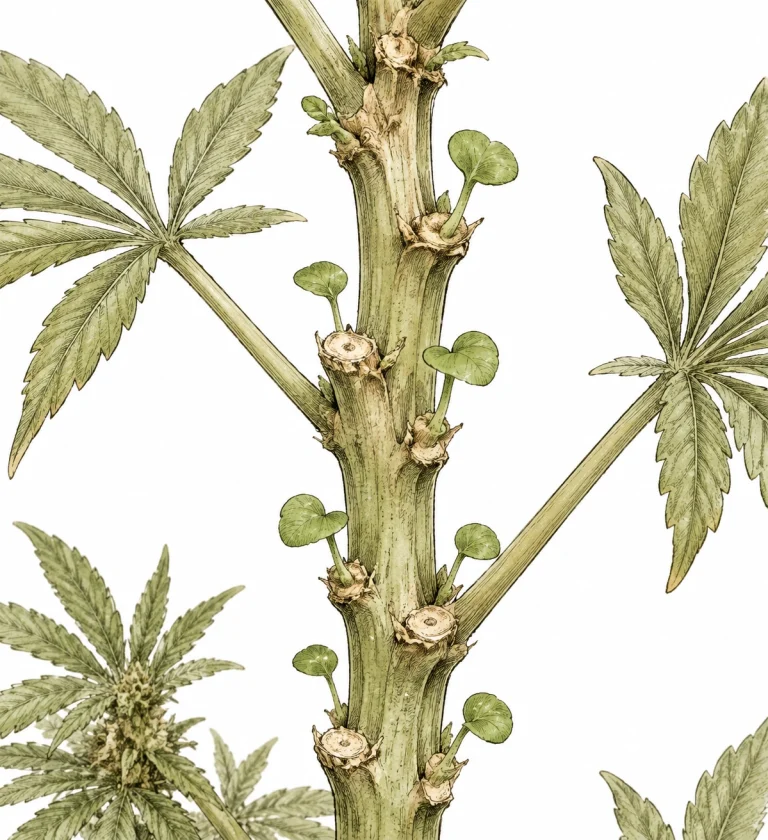
Under normal conditions, cannabis follows a clear life cycle: germination, vegetative stage, flowering stage, harvest. After flowering, the plant usually dies off. It has done its biological job. Cannabis revegetation breaks this cycle on purpose: after harvest, you give the plant a veg light cycle again and signal it to keep growing.
Technically speaking, cannabis is a photoperiod plant (in photoperiod strains). It uses special photoreceptors to measure the ratio of light to dark periods and decides from that whether it’s time for vegetative growth or flowering. When you switch the light cycle from 12/12 back to 18/6, the plant’s hormone balance gets reset. In a way, the plant “forgets” that it has flowered and starts building vegetative tissue again. Autoflowering strains can’t be revegged, or only to a very limited degree, because their flowering trigger is locked into their genetics.
What you get isn’t a brand-new plant. It’s an established mother plant with a fully developed root system. And that’s the key advantage: the roots are strong from day one, which can speed up regrowth a lot. If you’ve found a really great phenotype that was never cloned and isn’t available as seed, reveg lets you save that valuable genetics and keep growing it.
- Reveg only works reliably with photoperiod strains (not with autoflowers)
- Switching the light cycle from 12/12 back to 18/6 is the key trigger
- The plant keeps its established root system, which speeds up regrowth
- You can preserve valuable phenotypes this way without taking clones
- Reveg isn’t a standard process and takes patience and close observation
Why Reveg Cannabis? Pros and Cons at a Glance
The most obvious reason for cannabis revegetation is keeping an exceptional plant. Picture this: you grew a plant from seed that’s way above average in flavor, aroma or yield, and you missed the chance to take clones in time. Reveg is often the only way to save that genetics. On top of that, a good root system saves time: a revegged plant often grows faster in veg than a fresh seedling.
On the other hand, there are clear downsides. Depending on the plant’s condition and your grow conditions, reveg takes anywhere from two to eight weeks, and during that time you’ll see hardly any visible growth. The second harvest is often a bit lower in quality than the first, because the plant has spent resources on regenerating. The risk of fungal diseases is also higher, since harvest cuts leave open wounds that can serve as entry points for pathogens.
Another factor is stress. Reveg isn’t gentle. It puts serious physiological stress on the plant. Only healthy, well-fed plants with a stable root base reliably make it through. Weak or sick plants often fail and are better left out of reveg. If you want to read your plant’s stress symptoms correctly, our Plant Diagnosis hub gives you a systematic overview of all possible problems.
- Pro: Saves valuable genetics even if you never took clones
- Pro: An established root system gives you a faster start into the second veg stage
- Pro: Skips the time needed for germination and the early seedling stage
- Con: The process takes 2–8 weeks without visible growth
- Con: The second harvest is often a bit lower in quality than the first
- Con: Higher risk of fungal infections at the cut sites
- Con: Only suitable for healthy, vigorous plants
Preparing for Cannabis Revegetation: How to Harvest the Right Way for Reveg
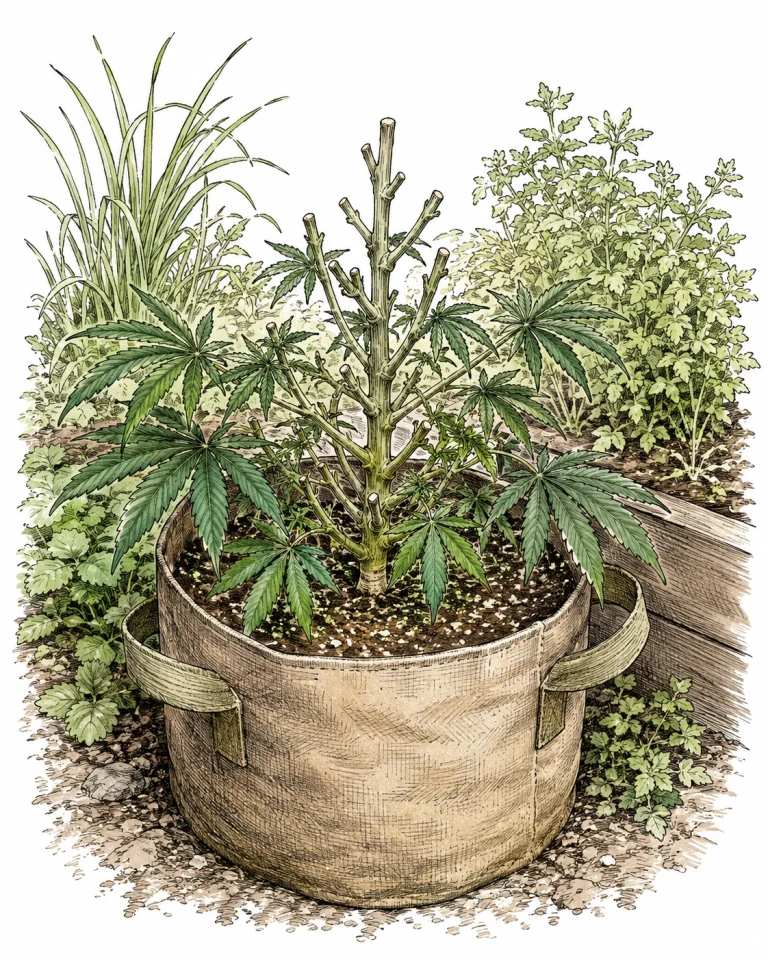
A successful reveg starts at harvest time. If you plan to reveg your plant, don’t take everything. Leave a few smaller buds and, above all, the lower leaves on the plant. These leaves are the “engine” of the reveg phase. They handle photosynthesis and give the plant the energy it needs to restart.
Rule of thumb: keep at least one or two fully developed leaf pairs on every main branch. The more green leaf mass you leave after harvest, the easier the reveg. Some experienced growers even leave small, immature bud sites on the plant, because new shoots tend to pop out of those nodes especially fast. The right watering schedule during reveg matters too. In this early recovery phase, less is often more.
After the partial harvest, disinfect every cut carefully. Treat fresh cuts briefly with colloidal silver, cinnamon or another natural antifungal to help prevent infections. Then switch your light cycle to 18/6 right away. You can even give the plant 24 hours of light for a while to speed up the switch. Keep the same pot. The growing medium should be well aerated and slightly moist, but not wet.
- Don’t harvest everything: leave at least 1–2 leaf pairs per main branch
- Leave small, immature buds on the plant – they encourage new shoots
- Disinfect cuts right away to help prevent fungal infections
- Switch the light cycle to 18/6 right away, or to 24/0 for a while
- Keep the growing medium slightly moist and avoid overwatering at all costs
Cannabis Reveg Timeline: What Happens and When
For the first one to two weeks after harvest, you’ll barely see any changes. The plant is switching its metabolism and sending energy to the roots and the remaining nodes. That’s normal. It doesn’t mean something is going wrong. Right now, patience is your best friend. Change as little as possible in the plant’s environment. Stable conditions make the switch easier.
Somewhere between week two and week four, the first new shoots show up. These early reveg leaves often look strange: at first they have just one or three fingers instead of the usual five to nine. This is a completely normal thing, often called “reveg morphology,” and it shows the plant hasn’t fully settled into the vegetative stage yet. Don’t worry – the leaves will look normal again over time.
After four to eight weeks, the plant should be clearly growing and putting out normal, well-formed leaves. Now you can start regular veg care: feeding, training and light adjustments. Balanced nutrients matter a lot at this point. Raise nitrogen slowly to avoid nutrient burn, which can hit a weakened reveg plant especially hard. Once the plant is growing strong and looks healthy, you can flip the light cycle to 12/12 to kick off the second flowering stage.
- Weeks 1–2: No visible changes, the plant is switching its metabolism internally
- Weeks 2–4: First new shoots with unusual 1- or 3-finger leaves (normal)
- Weeks 4–6: Leaves start looking normal, visible vegetative growth
- Weeks 6–8: Full veg activity, regular care can begin
- After that: Train again and start the second flowering stage whenever you’re ready
Common Cannabis Reveg Mistakes and How to Avoid Them
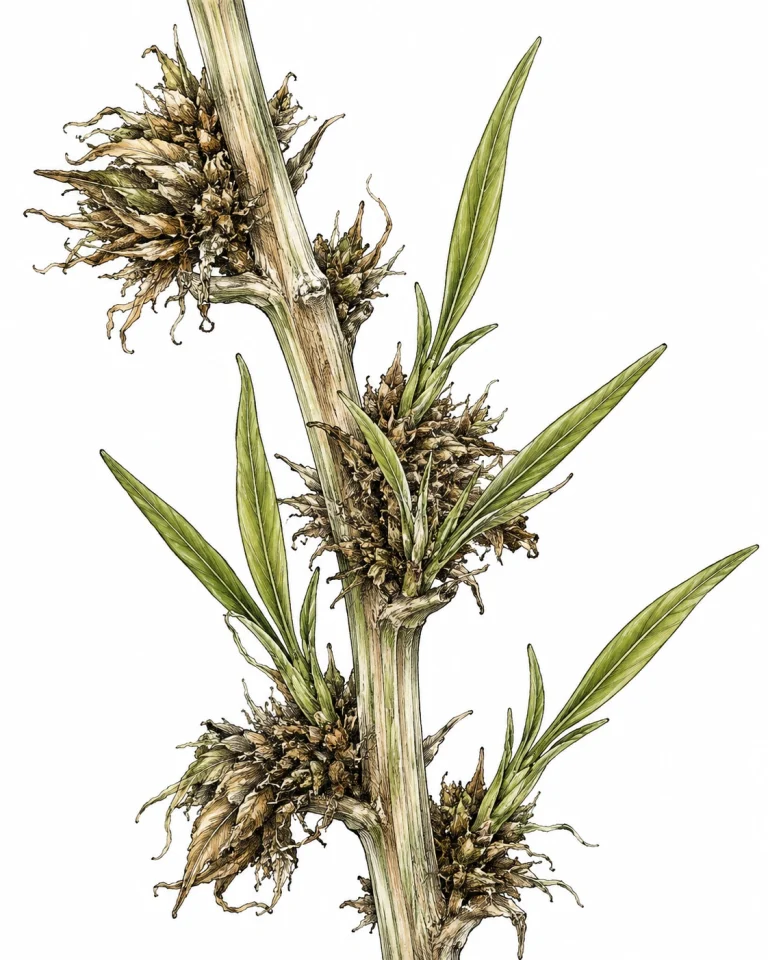
The most common mistake is messing with the plant too much in the first few weeks. Many growers get impatient, see no growth and start tweaking the lights, nutrients or watering. That usually makes things worse. Right now, the plant needs peace, stable conditions and, above all, time. Keep the temperature between 72 and 79 °F (22–26 °C) and the relative humidity (RH) at 50–60 %, and only water when the growing medium really needs it.
Another typical mistake is feeding too early or too heavily. A plant in early reveg needs very few nutrients. The root system is already established, but the few leaves left can’t take up much. Start with a quarter to half dose of your usual veg nutrients and only raise it once the plant is actively growing. Keep an eye on the pH of your water, too: the wrong pH for cannabis can cause nutrient lockout even when your feeding is spot-on.
Finally, many growers underestimate the risk of infection. Fresh cuts on a weakened plant are an open door for fungi like botrytis or fusarium. Make sure you have good airflow in your grow room, keep humidity under control and disinfect the cuts as described above. Solid all-round care plus regular check-ins is what really counts. You can find more common symptoms that can point to problems in our overview of yellow cannabis leaves.
- Mistake 1: Messing with the plant too much in the first 2 weeks – patience is key
- Mistake 2: Feeding too early or too strong – start at quarter strength
- Mistake 3: Ignoring pH – keep your growing medium between 6.0 and 7.0
- Mistake 4: Not disinfecting the cuts – you risk a fungal infection
- Mistake 5: Trying to reveg an autoflowering strain – genetically, it doesn’t work
- Mistake 6: Stripping every leaf at harvest – the plant has no energy left to recover
Reveg Cannabis: Is the Second Harvest Really Worse?
A lot of growers wonder about this. The honest answer: it depends. In many cases, the second harvest after a reveg is comparable in quality to the first, especially if you handled the plant with care. The established root system can take up nutrients very efficiently, and a well-done reveg can give you big, dense buds in the second flowering stage.
In other cases, growers report slightly lower density, a bit less resin or a shifted terpene profile compared to the first harvest. These differences are often small, and most home growers will barely notice them. Professional breeders who need maximum uniformity still prefer clones over revegging for consistency.
If you want to get the most out of your reveg, train the plant well during the second vegetative stage – for example with LST (low stress training) or a simple SCROG (screen of green) net. That way you maximize light distribution and get evenly developed bud sites. For a detailed guide to ideal growing conditions, check out our cannabis indoor grow guide – it helps you get the best out of every harvest.
- With good care, the second harvest is often comparable in quality to the first
- An established root system can even support lush bud development
- Slightly lower density or resin production is possible, but rarely a big deal
- Training in the second veg (LST, SCROG) maximizes your yield potential
- For professional-level uniformity, clones are still the better choice
When Is Cannabis Revegetation Really Worth It?
Reveg pays off in a few specific situations. The classic case: you grew a plant from seed that turned out to be an exceptional phenotype – perfect flavor, unusually high quality, impressive structure – and you forgot to take clones beforehand. In that scenario, reveg is often the only way to keep those genetics for future grows.
Reveg also makes sense if you’re short on seeds or growing expensive, rare genetics where every plant counts. And if you like to experiment and build your skills, you’ll learn a lot from it: reveg teaches you plenty about the plant’s life cycle, how it handles stress and how adaptable it is.
Reveg is less of a good idea when you’re short on time, because the process takes much longer than a fresh start with clones. It’s also risky with weakened, sick or pest-infested plants – a plant like that is unlikely to survive the extra stress. And as mentioned before: with autoflowering strains, any attempt at revegetation is doomed for genetic reasons.
- Recommended: An exceptional phenotype you didn’t take clones from
- Recommended: Rare or expensive genetics you want to keep
- Recommended: Growers who love to experiment and want to broaden their horizons
- Not recommended: Time pressure or a tight grow schedule
- Not recommended: Weakened, sick or pest-infested plants
- Not recommended: Autoflowering strains – genetically not possible
Once the plant is back in the vegetative stage, some targeted defoliation also helps it put its energy into new growth instead of old foliage.
Frequently Asked Questions
How Long Does Cannabis Revegetation Take?
It depends on the plant’s condition and your growing conditions. On average, expect two to eight weeks before the plant shows active vegetative growth. The first two weeks often show no visible change. After that, new shoots with unusual-looking leaves slowly start to appear.
Can I Reveg Autoflowering Strains?
No, that isn’t possible with true autoflowering strains. Autoflowers bloom based on their genetic program, no matter what the light cycle is. Since flowering isn’t triggered by the light cycle, switching the light cycle can’t push the plant back into the vegetative stage either. Reveg only works reliably with photoperiod strains.
Why Do the New Leaves Look So Weird During Reveg?
That’s completely normal. Early reveg leaves often have just one or three fingers because the plant is still switching its metabolism back to the vegetative stage. This usually fades after a few weeks, and the leaves return to the typical 5- to 9-finger pattern. It’s actually a sign that your reveg is working.
How many leaves should I leave on at harvest for reveg?
Rule of thumb: leave at least one or two fully developed leaf pairs per main branch. The more green leaf mass stays on after harvest, the more energy the plant has for regrowth, and the faster reveg tends to go. You can also leave small, immature bud sites on the plant.
Do I need to repot into a new pot after reveg?
That depends on the condition of your growing medium. If the soil still drains well after the first harvest and isn’t heavily loaded with salts, you can keep the plant in the same pot. If the medium is badly compacted or overfed, a careful transplant into fresh medium can give reveg a real boost. Just try to disturb the roots as little as possible.
How should I feed during reveg?
Start with a quarter to half dose of your regular veg nutrients, and only bump it up once the plant starts actively growing. Nutrient burn is a real risk in early reveg, because the plant can barely take up nutrients at that point. Always make sure your water has the right pH.
Reveg is also used on purpose for monster cropping, to take clones from plants that are already flowering. Check out our guide for the details.
Can a cannabis plant reveg by accident?
Yes, and it happens more often than you’d think. If extra light reaches the plant during the flowering stage, say from a light leak in the dark period or a longer power outage, it can read the disrupted light cycle as a signal to go back to vegetative growth. Suddenly, in the middle of flowering, you’ll see single, oddly shaped leaves pop up: the same reveg look you get from a planned reveg after harvest. The difference is that this usually isn’t intentional. It’s a light-proofing problem. Check your tent, door and grow room carefully for light leaks and keep your light cycle exact, or ripening can get delayed and your yield can take a noticeable hit.
Bottom Line
Cannabis revegetation (reveg) is a fascinating technique that lets you keep valuable genetics and use an established plant for another grow cycle. It takes patience, careful prep starting at harvest and a solid understanding of the plant’s life cycle. If you avoid the common mistakes (messing with the plant too much, overfeeding too early and neglecting hygiene), there’s a good chance your second harvest will be nearly as good as the first. Reveg is no substitute for properly taking clones, but it’s a valuable backup plan and a fun experiment for any experienced grower.
