


Giving your cannabis plants compost tea on a regular basis is a natural way to boost the soil life in your growing medium, and it can improve nutrient uptake. A homemade compost tea adds living microorganisms to your medium. They can strengthen roots and help prevent disease. Think of it as a supplement to your base feeding, not a replacement. In this article, we show you how to brew your own compost tea for your cannabis grow, which ingredients really matter and how to apply it the right way. If you’re into organic cannabis growing, this tool belongs in your kit.

What Is Compost Tea and Why Is It Worth It for Cannabis?

Compost tea is a liquid extract made from high-quality compost. You brew it with water, oxygen and food sources to multiply bacteria, fungi and other microorganisms. Unlike a simple compost extract, aerobic brewing pumps oxygen into the mix on purpose. That way, beneficial aerobic organisms can multiply explosively, while anaerobic and sometimes harmful microbes are kept in check. Don’t confuse compost tea with bokashi, where kitchen scraps are deliberately fermented without air.
For your cannabis plants, that means: compost tea supplies only small amounts of nutrients, but its real job is building soil biology. An active microbiome in your growing medium improves nutrient uptake, protects the roots from pathogenic fungi and can even raise tolerance to stress like drought or heat. Root partnerships with fungi are better built with mycorrhizal fungi, though, because compost tea contains hardly any viable mycorrhizal spores.
Regular doses pay off especially if you grow in living soil or want to skip synthetic nutrients. Compost tea is the perfect complement to the nutrient supply you can look up in our cannabis NPK chart.
- Boosts aerobic microorganisms in your growing medium
- Improves nutrient availability for the roots
- Can help prevent root diseases
- Raises your plant’s stress tolerance
Choosing the Right Ingredients for Cannabis Compost Tea
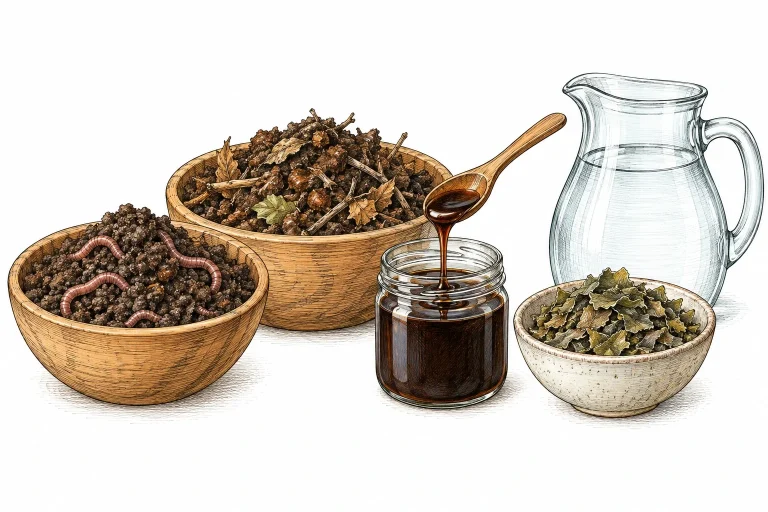
Your compost tea is only as good as its ingredients. Use high-quality, mature compost or worm castings as the base, since they already carry a high density of beneficial microorganisms. Poor or unfinished compost, on the other hand, can bring in unwanted putrefying bacteria and ruin the whole batch.
You also need food sources that kick microbial growth into gear. Molasses delivers fast sugars for bacteria, while oat flour or fish hydrolysate tends to boost fungal growth. Adjust your additives depending on your goal: a bacteria-dominated tea for the vegetative stage or a fungi-dominated tea for the flowering stage.
You can also mix in calcified seaweed, rock dust or kelp meal to add trace elements. Balance is key. Too many different additives at once can throw the mix off instead of helping it.
- Mature compost or worm castings as your microbial base
- Molasses as food for bacteria
- Oat flour or fish hydrolysate for fungal growth
- Kelp meal or rock dust for trace elements
How to Brew Compost Tea for Cannabis: Step by Step
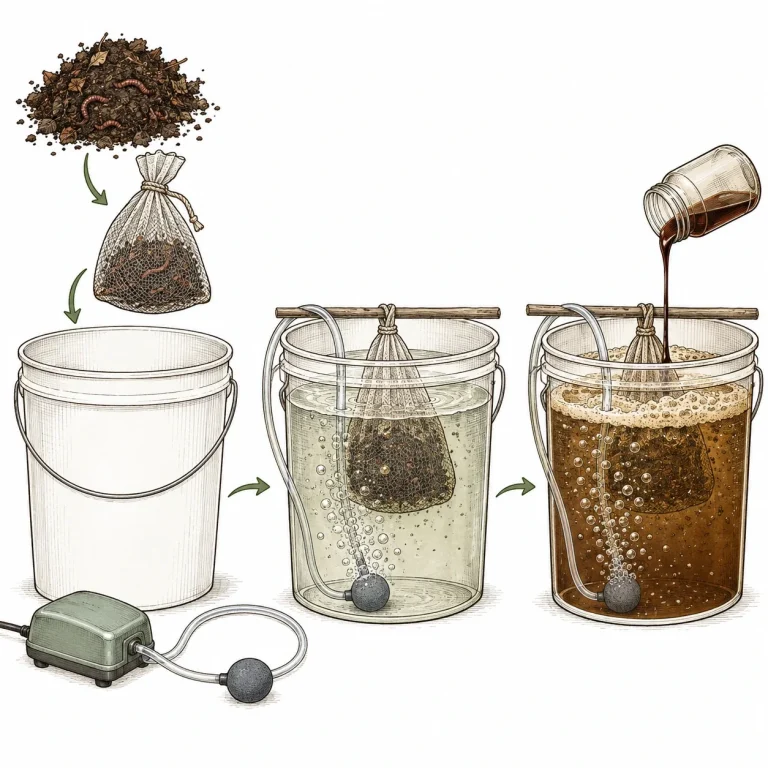
For a simple 24-hour brew, you need a clean bucket, chlorine-free water, an air pump with an air stone, a nylon stocking or tea bag for the compost, and your additives. Chlorine-free water really matters, because chlorine kills the microbes. If all you have is tap water, let it sit uncovered for 24 hours or bubble it with the air pump to drive off the chlorine. Heads-up: if your city uses chloramine, it won’t off-gas this way.
Fill the bucket with about 5.3 gal (20 L) of water and start the air pump at least an hour before you add any solids, so oxygen can dissolve into the water. A water temperature of about 68–77 °F (20–25 °C) is ideal. Much colder slows microbial growth, and much warmer means too little dissolved oxygen. Then add the compost in the nylon stocking, along with the molasses and any other additives. Keep the pump running nonstop so there’s always enough oxygen for aerobic growth.
After 24 to 36 hours, your tea is ready. You can tell by a pleasant, earthy smell and a light foam on the surface. If the brew smells rotten or like ammonia, something went wrong and you shouldn’t use it. Dilute the finished tea with water at a ratio of 1:4 to 1:10 before you apply it.
- Use chlorine-free water and clean equipment
- Keep the air pump running for at least 24 hours
- Use the finished tea right away while it’s fresh
- Toss the brew if it smells rotten
How to Apply and Dose Compost Tea
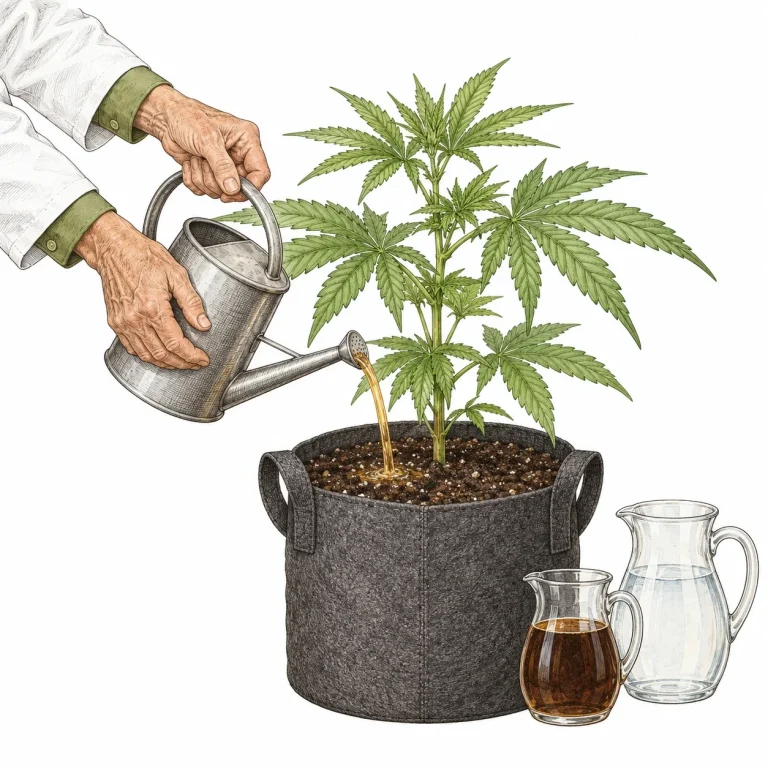
Always use compost tea fresh, ideally within a few hours of brewing. Without a steady oxygen supply, the microbes die off fast. Pour the diluted tea directly onto the growing medium around the root zone, ideally in the morning when the plant is actively taking up water.
For seedlings and young plants, go with a stronger dilution and apply less often, about once every two weeks. Mature plants in the vegetative or flowering stage can handle more frequent feedings, about once a week, especially if you’re running a fully organic feeding program.
You can also use compost tea as a foliar spray. This approach comes from biological plant protection: the beneficial microbes can crowd out disease-causing fungi on the leaf surface. Once buds start forming, it’s best to stop spraying them, because the extra moisture can encourage bud rot. Strain the tea finely so it doesn’t clog your spray nozzle. If you also run an automatic watering system, check whether it can handle organic additives. You’ll find more on that under Automatic Watering.
- Use it fresh, no more than a few hours after brewing
- Water it in diluted or use it as a foliar spray
- Feed young plants less often and at a weaker dilution
- Apply regularly every 1-2 weeks for the best results
Common Compost Tea Brewing Mistakes to Avoid
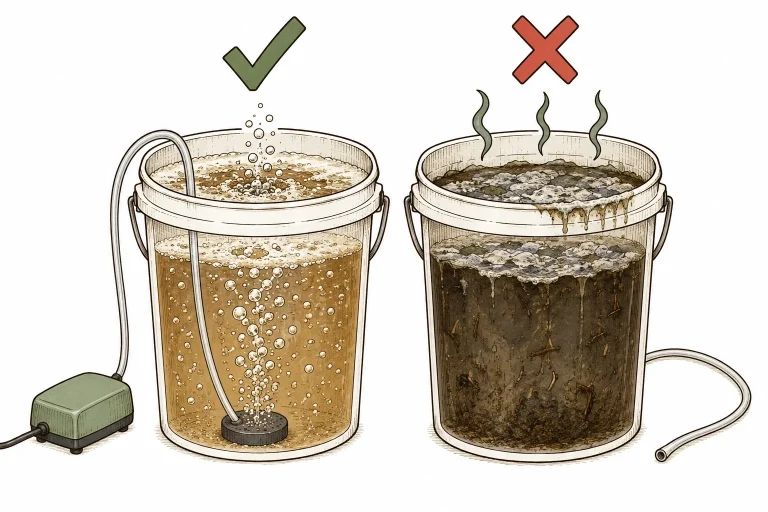
The most common mistake is not getting enough oxygen into the brew. Without a strong enough air pump, the batch can quickly turn anaerobic. That breeds harmful bacteria and a foul smell. It pays to buy a pump that is a bit stronger than you need. Extra oxygen rarely hurts.
Another mistake is adding too much sugar or molasses. Sure, it makes the bacteria multiply fast. But they also burn through the available oxygen just as fast, which raises the risk of the brew going bad. A good rule of thumb is about one tablespoon of molasses per 1-1.3 gal (4-5 L) of brew. For a 5.3 gal (20 L) batch, that is roughly four to five tablespoons.
Brewing too long can also cause trouble. After about 36 to 48 hours, the food supply in the brew is usually used up and the microbe population starts to crash again. So plan exactly when you want to use it, and don’t brew ahead to stockpile. If your plants are already dealing with nutrient imbalances, check out our cannabis nutrients guide first so you don’t overfeed.
- Use an air pump that is strong enough
- Go easy on sugar and molasses
- Limit brewing time to 24-36 hours
- Always smell and check the brew before you use it
Frequently Asked Questions
How often should I use compost tea on cannabis?
Usually, one application every one to two weeks is plenty. Applying it more often adds no extra benefit and can even upset the microbial balance in your growing medium.
Can I combine compost tea with synthetic nutrients?
In general, yes. But the high salt levels in synthetic nutrients can harm the microbes in the compost tea. Compost tea works best in organic growing.
How long does finished compost tea last?
Use compost tea within a few hours after brewing. Without active aeration, the aerobic microbes die off quickly and the tea loses its punch.
Can too much compost tea harm my cannabis plant?
Using too much or too strong a mix can lead to waterlogged soil or a nutrient imbalance. Stick to the recommended dilutions of 1:4 to 1:10 and watch how your plant responds.
Does compost tea work for autoflowers too?
Yes, compost tea works for autoflowers too. Because of their shorter vegetative stage, though, dose more carefully and at a lower concentration so you don’t overwhelm the sensitive roots.
Bottom Line
Brewing your own compost tea is a cheap, sustainable way to wake up the soil life and give your cannabis plants a natural boost. With the right ingredients, a clean brewing method and proper application, both the roots and the parts above ground benefit from this living feed. Avoid the most common mistakes and brew fresh tea regularly, and you may see healthier, more resilient plants after just a few feedings. To see how compost tea fits into a well-planned growing medium setup, check out our overview of cannabis growing media and soil.
