

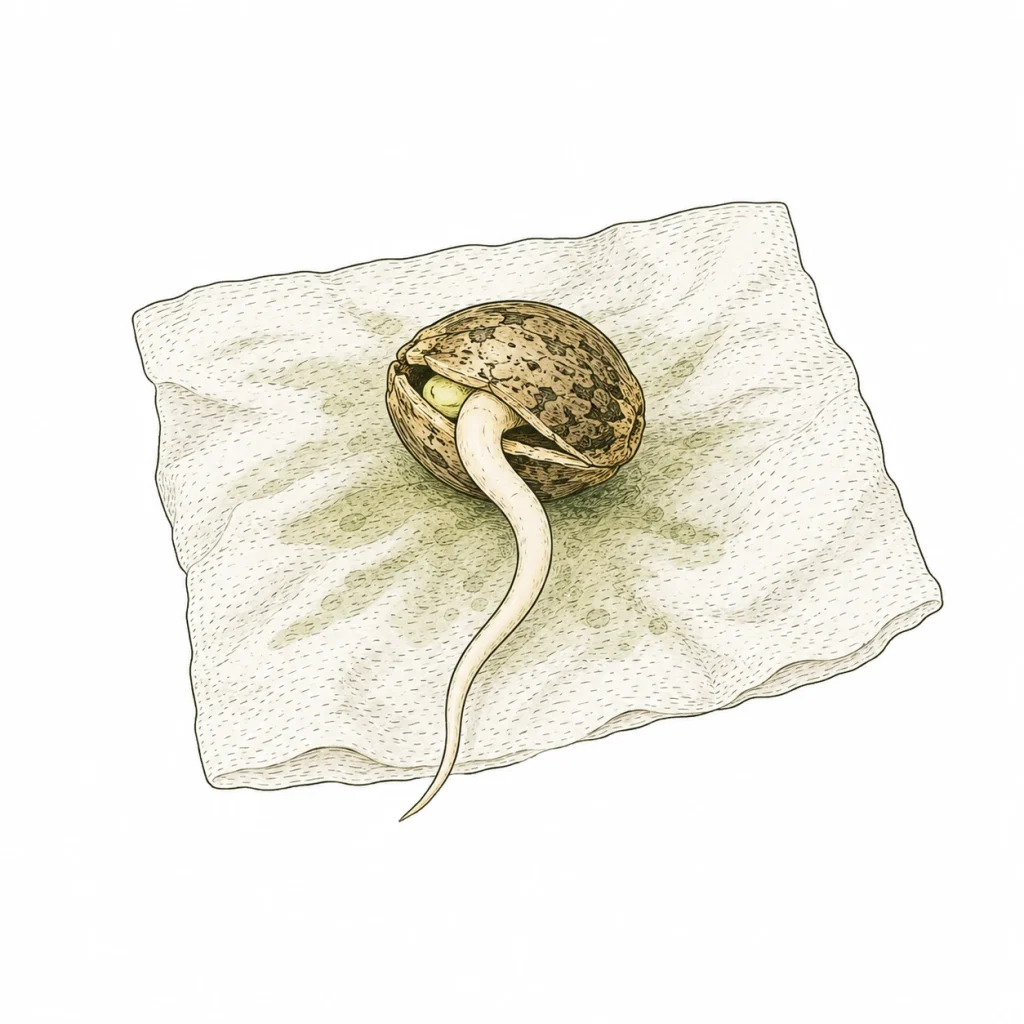
Germinating cannabis seeds is the very first step of every successful grow, and it’s a crucial one, whether you grow indoors or outdoors. Mistakes here can mean dead seeds, weak seedlings or needless delays before the real adventure even starts. In this article we compare the most popular germination methods, honestly and with a practical focus, so you know from day one which method suits you best. You’ll also learn which factors really affect your germination rate and how to avoid typical beginner mistakes. That way your first (or next) grow gets off to a relaxed start. Haven’t picked a strain yet? Our best cannabis strains for beginners guide helps you choose.
Why Germinating Cannabis Seeds Right Matters
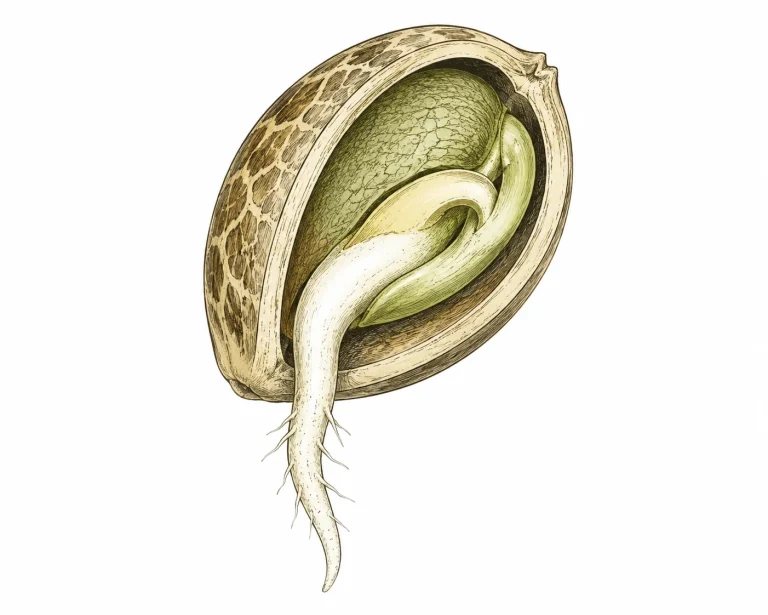
Many beginners underestimate how fragile cannabis seeds are during the first 24 to 120 hours. The sprout, also called the radicle or taproot, is the most delicate part of the plant. It reacts very sensitively to the wrong moisture level, the wrong temperature and physical damage. A seed that suffers a setback at this stage may still develop. But it often grows weaker and slower, and it can be more prone to problems than a seedling that germinated under ideal conditions.
Ideal germination happens in three phases. First, the seed takes up water and activates its enzymes (imbibition). Then the taproot breaks through the seed shell (radicle emergence). Finally, the young stem stretches upward and the seed leaves (cotyledons) unfold toward the light. Each phase needs the right conditions. The good news: with the right setup, all of this is easy to control and repeat. Research on germination physiology shows that seeds have an internal “thermometer” that deliberately delays germination until the temperature is really right.
Before you start with any germination method, check two things. First, the quality of your seeds: plump, dark seeds with a firm shell germinate more reliably than pale, soft or cracked ones. Second, your water quality. Tap water with a neutral pH between 6.0 and 7.0 is ideal. For a detailed walkthrough on dialing in the pH of your water, see our article on how to adjust pH for cannabis.
- Ideal germination temperature: 72–79 °F (22–26 °C)
- Ideal humidity (relative humidity, RH) during germination: 70–90 %
- No direct light on the seed needed during germination
- The taproot points down – never bend it or flip it over
- Use clean hands or tweezers, never grab seeds with bare fingers
- Use filtered tap water or tap water that has sat out, not fresh chlorinated water straight from the faucet
Germinating Cannabis Seeds with the Paper Towel Method
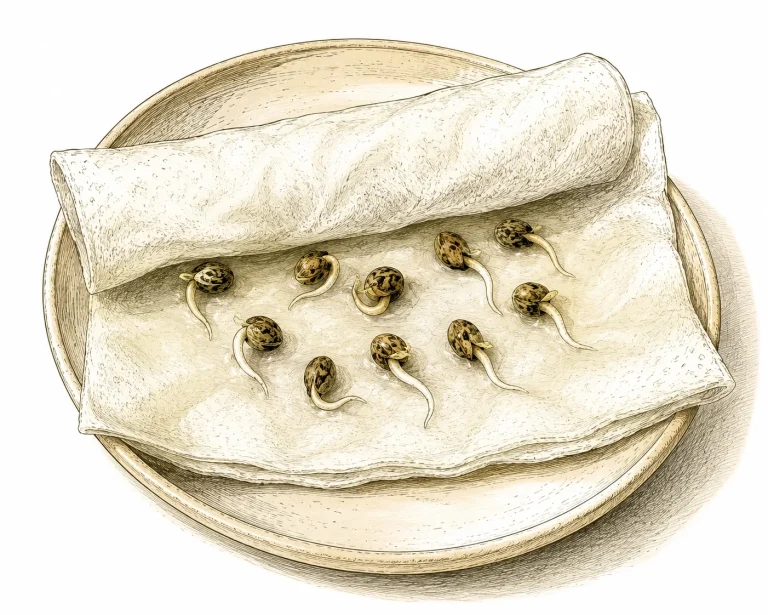
The paper towel method is by far the most popular method among home growers, and for good reason. It’s cheap, simple and fast, and it lets you check progress at any time without disturbing the seeds. All you need is two layers of paper towel, a flat plate or a plastic container with a lid, filtered water and a warm, dark spot.
Here’s how it works: moisten the paper towel, place the seeds on one layer at least 1 in (2 cm) apart and cover them with the second layer. The towel should be damp, not dripping wet. Too much water cuts off the seed’s oxygen supply and can encourage mold. Slip the plate into a plastic bag or cover it with a second plate to hold in the moisture. Then put it somewhere warm, 72–79 °F (22–26 °C), for example on top of the fridge or in a drawer near a heat source.
Most seeds show a taproot after 24 to 72 hours. Once it’s about 0.2–0.4 in (0.5–1 cm) long, it’s time to plant. Important: don’t wait too long. A taproot that’s too long is harder to plant without damaging it. The biggest downside of this method is the transfer itself, because you can accidentally injure the root. So use clean tweezers and touch the root as little as possible.
Despite this downside, we especially recommend the paper towel method for beginners. It gives you full control over germination and works with stuff everyone has at home.
- Pro: Cheap, simple, and you can see exactly how germination is going
- Pro: High germination rate if you follow the basic rules
- Con: Seedlings need to be transferred – the root can get damaged
- Con: Mold risk if you use too much water
- Tip: Use paper towels instead of toilet paper – they stay moist longer and don’t tear as easily
- Tip: Check the seeds after 24 hours, but don’t disturb them too often
Straight Into the Medium: Germinating Cannabis Seeds Without Transplanting
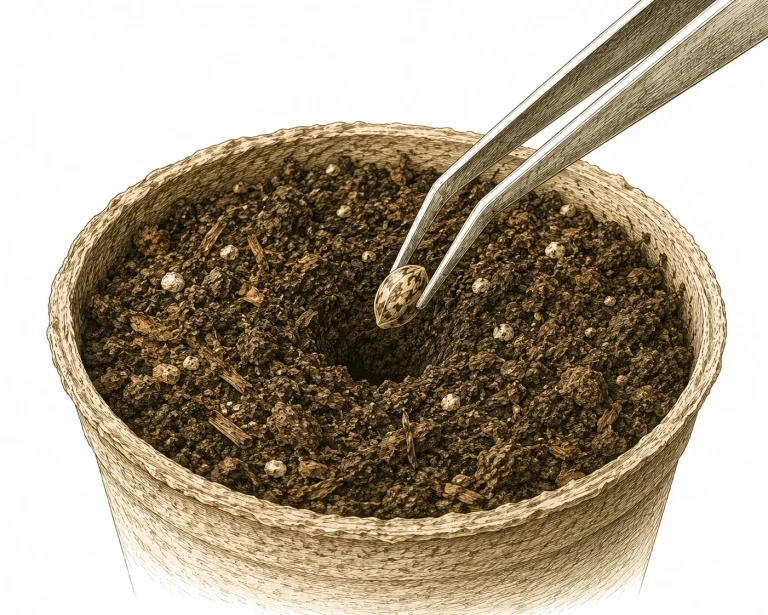
The most direct method is planting your seeds straight into the growing medium. You skip the risky transplant step entirely. The taproot can dig into the soil undisturbed, and your seedling never has to deal with any handling stress. This method comes closest to how seeds germinate in nature, so from the plant’s point of view it’s actually the gentlest option.
For direct sowing, use a loose, airy, low-nutrient seed-starting mix. Coco coir, a light seed-starting soil or a blend of both works great. Heavy, nutrient-rich soils can overwhelm seedlings and cause nutrient burn before the little plant has even put down proper roots. Want to know which growing medium fits which stage? Check out our article on spotting and fixing nutrient burn in cannabis. There we also explain why seedlings are especially sensitive to high nutrient levels.
Poke a hole about 0.4 in (1 cm) deep into the pre-moistened medium. Drop the seed in (blunt end down, or just on its side) and cover it loosely with soil. Don’t press it down. Keep the medium evenly moist but not wet. A spray bottle is your best friend here. Cover the pot with plastic wrap or a plastic cup to hold in the humidity. After three to seven days, your seedling should pop out of the soil with its cotyledons.
The downside of direct sowing: you can’t see if or how the seed is germinating. If nothing has happened after seven days, you won’t know whether the seed is still working or already dead. So if you’re a beginner who wants to watch every stage, the paper towel method or a germination station may suit you better.
- Pro: No stressful transplanting, roots grow undisturbed
- Pro: Gentlest method for the plant
- Con: No window into germination
- Con: Harder to tell whether the seed is sprouting
- Tip: Use a low-nutrient seed-starting mix, not a pre-fertilized potting mix
- Tip: Use a spray bottle instead of a watering can so you don’t flood the medium
Starter Cubes and Rockwool: Germinating Cannabis Seeds for Advanced Growers
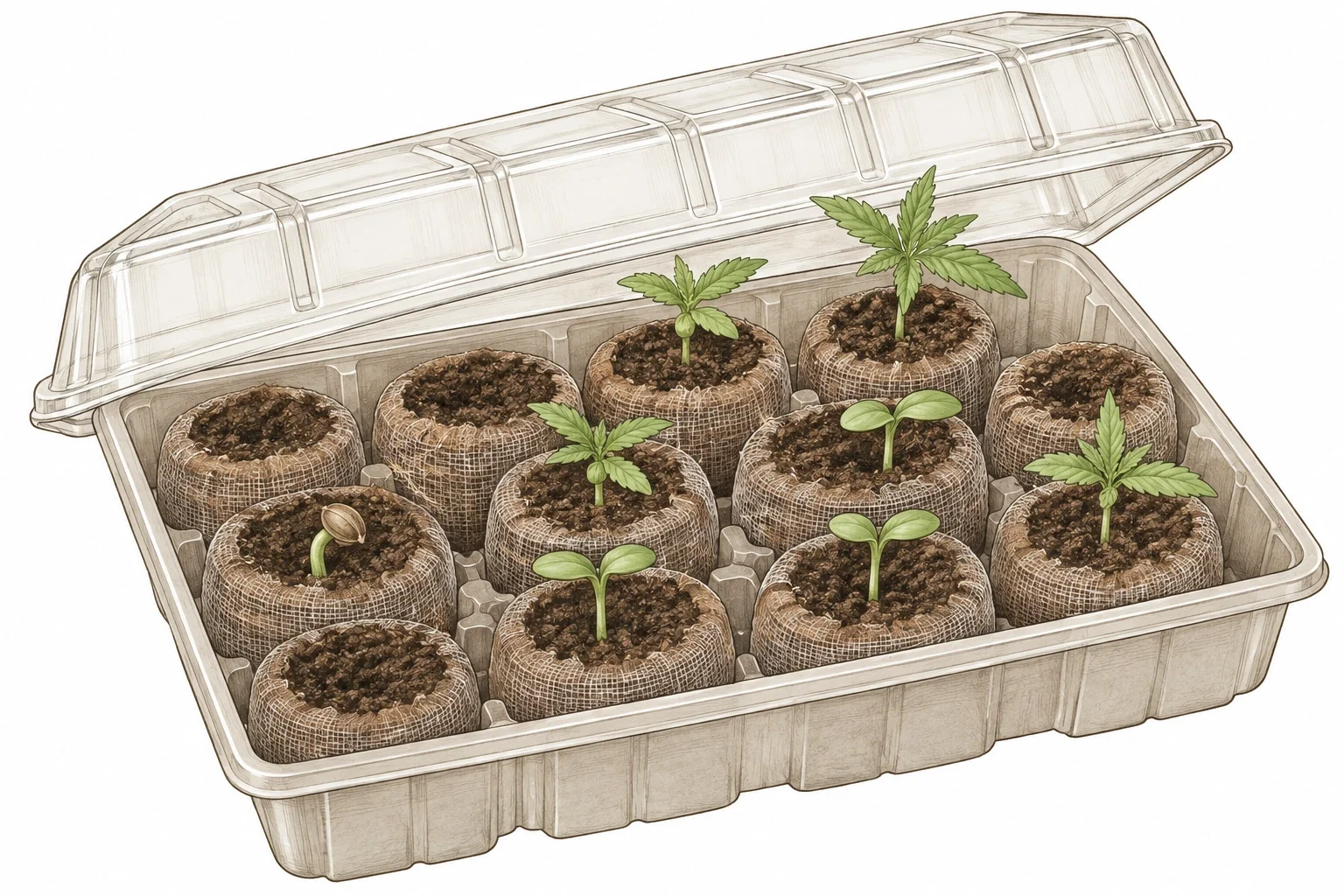
If you grow regularly or germinate several seeds at once, you’ll often reach for starter cubes made of peat (Jiffy-7), coco or rockwool. They offer an ideal balance of moisture and oxygen and make the annoying transplant step a lot easier. You simply set the whole cube into the next pot or straight into your hydroponic system.
Rockwool cubes (German) (German) must be soaked and pH-balanced before use. Rockwool naturally has a high, alkaline pH that can block germination. Soak the cubes for several hours in pH-adjusted water (pH 5.5–6.0 for rockwool) and let them drain well before you put in your seeds. Peat-based Jiffy plugs simply swell up in water and are ready to go, with a target pH of about 6.0–6.5.
Here’s how it works: push the seed about 0.4 in (1 cm) deep into the pre-made hole in the cube and loosely cover it with a small piece of rockwool or growing medium. Then place the cubes in a seedling tray with a humidity dome (propagator), for example from a seed-starting kit with dome, heat mat and pots (German) (German). A propagator keeps temperature and humidity steady and is especially handy when you’re germinating lots of seeds at once. Your seedlings should show up after two to five days.
This method is ideal if you want to move to hydroponics or coco setups, since the seedlings transfer seamlessly from the cube into the system. For beginners, the extra cost and slightly trickier handling make it more of a second choice.
- Pro: Easy transplanting – the whole cube goes in
- Pro: Optimal moisture-to-oxygen ratio
- Pro: Ideal for hydro and coco setups
- Con: Rockwool needs to be pH-adjusted
- Con: Extra cost for cubes and propagator
- Con: Slightly more prep work for beginners
Pre-Soaking Cannabis Seeds: Is It Worth It?
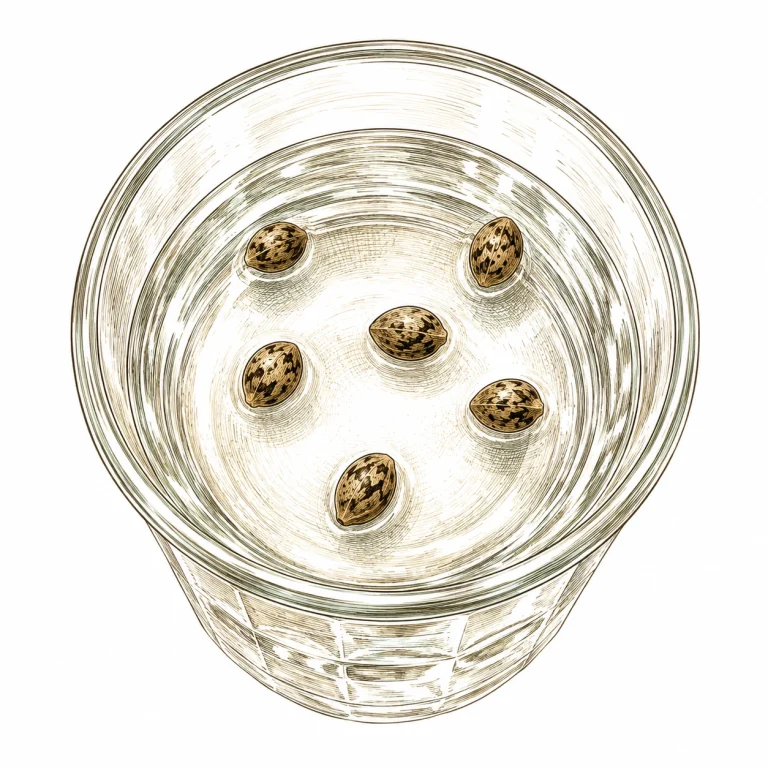
Pre-soaking means dropping your seeds into a glass of water for 12 to 24 hours before your actual germination method. It’s a proven trick to boost your germination rate. Soaking helps water get through the seed shell faster and wakes up the enzymes. On older or extra-hard seeds, it also softens the shell so the taproot can break through more easily.
Here’s how to do it: Fill a small, dark glass with room-temperature filtered water (pH 6.0–7.0) and drop the seeds in. Cover the glass and set it somewhere warm and dark. After 12 to 18 hours, well-hydrated seeds usually sink to the bottom. That’s a good sign they’re ready to germinate. If a seed is still floating after 24 hours, gently nudge it under with your finger. If it still doesn’t sprout after that, the seed may not be very viable.
Important: Don’t soak for more than 24 hours. Soaking too long cuts off the seed’s oxygen and can kill it. Pre-soaking works best as an add-on to the paper towel method or direct planting. After soaking, either plant the seed straight into your growing medium or place it on a damp paper towel.
- Ideal for older seeds or seeds with a very hard shell
- Soak for 24 hours max – longer does more harm than good
- Seeds that sink after 12–18 hours are ready
- Water temperature: 72–79 °F (22–26 °C), never use hot water
- Don’t add nutrients or additives to the soaking water
Germinating Cannabis Seeds: Common Mistakes and How to Avoid Them
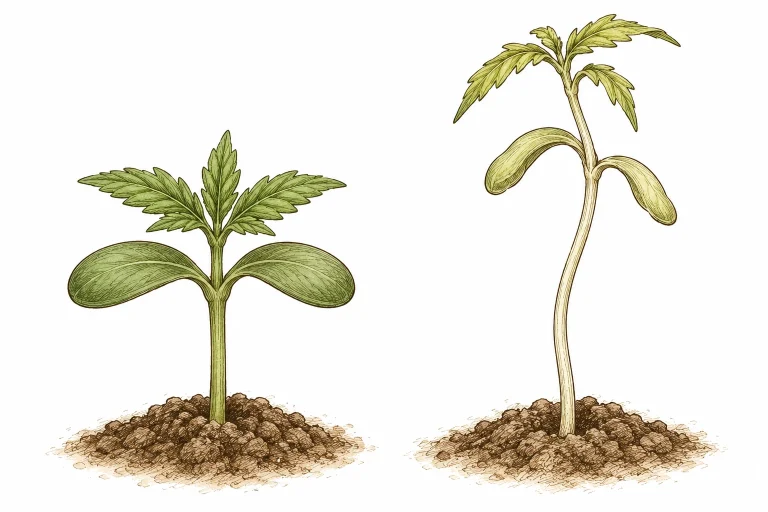
Even with the right method, beginners tend to make the same mistakes. The most common one: too much water. Seeds need moisture, but they need oxygen too. Standing water kills seeds and seedlings faster than almost anything else. If you’re not sure whether you’re watering too much or too little, check out our in-depth guide How to Water Cannabis – the basic rules there apply from day one of germination.
Another common mistake is the wrong temperature. Below 68 °F (20 °C), cannabis germinates very slowly or not at all. Above 86 °F (30 °C), enzymes break down and the seedling can die. Get a simple thermometer and place it right next to your germinating seeds. A heat mat under your germination tray can help you hold a steady 72–79 °F (22–26 °C).
Light that comes too early or too often is another problem many growers underestimate. Cannabis seeds don’t need light to germinate – darkness actually helps. Only once the seedling pokes its cotyledons (seed leaves) out of the soil does it need gentle light (no strong LED right on top of it). Start with your light far enough away to avoid light burn on the delicate seedling. Our article How to Spot Light Burn on Cannabis covers the right distance and light intensity for seedlings in detail.
Finally: patience. Some seeds take five to seven days to pop – that’s totally normal. Don’t toss your seed too soon. Check on it daily without disturbing it, and wait at least seven to ten days before you give up.
- Too much water: the most common mistake – keep the medium/paper damp, not wet
- Too cold: below 68 °F (20 °C), cannabis barely germinates
- Too much light too soon: only get the seedling used to light once it breaks the surface
- Damaged taproot: always use tweezers, never your bare fingers
- Wrong pH in your water: stick to pH 6.0–7.0
- Too impatient: wait at least 7–10 days before giving up
Germinating Cannabis Seeds: Methods Compared at a Glance
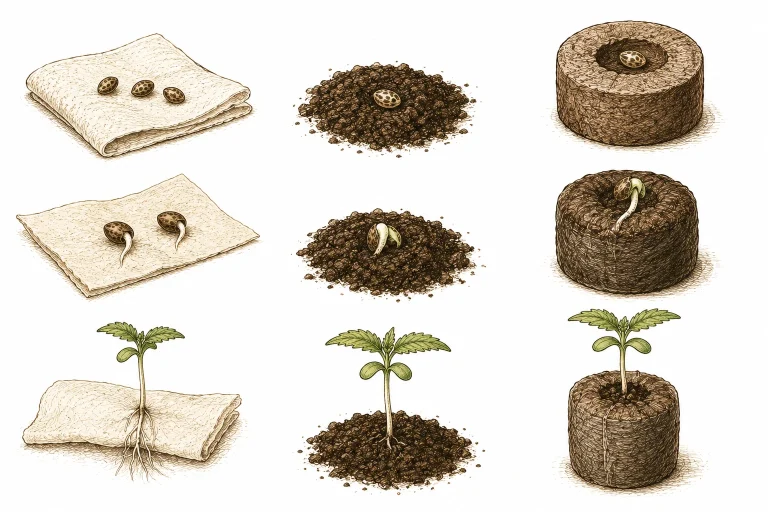
All three main methods – paper towel, direct planting and starter cubes – work reliably as long as you follow the basic rules. The differences come down to control, effort and how well each fits your grow setup. If you grow in soil and want the simplest start, the paper towel method or direct planting is your best bet. If you’re planning on hydroponics or coco, starter cubes are the way to go.
Whatever method you choose, the key factors for a high germination rate are temperature (72–79 °F / 22–26 °C), moisture (consistently damp, not wet), water pH (6.0–7.0) and seed quality. Always buy your seeds from a reputable seed bank that offers a germination guarantee – it saves you frustration and money.
Once your seedlings take off with their first true leaves, the real care starts. From here on, pH for cannabis becomes one of the most important things you check, because it decides whether your plant can take up all the nutrients it needs. To keep it growing without stress, check out our big Plant Diagnosis overview. There you can quickly identify every symptom, from deficiencies to pests.
- Paper towel: Simple, cheap, lots of control – recommended for beginners
- Direct sowing: The gentlest method, no transplanting – for the impatient and nature lovers
- Starter cubes (Jiffy/rockwool): Pro-level, ideal for hydro/coco – for experienced growers
- Pre-soaking as an add-on: Boosts germination rates for old or hard-shelled seeds
- Every method needs: the right pH, the right temperature and good moisture management
Not sure which genetics suit you? We explain it in Indica vs. Sativa vs. Hybrid: The Differences. If you want an especially beginner-friendly, fast strain, read our guide to growing autoflowers too. Instead of starting from seed, you can also propagate a plant from clones.
Frequently Asked Questions
How long does it take for cannabis seeds to germinate?
Under ideal conditions (72–79 °F (22–26 °C), steady moisture), most cannabis seeds show a taproot within 24 to 72 hours. Some seeds – especially older ones or those with a very hard shell – can take up to seven days. Give a seed at least ten days before you write it off as a dud.
What water works best for germinating cannabis seeds?
Filtered tap water or tap water that has sat out works best (leave it open for 24 hours so the chlorine can evaporate). The pH should be between 6.0 and 7.0. Bottled mineral water can work, but check the pH first. Plain distilled water is usually a poor choice, because it is very aggressive and can pull minerals out of the seeds.
Taproot pointing up – what should you do?
This sometimes happens when a seed goes in upside down or turns while it germinates. The plant fixes this on its own through gravitropism – the root will find its way down. If you transplant the seedling, place it so the root points down. Turn it very gently with clean tweezers, and never pull on the root.
Can you germinate cannabis seeds in winter?
Yes – indoors, the season doesn’t matter. What counts is the temperature where you germinate. Some rooms can get too cold in winter. A heat mat under your germination container helps you hold a steady 72–79 °F (22–26 °C). Germinating outdoors in winter isn’t a good idea, because cold and frost can kill the seeds.
How many out of ten seeds typically germinate?
With fresh, high-quality seeds from reputable seed banks, you can expect a germination rate of 80–95 %. With older seeds or bag seeds, the rate can be much lower. Seed banks with a germination guarantee often replace seeds that don’t sprout for free. Good storage (cool, dark, dry) keeps seeds viable for years.
Do cannabis seeds need light to germinate?
No. Cannabis seeds germinate just fine in the dark. In fact, they prefer darkness during germination. Your seedling only needs light once its cotyledons (the first seed leaves) have popped up out of the growing medium. Then start with gentle, low-intensity light and keep plenty of distance between the plant and the light source.
The Seed Shell Is Stuck on the Seedling – What Now?
Sometimes a seedling breaks through the soil, but the seed shell stays on top of the cotyledons like a tiny helmet. Growers call this a “helmet head.” It mostly happens when the shell was too hard or too dry to come off on its own as the plant grows, and poor seed storage can make the shell even more brittle. If it stays on too long, it can keep the seed leaves from opening fully and delay photosynthesis.
Important: never yank on it. That can damage the seedling or even snap it off. Instead, mist the stuck shell with lukewarm water several times a day so it softens over one to two days. If it still won’t come off by itself, use sterile, fine-tipped tweezers or clean nail scissors to carefully nick the softened shell and gently peel it away. If it doesn’t come off easily, let it stay moist for another day rather than forcing it. In most cases, the shell falls off on its own within two to four days.
Bottom Line
Germinating cannabis seeds is easier than many people think, as long as you know the basics and pick the right method. Beginners do best with the paper towel method or planting directly in the medium, while more experienced growers can get more professional results with starter cubes. Either way, what really matters is the right mix of temperature, correct pH and smart moisture management. Too much water is the most common mistake. Once your seedling gets going, bookmark our plant diagnosis overview. It helps you react fast at every growth stage if something looks off. Not sure yet which strain you want to germinate? Our Strain Finder (German) (German) helps you choose before you get started.
