

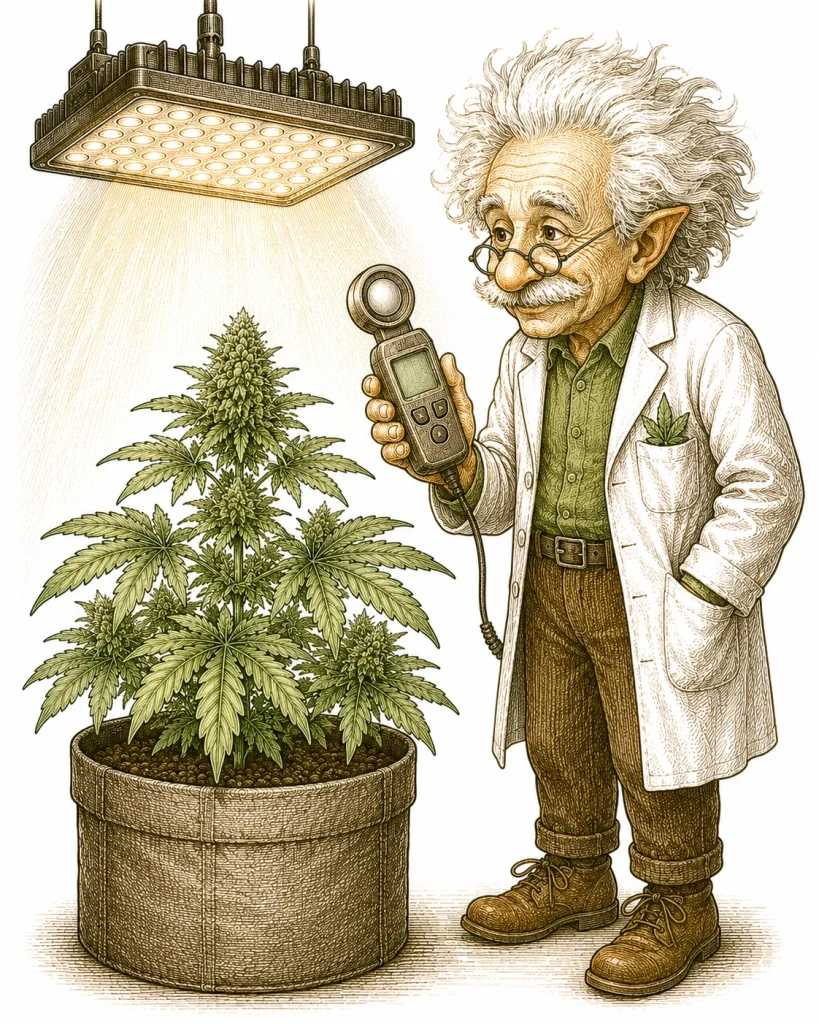
Light spectrum and light duration are the two key factors that decide whether your cannabis plant keeps growing vegetatively or switches into flower. Without the right light, the perfect pH, an ideal growing medium and precise watering won’t get you very far. Photosynthesis simply can’t run efficiently. In this article, you’ll learn which wavelengths matter in each growth stage, how long your light should stay on, and which type of grow light fits your setup best. Whether you’re a beginner or a seasoned grower, a solid understanding of cannabis lighting helps you get a lot more out of your plants.
Why Light Spectrum and Light Duration Matter So Much for Cannabis
Cannabis is a photoperiod plant. That means it controls its entire life cycle based on the ratio of light to darkness. This ratio tells the plant when to grow, when to flower and when to get ready to produce seeds. Once you understand this mechanism, you already hold the most important tool in indoor growing.
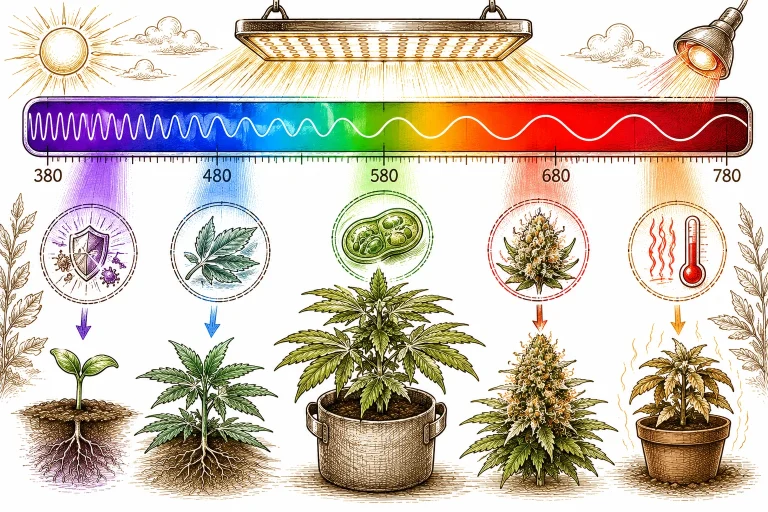
The light spectrum describes the wavelengths of light, measured in nanometers (nm). For cannabis, the blue range (400–500 nm) and the red range (620–700 nm) matter most, because the plant’s photoreceptors, the phytochromes and cryptochromes, absorb them especially well. Green light (500–600 nm) is used less, but the plant doesn’t ignore it completely. UV light below 380 nm can boost trichome production, but in high doses it can stress your plant.
Light duration, on the other hand, decides whether a photoperiod strain stays in the vegetative stage or switches to flowering. To be precise, the plant responds to the dark period: as soon as uninterrupted darkness lasts longer than 12 hours, the plant releases flower-triggering hormones. Autoflowering strains don’t rely on this mechanism and flower regardless of the light cycle.
- Blue light (400–500 nm): Promotes compact vegetative growth, thick stems and short internodes
- Red light (620–700 nm): Drives bud mass, stretching and the rate of photosynthesis
- Infrared (700–850 nm): Triggers the Emerson effect and boosts overall photosynthesis
- UV-B (280–315 nm): Can increase trichome production and resin content, so use it in moderation
- Green light (500–600 nm): Penetrates deeper into leaf tissue, which matters for lower leaves
Why Pure Blue+Red Light Is Only a Limited Choice
Many budget LED lights advertise a pure blue+red spectrum. You can spot them by the typical “purple light” you see when you look into the grow tent. At first glance, that seems logical, since cannabis mainly uses blue and red for photosynthesis. But take a closer look and this type of light is only a limited choice.
Here’s why: green and yellow light are also photosynthetically active and measurably add to the rate of photosynthesis, but they’re completely missing from a pure blue+red spectrum. Green light also penetrates deeper into leaf tissue and the lower parts of the plant than blue or red, which are mostly absorbed at the leaf surface. Without these wavelengths, the plant can grow less evenly across the width and depth of its canopy.
The better choice is a full-spectrum LED with a color temperature between 3500 K and 5700 K. These lights cover the entire visible spectrum, with blue, green, yellow and red in a balanced ratio. The result is more even, healthier growth across the whole plant, instead of just serving the wavelengths that stand out most to the naked eye.
- Pure blue+red light (“purple light”): usually budget lights, only a limited choice
- Green and yellow light are photosynthetically active, but missing from a blue+red spectrum
- Full-spectrum LEDs with a 3500–5700 K color temperature are the more balanced choice
Cannabis Light Spectrum in the Vegetative Stage: Blue Takes the Lead
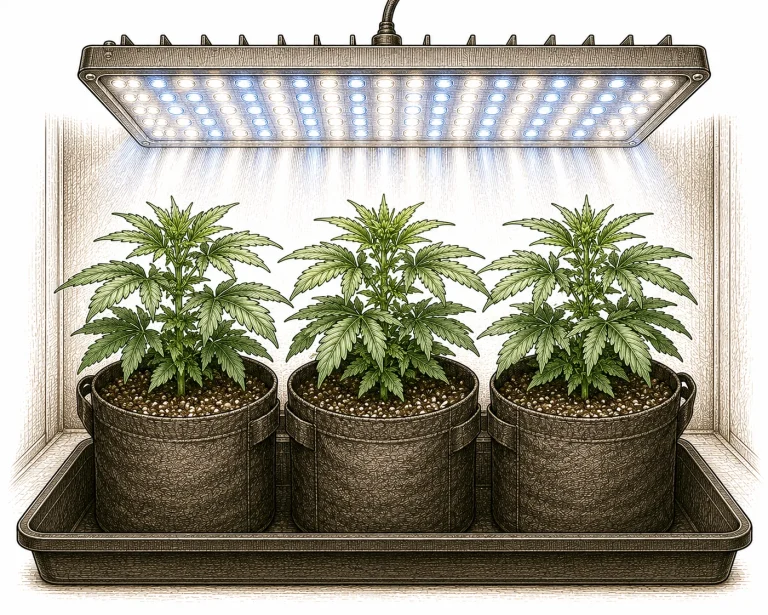
In the vegetative stage, the focus is on building structure. Your plant grows stems, leaves, side branches and a strong root system. For this, it mainly needs light in the blue part of the spectrum, between 400 and 500 nm. Blue light activates chlorophyll b absorption and regulates stretching. Plants that get enough blue light stay more compact, develop shorter internodes and are sturdier.
In practice, this means lights with a high share of blue work especially well during veg. Classic metal halide lamps (MH) naturally put out a lot of blue, while modern full-spectrum LEDs often mimic this with a “Veg” switch. Daylight lamps (6500 K) also cover the blue range well.
A common mistake is running only warm-white lamps (2700–3000 K) during veg. The result can be stretched, weak plants with long internodes, and that can cut your yield later on. If you train your plants with cannabis LST (low stress training) (German) or other techniques, you’ll benefit even more from a solid vegetative foundation with tight internode spacing.
For the light cycle in veg, 18 hours of light and 6 hours of darkness (18/6) is the proven standard. Some growers run 20/4 or even 24/0 to speed up growth. Running lights 24/0 is controversial, though. Some strains can react with stress, and the plant gets no rest period to recover. For most photoperiod strains, 18/6 is the sweet spot.
- Recommended color temperature in veg: 5500–7000 K (daylight white)
- Light cycle in veg: 18 hours light / 6 hours dark
- Ideal wavelength: 440–490 nm (blue) for compact growth
- Light types for veg: full-spectrum LED (veg mode), MH, T5 fluorescent tubes
- Only use 24/0 with hardy strains and autoflowers
Cannabis Light Spectrum in the Flowering Stage: Red and Warm Light for Maximum Colas
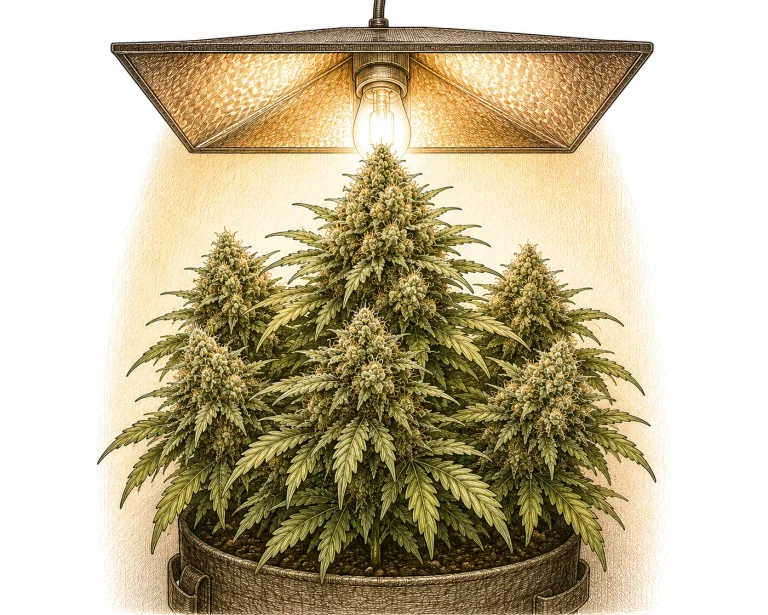
When you flip to a 12/12 light cycle, you’re telling your photoperiod plant: “It’s fall now. Time to ripen your flowers.” In this stage, the plant’s spectral needs shift toward red. Wavelengths between 620 and 700 nm are key for flower development. They activate the flower-triggering phytochromes and drive cell division in the bud tissue.
That’s why high-pressure sodium lamps (HPS), with their typical orange-red glow (2700 K), have been the go-to flowering lights for decades. They deliver exactly the cannabis light spectrum your plant needs in flower, and in the mid-price range they’re hard to beat on light output for the money, even with the heat they put out. Modern full-spectrum LEDs, however, can cover an even broader cannabis light spectrum while using a lot less power.
Especially interesting in the flowering stage (German) is so-called “deep red” at 660 nm. This wavelength is the most efficient one for chlorophyll a and directly maximizes the rate of photosynthesis. Many LED manufacturers use 660 nm diodes on purpose. You can also add far-red light (730 nm) for 10–15 minutes at the end of the light period to take advantage of the Emerson effect. This boosts overall photosynthesis and can speed up flower development.
In the last two weeks before harvest, some growers add UV-B light to stimulate trichome production. In response to UV stress, the plant produces more resin as a protective layer, which can raise potency. Be careful, though: UV-B is harsh, and too much exposure can damage the leaves. 30–60 minutes a day is plenty.
- Light cycle in flower: exactly 12 hours light / 12 hours dark
- Ideal wavelength: 620–700 nm (red), with 660 nm deep red being especially efficient
- Far-red 730 nm: 10–15 minutes at the end of the light period for the Emerson effect
- UV-B in the last 2 weeks: boosts trichome production, max. 1 hour a day
- Recommended lights: HPS 600W–1000W, full-spectrum LED with bloom mode, CMH/LEC
- The dark period must be completely uninterrupted. No light leaks at night!
Grow Light Types Compared: HPS, LED, CMH and CFL for Cannabis
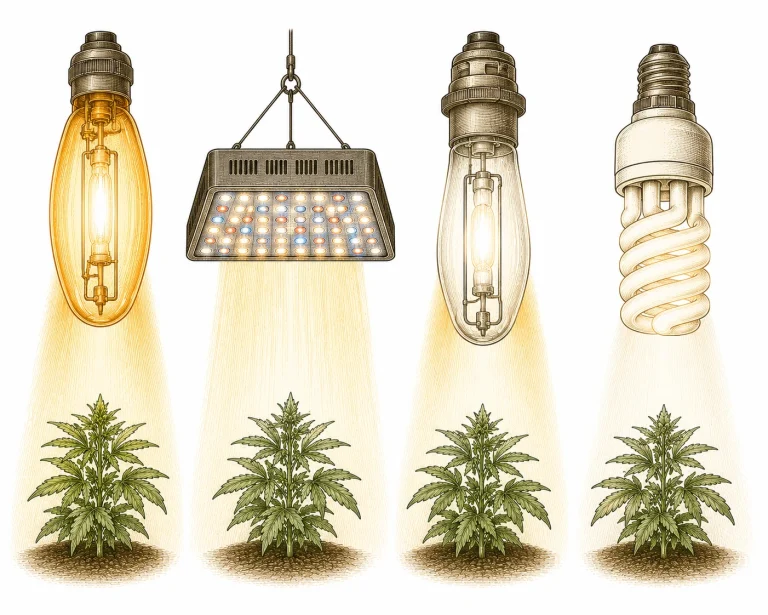
Picking the right light is one of the most important decisions in indoor cannabis growing (German). Every light type has its own strengths and weaknesses, and what works for a 10.8 sq ft (1 m²) grow isn’t necessarily right for a professional grow room.
HPS (high-pressure sodium) is the classic choice of indoor growers. 600-watt HPS lamps are widely seen as the best bang for your buck among flowering lights. They deliver a lot of light (PPFD, photosynthetic photon flux density), are cheap to buy and easy to find. The downside: they put out a lot of heat, drive up your power bill, and their cannabis light spectrum isn’t ideal for veg. On top of that, you’ll need a ballast and a reflector.
LEDs (light-emitting diodes) have improved dramatically over the last few years. Modern quantum board LEDs from brands like HLG, Spider Farmer or Mars Hydro deliver a full spectrum from 380–780 nm. They use a lot less power than HPS and put out less heat. They cost more up front, but lower energy bills pay that back over time. For small to medium grows, they’re now the go-to choice. We compare specific models by tent size in our LED grow light comparison.
CMH (ceramic metal halide) or LEC lamps combine the strengths of HPS and MH. They give you a very complete cannabis light spectrum, including natural UV. CMH lamps can produce excellent bud quality, and many connoisseur growers swear by them. The downsides are the higher price for the ballast and bulbs, and spare parts can be harder to find.
CFLs (compact fluorescent lamps) work best for small grows, germination and early veg. They’re cheap, run cool and can sit close to your plants. For the flowering stage, CFLs usually aren’t enough, unless you build an elaborate CFL array with lots of bulbs surrounding the plant.
The number that really matters when you buy a light isn’t wattage. It’s PPFD (photosynthetic photon flux density), measured in µmol/m²/s. Cannabis needs about 400–600 µmol/m²/s in veg and 600–1000 µmol/m²/s in flower. Pro setups can deliver up to 1500 µmol/m²/s, but at that level you need CO₂ supplementation so the plant can actually use all that light.
- HPS 600W: ~90,000 lumens, cheap, lots of heat, ideal for flowering on 10.8–12.9 sq ft (1–1.2 m²)
- LED quantum board 300W: ~1000–1200 µmol/m²/s, low heat, full spectrum, higher upfront cost
- CMH/LEC 315W: excellent cannabis light spectrum with natural UV, moderate heat
- CFL: cheap, low heat, only suited for germination/early veg or very small grows
- PPFD veg: 400–600 µmol/m²/s | PPFD flower: 600–1000 µmol/m²/s
- 1500 µmol/m²/s and up: CO₂ supplementation recommended
Light Distance, PPFD and DLI: Avoid Common Cannabis Lighting Mistakes
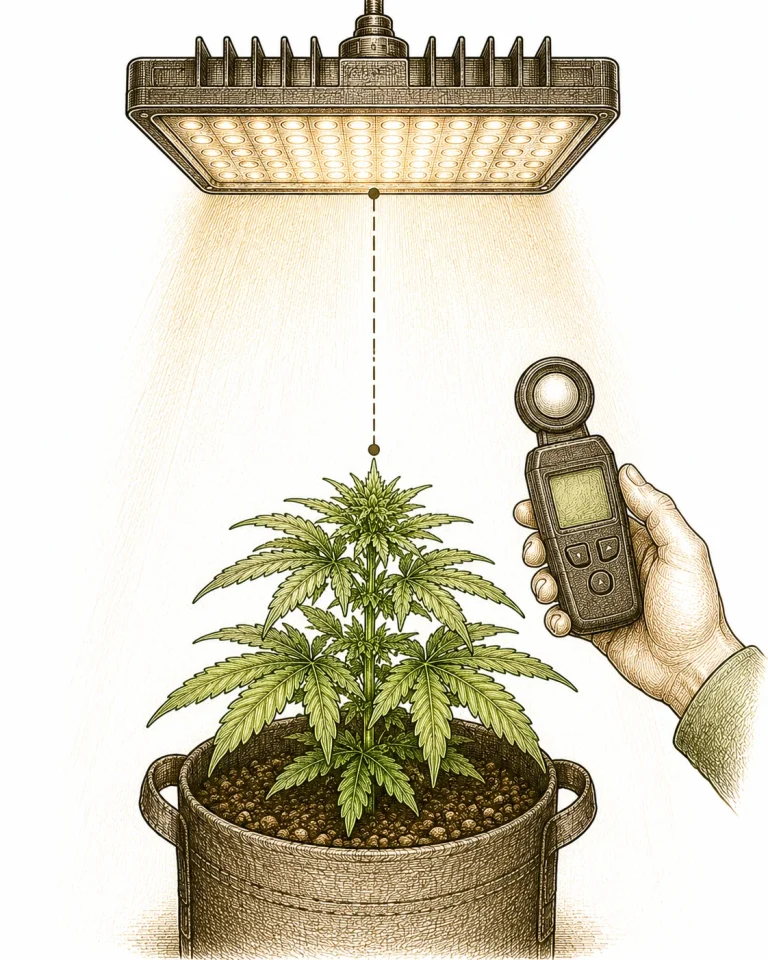
Even the best light won’t help if the distance is off. According to the Julius Kühn Institute, balanced light intensity is one of the most important factors for steady photosynthesis and healthy plant growth. Too close can cause light burn and heat stress: leaves turn pale, then brown, and new growth at the top curls upward. Too far away and your plants go light-hungry: stretched, weak plants with thin, airy colas. The right distance depends on the lamp type, wattage and reflector design.
As a rule of thumb, start with these distances: HPS 600W: 20–28 in (50–70 cm) in flower. LED quantum board 300W: 14–20 in (35–50 cm). CMH 315W: 16–24 in (40–60 cm). CFL: 4–8 in (10–20 cm). These are starting points. A PPFD meter (or a smartphone app like “Photone”) shows you exactly how much light reaches your plants.
DLI (daily light integral) is the key total for a whole light period: it tells you how many photons your plant gets per day and per square meter. Cannabis needs a DLI of 25–40 mol/m²/d in veg and 40–65 mol/m²/d in flower. The formula: DLI = PPFD × light hours × 3,600 / 1,000,000. A PPFD of 700 µmol/m²/s over 18 hours gives you a DLI of about 45 mol/m²/d, perfect for late veg.
Heads-up: light problems are often mistaken for nutrient deficiencies. Pale, yellowish leaves can point to too little light, but also to a calcium deficiency or other nutrient stress. Too much light can also cause yellow leaves, especially combined with heat stress. For a step-by-step diagnosis, check out our Plant Diagnosis hub. Light also affects nutrient uptake indirectly: with too little light, photosynthesis slows down and your plant uses fewer nutrients like nitrogen. That can easily lead to nutrient burn if you don’t adjust how much you feed.
- HPS 600W distance: 20–28 in (50–70 cm) in flower, down to 16 in (40 cm) with cooling
- LED QB 300W distance: 14–20 in (35–50 cm), check the manufacturer’s PPFD map
- Light burn: pale/brown spots at the top, leaves curling upward at the growing tips
- Light hunger: stretched internodes, thin stems, light green leaves
- The “Photone” smartphone app is a budget-friendly way to start measuring PPFD
- DLI target in flower: 40–65 mol/m²/d for maximum cola development
Light Cycle for Autoflower vs. Photoperiod Strains
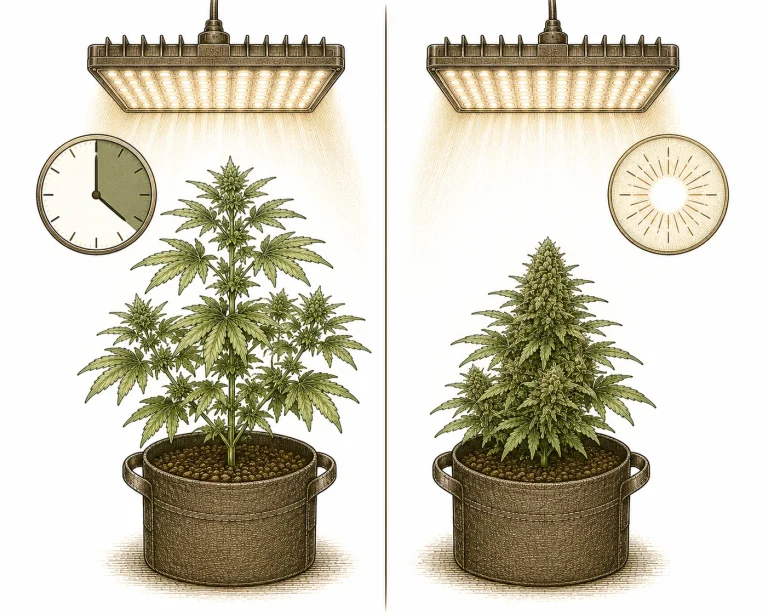
Photoperiod cannabis strains respond directly to the light cycle. In nature, they use day length as a signal for the changing seasons. In an indoor grow, you’re the one who sets that rhythm. The standard for photoperiod plants: 18/6 for veg, 12/12 for flowering. Switching to 12/12 is the signal to flower. From that moment on, most strains need 8–12 weeks until harvest.
Key point on a 12/12 cycle: the dark period has to be completely light-tight. Even a brief flash of light at night (just a few seconds through a leaky grow tent seam) can push the plant back into the vegetative stage or cause it to turn hermaphrodite. Seal your grow room carefully, never open the tent during the dark period, and let a reliable timer (German) handle the switch between light and dark exactly on schedule.
Autoflowering strains are different: they start flowering automatically at a genetically fixed age, no matter what the light cycle is. They carry ruderalis genetics that decoupled this mechanism from day length. Autoflowers do best under 18/6 or 20/4. More light means more energy for cola development. Some growers even run their autoflowers at 24/0, but a dark period of 4–6 hours gives the plants a rest and usually delivers better results.
Germination and the first few weeks follow their own rules: seedlings need less intense light. 50–200 µmol/m²/s is plenty for the first 10–14 days. Too much light during germination stresses the delicate seedlings and can slow their growth. Start with the lamp hung higher and lower it step by step as your plants grow.
- Photoperiod veg: 18/6 standard (or 20/4 for faster growth)
- Photoperiod flowering: exactly 12/12, keep the dark period completely light-tight
- Autoflowers: 18/6 or 20/4 from germination to harvest works best
- Germination: only 50–200 µmol/m²/s, start with the lamp far away
- Prevent light leaks: check your grow tent for light-tightness before flowering starts
- Risk of hermaphrodites if the dark period gets interrupted by light
Optimizing Your Cannabis Light Spectrum: Practical Tips for Bigger Yields
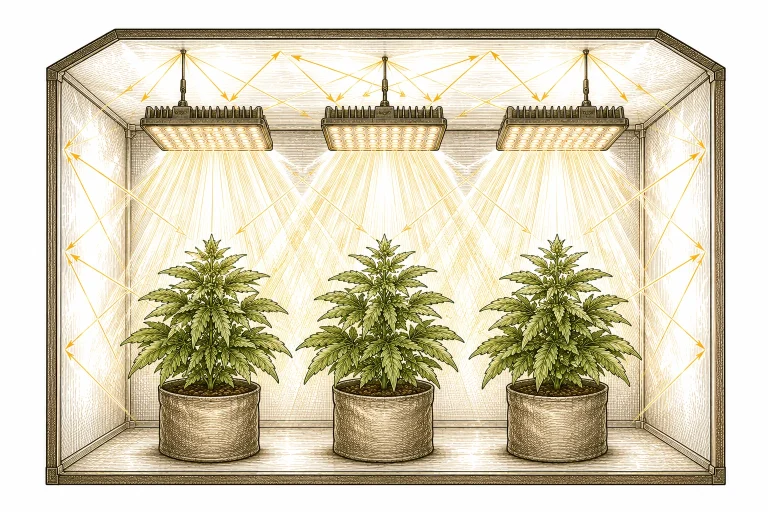
Light distribution is a factor many growers underestimate. Even a powerful lamp won’t do much if the light only hits the top leaves and the lower zones sit in the shade. Reflective walls (white paint, Mylar film or a dedicated grow tent lining) can boost usable light by 20–40 % without using a single extra kilowatt-hour.
Training techniques like LST (low stress training) or SCROG make sure all your bud sites grow at the same height and get even light. That’s one of the most effective ways to get the most out of your light. Not with more watts, but by spreading the photons you already have more evenly.
Temperature and light are closely linked. HPS lamps heat up a grow room fast, and with poor ventilation that can lead to heat stress, even when your PPFD is spot on. Proper watering matters more under strong light because the transpiration rate goes up. Check your leaf temperature regularly (target: 77–82 °F (25–28 °C)) and fine-tune lamp height, ventilation and watering together.
Finally, a look ahead: manufacturers like Fluence, Gavita and HLG are developing LEDs with precisely tuned spectra for every growth stage. Programmable light curves that simulate sunrise and sunset are designed to ease plants through the day and improve the terpene profile. For home growers on a tight budget, a good full-spectrum LED quantum board is still the safest and most efficient choice.
- Reflective white walls or Mylar film: up to 40 % more usable light
- SCROG and LST: even light on all bud sites without using more power
- Measure leaf temperature: target 77–82 °F (25–28 °C), make sure you have enough cooling with HPS
- Use a dimmer: many LEDs are dimmable, so dial them down to 30–50 % during germination
- Use a precise timer: digital timers accurate to the second keep your cycles exact
- Check your cannabis light spectrum with an app or PAR meter: take PPFD readings whenever you swap or buy a lamp
Frequently Asked Questions
How much light does cannabis need per day?
In the vegetative stage, cannabis needs a DLI of 25–40 mol/m²/d. With 18 hours of light, that works out to a PPFD of about 400–600 µmol/m²/s. During flowering, the DLI should climb to 40–65 mol/m²/d, which is roughly 600–1,000 µmol/m²/s over 12 hours.
What light spectrum does cannabis need during flowering?
During flowering, cannabis benefits most from red light in the 620–700 nm range. 660 nm (deep red) is especially ideal for chlorophyll a. On top of that, far-red (730 nm) at the end of the light period and UV-B in the last two weeks can boost trichome production.
Can I give cannabis too much light?
Yes. Above 1,000–1,200 µmol/m²/s without CO₂ supplementation, your plants hit light saturation. Photosynthesis doesn’t speed up any further, but heat stress and light burn can set in. Watch for bleached leaves at the tops and young leaves curling upward.
What happens if the dark period gets interrupted?
Even brief light interruptions during the 12-hour dark period can stall flowering or push your plant back into the vegetative stage. Worse, ongoing light leaks can trigger hermaphrodites. Your grow tent needs to be completely light-tight.
Which grow light is better for cannabis: HPS or LED?
Modern full-spectrum LEDs (quantum boards) use less power and run cooler at comparable light output. They also deliver a better cannabis light spectrum for every growth stage. HPS still offers excellent value for large grows and has a proven track record in flower. For beginners and small grows, LEDs are the top pick today.
Do autoflower strains need a different light cycle?
Autoflowering strains flower no matter what the light cycle is. Most growers run 18/6 or 20/4 from day one until harvest. More light means more energy and usually a bigger yield. The 4–6 hour dark period gives your plant an important rest.
How much of your light actually reaches the canopy is measured by the PPFD value. It’s a key factor right alongside the light spectrum itself.
The Bottom Line
Cannabis light spectrum and light duration aren’t complicated once you understand the basics. Blue light drives compact vegetative growth, red light drives maximum bud mass, and the light cycle is the switch between stages. With a modern full-spectrum LED quantum board, a reliable timer and reflective walls, you’re already in great shape. Keep your PPFD values on target and make your dark period completely light-tight. Adjust watering and feeding to your light intensity, because more light also means your plants use more water and nutrients. Dial in these settings and you lay the foundation for a healthy, high-yielding grow.
