

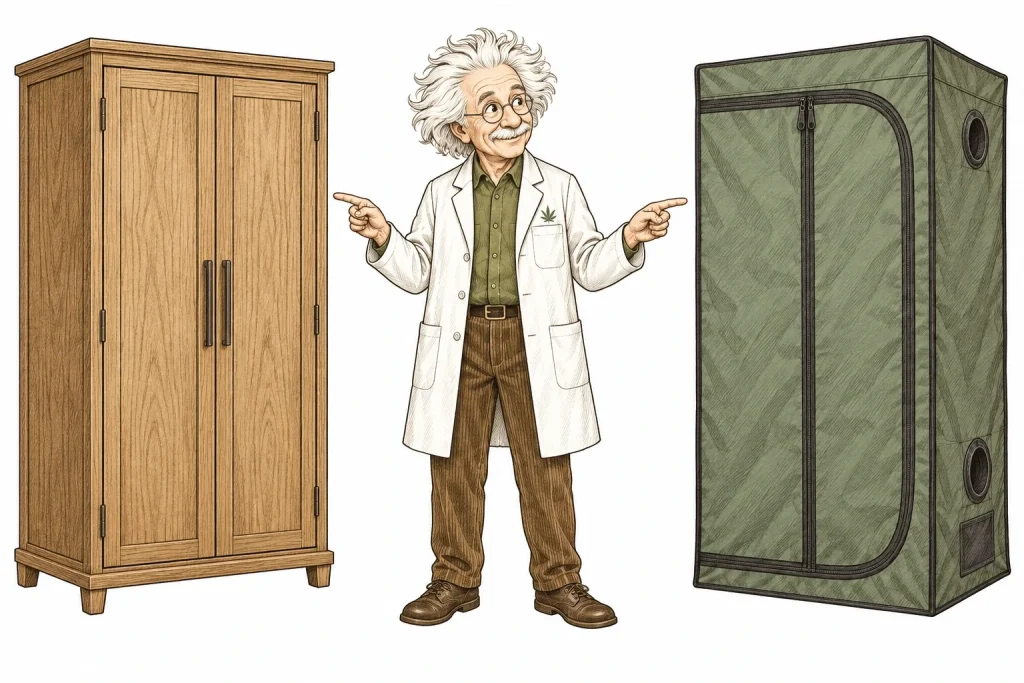
If you want to start growing indoors, you’ll quickly run into the cannabis grow cabinet question: buy a ready-made cabinet or go with a classic grow tent? Both have their place, but they differ a lot in price, discretion, footprint and flexibility. In this article, we compare both options in detail and show you which setup fits your space. That way you can make a smart buying decision instead of upgrading later.
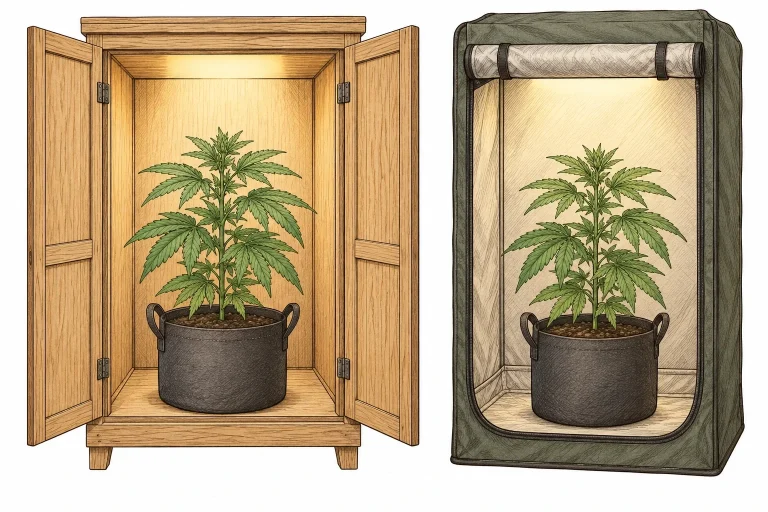
What Is a Cannabis Grow Cabinet?
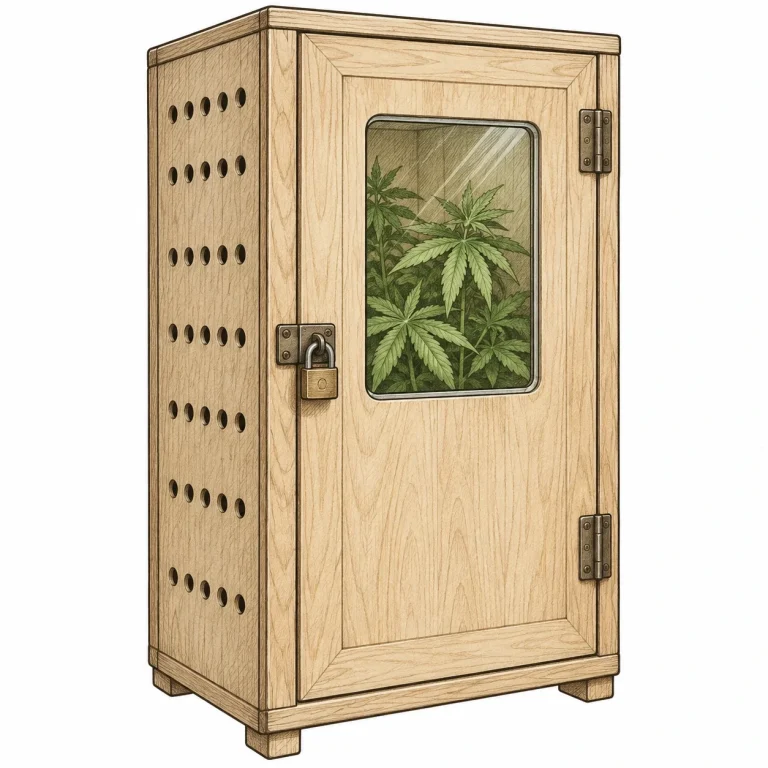
A grow cabinet is a solid, fully built cabinet, usually made of wood or metal, designed specifically for growing cannabis indoors. From the outside, it often looks like an ordinary wardrobe or sideboard. Inside, though, you’ll find reflective walls, lighting, ventilation openings and sometimes even a built-in exhaust system.
The big advantage of a grow cabinet is its look and its discretion. Many home growers want to keep their setup low-key in their living space. Check the cannabis laws where you live before growing. A grow cabinet blends into a living room or home office much better than a visible tent frame.
That said, grow cabinets usually cost a lot more than comparable grow tents. The sturdy build, the materials and the often pre-installed gear all come at a price. They’re also heavier and less flexible if you want to move them later or expand your grow.
- Solid, often furniture-style build made of wood or metal
- High discretion thanks to a low-key design
- Ventilation and lighting usually built in
- Much higher upfront cost than a tent
- Less flexible when you move or want to expand
What Is a Grow Tent and How Does It Work?
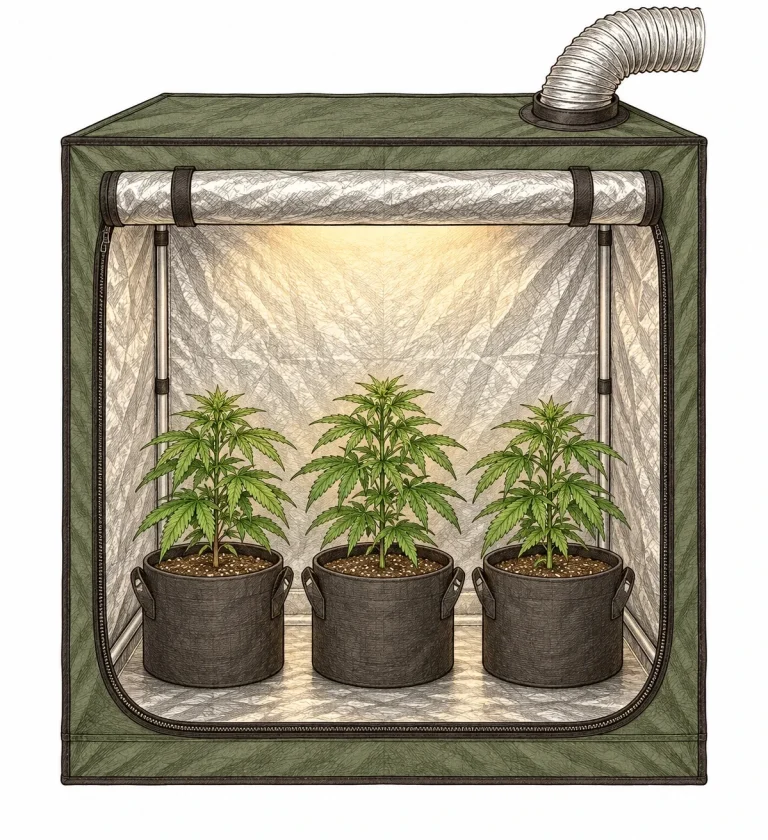
A grow tent is a sturdy aluminum frame covered with a tear-resistant fabric shell that’s reflective on the inside. You assemble it yourself, and it comes with plenty of ports for cables, intake and exhaust, plus viewing windows. Grow tents come in almost every size, from compact 2×2 ft (60×60 cm) models for a single plant to large 8×4 ft (240×120 cm) tents for several full-grown plants.
The biggest advantage of a grow tent is its flexibility combined with a low entry price. If you move to a new place or want to expand your grow space, you can simply take the tent down, transport it and set it back up somewhere else. You can put the money you save into high-quality components. Our guide on setting up a grow tent shows you how to combine them the smart way.
The downside: grow tents clearly look like grow gear. If you need maximum discretion, you’ll have to put the tent in a separate room like a basement or storage closet, where looks don’t matter.
- Low entry price: roughly $60 to $150 for small sizes
- Very flexible and easy to set up and take down
- Huge range of sizes for any number of plants
- Clearly recognizable as grow gear
- The fabric shell can wear out after a few years
Grow Cabinet vs. Grow Tent for Cannabis: Head-to-Head
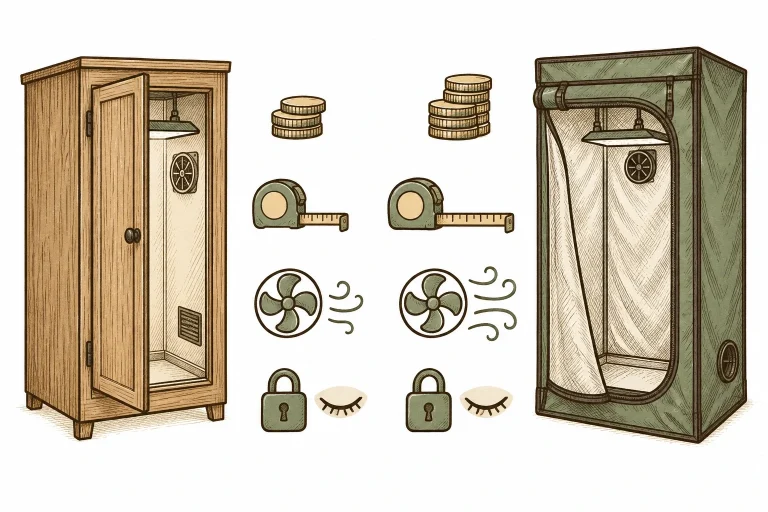
To make choosing between a grow cabinet and a grow tent easier, it helps to compare them on the five criteria that matter most. Both do the same job: they give your plants a closed, controllable environment. The differences are in the details.
On price, the grow tent wins hands down. A basic 32 x 32 in (80 x 80 cm) tent often costs less than $100, while a comparable grow cabinet can easily run $300 to $800 or more, especially if lighting and ventilation are already built in. Tents are also more practical for ventilation, thanks to all the pre-made ports for exhaust and intake air. With a grow cabinet, you often have to drill holes yourself. Either way, you need a well-planned grow tent ventilation setup so heat and humidity get pulled out reliably.
On discretion, the grow cabinet is the clear winner, because it looks like a regular piece of furniture. If your setup has to go in a shared living space, you’ll probably prefer a cabinet. For a basement, attic or spare room, though, a tent does the job just fine and is the far more budget-friendly choice.
- Price: grow tent is cheaper, grow cabinet costs more but is better built
- Discretion: grow cabinet is much less conspicuous
- Flexibility: grow tent is easier to move and expand
- Ventilation: grow tent offers more pre-made ports
- Durability: a sturdy grow cabinet usually lasts longer
Which Setup Is Right for You?
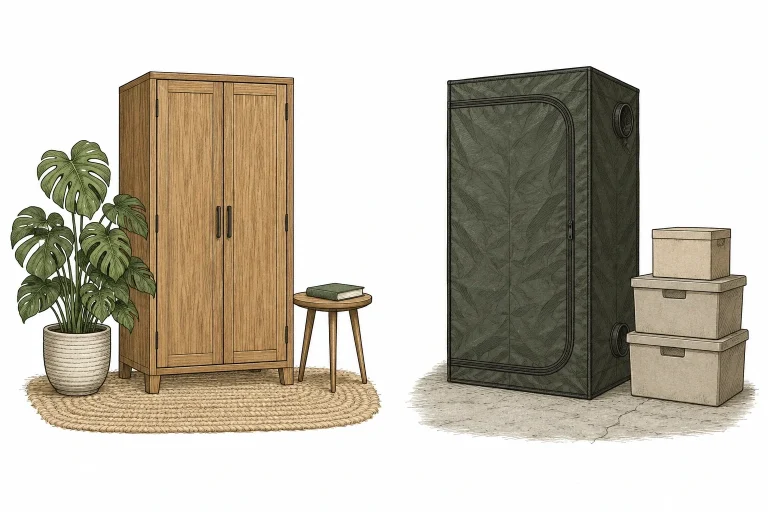
Choosing between a grow cabinet and a grow tent mostly comes down to your living situation and your budget. If you share an apartment with roommates or family and the setup has to go in a shared room, you’ll benefit from the inconspicuous look of a grow cabinet. And if you’re planning long term and don’t move often, the higher upfront cost can pay for itself over several grows.
If you’re a beginner who wants to try home growing first, a grow tent is often the better pick (check the cannabis laws where you live before growing). The lower price cuts your financial risk, and you can easily switch sizes for your next grow. Our grow tent comparison (German) shows which models come in 24 x 24 in (60 x 60 cm) and 32 x 32 in (80 x 80 cm). A tent also gives you more room to maneuver if you plan to switch from autoflowers to photoperiod strains later. Thanks to their longer vegetative stage, photoperiod plants usually get much bigger and need more height.
Another key factor with both setups is getting the right size for the number of plants. If you pick a tent or cabinet that’s too small, you can run into problems like root-bound cannabis from undersized pots, or stunted growth from a lack of headroom. So always plan some extra space for the flowering stage, when plants often shoot up quite a bit more.
- Grow cabinet: ideal for shared living spaces and long-term use
- Grow tent: ideal for beginners on a tight budget
- Grow tent: the better choice if you plan to change sizes
- Grow cabinet: makes sense when discretion is a top priority
- Both setups need enough height for the flowering stage
Key Buying Criteria for a Grow Cabinet or Grow Tent
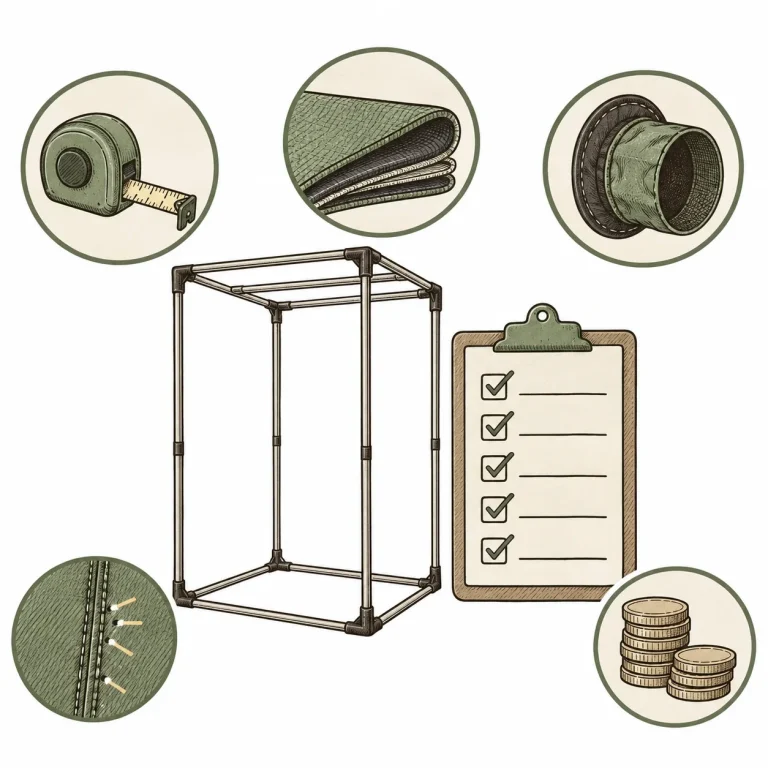
Whether you go with a grow cabinet or a grow tent, there are a few things you should always check before you buy. A realistic look at the total cost of your grow tent, gear and running costs saves you from nasty surprises. The thickness of the tent fabric or the cabinet walls affects how well outside light is blocked and how sturdy the whole setup is. Cheap tents with thin fabric can easily cave in when your exhaust is running hard.
Also pay attention to how many vent ports there are and where they sit. For an exhaust system that actually works, you need at least one port for intake air and one for exhaust. Ideally they’re at different heights, so air flows through the entire tent or cabinet. The interior lining matters too: Mylar reflects light a bit more efficiently than a flat white surface. What counts most is that there are no dark spots left that swallow light.
The right lighting is another key factor. Before you pick a grow light, check out our LED vs HPS for growing cannabis comparison to find the right tech for your cabinet or tent size. The max load of the top bars matters too if you plan to hang heavier lights or rope ratchet hangers.
- Check the thickness of the fabric or cabinet walls
- At least two vent ports for intake and exhaust
- Reflective interior lining for better light efficiency
- Mind the max load of the top bars
- Match the size to the number of plants and the height you plan for
Avoid Common Setup Mistakes
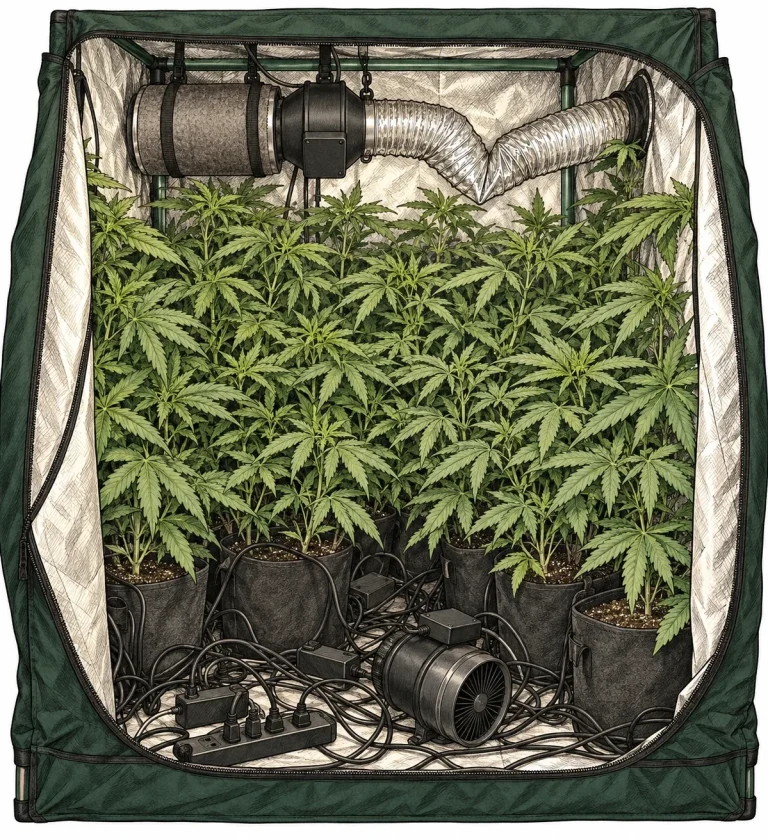
Grow cabinets and grow tents share the same setup mistakes, and they can cause trouble later on. A common one is an undersized exhaust, which leads to heat buildup and high humidity (relative humidity, RH). That invites mold and raises the risk of pests. If your exhaust alone can’t keep up, a dehumidifier for your grow tent can help. So figure out early how much fan power you need for the interior volume of your setup.
Another classic mistake is poor light-proofing, especially with photoperiod strains. Because of photoperiodism, they depend on a stable, uninterrupted dark period. Even small light leaks from zippers that don’t close properly or drill holes in a grow cabinet can disrupt the flowering stage and stress your plants. You’ll find more on the right cannabis light cycle settings in our separate guide.
Picking a setup that’s too small for the number of plants you want to grow also causes problems again and again. When things get too crowded, plants compete for light, which often leads to thin, weak shoots. If you’re already seeing thin cannabis stems, that can be a sign of too little space or light in your grow cabinet or tent.
- Always size your exhaust to the interior volume
- Check light-proofing regularly, especially around the zippers
- Don’t squeeze in more plants than your setup can reasonably handle
- Route cables and ducting neatly to avoid tripping hazards
- Plan regular cleaning to keep mold and pests away
Frequently Asked Questions
Is a grow cabinet for cannabis more expensive than a grow tent?
Yes, usually. A basic cannabis grow cabinet often costs somewhere between $300 and $800, while comparable grow tents start at around $60 to $150. The higher price of a cabinet comes from its sturdier build and the gear that’s often already built in.
Which is more discreet, a grow cabinet or a grow tent?
A grow cabinet is far more discreet because from the outside it looks like a regular piece of furniture. A grow tent is obviously a grow tent, so it works better in a separate space like a basement or storage room.
Can I ventilate a grow cabinet as well as a grow tent?
That depends on the model. Many grow tents come with more pre-made vent ports right out of the box. With a grow cabinet, you often have to cut extra openings for intake and exhaust yourself so the ventilation works well enough.
How many plants fit in a grow tent or grow cabinet?
That depends on the size. A compact 32 x 32 in (80 x 80 cm) setup usually fits one large plant or two smaller ones. Check the cannabis laws where you live before growing, and size your setup to match your plant count.
Is a DIY grow cabinet built from an old cabinet worth it?
Yes, it’s a budget-friendly alternative. Just make sure you get the ventilation, light-proofing and reflective interior walls right, so conditions can keep up with a professional grow cabinet or grow tent.
Made your choice and now looking for the right gear, like a grow tent, LED, exhaust or meters? On our Recommended Gear page you’ll find equipment that has proven itself in real grows. Our grow tent kit comparison compares complete kits with tent, light and exhaust.
Bottom Line
When it comes to a cannabis grow cabinet, the bottom line is this: whether a cabinet or a tent is the right pick depends mostly on your budget, your living situation and how discreet you need to be. If you want maximum stealth and plan to invest long term, a grow cabinet is a solid choice. Beginners and budget-minded growers are usually better off with a flexible grow tent. In the end, though, what matters more than the system itself is ventilation that actually works, enough space and a light-tight build. Nail these basics and you’ve laid the groundwork for a successful indoor grow. Check the cannabis laws where you live before growing. You’ll find more gear compared side by side in our equipment overview.
