

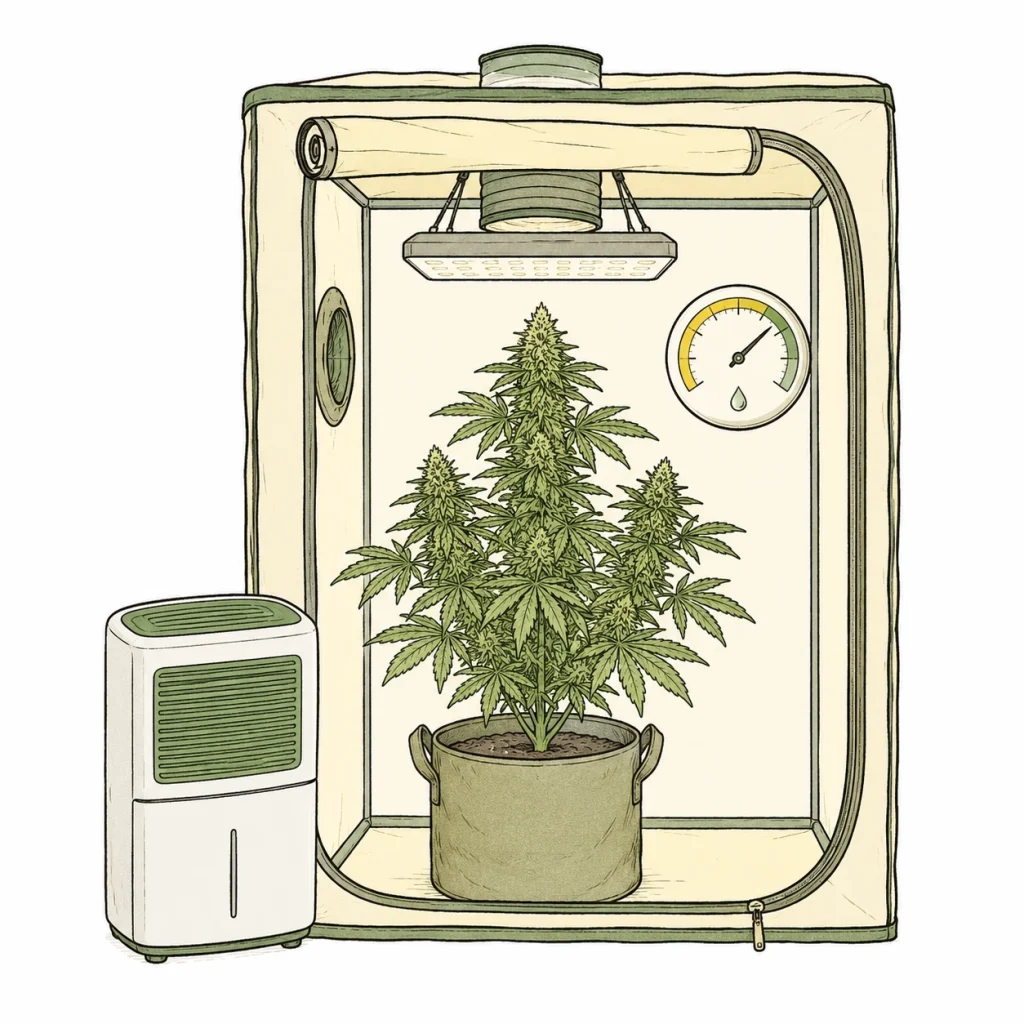
For many cannabis growers, a dehumidifier in the grow tent isn’t an optional extra but a real necessity – especially in late flower, when dense colas and high transpiration rates can quickly push relative humidity into the danger zone. Too much humidity in your grow opens the door to mold, bud rot (botrytis, gray mold) and powdery mildew, which can wipe out an entire harvest in just a few days. Choose a dehumidifier that’s right for your grow tent and install it properly, and you’ll reliably protect your plants and end up with denser, healthier buds. This guide covers everything you need to know about dehumidifiers in a cannabis grow: from the right unit size and optimal settings to the most common mistakes.
Why High Humidity in a Grow Tent Is Dangerous
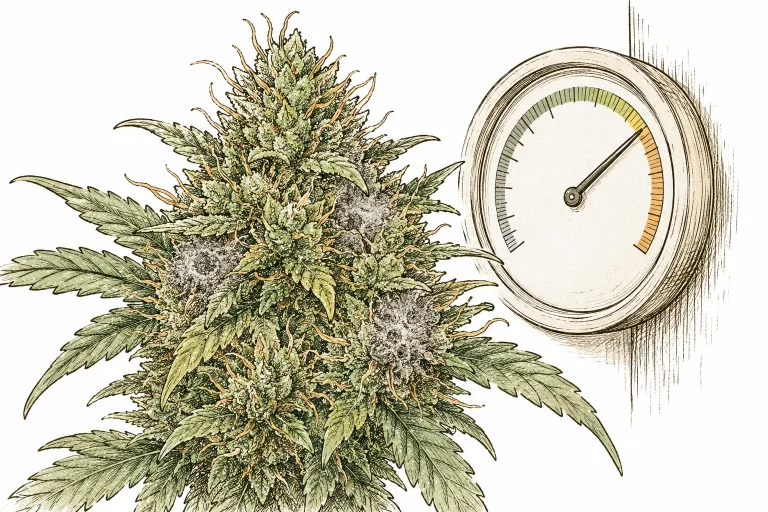
Cannabis constantly releases water through its leaves – in a process known as transpiration – and the more plants you have in a grow tent and the further flowering progresses, the more moisture the whole canopy releases into the surrounding air. In a closed or semi-closed grow tent, relative humidity (RH) can rise to 70, 80 or even 90 percent within a few hours – levels that, during the flowering stage are a serious problem for cannabis plants.
The most dangerous consequence of excess humidity is Botrytis cinerea, better known as bud rot. It thrives in dense colas where air barely moves, and it can grow from the inside out while staying invisible from the outside at first. Many growers only notice the problem once the bud turns brown and mushy – often too late. High humidity also favors powdery mildew as well as root and stem problems. Consistent humidity control isn’t about perfectionism – it’s about protecting your harvest.
Besides the direct damage to your plants, constant moisture can also damage the equipment in your grow tent. Corrosion on metal parts, mold on walls and tent fabric, and damaged ballasts or LED drivers are common results when humidity stays too high for weeks. So a quality dehumidifier for your grow tent protects not only your plants but also your investment.
- Flowering stage: RH above 50% noticeably increases the risk of bud rot
- From 60% RH in late flower: acute risk of mold
- High humidity promotes powdery mildew, root rot and pests
- Constant moisture can damage your equipment
- Dense colas are especially vulnerable because air barely circulates
Optimal Humidity for Every Growth Stage
Cannabis needs different humidity levels depending on the growth stage. During germination and the early seedling stage, high levels of 65–75% RH are ideal because the roots aren’t well developed yet and the plant takes up much of its water through its leaves and stem. As the roots develop, the plant becomes less sensitive and tolerates drier conditions better.
In the vegetative stage humidity should stay between 40 and 70% RH. The sweet spot here is around 50–60% – high enough for lush growth, low enough to minimize the risk of mold. By the time you switch to a 12/12 light cycle and flowering begins, at the latest, you should start lowering humidity step by step.
In early flower (weeks 1–4), aim for 40–55% RH. In mid flower (weeks 4–6), the target should drop to 40–50%. In late flower and the last two weeks before harvest, 35–45% RH is ideal. Some experienced growers even lower humidity to 30–35% in the final week, which is said to boost trichome production and minimize the risk of last-minute bud rot.
- Germination & seedlings: 65–75% RH
- Vegetative stage: 50–65% RH
- Early flower (weeks 1–4): 45–55% RH
- Mid flower (weeks 4–6): 40–50% RH
- Late flower & ripening: 35–45% RH
- Last 1–2 weeks: 30–40% RH for maximum safety
RH Reference Table: The Target Values for Each Stage
Because the running text and some other sections of this article mention slightly different ranges (for example in the humidifier section further down), use this narrower reference for day-to-day practice:
- Germination & seedlings: 65–75% RH
- Vegetative stage: 50–65% RH
- Early flower (weeks 1–4): 45–55% RH
- Mid flower (weeks 4–6): 40–50% RH
- Late flower & ripening: 35–45% RH
- Last 1–2 weeks before harvest: 30–40% RH
If a number elsewhere in this article differs, the narrower range here is the one to follow for cannabis in a grow tent.
Dehumidifiers for Grow Tents: What Types Are There?
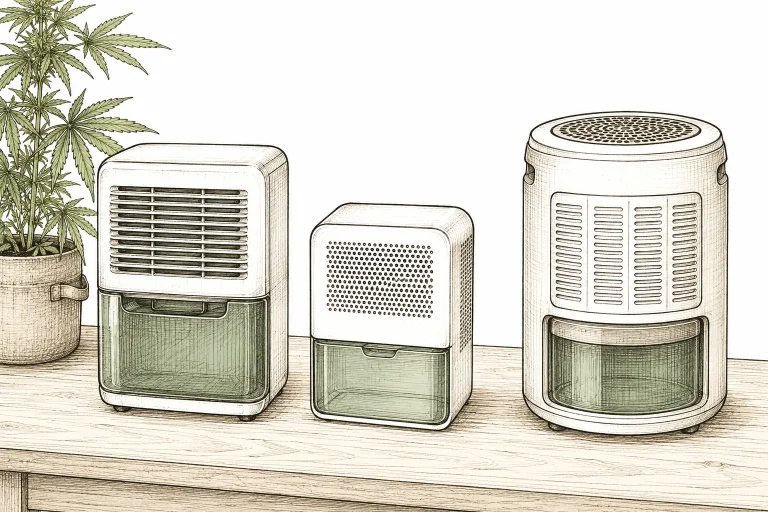
Not every dehumidifier is suitable for use in a grow tent. There are three basic types that differ considerably in how they work, how efficient they are and how well they suit a grow. The most common type is the compressor (refrigerant) dehumidifier. It cools a heat exchanger below the dew point so that moisture in the air condenses and collects in a tank. These units are energy-efficient and powerful, but they produce waste heat – which can be a problem in summer or in small tents.
A Peltier dehumidifier works on the same condensation principle but uses a thermoelectric effect instead of a compressor. These units are very quiet, use little electricity and produce hardly any heat – but they’re also much less powerful. They can be enough for small grow tents up to about 5.4 sq ft (0.5 m²), but they’re usually overwhelmed in larger setups.
Desiccant dehumidifiers (also called adsorption dehumidifiers) use hygroscopic materials such as silica gel to bind moisture. They work very effectively regardless of the ambient temperature – even at low temperatures, where compressor dehumidifiers reach their limits. However, they produce waste heat when regenerating the desiccant and use more electricity. Still, for winter grows in cold rooms or basements, they’re often the best choice.
- Compressor dehumidifier: most efficient, produces waste heat, effective from about 50 °F (10 °C)
- Peltier dehumidifier: quiet, no heat, only suitable for small tents
- Desiccant dehumidifier: ideal for cool environments, works at any temperature
- For grow tents of 10.8 sq ft (1 m²) and up: at least 21–42 pints/day (10–20 L/day) of dehumidifying capacity
- Watch the noise level: compressor dehumidifiers can be annoyingly loud
How to Size a Dehumidifier for Your Grow Tent
The biggest mistake when buying a dehumidifier for a grow tent is getting the size wrong. Manufacturers state dehumidifying capacity in pints (or liters) per day – but under ideal conditions (usually 86 °F (30 °C) and 80% RH). In a real grow with lower temperatures and a target humidity of 45–55% RH, actual capacity is often only half that. So plan generously and build in a safety margin.
As a rule of thumb: for a 2 x 2 ft (60 x 60 cm) grow tent with 2–4 plants, a unit rated at 21–25 pints/day (10–12 L/day) is enough. For a 2.6 x 2.6 ft (80 x 80 cm) tent, 25–34 pints/day (12–16 L/day) is recommended. For a 4 x 4 ft (120 x 120 cm) tent or larger, plan on 42–53 pints/day (20–25 L/day), or combine two smaller units. If your grow space is especially damp – in a basement, for example, or in a humid region – increase the target capacity by another 20–30%.
Another important factor is the water tank or drain. Many compact dehumidifiers have tanks that hold only about 1–2 qt (1–2 L). In a grow tent that’s running well, a unit can fill that tank in 12 hours or less – and then shuts off automatically. Either choose a unit with a continuous drain connection (hose straight to a drain) or plan on emptying it daily. In practice, a continuous drain is pretty much essential in a grow.
- 2 x 2 ft (60 x 60 cm) tent: 21–25 pints/day (10–12 L/day) of dehumidifying capacity recommended
- 2.6 x 2.6 ft (80 x 80 cm) tent: 25–34 pints/day (12–16 L/day)
- 4 x 4 ft (120 x 120 cm) tent: 42–53 pints/day (20–25 L/day)
- Basement or damp environment: add 20–30% to the base recommendation
- Continuous drain connection: essential in a grow to avoid shutoffs
- Cut the rated capacity in half for real grow conditions
Dehumidifier for Grow Tents – Placement and Setup
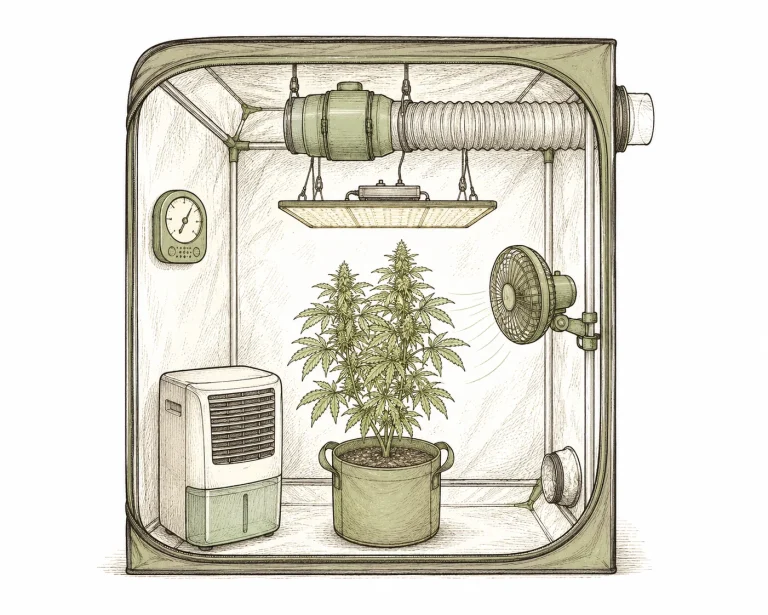
Where you place the dehumidifier in your grow tent is crucial for how well it works. Ideally, set it up so it can pull humid air directly from the canopy area – at bud height or just below. Many growers place the dehumidifier outside the tent and connect it to the inside with ducting. The advantage: waste heat and noise stay out of the grow space.
If you set the dehumidifier up inside the tent, make sure it doesn’t blow directly onto plants or buds – cold, dry air blowing straight onto colas can cause leaf damage or uneven drying. Position fans so they distribute the dehumidified air evenly through the tent. Hygrometers in several spots – especially deep in the canopy – help you monitor how humidity is actually distributed.
Also think about drainage: if you use a continuous drain, run the hose out of the tent into a bucket or straight into a drain. Make sure the hose has no kinks and the water can drain freely. Some growers combine the dehumidifier drain with their regular watering or use the condensate water for smaller plants – it’s essentially distilled water and contains no minerals.
For more advanced setups, a humidistat is a good idea – an automatic controller that only switches the dehumidifier on once a set humidity level is exceeded. That saves electricity and extends the unit’s lifespan. Many modern dehumidifiers have a built-in humidistat; for older models, you can add an external humidistat.
- Dehumidifier outside the tent: reduces heat and noise in the grow
- Don’t blow dry air directly onto the buds
- Continuous drain hose: free of kinks, secured against clogging
- Hygrometers in several spots, including inside the canopy
- Add a humidistat for automatic operation
- Condensate water can be used for watering
Common Mistakes When Using a Dehumidifier in Your Grow Tent
One of the most common mistakes is bringing in the dehumidifier too late. Many growers only buy one once they already see signs of mold or bud rot – but by then the problem is often well advanced. Start actively managing humidity as soon as your plants switch to flowering, not once symptoms show up. With humidity, too, prevention is much easier than damage control.
Another widespread mistake is pairing a dehumidifier that’s too small with a grow that’s too big. If the unit runs at full power all the time and humidity still doesn’t drop, that doesn’t mean the dehumidifier is broken – it simply means it’s undersized. Check its real-world capacity and upgrade if necessary. Sometimes combining a dehumidifier with a better exhaust system also helps move excess moisture outside.
Also, don’t forget to clean the dehumidifier’s filter regularly. Clogged filters reduce efficiency considerably and can damage the unit over time. Most manufacturers recommend cleaning every 2–4 weeks, more often in dusty or pollen-heavy grow environments. Keep in mind, too, that compressor dehumidifiers work less efficiently below 59 °F (15 °C) – in cool basements, a desiccant dehumidifier may be the better choice.
Finally, keep an eye on how your dehumidifier interacts with your exhaust system. Strong exhaust can move moisture outside, but it also pulls cold or warm outside air in – which, depending on the season, can raise humidity or destabilize temperature. The best solution is a balanced system of dehumidifier, exhaust and internal circulation fans that work together to keep conditions stable. If you want to read up on the basics, our guide to growing cannabis indoors also covers climate control.
- Starting too late: mold is often already visible before you take action
- Undersized unit: a dehumidifier running at full power nonstop is a warning sign
- Not cleaning the filter: significantly reduces efficiency and lifespan
- Cool environment below 59 °F (15 °C): compressor dehumidifiers lose effectiveness
- Exhaust imbalance: too much exhaust pulls humid outside air in
- No humidistat: the unit runs unnecessarily and wastes electricity
Alternatives to a Dehumidifier in Your Grow Tent
A dedicated dehumidifier is the most effective way to control humidity in a grow tent, but it’s not always the only option. Especially in small tents or when humidity is only moderately high, other measures can be enough or can usefully complement the dehumidifier. The first and most important addition is a properly sized exhaust system with a carbon filter. Exhaust that replaces the tent’s air volume several times per hour carries humid air outside – as long as the outside air is drier than the air inside. A properly sized exhaust kit with carbon filter does this reliably and keeps the smell inside at the same time.
Internal circulation fans greatly improve airflow in the canopy and reduce pockets of trapped moisture in dense buds. They don’t replace a dehumidifier, but they’re an important addition – because even when the room’s humidity is ideal, it can be much higher locally inside a dense cola. At least two fans blowing air through the canopy from different sides should be standard in every grow.
Defoliation – selectively removing large leaves during flowering – can improve airflow in the canopy and reduce moisture buildup. If you grow plants with very dense foliage, timely defoliation can noticeably lower the risk of mold. And don’t forget your watering amount: too much water at once leads to heavy transpiration and humidity spikes. Watering cannabis correctly is an underrated factor in humidity control.
- Strong exhaust: moves humid air outside, as long as the outside air is drier
- Internal circulation fans: prevent moisture pockets in the canopy
- Defoliation: improves airflow in dense plants
- Right watering amount: less water = less transpiration = less humidity
- Fewer plants: fewer plants = less total transpiration
- Silica gel packs: an emergency measure in very small tents
Raising Humidity: When You Need a Humidifier Instead of a Dehumidifier
Not every grow tent has too much moisture – especially in winter, with the heat running or in very dry indoor spaces, relative humidity can also be too low. If it stays below 40% in veg or below 60% for seedlings, plants react with curled leaf tips, slower growth and a VPD (vapor pressure deficit) that’s too high – the stomata close because the plant is losing too much water. In that case you don’t need a dehumidifier but the opposite: a humidifier.
A grow tent humidifier usually works as an ultrasonic or evaporative model and releases a fine mist or water vapor into the air. Here, too, a humidistat with an upper and lower limit is important so the unit shuts off automatically once the target is reached – otherwise constant over-humidifying opens the door to powdery mildew again. Use distilled or demineralized water if possible to avoid limescale deposits and fine mineral dust in your grow tent, and clean the tank regularly to prevent bacterial growth.
- Seedlings/clones: aim for 65–75% RH; a humidity dome is often enough instead of a device
- Vegetative stage: 50–65% RH; with dry heated indoor air, a small humidifier with a humidistat is worth it
- Flowering stage: RH is usually high enough from plant transpiration, so a humidifier is needed less often
- Alternatives without a device: water more during the day, put an open tray of water in the tent, turn the exhaust down slightly
For growers who switch between the vegetative stage and late flower, a combination unit that can both humidify and dehumidify can make sense – or simply two separate, smaller units you use depending on the stage. The VPD Calculator works best in both directions: it shows you whether the air is currently too dry or too humid for the growth stage you’re in.
Recommendations: Dehumidifiers for Grow Tents by Size
For small grow tents up to 2 x 2 ft (60 x 60 cm), compact Peltier dehumidifiers or smaller compressor units rated at 21–25 pints/day (10–12 L/day) are enough. Proven units in this category include the Ivation IVADM10 or similar compact models. These units are quiet and produce little heat – ideal for a cramped grow tent.
For medium tents from 2.6 x 2.6 ft (80 x 80 cm) to 3.3 x 3.3 ft (100 x 100 cm), compressor dehumidifiers rated at 25–42 pints/day (12–20 L/day) are recommended. Brands such as Meaco, EcoAir or Inventor are well established here and offer built-in humidistats and continuous drain connections. Investing in a quality unit pays off – cheap no-name dehumidifiers can work inconsistently and fail early. Four suitable units for tents up to 2.6 x 2.6 ft (80 x 80 cm) with a humidistat and hose drain are covered in our grow tent dehumidifier comparison.
For large tents from 4 x 4 ft (120 x 120 cm) or professional grow setups covering several square yards, you need powerful units rated at 42–63 pints/day (20–30 L/day) or a combination of several dehumidifiers. Professional setups often use dedicated air conditioners with a built-in dehumidifying function that control temperature and humidity together. If you have questions about why cannabis leaves turn yellow or about deficiencies that can result from humidity-related pH problems, our plant diagnosis resources are worth a look.
- Up to 2 x 2 ft (60 x 60 cm): Peltier or compressor dehumidifier, 21–25 pints/day (10–12 L/day)
- 2.6 x 2.6 ft to 3.3 x 3.3 ft (80 x 80 to 100 x 100 cm): compressor dehumidifier, 25–42 pints/day (12–20 L/day) with humidistat
- 4 x 4 ft (120 x 120 cm) and larger: 42–63+ pints/day (20–30+ L/day), possibly a combination of two units
- Professional grow: air conditioner with built-in dehumidification
- Brand tip: Meaco, EcoAir, Inventor for reliable performance
- Always: go for a continuous drain connection
How important controlled humidity and adequate ventilation are in enclosed growing spaces is also shown by the Bavarian Garden Academy (LWG) (German) in its fact sheet on small greenhouses: there, ventilating is considered more important than heating to prevent condensation and trapped moisture.
Frequently Asked Questions
When do I need a dehumidifier in my grow tent?
As soon as the humidity in your grow tent regularly climbs above 55–60% RH during the flowering stage, you should run a dehumidifier. In late flower, even 50% RH is borderline, despite good air circulation. If you grow in a damp basement or live in a humid region, run the dehumidifier from the start of flowering.
Can I use a regular household dehumidifier or a laundry dehumidifier?
Yes, standard household dehumidifiers generally work fine in a grow tent. Look for a continuous drain option, enough capacity for your tent size and a built-in humidistat. Units designed specifically for grows are often more compact and have more precise humidistats, but they usually cost more.
How much electricity does a grow room dehumidifier use?
Compact compressor dehumidifiers rated at 21–25 pints/day (10–12 L/day) usually draw 100–200 watts. With a humidistat that only switches the unit on when needed, actual consumption drops significantly – often to an average of 50–100 watts. Peltier dehumidifiers use less power (20–50 watts), but they also remove much less moisture.
My dehumidifier runs nonstop and the humidity still won’t drop – what should I do?
That’s a classic sign of an undersized unit or of a cause that dehumidifying alone can’t fix. First check whether your exhaust is pulling in more humid outside air, whether your plants are being overwatered or whether the tent has leaks. Often a combination of more exhaust and a stronger dehumidifier does the trick.
Can dehumidifying too much and running humidity too low cause harm?
Yes – especially in veg or with seedlings, air that’s too dry (below 30% RH) can cause stress. Leaves curl, the stomata close and growth slows down. Use a humidistat with an upper and lower limit to keep humidity in the target range. In flowering, the risk of humidity dropping too low is much lower.
Should the dehumidifier go inside or outside the tent?
Outside the tent is better if possible. That keeps the unit’s waste heat out of your grow space so it doesn’t throw off your temperature control. Connect the dehumidifier to the tent with flexible ducting. If that’s not possible, set it up inside, but not right next to your buds.
Conclusion
A well-chosen, properly installed dehumidifier in your grow tent is one of the most important investments any serious cannabis grower can make. It protects your harvest from mold and bud rot, stabilizes your climate and makes sure all your other growing parameters – light, nutrients, pH – can work to their full potential. Choose the unit based on your actual tent size and real humidity levels, not the manufacturer’s optimistic ratings. And if you need a thorough diagnosis of plant problems, our Plant Diagnosis hub has all the key information on deficiencies, pests and environmental stress. Start actively managing humidity no later than the switch to flowering – your future self at trimming time will thank you.
