

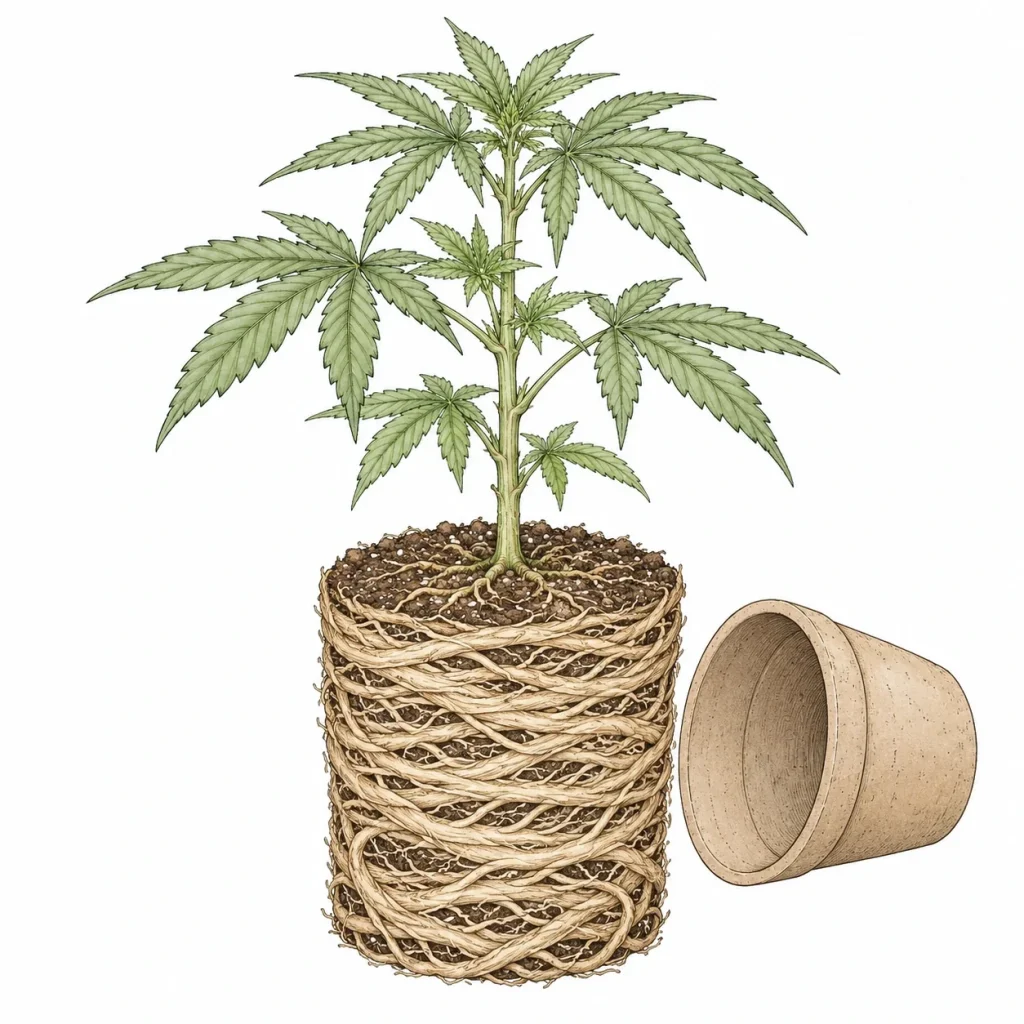
Your cannabis plant gets root bound when its roots have filled the entire pot and have no room left to grow. The result is a plant under constant stress. It can’t take up nutrients efficiently anymore, dries out in record time and stalls, even though you seem to be doing everything right. Here on PlantClue we see questions every day about yellow leaves, sudden stunted growth and drooping that seems to come from nowhere. In many of those cases, the pot is simply too small. In this article, you’ll learn how to reliably spot a root-bound cannabis plant, when and how to transplant the right way, and which pot size really fits each stage of your grow.
What Does Root Bound Mean for Cannabis?
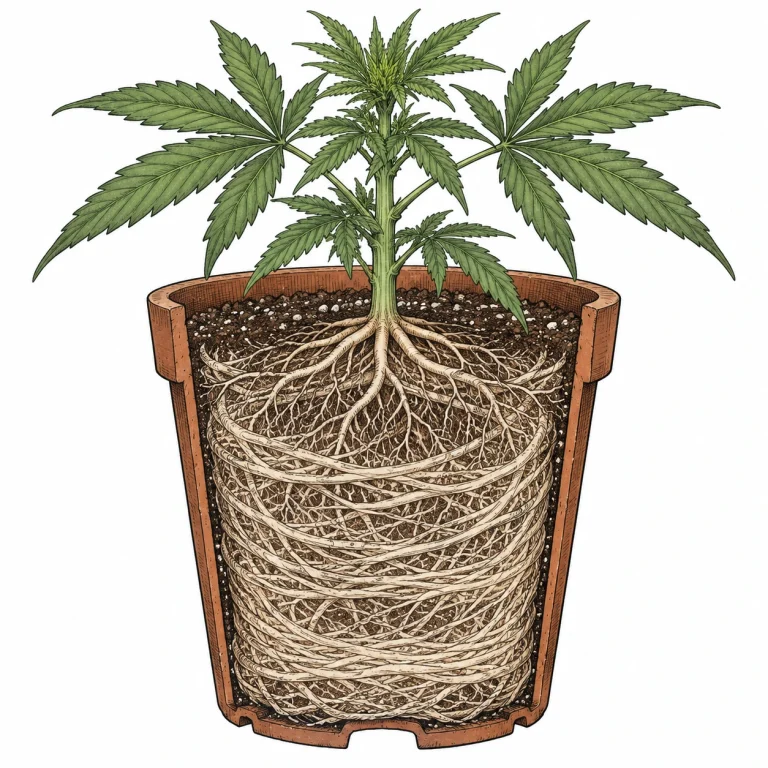
“Root bound” (often also called “pot bound”) describes a plant whose roots have grown so much that they fill all the available space in the pot. The roots start circling around the inside walls of the pot, grow out through the drainage holes or form a mat so dense that hardly any loose growing medium is left.
At first, that sounds like a sign of strong, healthy root growth. For a short time, it actually is. The trouble starts when this condition drags on and nothing is done about it. A root-bound system can’t absorb and distribute water evenly anymore. The root mass channels water straight down along the pot walls instead of letting it soak into the medium. This often leads to a lack of oxygen in the root zone on top of everything else. Nutrients move less efficiently, too, because the fine feeder roots can’t reach any fresh soil.
There’s also a hormonal effect. When roots hit resistance, the plant releases certain stress hormones that slow down growth above the soil. In a way, the plant tells itself there’s no room left to expand. In the vegetative stage, this can mean much slower growth in height and foliage. In the flowering stage, it can mean smaller buds and a lower final yield.
- Roots fill the entire inside of the pot
- Roots circle around the pot walls
- Roots visibly grow out of the drainage holes
- Hardly any loose growing medium left between the roots
- The plant releases stress hormones that slow down growth
Root-Bound Cannabis in a Pot That’s Too Small: The Symptoms to Watch For
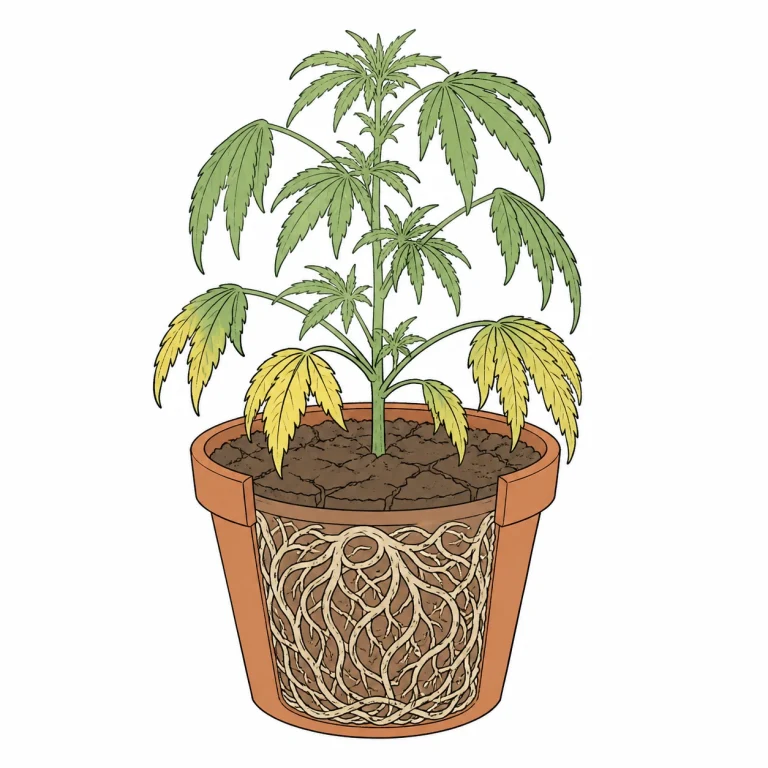
The tricky thing about a pot that’s too small is that the symptoms can look like completely different problems at first glance. Many growers read the signs as a nutrient deficiency or a watering mistake and end up treating the wrong cause, when the problem is literally at the root. Still, there are a few very typical signals that, taken together, clearly point to a root-bound plant.
The most obvious symptom is growing medium that dries out extremely fast. A pot with a normal root system stays moist for one to three days, depending on its size and the environment. A root-bound pot can dry out completely within twelve to twenty-four hours. That’s because there’s hardly any medium left to hold water. The root mass has pushed the soil out. Closely linked to this is frequent drooping: the plant hangs limp even shortly after watering, because water uptake can’t keep up with demand.
Another clear sign is growth that suddenly stalls or slows way down, even though light, temperature and feeding are all dialed in. New shoots barely develop, internodes stay short and the whole plant looks stuck. On top of that, yellow leaves can show up, mostly on the lower part of the plant, because the nutrient supply is limited. This can happen even when your pH is right and there are plenty of nutrients available. So if you spot yellow leaves on your plant, consider the pot as a possible cause.
The most direct symptom shows up when you look under the pot. Roots growing out through the drainage holes are a dead giveaway. Carefully lift the plant out of its pot. Don’t worry, you can do this without harming it. If the whole root ball is wrapped in a dense, white mass of roots that matches the exact shape of the pot, your plant is root bound.
- Growing medium dries out completely within 12–24 hours
- The plant droops again shortly after watering
- Growth suddenly stalls even though your care is on point
- Yellow lower leaves with no other obvious cause
- Roots visibly grow out of the drainage holes
- When you pull it out, the root ball has the exact shape of the pot: one dense clump of roots
Causes: Why Does Cannabis Get Root Bound?
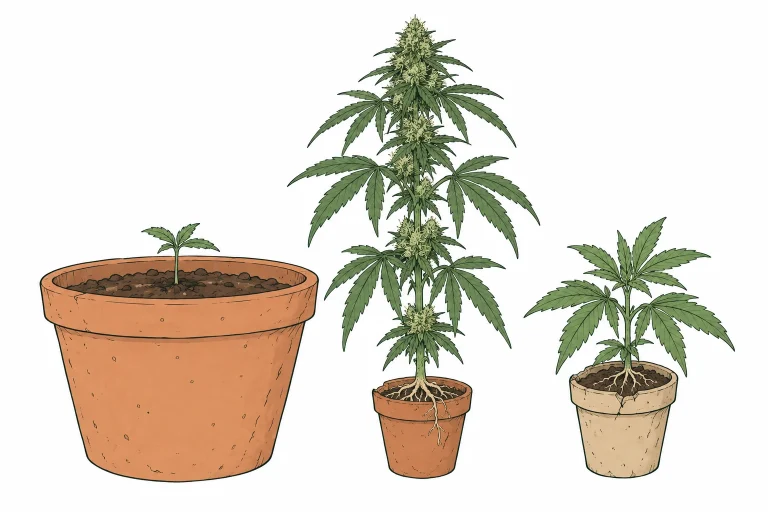
The most common cause is simple: starting in a pot that’s too small and not transplanting in time. Many beginners start in a 0.26 gal (1 L) pot and forget to move the plant up during the vegetative stage. Depending on the strain and conditions, cannabis can grow very fast in veg and fill its entire pot with roots in just two to three weeks.
Another reason is avoiding transplanting, on purpose or not, because you’re afraid of stressing the plant. That worry makes sense. Transplanting can cause some short-term stress. But being root bound causes far more stress, and it lasts longer than a careful transplant. If you want to learn how to water cannabis properly, you’ll quickly see that watering is closely tied to pot size. A pot that’s too small makes proper watering cycles pretty much impossible.
Root bound plants are especially common when you grow outdoors in containers (for an overview of all root problems, check out our article on cannabis root problems and their causes), because natural sunlight drives strong growth and the plants need a huge root zone. Outdoor plants in 4 or 5 gal (15 or 20 L) pots can be root bound by late summer, even though the same pot would still be big enough for an indoor plant of the same size.
Autoflowering strains are also more prone to root bound problems. Their life cycle is so short that every day of growth stress can directly cut into your final yield. With autos, it’s best to start in the final pot right away and skip the transplant risk altogether.
- Starter pot too small and no transplant in time
- Waiting too long between transplants
- Vigorous outdoor plants in pots that are too small
- Fear of transplant stress leads to skipping necessary steps
- Autoflowering strains are especially sensitive to a lack of root space
Root Bound Cannabis in a Pot That’s Too Small: How to Transplant the Right Way
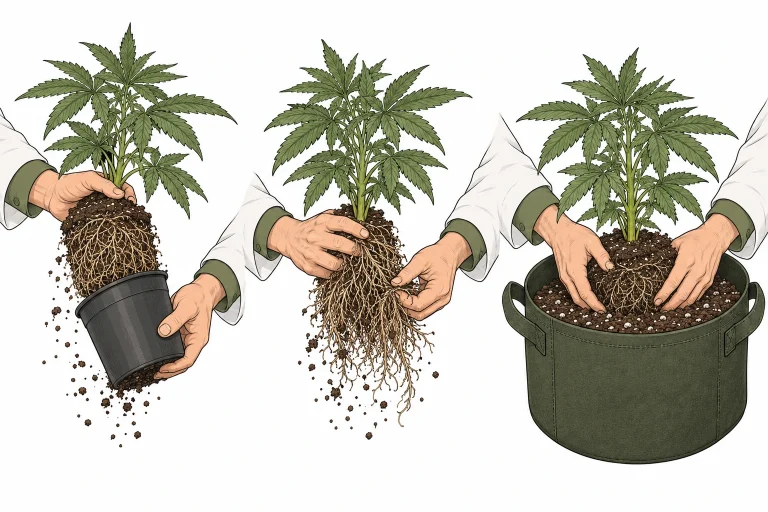
Transplanting is the only real fix for a root bound plant. If you do it right, it’s no big deal for your plant. The right time is whenever you spot two or more of the symptoms described above, or when roots are already growing out of the drainage holes. Cannabis handles transplanting just fine in the vegetative stage. In the flowering stage, try to avoid it if you can, because it can cause a lot more stress there.
Pick a new pot that’s about twice the size of the current one. The jump shouldn’t be too small or too big. A pot that’s too large can leave you with wet, oxygen-poor growing medium, because the roots can’t take up the water near the edges yet. That can trigger root problems, and you can learn more about them in our article on root oxygen deprivation in cannabis.
Here’s how to transplant: Water the plant two to three hours beforehand so the medium is slightly moist, not too dry and not too wet. Add fresh, loose growing medium to the bottom of the new pot so the old root ball will sit at the right height. Then carefully turn the old pot upside down and tap lightly on the bottom until the root ball slides out. Take a look at the roots: If they’ve circled around the walls, gently loosen them with your fingers and point them outward. Set the root ball in the center of the new pot and fill in the sides and top with fresh medium. Press it down gently, without packing it too tight.
After transplanting, water with lightly pH-adjusted water and no nutrients. Getting the pH for cannabis right is especially important now, so the roots can quickly spread into the fresh medium. For the next two to three days, keep the plant in a slightly shadier spot with reduced light intensity to keep transplant stress low. After about a week, you should see visible new growth.
- Choose a new pot: about twice the size of the old one
- Water lightly 2–3 hours before transplanting
- Gently loosen circling roots and point them outward
- Use fresh, loose growing medium and hold off on feeding right away
- After transplanting: pH-adjusted water, reduced light intensity for 2–3 days
- Avoid transplanting in the flowering stage whenever possible
The Right Pot Size for Every Growth Stage
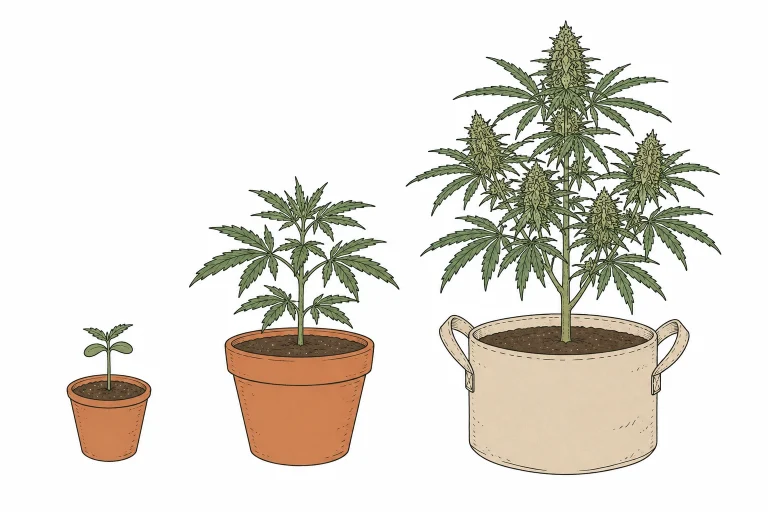
One of the most important decisions in growing cannabis is planning for the right pot size from the start. A rough rule of thumb: For every 12 in (30 cm) of plant height, you need about 2.6 to 3.2 gal (10 to 12 L) of pot volume. Of course, that’s just a guideline. It can vary with the strain, growing medium and growing style.
For seedlings and fresh clones, 0.13 to 0.26 gal (0.5 to 1 L) is plenty. These small containers actually help roots fill the medium faster and more evenly. As soon as the first roots reach the pot walls or show up at the surface (usually after one to two weeks), it’s time for the first transplant.
In the early vegetative stage, a pot of 0.8 to 1.3 gal (3 to 5 L) works well. After another two to three weeks, depending on the strain and how fast it grows, move up to 2 to 3 gal (7 to 11 L) for mid veg. For flowering a regular photoperiod strain indoors, start in a 3 to 5 gal (11 to 18 L) pot. For bigger plants or outdoor growing, go with 5 to 13 gal (20 to 50 L). Matching pot size to plant size also makes cannabis nutrient burn easier to avoid, because the growing medium can buffer nutrients better when the ratio is balanced.
Fabric pots are a great alternative to classic plastic pots when it comes to root bound plants. They air-prune the roots: as soon as a root reaches the porous wall, contact with the air stops it, and the plant grows more side roots instead. The result is a denser, more efficient root system, and true root-bound growth is naturally held back. Want to know which sets are worth it? Check out our fabric pot comparison (German).
- Seedlings and clones: 0.1–0.25 gal (0.5–1 L)
- Early veg: 0.8–1.3 gal (3–5 L)
- Mid veg: 2–3 gal (7–11 L)
- Indoor flowering, normal size: 3–5 gal (11–18 L)
- Larger indoor and outdoor plants: 5–13 gal (20–50 L)
- Fabric pots prevent root bound plants by air-pruning the roots
- Rule of thumb: about 2.5–3 gal per 12 in of plant height (10–12 L per 30 cm)
Root Bound in the Flowering Stage: What to Do When Transplanting Is Too Risky
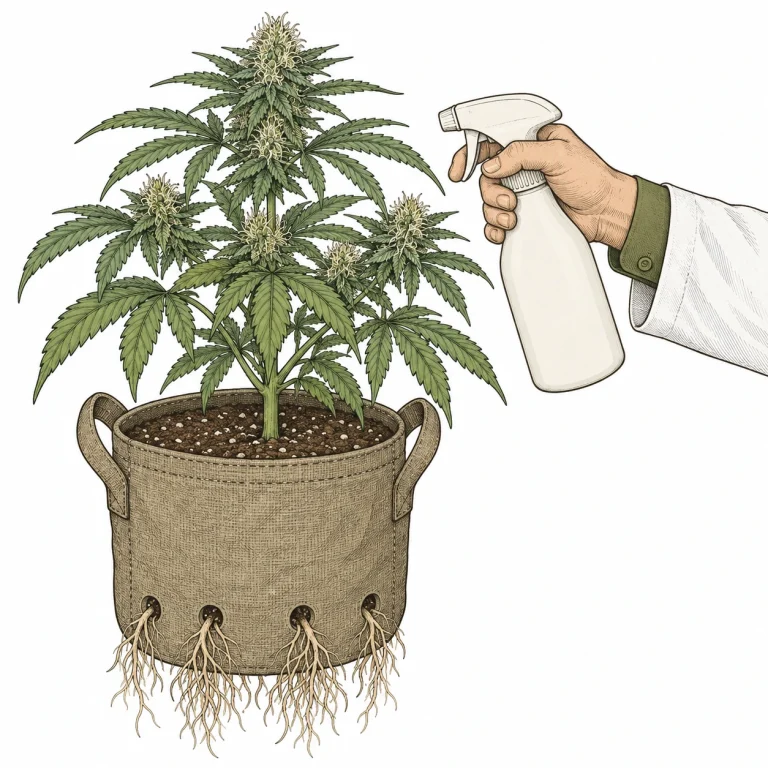
What if you only spot the root bound problem once your plant is already flowering? Transplanting in flower is possible, but risky. The stress can trigger hermaphrodites or stretch out the flowering time. If your plant is already in week three of flower or later, a different approach is usually the better call.
Water noticeably more often to make up for the fast water loss. Switch to pure root stimulants and lightly concentrated, fast-acting nutrients to get the most out of the limited uptake. Cut your overall feeding back a little, because a root-bound medium builds up salts faster. Oddly enough, that can make deficiencies look worse. Gentle flushing with pH-adjusted water every ten to fourteen days helps reduce salt buildup.
In early flower (weeks one to two), you have one more option: carefully transplant into a pot that is only slightly bigger, for example from 2 to 3 gal (7 to 11 L). If you keep the root ball as intact as possible and barely damage any roots, the stress stays manageable. Calcium deficiency often shows up in root-bound plants. Calcium is tied up in cation exchange in the medium and gets released less easily in overcrowded pots. If you see those symptoms, read up on calcium deficiency in cannabis.
Either way, the best fix for root bound plants in flower is prevention. If you moved your plants into big enough pots when switching from veg to flower, you won’t have to worry during the most critical stretch of your grow.
- Late flower (week 3 and later): avoid transplanting
- Water more often to keep the medium from drying out
- Reduce your nutrient dose slightly to avoid salt buildup
- Gently flush with pH-adjusted water every 10–14 days
- Early flower (weeks 1–2): careful transplanting with an intact root ball is possible
- Watch for calcium deficiency symptoms and correct early
How to Prevent Root Bound Cannabis: Plan Your Grow the Right Way
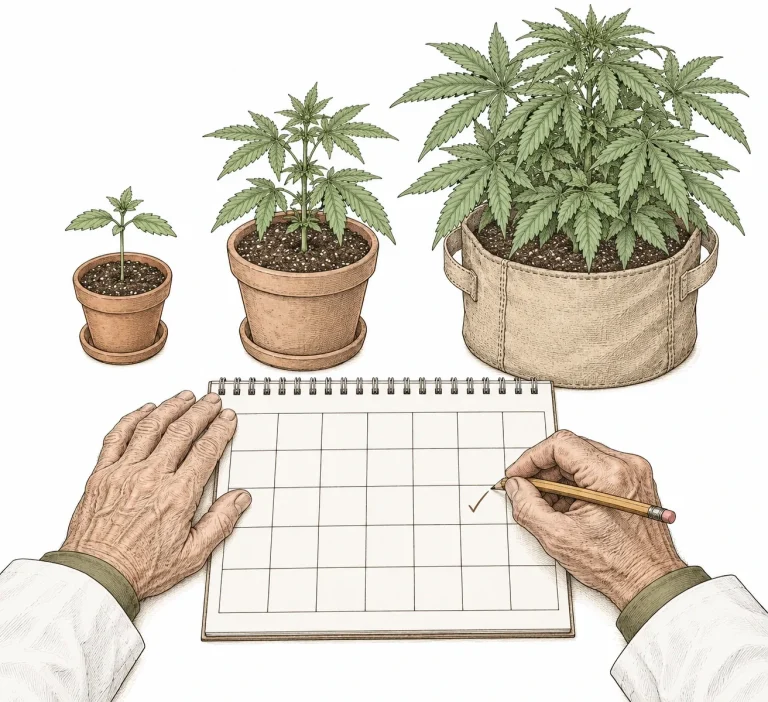
Prevention always beats damage control. If you make a clear transplant plan from day one, you can avoid root bound problems almost entirely. When you start your grow, write down which week you plan to move from which pot to which. As a rough guide: seedling in 0.1–0.25 gal (0.5–1 L), after one to two weeks into 0.8–1.3 gal (3–5 L), after another two to three weeks into 2–3 gal (7–11 L), and then, if needed, into the final flowering pot.
Check the drainage holes of your pot regularly, about once a week. As soon as you see the first fine, white root tips, it’s time to transplant. That’s the sweet spot: the plant has filled the whole pot but isn’t stressed by a lack of space yet.
Use a quality, airy growing medium with good drainage from the start. Heavy, dense soil compacts faster and gives the roots less oxygen, which indirectly makes root bound problems worse. For more, check out our complete indoor guide: Growing Cannabis Indoors covers choosing your medium and pots in detail for beginners.
Autoflowering strains follow their own rule: start them directly in a final pot of 2.5 to 4 gal (10 to 15 L). Autos run on a genetically fixed life cycle, so they have no time to recover from transplant stress. The apparent downside, that the medium dries out more slowly at first, is clearly the right trade-off for autos.
- Write down a transplant plan before you start your grow
- Check the drainage holes for root tips every week
- Use a loose, well-draining growing medium from day one
- Transplant as soon as the first roots reach the drainage holes
- Start autoflowering strains straight in their final pot (2.6–4 gal / 10–15 L)
- Consider fabric pots as a long-term way to prevent root binding
Frequently Asked Questions
How can I tell for sure if my cannabis plant is root bound?
The surest way is to slide the root ball out of the pot. If the root ball is completely wrapped in a dense mass of white roots and holds the exact shape of the pot, your plant is root bound. Other signs: the medium dries out within 12–24 hours, the plant wilts even though you water enough, and roots grow out of the drainage holes.
Can I still save a root-bound cannabis plant in flower?
Yes, but your options are limited. In weeks 1–2 of flower, you can still carefully transplant with the root ball intact. From week 3 on, you’re better off watering more often, dialing back your nutrients a little and doing a gentle flush every 10–14 days. That gets the most out of your plant, even if the early root-bound stress can cost you some yield.
What pot size is ideal for cannabis in the flowering stage?
For average-sized indoor plants, 3–5 gal (11–18 L) is a good rule of thumb for the flowering stage. For big, bushy indoor plants or outdoor grows, go with 5–13 gal (20–50 L). The rule of thumb: about 2.6–3 gal (10–12 L) for every 12 in (30 cm) of plant height. Fabric pots are a great choice in any size, since they prevent root binding through natural air pruning.
Can being root bound cause nutrient deficiencies?
Yes, root-bound plants often show signs of a nutrient deficiency even when your nutrients and pH are spot on. The cause is limited nutrient uptake: too little free growing medium and stressed roots. Calcium and magnesium deficiencies are especially common in these situations. The real problem is lack of space — transplanting is the only lasting fix.
Are fabric pots really better against root binding?
Yes, fabric pots have a clear advantage: as soon as roots reach the porous wall and hit air, they stop growing, and the plant puts out more fine side roots instead. This “air pruning” creates a denser, more efficient root system and prevents the circling roots that are the hallmark of a classic root-bound plant. Fabric pots also dry out more evenly and give the roots more oxygen.
How often do I need to transplant a cannabis plant?
That depends on the strain, how fast your plant grows and which pot sizes you use. As a rule of thumb, plan on two to four transplants over the whole grow. A typical schedule: start in 0.1–0.25 gal (0.5–1 L), move up to about 1 gal (3–5 L) after 1–2 weeks, then to 2–3 gal (7–11 L) after another 2–3 weeks, and into the final pot when you flip to flower. Start autoflowering strains directly in their final pot to avoid transplant stress.
The Bottom Line
Root-bound cannabis is one of the most common and most easily overlooked problems in a grow. The good news: it is also one of the easiest to fix if you catch it early. A pot that dries out fast, stalled growth and roots poking out of the drainage holes are clear warning signs you shouldn’t ignore. With a solid transplant plan, the right pot size for each stage and ideally fabric pots, you can reliably prevent root binding and give your plant the room it needs for strong growth and a heavy harvest. If you spot other problems with your plant, the Plant Diagnosis overview on PlantClue walks you step by step through all the common issues.
