

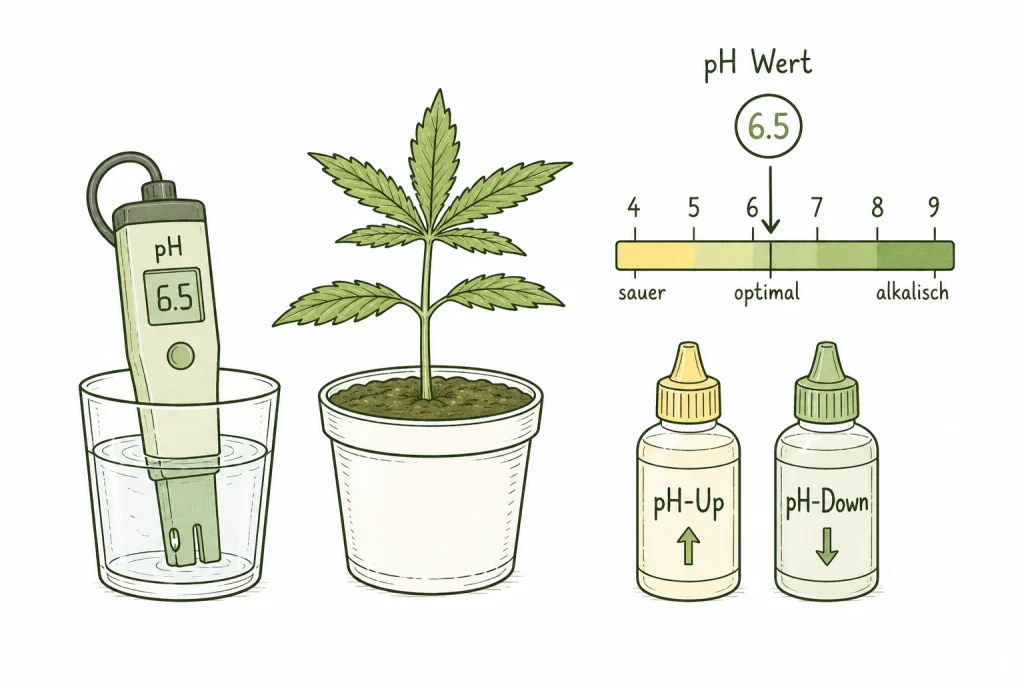
Knowing how to adjust your cannabis pH level is one of the most important basic skills in growing — and also one of the most common sources of mistakes for beginners. Even if light, water and nutrients are on point, the wrong pH can still make your plant look sick or stop growing.
Whether you call it cannabis or marijuana, pH affects your plant’s nutrient uptake in exactly the same way.
The reason is nutrient uptake: cannabis can only actually absorb the minerals from the growing medium or nutrient solution when the pH is in the right range. If it falls outside that window, nutrient lockout sets in — the plant starves even though plenty of nutrients are available.
Especially in indoor growing , a stable pH is critical, because mistakes in a controlled environment have a faster and stronger effect than outdoors. pH also plays a direct role when watering cannabis the right way , because your water is the main carrier for nutrients and pH adjustments.
In this article, you’ll learn which pH levels are optimal, how to measure them correctly, how to adjust and correct the pH when growing cannabis — and which mistakes you should avoid at all costs.
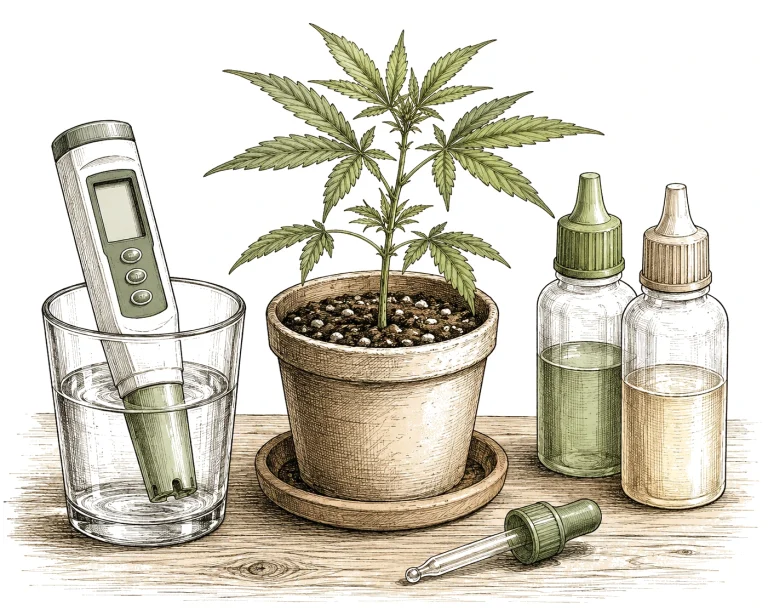
What Is pH and Why Does It Matter When Growing Cannabis?
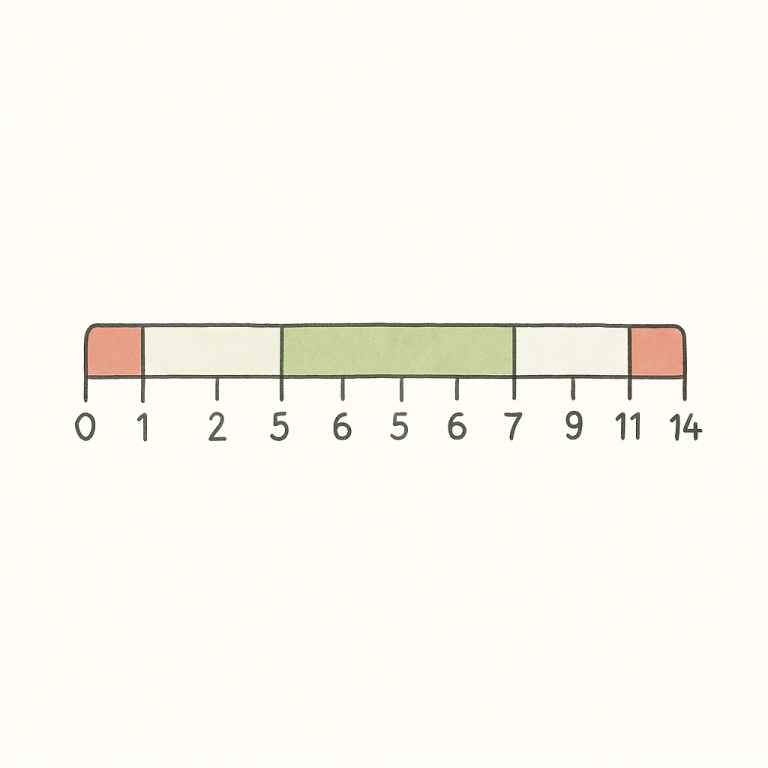
To understand why adjusting your cannabis pH level is so important: pH indicates the concentration of hydrogen ions in a solution and determines whether a medium is acidic, neutral or alkaline. The scale runs from 0 to 14 — below 7 is acidic, above 7 is alkaline, and exactly 7 is neutral.
This value is so crucial for cannabis because plant roots don’t simply absorb nutrients passively — uptake relies on chemical processes that only work at certain pH levels. Nitrogen, phosphorus, potassium and micronutrients like iron or manganese each have different pH windows in which they’re bioavailable.
If the pH is outside that window, insoluble compounds form that the roots can’t absorb. You can feed as much as you want — the nutrients stay trapped in the growing medium. This is called nutrient lockout, and it’s the most common reason for seemingly unexplainable deficiencies in cannabis.
A recent study by Veazie et al. (2025) shows that even small changes in the pH of the growing medium can significantly affect micronutrient availability in cannabis.
Optimal pH for Cannabis: Soil, Coco and Hydro Compared
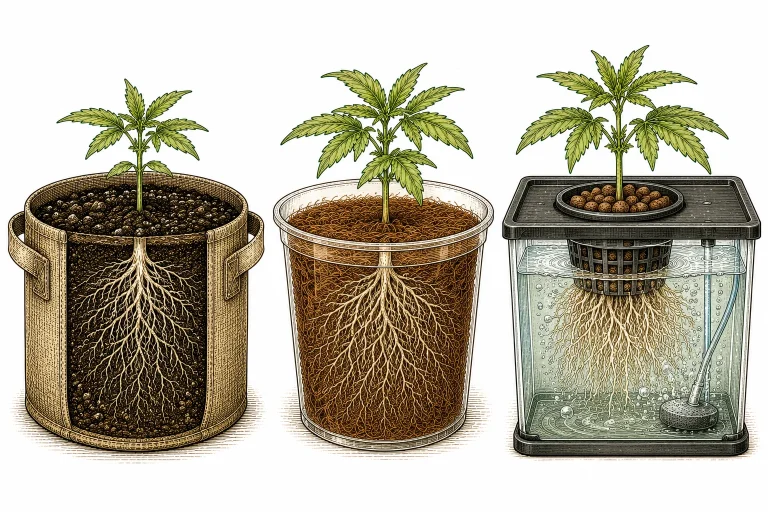
Adjusting your cannabis pH always means knowing the right target range for your medium, because the optimal pH range depends directly on what you grow in. Thanks to its organic matter, soil buffers pH swings more strongly than coco or hydro — that makes it more beginner-friendly, but also slower to respond to corrections.
| Medium | Optimal pH range | Critical range (problems) |
|---|---|---|
| Soil | 6.0 – 7.0 | below 5.8 or above 7.2 |
| Coco coir | 5.5 – 6.5 | below 5.3 or above 6.7 |
| Hydroponics | 5.5 – 6.5 | below 5.3 or above 6.8 |
pH in Soil
In soil, the ideal target is 6.2–6.5; with organic nutrients you can even go a bit higher, to 6.5–6.8 — in practice, organic growing tends to be more forgiving of pH swings than mineral feeding (source: Christian Büser, Merseburg University of Applied Sciences, talk “Easy Growing,” 2024). Soil buffers swings through its organic matter and soil life — small deviations within the range aren’t a problem, and a simple test strip is enough for most situations.
pH in Coco Coir
In coco coir, the target window of 5.5–6.5 is narrower and the buffering effect is much weaker than in soil. A digital meter is a must here, because test strips aren’t accurate enough. Coco that hasn’t been pre-rinsed (German) also releases calcium, which can push the pH up in the first few weeks — so check the runoff regularly.
pH in Hydroponics
In hydroponic systems, the 5.5–6.5 window is the tightest, because there’s no buffering medium at all — swings take effect fastest here. A digital meter is essential. Within the optimal range, letting the pH drift slightly between the lower and upper value is actually beneficial: different nutrients take turns being especially available. This deliberate drift is called pH cycling — a trick experienced growers use to improve the plant’s overall nutrient supply.
How to Measure pH Correctly: Methods and Tools
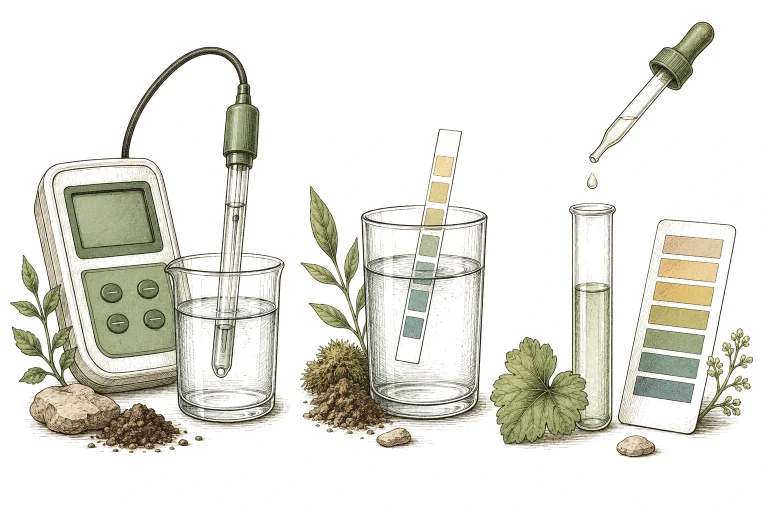
Before you can adjust your cannabis pH level, you need a reliable way to measure it. Without accurate readings, every correction is guesswork. There are three common methods:
Digital pH meter
A digital pH meter is the most accurate and practical solution — we compare dedicated pH testers for soil, coco and hydro in our pH meter comparison (German). Good entry-level meters are inexpensive; for an overview of suitable models, see our pH and EC meter comparison (German). Important: the electrode needs to be calibrated regularly — ideally once a month with calibration solution (pH 4.01 and pH 7.01). An outdated calibration gives wrong readings and leads to wrong corrections that make the problem worse instead of solving it.
pH test strips
Test strips are cheap and simple, but much less accurate. They work for rough checks when no meter is at hand. They’re not suitable for precise corrections or for coco and hydro — too inaccurate and too hard to read in colored solutions.
pH drop test (liquid test)
Liquid drop tests are more accurate than strips and cheaper than meters. They’re a solid stopgap for beginners, but need a clean, clear solution for reliable results. In strongly colored or cloudy water, reading the color is difficult.
For serious growing, a digital meter is clearly the way to go. To find out which models are really worth it, read our article on cannabis meters — pH and EC meters.
How to Adjust Cannabis pH: Step-by-Step Guide
Once you know your current pH, you can start adjusting your cannabis pH level in a targeted way. The process is always the same — whether in soil, coco or hydro:
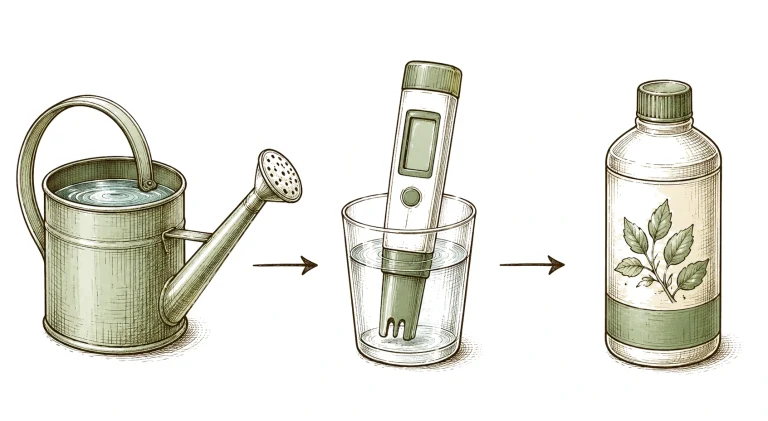
- Prepare your water: Fill up your water or nutrient solution. If possible, use filtered tap water or tap water that has been left to stand — chlorine can affect pH stability.
- Add nutrients first, then measure: Add your nutrients or nutrient concentrates before you adjust the pH. Nutrients change the pH of the solution — if you reverse the order, you’ll have to start over after feeding.
- Measure the pH: Measure the current value with your calibrated meter and write down the result.
- Add pH adjuster: If the value is too high (alkaline), use pH Down — usually phosphoric acid or citric acid. If it’s too low (acidic), use pH Up — usually potassium hydroxide.
- Adjust drop by drop: Add the pH adjuster only drop by drop. In small amounts of water, a single drop can shift the pH by 0.5–1.0 points. Slow is fast.
- Stir and measure again: Stir the solution well and wait 30 seconds before measuring again. Repeat until the value is within the optimal range.
- Check the runoff: Every second time you water, also measure the runoff at the bottom of the pot. If the runoff differs significantly from your input value, a pH problem has built up in the growing medium.

Checking the runoff is a step many beginners skip — and that means they miss the most important early warning sign of pH problems in the growing medium.
pH Too High: Causes and Fixes
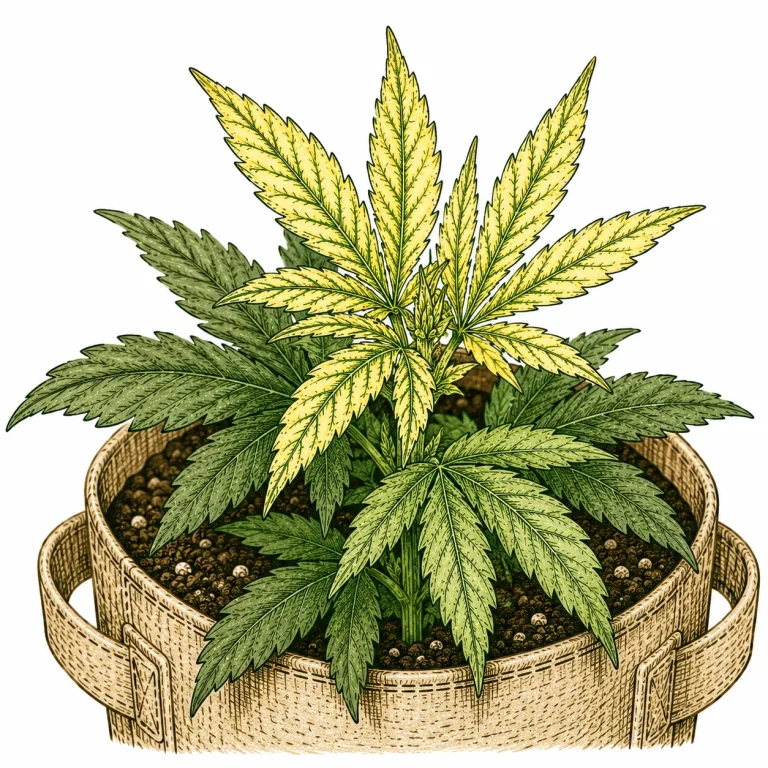
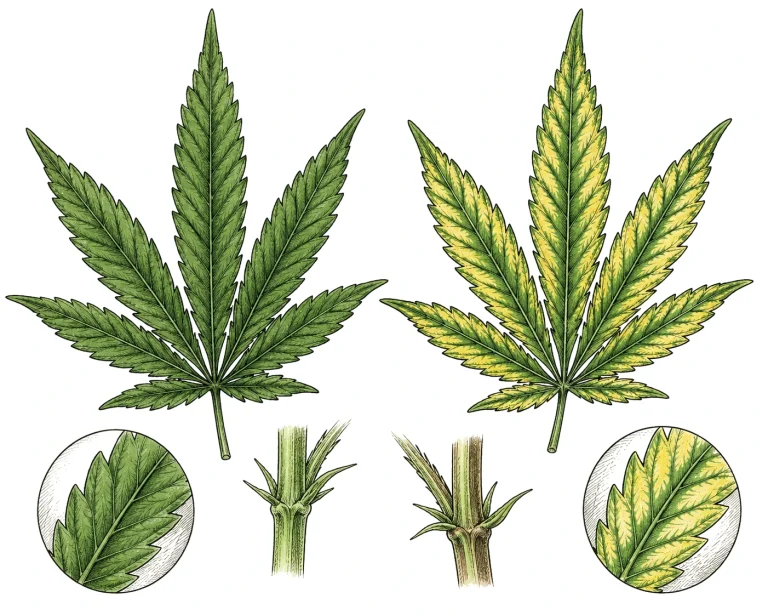
When you adjust your cannabis pH level, the most common problem you’ll run into is a value that’s too high. A pH above 7.0 in soil (above 6.5 in coco and hydro) mainly locks out micronutrients like iron, manganese, zinc and boron. The symptoms then often look like an iron deficiency: new leaves turn yellow between the veins while older leaves stay green — this is called interveinal chlorosis.
Typical causes of a pH that’s too high:
- Hard tap water with a high lime content — common in many regions
- Coco that hasn’t been pre-rinsed and releases calcium
- Calcium and magnesium building up in the growing medium over several weeks
- Too much pH Up added by accident
Short-term fix: add pH Down drop by drop to your water. If the growing medium stays too alkaline, a targeted flush with slightly acidic water (pH 5.8–6.0) helps wash out excess salts.
pH Too Low: Causes and Fixes
The second common problem when you adjust your cannabis pH: a value that’s too low (below 5.8 in soil, below 5.3 in coco/hydro) mainly locks out calcium, magnesium and phosphorus. The most common symptoms are brown spots on middle-aged leaves, purple stems or a general growth stall. In acidic growing media, an apparent calcium deficiency in cannabis is especially common — even when you’ve given enough calcium.
Typical causes of a pH that’s too low:
- Organic nutrients that naturally lower the pH
- Overfeeding over several weeks — salts build up and acidify the growing medium
- Soft water with no buffering capacity (low alkalinity, low KH)
- Microbial activity in organic growing media that produces acid
Short-term fix: add pH Up to your water. If the growing medium has been acidifying for weeks, it makes sense to flush with pH-neutral water before you start correcting upward.
The Most Common pH Adjustment Mistakes
Most problems with adjusting your cannabis pH are self-inflicted and completely avoidable. These are the five most common mistakes:
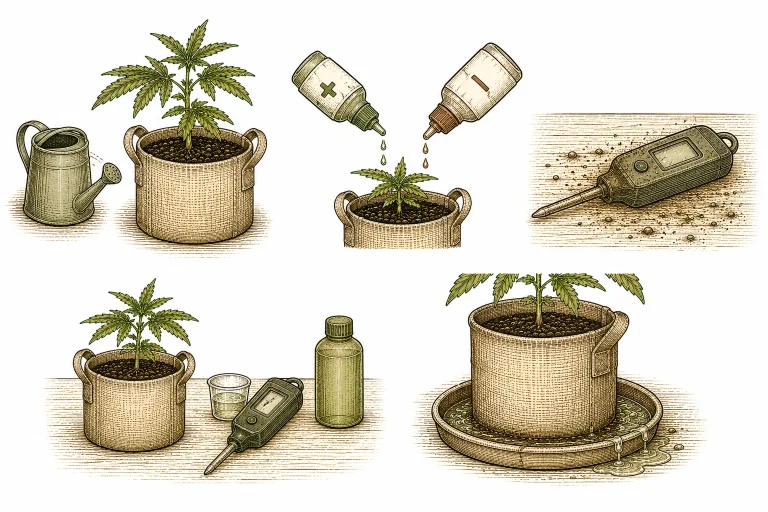
Mistake 1: Not Measuring pH at All
The most common mistake when trying to adjust your cannabis pH: not measuring it in the first place. Many beginners water with untested tap water and then wonder about deficiencies they can’t explain. Tap water often has a pH between 7.0 and 8.0 — well outside the optimal range for cannabis.
Mistake 2: Overcorrecting All at Once
pH adjusters are concentrated. If you add too much pH Down at once, you overshoot the target and have to counter with pH Up — the water swings back and forth out of control. Always correct in small steps and stir and measure after each addition.
Mistake 3: Not Checking the Runoff
The pH of your water and the actual pH in the growing medium can drift apart over weeks. If you don’t check the runoff, you’ll only notice a shift in the growing medium once the plant already shows clear symptoms.
Mistake 4: Not Calibrating Your Meter
A pH meter that hasn’t been calibrated for months gives wrong readings. Wrong readings lead to wrong corrections — you fix a problem that doesn’t exist, or miss one that’s building up. Calibrate monthly with fresh calibration solution.
Mistake 5: Adding Nutrients After Adjusting the pH
Nutrients can change the pH of a solution considerably. If you adjust the pH first and then add nutrients, you’ll end up with a different value again. The right order is always: nutrients into the water first, then adjust the pH.
pH and Nutrients: The Direct Connection
To adjust your cannabis pH level properly, it helps to understand why the value is so critical: every nutrient has a specific pH range in which it’s most available. That’s why a pH problem can look like a completely different problem at first glance:
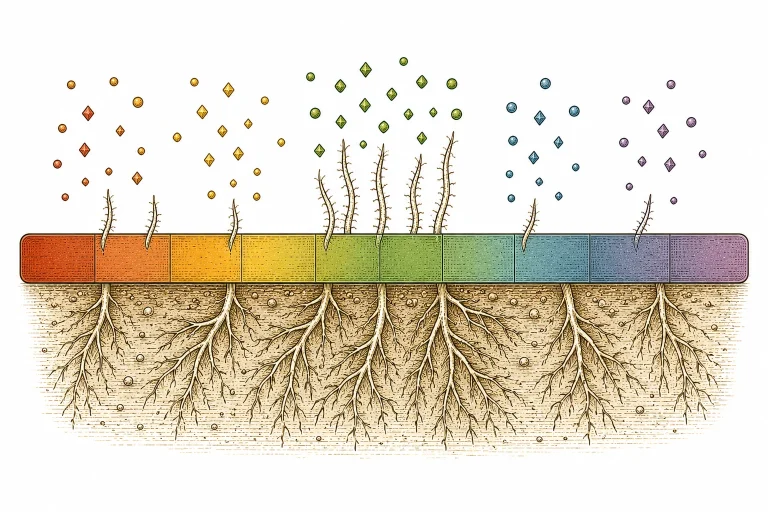
- Nitrogen is most available in the slightly acidic to neutral range (6.0–7.0 in soil)
- Phosphorus quickly loses solubility at a pH above 7.0
- Calcium and magnesium are more available at a higher pH — a pH that’s too low often causes an apparent calcium deficiency
- Iron, manganese, zinc are locked out at a high pH and cause interveinal chlorosis
When the wrong pH locks out several nutrients at once, it’s called pH lockout (also known as nutrient lockout). The typical result is a mix of different deficiency symptoms, even though you’re feeding enough. More nutrients can even make the problem worse. So measure the pH of your water and your runoff first and correct it in small steps before you change your feeding.
Problems like yellow leaves or creeping nutrient burn are often directly linked to an unstable pH — even if that’s not obvious at first glance.
The North Rhine-Westphalia Chamber of Agriculture (German) also explains in its resource on pH management that continuous pH monitoring is crucial to create stable nutrient conditions and catch problems early.
Frequently Asked Questions
What is the optimal pH for cannabis?
In soil, the optimal range is between 6.0 and 7.0. In coco coir and hydroponics, aim for 5.5 to 6.5, because these media react more sensitively to pH swings than soil.
What is the most accurate way to measure pH?
A digital pH meter gives the most accurate results, and good entry-level models are inexpensive. Test strips and drop tests are cheaper alternatives, but too inaccurate for coco and hydro. Make sure to calibrate your meter monthly with calibration solution.
In what order should I add nutrients and adjust the pH?
Always add nutrients first, then measure and adjust the pH. Nutrients change the pH of the solution themselves — if you reverse the order, you’ll have to adjust again after feeding.
What does a pH that’s too high mean for my plant?
A pH that’s too high mainly locks out micronutrients like iron, manganese, zinc and boron. The symptoms often look like an iron deficiency: new leaves turn yellow between the veins, while older leaves stay green.
What does a pH that’s too low mean for my plant?
A pH that’s too low mainly locks out calcium, magnesium and phosphorus. Typical symptoms are brown spots on middle-aged leaves, purple stems or a general growth stall — it often looks like a calcium deficiency, even though you’ve given enough calcium.
Why does soil buffer pH swings better than coco or hydro?
Soil contains organic matter and active soil life that buffer excess acids or bases before they reach the roots — a bit like a sponge. Coco and hydro have practically no such buffering capacity, which is why the pH swings faster and more strongly there and needs to be checked more closely.
How do I lower the pH in soil if it’s too high?
In soil, a small amount of pH Down added drop by drop to your water is usually enough. If the pH in the growing medium stays too high, a flush with slightly acidic water (pH 5.8–6.0) helps wash out excess calcium and magnesium salts. Because of its buffering effect, soil reacts more slowly to corrections than coco or hydro — so wait one or two waterings before you measure again and readjust.
How do I test the pH directly in the growing medium, not just in my water?
The most reliable method is the runoff test: measure the water that drains out of the bottom of the pot and compare it with the pH of your input water. If the runoff differs significantly, a pH problem has built up in the growing medium. Alternatively, you can do a slurry test: mix a small sample of the growing medium 1:1 with distilled water, let it sit for 30 minutes and measure directly in the liquid.
We present specific pH meters that have proven themselves in practice on our Recommended Gear page .
How does water quality (tap water or RO water) affect pH?
Hard tap water with a high lime content pushes the pH up and strongly buffers your corrections — you need more pH Down and have to measure more often. Reverse osmosis (RO) water contains hardly any dissolved minerals and therefore has almost no buffering effect: you can adjust the pH more precisely, but it also reacts faster to dosing mistakes. If your tap water is consistently very hard or fluctuates a lot, a reverse osmosis system usually helps — or take a look at your local water utility’s annual water quality report.
Conclusion: Checking pH Isn’t Rocket Science
Adjusting your cannabis pH level and keeping it stable isn’t a complicated process — it just takes a bit of routine and the right tools. If you measure regularly, correct drop by drop and keep an eye on your runoff, you’ll have your pH under control within a few weeks.
In short — here’s how to keep your cannabis pH level on track without much effort: pH 6.0–7.0 for soil, 5.5–6.5 for coco and hydro. Always add nutrients first, then adjust the pH. Calibrate your meter monthly. Check your runoff. Make corrections drop by drop.
If you consistently apply these pH basics, you’ll avoid most typical deficiencies and growth problems right from the start — and save yourself a lot of guesswork.
