

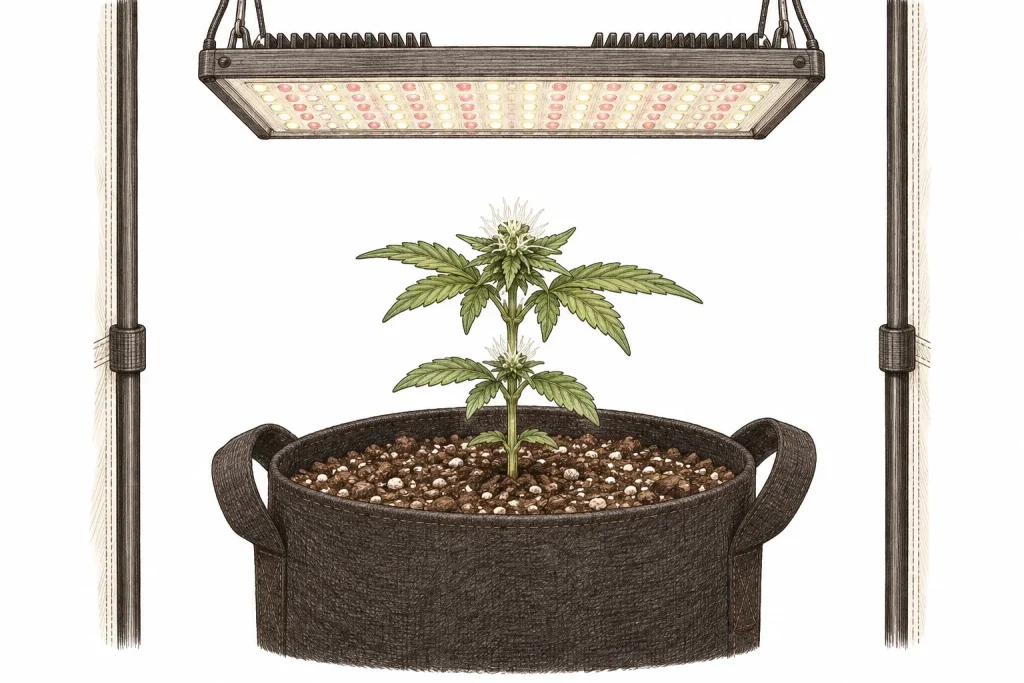
Is your autoflower flowering way too early, even though the plant is barely bigger than the palm of your hand? Then something’s off. Autoflowering strains kick off flowering based on their genetics. But stress, poor germination conditions or the wrong growing medium can make that switch happen far too soon. The result is a mini plant with a mini yield that never reaches its full potential. In this article, you’ll learn why autoflowers flower too early, which causes you can rule out right away, and how to get much better results on your next run.
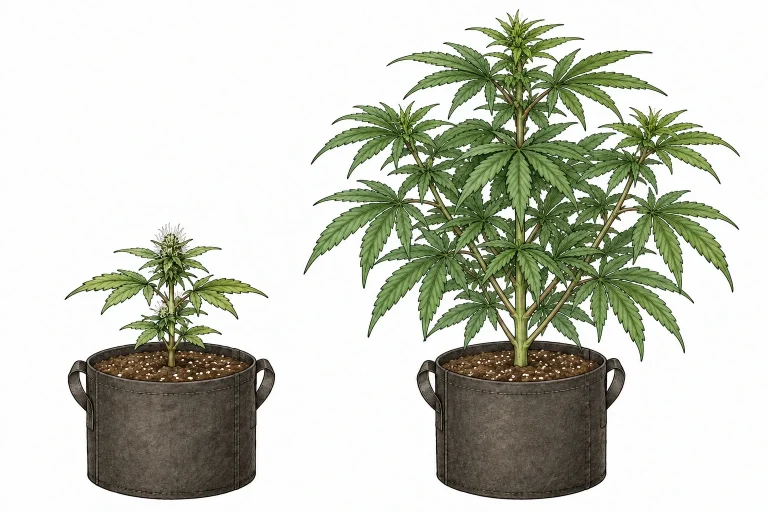
How Autoflowers Flower – and Why Timing Matters So Much
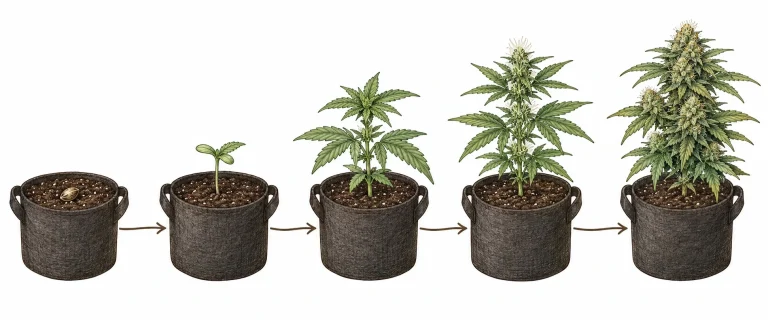
Autoflowering cannabis strains work very differently from photoperiod plants, whose flowering is triggered by day length (photoperiodism): they don’t start flowering based on the light cycle, but based on their age. This trait comes from Cannabis ruderalis, a subspecies from the short summers of Central Asia. As a rule, a healthy autoflower starts transitioning to flower between week two and week four after germination – as long as the vegetative stage has had enough time to build a solid structure.
An autoflower that’s already flowering in week two or even earlier hasn’t finished building that structure. The plant ends up with only a few branches, a weak stem and very little foliage. Because flowering is timed by genetics, you can’t stop it – all you can do is make sure the plant gets the best possible care in the short time it has left. That’s why prevention matters more with autoflowers than with any other type of strain.
- Flowering is set by genetics: no light switch needed – or possible
- Normal flowering onset: week 3–4 after germination
- Flowering too early: as soon as week 1–2, often with a tiny plant
- No way to reverse or delay flowering
- Short vegetative stage means mistakes show consequences right away
Autoflower Flowering Too Early: The 5 Most Common Causes
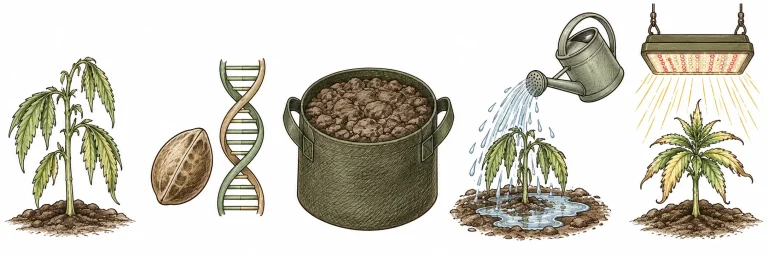
The reasons an autoflower flowers too early fall into five main groups. The tricky part: several factors can act at the same time – and make each other worse. Once you know the cause, you can take targeted action on your next grow.
Stress during the first weeks of life is the most common reason for early flowering. That includes root stress from transplanting too early, light burn, cold spells and physical damage. Autoflowers are especially sensitive to stress because their vegetative stage is so short – every setback costs precious days of growth. Also check out our article on cannabis seedling problems, which gives you a clear rundown of the most common early-stage mistakes.
The second big cause is the genetics themselves. Not all autoflower strains are the same. Some have an extremely short vegetative stage of just two weeks, while others manage four to five weeks. Cheap or poorly stabilized seeds from unknown sources tend to flower very early and very small. High-quality feminized autoflower seeds from established breeders usually give you a more reliable and slightly longer veg stage. Want to know exactly how autoflower and feminized seeds differ? Check out our comparison Autoflower vs. Feminized.
Third, your growing medium plays a key role. A medium that is too rich in nutrients can overwhelm young autoflowers in the first weeks and trigger stress signals that pull flowering forward. On the flip side, a nutrient-poor or overly compacted medium leads to deficiencies that also put the plant under pressure. For best results, go with a lightly amended soil that drains well. We cover this in detail in our article on mixing your own cannabis soil.
Fourth, improper watering can push your plant into early flowering. Waterlogged soil and overwatering starve the roots of oxygen, which causes serious stress. Autoflowers don’t have time to recover from root problems, so they often respond by rushing into flower. Stick to the “finger test” every time and use a well-draining medium to avoid this mistake.
The fifth factor is light stress. Lights that are too intense or hung too close, poorly calibrated LED panels, or even light leaks in your grow tent can trigger stress responses in autoflowers. Unlike photoperiod strains, autoflowers don’t react to dark periods. But an unstable or overly intense lighting setup in the first weeks can still hold back their development. Head over to our Cannabis Plant Diagnosis Hub for more checklists on light stress and other growth problems.
- Stress during germination and the seedling stage (transplanting, heat, cold, light burn)
- Poor genetics or unstable seed quality with a very short veg stage
- The wrong growing medium: too nutrient-rich or too compacted
- Overwatering and waterlogged roots, leading to root stress
- Light stress from overly intense or unstable lighting in the first weeks
Spotting the Symptoms: How to Tell If Your Autoflower Is Flowering Too Early
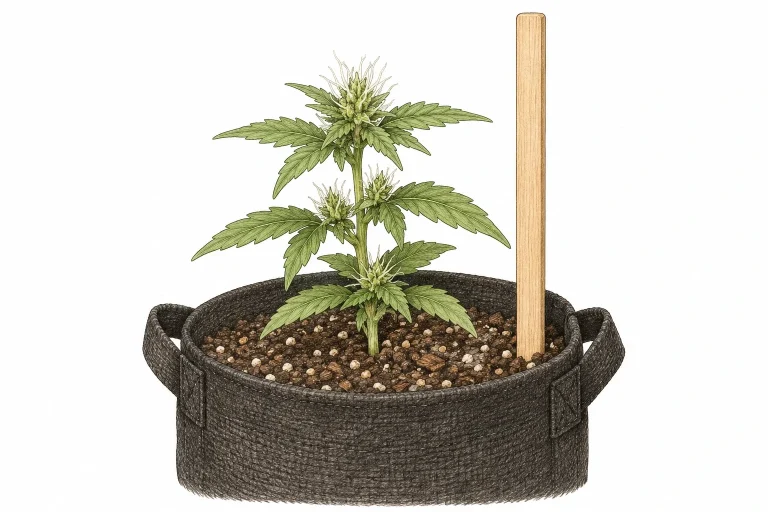
The most obvious sign is the plant’s size compared to its stage of development. If you spot the first white pistils or early bud sites while the plant is still under 4 to 6 in (10 to 15 cm) tall and has barely grown any side branches, it is definitely flowering too early. At this point, a healthy autoflower should still be in full vegetative growth and visibly gaining height every day.
Another warning sign is vegetative growth that suddenly slows down or stops. If your plant stops producing new internodes in week two and the main growing tip starts to thicken and harden instead, the switch to flowering is underway. Keep an eye on the leaf shape too: leaves that form during flowering are often narrower and more jagged than the broad fan leaves of the vegetative stage. At the same time, the plant’s smell changes slightly. That is an early sign of terpene production, which kicks in with flowering.
- White pistils at the main growing tip while the plant is under 4 in (10 cm) tall
- Growth stalls or slows down sharply in weeks 1–2
- Barely developed side branches, very few internodes
- The growing tip thickens and hardens without any stretch beforehand
- A weak, short stem with little leaf mass
- A first floral smell unusually early
Autoflower Flowering Too Early: What You Can Still Do
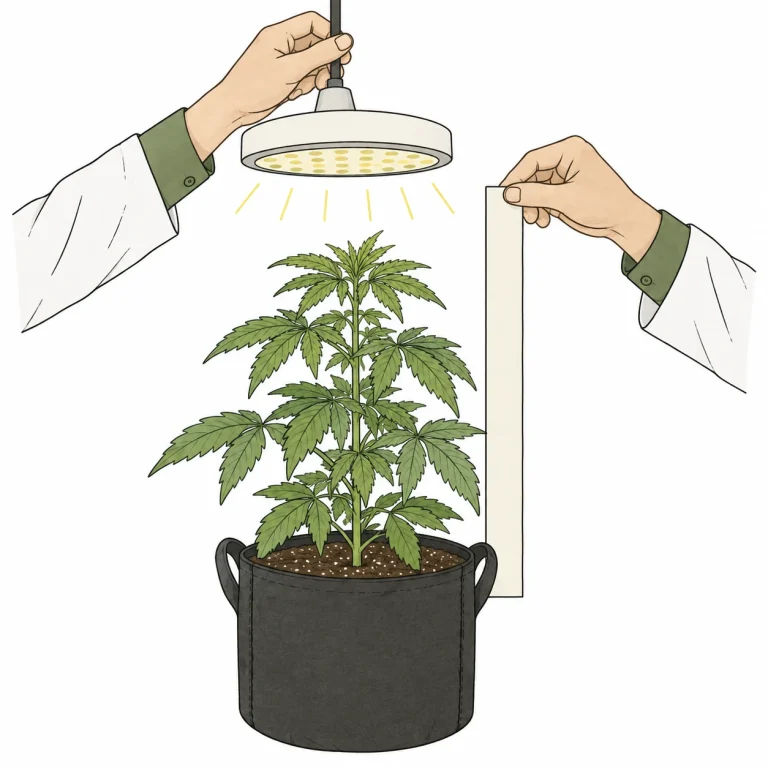
If your autoflower has already started flowering too early, there’s no way to stop or reverse it. Unlike photoperiod strains, you can’t push an autoflower back into veg by changing the light. That sounds discouraging, but it’s no reason to panic. You can still make the most of the remaining flowering time and get the best possible result from the plant.
Your first move should be to remove every source of stress. Check the light distance and make sure your panel hangs at least 16–24 in (40–60 cm) above the middle of the plant. Check the temperature (70–79 °F (21–26 °C) during the day) and make sure there are no drafts or cold spots near the plant. If the growing medium is too wet, let it dry out properly before you water again.
Feed very gently in the early flowering stage. Small plants need far fewer nutrients than full-size autoflowers. Too many nutrients at this point, especially nitrogen, can put even more pressure on an already stressed plant and hurt bud quality. Start with a quarter of the recommended dose and increase slowly as needed. You’ll find more tips on getting the dose right in our guide on how to dose cannabis nutrients (German).
If you have other autoflowers in the same run, treat this as a learning opportunity. Write down all your conditions (light, temperature, growing medium, watering intervals) so you can adjust on your next grow. A plant that flowers too early can still be harvested. The yield will be small, but the buds don’t have to be poor quality.
- Remove stress right away: check light distance, temperature and drafts
- Cut back on watering and use the finger test every time
- Feed much less, because a small plant needs small amounts
- Don’t try to stop flowering (it doesn’t work with autoflowers)
- Keep conditions dialed in for the rest of the flowering stage
- Write down what you learned for your next grow
Prevention: How to Keep Your Autoflower from Flowering Too Early
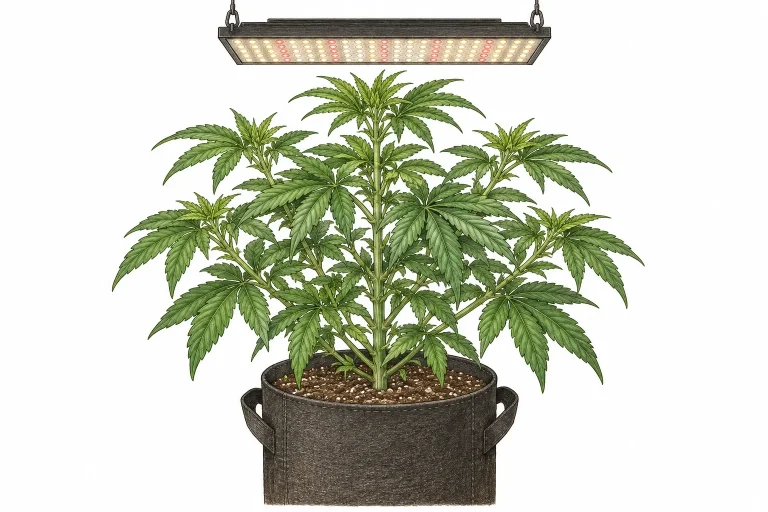
The best way to prevent early flowering in autoflowers is a stress-free start. Germinate your seeds directly in their final container. That way you avoid the root stress of transplanting, which can hit autoflowers especially hard. Fabric pots of 3–4 gal (11–15 L) have proven ideal for most autoflower strains because they offer good drainage and plenty of root space. Our detailed guide on transplanting cannabis (German) explains when transplanting makes sense.
Choose your growing medium carefully. Autoflower soils made specifically for cannabis, with a light starter charge (400–600 ppm (0.8–1.2 mS/cm)) and a high perlite share (20–30 %), are ideal. Nutrient-rich all-purpose mixes, or pure coco coir if you have no experience controlling EC (electrical conductivity), can raise the risk of stress in the first few weeks. Skip liquid nutrients completely for the first two weeks. The nutrients already in the medium are plenty for germinating seeds and seedlings.
Go with proven seed quality. Only buy feminized autoflower seeds from reputable breeders with stable genetics. Good autoflower strains are bred to run through a long enough vegetative stage before flowering kicks in. The price difference between budget seeds and quality seeds pays for itself fast when you think about how much time, money and effort goes into every grow. Our article on growing autoflower cannabis (German) gives you a complete overview of every part of an autoflower grow, from picking a strain to harvest.
Dim your light to 60–70 % of full power for the first two weeks and keep it at least 20–24 in (50–60 cm) above the plant. This can cut light stress a lot and gives the plant time to develop without pressure. Also keep temperature and humidity in the recommended ranges: 72–79 °F (22–26 °C) and 60–70 % relative humidity (RH) for seedlings. A stable environment is your best insurance against early flowering.
- Germinate directly in the final container to avoid transplant stress
- Use a 3–4 gal (11–15 L) fabric pot with perlite-rich autoflower mix
- Water without liquid nutrients for the first two weeks
- Only buy high-quality feminized autoflower seeds
- Dim the light to 60–70 % for the first two weeks
- Keep temperature (72–79 °F (22–26 °C)) and humidity (60–70 % RH) stable
- No training in the first two weeks: start LST (low stress training) (German) in week 3 at the earliest
Autoflower Flowering Small Anyway? How to Maximize Yield in the Flowering Stage
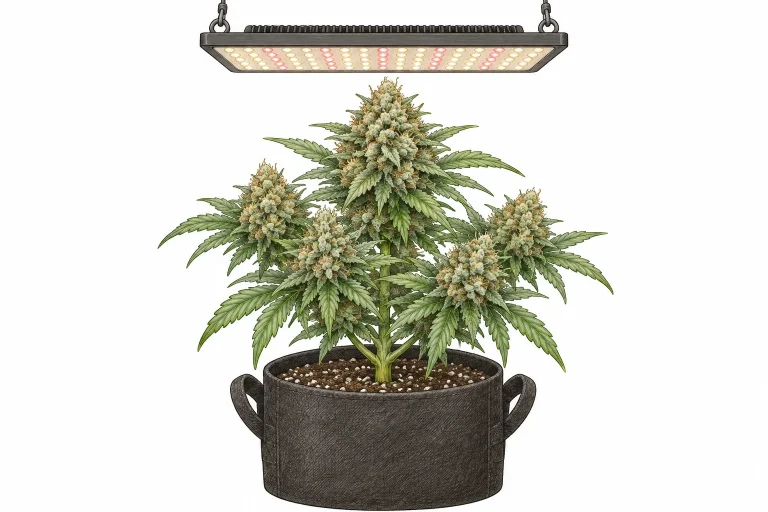
Your autoflower flipped to flower too early? Don’t give up on it. With the right care during the flowering stage, you can still noticeably boost both yield and bud quality. The most important step is matching your feeding to the plant’s actual size. Small plants need smaller doses. Go by EC (electrical conductivity) readings, not by the manufacturer’s feed chart – those charts are made for full-size plants.
Dial in your light spectrum for flowering. Many LED panels have a bloom mode that adds more red light. That extra red helps bud development, even on small plants. Once the plant stops stretching, gently lower the light a bit – but keep watching for signs of heat stress, like leaves curling upward or brown leaf tips.
Don’t strip leaves from a small autoflower that’s already stressed. Defoliation, lollipopping and other training techniques can backfire on a plant that’s flowering too early. At this point, every leaf is precious photosynthesis surface your plant needs to fuel bud growth. Instead, focus on proper watering, the right pH between 6.0 and 7.0, and a stable environment all the way to harvest. You can spot the ideal harvest window by trichome color – our guide on reading trichomes to time your harvest walks you through exactly what to look for, step by step.
- Match the EC of your nutrient solution to the plant’s actual size
- Switch on the bloom spectrum (more red light)
- No defoliation or lollipopping on stressed small plants
- Keep pH consistently between 6.0 and 7.0
- Check trichomes regularly so you don’t miss the ideal harvest window
- Keep temperature and humidity stable until harvest
Frequently Asked Questions
Can I stop an autoflower from flowering if it starts too early?
No. Flowering in an autoflower is genetically programmed. You can’t stop it or reverse it by changing the light. All you can do is optimize conditions so the plant produces as much yield as possible in the flowering time it has left.
How early is “too early” for an autoflower?
If your autoflower shows pistils within the first 10 to 14 days after germination and growth almost completely stops, it’s flowering too early. Flowering normally starts around week three to four after germination – with some strains, as late as week five.
What light cycle is best to keep autoflowers from flowering too early?
Autoflowers flower regardless of the light cycle. Still, 18–20 hours of light per day is a good choice for strong vegetative growth. You’ll find more in our article on light cycles for indoor growing. A 24-hour light cycle can work for some strains, but for others the missing dark period can cause mild stress – so test it strain by strain.
Why is my autoflower flowering so small and bushy?
If your autoflower is flowering very small, the cause is almost always stress during germination and the seedling stage: transplanting too early, overwatering, light that’s too intense or the wrong growing medium. Sometimes genetics are to blame, too – some strains simply stay smaller than others.
Can I pick an autoflower strain with a longer veg time for my next grow?
Yes, absolutely. Some autoflower strains – often marketed as “XXL” autoflowers – are bred for a longer veg stage of four to five weeks. Don’t mix them up: “Fast Version” strains are fast-flowering photoperiod strains, not autoflowers. Read the breeder’s specs and grower reports carefully before you choose a strain.
Is it still worth caring for an autoflower that flowered too early?
Yes. Even small autoflowers can produce surprisingly dense, potent buds when you support them well through the flowering stage. Proper feeding, a stable climate and the right harvest time make a big difference – even on small plants.
Planning your next autoflower grow and want to avoid light stress from day one? On our Recommended Gear page, you’ll find proven LED models, the right fabric pots and meters for a stress-free start.
Bottom Line
If your autoflower starts flowering before it has really grown, the cause is almost always stress in its first weeks of life, whether from the wrong growing medium, overwatering, light that’s too intense or poor seed quality. Because flowering is genetically locked in and can’t be reversed, prevention is everything with autoflowers. Start your next grow with quality seeds, right in the final container, with a light, airy growing medium and dimmed light, and you’ll see a clear difference. In short: an autoflower flowers too early when it gets stressed in its first weeks, so protect that stage above all. Everything about the rest of the flowering stage is in our Flowering hub, and if you run into other growth problems, our Cannabis Plant Diagnosis hub can help.
