

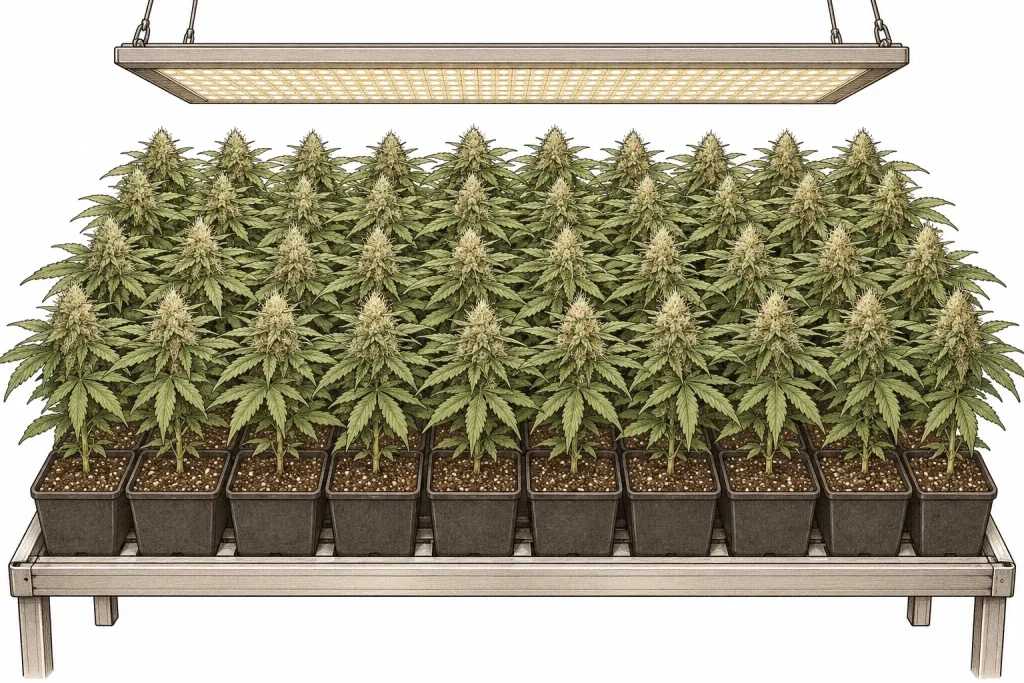
The Sea of Green (SoG) method is one of the most effective indoor growing techniques. You run lots of small plants to pull big yields in the shortest possible time. Instead of training a few large plants for months, SoG relies on a dense layout of small plants that you flip to flower early. The result is an even “sea of green” that makes the most of your light and cuts the time between harvests. In this guide, you’ll learn the full process, the ideal plant density, the best strains and the most common beginner mistakes with Sea of Green.
What Is the Sea of Green Method?
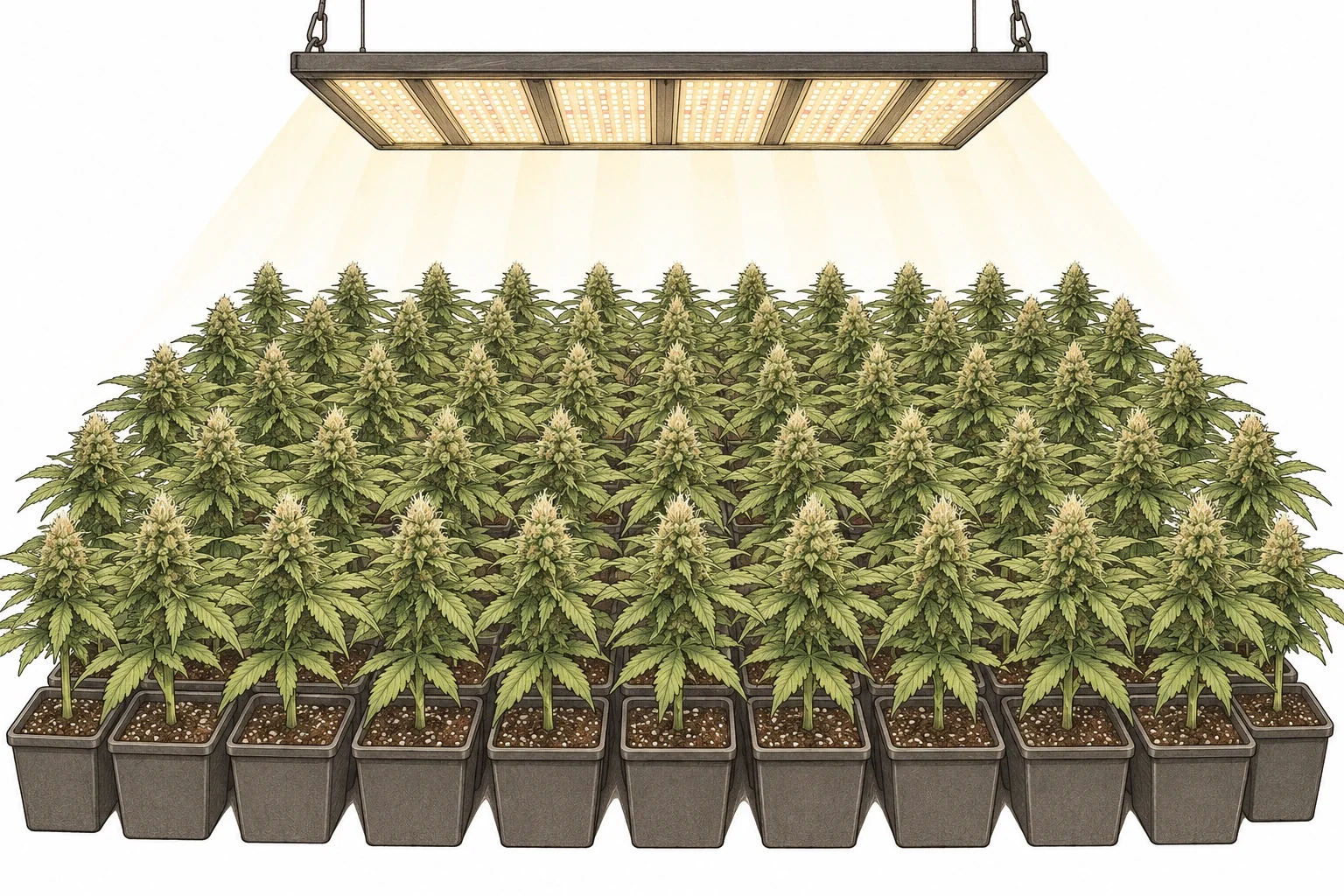
The name “Sea of Green” describes exactly what you see when you look down into the grow room: an even, dense sea of leaves and colas. The SoG method first took off in the Netherlands and is still one of the most popular techniques for commercial and home indoor growing. The idea is simple: you get lots of small cannabis plants into flower as fast as possible with minimal stress during veg. Each plant grows one dominant main cola instead of a bunch of side branches.
The big advantage over methods like SCROG or mainlining is the time you save. When you train big plants, you often plan 6 to 10 weeks of vegetative stage. With SoG, you can flip to flower after just 1 to 3 weeks. You don’t fill the space under your lights with one plant and lots of branches. You fill it with many small plants whose colas form a dense canopy that soaks up the light. That way, you get close to maximum efficiency out of every light.
Check the cannabis laws where you live before growing. SoG can also work with fewer plants, but then you need to plan plant density and pot size more carefully.
- Many small plants instead of a few big ones
- Each plant grows one dominant main cola
- Very short veg of 1 to 3 weeks
- Maximum light use thanks to an even canopy
- Originally from commercial Dutch growing
SoG Method: Step by Step to Your First Harvest
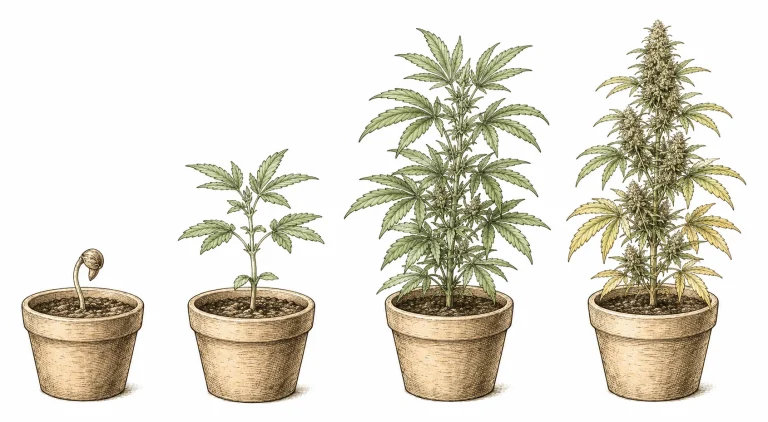
The first step in a Sea of Green is picking the right starting material. For consistent results, clones are your best bet. They’re genetically identical, so they flower at the same time and reach the same height. Plants grown from seed can vary more, but they also work well if you stick with stable feminized strains. Prep your starter media and begin germination or rooting all at once, so every plant is at the same growth stage.
Once your plants reach 6 to 10 in (15 to 25 cm) and have 3 to 4 nodes, it’s the perfect time to switch to a 12/12 light cycle. With SoG, you usually skip topping and other training techniques entirely, because the goal is one strong main cola per plant. Some growers only remove the lowest side branches (lollipopping) to focus energy on the main cola and improve airflow.
During the flowering stage, your plants keep growing quite a bit, usually to 1.5 to 2 times their size at the flip. Plan for this flower stretch (“stretch”) and make sure your lights have enough distance to the canopy. After 8 to 10 weeks of flower (depending on the strain), your colas are ready to harvest. Since you started all your plants at the same time, you can harvest them all at once too – a clear logistical plus.
After harvest, you have two options: start the next run right away with fresh clones or seeds, or reveg your photoperiod plants. The steady rhythm of short veg and full flower makes SoG the ideal system for growers who plan several harvests a year.
- Use clones or feminized seeds
- Flip plants to flower only at 6 to 10 in (15 to 25 cm)
- Switch to a 12/12 light cycle
- Remove the lowest side branches (optional, but recommended)
- Plan for stretch during the first weeks of flower
- Harvest all plants at the same time
Ideal Plant Density and Pot Size for Sea of Green
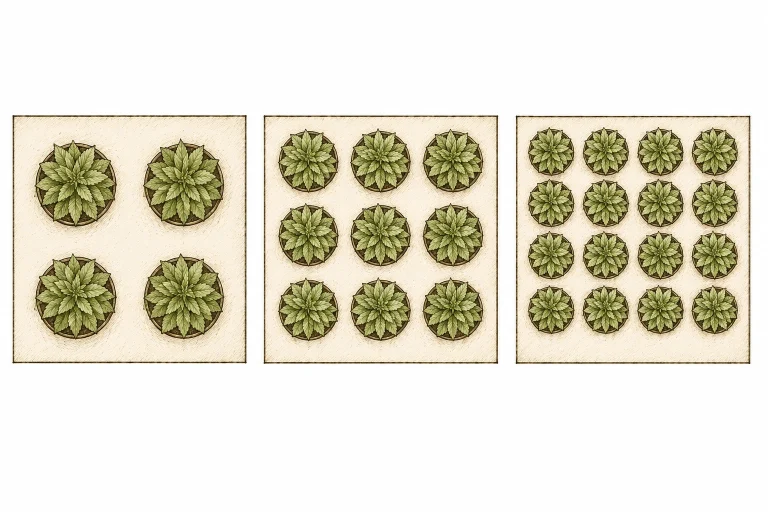
Plant density is the most important factor in a cannabis SOG. It directly affects your yield, airflow and how prone your plants are to disease. A good rule of thumb: 1 plant per 12 x 12 in (30 x 30 cm). That means you can fit about 9 to 16 plants in 10.8 sq ft (1 m²) of grow space. Plants packed too tightly compete for light. They react with what’s called shade avoidance syndrome: they stretch for no good reason, build weak colas and are more likely to get mold because of poor airflow. Plants spaced too far apart, on the other hand, waste your light footprint.
In a cannabis SOG, keep your pots small on purpose, since the plants only veg for a very short time. 0.8 gal (3 L) pots are ideal for clones with a short veg, and 1.3 gal (5 L) pots work well if you plan a bit more veg time. Bigger pots don’t give you any advantage in a SOG. They just push your plants farther apart and make the whole system less efficient. Make sure you have good drainage and keep your growing medium loose enough so the roots can breathe.
When it comes to growing medium, most SOG growers go with light, airy soil-perlite mixes or coco coir. Hydroponic systems like NFT or DWC are also very popular, since they speed up growth even more and cut the veg stage down further. No matter which medium you choose, a stable pH in the ideal range is especially important in a SOG, because nutrient problems can spread fast at this plant density.
- 1 plant per 12 x 12 in (30 x 30 cm) as a guideline
- 9 to 16 plants per 10.8 sq ft (1 m²) possible
- 0.8 to 1.3 gal (3 to 5 L) pots are ideal
- Go for light, airy growing media
- Soil-perlite, coco or hydro all work well
- Good drainage is a must
The Best Cannabis Strains for Sea of Green
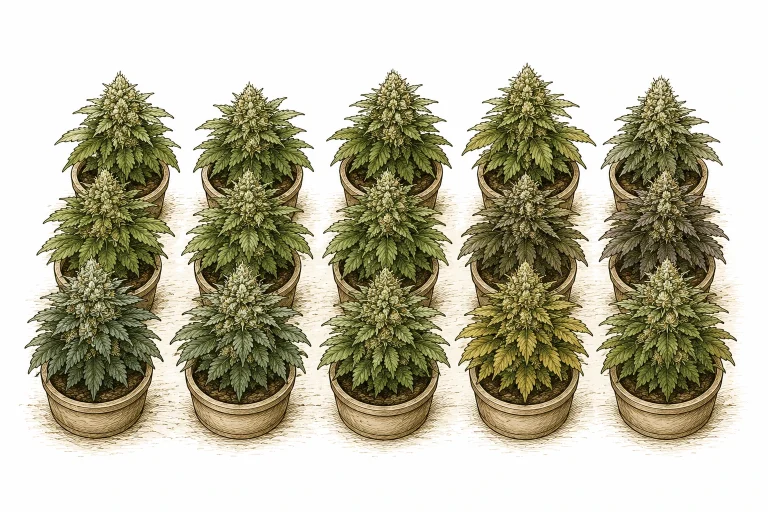
Not every strain is a good fit for Sea of Green. The best choices grow compact by nature, put out few side branches and flower fast. Indica-dominant strains and indica hybrids usually check all these boxes: they stay short, stretch less in flower than sativas and produce dense, resinous colas. That’s why classics like Northern Lights, Blueberry and OG Kush phenos are so popular with SOG growers.
Autoflowering strains are less suited to a classic SOG, because they flower regardless of the light cycle and run on their own schedule. In a SOG, you want to control exactly when flowering starts so all your plants stay in sync. If you want to grow autoflowers, pick a different method, or at least germinate all your seeds at the same time to keep them in sync.
Sativa-dominant strains and long-flowering strains can cause trouble in a SOG. They stretch a lot, grow past your target canopy level and form airy colas with less weight. If you still want to run sativa hybrids, pick ones known for short flowering times under 9 weeks and give your plants more space to make up for their stronger side growth.
- Indica-dominant strains are ideal
- Go for short flowering times under 9 weeks
- Little natural side branching is a plus
- Classics: Northern Lights, Blueberry, OG Kush
- Autoflowering strains only with an adjusted strategy
- Avoid sativas or give them more space
Feeding and Watering Your Cannabis Sea of Green
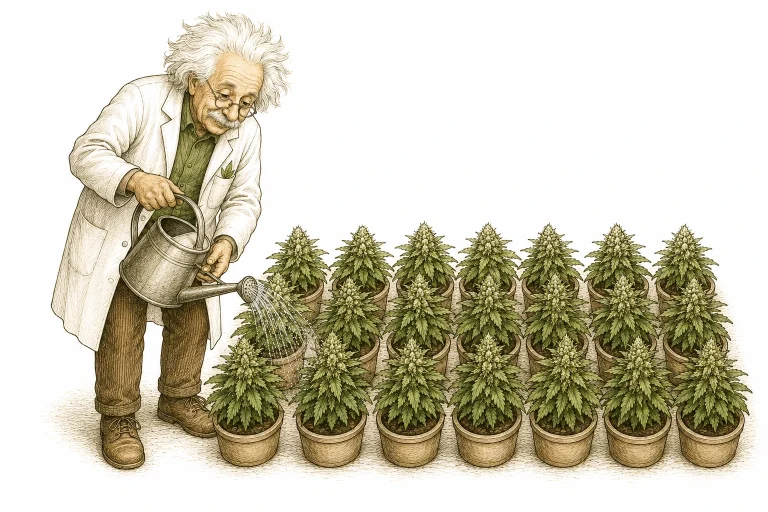
With the high plant density of a SOG, dialing in your feeding is especially important. Because the pots are small, the nutrient reserves in the growing medium run out faster than in big pots. Start feeding lightly from week two and ramp up the dose step by step. In flower, raise phosphorus and potassium for maximum cola development and cut back on nitrogen.
Watering right is a real challenge in a SoG, and many beginners underestimate it. Small pots dry out fast, especially under strong lights. At the same time, overwatering can quickly cause root problems when your plants are packed this tightly. The most reliable method is lifting the pots: light pots need water, heavy ones don’t yet. Over time, you’ll get a feel for the right watering interval.
A common mistake among SoG beginners is nutrient burn. Because there are so many plants in the room, some growers think they need to feed more. In reality, each plant needs exactly what it always needs. You’re feeding every plant individually in its own small pot of growing medium. Always start at half the manufacturer’s recommended dose and only go up when needed. Regular EC (electrical conductivity) checks of your runoff help you keep an eye on nutrient uptake.
- Start with a light base nutrient from week 2
- Flowering: more phosphorus and potassium, less nitrogen
- Check small pots regularly for dryness
- Use the lift test to find the right watering interval
- Start at 50% of the manufacturer’s recommended dose
- Measure EC in your runoff regularly
Avoid Common Sea of Green Mistakes
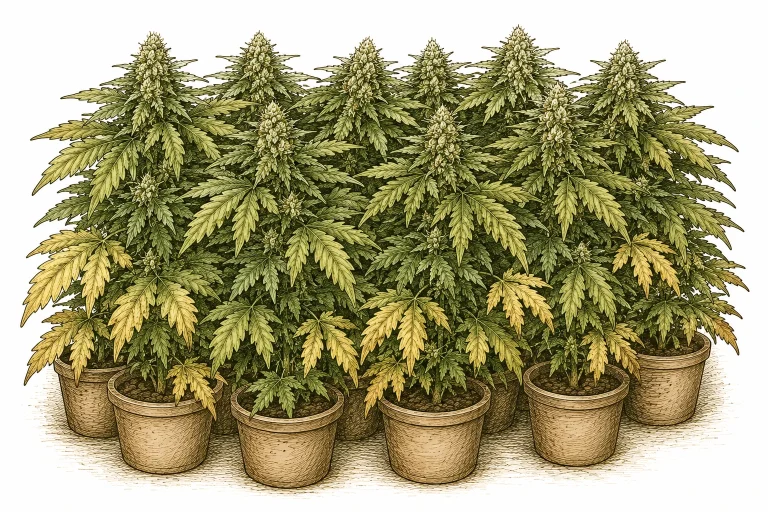
The most common Sea of Green mistake is packing plants too tightly while skimping on ventilation. When air can’t move between the plants, humidity around the leaves and colas can climb fast. That’s perfect for bud rot (botrytis, gray mold) and other fungal diseases. Make sure you run at least one fan in your grow room that keeps a gentle breeze moving through the whole canopy. Also remove dead or yellowing leaves down low on a regular basis. Yellow leaves can be an early warning sign, and in a SoG you need to act on them fast.
Another common mistake is mixing plants of different growth stages or genetics in one SoG run. If one plant grows slower than the rest, its neighbors shade it out and it falls even further behind. It’s a vicious cycle. When you set up, make sure all plants come from the same germination or rooting batch and are at the same stage. Pull out the outliers or move them to a separate spot.
Finally, many SoG beginners underestimate the workload. Lots of small plants means lots of individual pots to water, check and feed. What sounds dead simple with a few plants turns into a real daily routine with 16 or more plants in a tight space. Plan enough time for daily care, and consider automation like drip irrigation if you run larger SoG setups.
- Poor ventilation is mistake number 1
- Run at least one fan for air circulation
- Don’t mix plants at different growth stages
- Move height outliers to a separate spot
- Remove dead leaves regularly
- Don’t underestimate the daily workload
SoG vs. SCROG: Which Method Fits You?
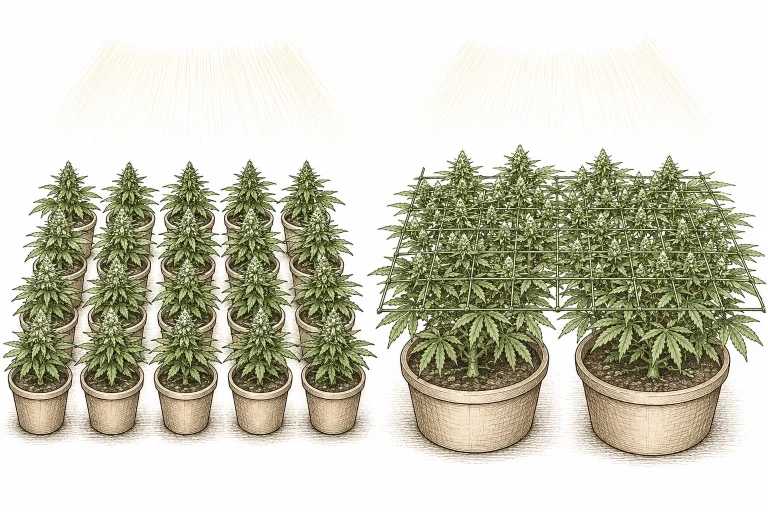
Choosing between Sea of Green and SCROG (screen of green) comes down to your goals, your space and your time. SoG is the clear pick if you want as many harvests per year as possible and work with clones or fast-flowering strains. The short vegetative stage saves time, the setup is simple, and you don’t need a net or a lot of training work. The tradeoff: with so many plants, the day-to-day care takes more effort.
SCROG is the better fit if you work with just a few plants and want to get the most out of them through intensive training. With a trellis net, you bring all colas up to an even height and use your light footprint almost as efficiently as in a SoG, just with far fewer plants. SCROG takes more patience, but for home growers with a limited plant count, it’s often the smarter choice.
Another option for fast cycles is the LST (low stress training) method. You pull branches down with plant ties and create multiple colas per plant without any cutting. LST pairs well with SoG and can help you get an even flatter canopy by taming the early flower stretch with gentle bending. In the end, many growers succeed because they combine techniques and adapt them to their own setup.
- SoG: Fast cycles, lots of plants, little training time
- SCROG: Few plants, intensive training, more patience
- LST pairs well with SoG for a more even canopy
- Check the cannabis laws and plant limits where you live before growing
- Combining different methods is possible and often smart
Cannabis Sea of Green and Lighting: How to Get the Most Out of Your Grow Lights
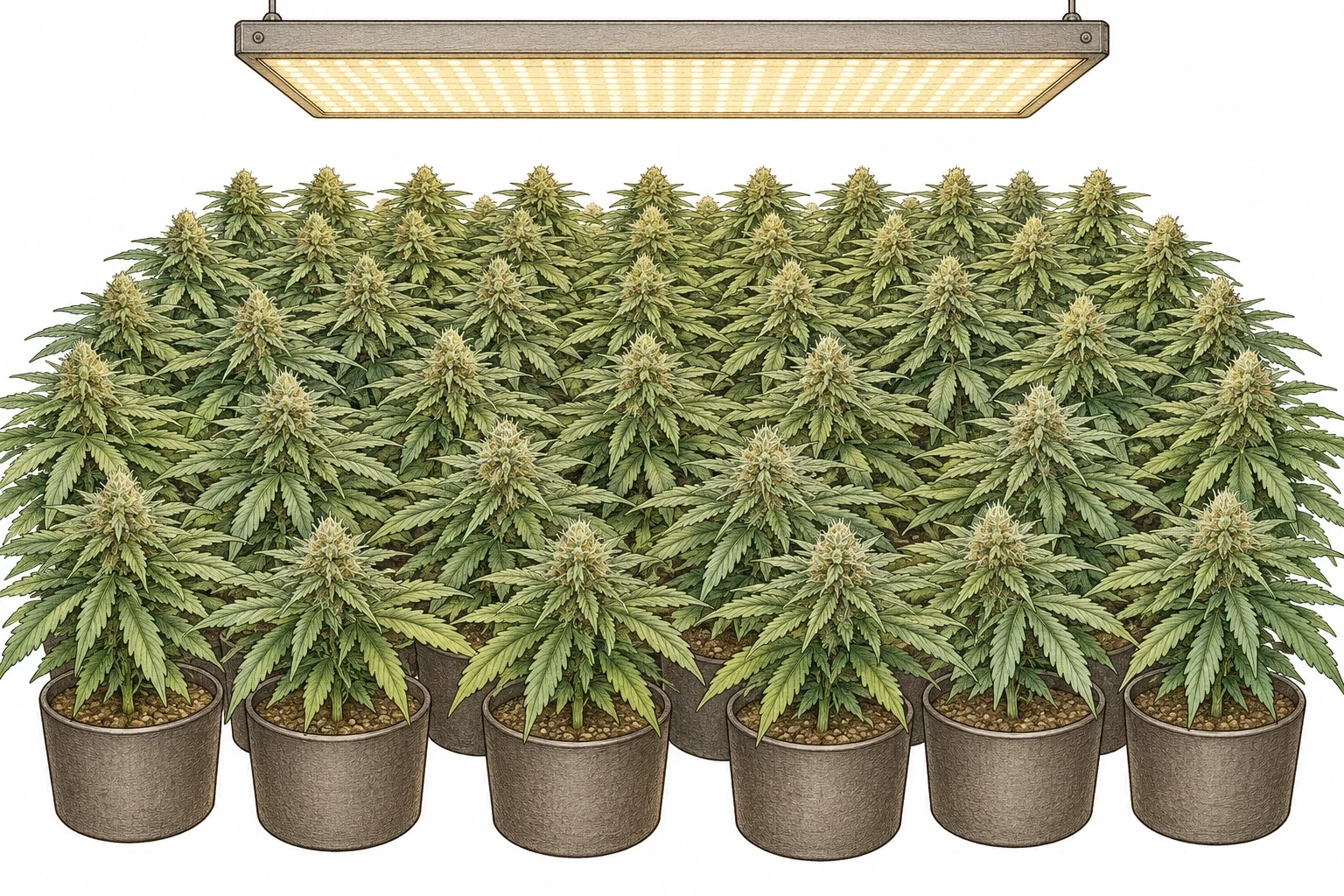
With Sea of Green, you get the most out of a flat, even canopy that soaks up as much light from above as possible. LEDs with a wide beam angle are ideal for SoG. They light a large area evenly, run cool and can hang close to your plants. For a 10.8 sq ft (1 m²) area, experienced growers recommend roughly 400 to 600 watts of LED power (actual draw, not marketing watts) for the best results.
Light height is especially critical in SoG. All your plants flower at the same height, so you can’t adjust the distance plant by plant. Follow the manufacturer’s recommendations for your light and, if you can, measure light intensity (PPFD, photosynthetic photon flux density) with a light meter. Typical flowering values are 600 to 900 µmol/m²/s. Too much light can cause light stress, too little can leave you with loose, airy colas.
Don’t leave any part of your grow space unused. A SoG lives on filling every inch of the lit area. If you spot gaps between pots during setup, add smaller filler plants or move the pots you already have. A gap-free canopy is the goal – every square inch left in the dark is yield you’re giving away.
- LEDs with a wide beam angle are ideal
- 400 to 600 watts of actual LED draw per 10.8 sq ft (1 m²) recommended
- Aim for a PPFD of 600 to 900 µmol/m²/s in flower
- Stick closely to the manufacturer’s light height recommendations
- Close gaps in the canopy by repositioning pots
- Make sure every plant gets even light
You can also squeeze extra yield out of a SoG with light supercropping of the main stems.
Frequently Asked Questions
How many plants do I need for a Sea of Green setup?
For an effective SoG on 10.8 sq ft (1 m²), you need 9 to 16 plants – roughly one plant every 10 to 12 in (25 to 30 cm). In a smaller 2 x 2 ft (60 x 60 cm) space, 4 to 6 plants are enough for a working SoG. More important than the exact number: start all plants at the same time and use the same genetics. Check the cannabis laws where you live before growing.
How long is the vegetative stage in a Sea of Green?
In SoG, veg is kept short on purpose: 1 to 3 weeks after transplanting or rooting is typical. Wait until your plants are 6 to 10 in (15 to 25 cm) tall and have 3 to 4 nodes, then switch to a 12/12 light cycle. If you run clones from a mother plant, veg can be even shorter, since clones can already be fairly big by the time they root.
What pot size works best for Sea of Green?
For a classic SoG with a short veg, 0.8 gal (3 L) pots are ideal. If you plan a bit more veg time or prefer bigger plants, you can step up to 1.3 gal (5 L) pots. Larger pots work against you in SoG: they spread your plants apart and lower your space efficiency. Make sure your pots have enough drainage holes.
Can you run a Sea of Green with autoflowering strains?
Autoflowering strains aren’t ideal for a classic SoG. The light cycle doesn’t trigger flowering, so you can’t flip all plants into bloom at the same time. You can still grow autoflowers SoG-style if you germinate all seeds at once and run them under a 20/4 or 18/6 light cycle. The result is similar, but not quite as controllable as with photoperiod strains.
How do I prevent mold in a dense SoG setup?
Good airflow is your best defense against mold in a SoG. Run at least one circulation fan that keeps a gentle, steady breeze moving through the canopy. Regularly remove lower leaves and side branches that won’t develop real colas (lollipopping). Keep humidity (relative humidity, RH) below 50% in late flower, and make sure your exhaust is sized big enough to pull out heat and moisture.
How much yield can I expect from a Sea of Green?
SoG yields can vary a lot depending on the strain, your light output and your experience as a grower. A good rule of thumb is 0.5 to 1 g per watt of light output per harvest. With a 400 W LED, you can realistically aim for 200 to 400 g per harvest. The real advantage of SoG isn’t the yield per harvest, though. It’s the chance to pull 4 to 6 harvests a year, which can seriously boost your total yearly yield.
The Bottom Line
The cannabis Sea of Green (SoG) method is the perfect technique if you want to max out your harvest frequency and get consistently high yields from lots of small plants with even colas. With the right strain, a consistent plant density and solid ventilation, SoG is very doable even for beginners. The keys: start all plants at the same time, keep your pH stable and never neglect your ventilation. Once you’ve pulled off your first successful Sea of Green run, you’ll quickly see why this method has been one of the most popular indoor growing techniques for decades.
