


If you know how to measure and dial in cannabis EC, you have a real edge over growers who feed blind. Cannabis EC shows you at a glance how concentrated your nutrient solution really is. Too high can mean salt stress and nutrient lockout. Too low can mean hungry plants and weak growth. A calibrated EC meter is a must-have, especially in hydroponics (hydro) and coco coir (coco). In this guide, you’ll learn the ideal values for each growth stage, the most common mistakes and how EC ties directly into your pH.
What Does EC Mean for Cannabis?
According to the North Rhine-Westphalia Chamber of Agriculture (Germany), the electrical conductivity of a nutrient solution is one of the most reliable indicators of healthy feeding. EC stands for “electrical conductivity.” Pure water barely conducts electricity. Dissolved mineral salts and nutrients are what raise a liquid’s conductivity. The more nutrient salts are dissolved in your solution, the higher your EC reading. It’s measured in millisiemens per centimeter (mS/cm), sometimes shown as µS/cm. Many US meters display ppm instead.
So EC tells you HOW MUCH dissolved material is in your nutrient solution, but not WHICH nutrients they are. That’s why you should always read EC together with a solid feeding schedule and regular pH checks. A reading of 1,000 ppm (2.0 mS/cm) can be a perfectly balanced nutrient mix, or a solution loaded with sodium and short on potassium. A meter alone won’t make you an expert, but it gives you the foundation for smart decisions.
In practice, growers measure EC mostly in hydro, aeroponics and coco. In classic soil grows with pre-fertilized, high-quality soil, it’s less common, but it can still pay off. Checking your runoff, for example, lets you keep an eye on salt buildup in your growing medium. Beginners especially benefit from measuring EC early on, because you quickly learn how your plants react to different feeding strengths.
- EC = electrical conductivity of the nutrient solution in mS/cm (or ppm)
- Pure water reads close to 0 ppm (0.0 mS/cm) – every dissolved nutrient raises the value
- High EC can lead to salt stress and nutrient lockout
- EC that’s too low can mean deficiencies and slower growth
- EC measures the AMOUNT, not the TYPE of nutrients
How to Measure Cannabis EC: The Right Meter and the Right Method
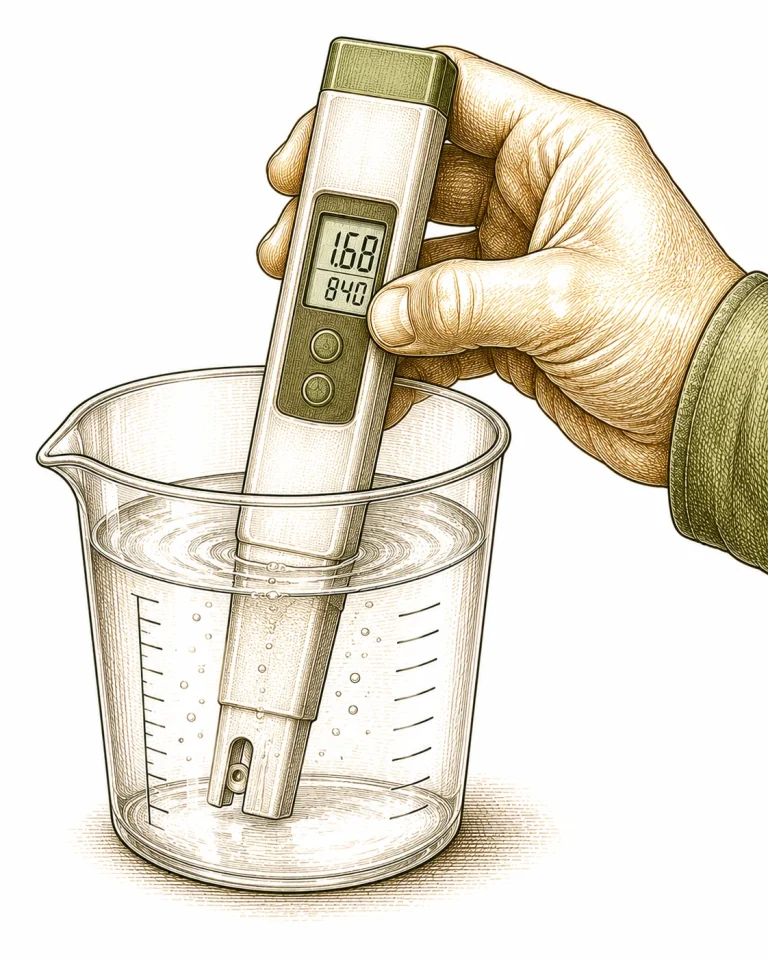
To measure cannabis EC reliably, you need a digital EC meter (also called an EC pen or TDS meter). Budget meters start at around $15 to $20. Pro combo meters that read EC, pH and temperature at the same time run roughly $40 to $150. Make sure you calibrate your meter regularly. Most manufacturers recommend calibrating every two to four weeks with a calibration solution of known conductivity. Our EC meter comparison (German) lines up EC-only pens without a pH function. Our pH and EC meter comparison (German) shows which combo models are a good fit for your grow.
Taking a reading is super simple: dip the meter’s probe at least about 1 in (2 to 3 cm) into your nutrient solution or water, wait 10 to 20 seconds for the number to settle, and write it down. Important: the temperature of the solution can have a big effect on your EC reading. Most meters have automatic temperature compensation (ATC), which normalizes the value to 77 °F (25 °C). If your meter doesn’t have ATC, measure at room temperature or correct the value by hand.
TDS meters show the value in ppm (parts per million) instead of mS/cm. The conversion factor depends on the meter. The common ones are 0.5 (the 500 scale, also called the Hanna or NaCl scale) and 0.7 (the 700 scale). So an EC of 1.0 mS/cm reads as 500 ppm or 700 ppm, depending on the scale. Most US growers work with the 500 scale, so this guide gives ppm (500 scale) first with mS/cm in parentheses. If you use a TDS meter, check your user manual to see which conversion factor it uses.
- Get a digital EC meter: budget pens start around $15, combo meters recommended
- Calibrate every 2–4 weeks with a calibration solution
- Dip the probe at least about 1 in (2–3 cm), wait 10–20 seconds
- Look for automatic temperature compensation (ATC)
- Converting ppm to mS/cm: factor 0.5 (500 scale) or 0.7 (700 scale)
Ideal Cannabis EC by Growth Stage: The Cannabis EC Chart
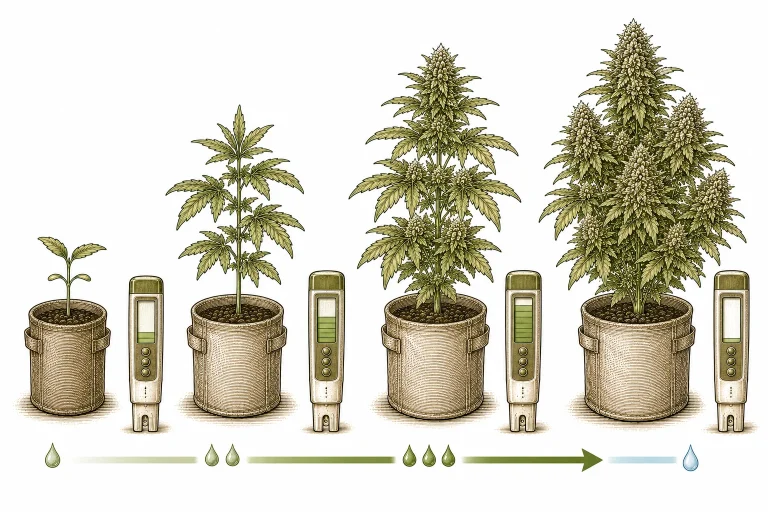
Cannabis has different nutrient needs at every stage of growth, so the ideal EC range changes too. Seedlings and young plants are especially sensitive and can only handle very low concentrations. As your plants get older and bigger, they can take higher and higher EC levels. The overview below is a guideline for hydroponics and coco coir. In soil, values usually run a bit lower because the growing medium already contains nutrients.
During germination and the early seedling stage (first 1-2 weeks), aim for 200 to 400 ppm (0.4 to 0.8 mS/cm). The root system is still very fragile, and concentrated nutrient solutions can easily damage it. That’s a common reason a seedling falls over. In the vegetative stage, the ideal range rises to 500 to 800 ppm (1.0 to 1.6 mS/cm). During the flowering stage, when your plants need lots of phosphorus and potassium, 800 to 1,100 ppm (1.6 to 2.2 mS/cm) is ideal. In the last two weeks before harvest, the so-called flush, you drop the EC to 0 to 200 ppm (0.0 to 0.4 mS/cm). Use only plain, pH-adjusted water to rinse leftover salt buildup out of the growing medium.
These numbers are guidelines, not hard limits. Some strains, especially sturdy indica hybrids, can handle higher EC levels just fine. Sensitive sativa-dominant genetics, on the other hand, may show mild stress at 1,000 ppm (2.0 mS/cm). Watch your plants closely and adjust the EC to how each one responds. Another key factor is your runoff: ideally, its EC shouldn’t be more than 150 to 250 ppm (0.3 to 0.5 mS/cm) above your input. If it’s a lot higher, that points to salt buildup in the growing medium.
- Seedlings: 200 – 400 ppm (0.4 – 0.8 mS/cm)
- Vegetative stage: 500 – 800 ppm (1.0 – 1.6 mS/cm)
- Early flowering: 800 – 1,100 ppm (1.6 – 2.2 mS/cm)
- Late flowering: 800 – 1,100 ppm (1.6 – 2.2 mS/cm) (follow the manufacturer’s feed chart)
- Flush (last 1-2 weeks): 0 – 200 ppm (0.0 – 0.4 mS/cm)
- Runoff EC: no more than 150-250 ppm (0.3-0.5 mS/cm) above your input
EC Too High in Cannabis: Symptoms and Fixes
An EC that’s too high is one of the most common mistakes, especially for growers who think “more is better.” When the concentration of dissolved salts gets too high, it causes osmotic stress: water moves out of the root cells toward the saltier solution, the exact opposite of what you want. Even with plenty of water around, the plant can’t take any up because the osmotic pressure is too high. This is called physiological drought.
The first signs of high EC are often leaf tips curling or pointing down (known as “clawing”), followed by burnt tips and edges. The tips turn yellow, then brown, and finally crispy. Your plants look stressed and growth slows down. With chronically high EC, nutrient lockout can set in, because the salt balance in the growing medium blocks the uptake of certain minerals. The result often looks like a calcium deficiency or other deficiencies, even though the nutrients are there.
The fix for high EC is flushing: run two to three times the pot volume of pH-adjusted, low-nutrient water through the growing medium. Then measure the runoff EC and repeat until it drops to an acceptable level. After that, start again with a freshly mixed nutrient solution at a lower EC than before. Also check whether your tap water already has a base EC (often 100 to 250 ppm, or 0.2 to 0.5 mS/cm), and factor it in when you mix your nutrient solution.
- Symptom: leaf tips curl down (clawing)
- Symptom: yellow-brown burn on leaf tips and edges
- Symptom: slow growth despite regular feeding
- Symptom: nutrient lockout and apparent deficiencies
- Fix: flush the growing medium with pH-adjusted water
- Fix: lower the EC of your next nutrient solution
- Fix: always account for your tap water’s base EC
EC Too Low in Cannabis: Symptoms and Fixes
An EC that’s too low means your plants are underfed. They simply aren’t getting enough minerals for healthy growth. Symptoms usually creep in slowly: first a slight yellow tint in the older, lower leaves (nitrogen deficiency), then spreading yellowing, stretched-out internodes and small, pale growth. In the flowering stage, low EC can lead to small, airy buds with less resin.
Low EC can be a real problem in coco coir, because coco contains almost no nutrients on its own and relies completely on what you feed. If you go too light on nutrients or forget to measure regularly, you can quickly end up with yellow cannabis leaves. Watering heavily without enough nutrients also dilutes the solution in the growing medium and lowers the effective EC.
The fix is simple: raise your nutrient dose step by step until you hit your target EC. Never raise it by more than 100 to 150 ppm (0.2 to 0.3 mS/cm) per watering, so a sudden change doesn’t stress your plants. If you follow proper watering with enough runoff and measure the runoff EC, you can control very precisely what EC actually reaches the growing medium.
- Symptom: Yellowish, pale lower leaves
- Symptom: Slow growth with no vigorous push
- Symptom: Small, airy buds during the flowering stage
- Symptom: General weakness and pale color across the whole plant
- Fix: Raise your nutrient dose gradually, by no more than 100–150 ppm (0.2–0.3 mS/cm) at a time
- Fix: Check your runoff EC after every watering
EC and pH in Cannabis: How They Work Together
EC (electrical conductivity) and pH go hand in hand. pH decides which nutrients in the solution (your EC) your roots can actually take up. A perfect 900 ppm (1.8 mS/cm) won’t help your plant if your pH is so far off that key elements like iron, manganese or calcium are no longer soluble. Think of it this way: EC = how much food is there, pH = how much of it your plant can actually eat.
In hydroponics, aim for a nutrient solution pH between 5.7 and 6.0 (tolerable range 5.5 to 6.1). In coco coir, a slightly higher pH of 5.9 to 6.1 works best (tolerable 5.8 to 6.3). In soil, the sweet spot is pH 6.2 to 6.8 (tolerable 6.0 to 7.0). For a detailed breakdown of the ideal ranges and how to correct them, check out our article on pH for cannabis. Rule of thumb: always measure EC first, then pH – and only adjust your pH AFTER mixing your nutrient solution, because nutrients change the pH of your water.
There’s another connection: when your pH drifts too high or too low and nutrient lockout sets in, you’ll often see symptoms that look like a deficiency – even though your EC is right on target. In that case, simply raising your EC won’t fix anything and can actually make things worse. So whenever you’re troubleshooting, always check both values at the same time. That’s also why combo meters that read both EC and pH are so popular. If you prefer separate pens, our pH meter comparison (German) covers six dedicated pH testers.
- EC = nutrient amount, pH = nutrient availability: both are crucial
- Hydroponics: pH 5.7–6.0 combined with the right EC
- Coco: pH 5.9–6.1 combined with the right EC
- Soil: pH 6.2–6.8, EC readings less critical but still useful
- Always mix to your target EC first, then adjust pH
- Seeing symptoms even though your EC is correct? Always check pH
Not sure how much you need to dilute or strengthen your nutrient solution? Our EC Calculator has you covered — enter your current and target EC and you’ll instantly get the amount of water you need.
Measuring EC in Soil Grows: Runoff as a Diagnostic Tool
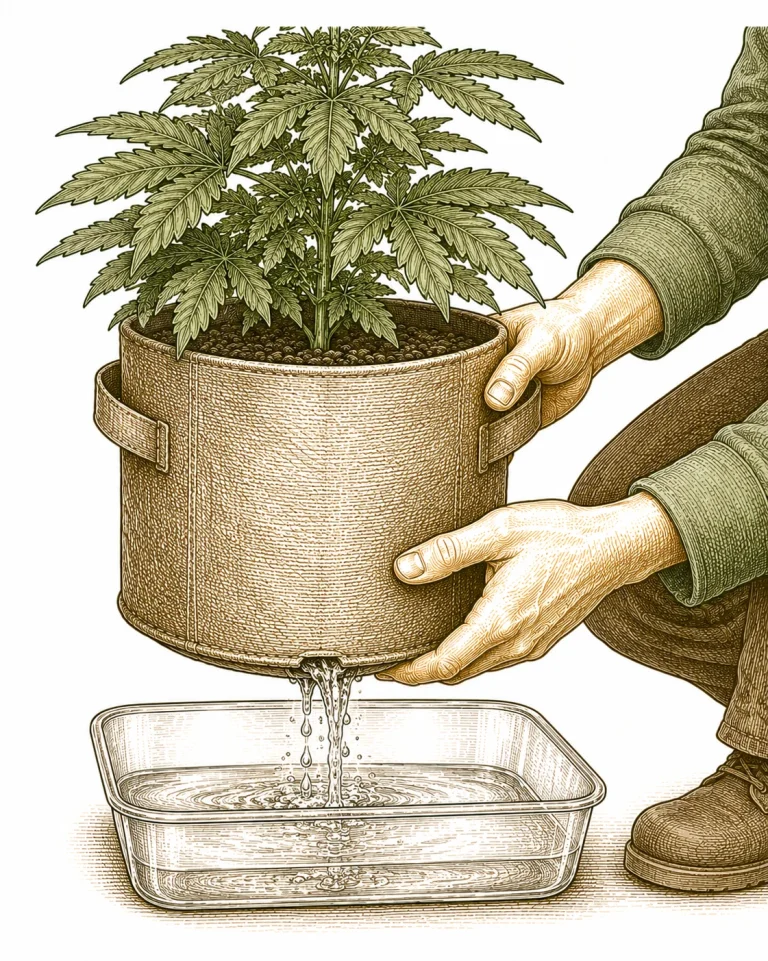
In a classic soil grow, growers measure the EC of their watering solution less often – which makes checking the runoff all the more valuable. Runoff EC gives you a direct look at the current salt level in your growing medium. If your runoff EC is clearly higher than the EC of the water you put in, salt buildup has formed in the pot. This mostly happens when you don’t get enough runoff or when your nutrient doses have been too high for a while.
A simple rule of thumb: measure the EC of your water before watering, then measure the first runoff that comes out. If the runoff reads more than 250 ppm (0.5 mS/cm) higher, start light flushing (plain water, no nutrients) for the next one or two waterings. If the runoff EC is clearly LOWER than what you put in, the medium has held back nutrients or is already so depleted that it dilutes the concentration – a sign your plant will need more food soon.
Keep in mind that pre-fertilized soils like premium mixes already contain enough nutrients for the first two to four weeks and can show a runoff of 1,000–1,500 ppm (2.0–3.0 mS/cm) – that’s normal and no reason to panic. Hold off on extra feeding during this phase and only start feeding once your runoff drops below 500–600 ppm (1.0–1.2 mS/cm). That’s an effective way to avoid cannabis nutrient burn, which can be especially dangerous for young plants.
- Runoff EC = the EC of the water draining out after watering
- Runoff more than 250 ppm (0.5 mS/cm) above input: salt buildup, time to flush
- Runoff lower than input: your medium needs more nutrients
- Fresh pre-fertilized soil: runoff of 1,000–1,500 ppm (2.0–3.0 mS/cm) is normal
- Only start feeding once runoff drops below 500–600 ppm (1.0–1.2 mS/cm)
Organic vs. Synthetic Watering Strategy: With or Without Runoff?
Whether you should water to runoff or not depends heavily on whether you feed organic or synthetic nutrients — and this is exactly where a lot of growers make a costly mistake. The two strategies are not interchangeable.
With organic feeding, you should NOT oversaturate, and you should deliberately water WITHOUT runoff. The goal is an even moisture level in your growing medium so microorganisms and soil life can thrive — they need steady moisture, not swings between soaking wet and bone dry. Learn more about the organic watering approach in our article on cannabis living soil.
With mineral nutrients, it’s the exact opposite: here you should ALWAYS water WITH runoff. Without runoff, mineral salts build up in the growing medium and can damage the roots over time. That’s exactly the rising runoff EC you can track as described earlier in this article. So with mineral nutrients, runoff isn’t a side effect. It’s a necessary safeguard against salt buildup.
- Organic: water WITHOUT runoff and keep moisture even for the soil life
- Organic: avoid oversaturating, because microorganisms need stable conditions
- Mineral: ALWAYS water WITH runoff, or salts can build up
- Mineral: check runoff EC regularly to catch salt buildup early
Common EC Measuring Mistakes and How to Avoid Them
The most common mistake is skipping calibration. An uncalibrated EC meter can be off by 10 to 30 percent. You think you’re feeding 900 ppm (1.8 mS/cm), but you’re actually at 1,150 ppm (2.3 mS/cm). The result can be burnt leaf tips and stressed plants, even though you think you did everything right. Calibrate your meter regularly and store the calibration solution in a cool, dark place.
Another typical mistake is ignoring the base EC of your tap water. In many cities, tap water already reads 100–300 ppm (0.2–0.6 mS/cm), thanks to calcium, magnesium and other minerals. If you don’t factor in this starting value and just mix your nutrients up to 1,000 ppm (2.0 mS/cm), the actual nutrient concentration may only be 700–900 ppm (1.4–1.8 mS/cm). Or, if you calculate it the wrong way around, you can overfeed your plants. So always measure your plain water first, before mixing.
Third common mistake: measuring at the wrong temperature without temperature compensation. At 59 °F (15 °C), a solution reads noticeably lower EC than at 77 °F (25 °C), even though the actual concentration hasn’t changed. If your meter doesn’t have automatic temperature compensation (ATC), bring the solution to room temperature (about 68–77 °F, 20–25 °C) before measuring, or multiply the reading by your meter’s correction factor. Many budget meters already have ATC built in, and that should be a key point when you shop for one.
- Mistake 1: Forgetting calibration – calibrate your meter regularly with calibration solution
- Mistake 2: Ignoring the base EC of your tap water – always measure the starting value
- Mistake 3: Measuring at the wrong temperature – look for ATC or bring the solution to 68–77 °F (20–25 °C)
- Mistake 4: Never measuring runoff EC – you miss key diagnostic info
- Mistake 5: Judging EC without checking pH at the same time
A constantly high EC is often the first warning sign of too much of a single nutrient. Typical examples are nitrogen toxicity, zinc toxicity or manganese toxicity. How to dial in your feeding in general is covered in How to Dose Cannabis Nutrients Correctly.
Which meter works best for pH and EC is covered in our article on pH and EC meters.
Tap Water, RO Water or Rainwater: Which Water Fits Your EC?
The EC of your nutrient solution doesn’t just depend on your nutrients. It also depends on your source water. Regular tap water has its own EC of about 100–400 ppm (0.2–0.8 mS/cm), depending on where you live, and it can be even higher in hard-water areas. You need to subtract this value from your target EC. Otherwise you can end up overfeeding every time, which is how calcium excess from hard tap water can happen.
RO water from a reverse osmosis system, on the other hand, has a base EC close to 0 ppm (0 mS/cm). That gives you full control over your nutrient solution, but it also strips out useful minerals like calcium and magnesium completely. You’ll need to add those back with Cal-Mag, or deficiencies can show up.
Rainwater usually sits somewhere in between: practically free of lime and low in base EC, but its quality can vary depending on your collection container and surroundings. Measure the starting EC after collecting it, before you factor it into your feeding plan.
- Tap water: measure EC first and subtract it from your target, especially with hard water
- RO water: EC close to 0, full control, but you need to remineralize with Cal-Mag
- Rainwater: usually low base EC, but still check it before watering
No matter what your water source is: always check pH and watering habits together with EC before you add nutrients. That’s the only reliable way to judge the real nutrient content of your finished solution.
Frequently Asked Questions
What EC should cannabis have in the vegetative stage?
In the vegetative stage, aim for 600–1,000 ppm (1.2–2.0 mS/cm). Young plants start at the low end (from about 500 ppm, 1.0 mS/cm), while older, well-developed plants in late veg can handle 1,000 ppm (2.0 mS/cm). Always adjust based on how your plants respond.
What’s the difference between EC and PPM?
PPM (parts per million) is another way to express the concentration of dissolved salts. To convert mS/cm to ppm, you multiply by either 500 (the 500 scale, also called the Hanna or NaCl scale) or 700 (the 700 scale, common in Europe). So an EC of 1.0 mS/cm equals 500 ppm on the 500 scale or 700 ppm on the 700 scale. In the US, most meters and feed charts use the 500 scale, so always check which scale your meter reads.
How often should I check EC?
In hydroponics (hydro), measure every time you water, or at least every two to three days. In soil, checking the runoff EC each time you water is enough. During critical stretches like the flowering stage, or when you spot signs of stress, a daily check is a smart move.
What should I do if my runoff EC is much higher than my input EC?
A runoff EC that’s clearly higher than your input points to salt buildup in your growing medium. Flush the medium with two to three times the pot volume of pH-adjusted water until the runoff EC drops to an acceptable level. Then start fresh with a lighter nutrient solution and keep checking your runoff regularly.
Can I measure EC in soil too?
Yes, and it’s a good idea. In soil, it’s best to measure the EC of the runoff draining from your pot. That way, you can catch salt buildup in the medium early, before it causes damage. This check matters most in the middle and toward the end of your grow.
Why does my EC meter show different readings in cold and warm water?
A solution’s electrical conductivity rises with temperature. At 59 °F (15 °C), your meter reads a lower EC than at 77 °F (25 °C), even though the actual concentration hasn’t changed. Quality EC meters have automatic temperature compensation (ATC), which normalizes the reading to 77 °F (25 °C). Without ATC, always measure at the same temperature.
A nutrient mix that’s too strong or mixed wrong often shows up in your EC reading first — learn more in our articles on dosing nutrients correctly and, if water sits in your pots or reservoir, algae in the growing medium.
You’ll find good EC meters in our Recommended Gear.
Bottom Line
Checking your cannabis EC (electrical conductivity) regularly and dialing it in correctly isn’t optional extra work. It’s a core tool for healthy growth and bigger yields. With a calibrated EC meter, solid target ranges for each growth stage and consistent runoff EC checks, you always know how well your plants are fed. Always look at EC and pH together. Only when both are in balance can your plants reach the full potential of their genetics. Master these basics and you lay the foundation for healthy, high-yielding grows. Check the cannabis laws where you live before growing.
