

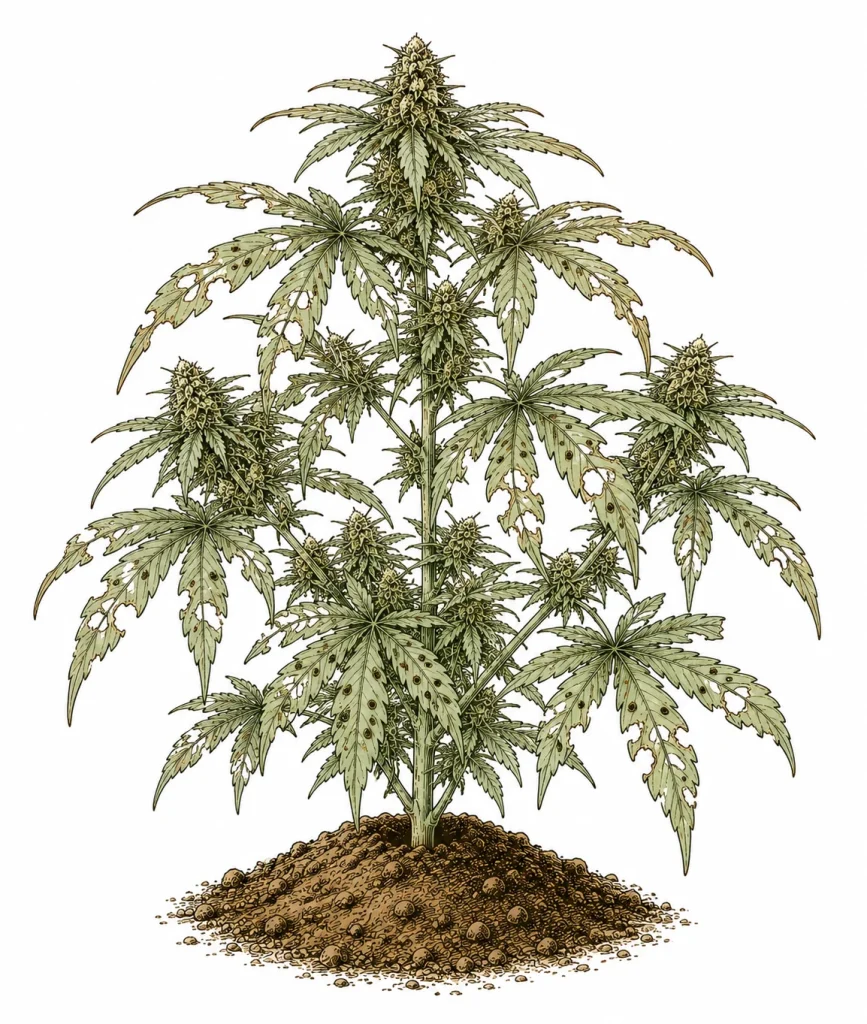
Caterpillars on cannabis outdoors — if you grow outside, you know the problem: overnight, chewed-up leaves, bitten-off shoot tips or dried-out buds suddenly appear, and the culprit is long gone. Caterpillars are among the most dangerous outdoor pests for cannabis plants, because they can cause enormous damage in a short time and often hide well during the day. In this article, we’ll show you how to reliably spot a caterpillar infestation, which species are especially common and which biological methods can still save your harvest. For a complete overview of all possible problems with your plant, we also recommend our Plant Diagnosis overview on PlantClue.
Why Caterpillars Are Especially Dangerous for Outdoor Cannabis
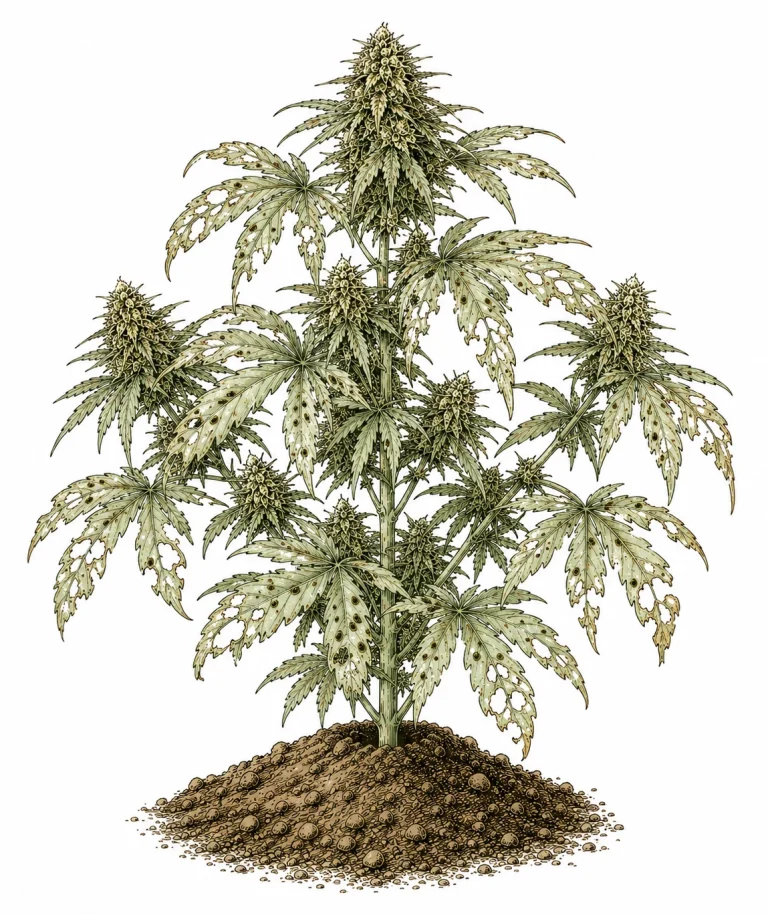
Outdoors, your cannabis plant is constantly exposed to egg-laying by various butterfly and moth species. Females specifically look for vigorous, lush green plants to lay their eggs on — and cannabis, with its large, nutrient-rich leaves, is an attractive target. As soon as the eggs hatch, the larvae start eating right away. Young caterpillars are tiny and easy to miss, but after just a few days, older cabbage moth larvae can skeletonize a medium-sized leaf within hours.
What makes them especially tricky: many caterpillar species prefer to feed at night or hide during the day on the undersides of leaves, in leaf axils or even inside the buds. By the time you notice the damage, the infestation is often already advanced. On top of that, open feeding wounds on leaves and stems are entry points for fungal infections like bud rot (botrytis, gray mold) — a double risk you should take seriously. Especially during wet summers and in cool, wet climates, what starts as a small caterpillar problem can quickly become a serious threat to your entire harvest.
An outdoor grow also gives caterpillars natural hiding places right nearby: hedges, shrubs and perennials close to your plants act as a reservoir from which new caterpillars keep moving in. That’s why regular checks — at least twice a week — are absolutely essential when growing outdoors.
- Each female moth lays up to several hundred eggs
- Larvae hatch after 5–14 days, depending on temperature
- Feeding damage weakens the plant and encourages fungal infections
- Many species prefer to feed at night — barely visible during the day
- Surrounding plants act as a permanent caterpillar reservoir
The Caterpillar Species That Most Often Attack Outdoor Cannabis
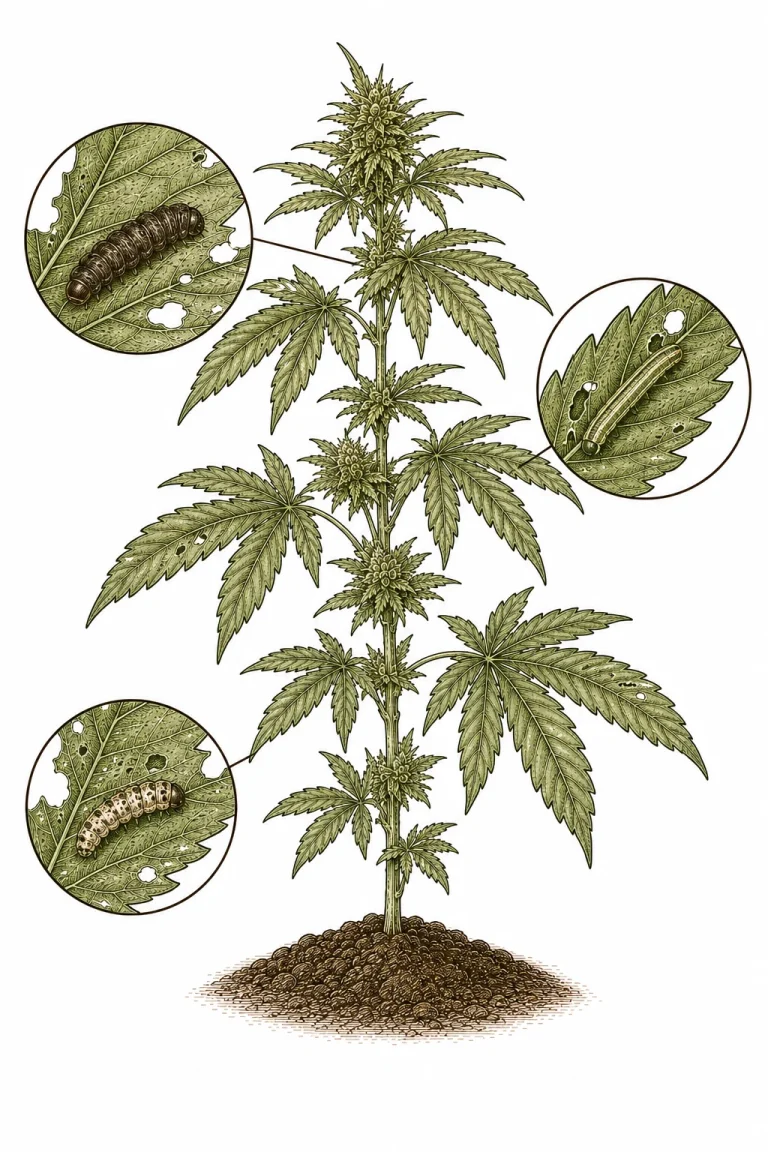
Not all caterpillars are the same — in an outdoor cannabis grow, you’ll keep running into a few specific species. The most common is the larva of the cabbage moth (Mamestra brassicae), an inconspicuous, gray-brown to greenish worm that can grow up to 2 in (5 cm) long and is especially active during the flowering stage. Also widespread is the silver Y moth (Autographa gamma), recognizable by the distinctive silver mark on the adult moth’s wings. Its caterpillars are light green and prefer the upper leaf areas. Both species can cause significant damage in a single night.
The European corn borer (Ostrinia nubilalis) is a special problem. Its caterpillars bore into stems and flowering branches, which is hard to see from the outside at first. Only when branches suddenly wilt or snap does the infestation become obvious — and by then it’s usually well advanced. Caterpillars of the owlet moth family (Noctuidae) are also frequent guests in outdoor grows. They often have greenish-brown markings and blend in perfectly with leaf and stem colors, which makes them hard to spot.
In late summer and fall, when the flowering stage begins, the risk from caterpillars that burrow into the buds rises sharply again. These caterpillars can work their way deep into the bud and eat it from the inside without being visible from the outside right away. The result is rotting buds riddled with droppings that often can’t be saved.
- Cabbage moth: gray-green larvae up to 2 in (5 cm), active at night, eats leaves and buds
- Silver Y moth: light green caterpillars, prefer the upper leaf levels
- European corn borer: bores into stems — only visible late
- Owlet moth caterpillars (Noctuidae): well camouflaged, very common outdoors
- Snout moth caterpillars (borers): burrow into buds, cause rot from the inside
How to Spot Caterpillars on Cannabis Outdoors: Signs of an Infestation
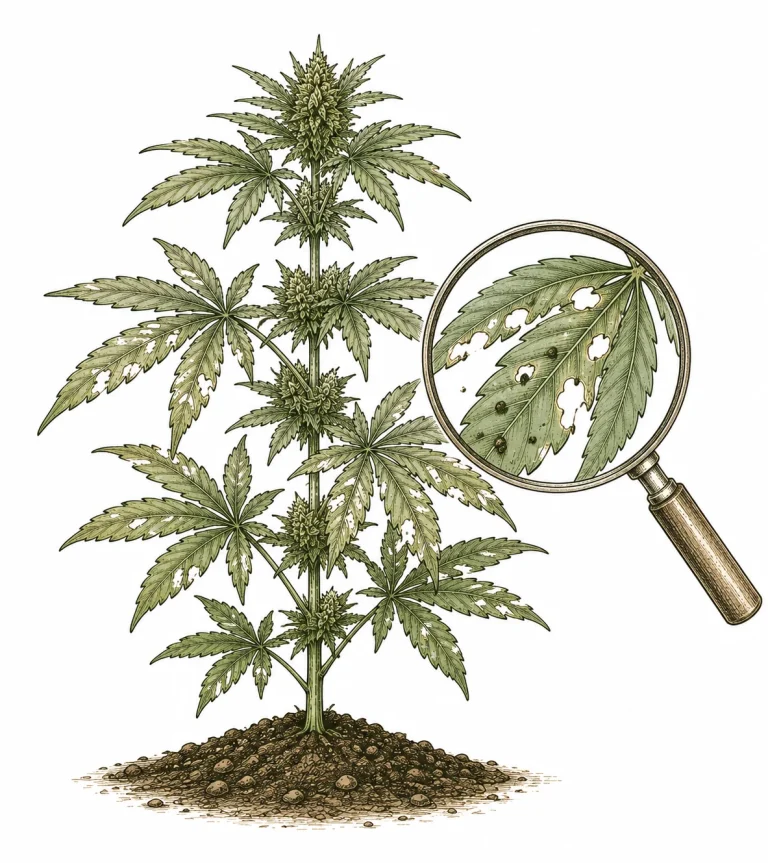
The surest sign of caterpillars is irregular feeding holes in the leaves. Unlike slugs and snails, which leave smooth, moist edges, caterpillar damage tends to have ragged, dry edges. Often whole leaf sections are missing or the leaf margin is clearly nibbled. In a heavy infestation, individual leaves can be almost completely skeletonized — only the veins remain. Also watch for wilting or suddenly drooping shoot tips, which can point to stem borers like the European corn borer.
An almost unmistakable clue is droppings (fraß) on the leaves and on the soil below the plant. These small, dark green to black pellets are what caterpillars leave behind, and they collect right below the spot where they feed. The bigger the droppings, the bigger (and hungrier) the caterpillar. When you find them, immediately search the leaves and leaf axils above — the caterpillar is usually close to its droppings.
Other clues include visible egg clusters on the undersides of leaves (often arranged like scales, pale yellow to whitish), chewed stem tissue or split bark on the main stem. It’s best to check your plants in the evening with a flashlight, since many caterpillars only become active after dark. For a systematic diagnosis, it’s also worth taking a look at our overview of all cannabis pests.
- Ragged feeding holes with dry edges in the leaves
- Skeletonized leaves — only the veins are left
- Dark droppings on the leaves and the soil
- Shoot tips wilting or snapping for no visible reason
- Egg clusters on leaf undersides: scale-like, pale yellow to white
- Split or chewed stem tissue
Biological Control of Caterpillars on Outdoor Cannabis: The Best Methods
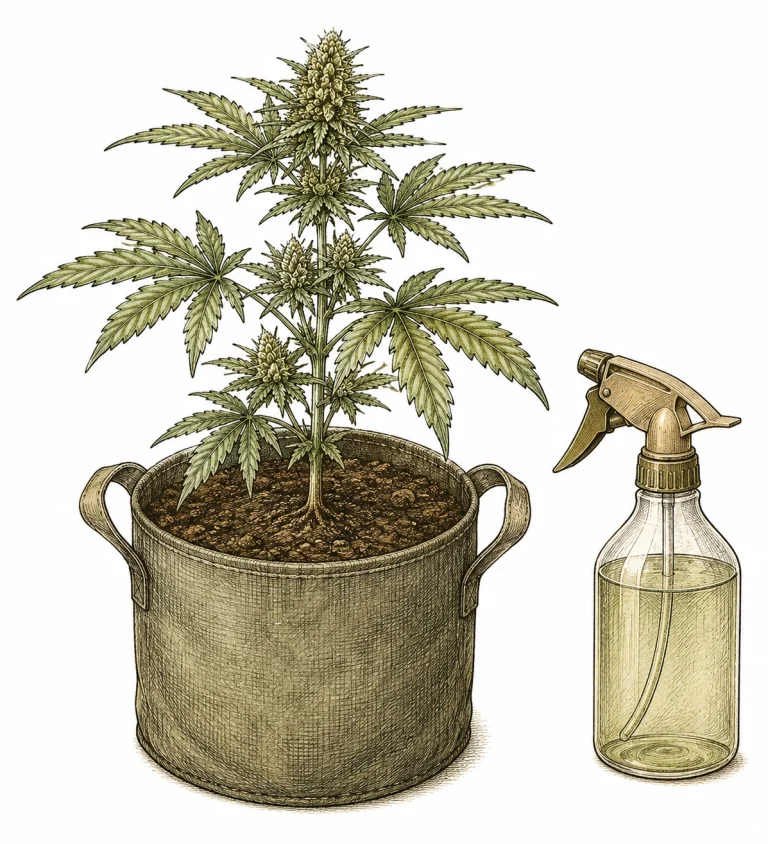
The most effective and at the same time most eco-friendly method against caterpillars is Bacillus thuringiensis var. kurstaki (Bt-k). This naturally occurring soil bacterium produces a protein that is deadly to caterpillars but completely harmless to mammals, birds and beneficial insects like bees. Bt-k is sold commercially as a biological pesticide (for example under brand names like XenTari or Dipel). You spray the solution directly onto leaves and buds — the caterpillars ingest the bacterium while feeding and die within 2–4 days. Important: Bt-k only works against feeding larvae, not against eggs or pupae, and loses its effect quickly after rain. Repeat the treatment every 5–7 days and after every rainfall.
Neem oil (azadirachtin) is another proven biological option. It acts as a feeding deterrent, disrupts the caterpillars’ molting and also repels butterflies and moths, so they lay fewer eggs. Mix 5 ml of cold-pressed neem oil with 1 quart (1 L) of water and a squirt of biodegradable dish soap as an emulsifier. Spray the mix onto leaves and stems in the evening — never in direct sunlight, as this can cause burns. Neem oil is especially recommended in the vegetative stage; in late flowering, use it sparingly so it doesn’t affect the taste and smell of your buds.
Beneficial insects are another natural weapon: parasitic wasps (for example Trichogramma species) parasitize the eggs of butterflies and moths and keep caterpillars from hatching in the first place. Trichogramma products are available from garden and grow suppliers and are attached to the plant as small cards. Searching for and picking off caterpillars by hand is also very effective in an outdoor grow — especially with just a few plants, an evening hunt with gloves is well worth it. You can drop caterpillars and egg clusters straight into a bucket of soapy water.
- Bacillus thuringiensis (Bt-k): highly effective, harmless to beneficial insects, reapply after rain
- Neem oil: feeding deterrent and repellent, spray in the evening
- Trichogramma parasitic wasps: parasitize eggs, use preventively
- Pick off caterpillars by hand in the evening with a flashlight and gloves
- Pyrethrin products (plant-based): as a last resort for heavy infestations
- Repeat treatments every 5–7 days, especially after rain
How to Prevent Caterpillars on Outdoor Cannabis: Protect Your Plants from the Start
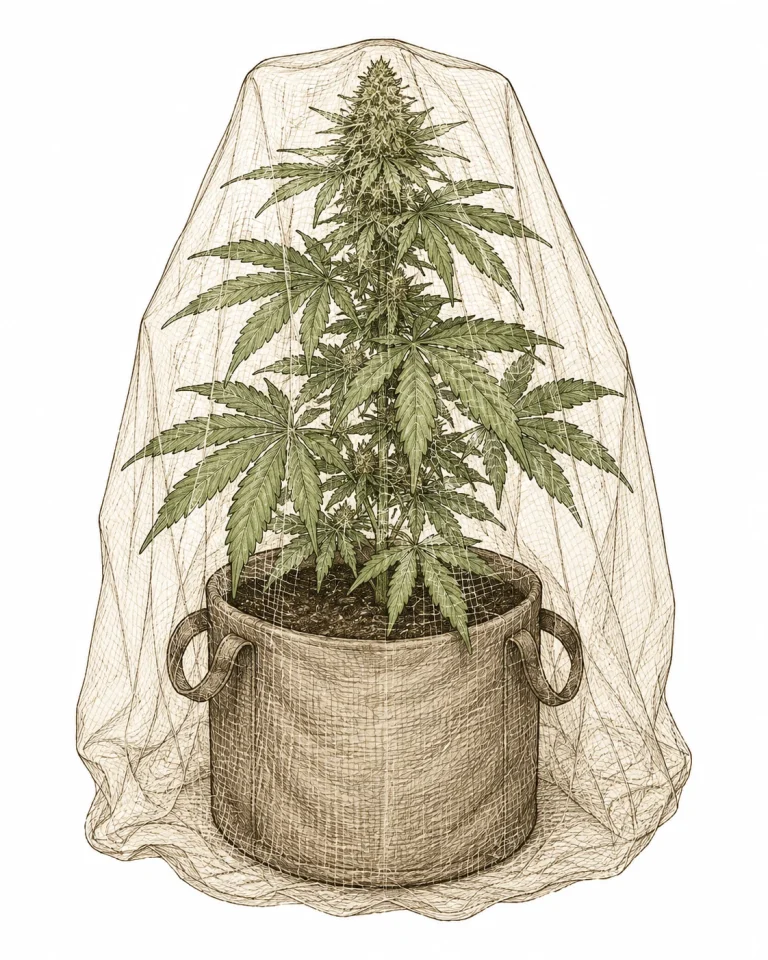
Prevention is the most important measure in an outdoor grow — because once an infestation is advanced, controlling it takes much more effort. Fine-mesh insect netting (mesh size under 0.04 in / 1 mm) over your plants keeps butterflies and moths from laying eggs at all. This method makes the most sense in the vegetative stage and early flowering. Check the netting regularly and close any gaps, since butterflies and moths will use even the smallest openings. In full bloom, the netting can get in the way and should only be used as protection against especially heavy pest pressure.
Companion plants can naturally keep butterflies and moths away or attract beneficial insects that reduce eggs and caterpillars. Lavender, sage, marigolds (Tagetes) and calendula planted near your cannabis have proven effective. These plants give off scents that irritate or confuse many butterfly and moth species. At the same time, their open flowers attract parasitic wasps, hoverflies and other beneficial insects that act as natural enemies of caterpillars.
Regular checks are essential: inspect your plants at least twice a week, especially the undersides of leaves, leaf axils and bud sites. Remove egg clusters right away, before the larvae hatch. A healthy, well-fed plant is more resilient — keep an eye on balanced pH and well-matched feeding. If you want to learn more about giving your cannabis plants the best basic care, read our beginner’s guide to growing cannabis indoors. Many of the same basic principles for healthy plant growth also apply outdoors.
- Put insect netting (mesh under 0.04 in / 1 mm) over your plants
- Companion plants: lavender, sage, marigolds (Tagetes), calendula
- Check your plants twice a week for egg clusters and young caterpillars
- Remove egg clusters right away — ideally cut off the leaf and throw it away
- A healthy nutrient balance strengthens natural resistance
- Treat preventively every 2 weeks with Bt-k or neem oil
Assessing Feeding Damage: When Can Your Plant Still Be Saved?
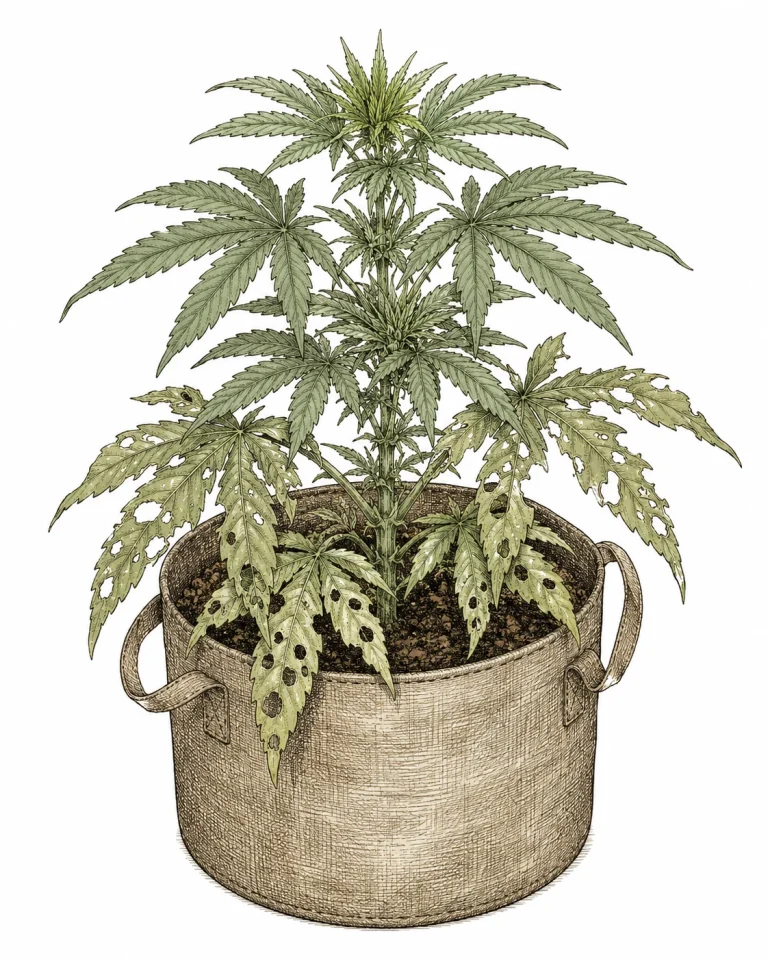
Not every bit of caterpillar damage means the end for your plant. Cannabis is an extremely resilient species that shows an amazing ability to recover if you act in time and the plant is otherwise in good shape. As long as the main stems, main branches and most of the leaf area are still intact, the plant can make up for feeding damage — provided you act quickly. Even heavily chewed leaves can still photosynthesize as long as the veins are there.
Things get critical when caterpillars have gotten into the buds and are feeding there. Remove affected buds generously, because caterpillar droppings combined with moisture create ideal conditions for mold. Don’t leave any chewed bud clusters on the plant — the risk of bud rot spreading is too high. If you’re not sure whether your plant has other problems besides caterpillars, such as yellowing or nutrient deficiencies, it’s best to also read our article on cannabis leaves turning yellow.
If stem borers have damaged the main stem and a shoot tip wilts completely or breaks off, that branch is lost. Cut it off cleanly below the entry hole and disinfect the cut with diluted hydrogen peroxide. In many cases, the plant regrows from side shoots, so the harvest can still be saved. A heavily infested plant — with more than 50% of the leaf area damaged — calls for immediate, consistent action with Bt-k and possibly an earlier harvest.
- Leaves with intact veins can still photosynthesize
- Remove chewed buds right away and generously (risk of mold)
- Stem borer damage: cut off the branch below the entry hole
- More than 50% leaf loss: use Bt-k right away, check your harvest timing
- The plant can recover strongly after timely treatment
- Disinfect cuts with diluted H2O2
Caterpillars on Outdoor Cannabis: Chemical vs. Biological Control Compared
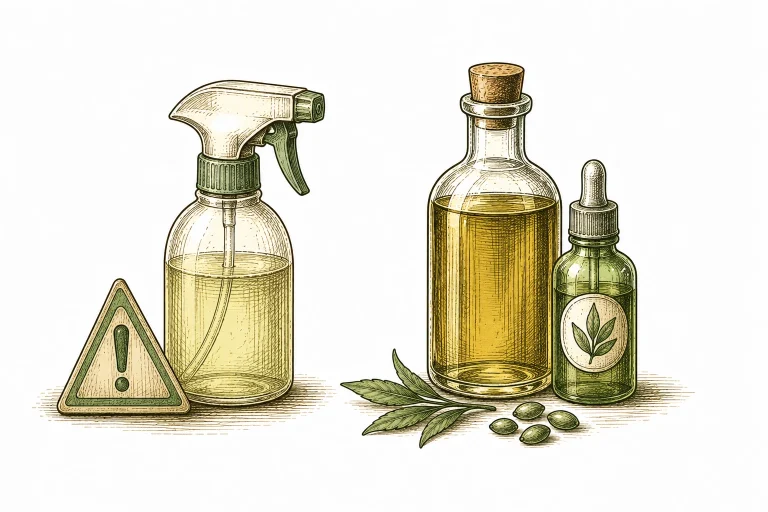
For home growing, we generally recommend biological methods, because chemical insecticides can leave residues in your final product and kill many beneficial insects. Synthetic pyrethroids, for example, reliably kill caterpillars, but they also wipe out bees, hoverflies and other pollinators that matter for a healthy garden ecosystem. On top of that, caterpillars can quickly build up resistance with repeated use.
Biological products like Bt-k and neem oil, on the other hand, are selective, break down quickly and, when used correctly, leave no harmful residues in the harvested material. Bt-k is considered so safe that it’s even approved for certified organic growing. The only downside: it takes a bit more patience and consistency, since repeat treatments are needed. So plan a regular treatment schedule for your outdoor grow from the start — whether or not you currently see an infestation.
Stressed plants are also more prone to pest problems in general, so it’s worth keeping an eye on your cannabis plant’s nutrient supply too. Weakened plants — for example from nutrient imbalances — are much more attractive to caterpillars and other pests. Our article on how to spot and fix cannabis nutrient burn helps you avoid that kind of stress.
- Biological: Bt-k, neem oil, Trichogramma — safe, low residue
- Chemical: fast-acting, but risk of residues and resistance
- Bt-k: approved for organic growing, selective, harmless to bees
- Synthetic pyrethroids: also kill beneficial insects, not recommended
- A regular treatment schedule protects better than one-off reactive measures
- Healthy, well-fed plants are less susceptible to pest infestations
For a complete overview of all cannabis pests, check out our Pests guide. Narrow, winding tunnels instead of large holes, on the other hand, are more likely to point to leaf miners .
Frequently Asked Questions
How do I spot caterpillars on my outdoor cannabis plant?
The clearest signs are ragged holes in the leaves, skeletonized leaf areas and dark droppings (fraß) on the leaves or on the soil. Many caterpillars are active at night, so checking your plants in the evening with a flashlight helps. Egg clusters on the undersides of leaves are also a sure sign that an infestation is on its way.
Which caterpillar species attack outdoor cannabis most often?
The most common species are the larvae of the cabbage moth (Mamestra brassicae), the silver Y moth (Autographa gamma) and caterpillars of various owlet moths (Noctuidae). The European corn borer (Ostrinia nubilalis) is another common pest, because its larvae bore into stems and shoots and are hard to see from the outside.
Is Bacillus thuringiensis (Bt-k) really safe for my cannabis plant?
Yes, Bt-k is completely harmless to the plant itself and also safe for mammals, birds and beneficial insects like bees. It only works against caterpillars that are actively feeding. Outdoors, Bt-k breaks down quickly and, when used correctly, leaves no residues of concern. It’s even approved for certified organic growing.
Can caterpillars cause mold on my cannabis plant?
Indirectly, yes. The feeding wounds caterpillars leave behind are open entry points for fungi like bud rot (botrytis, gray mold). It gets especially dangerous when caterpillars bore into the buds and feed there — the moist droppings inside a dense bud can lead to rot within just a few days. That’s why you should remove damaged bud sections right away.
When should I start preventing caterpillars?
Start preventive measures as early as spring, when the first butterflies and moths become active. Hang Trichogramma cards as soon as your plants go outside. Preventive Bt-k treatments every two weeks significantly reduce the risk of an infestation. Check your plants for egg clusters at least twice a week.
Can I still harvest my cannabis plant if caterpillars have gotten into the buds?
Often yes, if you act fast. Generously remove all chewed and rotting bud parts. If the damage is limited to individual branches and the rest of the plant is healthy, the harvest can still be saved. With a very heavy bud infestation, harvesting early makes more sense than waiting longer and risking mold spreading through the whole plant.
For more expert background on insect pests in outdoor growing, see the Bavarian State Institute for Viticulture and Horticulture (LWG) (German).
Conclusion
Caterpillars in an outdoor cannabis grow are a serious pest that can cause major crop losses if you don’t act fast. But with regular checks, preventive use of Bt-k and neem oil and smart companion planting, you can protect your outdoor grow very effectively. Biological methods aren’t just safer for you and the environment — they also work better than chemical alternatives in the long run. Act decisively at the first sign of an infestation — your plant will thank you with a healthy harvest.
