

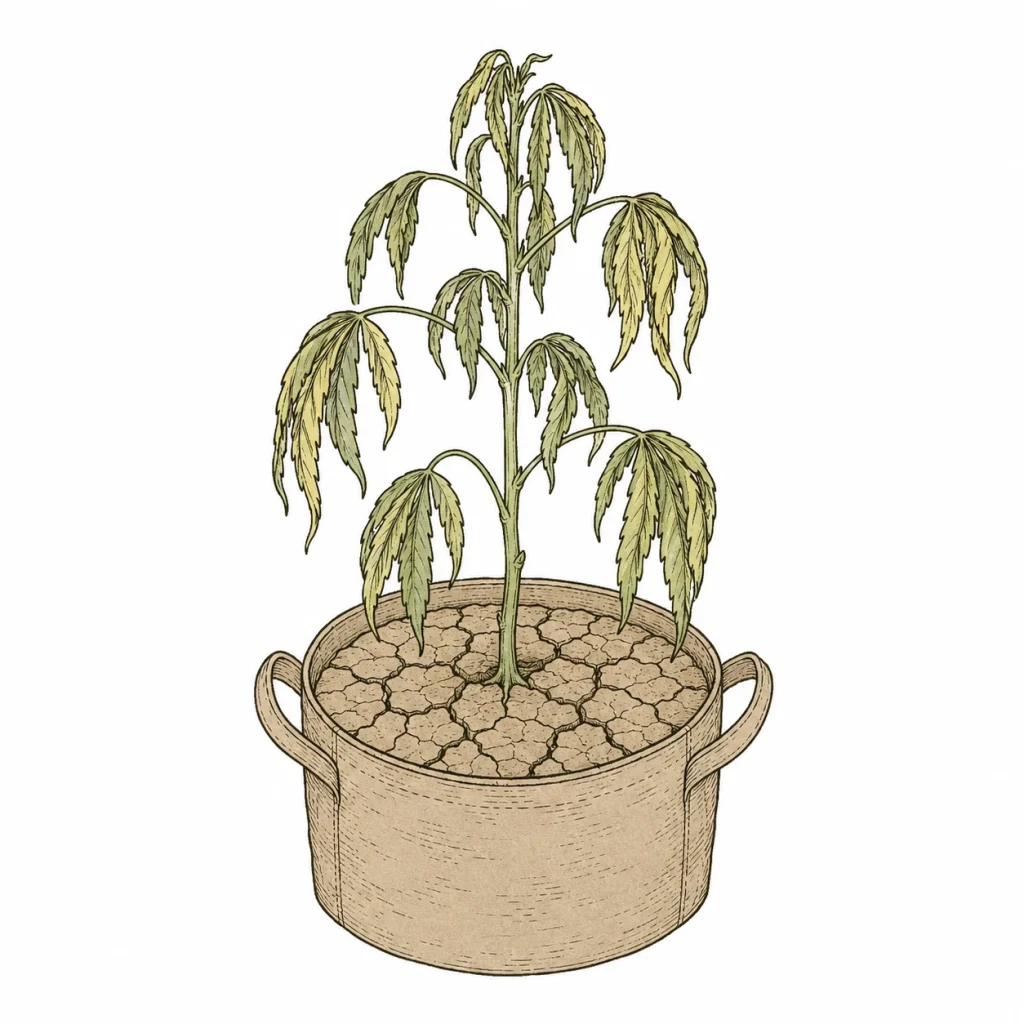
Recognizing an underwatered cannabis plant is one of the most important basic skills for any grower – because both too little and too much water can seriously harm your plant in a short time. Drooping leaves, a dried-out growing medium and an unusually light pot are the first warning signs you need to know. What makes it especially tricky: underwatering and overwatering (waterlogged soil) look very similar at first glance, but they have completely different causes and call for opposite treatments. In this article, you’ll learn how to reliably tell the two apart, which immediate steps help and how to keep soil moisture at the right level in the long run – so your grow stays healthy and productive.
Recognizing an underwatered cannabis plant: the typical symptoms at a glance
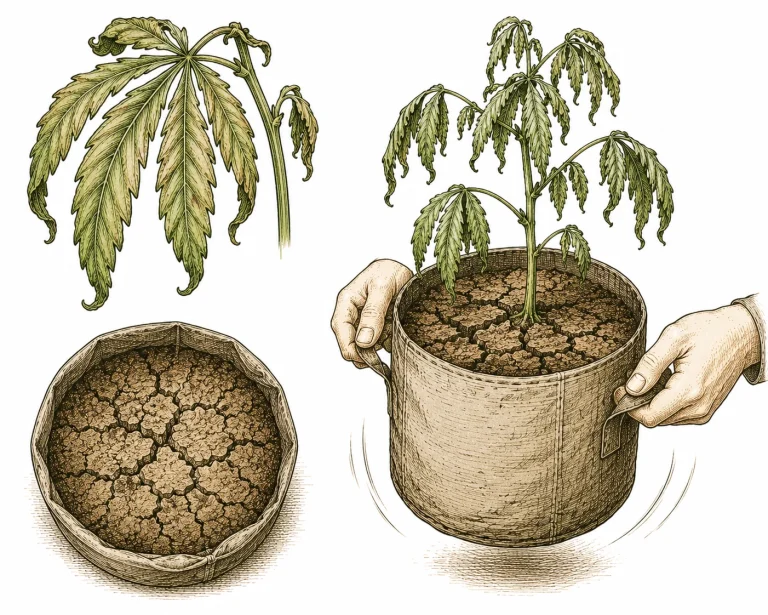
When your cannabis plant gets too little water, it reacts quickly and very visibly. The most noticeable symptom is drooping leaves: the leaf blades lose their turgor – the internal water pressure that keeps the plant cells firm – and hang down limply. Unlike with overwatering, the leaves stay comparatively thin and leathery, sometimes slightly curled inward. The plant looks dull and exhausted overall, not plump and green as it would in ideal condition.
Another sure sign is the growing medium itself. With underwatering, the soil is bone-dry, pulls away from the edge of the pot and may even show cracks. When you lift your pot, you’ll immediately notice how light it is – that’s one of the simplest and most reliable diagnostic methods there is. Experienced growers do the so-called “lift test” routinely: a well-watered pot feels much heavier than a dried-out one.
If the leaves go without water for a long time, the leaf edges can turn brownish and the plant stops growing completely. In extreme cases, older leaves die off while the younger shoot tips are the last to still be supplied. At this point, you need to act fast, because although the plant can recover, it loses valuable growing time.
- Leaves droop limply, leaf blades lose turgor
- Growing medium is bone-dry, pulls away from the edge of the pot or shows cracks
- Pot feels unusually light when lifted
- Leaves slightly curled inward, thin, leathery texture
- Growth stops and leaf edges discolor in severe cases
- Overall appearance: dull, limp, exhausted
Underwatering vs. overwatering: how to spot the key difference
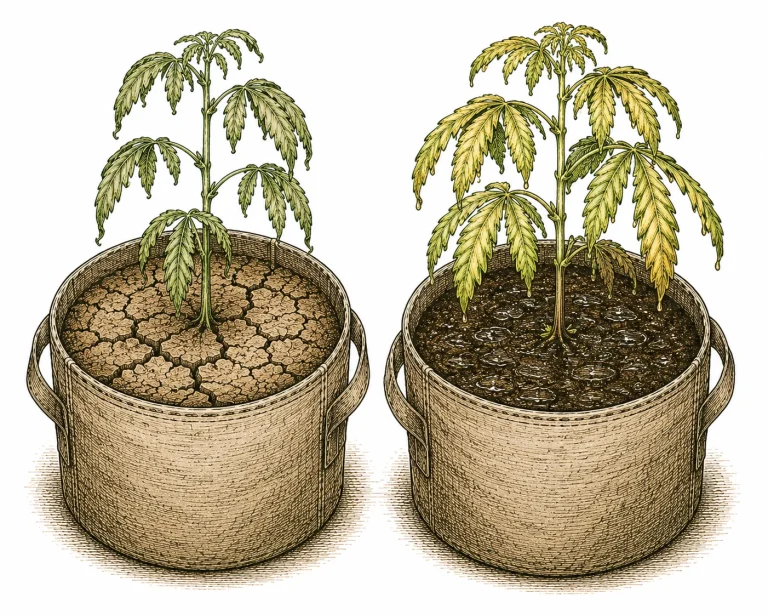
The biggest challenge for many growers is that cannabis shows similar outward symptoms with underwatering and with waterlogging (overwatering): in both cases, the leaves droop. The difference, however, lies in the growing medium and the weight of the pot. With underwatering, the growing medium is dry and the pot is light. With overwatering, the growing medium is wet to soaking, the pot is heavy and the soil may smell rotten or musty – a sign of oxygen deprivation in the root zone and the start of root rot.
If you look closely, the leaves look different too: with overwatering, the leaves tend to become soft and slightly yellowish, while with underwatering they tend to keep a darker, dull green color and curl up. In addition, overwatering often comes with other problems, such as nutrient deficiencies caused by limited root uptake or calcium deficiency in cannabis, which shows up as spots and deformed new growth.
The finger test is your fastest diagnostic tool: push your finger about 1–2 in (3–5 cm) deep into the growing medium. If it feels dry, you’re dealing with underwatering. If it feels wet and cold even though you may not have watered the plant for a while, that points to poor drainage or waterlogging. If in doubt, take a closer look at the basics in the article how to water cannabis plants – there you’ll find all the methods for working out the best time to water.
- Underwatering: growing medium dry, pot light, leaves dark, dull and curled
- Overwatering: growing medium wet, pot heavy, leaves yellowish and soft, soil smells rotten
- Finger test 1–2 in (3–5 cm) deep: dry = underwatering, wet = overwatering
- Lift test: a light pot means lack of water, a heavy pot means overwatering
- Overwatering often comes with nutrient deficiencies and root problems
- Both conditions stop growth but call for opposite measures
Common causes of underwatering in cannabis
The most obvious cause is simply watering too rarely. Many beginners are afraid of overwatering and wait too long before watering the plant again. Especially in the flowering stage, when the plant ramps up its metabolism and uses much more water, a rigid watering schedule of “once every three days” can quickly lead to a lack of water. The plant signals its needs by losing turgor – you should take this signal seriously and not ignore it.
Another common reason is a hydrophobic growing medium. When soil dries out too much, it can become water-repellent: the water then runs down the outside of the root ball and out of the pot without really soaking the growing medium inside. The plant keeps suffering from a lack of water even though you seem to be watering. This problem is especially common with peat-based mixes or very compact soils that shrink as they dry out.
A pot that’s too small can also be the cause: the roots fill the entire growing medium and use up the water extremely fast – sometimes within a few hours of watering. This is known as being “root-bound.” Very high ambient temperatures or intense lighting are also possible causes, since they drastically increase evaporation and can double or triple the plant’s water needs. If you want to learn more about choosing the right growing medium, you’ll find helpful information via our Plant Diagnosis hub. If the leaves are more slightly drooping without the growing medium being dry, our article on drooping leaves is the better place to start.
- Watering too rarely, especially during flowering with its higher water needs
- Hydrophobic growing medium: dried-out soil no longer absorbs water
- Pot too small, roots fill the entire volume (root-bound)
- High temperatures or intense lighting sharply increase evaporation
- Wrong watering schedule that isn’t adapted to the growth stage
- Poor-quality growing medium or soil that’s too compacted
Recognizing and fixing an underwatered cannabis plant right away: step-by-step guide
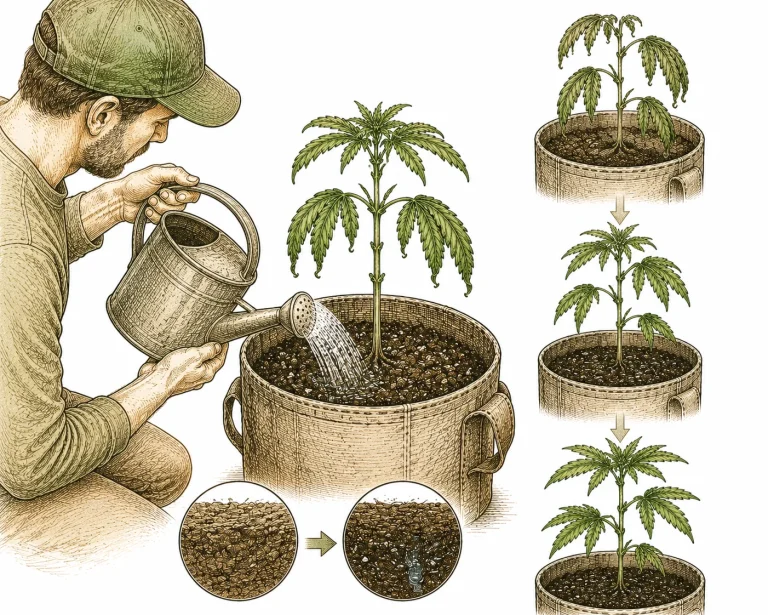
Once you’ve recognized that your cannabis plant is underwatered, the immediate step is clear: water the plant right away. But how you do it matters. If the growing medium has already dried out a lot and become hydrophobic, water slowly and in several small portions. Pour in a little water, wait 30 seconds, pour again – this way you can gradually make the growing medium absorbent again without the water running straight through the pot without being absorbed.
A proven method for a badly dried-out growing medium is soaking the pot: place the pot in a tub of lukewarm water for 20–30 minutes. The water is soaked up from below through the drainage holes and moistens the growing medium evenly from the inside. Then take the pot out and let it drain until no more water runs out of the holes. After proper watering, the leaves should perk back up within 30 minutes to a few hours – that’s a good sign.
Don’t add any nutrients to the water after severe underwatering. The stressed plant is sensitive, and nutrient salts could put extra strain on the damaged roots. Wait until the plant has recovered before you go back to normal feeding. Also check the pH of your water – the wrong pH can inhibit nutrient uptake and slow down recovery. You’ll find all the details in the article on pH for cannabis.
- Water right away: slowly and in several small portions if the growing medium is hydrophobic
- Soaking method: place the pot in a tub of water for 20–30 minutes
- No nutrients right after severe lack of water – let the plant recover first
- Check the pH of your water: 6.0–7.0 for soil, 5.5–6.5 for coco
- Watch for recovery: leaves should perk up within 30 min to 3 hours
- Adjust your watering cycle and check more regularly from now on
Fixing overwatered cannabis: what to do when the roots are suffering
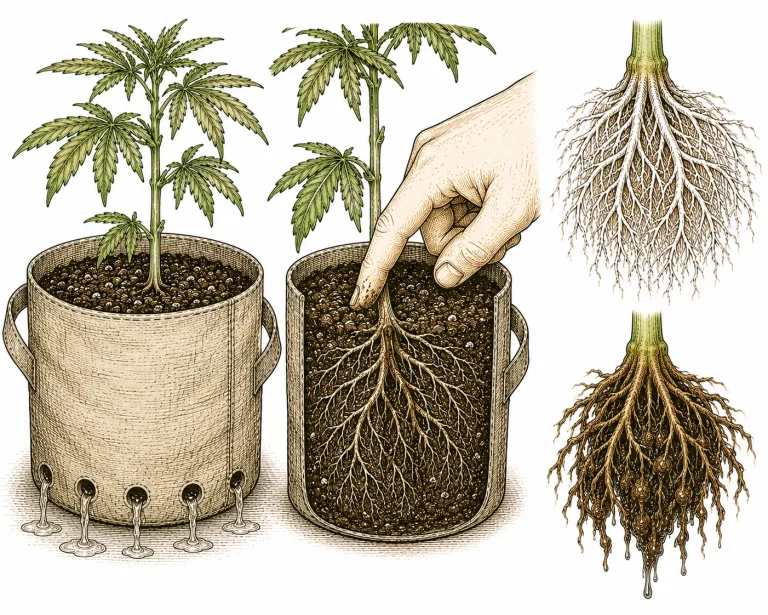
Overwatering is more serious than underwatering, because it doesn’t just stop growth – it actively damages the roots. When oxygen can no longer reach the root zone, roots die off and anaerobic bacteria can trigger root rot. Once you’ve confirmed overwatering, the first step is to stop watering completely. Only water again when the growing medium has really dried out according to the finger test and the lift test – even if that takes several days.
To prevent overwatering for good, drainage is key. Every pot needs drainage holes that are big enough. Set pots on saucers, but don’t let water stand in the saucer – the growing medium will soak it right back up from below. Add perlite to your growing medium (20–30 % by volume) to improve aeration in the soil and prevent waterlogging structurally. Perlite is an inexpensive and very effective measure that you can work in every time you repot.
In severe cases of overwatering where the roots are already brown and rotting, repotting into fresh, well-draining growing medium may be necessary. When you do, cleanly remove all rotten root parts with disinfected scissors. Treat the remaining roots with a product based on trichoderma or mycorrhizal fungi, which helps the roots recover. After that, pay particularly close attention to your watering rhythm and read through our detailed guide on how to water cannabis plants to avoid mistakes in the future.
- Stop watering immediately and let the growing medium dry out completely
- Improve drainage: drainage holes that are big enough, no water left in the saucer
- Work 20–30 % perlite into the growing medium for better aeration
- With root rot: repot into fresh growing medium, remove rotten roots
- Use trichoderma or mycorrhizal fungi to strengthen the roots after overwatering
- Rethink your watering rhythm from the ground up and adapt it to the plant’s needs
Long-term prevention: how to keep your cannabis plant from getting underwatered
The best protection against underwatering is consistently monitoring your plants. Briefly lift each pot every day and mentally compare its weight with how it feels right after watering. With a little practice, you’ll develop a reliable feel for when your plants need water. In addition, you can use inexpensive soil moisture sensors that show you the moisture level in the growing medium on a color scale or a numeric display – especially useful for beginners.
Actively adapt your watering rhythm to the growth stage. Small plants in the seedling stage and early vegetative stage need little water. In late veg and especially during flowering, when the plant grows vigorously and transpires a lot, its water needs rise considerably. High ambient temperatures and intense LED or HPS lighting speed up evaporation even more – adjust your watering cycle accordingly instead of stubbornly sticking to a fixed interval.
Choose the right pot size for your plant. Pots that are too small dry out too quickly, while pots that are too big hold moisture too long and encourage waterlogging. As a rule of thumb: 1.5–2 gal (6–8 L) for small to medium plants in veg, 3–5 gal (11–18 L) for full-grown plants in flowering. Fabric pots (grow bags (German)) are an excellent choice, because their breathable walls provide natural drainage and air pruning of the roots on their own and significantly reduce both waterlogging and extreme drying out.
- Daily lift test: lift the pot and compare its weight with how it feels after watering
- Use a soil moisture sensor for precise moisture control
- Adjust your watering rhythm flexibly to growth stage, temperature and light intensity
- Choose the right pot size: 3–5 gal (11–18 L) for flowering plants
- Use fabric pots: better drainage, air pruning, less waterlogging
- Mix the growing medium with 20–30 % perlite for the best water retention and aeration
The golden rule against underwatering is also cited by the Bavarian Garden Academy (in German): water less often but thoroughly, rather than regularly giving only small amounts of water.
If underwatering progresses, the plant can wilt badly – you can read how to save it at that point in our article on wilting plants.
Frequently asked questions
How quickly does cannabis recover from underwatering?
With mild to moderate underwatering, the leaves usually perk back up within 30 minutes to 3 hours after proper watering. With severe underwatering that has already caused leaf discoloration, full recovery can take 1–3 days. Leaves that have already died won’t recover, but new shoots will grow back healthy.
Can underwatering cause lasting damage to cannabis?
Short-term underwatering usually doesn’t cause lasting damage. But if the lack of water is ignored for several days, roots can be damaged and older leaves can die off for good. Chronic underwatering during the flowering stage can significantly reduce yield, because the plant doesn’t have enough energy for bud formation.
How do I tell underwatering from a nutrient deficiency?
A nutrient deficiency usually shows up first as discoloration (yellow, brown, purple) in specific areas of the leaf, while underwatering is mainly recognizable by drooping, wilted leaves without strong discoloration. The simplest test: water the plant and watch whether the leaves perk up within a few hours. If they do, it was underwatering. If not, there may be a different problem.
How often should I water my cannabis plants during flowering?
That depends on pot size, growing medium, temperature and plant development. As a guideline, many growers water every 1–3 days during flowering. The lift test is more reliable than any fixed interval – water when the pot feels light and the growing medium is dry about 1 in (2–3 cm) deep. In late flowering, at high temperatures or under intense light, daily watering may be necessary.
What do I do if the growing medium won’t absorb water anymore after drying out?
Set the pot in a tub of lukewarm water for 20–30 minutes. The growing medium soaks up water from below and rehydrates evenly. Alternatively, you can add small amounts of water from the top in several rounds, always waiting until the water has been absorbed. A few drops of a pH-neutral wetting agent (such as coconut-oil-based products) can make a hydrophobic growing medium absorbent again.
Are fabric pots really better against overwatering and underwatering?
Yes, fabric pots (grow bags) are much better than classic plastic pots. Their breathable walls let air reach the root zone, prevent waterlogging through better evaporation and provide natural air pruning of the roots. The growing medium dries out more evenly, which makes it easier to dose your watering. However, they also dry out faster than plastic pots – you need to adjust how often you water accordingly.
Conclusion
Recognizing an underwatered cannabis plant and reacting correctly is a basic skill that stays with every grower from day one – because watering remains one of the most important levers for health and yield across all growth stages. The key is not to water on a rigid schedule, but to respond flexibly to your plant’s signals and the condition of the growing medium. With the lift test, the finger test and a sharp eye on the leaves, you have all the tools to spot and fix both underwatering and overwatering early. Remember: a well-watered plant with a healthy root zone is the foundation for healthy growth, strong buds and maximum yield.
