

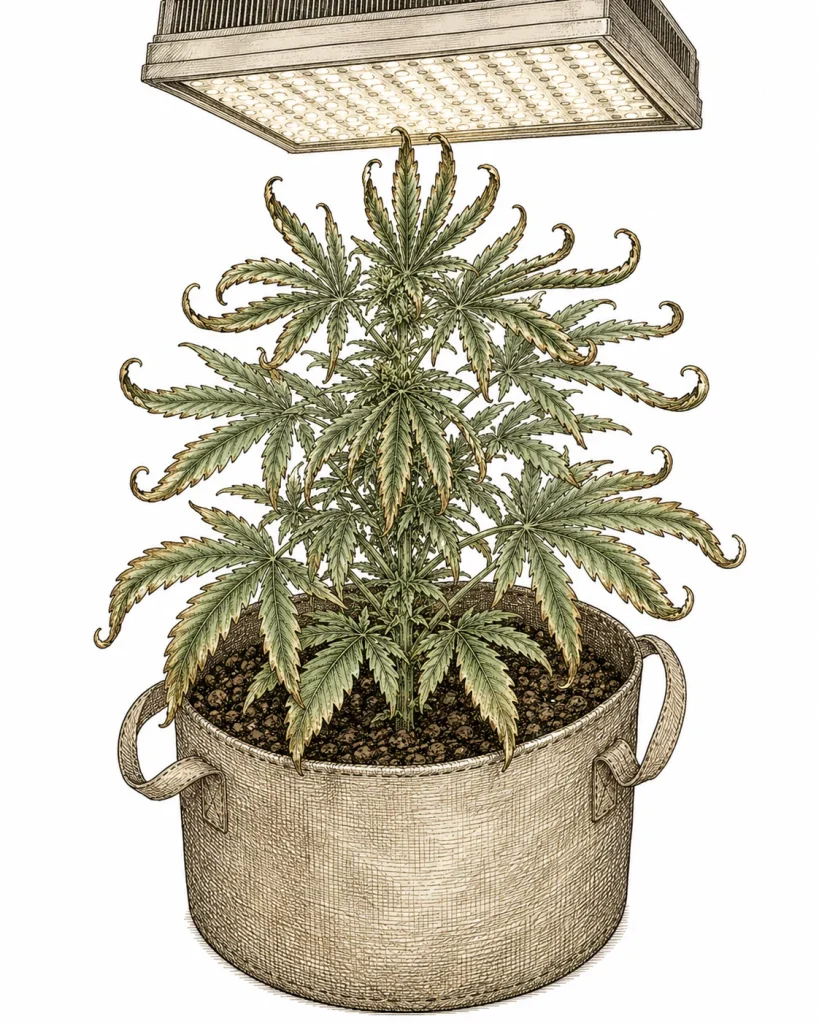
Cannabis heat stress symptoms are among the most common problems in indoor grows, and beginners often confuse them with nutrient deficiencies. When temperatures in your tent stay above 82–86 °F (28–30 °C), your plant responds with clear warning signs you need to know. The sooner you step in, the less yield and quality you lose. In this article, we explain all the symptoms, causes and effective fixes for your grow — practical and easy to follow.
Cannabis Heat Stress Symptoms: How to Spot the Problem
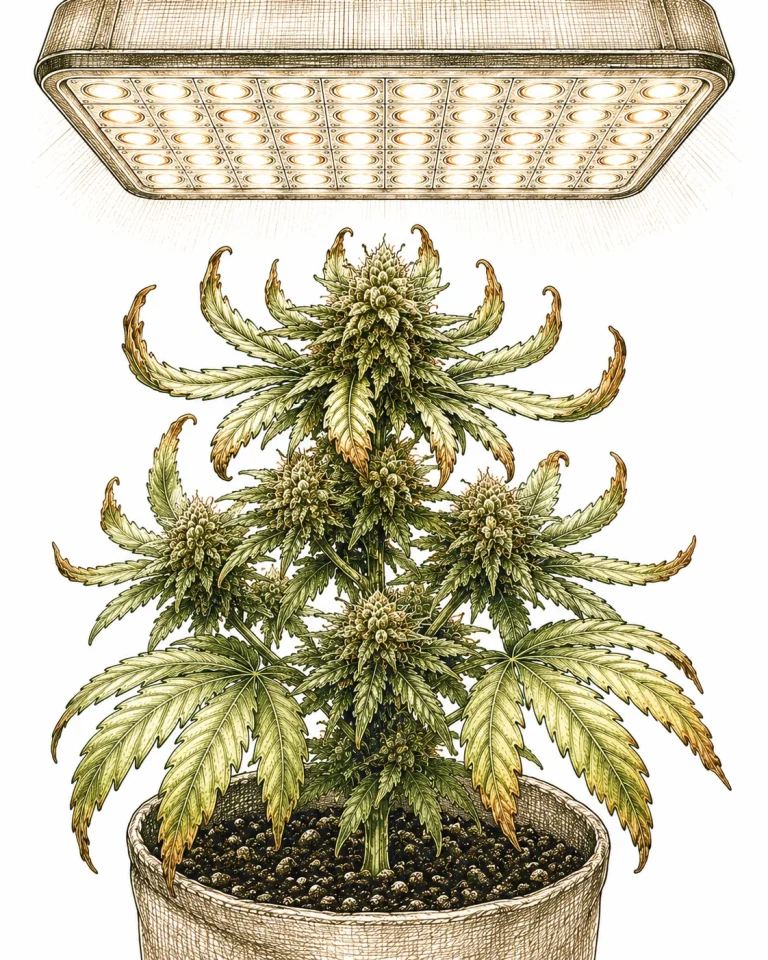
The most noticeable and best-known symptom of heat stress in cannabis is so-called “tacoing”: the leaves curl up from the sides so they take on the shape of a taco shell. This protective mechanism reduces the leaf area exposed to light and slows water loss. You can see it most clearly on the upper leaves growing directly under the light.
Besides curling leaves, prolonged heat stress causes other symptoms: leaf tips and edges turn yellowish to brown and can bend upward. The leaf tissue sometimes looks dry and brittle, and the plant looks wilted overall — even though the soil is moist. This is exactly what often causes confusion, because wilting from heat is easily mistaken for overwatering or underwatering.
At very high temperatures above 90–95 °F (32–35 °C), you’ll also see bleaching on the upper leaves. These pale, almost whitish spots are caused by the breakdown of chlorophyll, and growers sometimes mistakenly put them down to light burn instead. The difference: light burn usually only affects the tips directly under the light, while heat stress shows up over a wider area and more diffusely. If you want to learn more about light damage, the article on calcium deficiency in cannabis also has helpful tips for telling apart symptoms that look similar.
As it progresses, growth slows down noticeably. Internodes get shorter, and the plant puts its energy into survival mechanisms instead of biomass. Heat stress is especially problematic in the flowering stage: buds turn loose and airy and produce less resin. The risk of mold also goes up, since heat stress weakens the plant tissue.
If the bud tips grow wispy and overly long instead of just loose and airy, you may be dealing with foxtailing — a closely related but distinct heat stress symptom.
- Leaves curl upward (taco shape) — especially at the top of the plant
- Leaf tips and edges turn yellow to brown
- Wilting even though the soil is moist enough
- Bleached, pale spots on the upper leaves
- Slower growth and short internodes
- Loose, airy buds in the flowering stage
- Higher mold risk due to weakened tissue
Causes of Heat Stress in Your Grow — What’s Getting Too Hot?
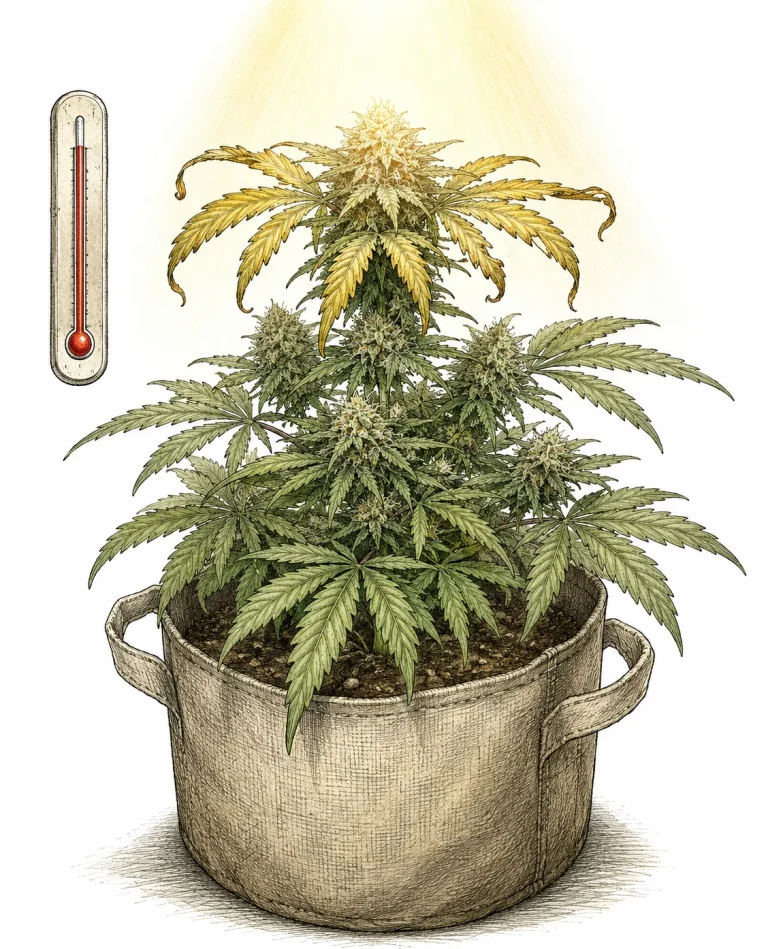
The most common trigger for cannabis heat stress is insufficient ventilation in the grow tent. If warm air isn’t exhausted fast enough and the intake air coming in is too warm, heat builds up. This is a serious problem especially in summer or in small rooms. A rule of thumb: the room temperature outside the tent should ideally be below 75 °F (24 °C) so an exhaust fan can actually cool effectively.
The distance between your light and the plant canopy also plays a central role. LED lights do give off less heat than HPS lights, but they can still cause significant heat stress if hung too close — especially powerful full-spectrum LEDs of 300 watts and up. Manufacturers specify minimum distances that you should definitely stick to. As a rule of thumb: the stronger the light, the greater the distance — at least 12–20 in (30–50 cm) for powerful LEDs.
An underestimated factor is CO2 concentration combined with temperature. Plants can tolerate higher temperatures better when more CO2 is available at the same time. In a standard grow without CO2 supplementation, the comfort zone for cannabis is 68–82 °F (20–28 °C). Above that, stress symptoms take over — enzyme activity is disrupted and photosynthesis runs less efficiently.
The pH of your irrigation water can also fluctuate more during hot spells and intensify nutrient problems that look like heat stress at first glance. Read our article on pH for cannabis to rule out a mix-up. On top of that, overfeeding combined with heat stress can make the damage much worse, since the roots are already under stress.
- Poor or underpowered ventilation in the grow tent
- Room temperature in the grow space too high (above 82 °F / 28 °C)
- Too little distance between the light and the plant canopy
- No air circulation from fans inside the tent
- Summer heat without adequate air conditioning
- Combination of heat and low CO2 levels
- Heat buildup from too many plants in too small a space
How to Fix Cannabis Heat Stress: The Most Important Immediate Steps
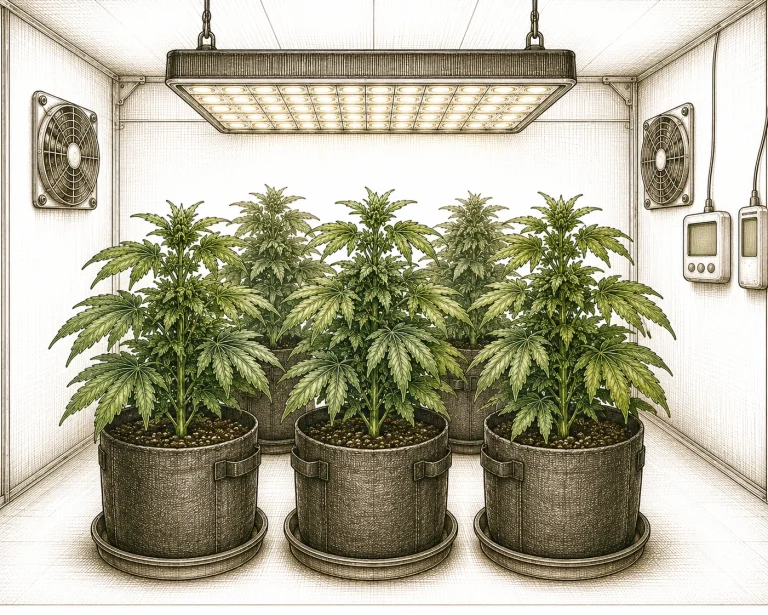
The first step with acute heat stress is always to identify the cause and eliminate it right away. Start by raising your light 2–4 in (5–10 cm) further from the plant canopy. This reduces both the heat and the light intensity in the critical zone. At the same time, check whether your exhaust system is sized properly — as a guideline, the entire air volume of the tent should be exchanged at least once per minute.
Install one or more clip fans inside the tent to keep air moving constantly over the canopy. This air movement cools the leaves through evaporation and also strengthens the stems. Make sure the fan doesn’t blow directly and constantly on a single plant — that can also cause stress (windburn). Angle the fan slightly or let it oscillate gently.
If outside temperatures are high for long periods, an air conditioner or a portable cooling unit can make sense. Alternatively, it helps to shift your light period to the night: when the lights run during the cooler nighttime hours, peak temperatures drop considerably. That’s why many indoor growers run their lights from 6 p.m. to 6 a.m. (veg) or from 8 p.m. to 8 a.m. (flower).
Avoid giving plants under heat stress too much water or too many nutrients. Stressed roots take up water and nutrients less effectively — a common beginner mistake is to water more right away when the leaves droop, which makes the problem worse. Our article on watering cannabis the right way explains very clearly how to water correctly. You should also keep your feeding balanced so you don’t pile stress on stress — too many nutrient salts can put extra strain on the roots.
- Raise the light 2–4 in (5–10 cm) right away
- Check your exhaust system’s capacity and upgrade it
- Install clip fans inside the tent for air movement
- Shift the light period to cooler night or morning hours
- Use an air conditioner or cooling unit during prolonged heat
- Don’t overwater or overfeed heat-stressed plants
- Optimize fresh air coming in from outside through the intake opening
Telling Cannabis Heat Stress Symptoms Apart From Other Problems
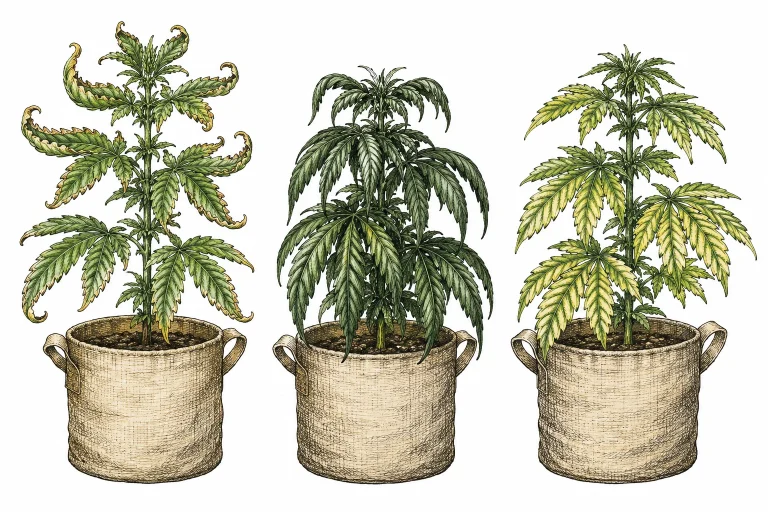
Heat stress is especially often confused with overwatering, nutrient deficiencies and pH problems. However, leaves curling upward (taco shape) are a fairly clear sign of heat stress or extreme dryness. With overwatering, the leaves tend to hang down limply without curling. So always check the leaf shape: curled upward = more likely heat or dryness, drooping down = more likely a root or water problem.
Bleaching and yellowing from heat stress look similar to a magnesium deficiency or nitrogen deficiency. The key difference is where it shows up: nutrient deficiencies usually start on the older lower leaves and work their way up. Heat stress, on the other hand, almost always hits the upper leaves closest to the light first. This distinction is crucial for the right treatment.
Nutrient burn can also cause symptoms that resemble heat stress — especially curling leaf tips and brown leaf tips on otherwise healthy leaf tissue. If you’re unsure, we recommend taking a look at the article how to spot cannabis nutrient burn fast to clearly tell the symptoms apart. You’ll find a complete overview of all symptoms and their causes in our Plant Diagnosis overview on PlantClue.
Another helpful way to tell them apart is the “hand test”: hold your palm at canopy height directly under the light for 30 seconds. If it gets uncomfortably hot, heat stress is likely a key cause. If the temperature feels comfortable, look for the problem in your watering, pH or feeding instead.
- Curling upward (taco): heat or dryness
- Leaves drooping down: overwatering or root problems
- Bleaching starting at the top: heat stress or light burn
- Yellowing from the bottom up: more likely a nutrient deficiency
- Brown, curled leaf tips on all leaves: possible nutrient burn
- Hand test under the light: a simple diagnostic method
Temperature Guidelines for Cannabis in Every Growth Stage
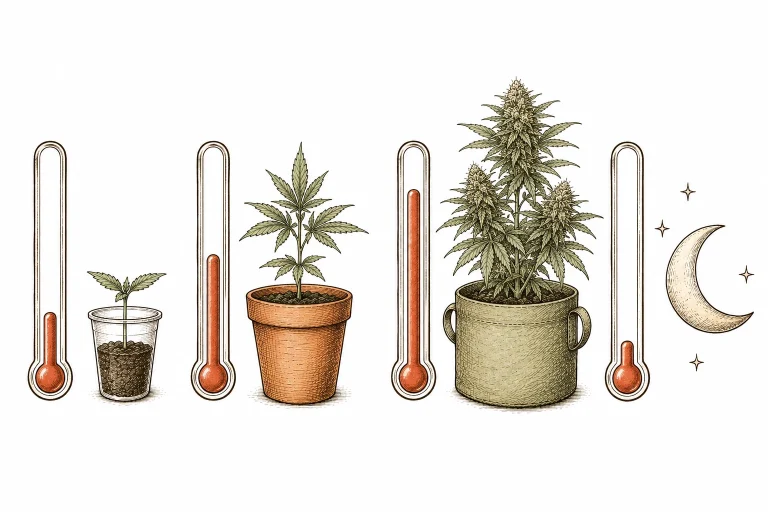
Cannabis has slightly different temperature preferences in each growth stage. Seedlings and young plants prefer somewhat warmer conditions between 72–82 °F (22–28 °C) with the lights on. In this stage, the tissue is still delicate, but the plants also respond faster to improvements. Pay special attention that the root zone temperature isn’t too low, since that slows root growth.
In the vegetative stage, the optimal range is 72–82 °F (22–28 °C) during the day and 64–72 °F (18–22 °C) at night. Short peaks up to 86 °F (30 °C) are tolerable but shouldn’t become the norm. If temperatures stay above 86 °F (30 °C), you’ll notice the first heat stress symptoms, even if they’re mild at first. The night temperature shouldn’t be more than 18 °F (10 °C) below the day temperature to avoid stress reactions from temperature swings.
In the flowering stage, plants are more sensitive to heat. Optimal temperatures here are 68–79 °F (20–26 °C). Higher temperatures during flowering lead to loose buds, reduced terpene production and a higher risk of mold. Some experienced growers even deliberately lower the temperature to 64–72 °F (18–22 °C) in the last two weeks before harvest to boost terpene synthesis and make the buds more aromatic and compact.
Also keep the temperature in the root zone in mind: the growing medium should ideally be between 64–72 °F (18–22 °C). Growing medium that’s too warm encourages bacterial and fungal growth, while medium that’s too cold slows nutrient uptake. Never water with ice-cold water straight from the tap — let your irrigation water come up to room temperature before you use it.
- Seedlings and young plants: 72–82 °F (22–28 °C) is optimal
- Vegetative stage day: 72–82 °F (22–28 °C), night: 64–72 °F (18–22 °C)
- Flowering stage day: 68–79 °F (20–26 °C) for compact buds
- Last weeks before harvest: 64–72 °F (18–22 °C) for terpene development
- Root zone temperature: 64–72 °F (18–22 °C) is ideal
- Irrigation water: always use it at room temperature
- Maximum tolerance: up to 86 °F (30 °C) briefly, problematic long term
Cannabis Heat Stress in Summer: Protecting Outdoor Plants
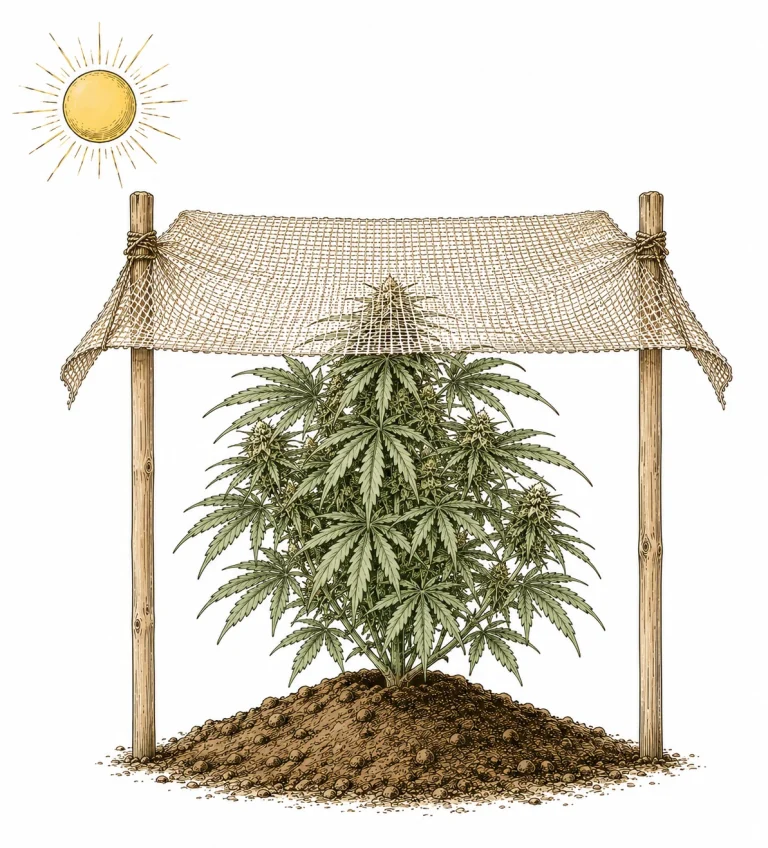
Outdoor plants also suffer from heat stress in hot summers, especially when they’re in pots and don’t have enough soil volume to buffer the heat. On hot days above 95 °F (35 °C), you’ll see the same symptoms as in an indoor grow: curled leaves, drooping branches and brown leaf edges. Plants in the ground are more resistant thanks to the buffering effect of the soil, but they also react to extreme heat.
A proven outdoor measure is stretching shade cloth with a 30–50% shade rating over the plants. It lets enough light through for normal growth but considerably reduces direct sunlight and radiant heat. At the same time, on hot days you should water more often, but early in the morning — that way the growing medium is moist before the heat sets in, and the water doesn’t evaporate right away.
Outdoor pots should ideally not be made of black plastic, since it absorbs a lot of sunlight and can heat the growing medium to over 95 °F (35 °C) — a direct root problem. Light-colored clay pots or fabric pots, which cool naturally through evaporation, are much better suited. Mulching around the pot or planting hole also helps keep the soil temperature stable.
Also keep in mind that stressed outdoor plants are more vulnerable to pests and mold. An immune system weakened by heat opens the door to spider mites, aphids and powdery mildew. So check your plants even more carefully on hot days and react quickly to the first signs of an infestation. Telling all symptoms apart clearly helps enormously — our Plant Diagnosis overview is the best place to start.
- Stretch shade cloth with 30–50% shade over outdoor plants
- Water early in the morning, before the heat sets in
- Use light-colored clay pots or fabric pots instead of black plastic pots
- Use mulch to keep the soil temperature stable
- Check plants for pests more often on hot days
- Water more, but be sure to avoid waterlogging
It’s most easily confused with sunburn — and unlike heat, cold stress shows exactly the opposite symptoms.
Frequently Asked Questions
At what temperature does heat stress start in cannabis?
Many cannabis strains show the first stress symptoms when temperatures stay above 82–86 °F (28–30 °C). Above 90 °F (32 °C), heat stress becomes clearly visible, and above 95 °F (35 °C), the plant can suffer lasting damage. Short peaks up to 86 °F (30 °C) are tolerable as long as the average temperature stays in the safe range.
Does a cannabis plant fully recover from heat stress?
Yes, if you catch it early and fix it quickly, most plants recover well. Leaves that are already damaged won’t fully recover, but new leaves grow back healthy once temperatures are back to normal. In the flowering stage, acting fast is even more important, since lost flowering time can’t be made up.
How do I tell heat stress apart from light burn?
Both problems start at the top of the plant, but light burn shows up as whitish bleaching right at the spots closest to the light. Heat stress, on the other hand, mainly shows up as curling leaves (taco shape) and more widespread yellowing. Heat stress also occurs without the light being extremely close when the air temperature is generally too high.
Can heat stress permanently reduce yield?
Yes, especially in the flowering stage. Prolonged heat stress leads to loose, airy buds with less resin and a weaker terpene profile. The risk of bud rot (botrytis, gray mold) also rises considerably. Even if the plant survives, a significant part of its yield potential can be lost if the stress isn’t eliminated in time.
Does watering more help against heat stress?
Only to a limited extent. Having enough water is important so the plant can cool itself through transpiration. But overwatering makes the problem worse, because stressed roots take up water less effectively and waterlogging sets in. Water normally and make sure the soil is evenly moist but not soaked.
Which cannabis strains are more heat-resistant?
Sativa-dominant strains and strains from warmer climates (e.g. Thai, Haze, Amnesia) are genetically better adapted to heat than indica strains from the mountain regions of Pakistan or Afghanistan. Autoflowering strains vary widely. If you grow in a warm climate, choose strains with known heat tolerance from your seed bank’s catalog.
You’ll find more technical background on temperature stress in crops from the Bavarian State Institute for Viticulture and Horticulture (LWG) (German).
Conclusion
Cannabis heat stress symptoms are easy to spot once you know what to look for: leaves curled into a taco shape, bleaching at the top of the canopy and wilting despite moist soil are the most important warning signs. With the right ventilation, correct light distance and optimal temperatures of 68–82 °F (20–28 °C), you can reliably prevent heat stress. If you react early enough, your plant will fully recover and deliver the yield it promised. Use our Plant Diagnosis overview on PlantClue whenever you’re unsure about symptoms — it helps you quickly tell heat stress apart from other problems.
