

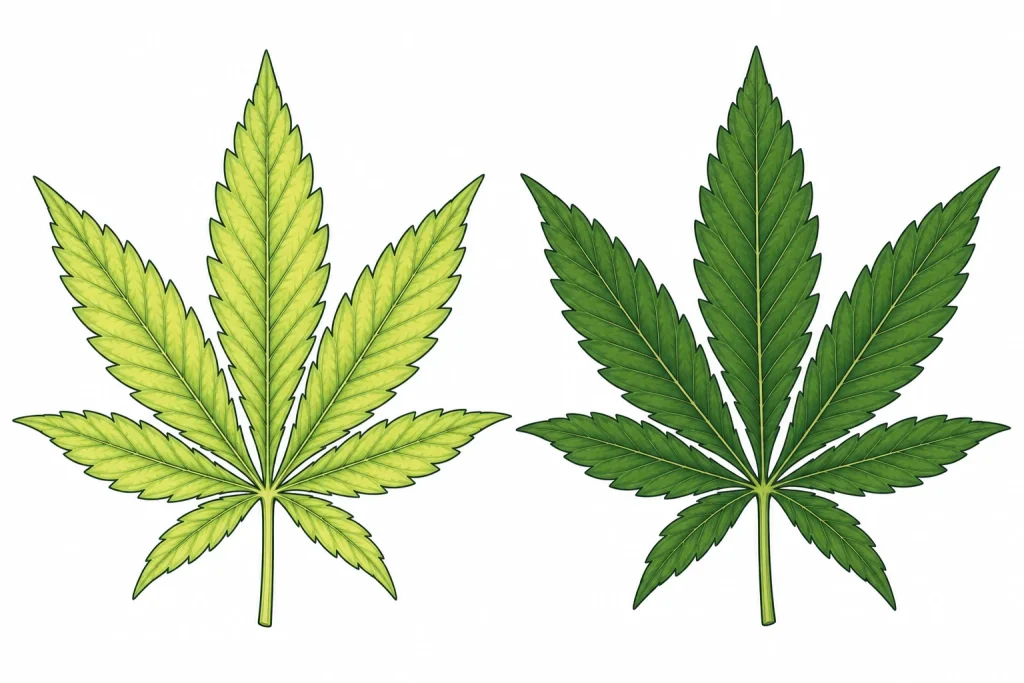
When your cannabis leaves turn light green, it’s a clear sign that something in your grow is off. The rich green color of healthy leaves comes from sufficient chlorophyll, and that’s exactly the pigment that gets lost when nutrients are missing, the pH gets out of hand or environmental conditions aren’t right. When this process is disrupted, the technical term is chlorosis, a well-documented phenomenon in plant science. The good news: light green cannabis leaves are usually an early warning sign that still gives you enough time to step in before serious damage occurs. In this article, we’ll show you what causes the leaves to lighten and how to save your plant step by step. For a complete overview of all cannabis deficiencies, also check out our article Cannabis Deficiencies: Complete Overview of 11 Deficiencies.
Why cannabis leaves turn light green: the biology behind it
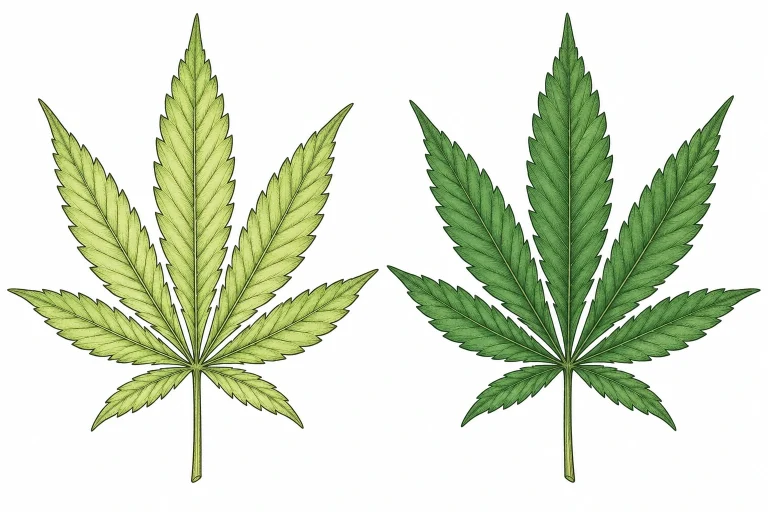
Chlorophyll is the heart of photosynthesis and gives leaves their characteristic dark green color. When cannabis leaves turn light green, it almost always means the plant is producing less chlorophyll than it should. There can be many reasons for this: missing building blocks for chlorophyll synthesis, nutrient uptake blocked by the wrong pH, or stress from poor environmental conditions.
It’s important to look closely at which leaves are affected. Light green old leaves at the base usually point to a different deficiency than light green new leaves at the growing tips. This difference helps you enormously with the diagnosis. Some nutrients are mobile and are actively moved by the plant from old leaves into new growth. Other nutrients are immobile and stay where they were first built in.
Another factor is how fast the leaves lighten. Does the light green color show up suddenly, or does it develop over several days? Rapid lightening often points to acute problems like a pH crash or light damage, while gradual lightening tends to indicate a slowly progressing nutrient deficiency.
- A lack of chlorophyll is the direct cause of light green leaves
- Old leaves affected = mobile nutrient (e.g., nitrogen, magnesium)
- New leaves affected = immobile nutrient (e.g., iron, sulfur)
- Fast lightening = acute problem, slow = creeping deficiency
- pH errors can trigger almost any nutrient deficiency
Nitrogen deficiency: the most common cause of light green cannabis leaves
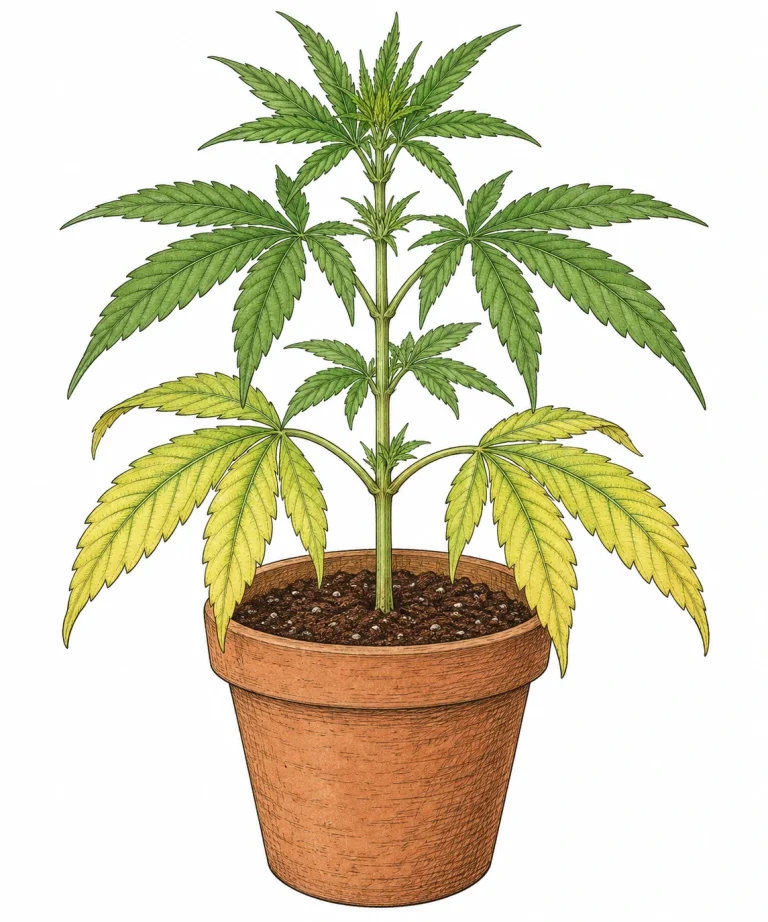
Nitrogen is the most important nutrient for leaf growth and is directly involved in building chlorophyll. A nitrogen deficiency first shows up on the oldest, lowest leaves, which turn light green and later a deep yellow. The plant actively pulls nitrogen from the old leaves to feed the young growing tips because it prioritizes growth. As a result, the lightening slowly works its way up the plant from the bottom.
In the vegetative stage, nitrogen deficiency is rare in plants that are fed properly. It does show up often, though, when your pH is too low and blocks uptake, or when you deliberately work with very nutrient-poor soil. In the flowering stage, on the other hand, a slight drop in nitrogen toward the end is normal and even desirable, since the plant puts its energy into building buds. But if the lower leaves already turn light green at the start of flowering, you need to act.
In most cases, the fix is simple: increase the nitrogen supply with a nitrogen-heavy nutrient, or first check whether your pH is in the optimal range. In soil, the pH should be between 6.0 and 7.0; in hydroponics , between 5.5 and 6.5. Often a single pH correction is enough to get nitrogen uptake back to normal without adding any extra nutrients at all. You can learn more about feeding the right way in our article on how to spot and fix cannabis nutrient burn. For all other symptoms, causes and the right treatment in detail, see our in-depth article on nitrogen deficiency in cannabis.
- Symptoms start on old, lower leaves
- Leaves turn light green first, then yellow
- Nitrogen is mobile: the plant pulls N from old leaves
- The cause is often a pH problem, not an actual lack of nutrients
- A slight drop in N is normal in late flowering
Magnesium and iron deficiency as causes of light green leaves
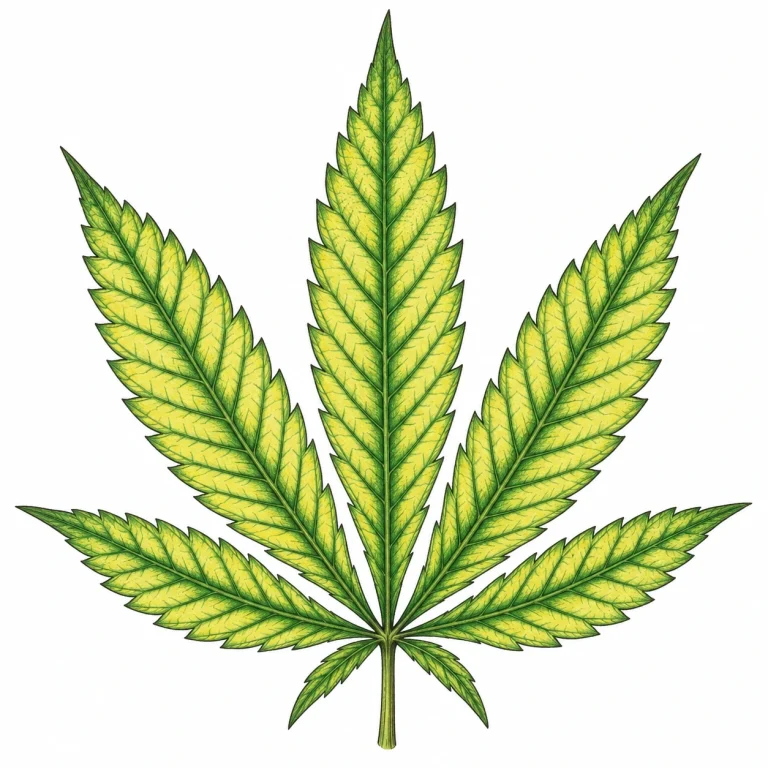
If it’s not the old leaves but the middle or young leaves turning light green, watch the pattern: if the leaf veins stay green while the tissue between them lightens, it’s called interveinal chlorosis. This pattern is a classic sign of magnesium deficiency. Magnesium is a central component of the chlorophyll molecule and also a mobile nutrient, which is why the symptoms first appear on the middle leaves before spreading to younger ones.
Magnesium deficiency is especially common when the pH is too low (below 6.0 in soil grows). Too much potassium and calcium in the growing medium can also push magnesium out in the competition for uptake. A quick fix is a foliar spray with a diluted Epsom salt solution (magnesium sulfate) while you correct the pH at the same time. We explain how to set your pH correctly in detail in our guide on how to adjust pH for cannabis.
Iron deficiency, on the other hand, shows up almost exclusively on the youngest leaves and growing tips, which turn light green to almost whitish-yellow while the older leaves still look healthy. Iron is immobile and can’t be relocated by the plant. In fed soils, iron deficiency is rarely a true supply shortage. Usually a pH problem is behind it: iron becomes insoluble at even a slightly elevated pH (above 7.0) and is no longer available to the roots. Lower the pH, and the iron supply usually returns to normal within a few days.
Sulfur is another nutrient that can cause symptoms similar to iron deficiency: here too, the lightening starts on the young leaves, since sulfur is also immobile. However, sulfur-deficient leaves lighten more evenly, without the striking vein pattern that stays visible with magnesium deficiency.
- Magnesium deficiency: interveinal chlorosis, green veins, pale tissue
- Magnesium is mobile: middle leaves are affected first
- Epsom salt as a quick fix for magnesium deficiency
- Iron deficiency: youngest leaves and growing tips light green to whitish
- Iron is immobile: a pH above 7.0 makes iron unavailable
- Sulfur deficiency: even lightening of young leaves without a vein pattern
pH problems: an underestimated reason cannabis leaves turn light green
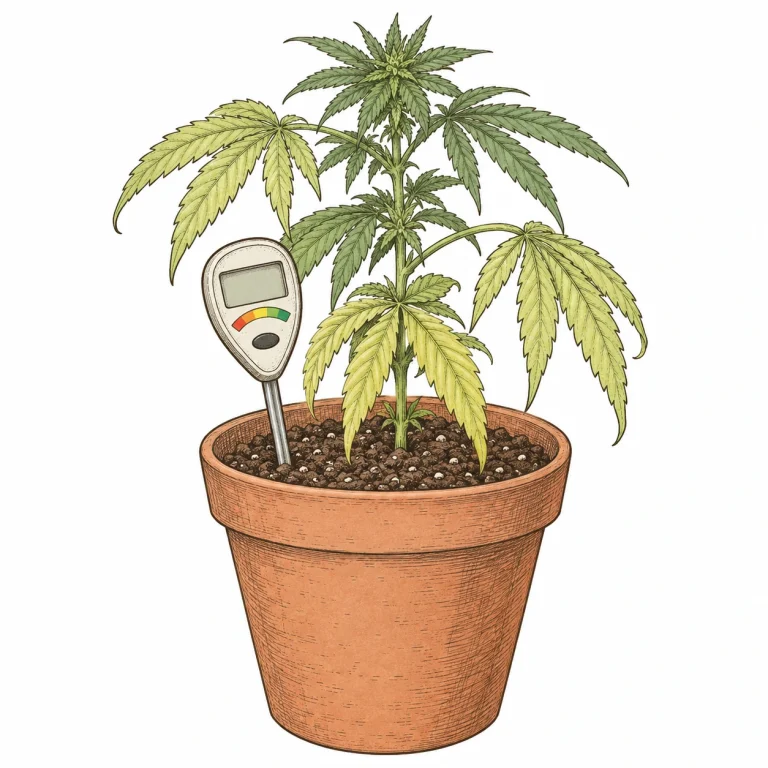
The wrong pH is the most common reason cannabis leaves turn light green without an actual lack of nutrients. The pH determines what form nutrients take in the growing medium or nutrient solution and whether the roots can take them up at all. If the pH is outside the optimal window, nutrients physically can’t be absorbed even though they’re present in sufficient amounts. This is called an induced nutrient lockout.
pH drift over time is especially tricky: you start your grow with the right pH. But repeated watering, feeding and biological activity in the growing medium gradually shift the pH toward the acidic or alkaline side. Many growers only measure the pH when mixing their water but forget to check the runoff pH regularly. The runoff gives you a much more accurate picture of what’s actually happening in the root zone.
Here’s how to proceed: first measure the pH of your water and your runoff. If the runoff pH is below 5.8 or above 7.0, you have pH drift. Adjust your water accordingly and flush the growing medium with pH-adjusted water to wash out built-up salts and substances that shift the pH. In most cases, plants with light green leaves recover visibly within a week after a successful pH correction.
Also make sure to measure the pH every time you feed after mixing the nutrient solution, not before. Nutrients change the pH of the solution, so measuring before adding them is useless. If you don’t own a reliable pH meter yet, it’s the most important investment you can make for your grow.
- pH lockout makes available nutrients unavailable
- Measure runoff pH for an accurate picture of the root zone
- Optimal pH in soil grows: 6.0 to 7.0
- Optimal pH in hydro/coco: 5.5 to 6.5
- Measure pH after mixing the nutrient solution, not before
- Flush the growing medium regularly to prevent salt buildup and drift
Light, heat and overwatering: other reasons for light green cannabis leaves
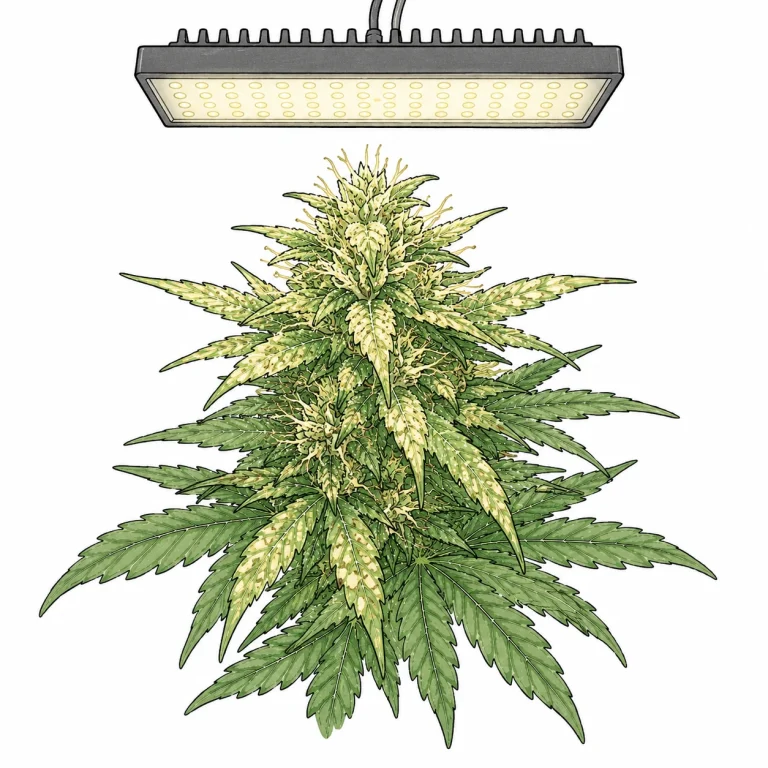
Not every cause of light green leaves is a nutrient deficiency. Lighting that’s too intense, especially when your lamp hangs too close to the buds, can cause light bleaching. The chlorophyll molecules are literally destroyed by too much light radiation. The pattern is typical: the top leaves and buds closest to the lamp turn whitish-yellow to light green while the lower parts of the plant are still a normal green. Raise the lamp and reduce the intensity if needed.
Heat stress from temperatures above 86 °F (30 °C) can also cause lightening. In the heat, the plant closes its stomata, its metabolism slows down and chlorophyll production suffers. Heat stress and light bleaching often occur together, since strong lamps produce both light and heat. Good climate control and regular temperature checks are therefore a must in an indoor grow.
Overwatering is one of the most common beginner mistakes and leads to a lack of oxygen at the roots. When roots sit in growing medium that’s too wet for a long time, they can no longer take up nutrients even though everything would be available. The result is a forced nutrient lockout that shows up, among other things, as light green leaves. We explain how to water cannabis properly and avoid overwatering in detail in our article on how to water cannabis the right way. A simple rule of thumb: only water once the top layer of the growing medium is dry and the pot feels noticeably lighter than right after watering.
Cold stress from temperatures below 59 °F (15 °C), especially at the roots, can also drastically limit nutrient uptake. Cold roots are sluggish and barely take up nutrients. This is a common problem, especially in winter or in poorly heated grow rooms, and growers often don’t connect it to the plant’s color right away.
- Light bleaching: top leaves and buds turn white to light green
- Increase the lamp distance if you see light bleaching
- Heat stress above 86 °F (30 °C): chlorophyll production suffers
- Overwatering causes a lack of oxygen and a forced nutrient lockout
- Finger test: only water the soil once the surface is dry
- Cold stress below 59 °F (15 °C) blocks nutrient uptake
Step-by-step diagnosis when your cannabis leaves turn light green
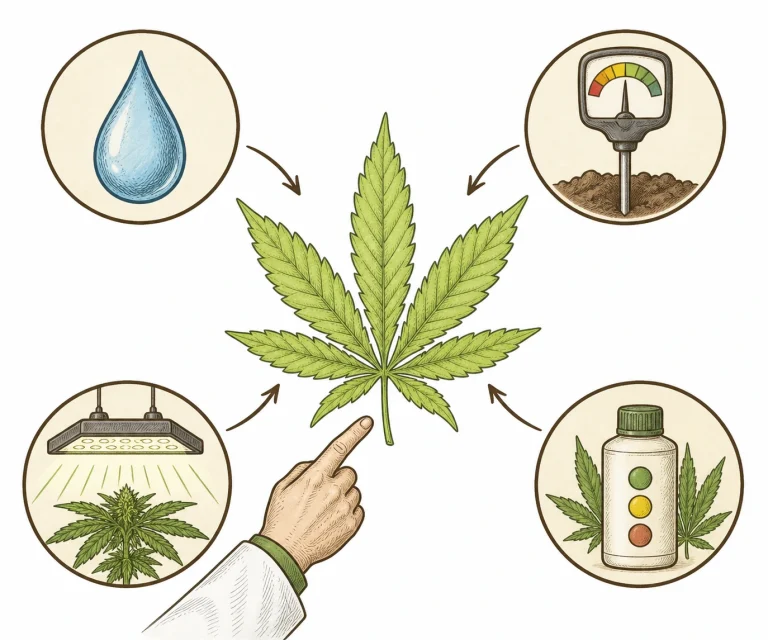
To narrow down the problem quickly and reliably, we recommend the following approach: always start with the basics before you tinker with your nutrients. Most problems come down to pH errors, improper watering or environmental issues, not actual nutrient deficiencies.
Step 1: Check the pH of your water and runoff. Is it in the optimal range? If not, correct it first before moving on. Step 2: Look closely at which leaves are light green. Old lower leaves? Middle leaves with green veins? New growing tips? This narrows down the cause enormously. Step 3: Check your environmental conditions: temperature, humidity, lamp distance. Step 4: Think about how you’ve been watering lately. Have you watered too often or too much? Step 5: Only once all the basics are right, adjust your feeding.
Another important note: don’t react too fast or too aggressively. The most common follow-up complication with light green leaves is rushed overfeeding. Growers see light green leaves, immediately think nutrient deficiency and feed heavily, even though the real mistake was the pH. The result is then cannabis nutrient burn on top of the original problem. Diagnosis before treatment, always. If you’re unsure about the diagnosis, visit the Plant Diagnosis overview on PlantClue, where you’ll find all symptom patterns at a glance.
- Step 1: Measure the pH of your water and runoff
- Step 2: Which leaves are affected? Analyze their position
- Old leaves light green = mobile deficiency (N, Mg)
- New leaves light green = immobile deficiency (Fe, S) or light
- Step 3: Check temperature, light and humidity
- Step 4: Rethink your watering habits
- Step 5: Adjust feeding only after checking the basics
Cannabis leaves turning light green in the flowering stage: what to keep in mind
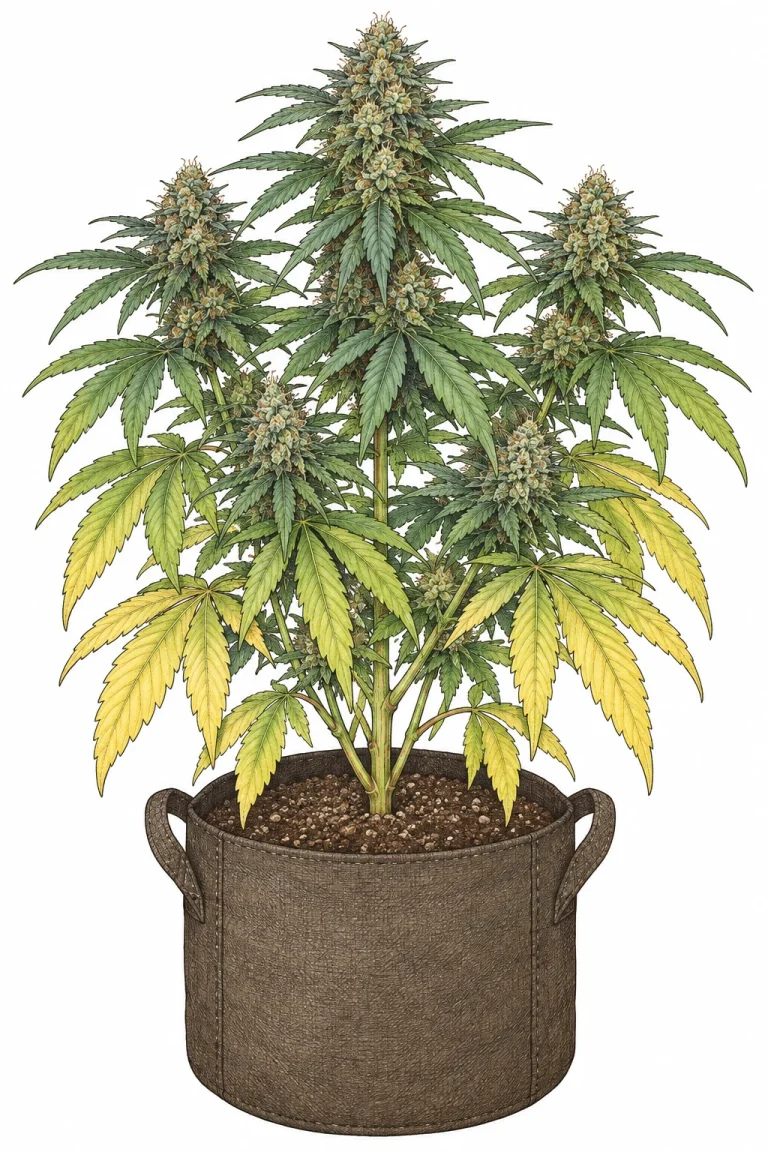
Different standards apply in the flowering stage than in veg. It’s completely normal, and even a sign of a well-managed plant, when the lowest leaves turn light green to yellow toward the end of flowering. The plant mobilizes its last nitrogen reserves for bud development and sacrifices the old leaves in the process. You shouldn’t try to stop this natural senescence with excessive nitrogen feeding.
It becomes a problem when the lightening starts in the first weeks of flowering or when it reaches the middle or upper leaves. Just as critical: when other stress symptoms show up at the same time, such as brown spots, crusty leaf edges or a limp, drooping posture. In these cases, it’s not a normal aging process but a real problem you need to address.
In flowering, potassium deficiency is a more common cause of leaf problems than in veg, because the plant needs significantly more potassium to build buds. A potassium deficiency often shows up as a combination of light green lightening and brownish, dead leaf edges and tips. If you’re not sure which symptoms your plant is showing, also take a look at our overview of yellow cannabis leaves , which describes many related symptom patterns in detail.
- Lower leaves lightening at the end of flowering is normal
- Don’t fight natural senescence with nutrients
- Early or widespread lightening is a warning sign
- Potassium deficiency is more common in flowering than in veg
- Lightening plus brown edges = check for potassium deficiency
If the leaf tips also change color, read our article on yellow leaf tips too. If the lightening shows up specifically in flowering, you’ll find more on yellow leaves during flowering.
Frequently asked questions
Why are my cannabis leaves turning light green even though I feed regularly?
Feeding regularly won’t protect you from nutrient problems if the pH is off. The wrong pH blocks nutrient uptake, so the nutrients are present in the growing medium, but the roots can’t take them up. Measure the pH of your water and runoff first and correct it before you increase the nutrient dose.
Is it normal for cannabis seedlings to have light green leaves?
Young seedlings and sprouts are often a bit lighter than mature plants because they haven’t built a complete chlorophyll system yet. But if the lightening is unusually strong or the plant isn’t growing, check the pH, moisture and light distance. Seedlings don’t need any nutrients yet, since the cotyledons supply enough nutrients for the first few weeks.
How fast do cannabis plants recover after fixing light green leaves?
Leaves that are already light green usually won’t turn back to a rich dark green, since mature leaves barely produce new chlorophyll. You can tell the plant is recovering, though, when new leaves come in a normal dark green again. With properly fixed problems, this happens within 5 to 14 days.
Can light green cannabis leaves point to a pest infestation?
Yes, in some cases. Spider mites, fungus gnat larvae and root rot can limit nutrient uptake so much that plants turn light green. So also check the undersides of the leaves and the roots. If you see tiny dots or webbing on the undersides of the leaves, you may have a pest infestation.
What pH is optimal to keep my cannabis plants from getting light green leaves?
In soil grows, the pH should be between 6.0 and 7.0, ideally around 6.5. In coco coir and hydroponics, the optimal window is narrower: 5.5 to 6.5, ideally around 6.0. Regularly measure both your water and your runoff to catch pH drift in the growing medium early.
Can too many nutrients cause light green leaves?
Yes. Nutrient burn, especially from nitrogen, can paradoxically lead to an apparent nutrient lockout, where nutrient imbalances in the growing medium block the uptake of other nutrients. On top of that, salt stress from too many nutrients can damage the roots, which limits the uptake of all nutrients and also causes the leaves to lighten.
Conclusion
When your cannabis leaves turn light green, it can be fixed in almost every case as long as you act early enough and work systematically. Always start by checking the pH, analyze which leaves are affected, and rule out environmental factors like heat, improper watering or a lamp hanging too close before you adjust your feeding. Rushing to add more nutrients without a diagnosis often makes the problem worse instead of solving it. With the right step-by-step diagnosis and a little patience, you’ll help your plant get back to a healthy, rich dark green.
