

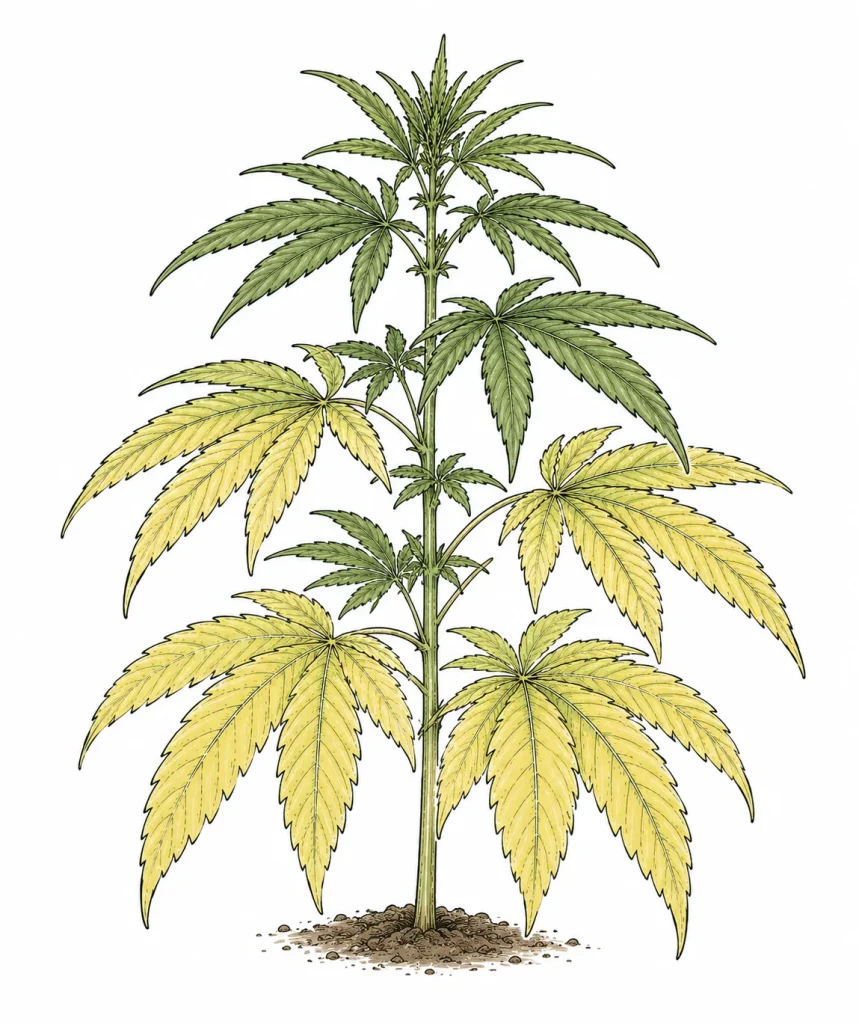
Learning to spot cannabis nitrogen deficiency is one of the most important skills you can develop as a grower — nitrogen is the macronutrient your plant needs most, and a deficiency can set in surprisingly fast. The telltale yellow leaves always start on the lowest, oldest leaves and slowly work their way up, which clearly sets this deficiency apart from many other problems. If you step in early, you can still save your harvest — if you wait too long, you risk stunted growth and noticeably lower yields. In this article, we at PlantClue show you how to reliably identify nitrogen deficiency, tell it apart from similar problems and fix it quickly and effectively.
What is nitrogen and why does cannabis need so much of it?
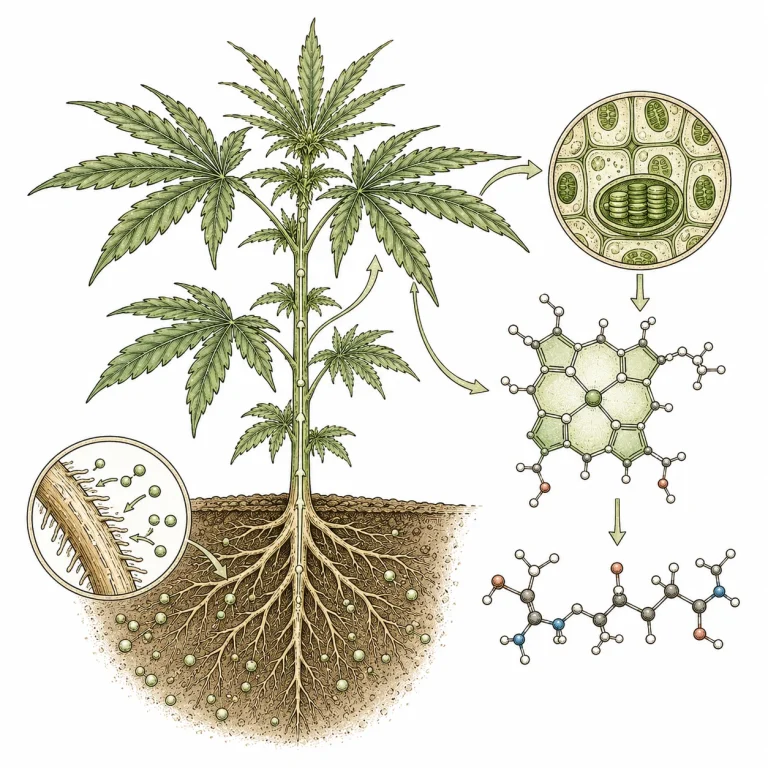
Nitrogen (N) is one of the three primary macronutrients — together with phosphorus (P) and potassium (K), it makes up the well-known NPK ratio printed on every nutrient bottle. Nitrogen is the basic building block of chlorophyll, amino acids and proteins. Without enough nitrogen, your plant literally can’t build healthy green leaf tissue — photosynthesis drops off and growth grinds to a halt.
Cannabis has a particularly high nitrogen demand in the vegetative stage. During this growth phase, nitrogen is needed to form new leaves, internodes and a sturdy stem. Once the plant switches to the flowering stage, demand drops step by step — some yellowing of the lower leaves toward the end of flowering is completely normal and no sign of a serious problem. Telling normal late-flower leaf drop apart from a true deficiency is one of the most valuable diagnostic skills you can learn.
Nitrogen is a mobile nutrient, which means the plant can move it from older leaves to young, growing shoots. That’s exactly what explains the typical nitrogen deficiency pattern — symptoms show up on the oldest, lowest leaves first because the plant actively “pulls” nitrogen out of them to feed the growing tips. Understanding this helps you draw the right conclusions right away when you look at your plant.
- Nitrogen is part of chlorophyll — no N, no green leaves
- Highest N demand in the vegetative stage and early flowering
- Mobile nutrient: deficiency shows up first on lower, older leaves
- N demand naturally drops in late flowering — slight yellowing at the bottom is normal
- Nitrogen directly affects growth rate, leaf size and stem strength
How to spot cannabis nitrogen deficiency: the classic symptoms
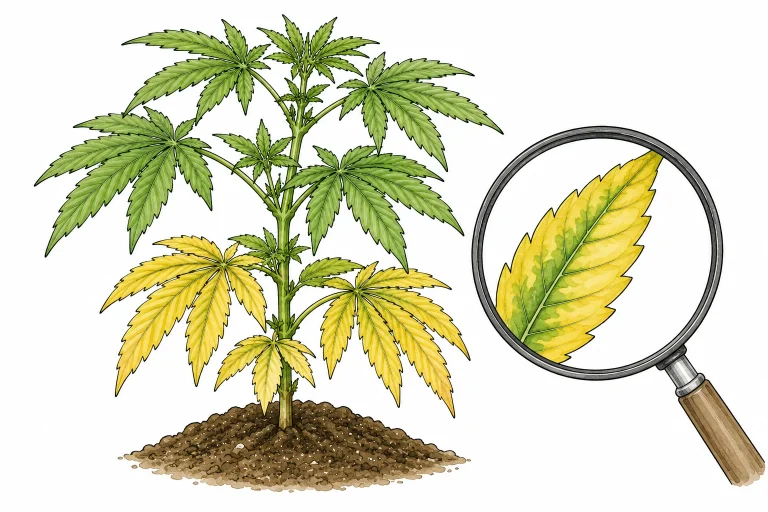
The key symptom of nitrogen deficiency is unmistakable: the lower, oldest leaves turn yellow evenly — first light green, then yellow, finally brown before they drop off. The yellowing affects the whole leaf at once and is evenly spread, which sets it apart from other deficiencies such as magnesium deficiency, which typically causes an interveinal pattern (green veins with yellow tissue in between). With nitrogen deficiency, the entire leaf yellows with no visible difference between veins and leaf tissue.
As it progresses, the yellowing moves up the plant layer by layer. The growing tips stay green at first — that’s typical of mobile nutrient deficiencies. If the middle and upper leaves are affected too, the deficiency is already well advanced. At the same time, growth slows down noticeably: new leaves stay smaller, internodes get shorter and the whole plant looks paler and weaker. In the flowering stage, a severe nitrogen deficiency can seriously hold back bud development and reduce the weight of the top colas.
Other symptoms can show up alongside it: stems often turn reddish-purple from anthocyanin buildup — although slightly red stems are normal for some strains and not a warning sign. What matters more is the combination: even yellowing of the lower leaves plus slower growth plus an overall pale plant adds up to the typical nitrogen deficiency picture. If you want to be extra sure, the complete overview of all nutrient deficiencies gives you a handy way to tell them apart.
- Even yellowing — the whole leaf, not just between the veins
- Always starts on the lowest, oldest leaves
- Growing tips stay green at first (mobile nutrient)
- Spreads from the bottom up if the deficiency continues
- Also possible: reddish-purple stems, pale overall color
- Slower growth, smaller new leaves
- In flowering: reduced bud development with a severe deficiency
How to tell nitrogen deficiency apart from similar problems
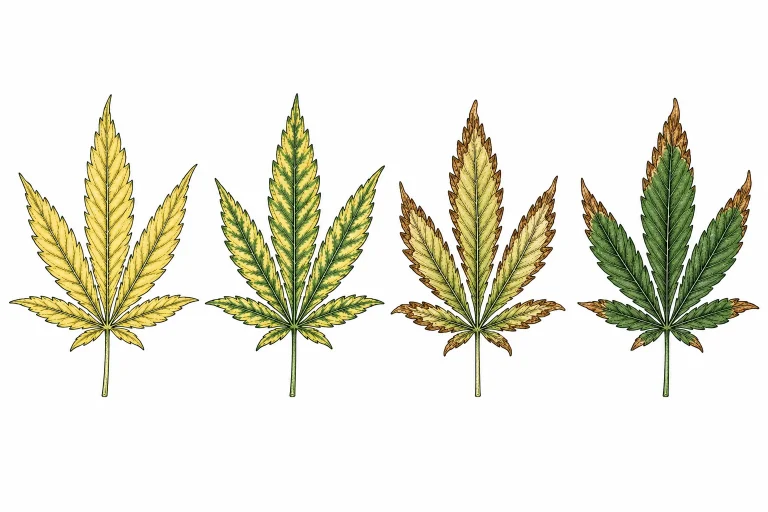
The biggest risk of mix-up is magnesium deficiency. While nitrogen deficiency yellows the entire leaf evenly, magnesium deficiency shows a clear interveinal pattern: the leaf veins stay green while the tissue between them turns yellow. Both deficiencies start on the lower leaves because magnesium is a mobile nutrient too. A close look at the veins settles the diagnosis. If you’re not sure about magnesium deficiency, the dedicated article on it will help you out.
You also need to tell nitrogen deficiency apart from normal late-flower leaf drop. In the last two to four weeks of flowering, it’s completely natural for the lowest leaves to turn yellow and fall off — the plant deliberately moves nutrients out of the foliage and into the buds. This process, called “senescence,” isn’t a deficiency but a healthy sign of ripening. The key difference: with normal leaf drop, the upper leaves stay a rich green and the yellowing progresses very slowly and stays limited. With a true nitrogen deficiency, the yellowing spreads faster and the whole plant looks increasingly pale.
Another common mix-up happens with overwatering, root problems or a rarer molybdenum deficiency, which can also cause more even yellowing. When the roots aren’t working properly — for example because of constantly wet soil or root rot — the plant can’t take up nutrients even though they’re in the growing medium. The result looks deceptively similar to nitrogen deficiency. It helps to take a look at your watering habits and how moist your growing medium is: if the pot is often wet and the leaves keep yellowing even though you feed, the problem may be the water supply rather than a lack of nitrogen.
- Magnesium deficiency: veins stay green, tissue between them yellows — with N deficiency, everything yellows evenly
- Normal late-flower leaf drop: only the lowest leaves, very slow, upper leaves stay a rich green
- Overwatering: roots can’t take up N even though it’s present in the growing medium
- pH problem: the wrong pH blocks nitrogen uptake even when supply is sufficient
- Potassium deficiency: starts with brown leaf edges, not with even yellowing
All deficiency symptoms at a glance: the cannabis nutrient deficiency chart helps you compare them side by side.
Causes: why does nitrogen deficiency happen in cannabis?
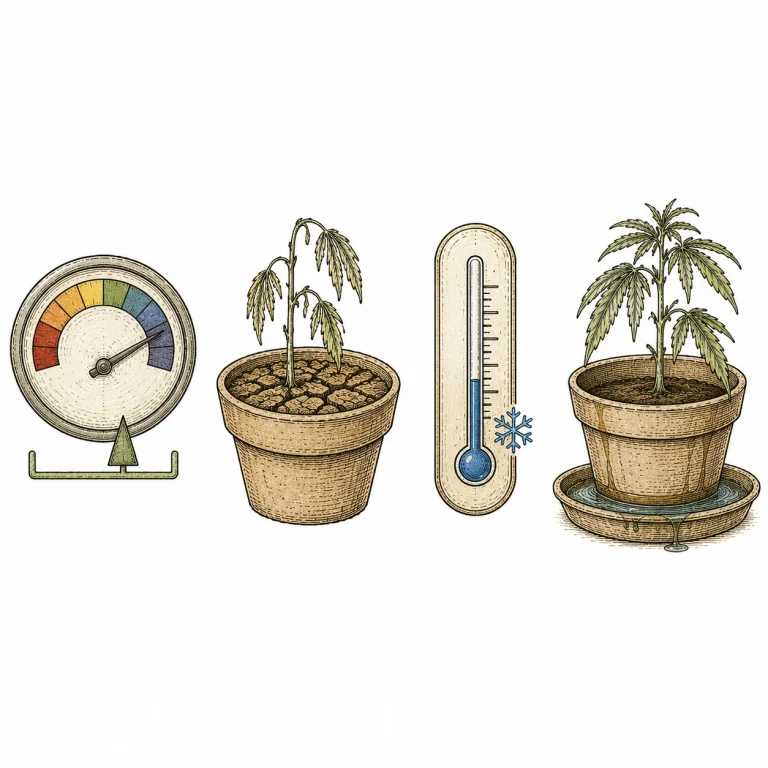
The most common cause of nitrogen deficiency is simply too little nitrogen in the growing medium or nutrient solution. This happens especially often when large plants sit in small pots with depleted soil — even good soil is usually “used up” after four to six weeks. If you only give plain water without any extra nutrients, you’ll run into this problem sooner or later. The same goes for using nutrients with too little N or feeding below the recommended dose.
The second most common reason is the wrong pH. Nitrogen is only available to the roots within a certain pH range: in soil the sweet spot is 6.0–7.0, in hydroponics it’s 5.5–6.5. If the pH falls outside these ranges, the roots can’t take up the nitrogen that’s there — this is called “nutrient lockout.” So no matter how much you feed, if the pH is off, the nitrogen never reaches the plant. That’s why dialing in the right pH is always the first diagnostic step whenever you see signs of a deficiency.
Other causes include root problems from overwatering, root temperatures that are too cold — below 64 °F (18 °C), nutrient uptake slows down considerably — or a pot that’s too small and restricts root growth. In rare cases, calcium excess can also block nitrogen uptake, because calcium and nitrogen compete with each other at high concentrations. A careful diagnosis therefore always looks at several factors at once, not just at the feeding schedule.
- Too little nitrogen in the growing medium or nutrient solution (most common cause)
- Wrong pH: nutrient lockout prevents uptake
- Overwatering and poor root health
- Root temperatures too cold, below 64 °F (18 °C)
- Pot too small, limiting root growth and nutrient uptake
- Depleted growing medium after several weeks without supplemental feeding
- Calcium excess can block N uptake in rare cases
How to fix cannabis nitrogen deficiency: step by step
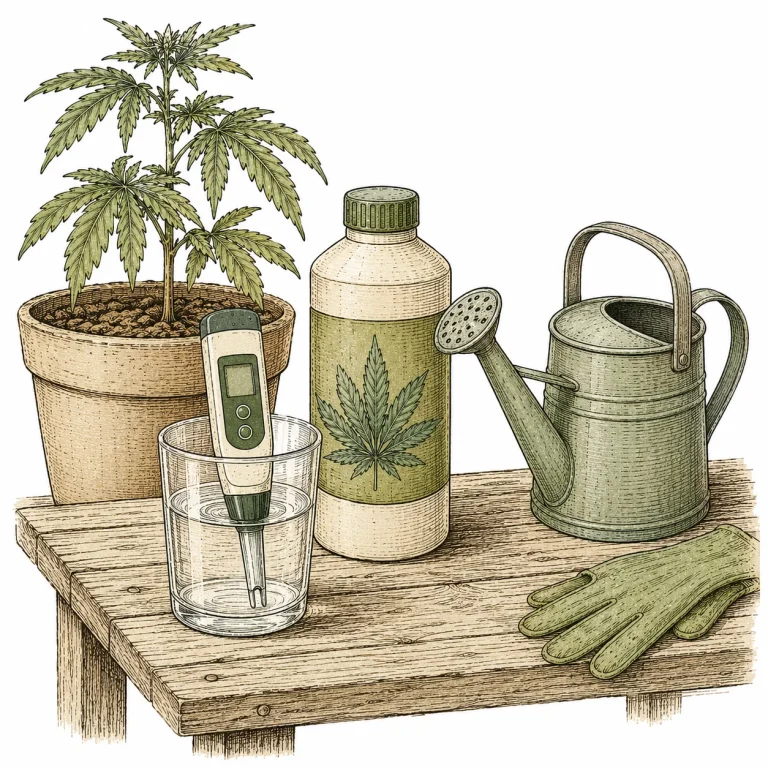
Once you’ve confidently diagnosed nitrogen deficiency, it’s time to act fast. The first step is always checking the pH: measure the pH of your water and — if possible — of your runoff too. The right ranges are 6.0–7.0 in soil and 5.5–6.5 in hydroponics. If the pH is outside this range, correct it first — without that, more nutrients won’t do anything. Only once the pH is right should you move on to step two and increase the nitrogen supply.
For the fastest results, try a foliar feed (foliar spray) with a diluted, nitrogen-rich nutrient solution. The leaves absorb it within hours, which bridges the gap until root uptake is back on track. Make sure to spray while the lights are off or dimmed to avoid burning the leaves. For feeding through the soil, use nutrients with a high N content — the first number (N) in the NPK ratio should be clearly higher than in standard bloom nutrients, for example a 10-4-7 product or something with a similar profile.
Important: don’t overshoot when you feed more. A sudden overdose of nitrogen can cause nutrient burn and make the problem worse instead of better. Start at 50–75% of the recommended dose and increase gradually if you see no improvement after three to five days. Check every day whether new growth comes in fresh and green — that’s the surest sign your fix is working. Leaves that have already turned yellow won’t recover, but healthy new leaves show you the deficiency is solved. To learn how to spot and avoid overfeeding, read our article on cannabis nutrient burn.
- Step 1: Check and correct the pH (soil 6.0–7.0, hydro 5.5–6.5)
- Step 2: Use nitrogen-rich nutrients (high N value in the NPK ratio)
- Step 3: Optionally foliar feed for fast first aid
- Step 4: Increase the dose slowly — start at 50–75%
- Step 5: Watch new growth — green tips mean it’s working
- Leaves that have turned yellow won’t recover — that’s normal
- Check your watering schedule: wet soil prevents nutrient uptake
Nitrogen deficiency in the flowering stage: what to keep in mind
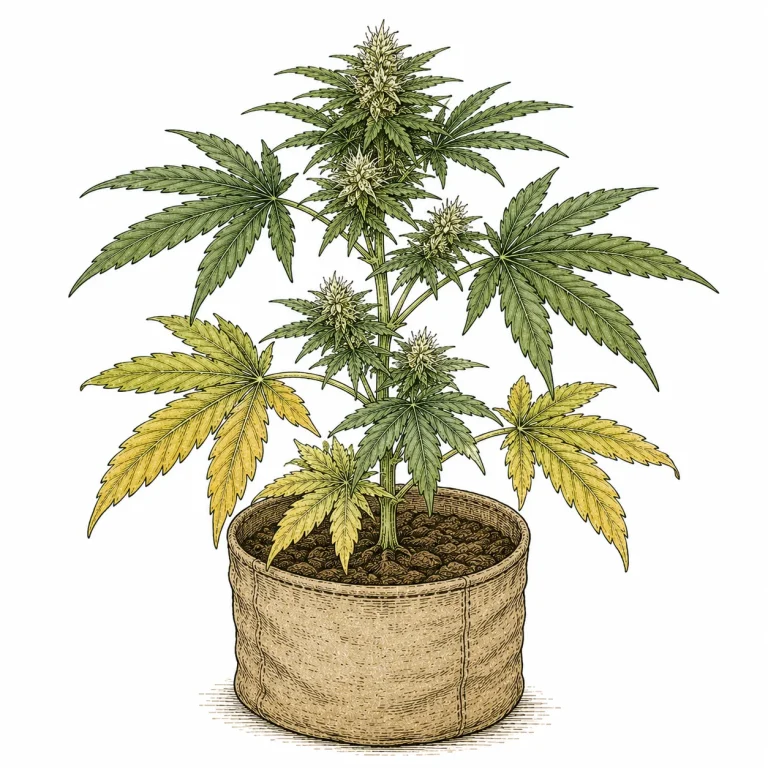
Diagnosing nitrogen deficiency in the flowering stage is especially tricky because the plant reduces its own N demand. From around week three to four of flowering, it’s normal — even desirable — for the plant to start using up some of its nitrogen, a process that has a positive effect on the quality of the final buds. Too much nitrogen in late flowering leads to delayed ripening, swollen buds and a harsher burn.
A true nitrogen deficiency in early to mid flowering (weeks 1–5), on the other hand, needs to be treated because it directly hurts bud development. Here, use a dedicated bloom nutrient with a moderate N content — not the high N levels from the vegetative stage anymore. Many high-quality bloom nutrients have an NPK ratio of around 5-10-10, which delivers a reduced but still sufficient amount of nitrogen. In the last two to three weeks before harvest, you then stop N-containing nutrients completely — flushing the growing medium helps you get a clean, aromatic harvest.
A common mistake in indoor grows during flowering: switching from grow to bloom nutrients too abruptly and too early. The plant still needs high-N veg nutrients for one to two weeks after the flip to 12/12 before switching to bloom nutrients makes sense. Switch too early and you’ll trigger nitrogen deficiency in the critical first weeks of flowering. The beginner’s guide to indoor growing gives you a detailed feeding schedule for every growth stage.
- Early flowering (weeks 1–5): actively fix nitrogen deficiency
- Mid flowering: a moderate N content in bloom nutrients is enough
- Late flowering: slight yellowing at the bottom is normal and desirable (senescence)
- Last 2–3 weeks: flush, no more nitrogen
- Don’t switch from veg to bloom nutrients too early — wait 1–2 weeks after the flip to 12/12
- Too much N in late flowering delays ripening and lowers quality
Preventing nitrogen deficiency: how to keep your plant green for good
Prevention is always easier than treatment. The most important preventive step is a consistent, regular feeding program with a high-quality nutrient line that contains all macro- and micronutrients. Keep a feeding log or use an app to record amounts, timing and any changes you notice — that way you spot patterns and can react before visible symptoms appear. Especially important: check the pH of your water regularly and adjust it every time you water.
If you grow in soil, use a high-quality, nutrient-rich mix when you transplant, topped up with slow-release organic fertilizers such as worm castings, guano or specially formulated cannabis soils with slow-release nutrients. These greatly reduce the risk of deficiencies because they release nutrients continuously. For hydro and coco growers, precise EC-based feeding is a must — measure the conductivity of your nutrient solution regularly and adjust it to the growth stage.
Regular visual checks are just as important — at least once a day, inspect every level of your plant, from the lowest leaves up to the growing tip. Early, slight yellowing on one or two lower leaves can be corrected quickly with a single extra dose of nitrogen before the deficiency spreads. Once you’ve mastered the basics of watering properly and have your pH under control, nitrogen deficiency will rarely become a serious problem for you.
- Adjust a regular feeding program to the growth stage
- Check and correct the pH every time you water
- Keep a feeding log for better control and early detection
- Use high-quality growing media with slow-release nutrients
- Measure EC (electrical conductivity) regularly in hydro/coco
- Check every leaf level daily — from the bottom up
- Repot and refresh the growing medium in time during long vegetative stages
Both sulfur deficiency and phosphorus deficiency can also cause similar yellowing. The opposite, nitrogen toxicity, shows up as strikingly dark green leaves instead of yellow ones.
Frequently asked questions
How fast does nitrogen deficiency show up in cannabis?
The first symptoms — slight yellowing of the lowest leaves — can appear within three to seven days of insufficient nitrogen supply. How fast it progresses depends heavily on the growth stage and on how many nutrients are left in the growing medium. In the vegetative stage, with its fast growth rate, a deficiency develops faster than in the flowering stage.
Can leaves that turned yellow from nitrogen deficiency turn green again?
No. Leaves that have already turned completely yellow from nitrogen deficiency usually won’t recover and will eventually drop off. But that’s no reason to panic — you can tell the treatment worked by the new growth: if new leaves come in fresh and a rich green, your fix has done its job.
What is the difference between nitrogen deficiency and magnesium deficiency?
With nitrogen deficiency, the entire leaf yellows evenly, from the base to the tip, with no recognizable pattern. With magnesium deficiency, on the other hand, the leaf veins stay green while the tissue between them turns yellow — this so-called interveinal pattern is the clearest way to tell them apart. Both deficiencies start on the lower, older leaves.
Can nitrogen deficiency happen even if you feed correctly?
Yes, it can. If the pH of your water or growing medium is outside the optimal range, you get what’s called nutrient lockout: the nitrogen is in the growing medium, but the roots can’t take it up. That’s why pH should be the first thing you check and correct whenever you see signs of a deficiency.
How much nitrogen does cannabis need in the flowering stage?
In early flowering (weeks 1–3), still about as much as in veg; after that, demand drops gradually. A good bloom nutrient has a moderate N content (e.g. NPK 5-10-10). In the last two to three weeks before harvest, you should stop adding nitrogen to get a clean harvest with better flavor and a smoother burn.
Does foliar feeding make sense for nitrogen deficiency?
Yes, a foliar feed (foliar spray) with a heavily diluted, nitrogen-rich nutrient solution can work very well as fast first aid. The leaves absorb it within a few hours. Important: always spray with the lights off or dimmed, and don’t use a solution that’s too concentrated, to avoid burning the leaves.
You’ll find the right nutrients to correct the deficiency in our Recommended Gear.
Conclusion
Thanks to its typical pattern — even yellowing from the bottom up — cannabis nitrogen deficiency is fairly easy to spot reliably with a little practice. The most important rule to remember: always check the pH first before you add more nutrients — without the right pH, even the best nutrients won’t help. If you react quickly, you can still get even an advanced nitrogen deficiency under control and save your harvest. Regular visual checks, a consistent feeding program and a basic understanding of mobile and immobile nutrients are your best insurance against this common but very manageable problem.
For further scientific information on nitrogen supply in plants, see the Chamber of Agriculture NRW (fertilization basics, in German) and the Julius Kühn Institute — Institute for Crop and Soil Science (in German).
