

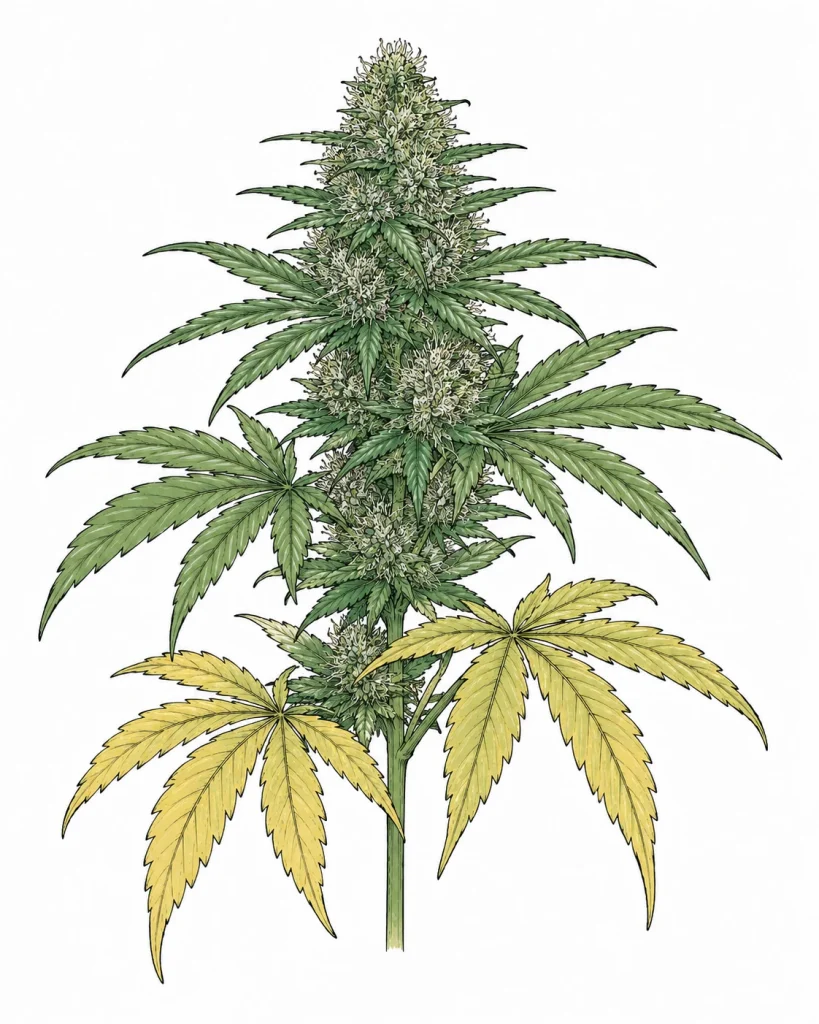
Yellow cannabis leaves during flowering are one of the most common problems growers run into at the most important point of the grow. Right when your plant is putting all its energy into stacking fat buds, yellowing leaves can point to serious nutrient issues, the wrong environment, or simply a natural process. Telling harmless yellowing from the critical kind decides whether you need to act now or can just stay calm. This guide walks you step by step through finding the cause and fixing it before your harvest suffers. For a full overview of all possible diagnoses, check out our Plant Diagnosis overview.
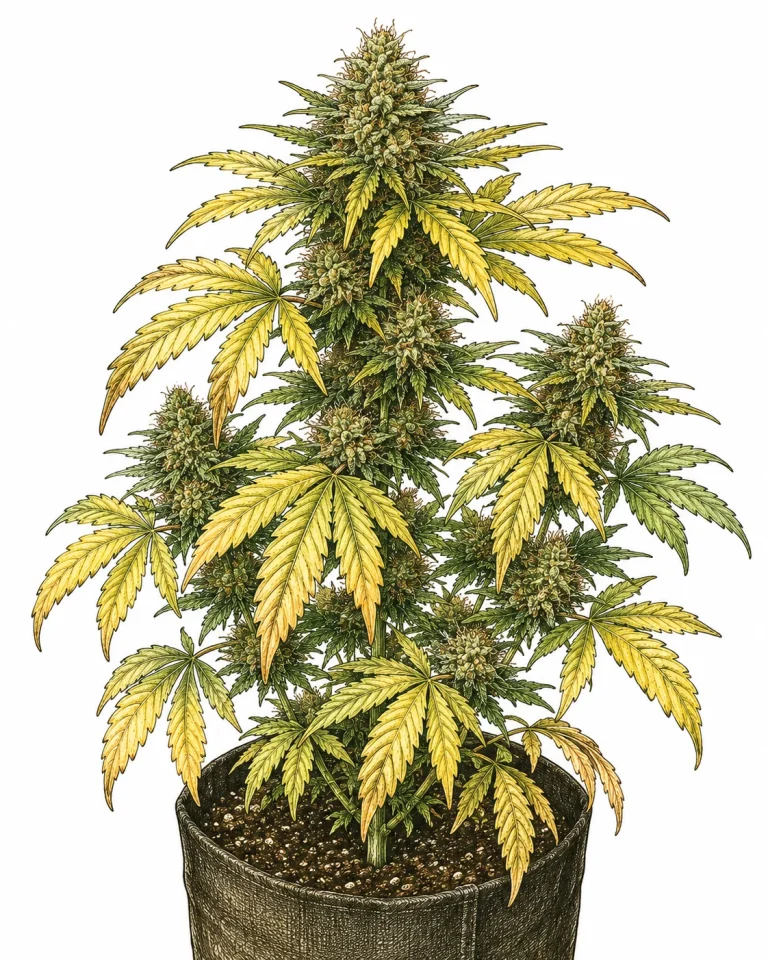
Why Do Cannabis Leaves Turn Yellow During Flowering?
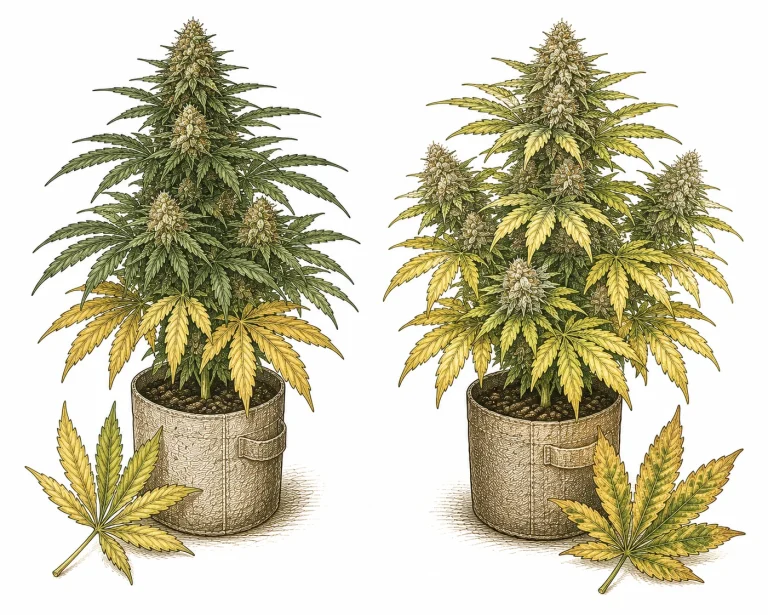
Before you panic, it helps to know that not every bit of yellowing in flower is automatically a problem. In the last two to three weeks before harvest, it’s completely normal for your cannabis plant to start dropping its lower, older leaves. The plant shifts every available resource into bud development and basically “cannibalizes” its own leaves. This natural senescence usually starts around week six to eight of flowering and slowly works its way from the bottom up.
Things get critical, though, when yellow leaves show up in the first weeks of the flowering stage, when the yellowing moves quickly up the plant, when sugar leaves or young shoot tips are affected, or when the whole plant looks weak. In these cases, there’s almost always one of a few clear triggers behind it: a nutrient deficiency, pH problems, overwatering, lighting issues, or environmental stress. What matters most is exactly where on the plant the yellowing appears and what pattern it follows.
- Lower, older leaves yellow in weeks 6-8: usually natural senescence, no action needed
- Yellowing starts in weeks 1-4 of flowering: a nutrient deficiency or pH problem is likely
- Yellow leaves evenly across the whole plant: check for light or environmental problems
- Young shoot tips turn yellow: micronutrient deficiency, often iron or manganese
- Fast-spreading yellowing with dead, brown spots (necrosis): act right away
Yellow Leaves in Flower From Nitrogen Deficiency: The Most Common Problem
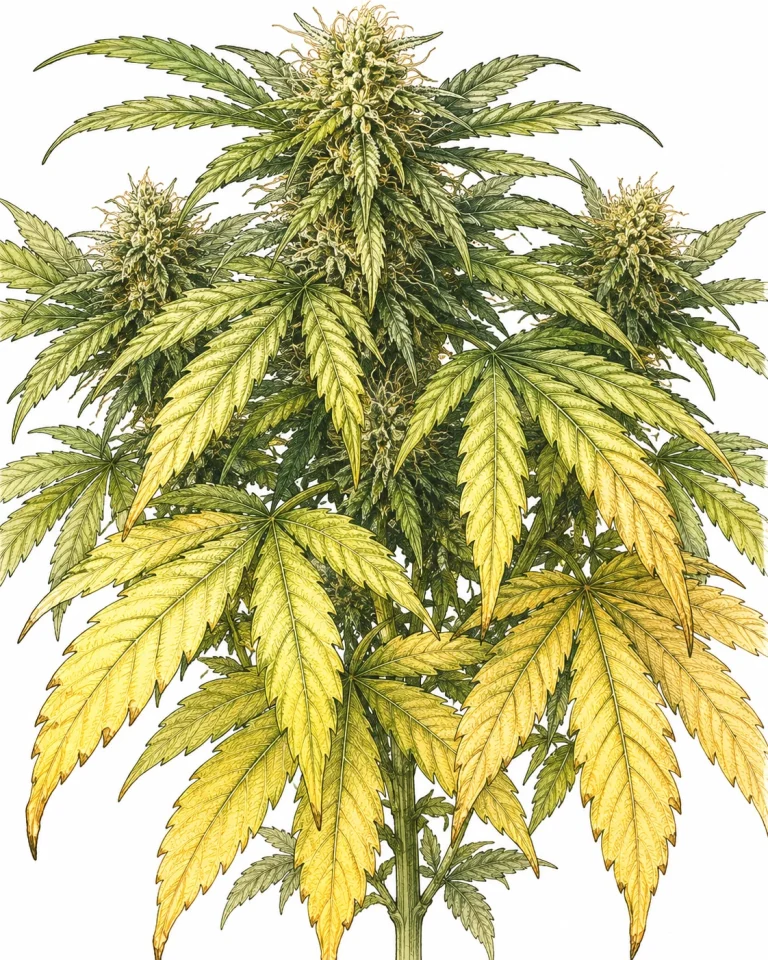
The most common reason for yellow cannabis leaves in flower is a nitrogen deficiency (N deficiency). Nitrogen is the main macronutrient for leaf growth and chlorophyll production. Because nitrogen is a mobile nutrient, a hungry plant moves it out of the older, lower leaves and into the newer growth and the buds. The classic picture: the lower leaves turn evenly pale green, then fully yellow and drop off, while the upper leaves still look healthy at first. A slight drop in nitrogen during flowering is normal and even wanted, but a strong deficiency can cost you yield.
A common cause of N deficiency in flower is switching too early to pure bloom nutrients with no nitrogen. Lots of beginners switch to bloom nutrients the moment they flip the lights to 12/12 and forget that the plant still needs a fair amount of nitrogen during the first four weeks of flowering. The wrong pH in your growing medium can also lock nitrogen out, even when there’s plenty of it. Start by checking the pH of your water and your medium: in soil, it should sit between 6.0 and 7.0, in hydro between 5.5 and 6.5. You’ll find more on dialing in your pH in our article on pH for cannabis.
The fix for a true N deficiency in flower: bump up the nitrogen in your nutrient solution for a short while. Use a grow (veg) nutrient or a PK booster that contains some nitrogen. Then deliberately cut nitrogen back again in the last three to four weeks to help your buds ripen and boost quality.
- Symptom: even yellowing from the bottom up, starting at the leaf stems
- Lower leaves turn pale green first, then bright yellow, then brown
- Upper leaves and buds stay untouched at first
- Cause 1: switching too early to nitrogen-free bloom nutrients
- Cause 2: pH outside the ideal range blocks nitrogen uptake
- Fix: check pH, raise nitrogen temporarily, cut it back again in late flower
Magnesium Deficiency in Flowering: How to Read Interveinal Chlorosis
For more detail, check out How to Spot Nitrogen Deficiency in Cannabis and our Cannabis Deficiency Overview.
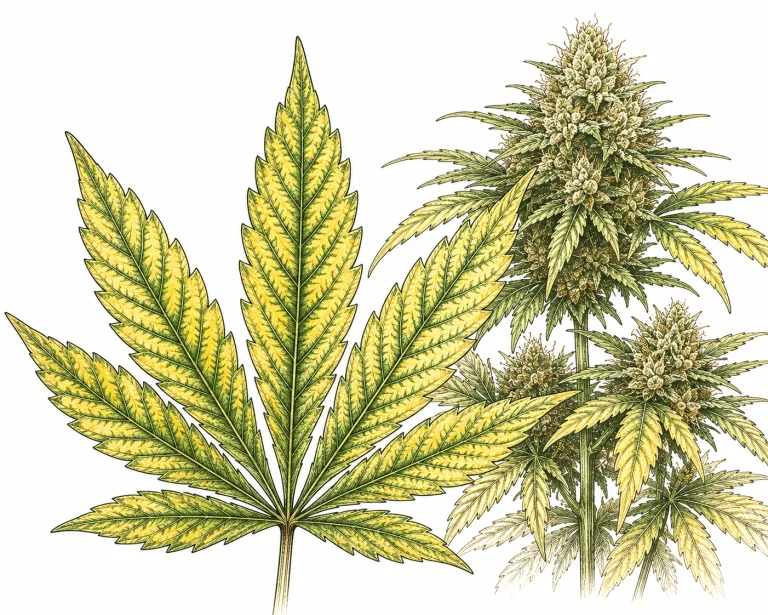
After nitrogen deficiency, magnesium deficiency is the second most common reason for yellow cannabis leaves during flowering. The telltale sign is interveinal chlorosis: the tissue between the leaf veins turns yellow, while the veins themselves stay green at first. You see this pattern because the leaf tissue needs magnesium to make chlorophyll. Magnesium is a mobile nutrient, too, so this deficiency also starts on the older, lower leaves. As it gets worse, the symptoms move up the plant, and affected leaves can also turn reddish-purple.
Cannabis needs a lot more magnesium in the flowering stage, because the plant uses it to power the enzymes behind bud development. Common triggers are soft tap water with low mineral content, a pH that is too acidic (below 6.0, which blocks Mg uptake), or a calcium-magnesium imbalance from overdoing your Cal-Mag. For a quick fix, try a foliar spray with Epsom salt (magnesium sulfate): dissolve 8–19 g per gallon (2–5 g per liter) of water and spray the affected leaves directly. At the same time, check your pH and adjust it if needed. Want to learn more about how calcium and magnesium deficiencies are connected? Read our article on calcium deficiency in cannabis.
- Symptom: yellow tissue between the leaf veins, veins stay green (interveinal chlorosis)
- Starts on older, lower leaves and moves up the plant
- Leaves may turn red or purple
- Triggers: pH too low, soft water, calcium-magnesium imbalance
- Quick fix: Epsom salt foliar spray (8–19 g/gal, or 2–5 g/L of water)
- At the same time, bring the pH in your growing medium back to 6.2–6.8
Yellow Cannabis Leaves in Flowering from Potassium and Phosphorus Deficiency
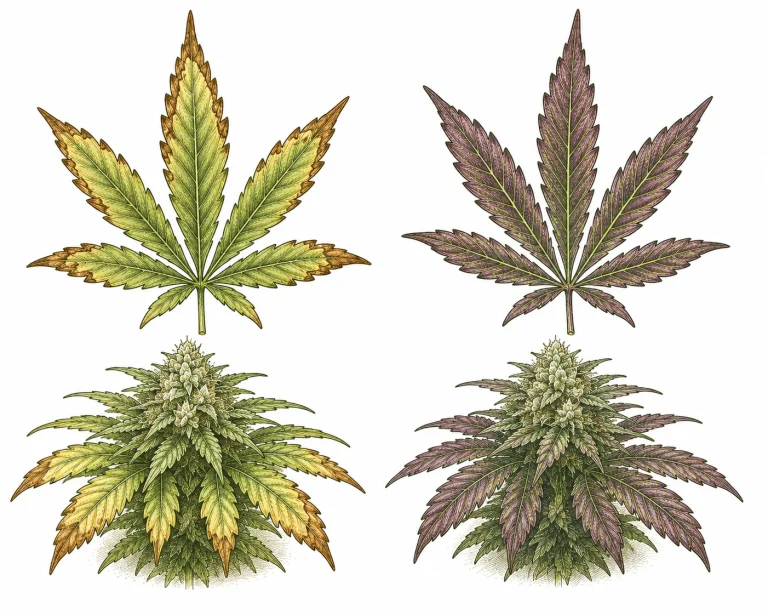
Potassium and phosphorus deficiencies often hit cannabis in mid to late flowering, when the plant’s demand for these nutrients peaks. Potassium deficiency (K deficiency) usually shows up as brown, crispy (necrotic) leaf edges and tips, surrounded by a pale yellow zone. At first, the leaves can look unusually dark green before the edges start to burn. In flowering, potassium moves sugars through the plant and helps it handle stress, so a deficiency can seriously cut your yield. Common causes are pH swings or nutrients with a poor K ratio.
You can spot phosphorus deficiency (P deficiency) by its typical purple to dark red color on leaves and stems, often combined with yellowing. Leaves may turn a dark bluish green before they fade to yellow. In flowering, phosphorus is arguably the most critical nutrient of all, because it drives energy production (ATP) and bud formation. In soil, a pH above 7.2 can block phosphorus uptake almost completely. Check your pH right away and switch to a bloom nutrient with more phosphorus – our feeding guide shows you how to dose nutrients correctly in flowering. Important: correcting too hard can lead to nutrient burn – read our article on cannabis nutrient burn.
- Potassium deficiency: brown, necrotic leaf edges, pale yellow margin, leaves dark green at first
- Potassium deficiency shows up especially in weeks 4–8 of flowering
- Phosphorus deficiency: purple-red leaves and stems, followed by yellowing
- Phosphorus deficiency is often caused by a pH that is too high (>7.2)
- Potassium fix: correct the pH, use a K-rich bloom booster
- Phosphorus fix: lower the pH, feed a P-rich nutrient, but don’t overdo it
Overwatering and Root Problems: The Underrated Cause
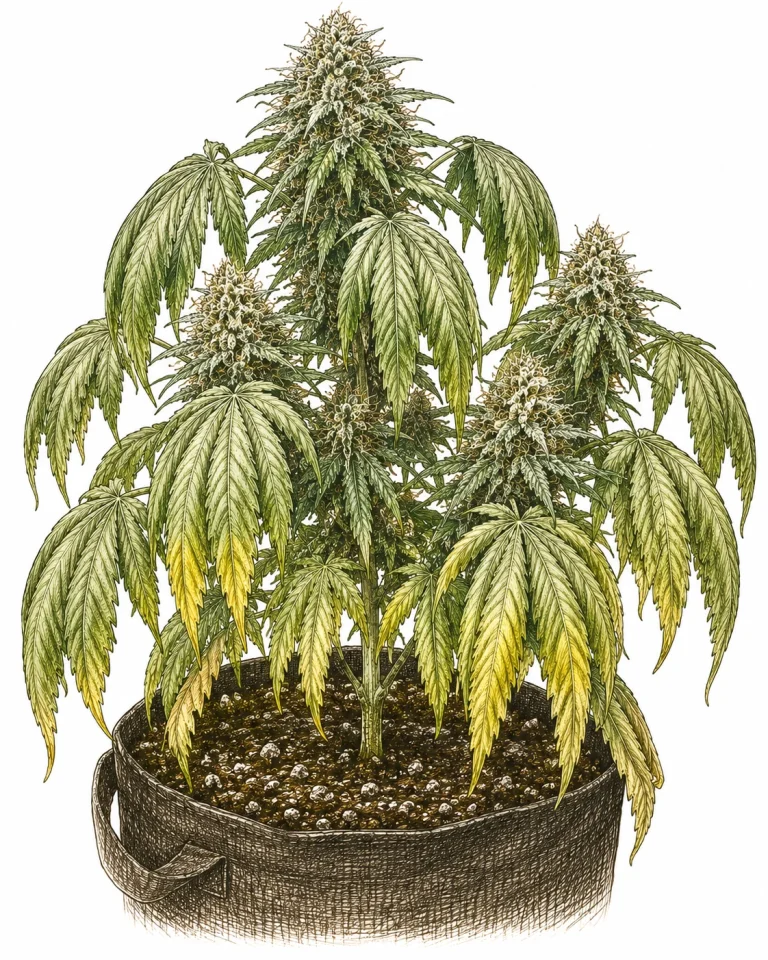
When leaves turn yellow, a lot of growers think “deficiency” and reach straight for the nutrient bottle. But overwatering is one of the most common causes of yellowing during the flowering stage. When the soil stays wet all the time, the root zone runs low on oxygen and roots can start to die. Dead roots can’t take up nutrients anymore, so you may see every classic deficiency pattern even though there’s plenty of food in the growing medium. The leaves turn evenly pale green to yellow and droop (with overwatering, they first stiffen and curl outward, then go limp), and the whole plant’s growth stalls.
The easiest diagnostic tool? Lift your pot. A pot that’s heavy and wet after watering and still heavy two or three days later points to drainage problems. Also stick your finger 1–1.5 in (3–4 cm) deep into the medium: only water once it feels dry down there. In flower, cannabis often needs a lot less water than you’d expect, especially when you’ve dialed back the light or temperatures are low. You’ll find everything about the right watering rhythm in our guide How to Water Cannabis. With serious root problems, a fungal infection (pythium root rot) may also be in play, and that calls for fast action.
- Symptom: Even yellowing and droopy leaves even though the medium is moist
- A heavy pot that stays wet is the most reliable sign
- Finger test: Only water again once the medium is dry 1–1.5 in (3–4 cm) down
- In flower, plants often need less water than in the vegetative stage
- Fix: Stretch out the time between waterings and improve drainage
- If you see root rot: Consider a hydrogen peroxide treatment (3% H2O2, 7.5 ml/gal (2 ml/L))
Heat Stress, Light Problems and pH Mistakes as Other Triggers
Learn more about soil fertility and nutrient availability from the Julius Kühn Institute.
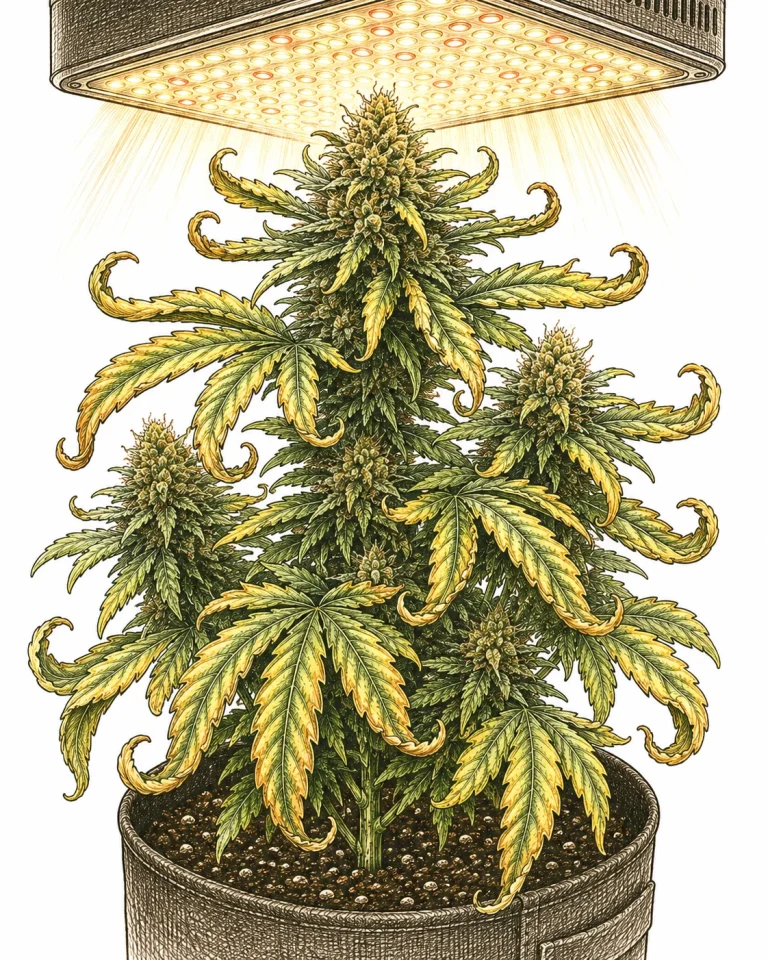
Yellow cannabis leaves in flower can also come from environmental factors that have nothing to do with feeding. Heat stress can set in when your grow space stays above 82–86 °F (28–30 °C) for long stretches. The leaves first curl upward (“tacoing”), then develop heat burn on the tips and edges and turn yellow. The area right under the light is hit hardest. Powerful LED lights can also cause yellowing at the right temperature if they hang too close (light burn). The telltale sign of light burn: Only the top leaves closest to the light are affected, while the rest of the plant looks healthy.
The wrong pH, on the other hand, is the silent killer behind yellowing in flower, because it can make every nutrient problem worse or even cause it in the first place. When pH drifts outside the ideal window, certain elements become invisible and unavailable to the roots, even if there’s plenty of them in the medium. That’s called nutrient lockout. Check pH regularly with a calibrated meter, both in your feed water (before watering) and in the runoff (after watering). If you’re off target by more than 0.5 pH units, correct it right away. You’ll find everything you need in our article on pH for Cannabis.
- Heat stress: Leaves curl upward (“tacoing”), edges yellow and burn
- Ideal temperature in flower: 72–79 °F (22–26 °C) during the day, 64–72 °F (18–22 °C) at night
- Light burn: Only the top leaves closest to the light are affected – raise your light
- pH mistakes cause nutrient lockout even when nutrients are there
- pH in soil: aim for 6.0–7.0; in hydro: 5.5–6.5
- Check pH in your feed water daily and in the runoff weekly
Yellow Cannabis Leaves in Flower: Step-by-Step Diagnosis
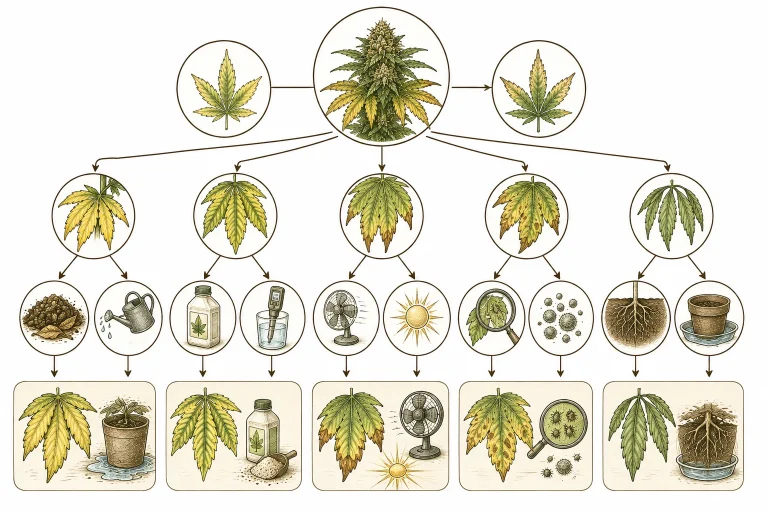
To get the diagnosis right when your cannabis leaves turn yellow in flower, a systematic approach is key. Feeding at random without pinning down the cause can make things worse. Stick to this proven diagnosis routine: First, figure out which week of flower you’re in. From week 6 on, some light yellowing of the lower leaves is normal. Next, check the pH of your feed water and your runoff. The wrong pH is the most common cause of nutrient problems. Then watch where the yellowing starts and what the pattern looks like: bottom to top points to mobile nutrients (N, P, K, Mg), top to bottom points to immobile nutrients (Ca, Fe, Mn, Zn).
Also check your environment: temperature, humidity (ideally 40–50% RH in flower), light distance and watering rhythm. Only once you’ve ruled out all of these should you step in with targeted feeding. Always start with the lowest recommended dose and work your way up. Keep notes on what you change and watch the plant for 48–72 h for signs of improvement before you change anything else.
- Step 1: Figure out your flowering week – from week 6-8 on, yellowing at the bottom is often normal
- Step 2: Measure the pH of your input water and runoff and write it down
- Step 3: Read the yellowing pattern – is it starting at the bottom or the top?
- Step 4: Check the environment – temperature, humidity, light distance
- Step 5: Check your watering schedule and pot weight
- Step 6: Only then feed with a purpose – start with a low dose
Yellow Leaves in Late Flower: When Should You Leave Them Alone?
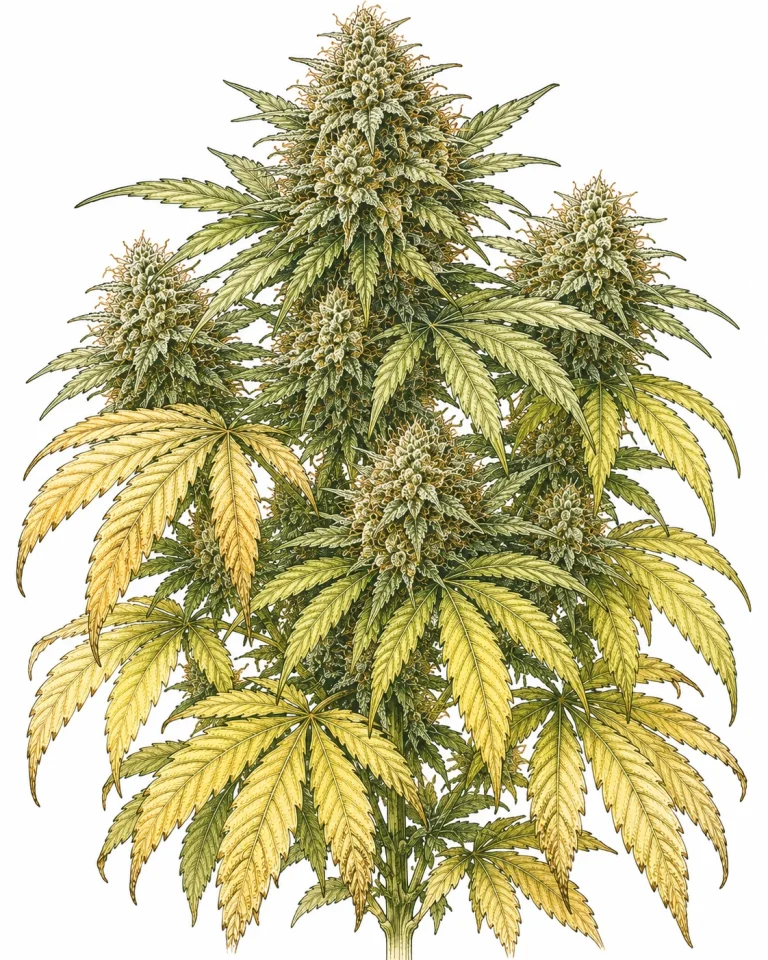
There’s one stage where yellow leaves during flowering aren’t just normal – they’re actually a good sign: the last two to four weeks before harvest. During this time, often called the “flush phase” or “ripening phase,” the plant starts actively moving its own nutrient reserves out of the leaves and into the buds. The yellowing simply shows that your plant is following its genetic program and putting everything into ripening. Experienced growers see evenly yellowing leaves right before harvest as a positive signal, not a problem.
How to spot harmless late-flower yellowing: It starts on the lowest, oldest leaves. It moves slowly and evenly. The buds themselves are dense, frosty with trichomes and keep visibly ripening. The plant shows no other stress signs like necrosis, mold or pests. At this point, cutting off yellow leaves is optional – most of them drop on their own. Many growers also start flushing in this phase (rinsing the growing medium with plain water) to wash out leftover nutrients and improve the quality of the final product.
- Harmless late-flower yellowing starts in week 6-10 on the lowest leaves
- Slow, even progress from the bottom up is normal
- Buds are healthy, dense and still ripening: no reason to panic
- No visible necrosis, mold or pests
- You can cut off yellow leaves or just let them drop
- Flushing with plain water in the last 1-2 weeks is recommended
Frequently Asked Questions
Is it normal for cannabis to get yellow leaves during flowering?
Yes. In late flower (from week 6-8 on), yellowing of the lower, older leaves is completely normal. The plant shifts nutrients from its leaves into the buds. It becomes a concern when the yellowing starts early, spreads fast or also hits new growth.
Which nutrient deficiency most often causes yellow leaves in flower?
Nitrogen deficiency is by far the most common cause. It shows up as even yellowing from the bottom up. Magnesium deficiency comes second – you can spot it by interveinal chlorosis (the veins stay green). Always check your pH first before you adjust your nutrients.
What should you do about yellow cannabis leaves during flowering?
Diagnose first, then act: measure pH, check your watering schedule, read the yellowing pattern (bottom or top) and check your grow environment. Then fix the actual cause: correct the pH, add the missing nutrient, stop overwatering or adjust your light distance.
Can yellow leaves in flower ruin your harvest?
That depends on the cause and the stage. Natural yellowing at the end of flower won’t hurt your harvest. Early, severe yellowing from nutrient deficiencies or root problems can noticeably cut yield and quality if you don’t treat it in time.
Should you cut off yellow leaves during flowering?
Leaves that have turned fully yellow can be removed without worry, since they no longer photosynthesize. Leave half-yellow leaves on the plant as long as they still have some green tissue. Never remove too many leaves at once – you don’t want to stress the plant even more.
Why are the top leaves of my cannabis plant turning yellow in flower?
Yellowing that starts at the top and works its way down points to immobile nutrients: calcium, iron, manganese or zinc. Your plant can’t move these out of older leaves to feed new growth. Common causes are a pH that’s too low or water that’s too hard or too soft.
Do yellow cannabis leaves turn green again?
No. Once leaf tissue has turned yellow, it won’t go back to green, because the chlorophyll breakdown in those cells can’t be reversed. Affected leaves stay yellow or eventually drop off. What really matters is fixing the cause in time: new leaves and shoots will then come in healthy and green, and your plant can make a full recovery. Only the leaves that are already damaged stay that way.
The Bottom Line
Yellow leaves during flowering aren’t automatically a red flag, but they are a sign you should track down step by step. Natural senescence in the last weeks of flowering doesn’t need any action, but early or fast-spreading yellowing deserves your attention. Always check your pH first, then your watering schedule, and only then your plant’s feeding. With the right diagnosis process, you can pin down and fix most causes quickly, before your harvest really takes a hit.
