

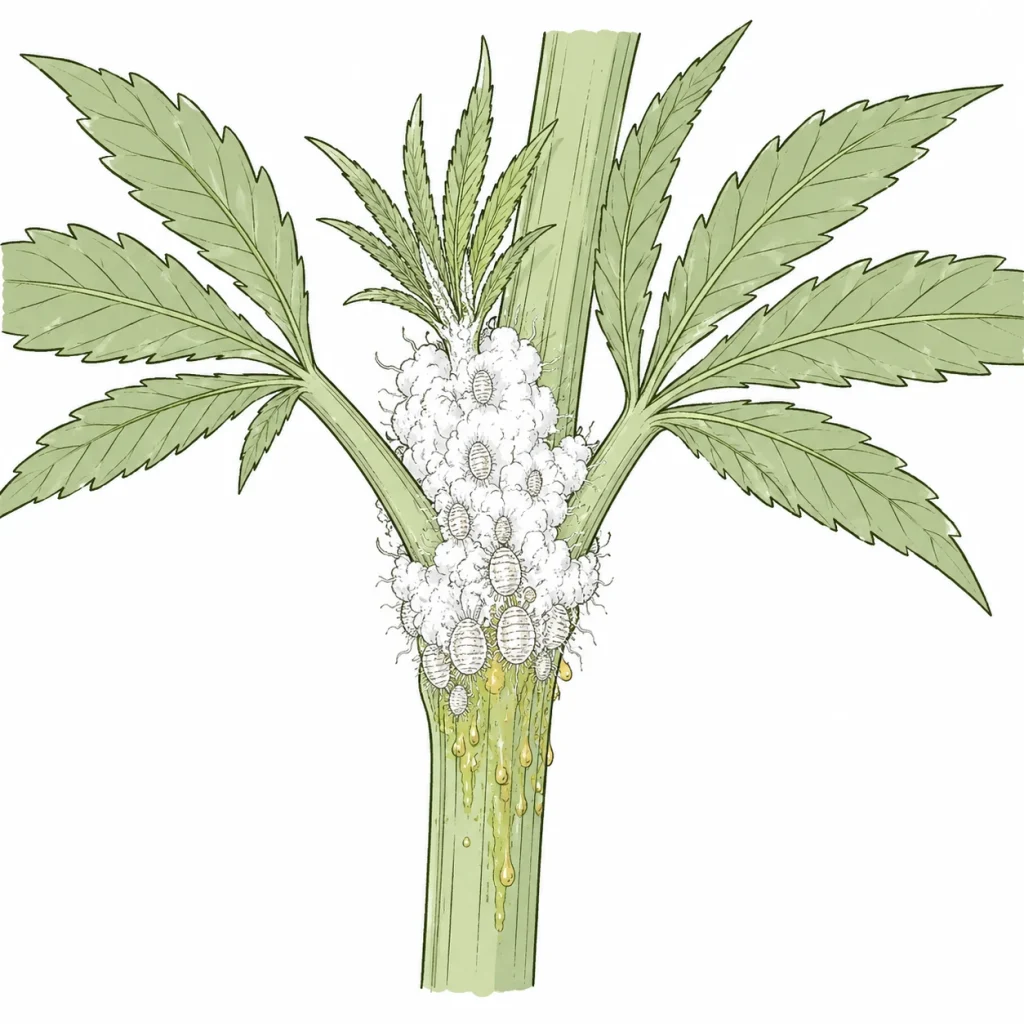
Spotting mealybugs on cannabis is a real challenge for many growers, because an infestation often goes unnoticed for weeks – until the plant is visibly weakened. These tiny insects, covered in white waxy dust, constantly suck plant sap and excrete sticky honeydew that can encourage mold. If you act early, you can still save your grow. If you wait, you risk losing entire harvests. In this article you’ll learn everything you need to know about mealybugs on cannabis: from the first symptoms to proven home remedies and professional products.
How to Spot Mealybugs on Cannabis: The First Signs
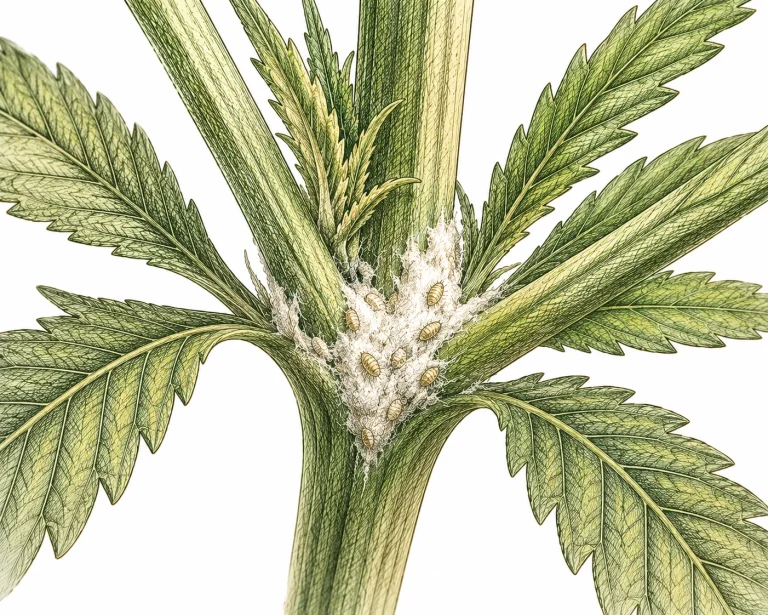
Mealybugs (Pseudococcidae) are oval scale insects up to 0.2 in (5 mm) long that protect their bodies with a floury white wax coating. This coating is their most obvious feature. At first glance it can look like mold or flour residue – a mix-up that can cost you valuable time. Unlike real powdery mildew, you can’t just wipe the woolly coating off without touching the insects hiding underneath.
Their favorite hiding spots are leaf axils, stem joints, the undersides of large fan leaves and the spot where the stem meets the growing medium. That’s exactly where the females hide to lay their eggs in cottony sacs. A single female mealybug can produce hundreds of offspring within a few weeks, so even a small infestation can quickly turn into a full-blown outbreak.
Besides the telltale white woolly coating, you can spot an infestation by sticky honeydew on leaves and stems, and by leaves that turn yellow or wilt because the constant sap loss weakens them. On your next plant check, grab a magnifying glass or jeweler’s loupe and look into every nook and cranny – mealybugs are masters of hide-and-seek.
- White, cottony or floury coating on leaf axils and stems
- Sticky, shiny honeydew on leaf surfaces
- Small, oval, creamy-white insects (0.04–0.2 in / 1–5 mm) visible under magnification
- Yellowing or wilting leaves even though your watering is on point
- Black sooty mold growing on honeydew residue
- Slower growth and overall weakness of the plant
Causes: Why Do Mealybugs Attack Your Cannabis Plant?
Mealybugs can sneak into your grow in several ways. Most often they come in with new growing medium or clones that already carry eggs or young crawlers. Clothing, tools and even intake vents can bring them in too. Indoors, natural enemies like ladybugs or parasitic wasps are almost completely missing, so populations can multiply unchecked.
Certain conditions make an infestation much more likely. Mealybugs love warm, dry air between 75 and 86 °F (24–30 °C) with humidity below 40 % RH. Stressed plants that get too many or too few nutrients are especially vulnerable, because their natural defenses are weakened. So if you consistently give your plants optimal conditions, you can noticeably lower the risk of an infestation.
Outdoor growers are at risk too, especially if infested ornamental plants grow nearby or ants are active. Ants literally “farm” mealybugs because they feed on the honeydew, and they actively carry them to new host plants. If you notice lots of ants on your cannabis plants, check them right away for scale insects.
- Infested clones or contaminated growing medium bringing them in
- Warm, dry grow environment (above 75 °F (24 °C), below 40 % RH)
- Plants weakened by nutrient stress or pH problems
- No natural predators in a closed indoor setup
- Ants actively spreading mealybugs outdoors
- Contaminated tools or clothing
Getting Rid of Mealybugs on Cannabis: Immediate Steps at a Glance

Once you spot mealybugs on your cannabis plants, every hour counts. Isolate infested plants from the rest of your grow right away to keep them from spreading. Remove visible mealybugs and their wax coating by hand with a cotton swab or soft cloth soaked in isopropyl alcohol (70 %). This step cuts the population immediately and makes every treatment that follows much more effective.
After manual removal comes chemical or biological treatment. Neem oil is the most popular home remedy: mix 5 ml of pure neem oil with 2–3 drops of dish soap as an emulsifier in about a quart (1 L) of lukewarm water. Spray the whole plant, especially the leaf undersides and axils. Repeat every three to four days for at least two weeks, so you also catch freshly hatched crawlers that weren’t exposed during the first round of spraying.
For stubborn infestations, or for sensitive plants in the flowering stage, insecticidal soap (potassium soap) is a gentler alternative. A 2–3% solution breaks down the mealybugs’ waxy coating and kills them by drying them out. It’s also easier on your trichomes than oily sprays. For heavy infestations, alternate insecticidal soap and neem oil to cover more bases.
- Isolate infested plants right away
- Remove mealybugs by hand with isopropyl alcohol
- Spray neem oil solution (5 ml/L, about 19 ml/gal) every 3–4 days for at least 2 weeks
- Use insecticidal soap (2–3%) as a gentle option during flowering
- Treat the whole plant, including leaf undersides and stem joints
- Clean your grow tent and gear at the same time
Organic and Chemical Treatments for Mealybugs on Cannabis
In an indoor grow, beneficial insects are a highly effective, residue-free option. The mealybug destroyer (Cryptolaemus montrouzieri) is a ladybug that specializes in mealybugs and eats both adults and eggs. In a grow tent, just a few of them can keep a moderate population under control. The parasitic wasp Leptomastix dactylopii attacks mealybug nymphs directly and works especially well in the vegetative stage. You can order both from garden suppliers and beneficial insect vendors. For a detailed overview of using beneficial insects for plant protection, check out the Bavarian State Institute for Viticulture and Horticulture (in German).
Spinosad is an insecticide made from naturally occurring soil bacteria (actinobacteria) and is widely used in crop protection. It attacks the insects’ nervous system and has very low toxicity for mammals and birds. Spinosad is a great pick in veg. During flowering, use it only in the first two weeks, since residues can end up in your harvest. Always follow the label instructions on waiting periods.
Pyrethrins, made from chrysanthemum flowers, are another natural option. They break down quickly and hit hard in the short term. Still, don’t use them in the last four weeks before harvest. Systemic insecticides like imidacloprid are a questionable choice for anything you plan to consume, because they build up inside the plant. Use them only as a last resort, and never during flowering.
- Beneficial insect Cryptolaemus montrouzieri (mealybug destroyer) – ideal for indoor grows
- Parasitic wasp Leptomastix dactylopii – effectively parasitizes nymphs
- Spinosad – organic, effective, short waiting period
- Pyrethrin spray – fast knockdown, veg only
- Insecticidal soap as a gentle ongoing treatment
- Systemics (imidacloprid) only as a last resort, never during flowering
How to Spot Mealybugs on Cannabis and Prevent Them Long-Term
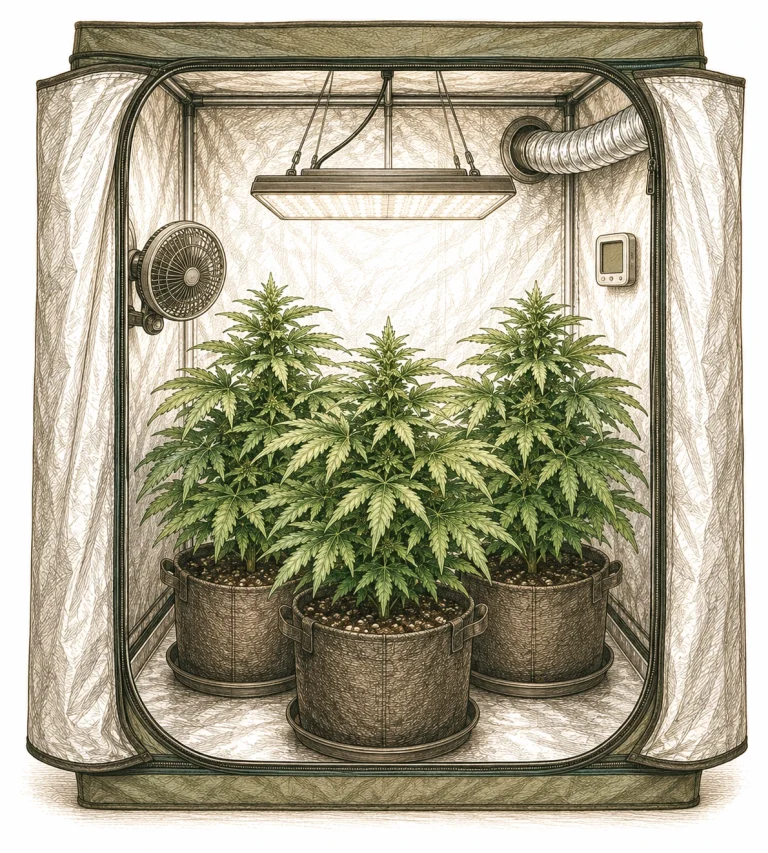
Prevention is your best weapon against mealybugs. Put every clone or new plant through a two-day quarantine in a separate area before it joins your main grow. Check the root ball, stem joints and leaf undersides with a good magnifier or a smartphone macro lens. Skipping this one step is the most common cause of pest problems in indoor grows.
Dial in your grow climate for the long run: keep humidity between 55 and 70% in veg and make sure you have good air circulation. Mealybugs like it warm and dry, so a well-ventilated space with the right humidity already works as a natural barrier. Keep in mind that you’ll need to lower humidity during flowering to prevent mold. Make up for it by checking your plants more often. Our cannabis plant diagnosis overview helps you tell pests apart from other stress symptoms early on.
Only use sterile, pasteurized growing medium or medium from sealed bags. Pasteurize recycled medium before reusing it (176 °F (80 °C) for 30 minutes), because mealybug eggs and other pests can survive in it. Clean your grow tent thoroughly with isopropyl alcohol or a mild disinfectant after every harvest, and stick with it after every finished grow cycle. Plants with balanced feeding and the right pH for cannabis have much stronger natural defenses.
- Quarantine all new plants and clones (at least 48 hours)
- Inspect regularly with a magnifier, especially leaf joints
- Keep humidity at 55–70% in veg
- Use only sterile, sealed growing medium
- Fully disinfect your grow tent after every harvest
- Disinfect tools and scissors with alcohol before each use
- Keep plants strong with balanced feeding
Mealybugs During Flowering: What You Can Still Use
A mealybug infestation during the flowering stage is especially tricky. Many treatments can either leave residue on your harvest or damage the trichomes on your buds. Stop using oil-based sprays like neem oil at least two to three weeks before harvest, because that distinctive neem smell can carry over into the final product. Insecticidal soap is different: you can still use it in the last weeks of flowering, since it breaks down without leaving residue.
In the last four weeks before harvest, your safest options are manual removal with isopropyl alcohol, insecticidal soap sprays and beneficial insects. Don’t put freshly sprayed buds right in front of a fan or exhaust. Leftover moisture in dense buds can encourage bud rot (botrytis, gray mold). So always spray early in the light cycle and make sure you have good air circulation after each treatment.
If the infestation is so bad that saving the harvest no longer looks realistic, the smarter move can be to harvest the affected plant early, disinfect everything and restart your grow. Leaving an infested plant in place puts every other plant in your grow at risk. It’s a tough call, but it protects the rest of your plants.
- Stop neem oil at least 3 weeks before harvest
- Insecticidal soap is still safe in the late weeks of flowering
- Manual removal with isopropyl alcohol is always an option
- Make sure you have good air circulation after every treatment (bud rot prevention)
- Beneficial insects can be used right up to harvest with no residue issues
- Worst case: consider an early harvest instead of risking all your plants
How to Tell Mealybugs Apart from Similar Pests and Problems
Mealybugs often get mistaken for powdery mildew, since both show up as a white coating on the plant. The key difference: powdery mildew forms a flat, powdery film on leaf surfaces that’s hard to rub off without damaging the leaf. Mealybugs form fluffy, three-dimensional wax clumps in leaf axils and stem joints, and if you look closely, you’ll see the insects underneath. A magnifying glass or jeweler’s loupe clears things up in seconds.
Soft scale insects (Coccidae) and spider mites can also cause similar damage. Soft scale forms shell-like structures too, but they’re flatter, often brownish and oval, without the telltale cottony coating. Spider mites leave fine webbing and tiny yellow speckles on leaf surfaces, but no white wax. Yellow leaves can show up with either pest. Our overview Cannabis Yellow Leaves – All Causes at a Glance helps you nail down the right diagnosis fast.
Finally, a white coating on stems can also point to calcium excess or salt buildup from the growing medium. These deposits are even and crystalline, not fluffy or cotton-like, and you won’t find any live bugs underneath. A quick look with a magnifier, combined with a check for calcium deficiency in cannabis and other nutrient problems, reliably rules out a misdiagnosis.
Aphids and fungus gnat larvae sometimes get confused with mealybugs too, even though their damage looks clearly different up close. For a complete overview of all cannabis pests, check out our pests overview, including direct links to aphids and fungus gnats.
- Powdery mildew: flat, powdery film on leaf surfaces, no visible insects
- Mealybugs: three-dimensional wax clumps in leaf axils, insects visible under a magnifier
- Soft scale: flat, brownish, oval shells without a cottony coating
- Spider mites: fine webbing, yellow speckles, no wax coating
- Salt buildup: crystalline, even, no live bugs
You’ll find a complete overview of all cannabis pests in our pests guide.
Frequently Asked Questions
How fast do mealybugs multiply on cannabis plants?
Very fast. A single female can lay up to 600 eggs in about four weeks. At warm temps around 77 °F (25 °C), one generation (egg to adult) takes only three to five weeks. So a small infestation can turn into a serious outbreak within one to two months if you don’t catch and treat it early.
Are mealybugs harmful to humans?
No, mealybugs aren’t directly dangerous to people or pets. They don’t bite and don’t transmit any known human diseases. However, infested plants can develop mold (sooty mold growing on honeydew), which can be a problem if you consume the harvest. That’s why it’s important to treat an infestation in time and inspect affected buds carefully.
Can I get rid of mealybugs completely with home remedies?
For light to moderate infestations, yes. Neem oil sprays, insecticidal soap and manual removal with isopropyl alcohol work very well if you stick with them consistently for two to three weeks. For heavy infestations, it’s worth adding beneficial insects like the mealybug destroyer (Cryptolaemus montrouzieri). Consistency is key: a single treatment is almost never enough.
How do I spot mealybugs early?
In the early stages, you’ll spot tiny, creamy-white dots in the leaf axils that look like leftover flour. With a 30–60x loupe or a smartphone macro lens, you can make out the oval bugs and their waxy threads very early on. Regular weekly checks – especially on new clones and at the stem joints – are your best early warning system.
Does neem oil leave residue in the final product?
If you use neem oil too close to harvest, it can pass its typical bitter neem smell and taste on to your buds. The active ingredient, azadirachtin, breaks down within one to two weeks. Rule of thumb: stop using neem oil at least three weeks before your planned harvest, then switch to insecticidal soap or beneficial insects.
Can mealybugs get in through vents?
Yes, in rare cases young mealybugs can get in through unscreened vents, especially if your grow room isn’t protected with insect screens. Still, the most common way they get in is contaminated growing medium and clones. Insect screens on all intake vents and a quarantine routine for new plants cut this risk dramatically.
The Bottom Line
Spotting mealybugs on cannabis is the first and most important step: if you act early, you can save your grow with simple tools like neem oil, insecticidal soap and manual removal. Your best prevention is still a strict quarantine for every new clone plus regular visual checks with a loupe. Dialed-in growing conditions with the right humidity and nutrients make your plants even tougher against pests. With what you’ve learned in this article, you’re well equipped to spot mealybugs, knock them out and keep them away for good.
