

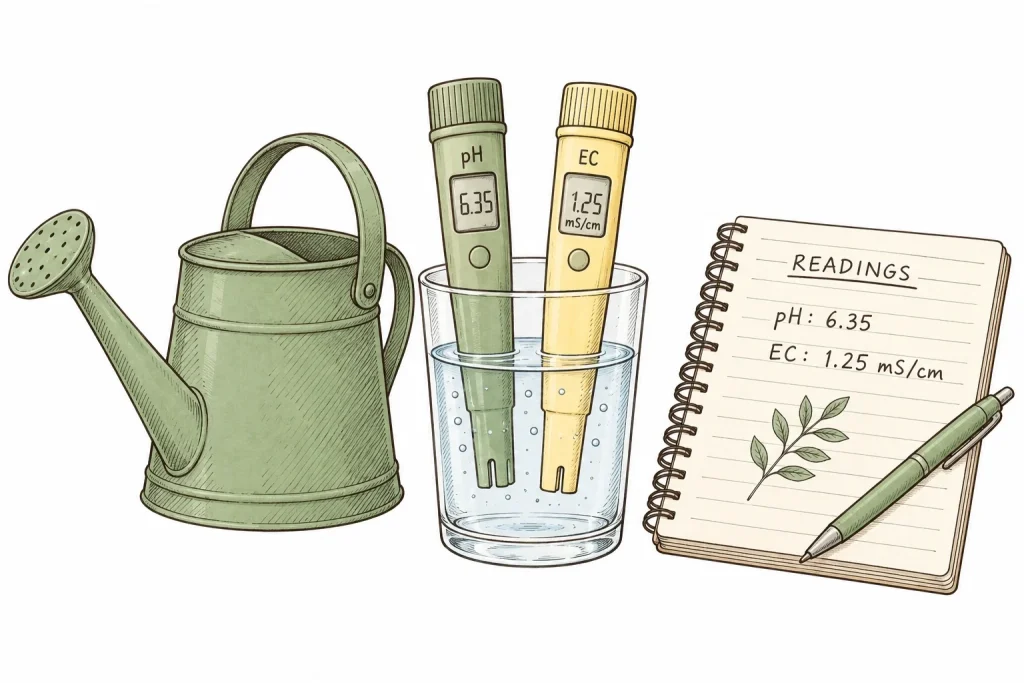
If you grow cannabis, there are two meters you can’t skip: a cannabis pH meter and an EC meter. Neither one is an optional extra. They’re the foundation for healthy plants and heavy yields. Without reliable readings, you’re flying blind every time you water and feed. In this article, you’ll learn how these meters work, which models are really worth your money, and how to avoid common measuring mistakes from day one.
Why a Cannabis pH Meter and an EC Meter Are Must-Haves
pH determines whether your cannabis plant can pull nutrients from the growing medium at all. If the value drifts even slightly outside the ideal range, certain nutrients become locked out of the root zone. The result is deficiency symptoms (German) that many growers blame on the wrong feeding, when the real culprit is simply off pH. That’s why a reliable cannabis pH meter is part of the bare-minimum gear for every grow.
EC (electrical conductivity) (German) of your water shows you how many dissolved salts and nutrients it contains. If EC runs too high, you overfeed your plants and risk nutrient burn. If it’s too low, your plant goes hungry. Especially in indoor growing, where you control the entire nutrient supply, the EC meter is your direct feedback tool. Feeding without one means feeding by feel, and that can lead to damage you didn’t need.
Many beginners underestimate how quickly pH can shift after you mix water and nutrients. If you want to dial in your cannabis pH the right way (German), you need an accurate meter, not just test strips that are imprecise and hard to read. Digital cannabis pH meters give you repeatable readings to two decimal places and pay for themselves during your very first grow.
- Ideal pH in soil: 6.2 to 6.8 (tolerable 6.0 to 7.0)
- Ideal pH in coco: 5.9 to 6.1 (tolerable 5.8 to 6.3); in hydro: 5.7 to 6.0 (tolerable 5.5 to 6.1)
- Ideal EC in the vegetative stage: 500 to 800 ppm (1.0 to 1.6 mS/cm)
- Ideal EC in the flowering stage: 800 to 1,100 ppm (1.6 to 2.2 mS/cm)
- Tap water often already reads between 150 and 400 ppm (0.3 to 0.8 mS/cm), so measure yours first
How a Cannabis pH Meter Works and What to Look for When You Buy One
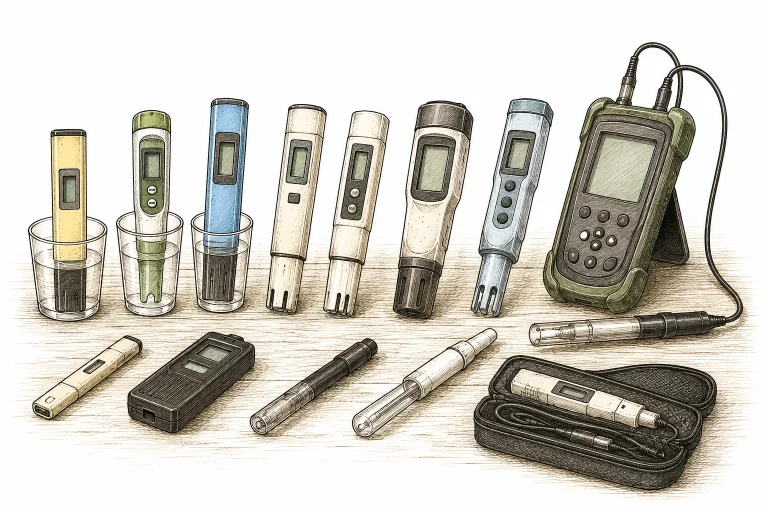
A digital cannabis pH meter uses a glass electrode that generates an electrochemical voltage as soon as it touches a water-based solution. That voltage correlates directly with the concentration of hydrogen ions in the water, and the meter converts it into a pH reading. Accuracy depends heavily on the quality of the electrode and, above all, on whether you calibrate the meter regularly. An inaccurate or dried-out electrode gives you readings you can’t trust.
When you shop for a cannabis pH meter, three things matter most: accuracy, calibration, and easy maintenance. Cheap meters under $15 often can’t be calibrated at all, or they lose their calibration within a few weeks. Go for a meter that allows two-point calibration with buffer solutions and lets you store the electrode in storage solution. Well-known, proven brands in the grow world include Bluelab, Apera and Milwaukee, but more affordable brands like HM Digital can also deliver good results if you calibrate them regularly.
Here’s a point many growers overlook: never store the electrode of your cannabis pH meter dry. If you put the meter away without storage solution, or just with a dry protective cap on, the electrode ages much faster and can start giving false readings. Good manufacturers include a small amount of storage solution. As a short-term backup, you can also keep the electrode in pH 7.0 buffer solution. Distilled water is definitely not a storage solution, because it leaches the electrode.
- Accuracy: look for a resolution of at least ±0.05 pH
- Two-point calibration with pH 4.0 and pH 7.0 buffer solution is standard
- Always store the electrode in storage solution, never dry
- Calibrate at least once a week
- Automatic temperature compensation (ATC) gives you more accurate readings
- Replace buffer solutions regularly, since used solutions can throw off your calibration
Using an EC Meter the Right Way: How to Control Nutrient Strength
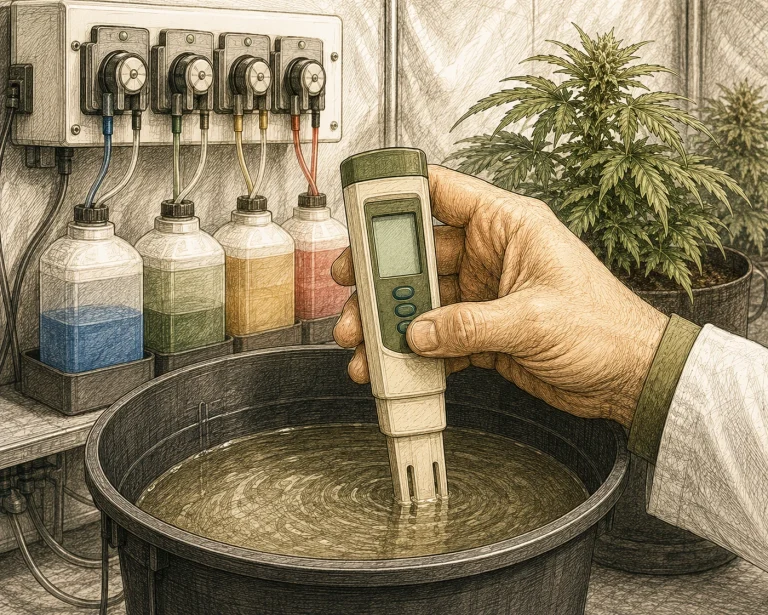
An EC meter measures the electrical conductivity of a liquid in mS/cm (millisiemens per centimeter). The more dissolved salts in the water, the higher the conductivity. Plant nutrients exist as ions, so they conduct electricity. That means EC ties directly to the nutrient concentration in your feed water (EC-controlled fertigation, German PDF). Your meter won’t tell you which nutrients are in there, but it tells you how much is dissolved in total.
To get real value from your EC meter, always start by measuring your plain tap water before adding nutrients. That reading is your baseline EC. Then mix in your nutrients and measure again. Total EC minus baseline EC is the nutrient EC your plant actually gets. Plenty of beginners skip the baseline and can’t figure out why their plants show burn at what looks like a light feeding. If you want to know why cannabis nutrient burn can sneak up on you so fast, an overlooked baseline EC is often the answer.
Near harvest, usually in the last two weeks before the chop, many growers flush their plants with plain water. This clears nutrient salts out of the growing medium. Your EC meter helps here too: measure the EC of the runoff coming out of the bottom of the pot and watch it get closer to the EC of the water you’re pouring in. If the runoff is still well above your input water, there’s a lot of salt left in the medium, so keep flushing.
- Always measure the baseline EC of your tap water first
- Total EC minus baseline EC = effective nutrient EC
- Check runoff EC to spot salt buildup
- EC too high: flush the plant with plain water
- EC too low: raise your nutrient dose step by step
- Runoff EC should be no more than 150 to 250 ppm (0.3 to 0.5 mS/cm) above your input water
Cannabis pH Meter Calibration: The Most Important Step for Reliable Readings
Whether you water to runoff or not depends on how you feed. With organic nutrients, it’s usually best to water without runoff. That keeps moisture in the medium even and supports the soil life that makes nutrients available to your plant in the first place. With synthetic (mineral) nutrients, you should always water to runoff, meaning you give enough water that some drains out the bottom of the pot. Otherwise salts from the nutrients can build up in the medium, your EC can creep up unnoticed, and at some point your plant may show burn even though you fed exactly by the schedule.
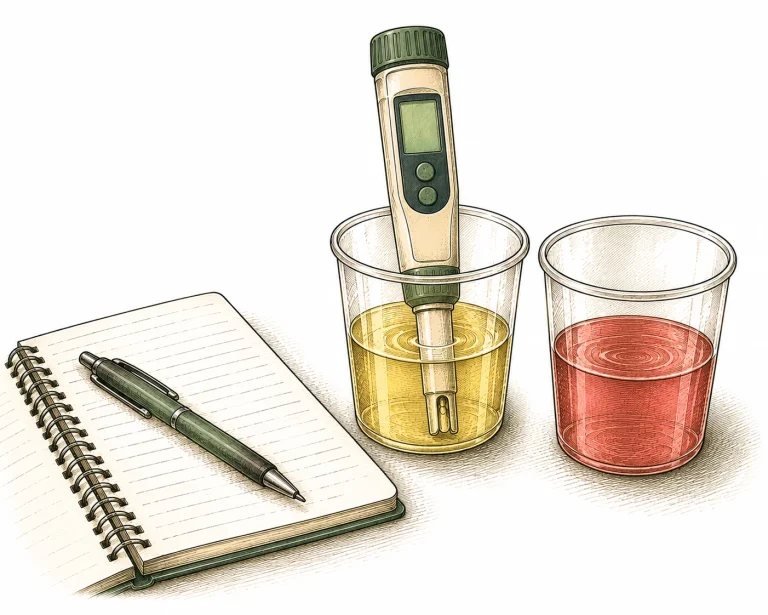
Calibration is the most common mistake growers make with their meters. Lots of people buy a cannabis pH meter, calibrate it once out of the box, and then trust that reading for months. That’s a serious mistake. The glass electrode in a cannabis pH meter ages constantly, especially when it’s regularly dipped in nutrient-rich solutions. Calibrating once a week before you water is the minimum. If you use your meter heavily, calibrate daily.
Two-point calibration is the standard for every cannabis grower. You need two certified buffer solutions, usually pH 4.0 and pH 7.0. Dip the electrode in the pH 7.0 solution first and confirm the value on the meter. Then rinse with distilled water and dip the electrode in the pH 4.0 solution. After calibration, your meter gives accurate readings across the range that matters for cannabis. Important: never pour used buffer solution back into the original bottle. Contamination can ruin the whole bottle.
EC meters need calibrating too, just less often than your cannabis pH meter. Most come with a calibration solution of known conductivity, typically 1413 µS/cm. Calibrating once a month is plenty for an EC meter in a normal grow room. Combo meters that measure pH and EC in one unit are handy, but there’s a catch: if the unit fails, you lose both readings at once.
- Cannabis pH meter: weekly two-point calibration recommended
- Always keep pH 4.0 and pH 7.0 buffer solutions on hand
- Rinse the electrode with distilled water between calibration steps
- EC meter: monthly calibration with 1413 µS/cm solution
- Store opened buffer solutions somewhere cool and dark
- Write the calibration date in your grow journal
Cannabis pH Meter and EC Meter: The Best Models for Every Budget
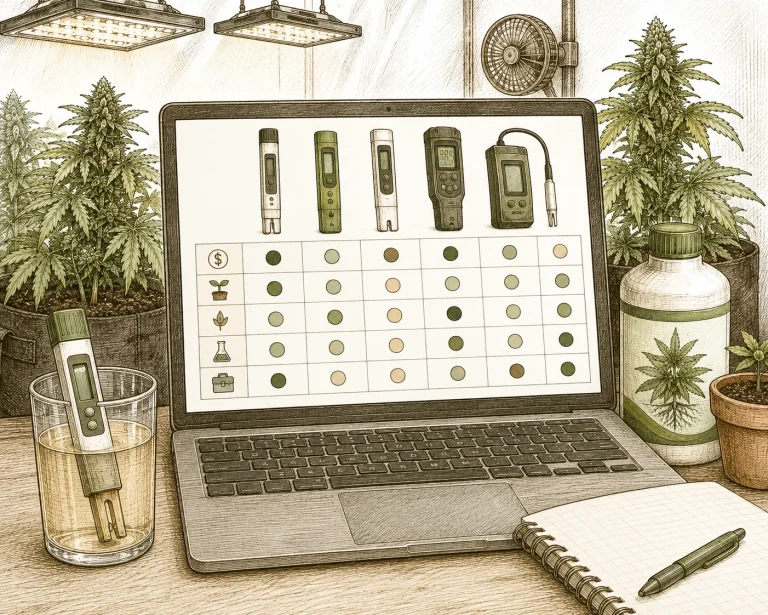
In the entry-level range, up to about $35, the Apera PH20 and the Milwaukee MW101 are the most popular cannabis pH meters among home growers. Both can be calibrated, are accurate enough for home growing and are tough enough for daily use. If you want a simple EC meter in the same price range, the HM Digital COM-80 is a solid pick. This combo EC/TDS meter gives you reliable readings and is quick to clean. Our EC meter comparison (German) puts five dedicated EC meters, from Apera to Bluelab, head to head.
If you’re willing to spend a bit more and want maximum precision, go with Bluelab. If you only need to measure pH, our pH meter comparison (German) covers six dedicated pH testers, with a top pick and a best-value pick. The Bluelab pH Pen and the Bluelab Conductivity Pen are used in professional grow rooms around the world. They calibrate quickly, are waterproof and keep giving you stable readings even after months of constant use. The Bluelab Combo Meter combines pH, EC and temperature in one device. It’s especially handy for hydro growers, because you can measure all three values at the same time. For six models compared side by side, including calibration, probes and use in soil, coco and hydro, check out our pH EC meter comparison (German).
Ad / affiliate link: You can find the Apera PH20 here on Amazon. *As an Amazon Associate, we earn from qualifying purchases.
Ad / affiliate link: You can find the HM Digital COM-80 here on Amazon. *As an Amazon Associate, we earn from qualifying purchases.
Ad / affiliate link: You can find the Milwaukee MW102 Pro here on Amazon. *As an Amazon Associate, we earn from qualifying purchases.
Ad / affiliate link: You can find the Bluelab pH Pen here on Amazon. *As an Amazon Associate, we earn from qualifying purchases.
Ad / affiliate link: You can find the Bluelab Conductivity Pen here on Amazon. *As an Amazon Associate, we earn from qualifying purchases.
Ad / affiliate link: You can find the Bluelab Combo Meter here on Amazon. *As an Amazon Associate, we earn from qualifying purchases.
If you’re planning a complete setup and want to dig deeper into the basics of growing, take a look at our beginner’s guide to growing cannabis indoors. There you’ll find all our other gear recommendations beyond meters. Whatever price range you choose, never cut corners on your cannabis pH meter. A broken or uncalibrated meter can end up costing you an entire harvest.
- Beginner: Apera PH20 (pH) + HM Digital COM-80 (EC) – about $45 to $55 total
- Mid-range: Milwaukee MW102 Pro (pH) + Milwaukee MC122 (EC) – about $90
- Pro: Bluelab pH Pen + Bluelab Conductivity Pen – about $160 to $200
- All-in-one: Bluelab Combo Meter – about $220, measures pH, EC and temperature
- Important: Always pick up buffer solutions and storage solution when you buy your meter
Common Mistakes with Meters in Your Cannabis Grow and How to Avoid Them
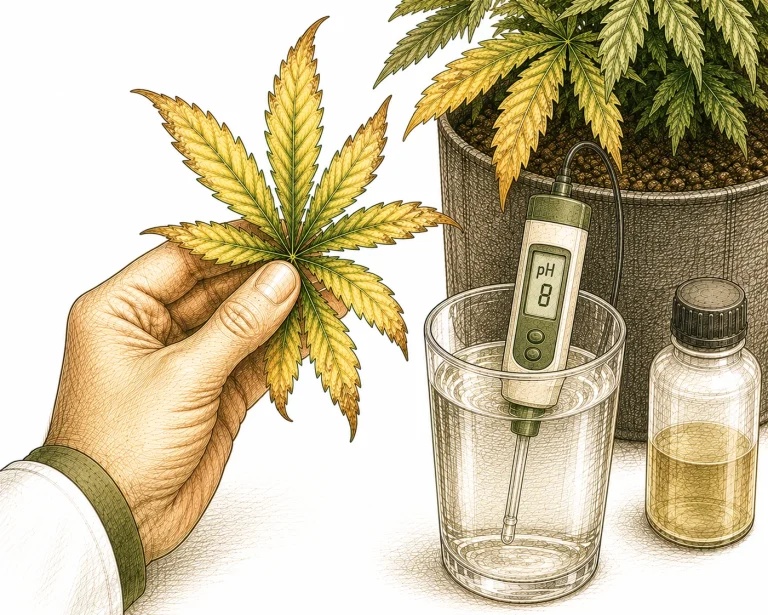
The most common mistake is measuring without calibrating first. Lots of growers spot yellowish leaves and immediately check the pH without knowing when the meter was last calibrated. An uncalibrated cannabis pH meter can give you readings that are off by 0.5 to 1.0 pH units. That means you may adjust the pH in the wrong direction and make the problem worse. So if your plant suddenly shows yellow leaves, the first thing you should do is give your cannabis pH meter a fresh calibration.
Another common mistake is measuring the wrong liquid. Many beginners check the pH of their water after mixing nutrients and forget to measure the runoff too. The pH in your growing medium can be quite different from the pH of the water you pour in, especially when salts have built up. That’s why the pro approach is to measure both: what goes in and what comes out as runoff. It’s the only way to see what’s really happening in your pot.
Finally, a lot of growers forget to clean their meters after use. Nutrient residue on the electrode wears down the membrane faster and causes drift, so your meter can give you less and less accurate readings over time. After every reading, rinse the electrode briefly with distilled water, gently pat it dry with a soft cloth, and store it in storage solution. This simple routine can add months or even years to the life of your cannabis pH meter. If you’re just starting out and want to keep an eye on pH and EC while watering your plants the right way, this routine is an absolute must.
- Mistake 1: Measuring without a fresh calibration, which leads to wrong corrections
- Mistake 2: Measuring only your feed water, not the runoff
- Mistake 3: Storing the electrode dry or in distilled water
- Mistake 4: Reusing calibration solutions or storing them too warm
- Mistake 5: Not rinsing the electrode after a reading
- Mistake 6: Reading EC without accounting for the baseline EC of your tap water
Cannabis pH Meter and EC Meter as a Team: How to Combine Both Readings
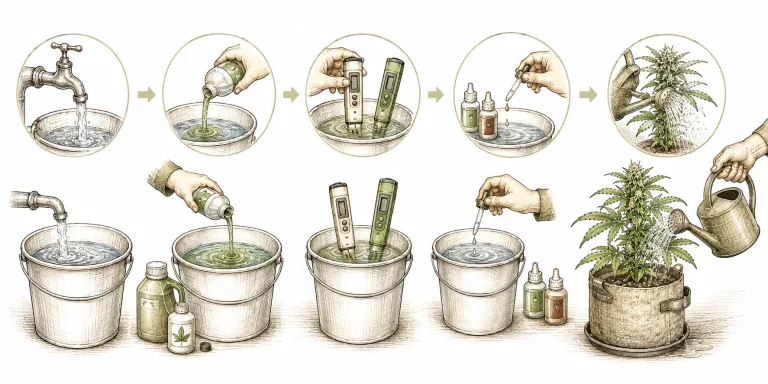
pH and EC meters work best as a team. Here’s the ideal workflow for mixing your feed water. First, measure the EC of your plain tap water. Then add your nutrients and measure EC again. Now you know how many nutrients are actually dissolved in the water. Only then do you adjust pH to your target range. Finish with one last pH check to make sure you’re in the green. The order matters because pH adjustments can shift EC slightly.
Your runoff gives you valuable feedback on the condition of your growing medium. When you measure both pH and EC of the runoff, you can spot salt buildup (high runoff EC) and pH drift in the medium (runoff pH far off from your feed water pH). Without this combo, a full diagnosis of your plant just isn’t possible. You’ll find more important signals from your plant in our plant diagnosis overview, which helps you narrow down symptoms step by step.
Once your measuring routine is set, it only adds about five minutes per watering. Those five minutes are the best investment you can make in your grow. A solid measuring routine helps prevent the most common problems in cannabis growing. These include nutrient deficiencies, nutrient burn, and chronic pH stress that can creep in over weeks before it finally shows up as obvious symptoms.
- Measuring order: baseline EC → add nutrients → measure total EC → adjust pH → check pH
- Runoff: measure pH and EC to judge the condition of your growing medium
- Always adjust pH after measuring EC
- Log every reading in your grow journal so you can troubleshoot later
- Measure at the same temperature every time, since conductivity depends on temperature
Frequently Asked Questions
Which cannabis pH meter is best for beginners?
For beginners, the Apera PH20 is an excellent choice. It’s affordable, calibratable, and gives accurate results. Important: always buy pH 4.0 and pH 7.0 calibration solutions with it and calibrate the meter every week.
How often do I need to calibrate my cannabis pH meter?
Do a two-point calibration with pH 4.0 and pH 7.0 calibration solution at least once a week. If you use your meter daily or you’re in an intense stage of your grow, it’s a good idea to calibrate every day before watering.
What’s the difference between EC and TDS?
EC (electrical conductivity) is measured in mS/cm and directly reflects the salt concentration in the water. TDS (total dissolved solids) is shown in ppm and is calculated from the EC reading. In the US, most growers read ppm on the 500 scale, but EC is the more reliable number, because conversion factors can vary from meter to meter.
Why is my cannabis pH meter suddenly showing wrong readings?
The most common causes are an old or damaged electrode, improper storage (dry or in distilled water), used-up calibration solutions, or skipped calibration. Start with a two-point calibration. If nothing changes, you may need to replace the electrode.
Do I need a combo meter or separate meters for pH and EC?
Separate meters are usually more reliable, because if one breaks, you don’t lose both readings. Combo meters like the Bluelab Combo Meter are convenient, though, and reliable enough for home growing. If you’re just starting out, we recommend a budget-friendly standalone pH meter plus a separate EC meter.
How do I store my cannabis pH meter properly?
The glass electrode always needs to stay moist. Store it in a dedicated storage solution or, for short periods, in pH 7.0 buffer solution. Never store it dry and never in distilled water. Distilled water leaches the electrode and can drastically shorten its lifespan.
On our Recommended Gear page, we’ve put proven pH and EC meters side by side so you can compare them directly.
The Bottom Line
A cannabis pH meter and an EC meter aren’t luxury purchases. They’re the most important basic gear for any serious grow. They give you control over two of the most influential factors in growing and protect you from the most common, most avoidable mistakes. Invest in solid meters, calibrate them regularly and check both readings every time you water. With this routine, you lay the foundation for healthy plants and big yields.
