

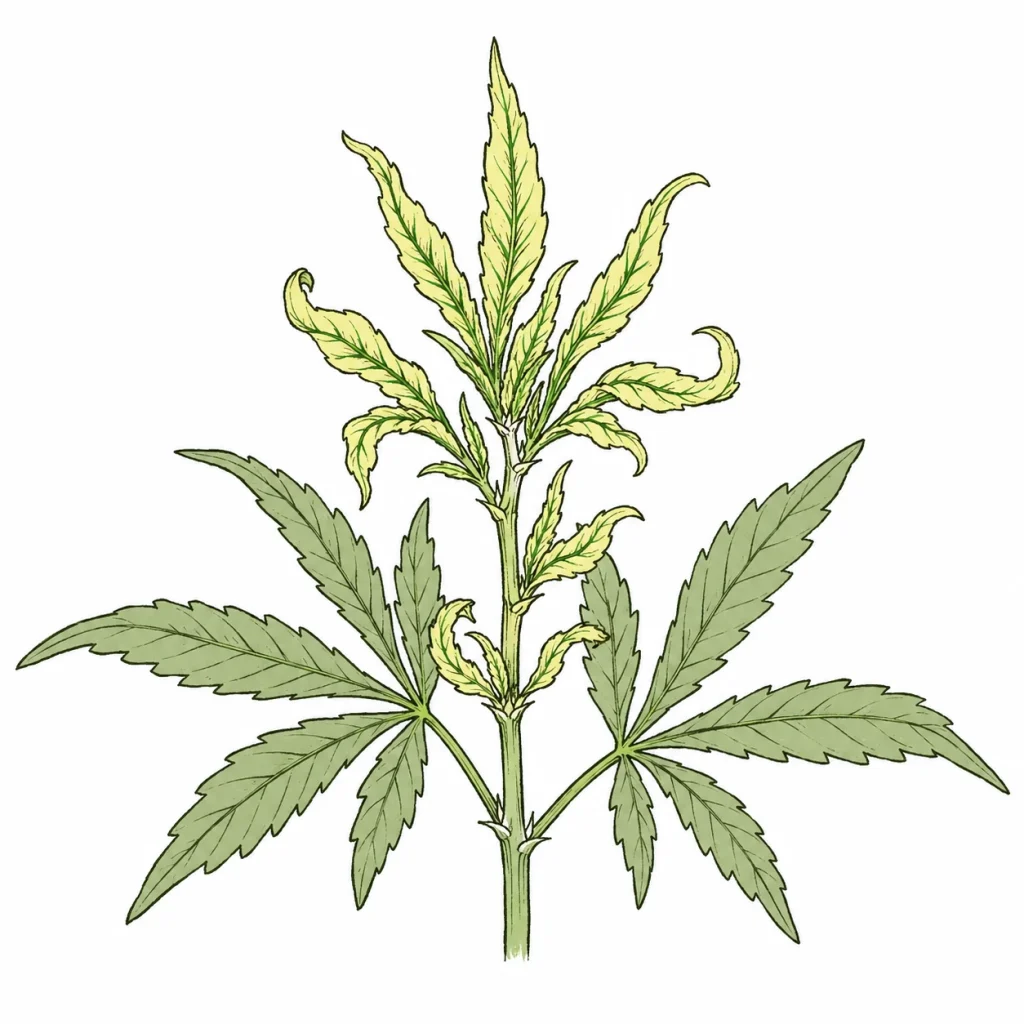
Zinc deficiency symptoms in cannabis are among the more common micronutrient problems. They mostly hit indoor growers, and many don’t realize at first what’s wrong with their plant. Small, twisted or misshapen new leaves, yellowing between the veins and growth that suddenly stalls are the classic warning signs. You should know them. The tricky part is that zinc is usually present in the soil, but the wrong pH can block uptake completely. In this article, you’ll learn how to reliably spot a zinc deficiency and track down the real cause. Then you’ll save your plant step by step.
What Is Zinc and Why Does Cannabis Need It?
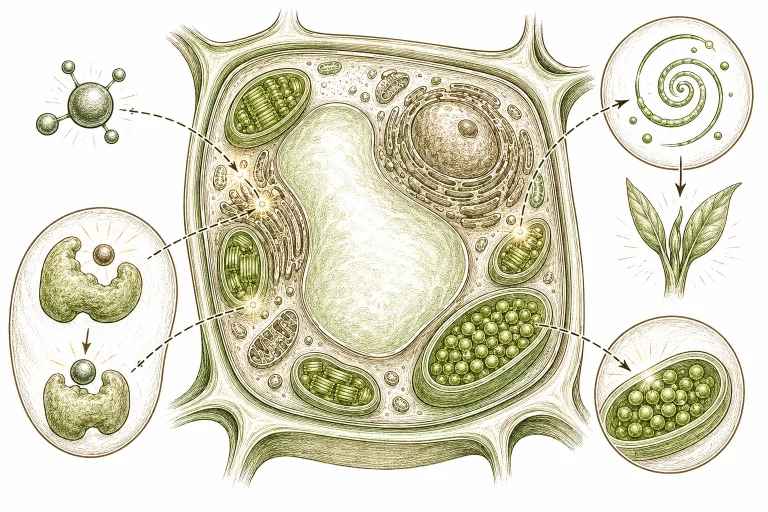
Zinc is an essential trace element. Cannabis only needs small amounts, but without zinc nothing works quite right. It helps activate more than 300 enzymes. These enzymes drive metabolic processes like protein synthesis, cell division and the production of chlorophyll. Zinc is especially important for making auxins, the plant’s growth hormones. They control how internodes stretch and how leaves grow.
Without enough zinc, new shoots can’t grow normally. The cells still divide, but they don’t expand enough. The result is the typical small, tightly stacked leaves that look almost like a rosette. At the same time, chlorophyll production drops off between the veins, while the veins themselves stay green. This pattern is called interveinal chlorosis, and it’s a key sign that sets zinc deficiency apart from other deficiencies.
That’s why a zinc deficiency follows a clear pattern. Zinc is an immobile nutrient. The plant can’t move it from older leaves to newer ones. In practice, that means symptoms always show up first on the youngest leaves and the growing tips. You won’t see them on the lower, older leaves. This detail helps you a lot when you need a quick diagnosis.
- Zinc activates more than 300 enzymes in the plant’s metabolism
- Essential for auxin production and therefore for normal leaf growth
- Important for chlorophyll production and cell division
- Immobile nutrient: symptoms show up first on new leaves
- Uptake can be blocked even when the soil has enough zinc
Zinc Deficiency Symptoms in Cannabis: How to Spot the Problem for Sure
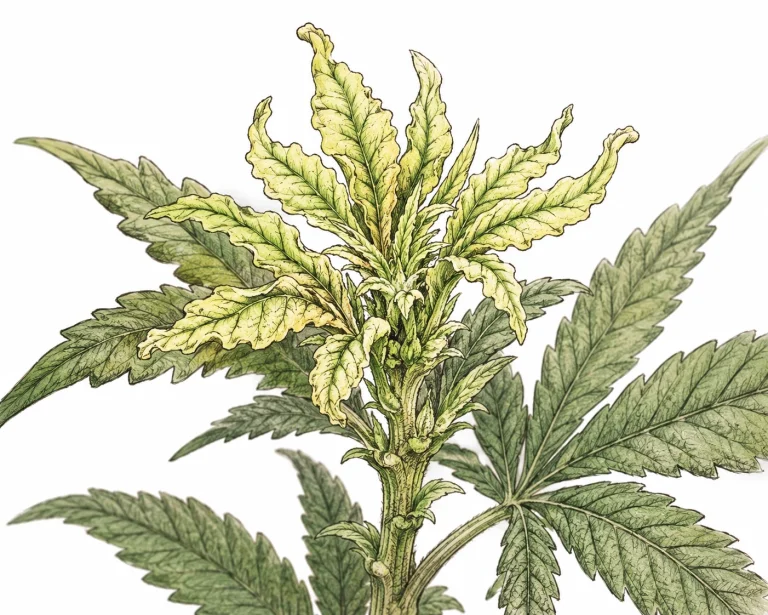
These symptoms are distinctive enough to tell them apart from other nutrient problems. You just need to know what to look for. The first sign is almost always that new leaves stay small. Healthy cannabis leaves unfold and stretch out quickly. With a zinc deficiency, they look folded, narrow or oddly undersized instead. The internodes, the gaps between leaf pairs, get shorter. The whole plant looks squat and compressed.
At the same time, interveinal chlorosis sets in: the leaf tissue between the veins turns yellowish to pale green. The veins themselves stay dark green. This web of green lines on a yellow background is easy to spot and a strong sign. In later stages, the leaf edges can turn brown and curl. Dried-out tips or wavy, twisted leaves can show up too.
Key for your diagnosis: always check the youngest leaves and the growing tips first. Do the symptoms start at the top while the older leaves lower down still look healthy? That strongly points to a deficiency of an immobile nutrient like zinc, iron or manganese. If you compare zinc deficiency with the similar-looking iron deficiency, one difference stands out. Iron deficiency causes a more even paling of the new leaves, while zinc deficiency comes with more deformation and stunted growth.
Zinc deficiency can show up at any stage, including flowering. In very severe cases, the whole growing tip can stall, or the main stem looks frozen in place. Hardly any new leaves form. When they do, they’re so small and deformed that you can barely tell they’re cannabis leaves. If zinc deficiency hits during the flowering stage, new calyx formation suffers. That can cut your overall yield noticeably.
- New leaves stay noticeably small and don’t unfold normally
- Interveinal chlorosis: yellow leaf tissue with veins that stay green
- Shorter internodes, the plant looks squat and stunted
- Leaf edges can turn brown, leaves curl or turn wavy
- Growth stalls or slows down a lot at the top
- Symptoms start at the top – on new leaves, not at the bottom
Causes: Why Does Zinc Deficiency Happen in Cannabis?
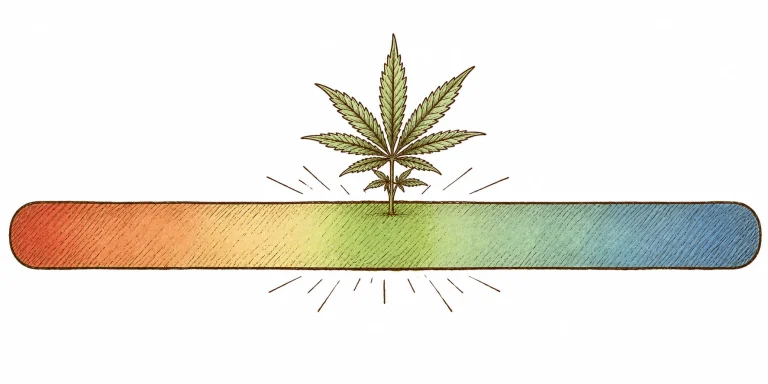
Zinc deficiency almost always comes down to one main cause. Your growing medium rarely runs out of zinc. Most of the time, the wrong pH is blocking uptake. Zinc is most available at a pH between 6.0 and 7.0 in soil (or 5.5–6.0 in hydroponics). Once the pH climbs above 7.0, zinc gets chemically bound in the medium. Your plant’s roots simply can’t reach it anymore, no matter how much you feed. This is by far the most common cause, so rule it out first.
For exact reference values on zinc and other trace element levels in soil, check the guide from the North Rhine-Westphalia Chamber of Agriculture (German). Its ratings carry over to cannabis growing media pretty well.
An overly alkaline medium often comes from too much lime or from hard, mineral-heavy tap water. Some soils also just have a high pH by nature. But a pH that’s too low, below 5.5, can cause trouble too. Your plant may take up zinc and other metals, but calcium or magnesium get locked out. The result is a messy mix of deficiencies. That’s why checking pH regularly isn’t optional – it’s a must. Learn more in our article on how to dial in pH for cannabis.
Besides pH problems, your medium can also run truly low on zinc. Typical reasons: reusing the same medium for many grows without amending it, or feeding only low-zinc organic nutrients. Very soft, mineral-poor source water can play a role too. Phosphorus toxicity can also block zinc, because phosphate and zinc compete in the root zone. So if you go heavy on PK boosters, you can trigger a zinc deficiency indirectly.
Cold stress matters as well: once roots drop below 59 °F (15 °C), nutrient uptake slows down across the board. Zinc uptake suffers too. Indoor growers who don’t heat their root zone in winter sometimes see what looks like a zinc deficiency. It often clears up on its own once root temperatures improve. Compacted or poorly aerated media make things worse, because the roots are already struggling.
Coco coir has an even narrower window than soil. Keep the pH between 5.5 and 6.3 to reliably prevent zinc deficiency in cannabis grown in coco. Coco fibers naturally bind calcium and magnesium, which makes the whole nutrient balance more sensitive. So in coco, also check your runoff pH at the bottom of the pot regularly – not just the pH of your freshly mixed nutrient solution. Over time, these two values can drift far apart without you noticing it in the nutrient solution itself.
- pH too high (above 7.0): most common cause – zinc gets chemically bound
- Hard, mineral-heavy tap water slowly pushes the pH up
- True zinc deficiency from a depleted medium or low-zinc nutrients
- Phosphorus toxicity antagonistically blocks zinc uptake
- A cold root zone below 59 °F (15 °C) reduces nutrient uptake in general
- Compacted media hinder root function and nutrient uptake
How to Tell Zinc Deficiency Apart from Similar Problems
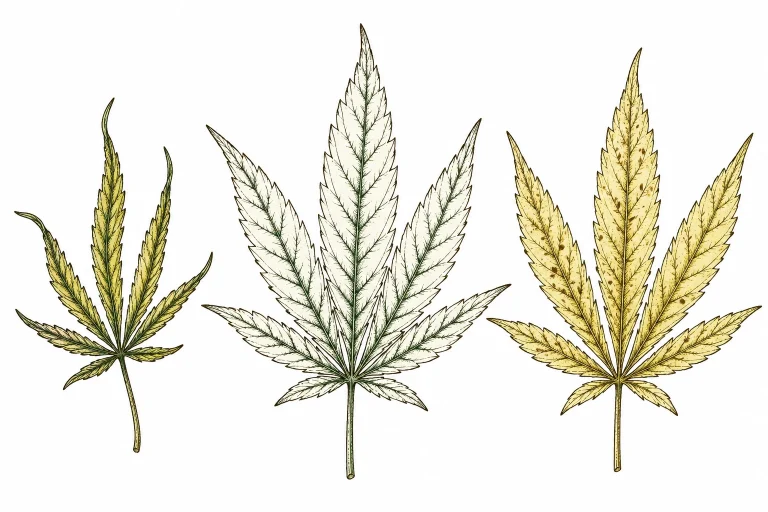
Since zinc deficiency looks a lot like other micronutrient deficiencies, it pays to know the key differences. The most common mix-up is iron deficiency: here too, young leaves turn yellow while the veins stay green. The difference is leaf shape. With iron deficiency, leaves usually keep their normal size and shape. Zinc deficiency, on the other hand, almost always comes with small, twisted and stunted leaves. Iron chlorosis also tends to be more even and paler.
Manganese deficiency looks similar as well: interveinal chlorosis on young leaves. But the yellow spots often look more irregular and blotchy, and the veins don’t outline them as clearly. Leaves with manganese deficiency usually keep their normal size, too. Stunted growth and deformed leaves are much more pronounced with zinc. For a detailed overview of all micronutrient deficiencies, check out our plant diagnosis overview on PlantClue.
You can also confuse it with heat stress or light burn at the growing tips. Those, however, come from outside factors. They usually show up evenly on the tops closest to the light. That happens when your plant sits too close to the lamp. With zinc deficiency, the deformation shows up evenly on all new leaves, no matter where they sit in relation to the light. To be safe, check your pH and feeding before you settle on a diagnosis.
One more thing to watch for: nutrient burn can look similar at first glance. Too much nutrient salt damages the roots and blocks uptake. With cannabis nutrient burn, though, you’ll usually also see burnt leaf tips on older and middle leaves. Pure zinc deficiency doesn’t show that sign.
Boron deficiency can also look a lot like zinc deficiency on the newest shoots. Both hit the growing tip first. The difference: with boron deficiency, the shoot tips often die off completely or keep growing brittle and twisted. With zinc deficiency, new leaves stay small and misshapen. But they keep growing and don’t turn brown.
- Iron deficiency: similar chlorosis, but leaves keep their normal size and shape
- Manganese deficiency: blotchier, more irregular pale spots, no growth deformities
- Heat stress: damage spread evenly close to the light, no leaf deformities
- Nutrient burn: the giveaway is extra brown leaf tips on older leaves
- Boron deficiency: shoot tips die off or grow brittle and twisted instead of just staying small and misshapen
- Key sign of zinc deficiency: small, misshapen leaves PLUS interveinal chlorosis
How to Fix Zinc Deficiency in Cannabis: Step by Step
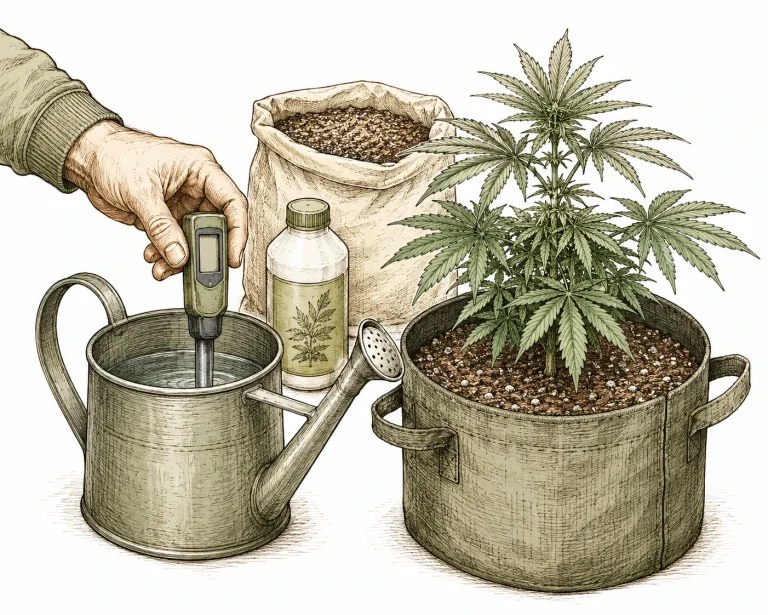
To fix zinc deficiency, your first and most important step is always correcting the pH. Measure the pH of your water and, if you can, of your growing medium. Is it above 7.0 in soil or above 6.0 in hydro? Then that’s very likely the cause. Bring your water pH down to the sweet spot of 6.0 to 6.5 for soil. Use a suitable pH down product based on citric acid or phosphoric acid. Just two or three waterings at the right pH can be enough to get zinc uptake going again. Our in-depth article on how to adjust pH for cannabis covers everything you need to know.
If your pH is already on point, a real lack of zinc in the medium is the likely cause. Zinc supplements can help here, either as zinc sulfate or as part of a complete micronutrient foliar spray. Foliar feeding means spraying a heavily diluted zinc solution directly onto the leaves. It works faster than feeding through the root zone. The plant takes up the nutrient straight through the leaves, so it doesn’t have to travel through the medium first. Keep concentrations very low and follow the manufacturer’s directions, since too much zinc can be toxic.
Keep an eye on your water, too: soft or distilled water can be low in minerals and contains hardly any zinc. In that case, a complete mineral nutrient with trace elements or a dedicated zinc supplement is worth it. If you use hard tap water, mix it with reverse osmosis (RO) water. Or make sure you correct the pH every time before you water. You’ll find more tips in our guide to watering cannabis the right way.
Replace compacted medium or improve drainage if it’s cramping the roots. Gently loosen the soil and mix in perlite. Or transplant into a bigger pot with fresh medium. Check your root zone temperature: for indoor grows in winter, a simple heat mat can work wonders. Once zinc can be taken up again, you’ll usually see improvement within five to ten days. Leaves that are already damaged won’t recover, though. Watch the shoot tips: when new leaves come in healthy and full-sized, the problem is solved.
- Step 1: Measure pH and correct it to 6.0–6.5 (soil)
- Step 2: Check your water – treat hard water with pH down
- Step 3: For quick relief, spray a zinc foliar feed directly onto the leaves
- Step 4: Feed the root zone with zinc-containing trace element products
- Step 5: Check the medium for compaction, loosen it or transplant if needed
- Step 6: Monitor root temperature – aim for at least 64 °F (18 °C)
- Watch new leaves as your indicator: healthy new growth = problem solved
How to Prevent Zinc Deficiency in Cannabis for the Long Run
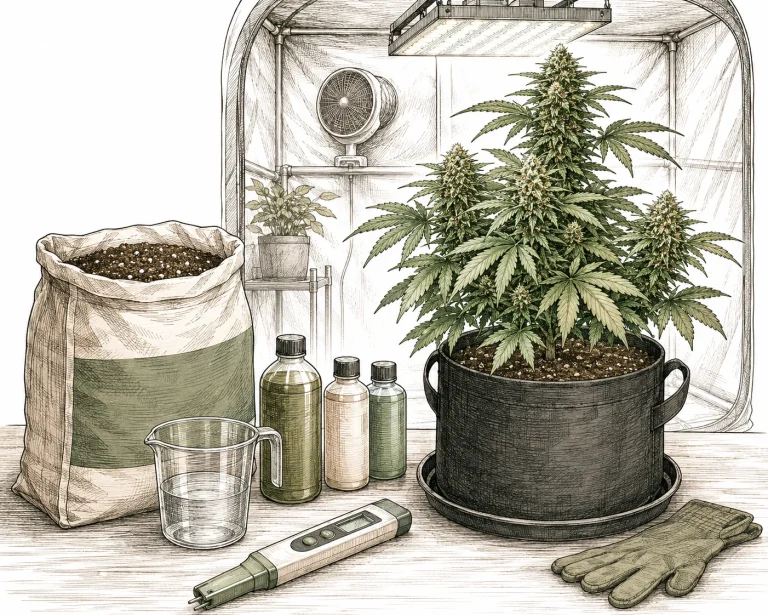
Your best protection against zinc deficiency is consistent pH management throughout the whole grow. Measure the pH of your water every time you water, and check the pH of your runoff or medium regularly. Small corrections early on are always easier than fighting a full-blown deficiency. If you water with properly adjusted water from day one, you’ll most likely never run into zinc deficiency at all. Our plant diagnosis overview helps you pin down problems early.
Preventing zinc deficiency starts with your growing medium. Use a high-quality mix with a balanced nutrient profile. As your grow goes on, add a complete micronutrient formula. It should contain zinc, iron, manganese and other trace elements. Many cheap base nutrients cover NPK but skimp on trace elements. On longer grows, that can easily lead to deficiencies. If you grow organic, use compost, worm castings or mycorrhizal inoculants. They improve micronutrient availability in your medium over the long run.
Avoiding phosphorus overfeeding also helps prevent zinc deficiency. Only use PK boosters at the recommended dose, and watch the growing tips for symptoms. A balanced feeding program always beats overdoing one single nutrient. You can learn more about dosing right in the article How to Spot and Fix Calcium Deficiency in Cannabis Fast. It covers many of the same basics.
Finally, a good medium structure helps. A loose, well-draining mix with perlite or coco coir supports strong root growth and nutrient uptake. Swap out your medium after every grow so you don’t end up with depleted soil. That gives you a solid foundation right from the start. Zinc and all other trace elements stay reliably available.
- Check your pH every time you water and keep it at 6.0–6.5
- Use a complete micronutrient formula with trace elements
- Avoid phosphorus overfeeding – don’t overdose PK boosters
- Use a high-quality, loose growing medium with good drainage
- Replace your medium after every grow to avoid nutrient depletion
- Mycorrhizal fungi and worm castings improve micronutrient availability over time
Copper deficiency also shows similar symptoms on young leaves and is easy to mix up with zinc deficiency.
Frequently Asked Questions
How fast does zinc deficiency show up in cannabis?
Zinc deficiency usually becomes visible within a few days once uptake is disrupted. The first signs are small, distorted shoots and early chlorosis on the youngest leaves. If a pH lockout is the cause, the deficiency can appear three to five days after your medium turns too acidic. If you act fast with a pH correction or a foliar spray, you’ll see the first improvement on new leaves. That takes about five to ten days.
Can leaves damaged by zinc deficiency recover?
No – once leaves are damaged, they won’t fully recover. Chlorotic and distorted leaves stay that way. The goal of treatment is healthy new growth. So keep an eye on the growing tips. If new leaves come in at normal size and green, you’ve fixed the problem. You can remove the old damaged leaves once healthy new ones have grown in.
Which pH best prevents zinc deficiency?
In soil, the ideal pH for good zinc availability is between 6.0 and 6.5. In hydro or coco, aim a little lower, at 5.5 to 6.0. Outside these ranges, especially above 7.0, zinc gets chemically locked up in the medium. Your roots can’t take it up anymore, even if there’s plenty of it. That’s why checking your pH often is the most important way to prevent it.
Is zinc deficiency toxic to the plant?
Zinc deficiency itself isn’t toxic. But it can seriously slow growth, and in severe cases it can bring growth to an almost complete stop. Zinc toxicity is more dangerous: too much zinc is toxic and damages the roots and the chloroplasts. So when you add zinc, the rule is always: less is more. Stick to the manufacturer’s recommended dose.
Can I fix zinc deficiency with regular potting soil?
Fresh, high-quality potting soil often holds enough trace elements for the first few weeks, but not for a long grow. If you transplant into fresh soil, a pH-related uptake block can clear up on its own. That only works if the new medium has the right pH, though. A targeted zinc boost from a micronutrient product or foliar spray works faster. It’s also more reliable than just hoping the new soil carries enough zinc.
You’ll find the right nutrients to correct the deficiency in our recommended gear.
Bottom Line
Cannabis zinc deficiency symptoms show up as small, twisted leaves with interveinal chlorosis at the growing tips. They’re easy to spot once you know what to look for. In most cases, there’s no real zinc shortage behind it, but a pH that’s off and blocks uptake. Correct your pH to 6.0 to 6.5 first. If needed, add a zinc-containing micronutrient foliar feed and make sure your growing medium is loose and well structured. With these steps, zinc deficiency usually clears up quickly and reliably. Consistent pH management helps you avoid it in the future.
