

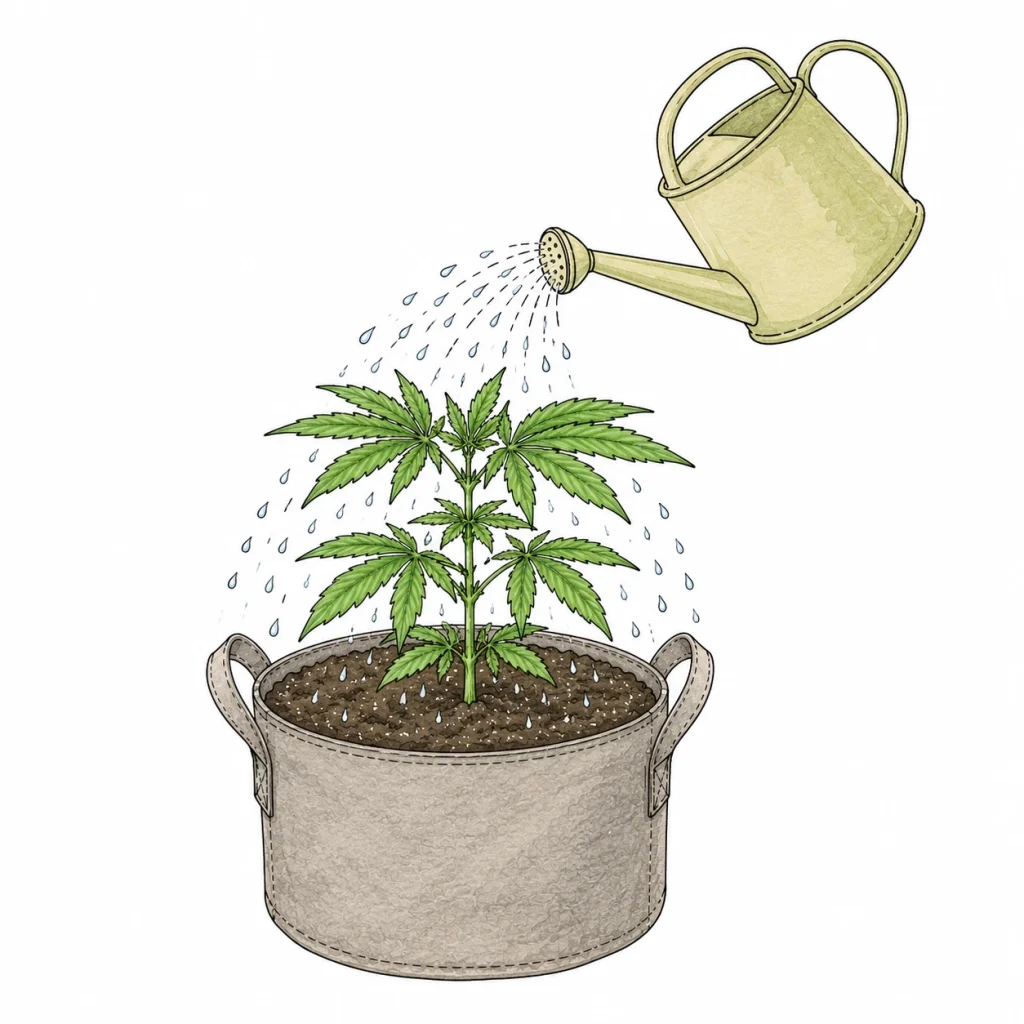
Watering cannabis the right way is one of the most important basics of growing — and at the same time one of the most common sources of mistakes. Beginners in particular underestimate how sensitively plants react to too much or too little water. That’s why this guide also answers the question most growers ask first: how often to water cannabis, and how to tell when your plant actually needs it.
Hemp is just as sensitive to watering as any other cannabis strain — the basic rules below apply no matter which term you use.
Watering too often can quickly lead to problems like root rot or nutrient issues, while too little water slows down growth. Once you understand the basics, you can avoid many typical problems right from the start.
Especially in indoor growing, proper watering is crucial, because you control every condition and mistakes can show up faster.
In this article, you’ll learn how to water cannabis plants correctly, how often you should water and what you really need to watch out for.
Signs of overwatering
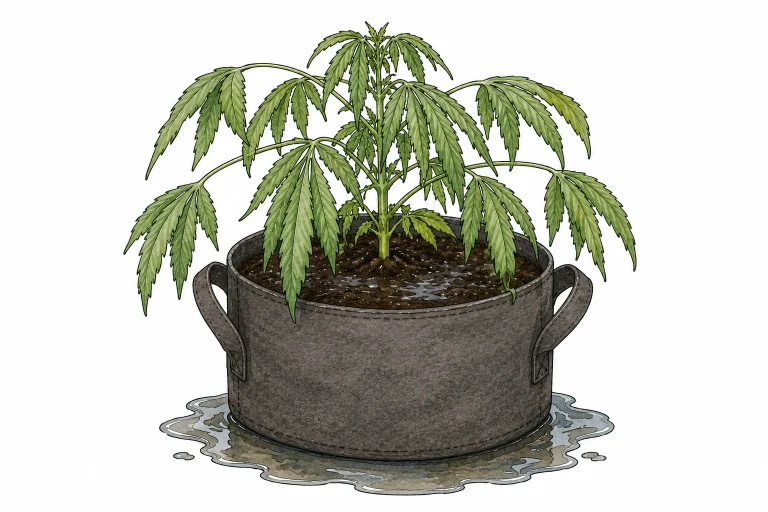
Too much water is one of the most common causes of problems when growing cannabis. If you want to water your cannabis correctly, you should know these signs: drooping leaves, slow growth and soil that stays wet all the time.
If you notice symptoms like these, adjust your watering habits right away. Similar signs can also appear with nutrient burn, since the two problems are often connected.
Signs of underwatering
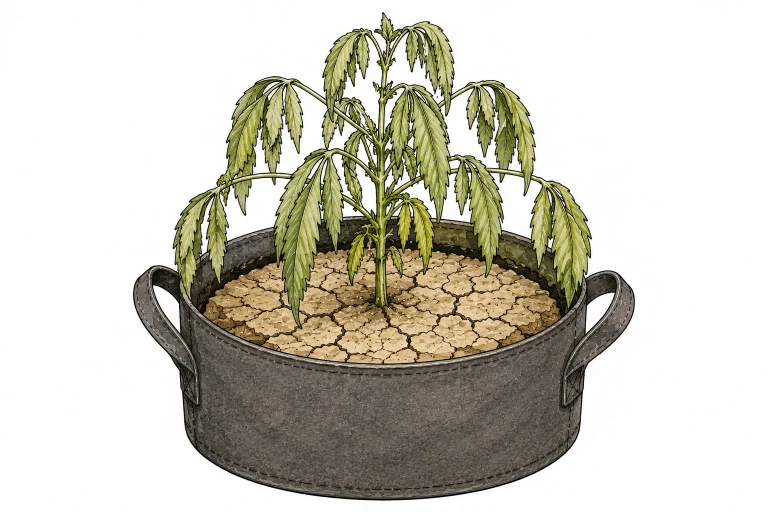
Too little water causes the plant to dry out and lose its turgor. The leaves look limp and often hang down without any strength.
Unlike with overwatering, the soil dries out quickly here and turns hard. Here too, learning how to water cannabis properly helps you avoid both extremes — in this case, increase the amount of water carefully.
How to water cannabis plants: step by step
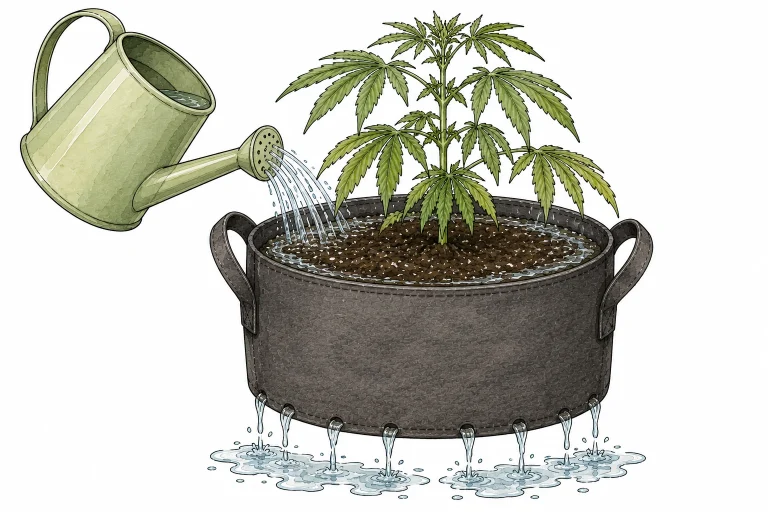
Watering cannabis correctly means watering the plant evenly and thoroughly. Make sure the water reaches the entire root zone and spreads evenly through the growing medium.
It’s better to water less often but thoroughly. Afterward, wait until the soil has dried out slightly before you water again. That way you make sure the roots get enough oxygen and don’t sit in water all the time.
The key point is the right balance: too much water pushes oxygen out of the soil, while too little water limits nutrient uptake. This balance decides whether your plant grows healthy or develops problems.
The Julius Kühn Institute (Germany’s federal research center for cultivated plants) also points out that proper watering should always be based on the condition of the soil, not on fixed schedules.
How often to water cannabis: watering schedule by growth stage
How often and how much you water depends heavily on which stage your plant is in right now. A one-size-fits-all schedule for the whole grow almost always leads to overwatering or underwatering.
- Seedling: Small roots, small water needs. Water only a little and keep the growing medium slightly moist without letting it get waterlogged.
- Vegetative stage: As leaf mass and the root system grow, water needs rise noticeably. Water more thoroughly, but let the top of the medium dry out again between waterings.
- Flowering stage: Water needs peak, then deliberately drop again in the last one to two weeks before harvest to prepare the plant for harvest.
Never rely on a fixed calendar alone — always check the condition of the growing medium and the weight of the pot as well.
Basic principles of proper watering
Watering cannabis correctly isn’t just about the right amount, it’s also about the basic principles of watering. What matters is that the soil gets evenly moist without becoming waterlogged.
One important rule: the water should always reach the entire root zone. If you only water the surface, the roots won’t develop properly and the plant stays more vulnerable to stress.
Good drainage is just as important. Excess water has to be able to drain away so the roots don’t sit in water all the time. Otherwise, the soil can quickly run short of oxygen, which noticeably hurts growth.
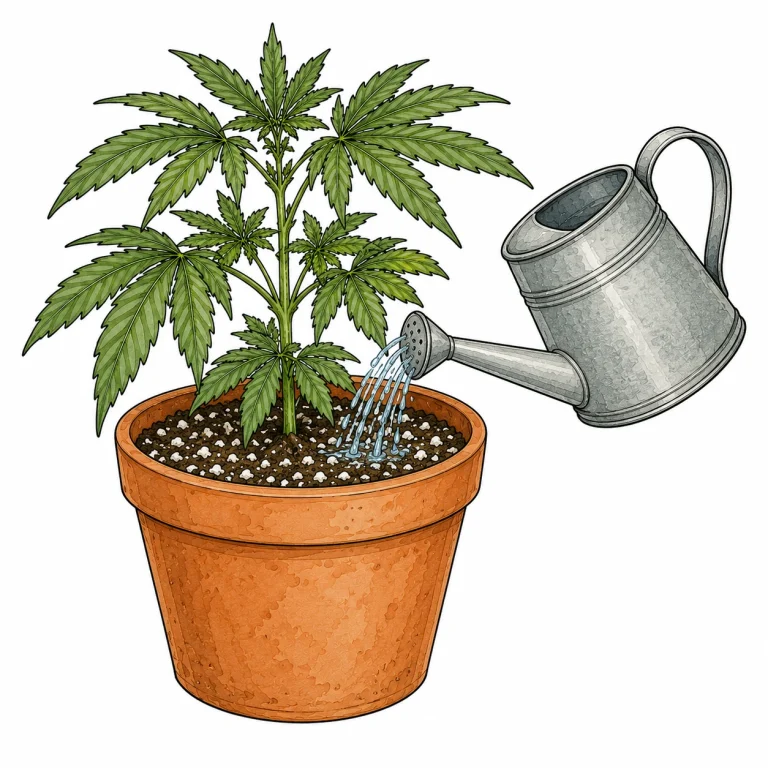
The LWG Bayern (Bavarian State Institute for Viticulture and Horticulture) also notes that even water distribution and controlled watering are crucial for healthy plants and stable yields.
How much water: rule of thumb and the weight method
As a rough rule of thumb, water about one third of the pot volume. In a 2.4-gallon (9 L) pot, that’s around 0.65 to 0.8 gal (2.5 to 3 L) per watering, until a little water drains out of the bottom of the pot.
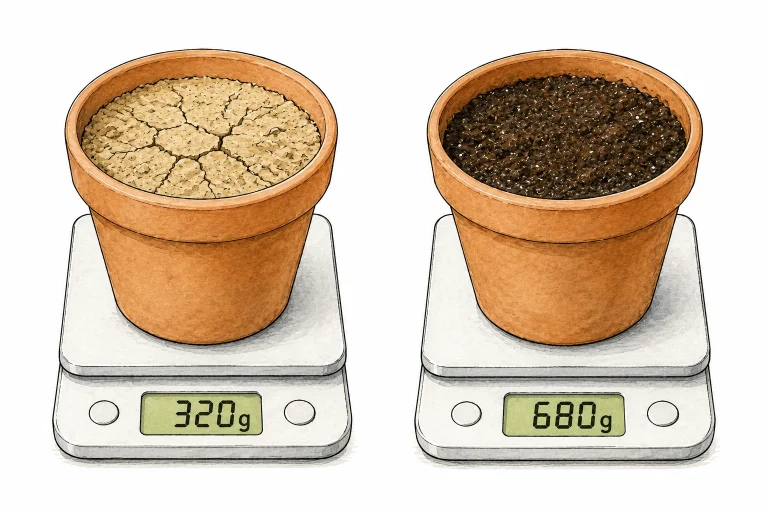
A simple, practical way to tell when it’s time to water is the weight method: lift the pot shortly after watering to learn how heavy it feels when the medium is fully soaked. Once the pot feels noticeably lighter, it’s time for the next watering.
If you want to calculate the right watering amount for your pot and growing medium exactly, use our Watering Calculator.
Common watering mistakes
Typical mistakes are watering too often, watering too little at a time, or watering irregularly. Ignoring the growing environment can cause problems too. If you want to learn how to water cannabis correctly, keep these mistakes in mind from the start.
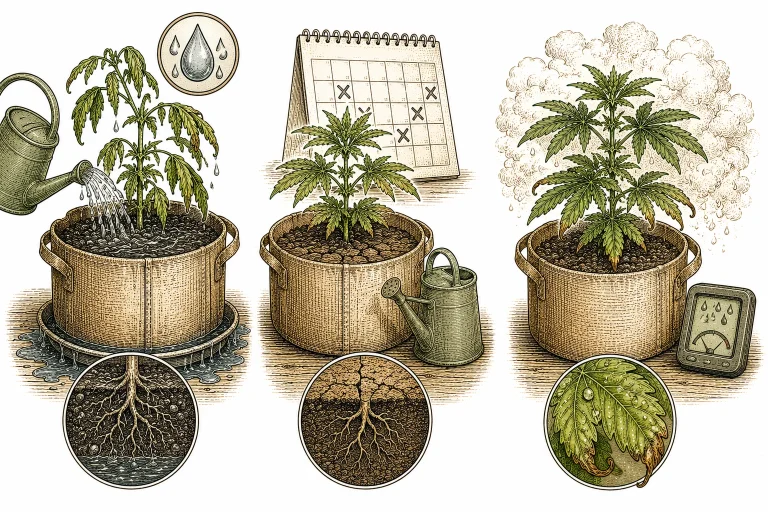
Especially in indoor growing, improper watering can quickly affect other areas of your grow. If you’re unsure, our guide to growing cannabis indoors also helps you get a better grip on the basics.
If you want to water cannabis correctly, make sure you avoid these mistakes so you grow healthy plants in the long run.
Irregular watering schedule: changing symptoms
If the plant keeps swinging between bone-dry and soaked growing medium, it won’t show a consistent picture: sometimes the leaves droop from thirst, sometimes from too much water, and brown spots and leaf edges that look like a calcium deficiency can show up as well. The reason: the plant takes up calcium with the flow of water, and that flow keeps breaking off during dry phases.
What helps is a steady schedule based on what the plant actually needs instead of the calendar: lift the pot, check the top 1 in (2–3 cm) of the growing medium and only water once the pot feels clearly lighter. That way, an even cycle of wet and dry-back phases settles in.
Watering systems: watering can vs. automatic solutions
With a watering can, you have full control over every single watering — with one or two plants, that’s usually the simplest and cheapest solution. Once you’re looking after several plants or are often away from home for a few days, though, automated systems are worth a look.
Drip irrigation
With drip irrigation, thin tubes with drippers deliver water straight to the root zone of each plant. Combined with a timer-controlled pump (see below), the system runs fully automatically and distributes the water more evenly than watering by hand — especially handy with several pots that have similar needs. Setting it up takes some time, but afterward you skip the daily watering.
Ollas (clay pots)
Ollas are unglazed clay pots that you bury in the growing medium and fill with water. Through the porous wall, the clay releases water slowly and only as needed into the soil — no electricity or tech required. That makes them the most popular solution for organic growing methods like living soil, where a moisture level that’s as constant as possible matters more than exact watering amounts.
Timer-controlled pumps
In larger setups with several plants or in hydro systems, a small submersible pump with a programmable timer takes over the watering at set times. The upside: absolute reliability, even while you’re on vacation. The downside: a pump failure often goes unnoticed for days — so check the system regularly, especially in the first week after setting it up.
Watering coco: different rules than soil
Coco coir behaves fundamentally differently from soil when it comes to watering — if you simply carry over your habits from soil grows, you can quickly run into nutrient lockout or root damage. The most important difference: coco is inert and holds hardly any nutrients, so you feed with every watering instead of giving plain water — growers call this “fertigation” rather than classic watering.
The rhythm is different, too. While soil should dry out a bit between waterings (dry-back), coco doesn’t handle that well: it does better with more frequent, smaller waterings so the medium never dries out completely. As a guideline, aim for runoff — the excess water that drains out of the bottom of the pot — of 10 to 20 percent per watering. This flushes out excess salts before they build up.
- Every watering = feeding (fertigation), plain water only in exceptional cases
- Small and often instead of large amounts with a dry phase in between
- Target runoff: 10–20% of the watering amount drains out the bottom
- Check the pH of the runoff regularly, not just the pH of your nutrient solution
- Plan for a Cal-Mag supplement — coco naturally binds calcium and magnesium (see our growing medium comparison)
Understanding watering and nutrients
How you water has a direct impact on nutrient uptake. That’s exactly why watering and feeding go hand in hand if you want to water cannabis correctly.
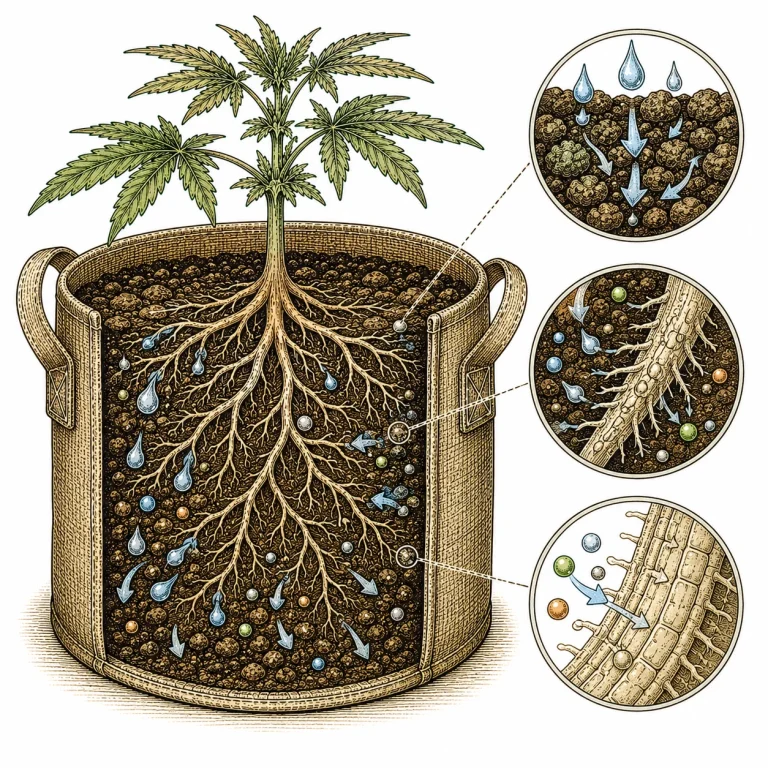
Other nutrient problems such as calcium deficiency in cannabis can get worse with improper watering. That’s why a balanced ratio of water and oxygen in the soil is crucial.
Another important factor is pH, because it determines how well the plant can take up nutrients. You can learn more in our article on pH for cannabis.
Nutrient burn can also cause similar symptoms and is often made worse by improper watering. You can find out more in our article on cannabis nutrient burn.
Frequently asked questions
How often should I water my cannabis plants?
If you want to water cannabis correctly, there’s no fixed number of days — just a simple test: only water again once the top layer of soil has dried out and the pot feels lighter than right after watering. Water less often but thoroughly, instead of giving small amounts frequently.
How can I tell if I’ve overwatered?
Typical signs of overwatering are drooping leaves, slow growth and soil that stays wet all the time. These symptoms often look like nutrient burn, since the two problems are frequently connected.
How can I tell if I’ve underwatered?
With underwatering, the leaves look limp and hang down without any strength, while the soil dries out quickly and turns hard. Unlike with overwatering, the soil doesn’t stay moist here.
What are the most common watering mistakes?
If you want to water cannabis correctly, you should know these mistakes above all: watering too often, watering too little at a time and watering irregularly without regard to the actual condition of the soil. Ignoring environmental conditions like temperature and humidity also leads to problems.
How are watering and nutrient uptake connected?
Too much water can wash nutrients out of the growing medium, while too little water makes uptake harder. The pH of your water also plays a direct role in how well the plant can actually take up the nutrients.
Is automatic watering worth it for cannabis?
With one or two plants, a watering can is usually all you need. Once you’re looking after several plants or are often away for a few days, drip irrigation or a timer-controlled pump save a lot of time and deliver more even results than watering by hand. Ollas are an electricity-free alternative that works especially well for organic growing methods.
Should I water cannabis in the morning or the evening?
It’s best to water cannabis in the morning, shortly before or after the lights come on. That way, the plant can take up the water throughout the day, and excess moisture evaporates before the dark period begins. If you water in the evening instead, the growing medium stays wet and cool longer overnight — which encourages mold and root rot, especially with poor air circulation. The exact time matters less, though: what counts is still the moisture test of the top layer of soil, not a fixed schedule.
Conclusion
Watering cannabis correctly is a basic skill every grower should master. You can avoid many problems if you pay attention to what your plants need.
With a little experience, you’ll quickly develop a feel for the right timing and the right amount. Once this routine becomes second nature, watering cannabis gets easier with every grow.
