

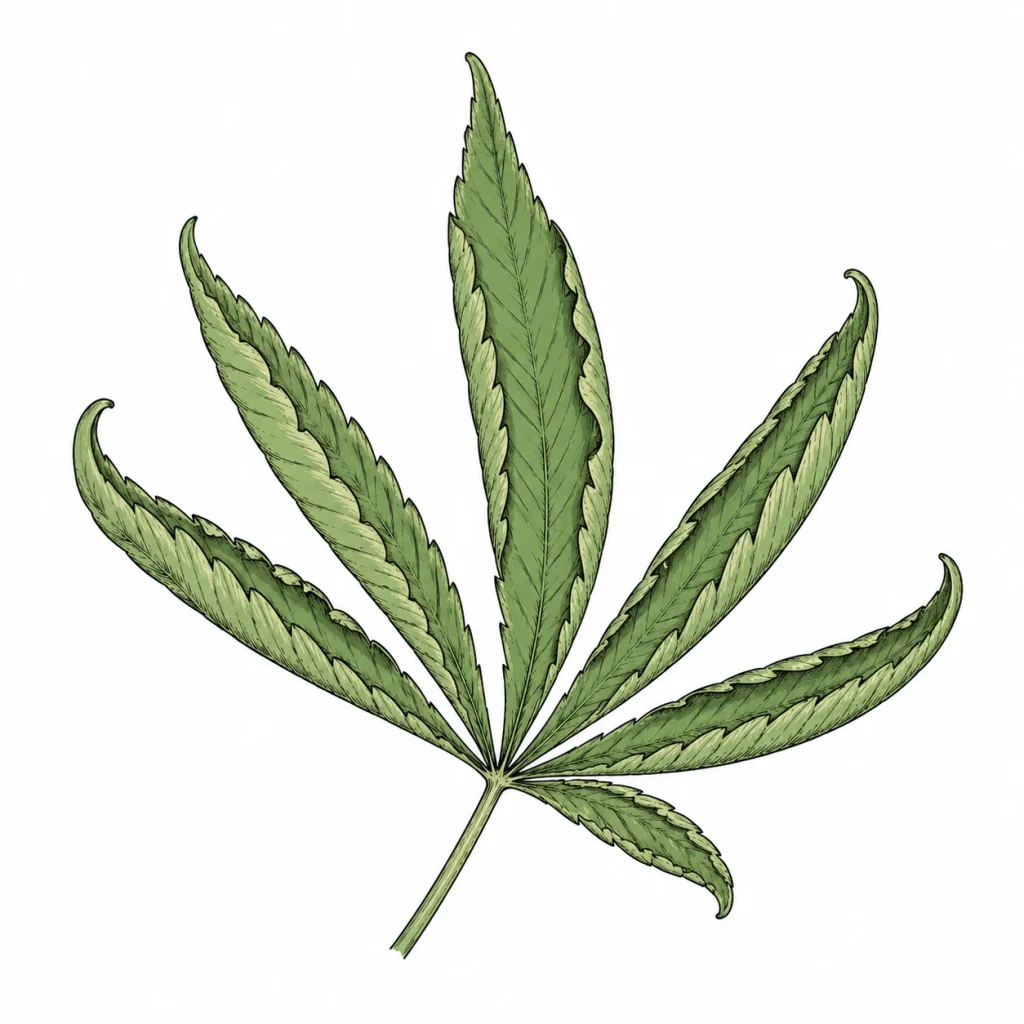
When you notice cannabis leaves curling up or down, it’s a clear warning sign from your plant: it’s telling you that something in its environment isn’t right. Leaf curling, also called “cupping,” can go in different directions, and that alone gives you a first clue to the cause. Whether it’s heat stress, nutrient burn, water stress or a pH that’s off: each problem leaves a characteristic pattern that you can learn to read. In this article, we at PlantClue explain all the common causes and show you step by step how to save your plant quickly and effectively.
Cannabis leaves curling: how to tell the curl directions apart
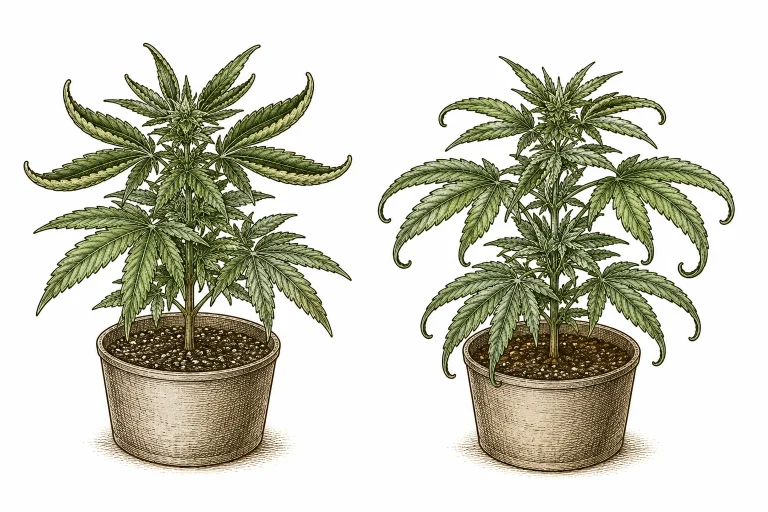
Before you start your diagnosis, it’s crucial to watch which direction your cannabis leaves are curling. The curl direction isn’t random; it’s a direct signal from the plant. There are three main patterns: leaf edges curling upward (cupping or tacoing), curling downward, and rolling lengthwise toward the midrib.
With the classic “taco leaf,” the leaf edges bend up and inward so the leaf looks like a taco shell. This pattern is most often linked to heat stress, too much light or severe underwatering. Curling downward, when the leaf edges bend toward the underside, tends to point to nutrient burn, especially nitrogen toxicity, or to root problems. Rolling lengthwise toward the midrib is often a sign of extreme heat stress or severe dehydration.
Another important factor is the position of the affected leaves. If mainly the upper, young leaves are curling, that points more strongly to environmental factors like heat or light. If the lower, older leaves are affected, nutrient problems or root stress may be the cause. Also note whether the leaf is discolored at the same time: combined symptoms give you the most precise clues.
- Leaf edges curl upward (tacoing): heat stress, too much light, underwatering
- Leaf edges curl downward: nutrient burn, nitrogen toxicity, root problems
- Lengthwise rolling toward the midrib: extreme heat, severe dehydration
- Upper leaves affected: environmental stress (light, temperature)
- Lower leaves affected: nutrient problems, root stress
Heat stress and too much light: the most common reason cannabis leaves curl
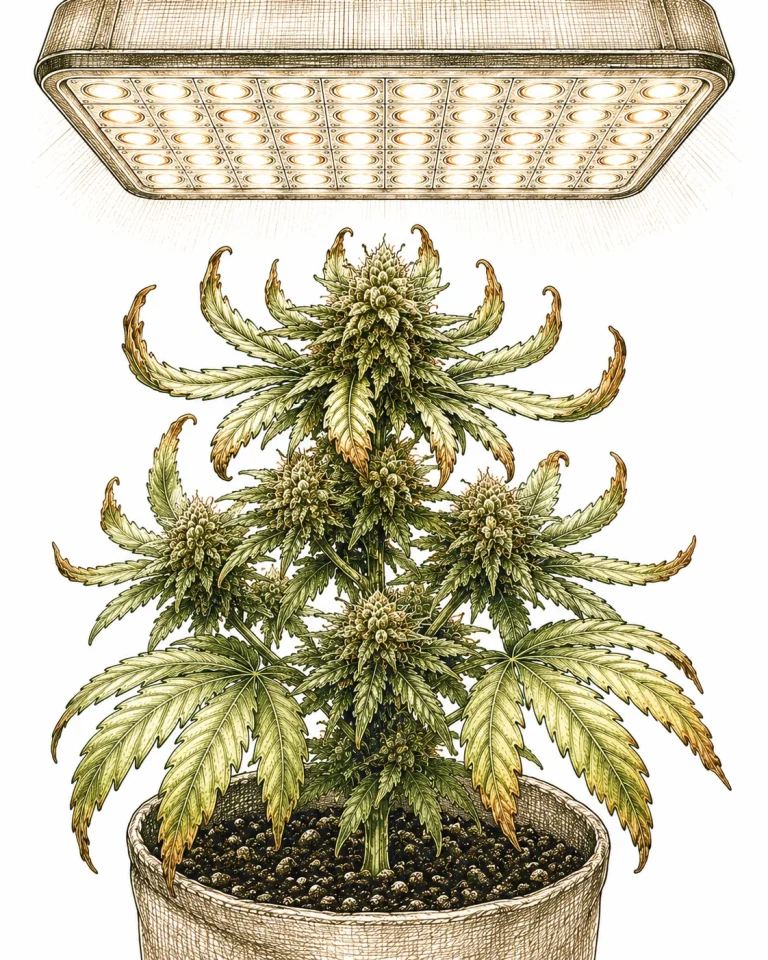
Heat stress is by far the most common cause of cannabis leaves curling, especially in indoor grows. Cannabis prefers temperatures between 68 and 82 °F (20 and 28 °C) in the vegetative stage and between 64 and 79 °F (18 and 26 °C) in flowering. If temperatures consistently go above the 82–86 °F (28–30 °C) mark, the plant starts curling its leaves upward to shrink the surface exposed to the light and reduce water loss through evaporation.
Closely related to this is too much light. If your lamp hangs too close to the plant or is too intense, the upper canopy leaves respond with the typical taco effect. Especially powerful LED lamps can cause light burn even at moderate temperatures, which first shows up as curling and later as bleached leaves. The easiest test: hold the back of your hand where the top of the plant is for 30 seconds. If it gets uncomfortably hot, the lamp is hanging too close.
To fix heat stress, first make sure there’s enough air circulation with a fan and check your exhaust. Hang the lamp higher, reduce the intensity or add extra cooling. For indoor setups, good climate control is the key to success. You’ll find more tips in our beginner’s guide to growing cannabis indoors.
- Optimal temperature: 68–82 °F (20–28 °C) in veg, 64–79 °F (18–26 °C) in flowering
- From 86 °F (30 °C): heat stress and leaf curling begin
- Check the lamp distance: back-of-hand test above the canopy
- Fix: fan, hang the lamp higher, reduce intensity
- Check the temperature at night too: a drop below 64 °F (18 °C) is also harmful
Water stress: too little or too much both make cannabis leaves curl
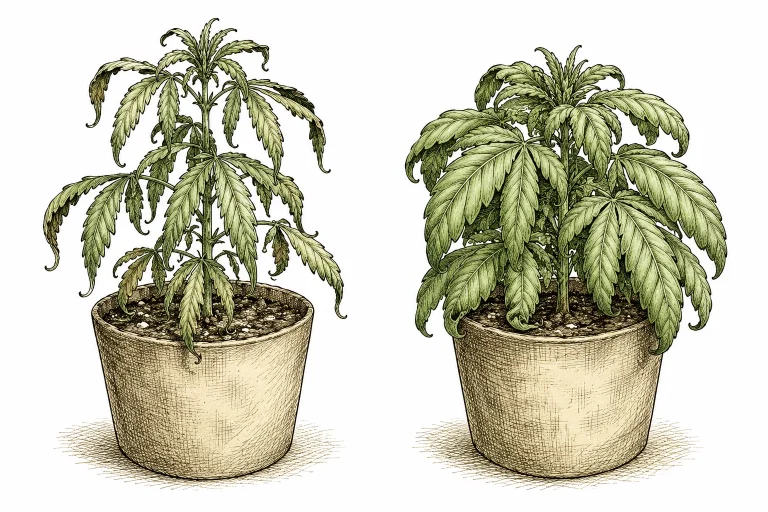
Water stress is another main cause of curled leaves on cannabis, and it can come from both too little and too much water. When underwatered, the plant loses turgor (the internal cell pressure) that keeps the leaves firm. The result is first a droopy, wilted look, along with leaves curling inward or upward. The soil feels bone-dry, and the pot is very light.
With overwatering, a common beginner mistake, the picture is paradoxically similar. The roots can no longer get oxygen when the growing medium is constantly too wet, and they start to rot. As a result, the plant can no longer move water efficiently, even though it’s literally standing in water. The leaves curl, look heavy and point downward. The pot feels very heavy, and the soil is constantly moist. You can read more about these typical signs in our guide on how to water cannabis the right way .
The easiest way to diagnose water stress is the pot lift test: a light pot points to dehydration, a heavy one to overwatering. You can also stick your finger about 1–1.5 in (3–4 cm) deep into the growing medium: if it feels dry, it’s time to water; if it still feels moist, wait another day or two. The right watering amount and the right timing are crucial for healthy, stress-free growth.
- Underwatering: light pot, leaves wilted and curled up/inward
- Overwatering: heavy pot, leaves heavy and drooping, curling downward
- Pot lift test as a quick diagnostic method
- Finger test: stick your finger 1–1.5 in (3–4 cm) into the soil
- Make sure there’s drainage: holes in the bottom of the pot are a must
- Root rot is possible as a result of constant overwatering
Nutrient problems and pH errors as a cause of curled cannabis leaves
You’ll find a complete overview of all deficiencies in our cannabis deficiency overview.
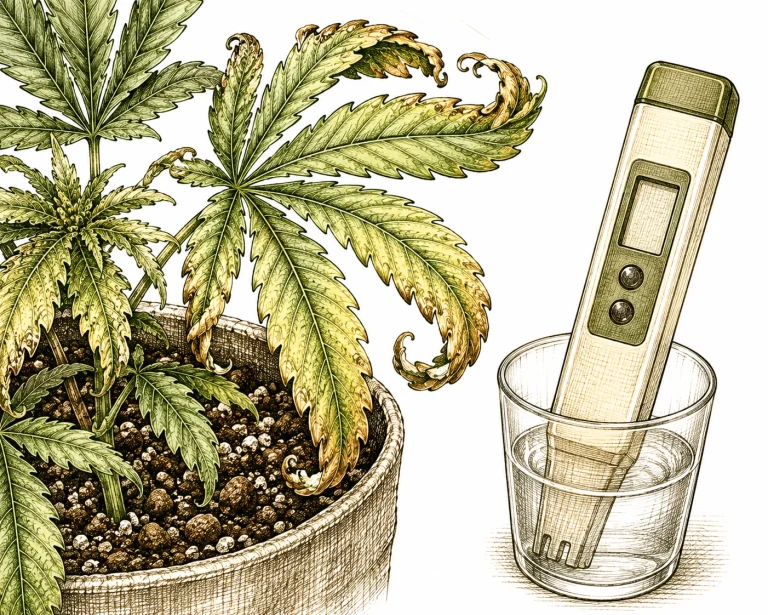
When cannabis leaves curl and also show discoloration like yellowing, brown spots or an unnatural dark green, nutrient problems are often the cause. Nitrogen toxicity, one of the most common forms of nutrient burn in cannabis, leads to deep green leaves that curl downward at the edges and develop what’s known as “claw leaves.” The plant can’t break down the excess nitrogen, and the leaves react to the toxicity with this characteristic curling pattern. You can learn more about this in our article on cannabis nutrient burn.
The wrong pH in the growing medium or water is one of the most frequently overlooked stress factors and can also make cannabis leaves curl. If the pH is outside the optimal range (6.0–7.0 in soil, 5.5–6.5 in hydro), nutrients can’t be taken up properly, even if they’re present in sufficient amounts. This is called nutrient lockout. The plant suffers from an apparent deficiency despite full feeding, and the leaves respond with stress, curling and discoloration. Setting the pH correctly is therefore one of the most important basics. You’ll find everything about it in our guide on pH for cannabis.
Potassium deficiency can also lead to curled leaves, especially in the flowering stage, when potassium demand rises sharply. The leaves then often show brown, burnt edges combined with upward curling. As a general rule: always measure the pH first before you start feeding or change your nutrient dose. The wrong pH makes every other measure ineffective.
- Nitrogen toxicity: dark green leaves, edges curl downward (claw leaves)
- pH errors (outside 6.0–7.0 in soil): nutrient lockout despite sufficient feeding
- Potassium deficiency: leaf edges brown and curled upward, especially in flowering
- Measure pH first, then assess the nutrient status
- Check the EC of your water and nutrient solution (ideally 400–1,000 ppm, or 0.8–2.0 mS/cm, depending on the stage)
- Flush with pH-adjusted water if there’s a nutrient excess
Humidity and root problems: underestimated reasons cannabis leaves curl
For more on the risks of waterlogged soil and root damage, see the LWG Bayern (Bavarian State Institute for Horticulture, in German).
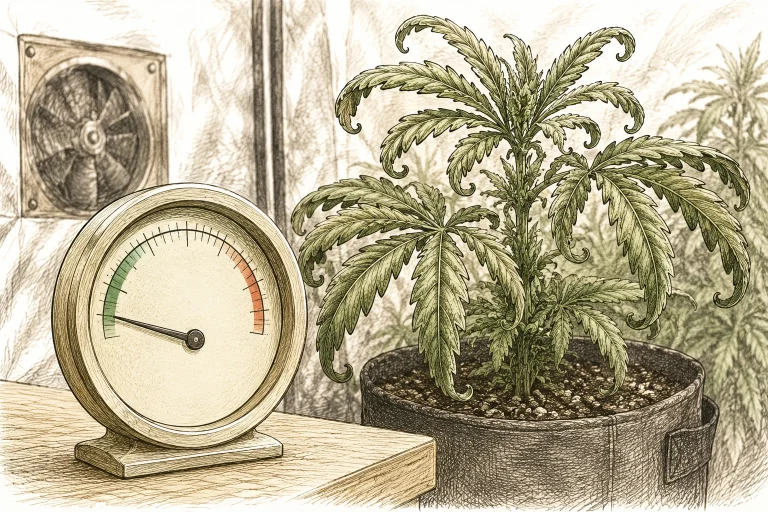
Humidity that’s too low is an often underestimated trigger when cannabis leaves curl. At a relative humidity below 30–35%, the plant partially closes its stomata (breathing pores) to save water, which means it can take in less carbon dioxide and also suffers more from heat. As a protective reaction, it curls its leaves to reduce the evaporation surface. Optimal levels are 40–70% RH in the vegetative stage and 40–50% in flowering. This can become a problem especially in winter, when heated indoor air dries out the rooms.
Root problems, whether from being root-bound, root rot or mechanical damage during transplanting, seriously impair the plant’s water supply and can also cause the leaves to curl as a result. A root-bound plant (pot too small, roots circling in the pot) can no longer take up water efficiently, even though the growing medium seems moist. The result looks like water stress, even though the pot is actually getting enough water. Transplanting into a bigger container is the fix in this case.
Wind stress from fan airflow that’s too direct or too strong can also put mechanical strain on the leaves and lead to permanent curling. Check whether the leaves are constantly moving a lot; that’s a sure sign of airflow that’s too direct. The fan should create gentle movement but not constantly bend the leaves. Aim the airflow at a wall or use an oscillating fan that distributes the air evenly.
- Optimal humidity: 40–70% RH (veg), 40–50% RH (flowering)
- Below 30% RH: protective reaction with curling leaves
- Root-bound (pot too small): water uptake limited despite watering
- Fix for root-bound plants: transplant into a container 20–30% larger
- Wind stress: fan aimed too directly at the plant
- Use a humidifier if the air is constantly too dry
Step-by-step diagnosis: cannabis leaves curling, what to do?
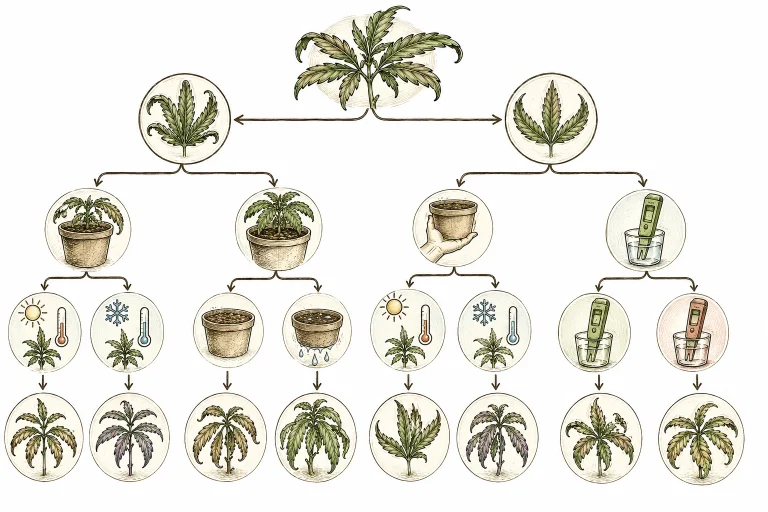
With a structured approach, you’ll usually find the cause of your cannabis leaves curling within a few minutes. Always start with the basics before jumping to more complicated causes. In 80% of cases, the problem lies with one of the basic factors: water, temperature, light or pH.
Step 1 – Watch the curl direction: if the leaves curl upward (taco), suspect heat stress, light or underwatering. If they curl downward, suspect nutrient burn or overwatering. Step 2 – Check the environment: measure the temperature right at the canopy. Above 82 °F (28 °C) is critical. Check the lamp distance. Step 3 – Determine the water status: lift the pot. Stick your finger 1–1.5 in (3–4 cm) deep into the soil. Too dry? Water right away. Too wet? Let it dry out and improve drainage. Step 4 – Measure the pH: measure the pH of your water and your runoff. Correct it if needed. Step 5 – Assess nutrients: is the foliage an unnatural dark green? Nutrient burn is likely. Is there discoloration? Check for a specific deficiency.
Always make only one change at a time and watch the result for 24–48 hours before taking the next step. Making many quick changes at once makes it impossible to identify the cause and can cause additional stress. Document your observations and actions; that helps you react faster on your next grow.
- Step 1: Determine the curl direction (up/down/toward the center)
- Step 2: Measure temperature and lamp distance
- Step 3: Pot lift test and finger test in the growing medium
- Step 4: Measure the pH of your water and runoff
- Step 5: Assess leaf color and nutrient status
- Only one change at a time: 24–48 h observation period
- Keep a log for future grows
Prevention: how to keep cannabis leaves from curling in the future
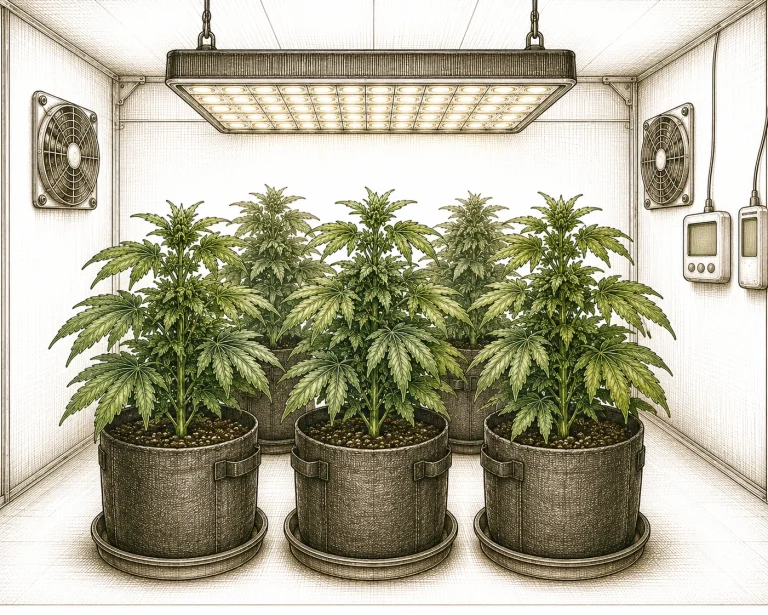
As always, prevention is better than treatment. If you have the basic growing conditions under control from the start, you’ll hardly ever run into curled leaves. Regular monitoring of your grow is essential. Invest in a good thermometer and hygrometer (ideally a digital combo unit with min/max memory) and place it at canopy height.
Keep a steady watering schedule and let the growing medium dry out slightly between waterings (lift test). Calibrate your pH meter regularly and measure the pH every time you water. Start with a moderate nutrient dose (50–75% of the recommended amount) and only increase it when needed; that way you avoid nutrient burn from the start. Make sure your pots have enough drainage holes and the plant isn’t root-bound.
For indoor growing, a carefully planned setup is the best insurance. Follow the manufacturer’s recommended lamp distances, use oscillating fans for even air circulation and make sure there’s enough fresh air coming in. You’ll find a comprehensive overview of other possible diagnoses and problems in the Plant Diagnosis overview on PlantClue, where you can quickly look up your plant’s symptoms.
- Place a thermometer and hygrometer at canopy height
- Check temperature and humidity daily
- Calibrate your pH meter regularly and measure every time you water
- Ramp up feeding slowly: start with 50–75% of the recommended dose
- Check pot size regularly and transplant in time
- Set fans to oscillate, never aim them directly at the plant
- Keep a watering log for optimal watering intervals
If you also see irregular spots instead of just curled leaves, read our article on spotted leaves.
Frequently asked questions
Why are my cannabis leaves curling upward like a taco shell?
The so-called “taco leaf,” or upward cupping, is almost always a sign of heat stress, too much light or underwatering. By curling, the plant reduces the leaf surface exposed to light and heat to minimize evaporation. First check the temperature at the canopy (optimal: max. 82 °F (28 °C)), the lamp distance and the moisture level of the growing medium.
My cannabis leaves are curling downward. What’s the cause?
Leaves curling downward often point to nutrient burn, especially nitrogen toxicity, or to overwatering. With nutrient burn, the leaves are often very dark green and turn into what’s known as claw leaves. With overwatering, the pot is constantly heavy and the growing medium wet. Reduce your nutrient dose and/or improve drainage.
Can curled cannabis leaves recover?
Yes, in most cases the leaves recover completely if you fix the cause in time. Mild to moderate stress symptoms often disappear within 24–72 hours after the fix. With very severe damage or if the leaves are already necrotic (dead), the affected leaf won’t regenerate, but new, healthy leaves will grow in.
Can the wrong pH make cannabis leaves curl?
Absolutely. A pH outside the optimal range (6.0–7.0 in soil, 5.5–6.5 in hydro) leads to nutrient lockout, where the plant can’t take up minerals despite sufficient feeding. This deficiency stress can show up as curled leaves, discoloration and slowed growth. That’s why you should always measure the pH first before taking action.
How fast do I need to react when cannabis leaves curl?
You should react as quickly as possible, ideally within 12–24 hours. Short-term stress (e.g., drying out once) usually causes only minor, reversible damage. Prolonged stress over several days, however, can permanently slow growth, reduce your harvest and make the plant more vulnerable to diseases and pests.
My seedlings’ leaves are curling. Is that normal?
Seedlings are especially sensitive and can react even to small stressors. Common causes in seedlings are lighting that’s too intense (lamp too close), humidity that’s too low (optimal: 60–70% RH for seedlings) or uneven watering. Check these factors first. A slight curve in the cotyledons can also be normal and isn’t necessarily a warning sign.
What does it mean when cannabis leaves curl inward?
When cannabis leaves curl inward, it usually means the same thing as the taco leaf described above: the leaf edges bend upward and toward the center of the leaf so the leaf takes on a bowl shape. The most common triggers are heat stress, lighting that’s too intense and wind stress from a fan that’s aimed too directly. Acute underwatering can also make leaves curl inward to reduce the evaporation surface. Check temperature, lamp distance and airflow first before you tinker with feeding or pH.
Conclusion
When your cannabis leaves curl, it’s always a stress signal, but no reason to panic, because with the right approach, you can almost always identify and fix the cause quickly. The curl direction gives you the first important clue: upward usually means heat stress or underwatering, downward more likely nutrient burn or overwatering. Always work systematically: check temperature, water and pH first before you adjust your nutrients. With regular monitoring and the right basics, you’ll hardly ever run into curled leaves in the future.
