

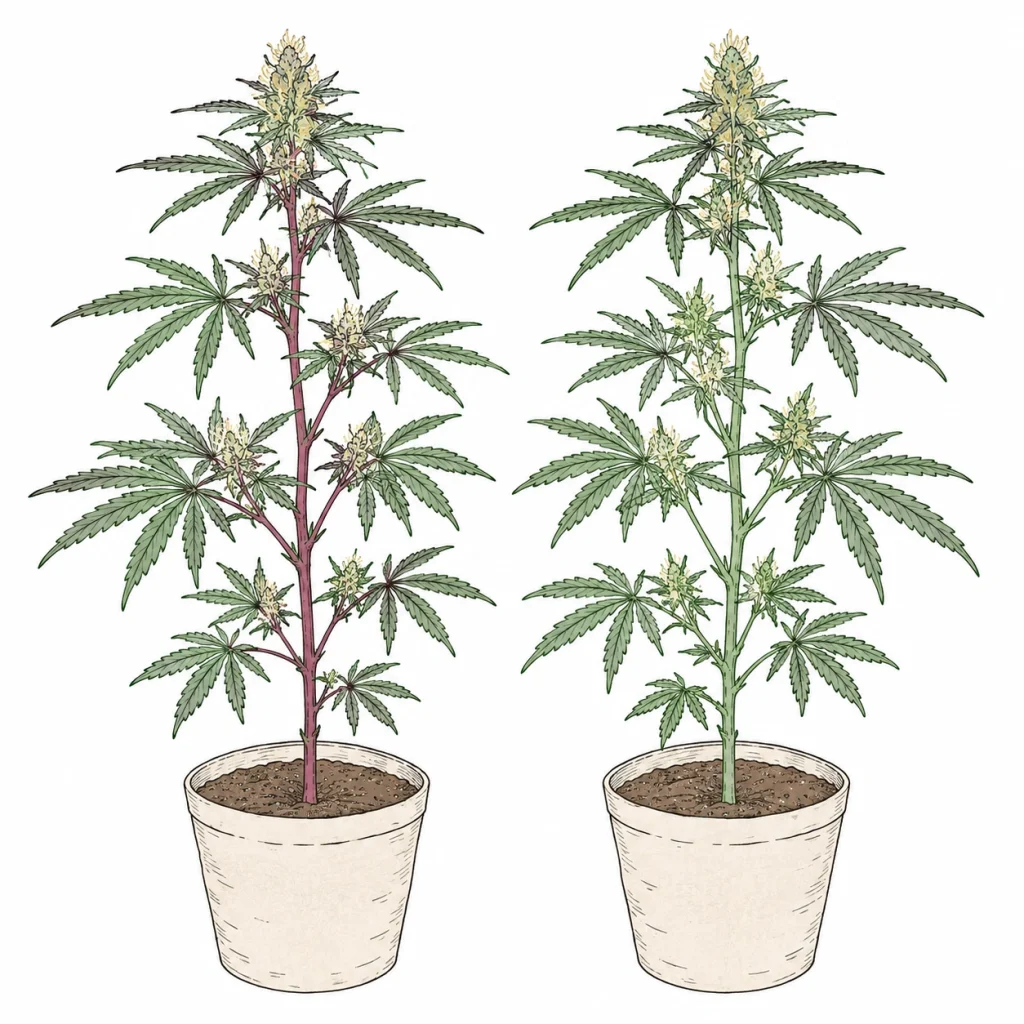
Red or purple stems on your cannabis plant look dramatic at first glance – but not every discoloration is a cause for alarm. Red stems on cannabis can be genetic, triggered by cold or a sign of a real nutrient deficiency. What matters is classifying the discoloration correctly before you step in. In this article, we at PlantClue explain step by step how to identify the cause and save your plant with targeted action. You’ll find all other diagnosis topics in the PlantClue plant diagnosis overview.
What do red stems on cannabis actually mean?
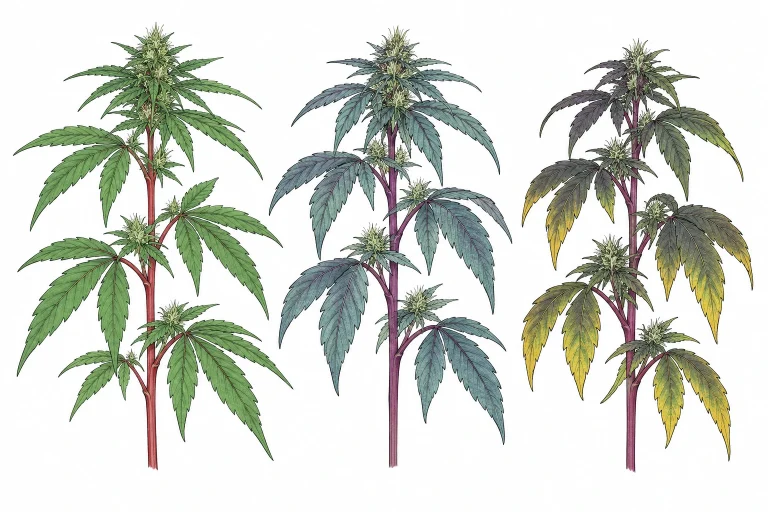
When cannabis stems turn red, purple or pink, one of three basic causes is always behind it: genetics, environmental stress or a nutrient problem. All three look similar, but they call for completely different responses from you as a grower. If you feed hastily or change the pH, you risk doing more harm than good.
Your first look should always go to the overall condition of the plant. If the leaves are healthy and dark green and show no spots or deformities, the discoloration of the stems is often harmless. If the leaves show additional symptoms such as discoloration, necrosis or poor growth, it’s time to act. Red stems alone aren’t a deficiency – they’re a signal you need to assess in context.
An important distinction: Anthocyanins are natural plant pigments that give some genetics red and purple stems without any outside influence at all. In other strains, however, the same look means real stress. Know your strain and compare it with how healthy plants of it normally look.
- Red stems can be caused by genetics, temperature or a deficiency
- Leaf health is the most important indicator of whether you really need to act
- Anthocyanins are harmless plant pigments in many strains
- Don’t take hasty action without assessing the context
Cause 1: Genetics – when red stems are normal
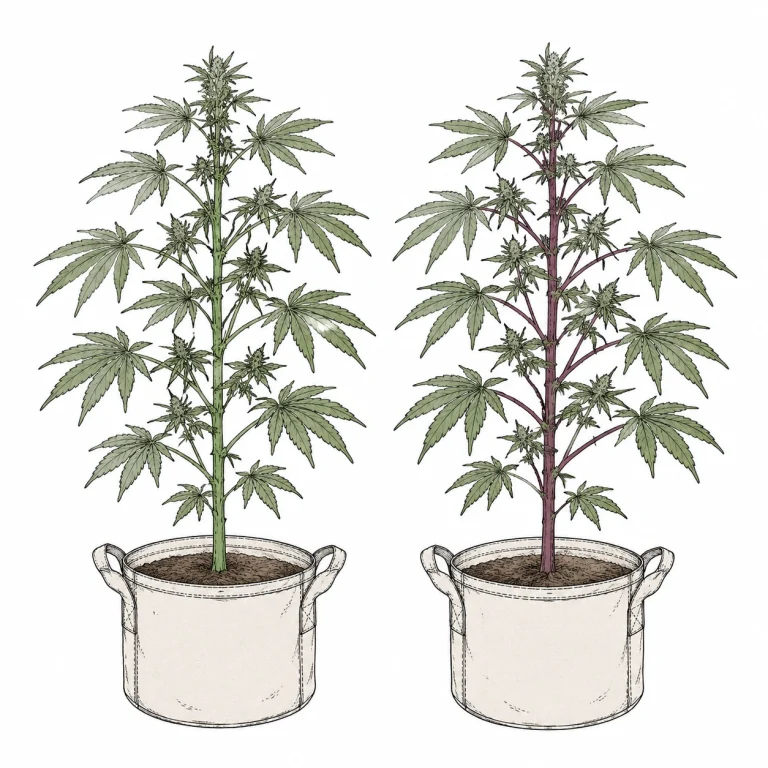
Many cannabis strains naturally produce anthocyanins, meaning purple and red color pigments. This is especially true of indica-dominant genetics, purple strains like Purple Kush or Black Domina, and many autoflowering strains. These plants show red or purple stems as early as the seedling stage, without any stress factor being present.
The telltale sign of genetic red stems is simple: otherwise, the plant looks perfectly healthy. The leaves are a vigorous green, growth is even and the discoloration is consistent across the whole plant. There are no spots, no dying leaf tissue and no stunted growth.
If you’re not sure about your strain, do some quick research on the typical phenotypes of your genetics. Many seed bank descriptions explicitly mention whether a strain tends to turn purple. In that case, there’s no need to act – just enjoy the colorful plant and keep watching.
- Indica and purple strains often turn red or purple due to genetics
- Healthy leaves and even growth = no need to act
- Consistent coloring across the whole plant is typical of genetics
- Researching your strain tells you what’s normal for it
Cause 2: Cold stress – red cannabis stems caused by low temperatures
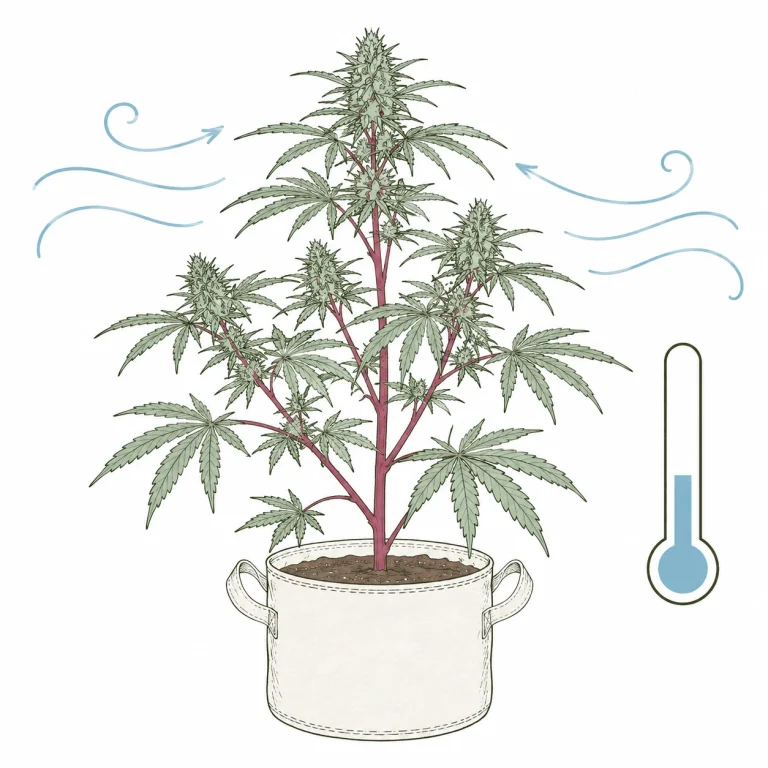
Temperatures below 59 °F (15 °C) are pure stress for cannabis plants. The plant reacts to the cold by producing more anthocyanins – the red and purple pigments act as a kind of cold protection for the plant tissue. This is an evolutionary mechanism cannabis brought with it from colder mountain regions.
What’s typical of temperature-related red stems is that the discoloration appears suddenly after temperatures have dropped – for example, after a cold night in an outdoor grow or when the heater in the grow room has failed. The plant often shows no other symptoms, except maybe slightly slower growth.
The fix couldn’t be simpler: make sure the temperature in your grow space stays steady between 68 and 82 °F (20 and 28 °C). When growing outdoors in spring or fall, frost cloth covers or bringing the plant inside at night can help. As soon as the temperatures are right again, the red stems usually go away on their own within a few days.
- Temperatures below 59 °F (15 °C) trigger anthocyanin production
- Discoloration that appears suddenly after a temperature drop is typical
- Optimal growing temperature: 68–82 °F (20–28 °C)
- When growing outdoors, use frost cloth covers or night protection
- The symptom usually goes away on its own once temperatures rise
Cause 3: Phosphorus deficiency as the cause of red stems on cannabis
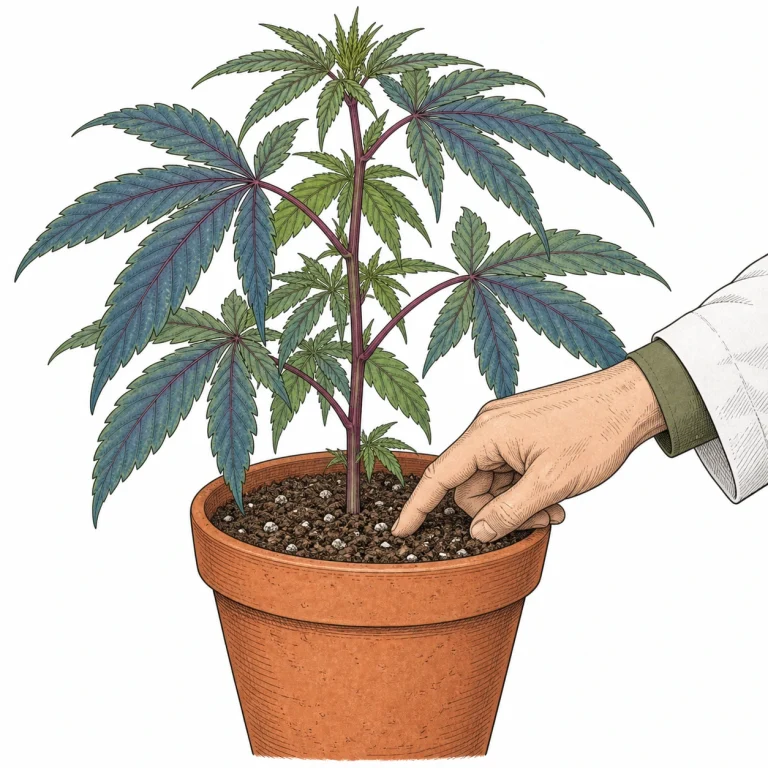
Phosphorus deficiency is the most serious cause of red stems on cannabis and calls for real action. Phosphorus is a macronutrient that’s essential for energy transport, root development and bud formation. If it’s lacking, the plant can no longer fully carry out important metabolic processes – and the stems turn red to purple.
The difference from genetic or cold-related discoloration lies in the accompanying symptoms. With phosphorus deficiency, the leaves often have a slightly bluish-green or grayish-green tint and sometimes look glossy or waxy. Older leaves may start to yellow or discolor. Growth slows noticeably, especially during the flowering stage, when the plant needs the most phosphorus.
The most common reason for phosphorus deficiency isn’t an actual lack in the growing medium but the wrong pH. At a pH below 6.0 in soil or below 5.5 in hydro, phosphorus becomes insoluble for the plant and the roots can’t take it up – so there’s enough phosphorus available, but the plant can’t get to it. You’ll find detailed instructions on adjusting the pH correctly in the article how to adjust the pH for cannabis correctly.
Check your pH first before you start using phosphorus nutrients. If the pH is right and you still suspect a deficiency, you can help out with a phosphorus-heavy bloom nutrient or use organic sources such as bone meal. Be sure to pay attention to the dose – nutrient burn happens quickly and does more damage than the original deficiency.
- Phosphorus deficiency: bluish-green leaves + red stems + slowed growth
- Most common cause: pH too low, phosphorus gets locked out
- Optimal pH for soil: 6.0–7.0; for hydro: 5.5–6.5
- Check the pH first, then add phosphorus nutrients
- Make sure there’s enough phosphorus, especially during the flowering stage
Other causes of red stems on cannabis
Besides the three main causes, there are other, less common triggers for red stems. Light intensity plays a role: when plants are exposed to very strong direct light, the stems can produce anthocyanins as a protective response. This happens especially with young seedlings under LEDs that are too strong or with outdoor plants in the blazing midday sun.
Root problems can also lead to red stems indirectly. When the roots are damaged by waterlogging, pests or pathogens, nutrient uptake in general can be limited – which then also affects phosphorus and other nutrients. In such cases, the plant is weakened overall and shows several symptoms at once. To learn how to improve your watering habits and avoid root problems, see the article how to water cannabis plants.
Another often overlooked factor is mechanical stress: when stems are bent, crushed or otherwise injured – for example during training such as LST (low stress training) or supercropping – the affected spots can turn red. This is a normal healing response and not a sign of a deficiency. This kind of discoloration is limited to the spot and goes away once the wound has healed.
- Light that’s too intense can trigger anthocyanin production
- Root problems from waterlogging limit nutrient uptake
- Mechanical stress from training (LST, supercropping) = localized reddening
- Localized, limited discoloration after training is harmless
How to diagnose the cause correctly, step by step
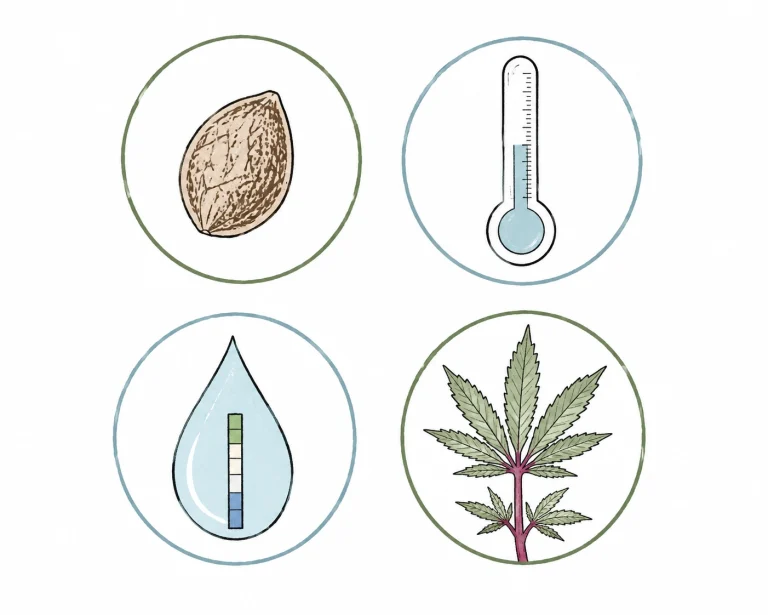
A systematic diagnosis saves you time and prevents the wrong treatment. Always go through the steps in the same order to avoid knee-jerk reactions. We recommend the following approach:
Step 1 – Check the genetics: know your strain. Does it tend to turn purple? If so, and the plant otherwise looks perfectly healthy, there’s nothing to do. Step 2 – Measure the temperature: grab a thermometer and check the temperatures in your grow room, especially at night. Below 59 °F (15 °C)? Then you’ve found your culprit. Step 3 – Test the pH: measure the pH of your irrigation water and of the water draining from the growing medium (runoff). Is it outside the optimal range? Correct the pH first before taking any other steps. Step 4 – Examine the leaves closely: do the leaves show discoloration, spots or a bluish-green tint? Then you’re most likely dealing with a real phosphorus deficiency.
If you’ve gone through all these steps and still haven’t found a clear cause, take a close look at your plant’s other symptoms. Yellow leaves combined with red stems can point to several deficiencies at once. You’ll find a comprehensive overview of all common nutrient deficiencies in the article Identifying cannabis deficiencies: when your cannabis has yellow leaves.
- Step 1: Research your strain’s genetics
- Step 2: Measure temperatures, especially at night
- Step 3: Check the pH of your irrigation water and runoff
- Step 4: Examine the leaves for accompanying symptoms
- Only take targeted action once the diagnosis is complete
Fixing red stems on cannabis: the right steps
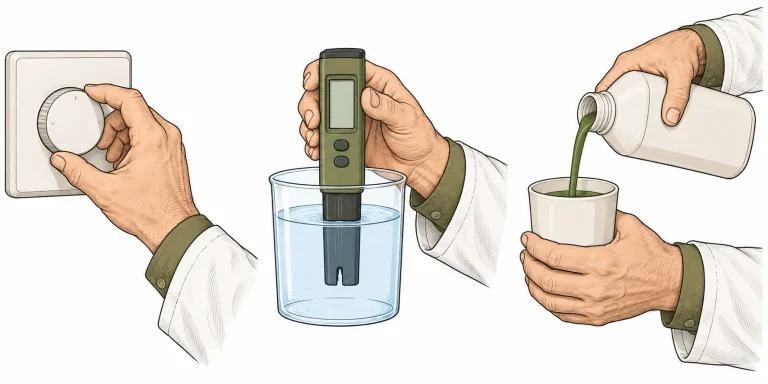
You don’t treat genetic discoloration at all – watching is the only step you need. Keep the general growing conditions stable and enjoy your plant’s colorful look. Some growers also value purple strains for their higher anthocyanin content, which comes with potential antioxidant properties.
With temperature-related red stems, warmth is the fix. Make sure the night temperature doesn’t drop below 64 °F (18 °C). In an indoor grow, you can use a heat mat, a terrarium heater or better insulation for your grow tent. When growing outdoors, frost cloth, mini greenhouses or bringing the plants inside in the evening will help. As soon as temperatures are consistently in the target range, the plant’s appearance improves quickly.
With a real phosphorus deficiency, here’s how to proceed: first correct the pH to 6.2–6.8 (soil) or 5.8–6.2 (hydro). Then wait 24 to 48 hours and watch the plant. If things improve, the pH was the problem. If not, add a phosphorus-heavy bloom nutrient at half strength and increase slowly if needed. Also do a short flush with pH-adjusted water to dissolve any nutrient salt buildup.
Document every step and its effect. Cannabis problems rarely resolve overnight – give each step at least three to five days before you adjust the next variable. Patience is just as important here as the right diagnosis.
- Genetics: do nothing, just watch
- Cold: raise the night temperature to at least 64 °F (18 °C)
- Phosphorus deficiency: correct the pH first, then adjust nutrients
- Consider flushing if nutrient salts have built up
- Give each step 3–5 days to work before the next one
Red stems during the flowering stage: what to keep in mind
Red stems during the flowering stage are more common and can be more serious than in the vegetative stage. A cannabis plant’s need for phosphorus rises sharply during flowering, because phosphorus is directly needed to build the bud structures. A phosphorus deficiency during flowering doesn’t just slow growth – it can also significantly reduce the yield and quality of your harvest.
Many growers who switch to calcium-heavy or nitrogen-heavy nutrients during flowering forget about phosphorus. Make sure your bloom nutrient contains enough phosphorus, and check the pH regularly, since it can shift due to the heavy nutrient uptake during flowering. Calcium deficiency can occur at the same time and make the diagnosis harder – you’ll find a separate article on it at how to identify and fix calcium deficiency in cannabis.
In the last few weeks before harvest, however, a slight red tint on the stems is completely normal and no cause for alarm. The plant has almost completed its natural life cycle and starts moving nutrients from the vegetative tissue into the buds. This is called senescence – a natural process that can look like a deficiency but isn’t one.
- Phosphorus needs are much higher during flowering than in the vegetative stage
- Your bloom nutrient must contain enough phosphorus
- Check the pH regularly during flowering
- Slight reddening shortly before harvest is normal (senescence)
- Calcium deficiency can occur at the same time and make diagnosis harder
Frequently asked questions
Are red stems on cannabis always a sign of phosphorus deficiency?
No. Red stems can be genetic, caused by cold stress or a sign of phosphorus deficiency. Only when accompanying symptoms such as bluish-green leaves, slowed growth and a confirmed pH problem are present is phosphorus deficiency likely.
At what temperature do cannabis stems turn red from the cold?
Temperatures below 59 °F (15 °C) often trigger anthocyanin production, which causes red and purple stems. Keep the growing temperature steady between 68 and 82 °F (20 and 28 °C) to avoid cold-related stress.
How quickly do red stems go away after treatment?
Stems that are already colored won’t turn green again. But new stems should look normal again within 5 to 10 days after successful treatment. If the old red stems remain the only affected spots and no new ones appear, the treatment is working.
Can red stems affect my plant’s yield?
That depends on the cause. Red coloring from genetics or cold hardly affects yield. A real phosphorus deficiency during the flowering stage, on the other hand, can significantly reduce the yield and quality of the buds and should be fixed quickly.
My seedling has red stems – is that normal?
Red stems are common in seedlings and are often genetic or caused by mild light or temperature stress. As long as the cotyledons and the first true leaves are healthy and green, there’s usually no need to act. Keep an eye on the plant and only step in if other symptoms appear.
What’s the difference between red and purple stems on cannabis?
Red and purple stems have the same cause: anthocyanin pigments. The shade varies depending on the amount of anthocyanins produced and the specific genetics of the plant. Both colors can be caused by genetics, cold or phosphorus deficiency and are diagnosed using the same criteria.
Conclusion
Red stems on cannabis always have a cause – and most of them are no reason to panic. With the right diagnostic order, you’ll quickly find out whether it’s genetics, cold or a real phosphorus deficiency. Always check temperature and pH first before reaching for nutrients, because the wrong intervention does more harm than good. With patience, systematic observation and the right steps, you’ll get your plant back in top shape.
