

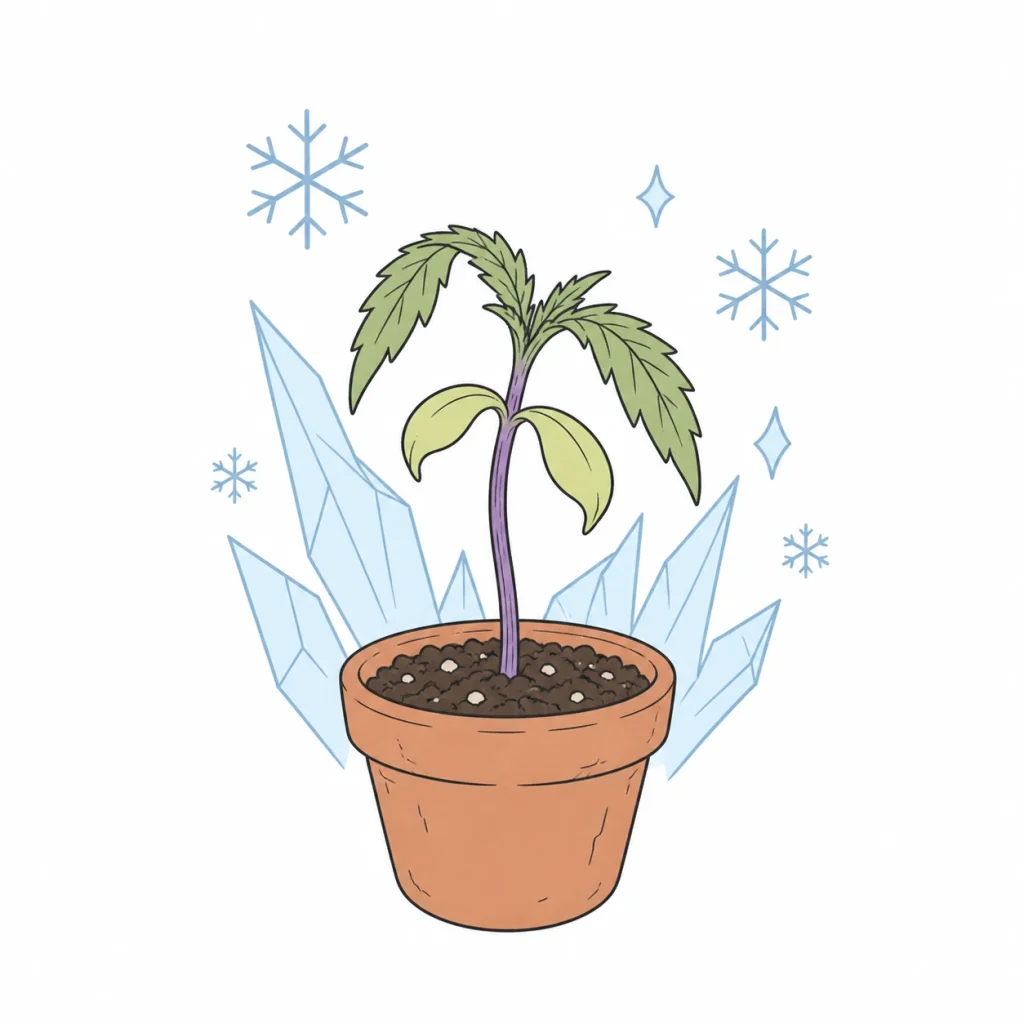
Knowing how to spot cannabis cold stress is a key basic skill for every grower — because low temperatures are among the most common and, at the same time, most underestimated stress factors in growing. Whether in an indoor grow room, an outdoor bed or a greenhouse: as soon as temperatures drop below about 59 °F (15 °C), cannabis reacts with clearly visible symptoms that call for quick action. Purple or red discoloration, drooping leaves, slowed growth and nutrient lockout are typical warning signs you should know. In this article, you’ll learn how to reliably recognize cold stress, what causes it and what you can do right away to save your plant.
Spotting cannabis cold stress: the key symptoms at a glance
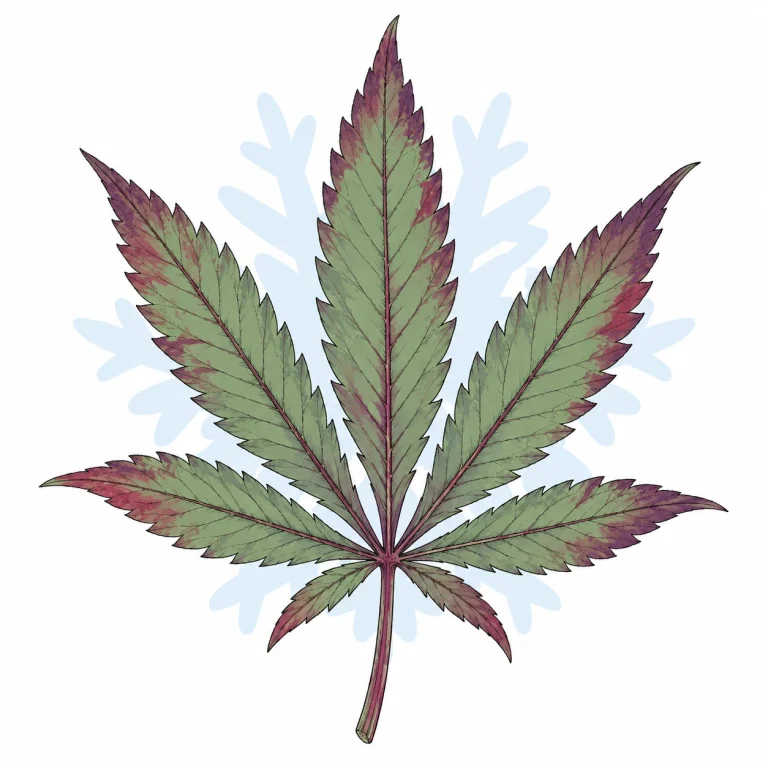
Cannabis is a fairly hardy plant, but temperatures below 59 °F (15 °C) take a real toll on it. The first and most noticeable symptom of cold stress is purple or red discoloration of the leaves and stems. This happens because the plant’s metabolism slows down in the cold and it produces more of certain anthocyanins — natural plant pigments. Not every purple discoloration automatically means cold stress, since some strains turn purple because of their genetics, but combined with other symptoms, it’s a clear warning sign.
Another clear sign is so-called drooping — the leaves hang down limply, similar to overwatering. The difference is that with cold stress, the leaves also look wilted and lifeless, while with overwatering they still look plump. Growth also slows down noticeably or stops completely. New shoots barely develop, and the plant seems sluggish and unresponsive overall. In advanced cases, brown or necrotic spots form on the leaf edges, which can be mistaken for a nutrient deficiency.
Good to know: cold stress directly affects nutrient uptake. At low temperatures, the roots can barely take up calcium, magnesium and phosphorus, which triggers secondary deficiency symptoms. So if you suddenly notice signs of calcium deficiency in cannabis or phosphorus deficiency, always check the room temperature too before you correct with extra nutrients.
- Purple, red or violet discoloration on leaves, stems and shoots
- Limp, drooping leaves without obvious overwatering
- Slowed or completely stalled growth
- Brown discoloration or necrotic spots on leaf edges
- Secondary nutrient deficiency symptoms despite correct feeding
- Shiny or leathery-looking leaf surface
- Twisted or curled leaves in extreme cold
Causes of cannabis cold stress: when is it too cold?
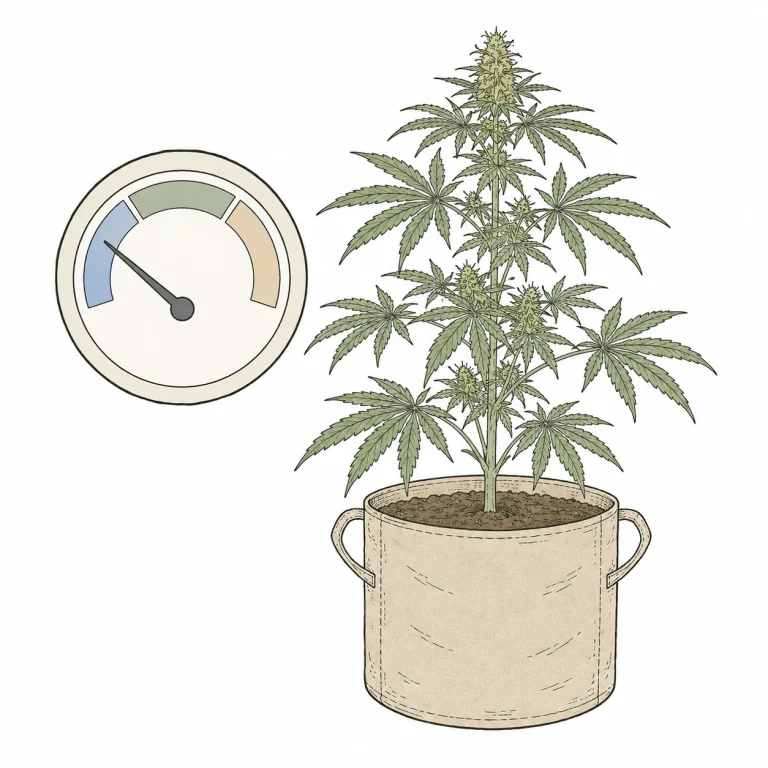
Cannabis grows best at temperatures between 68 and 82 °F (20 and 28 °C) during the light period. During the dark period the temperature can drop to 64 to 68 °F (18 to 20 °C) — but a difference of more than 18 °F (10 °C) between the light and dark periods is already critical. The most common cause of cold stress in indoor growing is inadequate heating or missing insulation in the grow room, especially in the fall and winter months. When the lights go off at night and there’s no heater, the temperature in unheated rooms quickly drops below the critical mark.
In outdoor growing and in greenhouses, the cause is usually seasonal: late frosts in spring or early cold snaps in fall can put the harvest at risk. The root zone is especially sensitive to cold — cold soil or a cold growing medium slows nutrient uptake considerably, even if the air temperature is still in an acceptable range. Pots standing directly on a cold concrete floor are an often overlooked source of cold: the roots cool down from below while the plant looks seemingly normal above ground.
Drafts and cold intake air from poorly placed vents can also create local cold zones. A fan blowing cool outside air directly onto the plants is enough to trigger cold stress on individual branches or leaves while the rest of the grow stays unaffected. In addition, young plants and seedlings are much more sensitive than mature plants in flower — even short cold spells can cause lasting damage here.
- Missing or inadequate heating in the grow room, especially during the dark period
- Large temperature swings between the light and dark periods (more than 18 °F / 10 °C difference)
- Cold concrete floor under the pots without insulation
- Cold outside air from poorly placed intake or fans
- Seasonal cold snaps in outdoor growing
- Cold tap water straight from the faucet (below 64 °F / 18 °C)
- Nutrient solution that’s too cold in hydroponic systems
Real frost damage on cannabis: glassy, black leaves and first aid
Cold stress and real frost damage are often confused, but they’re fundamentally different. Cold stress usually sets in at around 59 °F (15 °C), shows up as purple discoloration or drooping leaves and is reversible — the plant usually recovers within a few days. Real frost, on the other hand, starts at 32 °F (0 °C) or below. Ice crystals form in the plant cells and destroy the cell walls from the inside. This damage is irreversible: affected tissue dies and can’t recover.
How to recognize real frost damage
The typical signs are clearly different from normal cold stress:
- At first, leaves look watery, glassy and translucent, as if they were soaked with water
- Within a few hours to days, the affected areas turn dark brown to black
- The damaged tissue becomes limp and wilted, while the rest of the plant still looks normal
- With hard frost, entire shoot tips or sections of leaves are affected, not just individual leaves
- Unlike nutrient problems, the discoloration appears suddenly after a cold night, not gradually over several days
First aid after a frosty night
If it really is frost damage rather than reversible cold stress, every hour counts:
- Remove affected leaves and shoot tips that have already turned black with clean, disinfected scissors — dead tissue won’t recover and only invites rot
- Bring the plant up to room temperature slowly; never warm it up abruptly with direct heat (space heater, blazing sun)
- Cut back on watering for now, since damaged root and leaf tissue can process less water and you’d otherwise risk waterlogging in the pot
- Check the plant closely over the next few days for mold at the cut sites and in dense buds — frost-damaged, damp tissue is an ideal breeding ground for bud rot (botrytis, gray mold)
- If more frost is forecast for the next few nights and flowering is already well advanced, an early harvest may make more sense than risking a total loss
Important: a single frost doesn’t have to mean the end of the plant. As long as the growing tip and a sufficient part of the foliage stay undamaged, cannabis can keep growing even after frost damage to individual shoots — but the affected areas won’t grow back.
Fixing cannabis cold stress: immediate steps and quick help
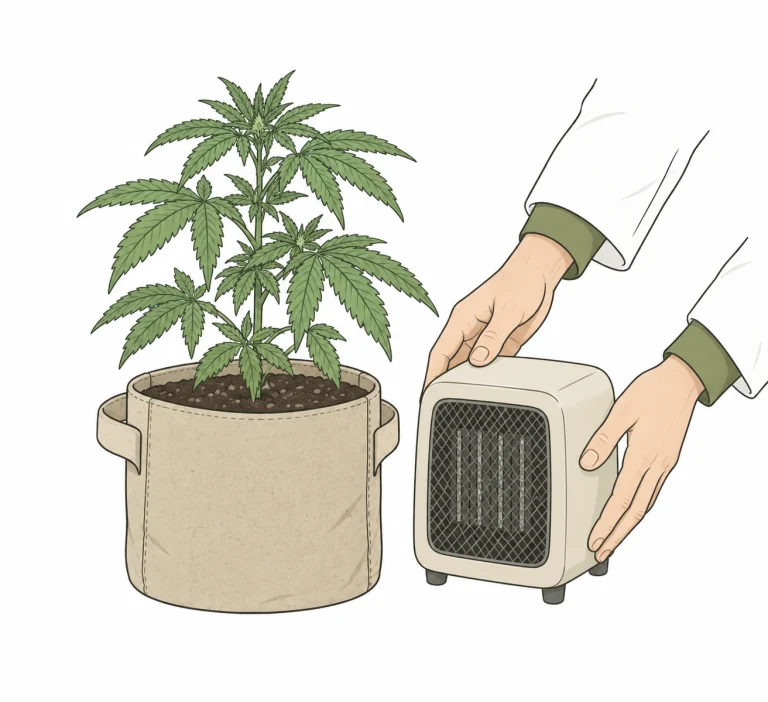
The most important immediate step is really simple: bring the temperature back into the ideal range. Put a space heater or a heat mat in the grow room and make sure the temperature stays between 68 and 79 °F (20 and 26 °C) at all times — including the dark period. The temperature shouldn’t drop below 64 °F (18 °C) during the dark period. Digital thermometers with a min/max display help you keep an eye on nighttime lows you might otherwise miss.
If the pots are standing on a cold floor, raise them onto an insulating base right away: wooden pallets, foam boards or special plant caddies that keep the pots off the floor are a simple but effective way to protect the root zone from the cold. Also pay attention to the temperature of your water — it should be at least room temperature, so between 68 and 72 °F (20 and 22 °C). Cold tap water straight from the faucet can chill the soil abruptly and slow down recovery considerably.
While the plant recovers, avoid any additional stress. Don’t feed full-strength nutrients while the plant is stressed — nutrient uptake is blocked anyway, and too many nutrients in the growing medium can quickly turn into cannabis nutrient burn once the plant recovers. Instead, temporarily reduce the nutrient dose to about 50 to 70 percent of the normal amount and watch how things develop over several days.
- Raise the temperature to 68–79 °F (20–26 °C) right away; use a space heater or heat mat
- Lift pots off the cold floor and insulate them (wood, foam board, plant caddies)
- Warm your water to room temperature (68–72 °F / 20–22 °C); never water with cold water
- Reduce the nutrient dose to 50–70% during recovery
- Install a min/max thermometer to monitor temperatures at night as well
- Eliminate drafts and don’t point fans directly at the plants
- Don’t add any other stress factors (no topping, no LST during recovery)
Preventing cannabis cold stress: long-term measures for a stable climate
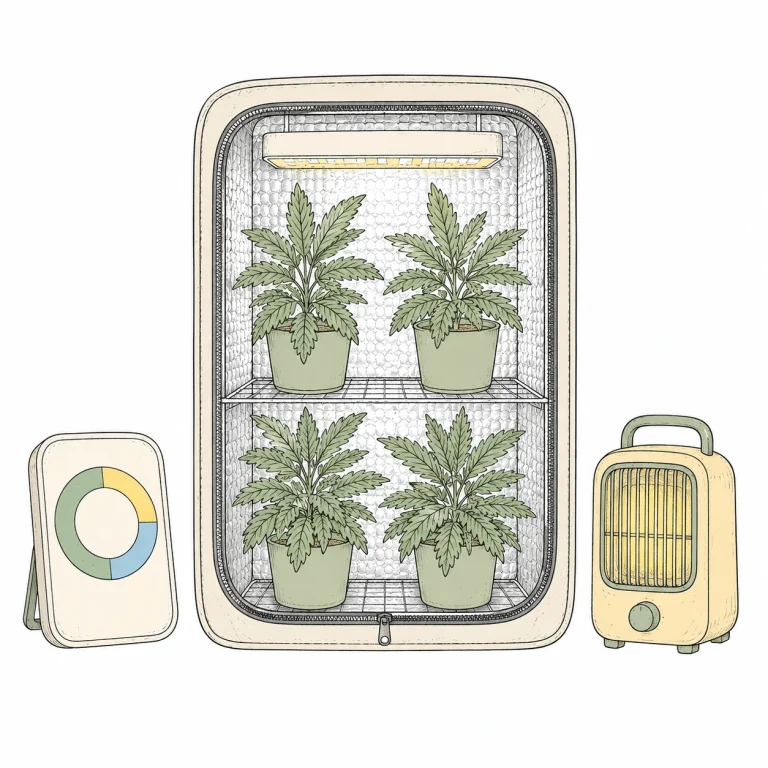
Long-term prevention starts with setting up your grow room properly. Invest in a reliable thermo-hygrometer that measures both temperature and humidity and ideally stores minimum and maximum values. Even better are smart sensors that send you an app notification as soon as the temperature drops below a set threshold. An automatically controlled heater that kicks in during the dark period is essential in winter for every serious indoor grower.
In outdoor growing, keep an eye on the weather forecast and take precautions when cold snaps are predicted: frost cloth or special plant protection film protects your plants from frost. Autoflowering strains are often a bit more cold-tolerant than photoperiod strains, but that’s no guarantee. Plan your outdoor grow so that the flowering stage doesn’t fall in the coldest months — especially in cooler climates, an early fall can put the harvest at risk. It’s also worth checking your cannabis pH after cold spells, since a cold growing medium can affect pH.
In the grow room itself, good planning helps: insulate the walls with foam insulation or reflective film, which also keeps heat in the room. Make sure cold intake air from the ventilation system doesn’t hit the plants directly — deflectors or rerouted airflow fix that. If you’re not sure whether your whole setup is right, we recommend taking a look at our comprehensive overview of yellow cannabis leaves and their causes, since many of the nutrient problems described there can also be caused by temperature.
- Install a thermo-hygrometer with min/max function and a good alarm system
- Set up an automatically controlled heater for the dark period
- Insulate grow room walls to minimize heat loss
- For outdoor grows, watch for weather warnings and keep frost cloth on hand
- Never direct intake air straight at plants; use deflectors
- Always bring your water to room temperature before watering
- Plant caddies or wooden pallets as permanent floor insulation
Cold stress vs. other problems: how to tell them apart
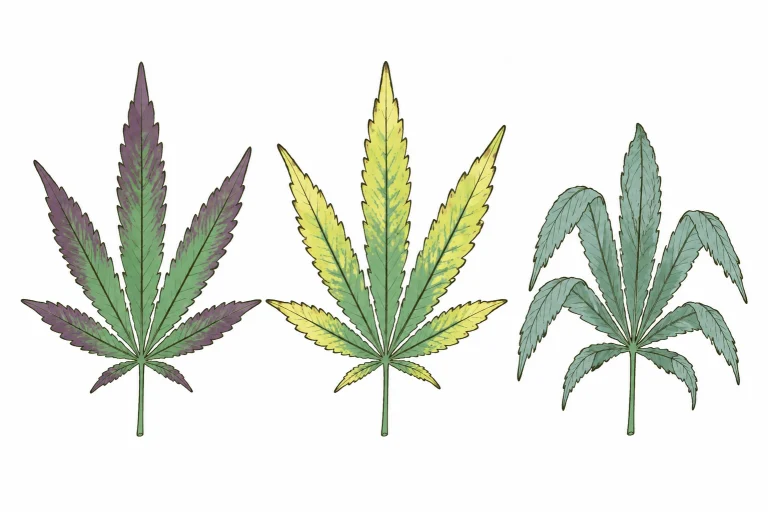
Cold stress can be confused with several other common problems, which makes diagnosis harder. Purple discoloration can also come from anthocyanins produced for genetic reasons — but in that case, the accompanying symptoms like drooping, stalled growth or necrotic leaf edges are missing. Phosphorus deficiency can also cause reddish-purple discoloration, especially on the leaf stems and the undersides of the leaves. The key difference: with phosphorus deficiency, the cause lies in the plant’s nutrient balance, while cold stress correlates directly with measurable temperature readings.
Drooping from cold stress looks similar to overwatering — how to water cannabis plants is a topic of its own that you should know about. The difference is in the leaf structure: with overwatering, the leaves look plump and heavy; with cold stress, they look more leathery and lifeless. Also, overwatering droop shows up shortly after watering, while cold droop occurs regardless of your watering schedule and is most pronounced in the early morning hours after cold nights.
A systematic diagnosis should always start with a temperature reading. Check the min/max values on your thermometer and see whether the temperature has dropped below 59 °F (15 °C) in the last 24 to 48 hours. If it has, cold stress is the most likely cause, and you should correct the temperature before you respond with nutrients or other measures. You’ll find a detailed overview of all possible causes of leaf discoloration and stress symptoms on our Plant Diagnosis overview page.
- Purple discoloration from genetics: no accompanying symptoms, no stalled growth
- Phosphorus deficiency: reddish stems, but check pH and temperature
- Overwatering: plump leaves, drooping after watering — not related to cold
- Magnesium or calcium deficiency: can be a secondary effect of cold stress
- Always measure the temperature first before taking any nutrient measures
- Cold droop is especially pronounced in the morning after cold nights
Both LED light burn and sunburn can cause leaf discoloration too, but they usually show up on leaves close to the light rather than as purple leaves. The opposite problem, heat stress, shows up as curled leaves rather than purple ones. Red or purple stems can also be genetic — learn more in our article on red stems.
Frequently asked questions
At what temperature does cannabis get cold stress?
Cannabis starts to suffer noticeably below about 59 °F (15 °C). Temperatures between 50 and 59 °F (10 and 15 °C) slow growth and nutrient uptake considerably, and below 50 °F (10 °C), irreversible damage can occur. Ideal are 68–82 °F (20–28 °C) during the light period and at least 64 °F (18 °C) during the dark period.
Does cannabis recover from cold stress?
Yes, cannabis usually recovers well from cold stress as long as the cold exposure didn’t last too long and there’s no frost damage. Once you bring the temperature back to normal, recovery usually starts within 3 to 7 days. Leaf tissue that has already died won’t regenerate, but new growth comes in normally again.
Why do cannabis leaves turn purple in the cold?
Purple discoloration comes from increased production of anthocyanins — natural plant pigments the plant produces as a stress response to cold. Some strains are genetically more prone to this than others. If the discoloration is caused by cold, the purple tones disappear again once the temperature returns to normal.
Is cold stress during the flowering stage bad for your harvest?
Cold stress during the flowering stage can briefly stimulate trichome production, but it’s generally harmful: it slows bud development, raises the risk of mold because of higher humidity and can reduce bud potency. A short spell of mild cold shortly before harvest is less of a problem than ongoing cold stress during flowering.
Do I need to feed more after cold stress?
No — quite the opposite. After a cold spell, you should reduce the nutrient dose at first, because the roots’ nutrient uptake is disrupted. If you keep feeding normally, nutrient salts can build up in the growing medium and cause nutrient burn once the plant recovers. Reduce to 50–70% of the normal dose and only increase again once you see visible new growth.
How do I protect my outdoor plants from the cold?
Frost cloth (row cover) or frost protection film offers simple, inexpensive protection when cold nights are forecast. Alternatively, you can temporarily bring potted plants indoors or into a heated greenhouse. Mulch on the soil surface insulates the root zone. Plan your outdoor grow so that the flowering stage falls in the warmest months and finishes before the first frost.
Conclusion
Spotting cannabis cold stress and acting quickly is crucial to avoid lasting damage — because the longer the plant is exposed to temperatures below 59 °F (15 °C), the harder it is to recover. With a reliable thermometer, controlled room heating and a few simple insulation measures, you can prevent cold stress completely in most cases. If symptoms are already visible, stay calm: bring the temperature back to normal, reduce nutrients, avoid stress — and give the plant time to recover. Stable climate management is the best investment in healthy, high-yielding cannabis plants.
