

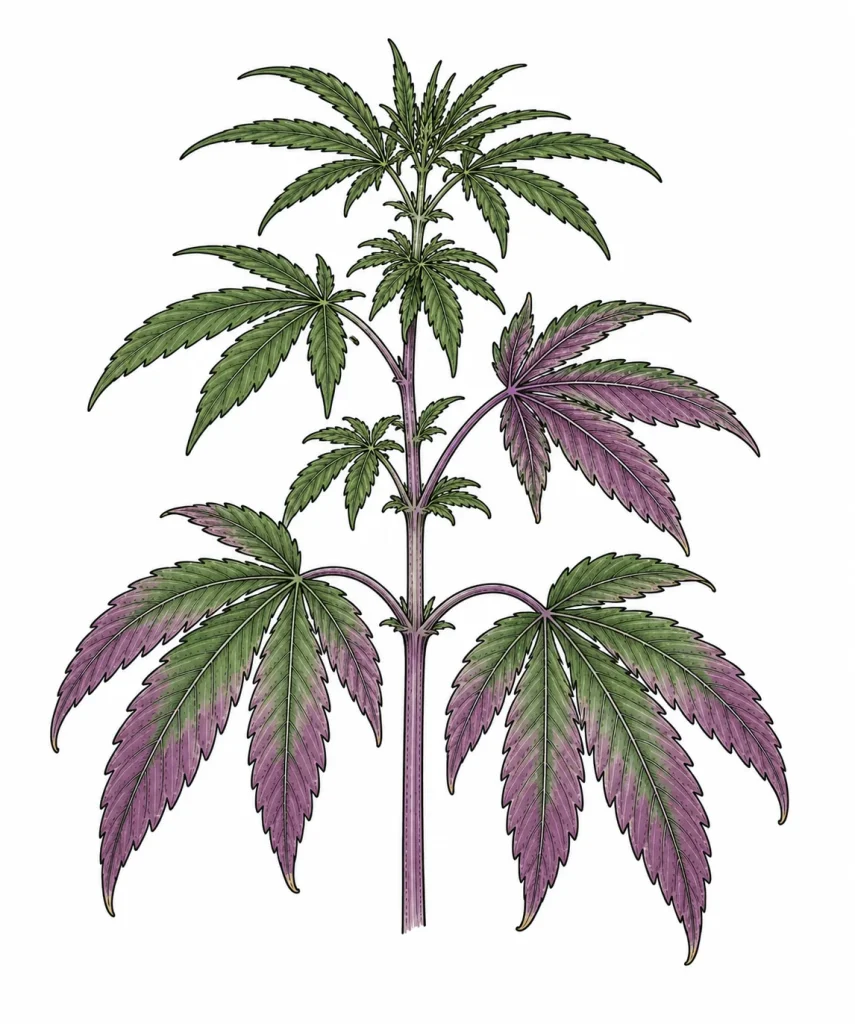
Many growers overlook cannabis phosphorus deficiency symptoms at first or mistake them for other problems — yet they’re a serious warning sign from your plant. Typical signs are dark green to purple-violet leaves, reddish stems and noticeably slower development, especially in the flowering stage. Without enough phosphorus, your cannabis plant can’t store energy efficiently or build strong buds. In this article, you’ll learn how to reliably spot the symptoms, what causes them and how to help your plant quickly and effectively.
What is phosphorus and why does cannabis need it?
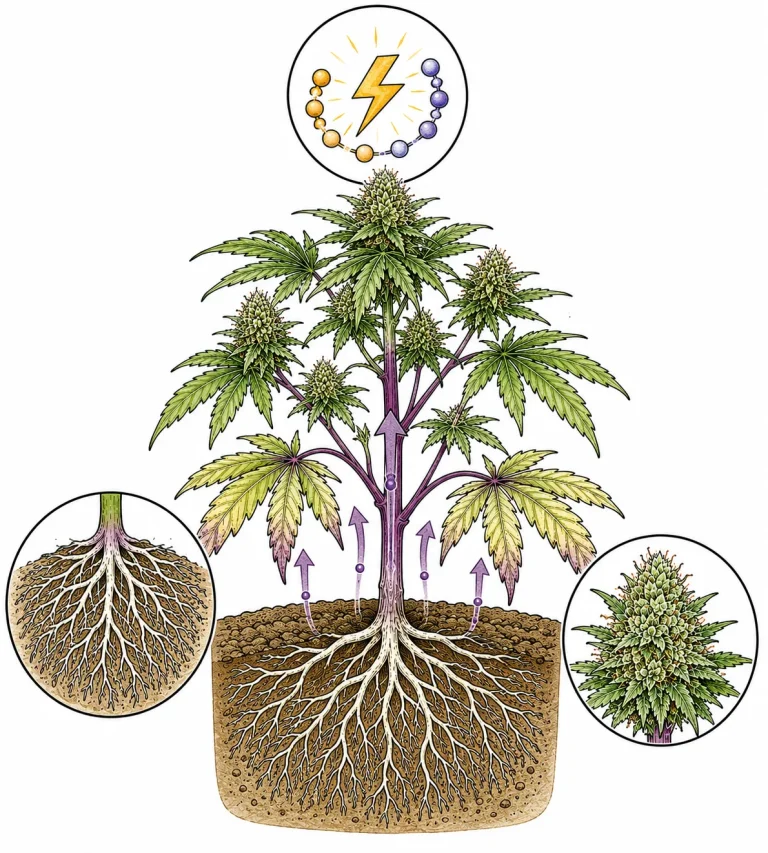
Alongside nitrogen and potassium, phosphorus (P) is one of the three most important macronutrients for cannabis. It’s essential for energy transfer in the plant cell — more precisely, for building ATP (adenosine triphosphate), the universal energy carrier of all living things (see Julius Kühn Institute: Soil Fertility and Plant Nutrition (German)). Without enough phosphorus, your plant can’t efficiently use and pass on the energy it gains through photosynthesis.
Phosphorus is also directly involved in cell division, DNA synthesis and building cell membranes. Especially relevant for cannabis growers: phosphorus drives root growth and is crucial for forming big, dense buds in the flowering stage. That’s why typical cannabis bloom nutrients have a higher P ratio in their NPK value. If you want to understand how nutrients should be dosed, we recommend the article How to dose cannabis nutrients and understand NPK as further reading.
Phosphorus is also a mobile nutrient: when it runs short, the plant can move it out of older, lower leaves and into younger, more active growth areas. During this relocation, anthocyanins can build up — red and purple pigments that collect in the stems, branches and leaf veins. This anthocyanin buildup is the direct reason why purple or violet stems are such a typical phosphorus deficiency symptom. That’s why the first symptoms of a phosphorus deficiency almost always show up on the lower and middle leaves of the plant first.
Cannabis phosphorus deficiency symptoms: how to spot the deficiency for sure
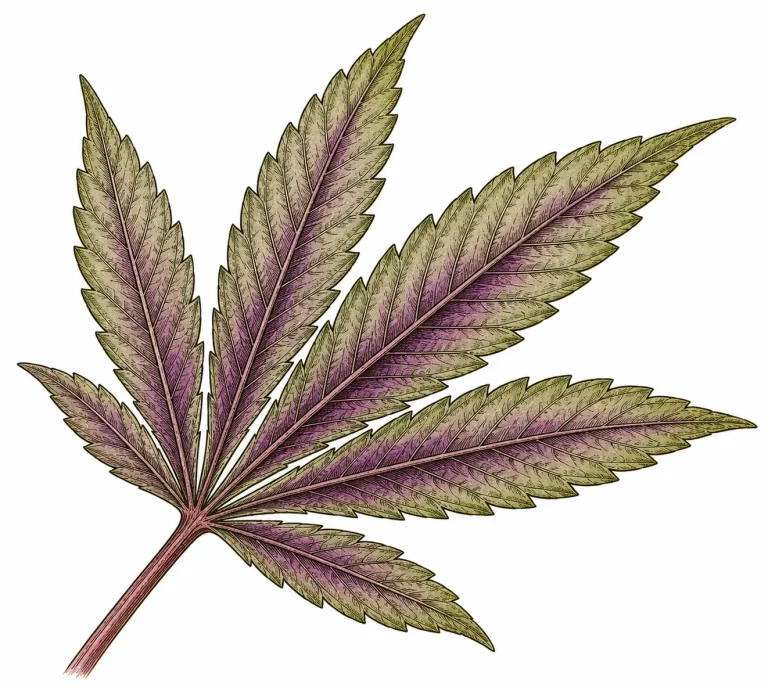
Cannabis phosphorus deficiency symptoms are distinctive, but beginners in particular often misread them. That’s because a slight violet or purple tint on the stems and leaf undersides can also be genetic — in some strains, it’s completely normal. What matters is the overall picture of several symptoms at once.
The most obvious sign is violet or purple coloring on the leaf stems, branches and leaf undersides. At first, the leaves look dark green, almost unnaturally rich, before they turn brownish or violet. Bronze or dark brown spots can appear on the leaf surfaces themselves, mostly between the leaf veins. The leaf blade often feels stiff and leathery.
Other typical signs: the plant grows noticeably slower, bud sites stay small and the roots develop poorly. In advanced cases, the lower leaves turn yellow, then brown, and drop off. If your cannabis has yellow leaves and purple stems at the same time, phosphorus deficiency is a very likely trigger.
- Violet-purple discoloration of leaf stems, branches and leaf undersides
- Dark green, almost blackish leaf color in early stages
- Bronze or dark brown spots on the leaf blade
- Slower growth and small, weak bud sites
- Lower leaves dying off (yellowing, then browning)
- Stiff, leathery leaf texture
- Poor root development, thin lateral roots
Phosphorus deficiency vs. genetic purple coloring: how to tell them apart reliably
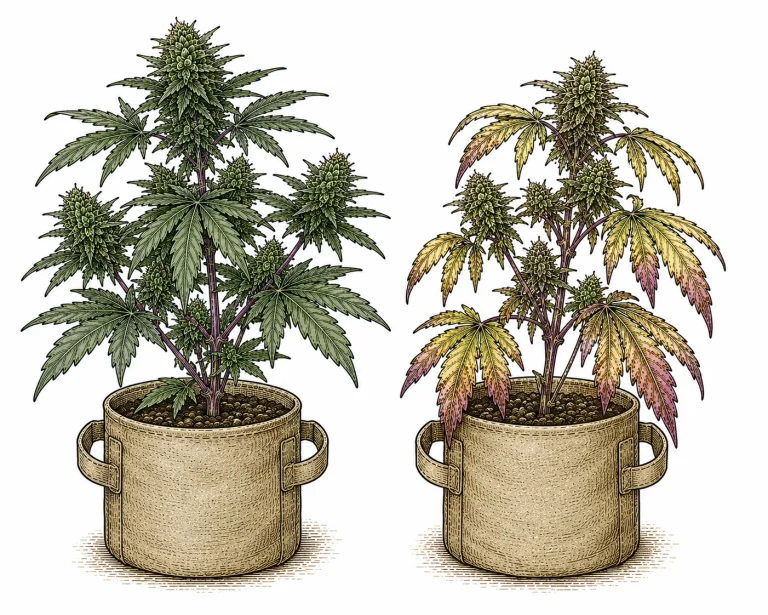
One of the most common questions among growers: is this a deficiency or just the genetics of my strain? Telling the two apart is crucial to avoid unnecessary changes to a healthy nutrient system. Many cannabis strains — especially indica-dominant varieties and purple genetics such as Purple Kush, Granddaddy Purple or many Blue crosses — are genetically built to produce purple to violet anthocyanin pigments under certain conditions, especially cooler nighttime temperatures. That’s not a deficiency, it’s a normal strain trait.
The key difference: healthy plants with purple genetics do show purple stems, but the rest of the plant looks vigorous and healthy. The leaves are a strong green, growth is fast and there are no leaf spots, no curling and no discoloration on the leaf surfaces themselves. With a true phosphorus deficiency, on the other hand, the stems are only the first clue — more symptoms on the leaves, growth and color will inevitably follow.
Another helpful method: check whether the purple coloring is new or has been there from the start. If it’s been there from the beginning and the plant has never looked different, it’s most likely genetics. If the coloring developed suddenly and is spreading, you’re dealing with an environmental problem or a deficiency. Document the condition of your plants regularly with photos — it helps enormously with troubleshooting. If you’re unsure: check your pH first. If it’s in the optimal range and the plant shows no other stress symptoms, the violet coloring is most likely genetic.
- Purple genetics: purple stems with no other symptoms, vigorous growth, strong green leaves
- Phosphorus deficiency: purple stems PLUS leaf spots, stunted growth, discoloration
- Genetic coloring often appears from the start or during cool nights
- Deficiency coloring develops suddenly and spreads
- Regular photo documentation helps you track changes over time
- When in doubt: always measure the pH first
Causes of phosphorus deficiency in cannabis
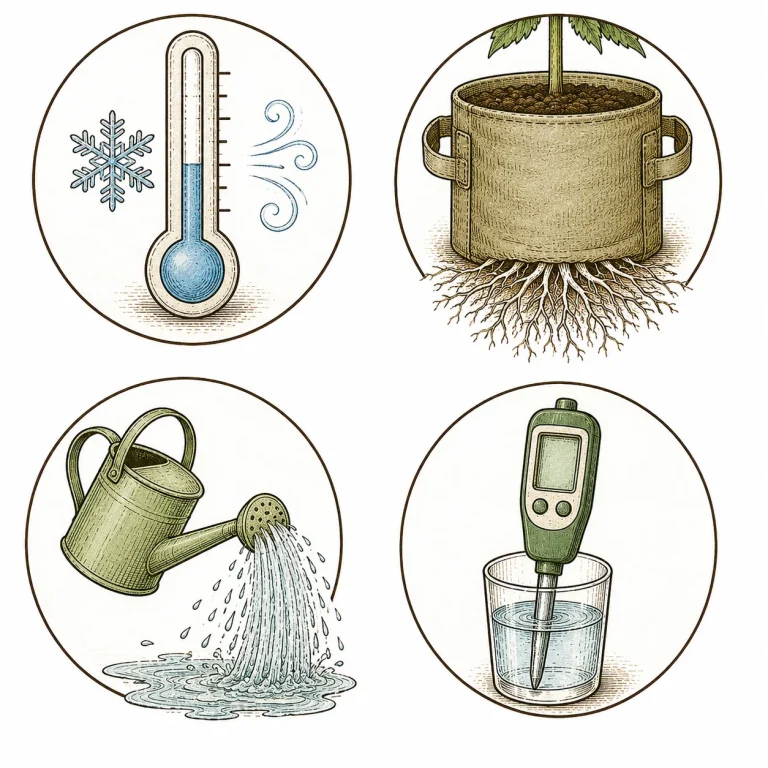
The most common cause of phosphorus deficiency isn’t too little phosphorus in your nutrients, but the wrong pH in the growing medium or nutrient solution. Cannabis roots can only take up phosphorus within a narrow pH range. In soil, that range is ideally between 6.2 and 6.8, in coco between 5.8 and 6.3, and in hydroponics between 5.5 and 6.2. If the pH falls outside these ranges, it blocks uptake — even when there’s enough phosphorus available. This is called an induced deficiency or pH lockout. The article How to set the right pH for cannabis and avoid mistakes explains how to measure and correct your pH properly.
Other common causes are root zones that are too cold (below 59 °F (15 °C)), because cannabis takes up phosphorus much less efficiently at low temperatures. Pots sitting on cold floors are an underestimated trigger — the root zone cools down quickly, especially at night. A waterlogged growing medium or overwatering can also reduce the oxygen supply to the roots and block nutrient uptake as a result. If you water your cannabis correctly and avoid waterlogging, you effectively prevent this cause.
Less common, but possible: a true phosphorus shortage from too little P in your nutrients, especially with homemade or organic mixes. A heavily depleted growing medium after a long grow can also lead to a true phosphorus deficiency, while, the other way around, phosphorus toxicity from too much PK booster blocks other nutrients. Last but not least, an excess of zinc, iron, calcium or potassium can inhibit phosphorus uptake through ion competition.
- Wrong pH (most common cause!) — phosphorus isn’t available to the plant
- Root zone too cold (below 59 °F (15 °C)) — especially pots on cold floors
- Waterlogged or overly wet soil — poor oxygen supply to the roots
- Genuinely too little phosphorus in your nutrients (rare, but possible)
- Heavily depleted growing medium
- Ion competition from an excess of zinc, iron, calcium or potassium
How to fix cannabis phosphorus deficiency: step-by-step guide
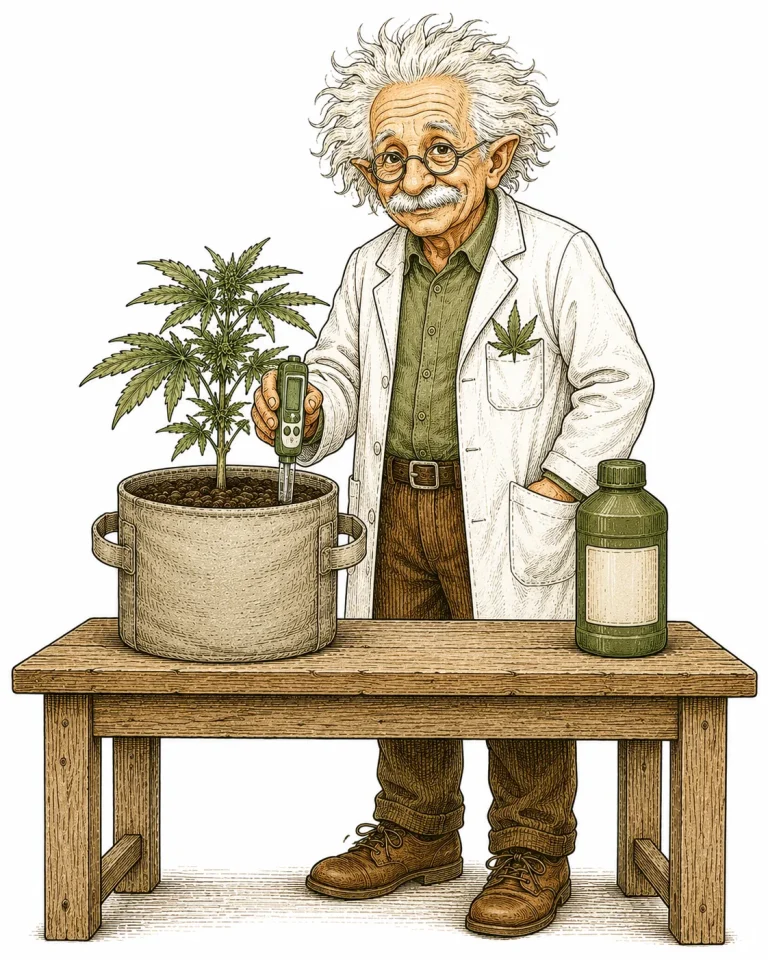
Step 1 – Check and correct the pH: before you feed anything, measure the pH in your growing medium and your water. That’s the absolute first step. Correct soil to 6.2–6.8, coco to 5.8–6.3 and hydro to 5.5–6.2. Also measure the runoff and compare it with the input pH — the difference tells you whether salts are building up in the growing medium. If your pH is right and you still see symptoms, check the nutrient concentration.
Step 2 – Flush for pH problems or nutrient lockout: if there’s heavy salt buildup in the growing medium or you’ve been watering with the wrong pH for a long time, a thorough rinse (flushing) with pH-adjusted water is a good idea. Run 2–3 times the pot volume through until the runoff is back to a normal, low EC reading.
Step 3 – Use a phosphorus-rich nutrient: after flushing, or if the pH is right but there’s a true phosphorus deficiency, raise the P share in a targeted way. For organic growers, bone meal (slow-acting), bat guano or worm castings (more readily available) work well. For mineral feeding, use a bloom nutrient with a higher P share or a dedicated PK booster product (e.g. PK 13/14). Be sure to keep an eye on the total dose — cannabis nutrient burn can make the symptoms worse.
Step 4 – Control the root zone temperature: if your grow room or growing medium is too cold, warm the environment to at least 64–72 °F (18–22 °C). Never set pots directly on cold floors — insulating mats or saucers under the pots are a quick, inexpensive fix. Check the temperature at the bottom of the pot, not just at light height.
Step 5 – Watch and document: old leaves won’t recover — that’s normal. Check whether new growth (new shoot tips, new leaves) comes in healthy and green. That tells you the correction has worked. With phosphorus deficiency, you’ll usually see the first improvements within 3–7 days.
Phosphorus deficiency in the flowering stage: especially dangerous
Cannabis phosphorus deficiency symptoms show up most often — and do the most damage — in the flowering stage. The reason: cannabis needs much more phosphorus in flower, because phosphorus is directly required to form and develop the buds. Many growers don’t switch to a phosphorus-rich bloom nutrient in time when moving from veg to flower — a classic mistake.
An untreated phosphorus deficiency in the flowering stage leads to small, airy buds with little resin production and therefore a much smaller harvest. In the worst case, whole branches die off. So if you see symptoms in early flower, act right away. The first 3–4 weeks of flower are decisive for your yield.
When feeding in flower, make sure your product has an NPK ratio with clearly higher P and K (e.g. 3-10-7 or similar). Many commercial bloom nutrients are designed exactly for this. A PK booster between weeks 3 and 6 of flower can also make sense — but only if you have your pH under control.
- Flowering stage = highest phosphorus demand of the entire grow
- A deficiency caught too late leads to small, airy buds
- Switch to a bloom nutrient with a higher P share in time
- Use a PK booster between weeks 3–6 of flower
- Treat symptoms right away — every week of delay costs yield
Preventing phosphorus deficiency: tips for healthy growth
Prevention is always better than correction. The most important protection against phosphorus deficiency is consistently checking the pH every time you water. Get a reliable pH meter (German) and calibrate it regularly. Don’t just measure your water, measure the runoff too — the difference tells you whether salts are building up in the growing medium. Also keep a feeding log: write down doses, pH readings and observations so you can catch problems early and spot patterns.
In the flowering stage, always use a dedicated bloom nutrient with a balanced NPK ratio and enough P. If you grow organically, work bone meal or bat guano into the growing medium before planting — that provides a slow baseline supply for the whole season. Replace your growing medium regularly and avoid reusing the same soil several times without amending it.
Keep the temperature in the grow room and at the root zone consistently above 64 °F (18 °C). Avoid day-night temperature swings of more than 18 °F (10 °C) — swings that big trigger stress responses that impair nutrient uptake and encourage purple discoloration. Set pots on insulating mats instead of directly on cold floors. Water evenly, avoid waterlogging and make sure there’s enough drainage. A good baseline nutrient supply, clean equipment and regularly watching your plants are the three most important pillars of a healthy, high-yielding grow.
- Check the pH every time you water (input water AND runoff)
- Buy a reliable pH meter and calibrate it regularly
- Keep a feeding log to catch problems early
- Stage-appropriate feeding: start bloom nutrients in time
- For organic growing: work bone meal or bat guano into the growing medium
- Keep day-night temperature swings below 18 °F (10 °C)
- Set pots on insulating mats — avoid cold roots
- Water evenly, avoid waterlogging
Phosphorus deficiency or another deficiency? The most common mix-ups
Phosphorus deficiency is most often confused with calcium deficiency, magnesium deficiency or simply with cold stress symptoms. The key difference: calcium deficiency in cannabis causes rusty brown spots mainly on young leaves and new shoots, because calcium is immobile. Phosphorus, on the other hand, is mobile — the symptoms always start on the old, lower leaves and move upward.
Magnesium deficiency shows interveinal chlorosis (veins stay green, the leaf tissue turns yellow) on old leaves, but no purple/violet stem discoloration. Cold stress can trigger similar violet coloring, but without the typical growth problems and leaf spots — and only when temperatures actually drop below 59 °F (15 °C). Nitrogen deficiency starts with even yellowing of the lower leaves without any violet tones.
The best way to get a reliable diagnosis: always check the pH first, note exactly where the symptoms appear (top/bottom, young/old) and look at the combination of signs. If you see several deficiencies at once or you’re unsure, check out the complete cannabis nutrient deficiency chart — there you’ll find all deficiencies compared side by side.
- Phosphorus deficiency: purple stems + spots + symptoms start at the BOTTOM (mobile nutrient)
- Calcium deficiency: rusty brown spots + symptoms start at the TOP (immobile nutrient)
- Magnesium deficiency: interveinal chlorosis WITHOUT purple discoloration
- Cold stress: purple coloring without leaf spots and without stalled growth
- Nitrogen deficiency: even yellowing at the bottom without violet tones
Red or purple stems can have other causes too — learn more in our article on red stems.
Frequently asked questions
Why are my cannabis leaves turning purple — is it phosphorus deficiency?
Purple or violet leaves and stems can point to phosphorus deficiency, but they can also be genetic or triggered by cold. With a true phosphorus deficiency, you’ll also see slower growth, brown spots on the leaves and lower leaves dying off. Genetic purple coloring, on the other hand, appears evenly and doesn’t affect growth. Always check your pH and the overall picture of the plant first.
Can cold cause purple stems without a phosphorus deficiency?
Yes, definitely. Temperatures below 59 °F (15 °C) can trigger increased anthocyanin production in cannabis, which leads to purple stems — without a true phosphorus deficiency. This cold-related discoloration happens especially at night, when the grow room cools down. Check your nighttime temperatures and the root zone temperature. If you raise the temperatures and the purple coloring stops spreading and no other stress symptoms appear, cold was the cause.
When does phosphorus deficiency occur most often in cannabis?
Phosphorus deficiency occurs most often in the flowering stage, because that’s when cannabis has the highest phosphorus demand. Many growers fail to switch to a phosphorus-rich bloom nutrient in time. The transition from veg to flower is also a critical phase in which phosphorus deficiency can develop.
How fast does a cannabis plant recover from phosphorus deficiency?
Once you’ve fixed the cause properly (pH correction, the right feeding), you’ll usually see improvement on new shoot tips and young leaves within 3–7 days. Old leaves that are already affected won’t recover — that’s normal. Always use the new growth as the indicator of whether your measures are working.
What pH is optimal for cannabis to take up phosphorus?
In soil, the pH should be between 6.2 and 6.8. In coco, the optimal range is between 5.8 and 6.3, and in hydroponics between 5.5 and 6.2. Outside these ranges, phosphorus gets locked out and isn’t available to the plant, even if there’s enough of it in the growing medium.
What’s the difference between phosphorus deficiency and potassium deficiency in cannabis?
Both deficiencies can cause purple or reddish discoloration, but they show different patterns. Phosphorus deficiency shows up mainly on the stems and leaf undersides, with dark green leaves in early stages, and the symptoms start on the lower, older leaves. Potassium deficiency first shows up as leaf-edge necrosis instead — the leaf edges turn brown and look burnt. With potassium deficiency, the leaves also yellow from the edges inward. Telling them apart accurately is important so you can start the right treatment.
Can I fix phosphorus deficiency with home remedies?
For organic growers, bat guano works as a fast-acting phosphorus source, bone meal as a slow-acting option, and fish meal or worm castings as a gentle soil amendment. Banana peel tea also contains some phosphorus and potassium. However, these methods work much more slowly than mineral solutions. You should always correct the pH first, because in most cases that’s the real cause.
Is phosphorus deficiency more common outdoors than indoors?
Not necessarily more common, but harder to control in an outdoor grow. Heavy rain can leach the growing medium and wash phosphorus out. Cold nights cool down the root zone and reduce phosphorus uptake. Indoors, you have more control over temperature and pH, which is why true phosphorus deficiencies can usually be spotted and fixed faster there.
You’ll find suitable nutrients to correct the deficiency in a targeted way in our Recommended Gear.
Conclusion
Cannabis phosphorus deficiency symptoms such as purple stems, dark leaves and stunted buds are clear warning signs that you should take seriously as a grower. In most cases, the wrong pH is behind the problem — not too little phosphorus in your nutrients. Act fast: measure your pH, flush if needed and adjust your feeding. You’ll find all other diagnosis topics on the PlantClue Plant Diagnosis overview.
