

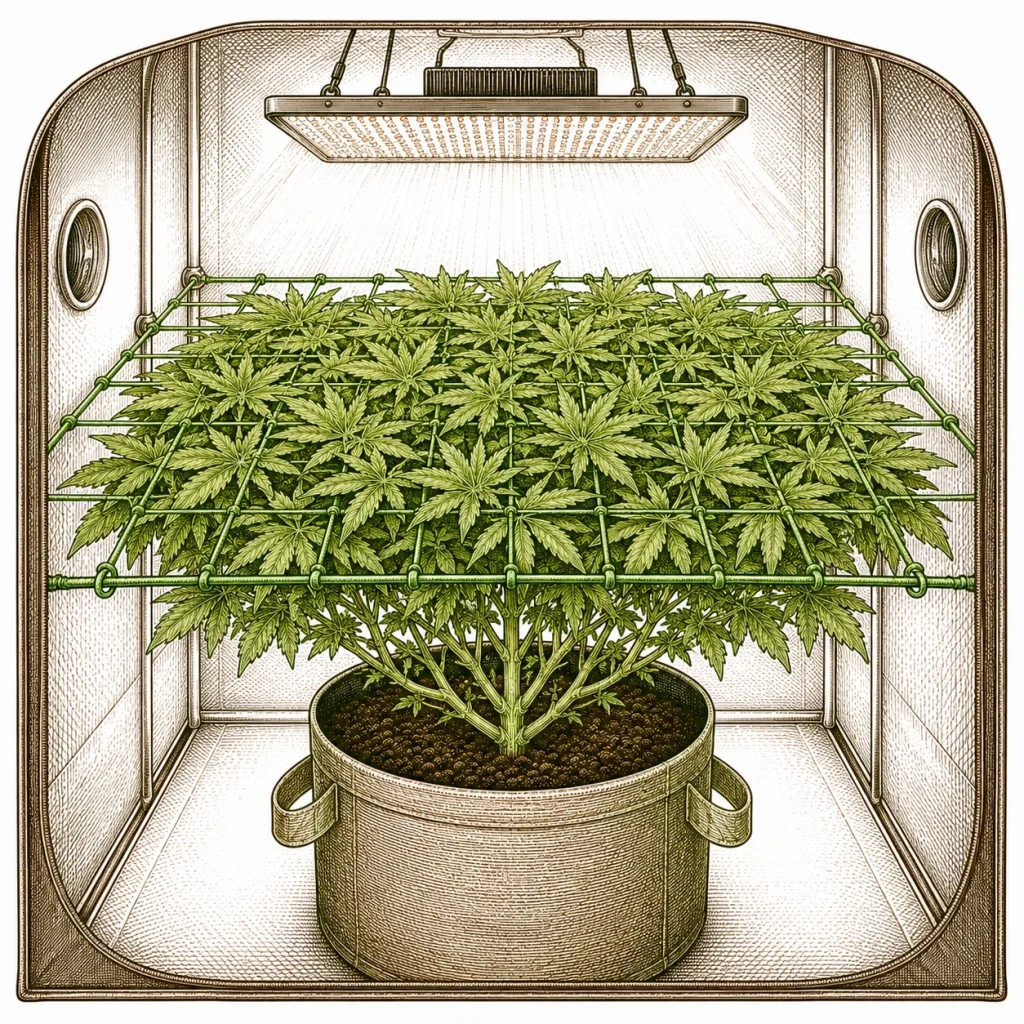
The cannabis SCROG (screen of green) method is one of the most effective ways to pull maximum yields from just a few plants. You stretch a horizontal net over your plants. It spreads the branches out evenly and makes the most of your light footprint. According to the Bavarian State Institute for Viticulture and Horticulture, even light distribution has a direct impact on yield and plant health. For indoor growing with limited light coverage, cannabis SCROG is one of the smartest investments of your time and materials. In this article, you’ll learn step by step how to set up the net, when to start weaving, and which mistakes you really want to avoid.
What Is Cannabis SCROG (Screen of Green)?
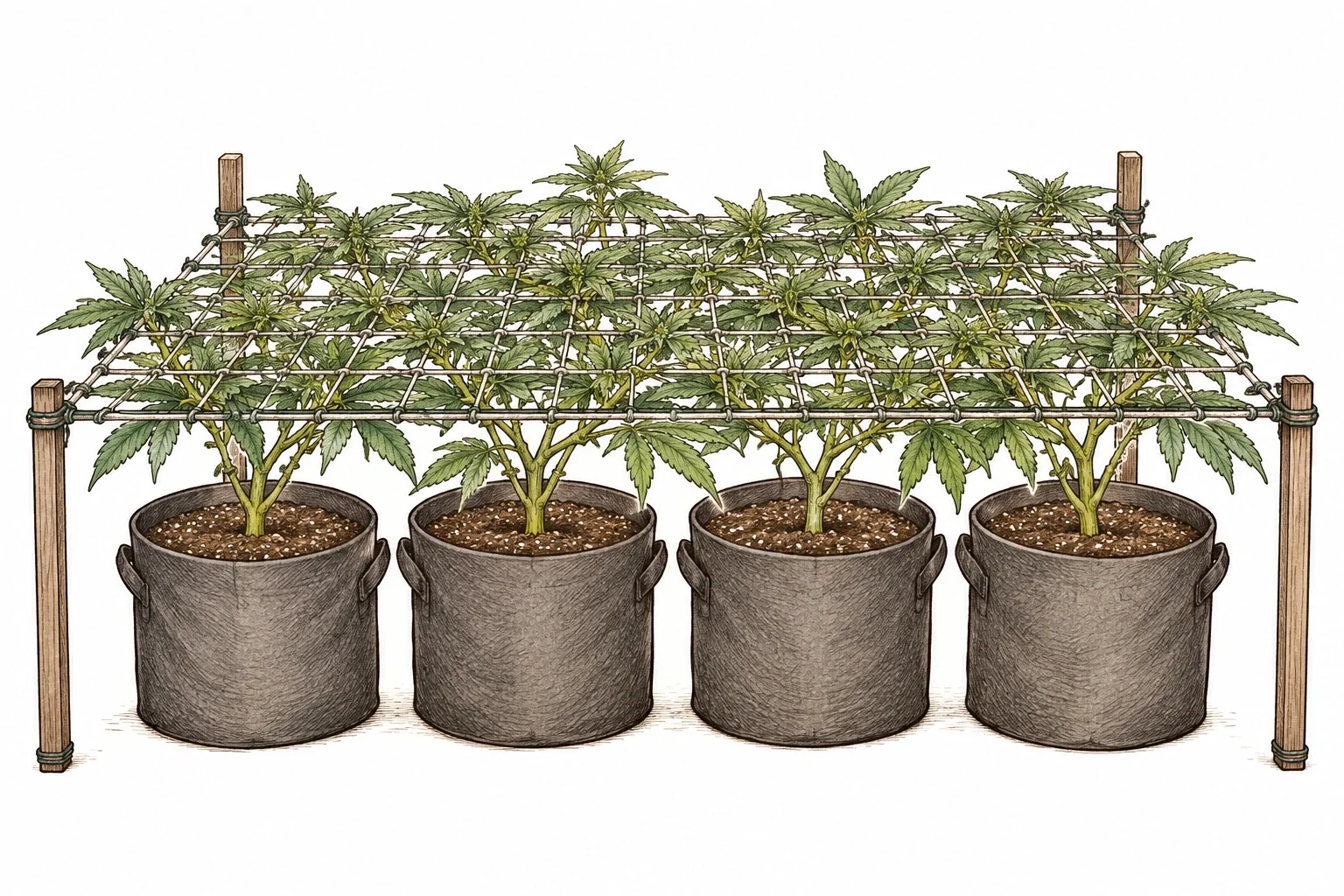
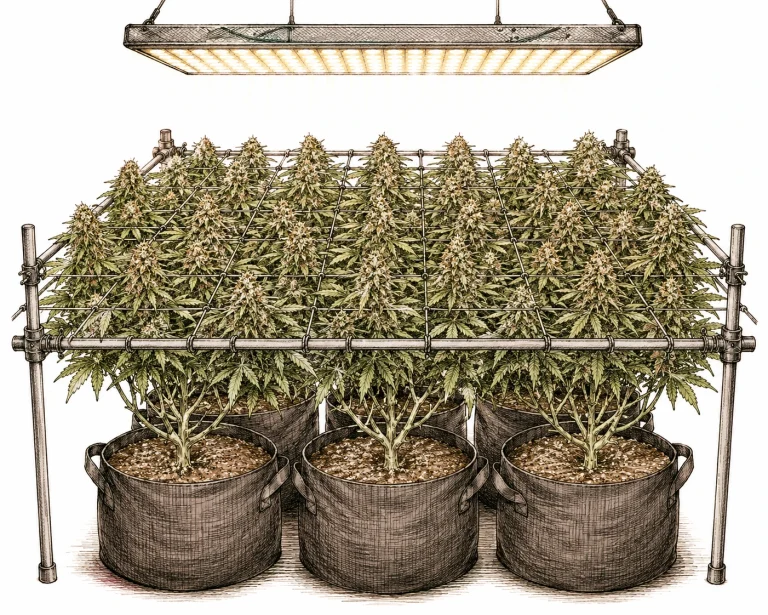
Cannabis SCROG stands for “screen of green.” It’s a training technique where you mount a horizontal net or grid at a set height above your plants. You guide the plant’s branches through the squares of the net, which forces them to grow sideways. The goal is an even, flat canopy that uses all the light from your lamp efficiently.
Unlike the sea of green method (SOG), where you flip lots of small plants into flower quickly, cannabis SCROG relies on just a few plants with intensive training. A single well-trained plant under a cannabis SCROG net can fill an entire grow tent. That cuts down on the clones and seeds you need, but it adds a lot more work per plant.
The method is a great fit for indoor growing because it maximizes light efficiency. Left untrained, cannabis naturally grows like a bush or a tree with one dominant main stem. That main cola towers over every other branch and hogs the best light. A cannabis SCROG net evens out those height differences, so all the bud sites sit on the same level and get the same amount of light.
- Few plants, maximum use of your space
- Even light distribution across all bud sites
- Ideal for photoperiod strains with a long veg
- Reduces hot spots and helps prevent light burn
- Especially effective when combined with topping or LST
Cannabis SCROG vs. Other Cannabis Training Techniques
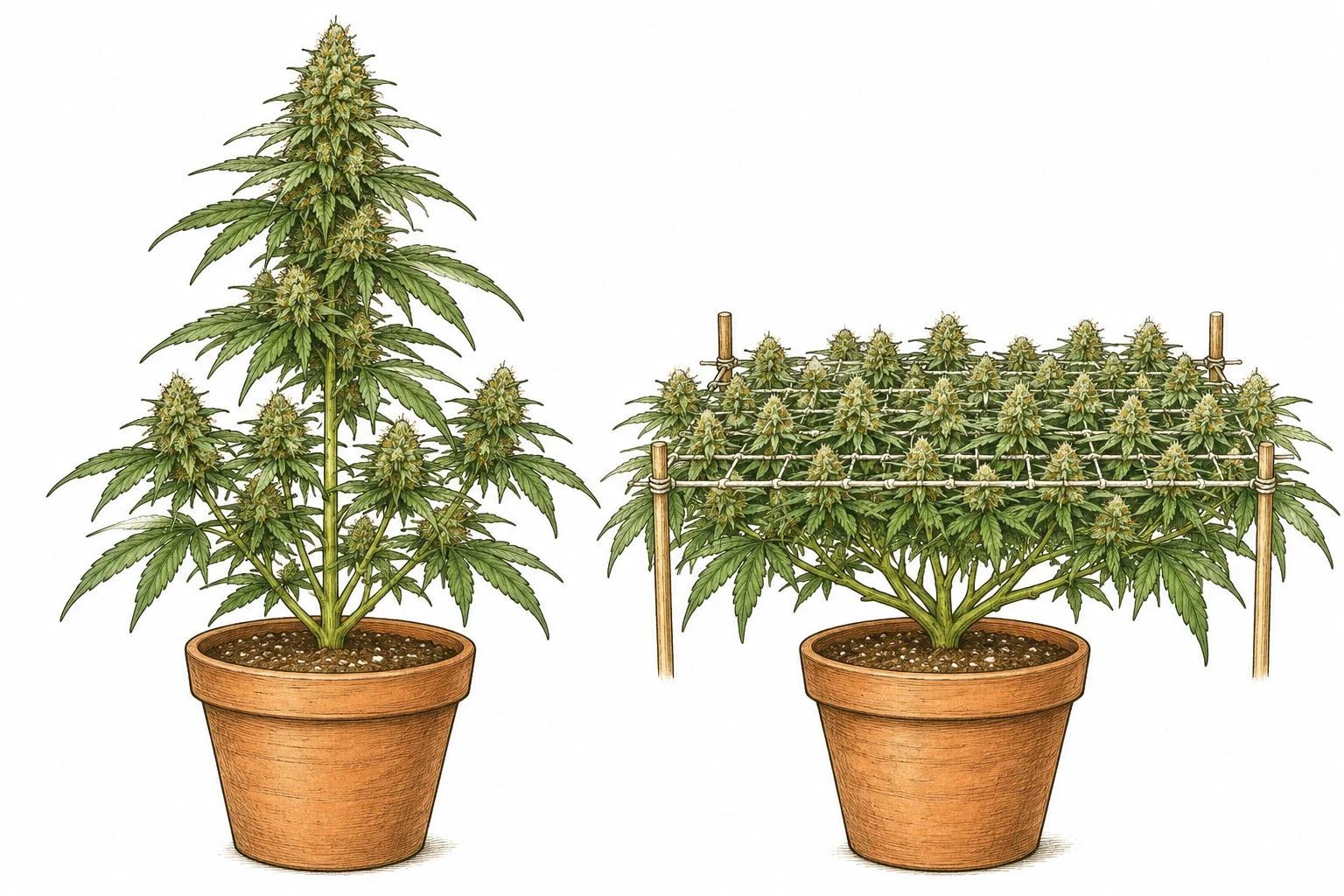
Before you start building your cannabis SCROG, it’s worth a quick comparison with other methods. With cannabis LST (low stress training), you simply tie the branches down with wire or string, no net needed. LST is easier, but less systematic than cannabis SCROG. The SCROG net gives you a clear structure and makes plant care easier to keep track of.
Topping and FIMing are often used to prep plants for SCROG. Removing the main stem tip creates several equal side branches that spread out nicely under the net. That’s why topping plus SCROG is such a popular combo. If you want to dig deeper into the basics, the grow guide to training techniques gives you an overview of every method.
SCROG is less suited to autoflowering strains. Their short vegetative stage usually doesn’t give them enough time to fill the net completely. For photoperiod strains, where you decide how long to veg, SCROG is ideal. The longer you veg, the more branches you get and the fuller your net becomes.
- LST: easier, but less structured than SCROG
- Topping: the ideal prep for SCROG
- Autoflowers: SCROG only recommended with limitations
- Photoperiod strains: a perfect match for SCROG
- SCROG takes more planning, but gives you more even results
The Right Materials for Your SCROG Setup
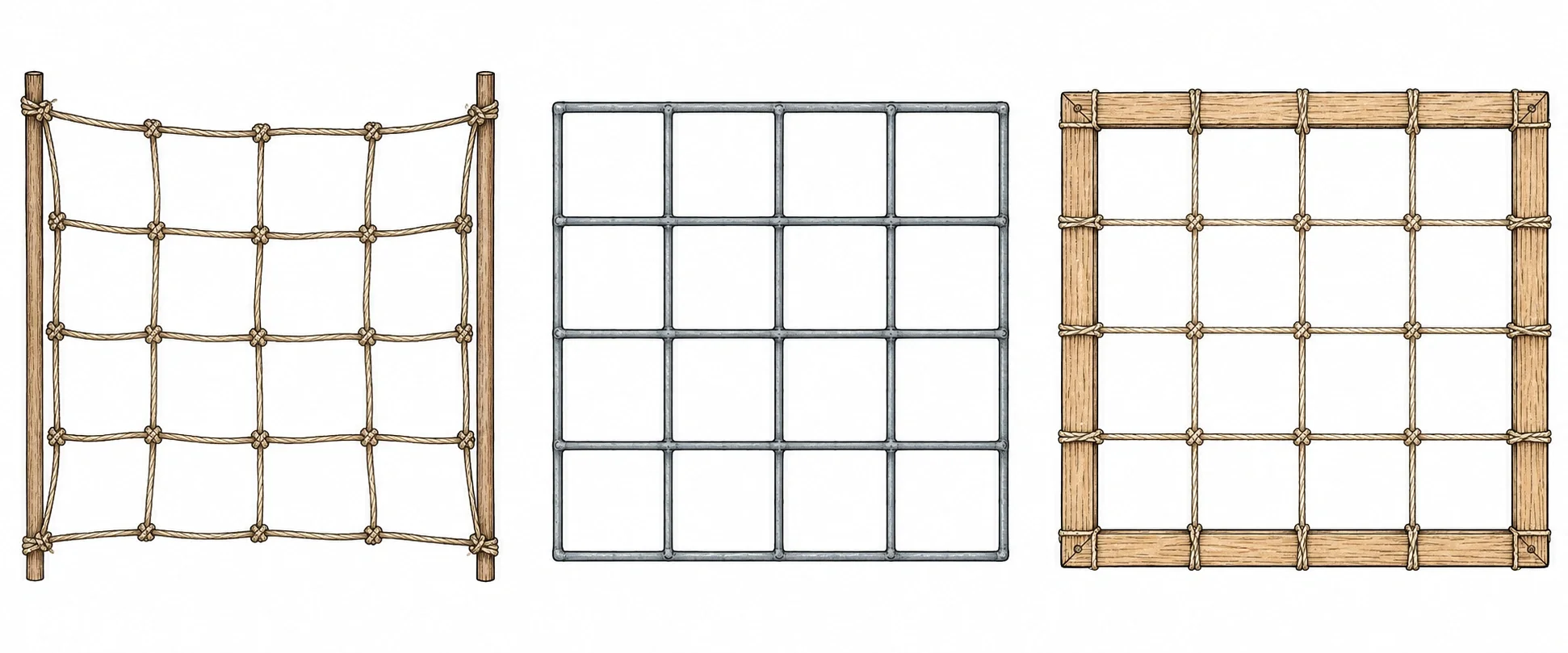
You don’t need much to set up a SCROG net. The key piece is a net or screen with a mesh size of about 2 x 2 in (5 x 5 cm) to 4 x 4 in (10 x 10 cm). Smaller squares make it hard to weave the shoots through. Bigger ones leave too much play, so you lose control. You can buy ready-made SCROG nets (German) made of nylon or plastic that are easy to mount in your grow tent.
You can also build your own. A simple wooden frame made of furring strips and strung with twine or fishing line works just as well. The frame needs to be sturdy enough to carry the weight of the branches during flowering. Heavy buds can put a lot of strain on the net, especially if your plant has been well fed.
The height of the net matters a lot. Rule of thumb: mount it about 8–12 in (20–30 cm) above the soil or the rim of the pot. That gives the shoots enough room to develop below the net before you guide them through the squares. With bigger containers, you can adjust the height to match.
Besides the net, you’ll need soft plant ties, twine or twist ties to position the shoots. Sometimes it’s enough to just tuck the shoots through the squares. Sometimes you’ll need to secure them lightly. Make sure no sharp edges or wires can damage the delicate stems.
- Mesh size: 2×2 in (5×5 cm) to 4×4 in (10×10 cm) recommended
- Ready-made nylon nets or a DIY wooden frame strung with twine
- Height above soil: 8–12 in (20–30 cm) as a guideline
- Sturdy frame needed to carry the weight of the buds
- Use soft tie material, no sharp edges
When Should You Start Cannabis SCROG (Screen of Green) Training?
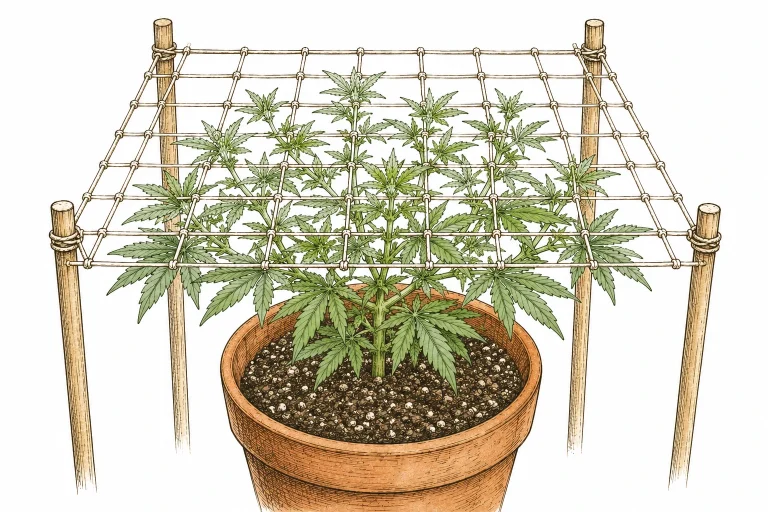
SCROG training starts in the vegetative stage, as soon as your plant is big enough to guide its first side shoots through the net. In practice, that means you mount the net before the shoots reach net height, and you start weaving as soon as they poke through. A good time is when your plant has about 5–7 nodes.
If you use topping as prep, wait at least one week after topping before you start weaving actively. Your plant needs time to recover and strengthen its new shoots. Topping right before you start the SCROG can cause stress that slows growth.
A common mistake is flipping to flower too early. Your net should be at least 60–70 % full before you switch the light cycle to 12/12. In flowering, the shoots stretch a lot more, which is known as the “flower stretch“. You use this stretch to fill the net completely without your plants hitting the light.
Throughout veg, check regularly which shoots are already poking through the net and redirect them into open squares. This takes daily attention, or at least every other day. The more time you put into the vegetative stage, the more even and productive your flowering stage can be.
- Start: from 5–7 nodes in the vegetative stage
- After topping: plan at least 1 week of recovery time
- Fill the net 60–70 % before switching to 12/12
- Daily checks and weaving of the shoots needed
- Use the stretch in early flower to fill the net
Cannabis SCROG (Screen of Green): Step-by-Step Guide
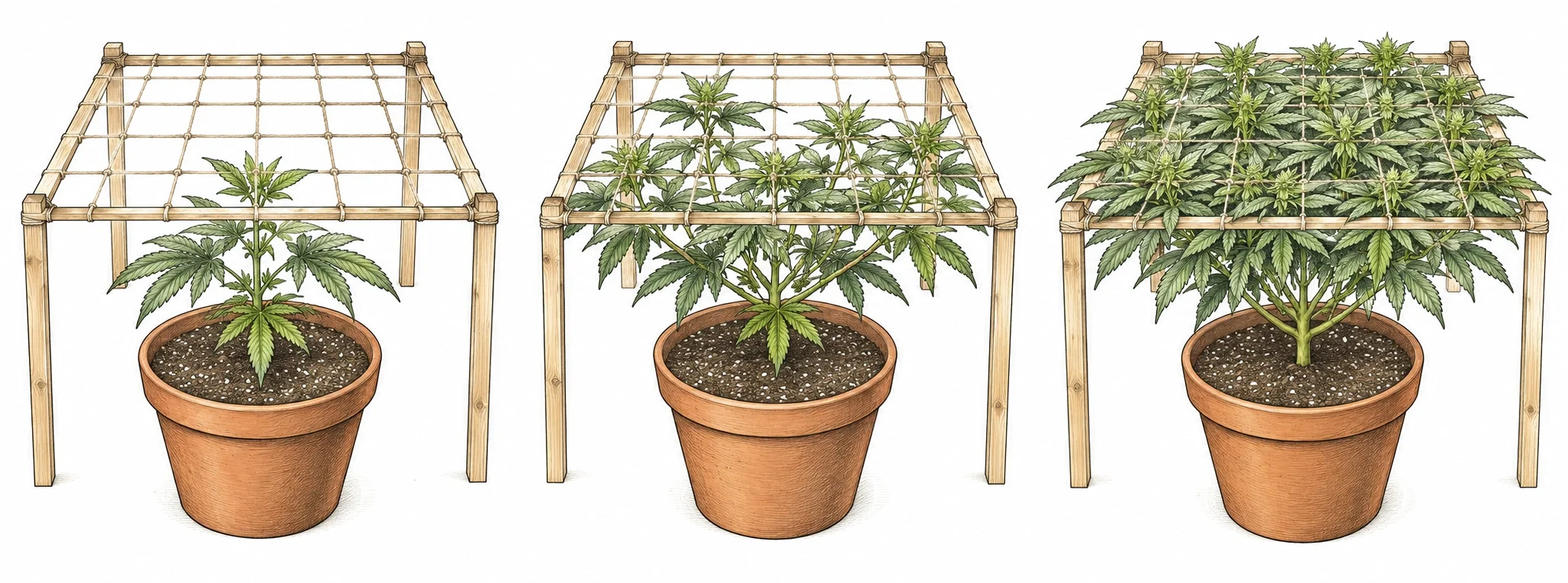
Step 1 – Prep your plant: Start with a photoperiod strain in a pot of the right size. Top above the 5th or 6th node to create several equal main colas. Let your plant recover and wait until the new side shoots are growing vigorously.
Step 2 – Mount the net: Build your SCROG frame or hang the ready-made net about 8–10 in (20–25 cm) above the soil. Make sure it’s firmly anchored and can’t shift. Check that the squares are even and there are no sharp ends.
Step 3 – Start weaving: As soon as shoots poke through the net, gently guide them into the next open square. The goal is to spread all the shoot tips evenly across the net. Shoots that grow too fast in one direction get redirected to emptier areas of the net. This phase takes patience and regular checks.
Step 4 – Extend veg: Keep your plant on an 18/6 light cycle until the net is about 60–70 % covered. Depending on the strain and the number of plants, this can take 4–10 weeks. A longer veg means more work, but also a lot more potential bud sites.
Step 5 – Flip to flower and use the stretch: Switch your light cycle to 12/12. During the first 2–3 weeks of flowering, the shoots still stretch quite a bit. Use that stretch on purpose to fill any empty squares left in the net. Once the stretch is over, stop moving new shoots and let the plant flower undisturbed.
- Step 1: Top your plant to set up several main colas
- Step 2: Mount the net securely at 8–10 in (20–25 cm)
- Step 3: Weave shoots evenly into empty squares
- Step 4: Extend veg until the net is 60–70 % full
- Step 5: Flip to flower and use the stretch to fill the net
Lollipopping and Defoliation to Boost Your SCROG
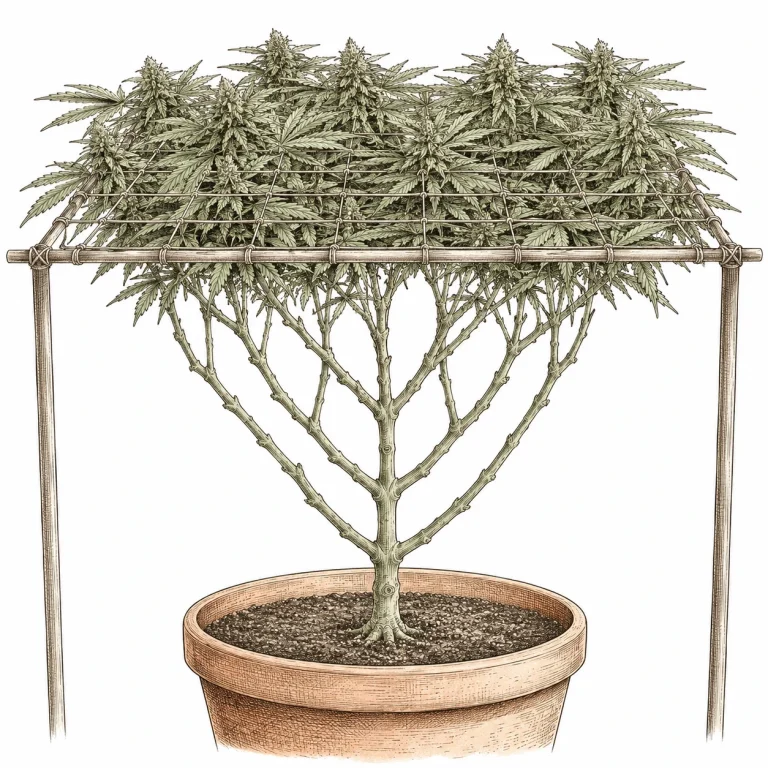
One of the most effective add-ons to a SCROG is lollipopping. You remove all shoots and leaves below the net that no longer get direct light. These lower areas would only produce popcorn buds anyway: small, airy flowers that aren’t worth much. By removing them, you help the plant send all its energy into the colas above the net.
Targeted defoliation at the start of flowering is also a smart move. Removing big, shade-casting fan leaves opens up the bud zone to more light and airflow. Too many leaves in the flowering area can also trap moisture, which raises the risk of mold. Never remove more than 20–30 % of the leaf mass at once, so you don’t overstress the plant.
After lollipopping and defoliation, make sure your plant gets enough nutrients and water. Stress increases its nutrient demand. Read up on common nutrient problems like nutrient burn and keep your pH in the optimal range so the plant can take up every nutrient. Calcium deficiency can also show up after heavy training, when the stressed plant uses up more minerals.
- Lollipopping: Remove everything below the net
- Popcorn buds are gone, energy flows into the main colas
- Defoliation at the start of flowering for better light penetration
- Never remove more than 20–30 % of the leaves at once
- After pruning: Check feeding and pH
Common Cannabis SCROG (Screen of Green) Mistakes
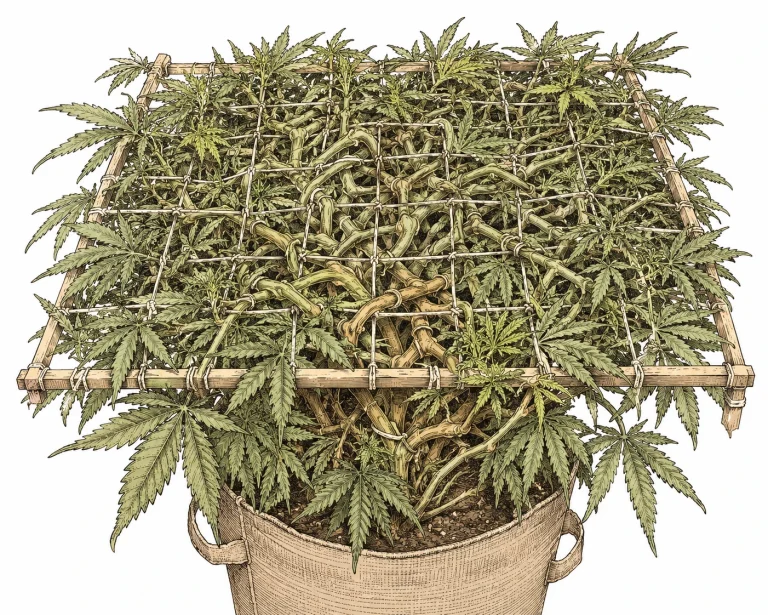
The most common SCROG mistake is flipping to flower too early. If your net is only half full when you switch to 12/12, you waste most of what this method can do. The stretch will fill a few more squares, but not enough. Be patient and wait until 60–70 % of the screen is covered.
Another mistake is poor airflow. A dense SCROG net packed with leaves and shoots can seriously restrict air movement. Humid, stagnant air in the bud zone is a breeding ground for botrytis (bud rot, gray mold). Make sure your ventilation is sized properly and that air also reaches the space below the net.
Many growers also underestimate how much access they’ll need. A SCROG net locks the plant in place so tightly that taking it out of the grow tent is nearly impossible without removing or damaging the net. So plan from day one how you’ll reach the root zone, pots and drainage holes, and test that access before the net is fully grown in.
When watering, also make sure every pot gets the same attention. Under a dense leaf canopy, it’s hard to tell which pot needs water. Lift your pots to check their weight, or use a moisture meter to avoid underwatering and overwatering.
- Mistake 1: Flipping to flower before the net is full enough
- Mistake 2: Poor airflow below the net
- Mistake 3: Plants locked into the net, no more access to the pots
- Mistake 4: Uneven watering because you can’t see what’s going on
- Mistake 5: Pruning too aggressively right before flowering
Yield and Results with the SCROG Method
So what can you realistically expect? A well-run SCROG can boost your yield significantly compared to an untrained plant. In a standard 2×2 ft (60×60 cm) grow tent, a single well-trained plant under a SCROG can give you somewhere between 80 and 150 grams of dried bud, depending on the strain, your light and how much care you put in. In bigger tents with powerful LED lighting, 200-400 grams per plant are possible too.
The key to big SCROG yields is even cola development. Since all the tops sit on the same level at the same distance from the light, your buds develop evenly. No dominant colas steal light from the rest, and no weak lower areas wither away into useless popcorn buds.
Another plus is consistent quality. Growers who run SCROG regularly report more uniform terpene profiles and more even trichome ripening, because the whole plant flowers under identical light conditions. That makes harvest easier too, since all the colas are ready at the same time.
- 2×2 ft (60×60 cm) tent: 80-150 g per plant is realistic
- Bigger tents with a strong LED: up to 400 g possible
- Even cola development thanks to a uniform canopy height
- No popcorn buds if you stay on top of lollipopping
- More even trichome ripening makes it easier to nail your harvest window
SCROG is often combined with supercropping (German) for extra branching, or used as the next step up from Sea of Green when you have more space to work with.
Frequently Asked Questions
How many plants do I need for a SCROG?
For a SCROG, one well-trained plant is often enough to fill a 2×2 ft (60×60 cm) or 32×32 in (80×80 cm) tent completely. In bigger tents, 2-4 plants can make sense. Check the cannabis laws where you live before growing. It’s better to veg one plant longer than to start too many at once.
Does SCROG work with autoflowers?
Basically yes, but the payoff is limited. Autoflowering strains have a short, fixed vegetative stage and are sensitive to stress. You can set up the net, but most autoflowers won’t fill it completely before flowering kicks in on its own. Photoperiod strains are a much better fit for SCROG.
What’s the best mesh size for a SCROG?
The ideal mesh size is between 2×2 in (5×5 cm) and 4×4 in (10×10 cm). Smaller squares make it harder to weave and redirect the branches. Bigger squares don’t give enough support, and the branches can grow out of control. Many experienced growers prefer 2×2 in (5×5 cm) or 2.5×2.5 in (6×6 cm) for precise training.
When should I stop tucking branches into the SCROG net?
Stop active tucking by the second or third week of flowering at the latest. By then, bud sites have formed, and moving the branches only causes unnecessary stress. From that point on, just let the plant flower and focus on giving it the best possible care.
Can I reuse my SCROG net?
Nets made of nylon or string can usually be cleaned and reused. After harvest, clean the net thoroughly with isopropyl alcohol or a mild cleaner to get rid of mold spores and pest eggs. Replace heavily soiled or damaged nets, since they can become a source of infection.
How high above the plants should the SCROG net be?
As a rule of thumb, set the net 8 to 12 in (20 to 30 cm) above the soil or the rim of the pot. With big pots, or when you plant deep in soil, you can go a bit higher. What matters is leaving enough room under the net for the main stem structure and for air to circulate.
The Bottom Line
The cannabis SCROG (screen of green) method is one of the most effective techniques for indoor growing. With a little planning and regular attention, it can boost your yields noticeably. The extra work in veg pays off many times over in flower, because you use your entire light footprint and all your colas ripen evenly. Combined with topping, lollipopping and good ventilation, SCROG is the complete package for ambitious home growers. Once you’ve run a SCROG, you probably won’t want to go back to untrained plants.
