

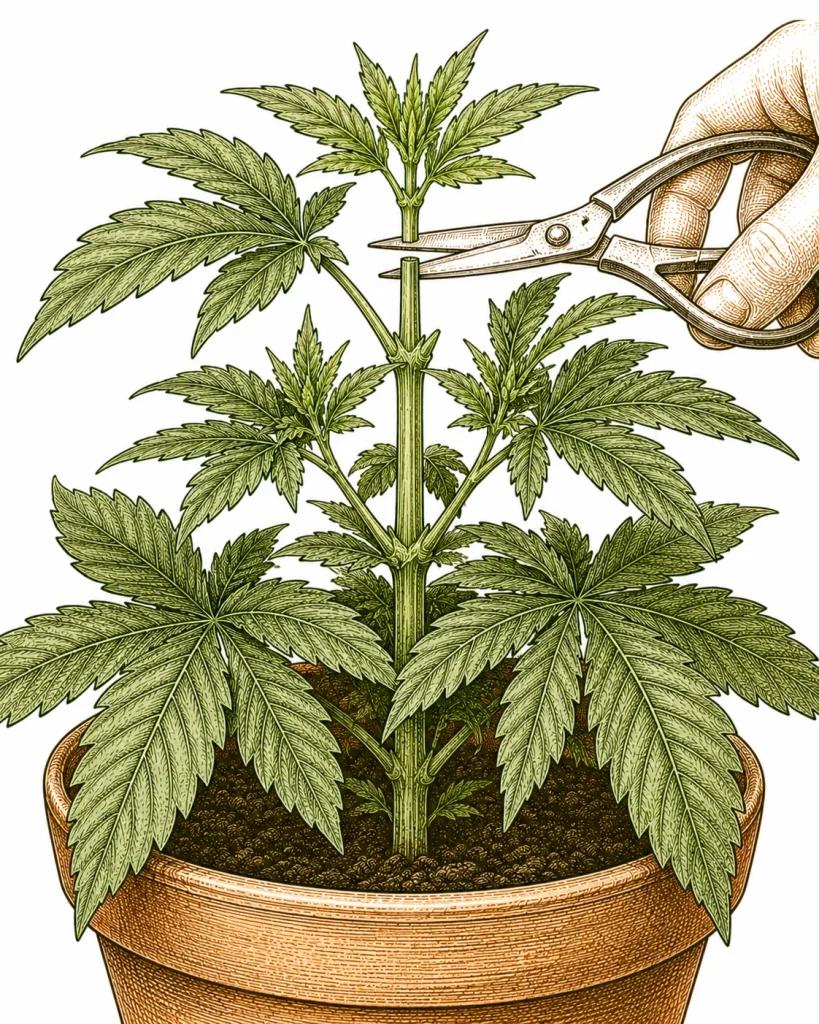
This cannabis topping guide is for every grower who wants more colas and a noticeably bigger yield. When you top a cannabis plant, you cut off the main growing tip on purpose, so the plant splits into two equal main branches. Instead of one long main cola, you get several strong bud sites. This high stress training (HST) technique is one of the most effective ways, indoors and outdoors, to spread light more evenly across your plant and get the most out of your harvest. Do it right and time it well, and you can pull a lot more quality colas at your next harvest.
What Is Cannabis Topping and How Does It Work?
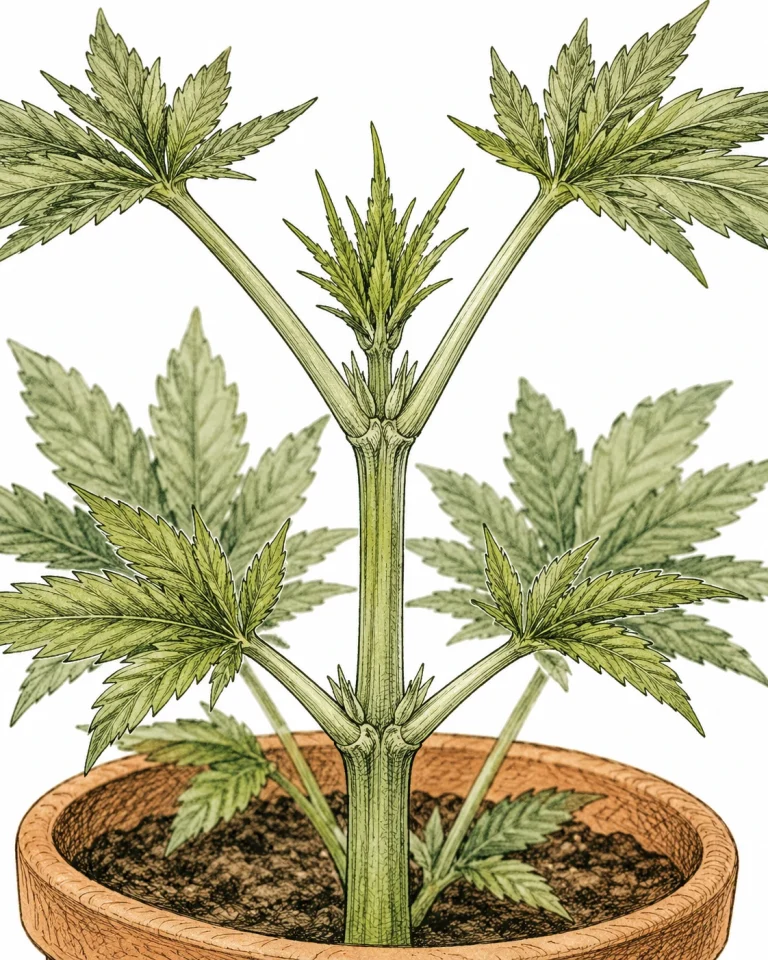
Topping means removing the apical meristem on purpose – the very top growing tip of the plant. Normally, apical dominance lets the main stem pull all the energy toward itself and holds back the side branches. Once you remove that dominant growing tip, the plant sends more growth hormones (cytokinins) into the remaining side shoots. The result: two new main branches of equal strength grow out from the topped main stem.
If you keep topping, you can cut these two new shoots again, which doubles the number of main branches – and the number of colas – each time. In theory, a plant you top three times can grow eight equal main branches. The plant gets wider and shorter, which is a big plus for indoor growing, because your grow light hits all bud sites more evenly. Topping counts as a high stress training (HST) technique because you cut directly into the living plant.
One big difference from low stress training is that topping puts your plant under temporary stress. After the cut, the plant needs a short recovery period of about two to five days before it starts growing actively again. This short pause in growth is normal and doesn’t mean you did anything wrong. In the long run, the benefits clearly win out – as long as your plant is healthy and you make a clean cut.
- Topping removes the main stem tip and creates two equal replacement shoots
- Breaks apical dominance with a targeted cut
- Repeated topping can give you even more colas
- Your plant grows bushier and more even
- Belongs to the high stress training (HST) techniques
How to Top Cannabis for More Colas: Step by Step
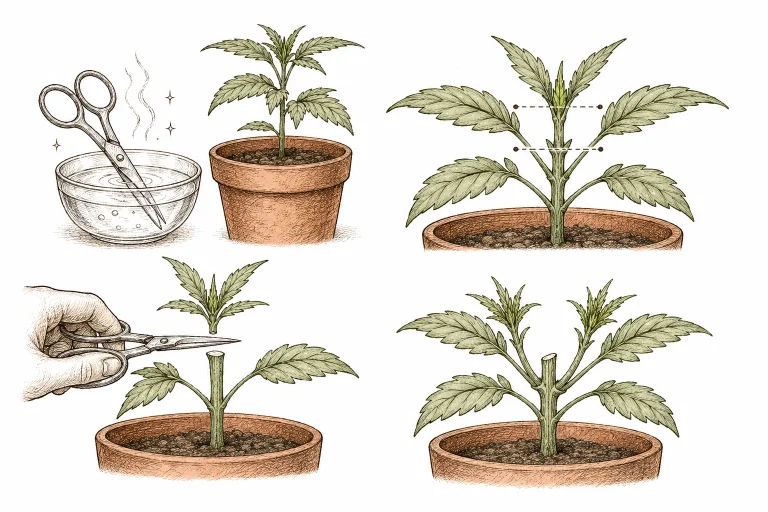
Before you start topping, make sure your plant is healthy and developed enough. The ideal time is usually once your plant has grown 4 to 6 nodes. Topping earlier can be too much for a young plant, while topping later can stretch your vegetative stage for no good reason. Also check that your plant doesn’t have any nutrient deficiency – a common one is calcium deficiency in cannabis, which can slow down recovery after the cut.
Step 1: Get your tools ready. Use sharp, sterile scissors (German) or a scalpel. Disinfect the blade with isopropyl alcohol (70%) to prevent infections. Dull or dirty blades crush the tissue and can raise the risk of infection a lot. Step 2: Find the cutting point. Locate the top node and the growing tip sitting on it. Make your cut right above the last fully developed pair of leaves – so between the 5th and 6th node. Step 3: Make a clean cut. Cut quickly at an angle of about 45 degrees. Avoid snipping the same spot several times. Step 4: Aftercare. Let the wound air-dry and avoid too much moisture right after the cut.
After topping, leave your plant alone for about two to three days and do only what’s necessary – water when the soil is dry and keep your lighting the same. Dialed-in watering matters a lot right now; check out our guide on how to water cannabis the right way. Within a few days, you’ll see the two side shoots take off and replace the old main stem. Once your plant has fully recovered, you can top it a second time after another 10 to 14 days.
- Your plant is ready for its first topping once it has 4 to 6 nodes
- Only top healthy plants with no deficiencies
- Use sterile, sharp scissors or a scalpel
- Make the cut just above the last fully developed pair of leaves
- Plan for 2–5 days of recovery after the cut
- Wait at least 10–14 days before topping a second time
Perfect Timing: When to Top Your Cannabis Plant
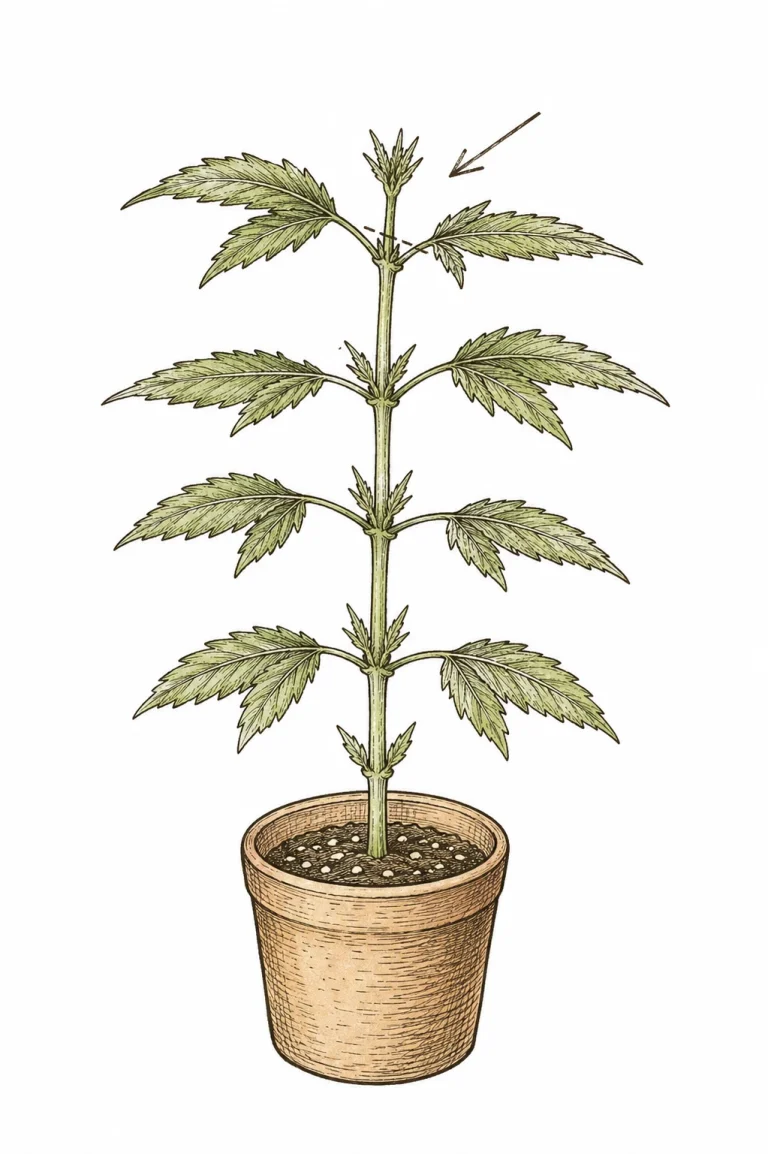
Timing is everything when you top cannabis. Top too early and you can seriously stress your plant and set its development back for good. As a rule of thumb, your plant should have at least four to five fully developed nodes and be actively growing. In the vegetative stage, the plant has enough energy to bounce back from the cut quickly. Once it hits the flowering stage, stop topping — the stress can seriously disrupt bud development and cut your yield instead of boosting it.
Be extra careful with autoflowering strains. Autos flower on a genetically fixed schedule, so they have less time to recover from stress. Many experienced growers advise against topping autoflowers altogether and go with gentler methods like LST (low stress training) instead. If you still want to top an autoflower, do it by day 20 to 25 after germination at the latest — and only if the plant looks strong and healthy.
With photoperiod strains, you have a lot more room to work. You can top multiple times and extend the vegetative stage as long as you like, giving the plant time to recover and build a bushy framework. Pair topping with other techniques like a SCROG (screen of green) net and you get an even, dense canopy of buds that makes the most of your light. Topping plus SCROG is considered one of the highest-yielding methods in indoor growing.
- At least 4–5 fully developed nodes before the first topping
- Veg stage only – never top during flowering
- Autoflowering strains: if at all, only up to day 20–25 after germination
- Photoperiod strains: topping multiple times is no problem
- Combine with SCROG for maximum yield
Topping vs. FIMing: The Differences and When to Use Each
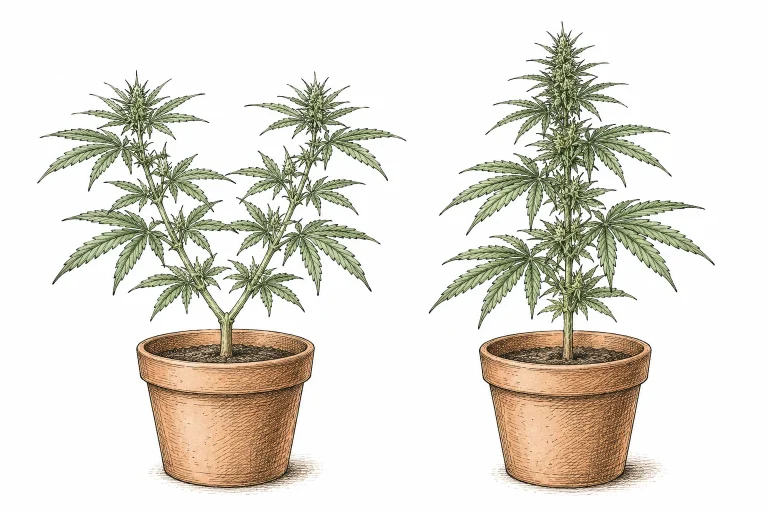
Topping and FIMing are both HST (high stress training) techniques aimed at producing more colas — but they differ a lot in how you do them and what you get. With classic topping, you remove the entire growth tip, which reliably gives you two new main branches. With FIMing (short for “F*** I Missed”), you only take off about 70 to 80 percent of the growth tip. The result is less predictable, but it can produce three to four new shoots instead of just two.
The downside of FIMing is the lack of precision: since you only remove part of the growth tip, results can vary a lot. If you want clean, symmetrical plants with well-defined main branches, topping is the better choice. FIMing causes slightly less stress and the plant recovers faster, but it doesn’t give you the same structural control. That’s why only topping works for techniques like mainlining or manifolding — it gives you the symmetrical base structure they need.
If you’re new to this, we recommend starting with classic topping, since the results are easier to control and predict. FIMing is a better fit for experienced growers who want more shoots at once and can handle less consistent results. You’ll find both techniques explained in detail in our overview of all cannabis growing techniques, where we compare LST, SCROG, SOG (sea of green), lollipopping and more.
- Topping: remove 100% of the tip – reliably gives you 2 new shoots
- FIMing: remove 70–80% of the tip – gives you 3–4 shoots, but uneven ones
- Topping is the go-to for symmetrical structures (mainlining, manifolding)
- FIMing causes slightly less stress
- Beginners: topping is the easier option to control
How to Top Cannabis for More Colas: Common Mistakes and How to Avoid Them
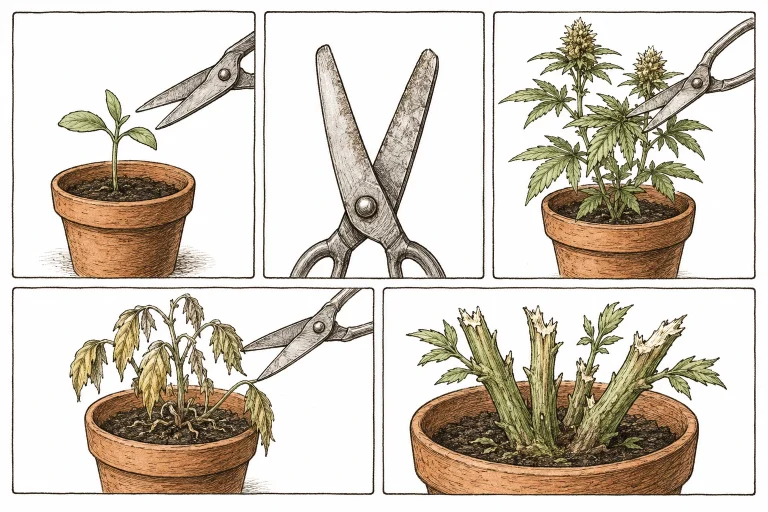
The most common topping mistake is bad timing. Either you top too early (before the 4th node) or during the flowering stage. Another classic mistake is using dull or unsanitized tools. Crushed plant tissue heals more slowly and leaves the door wide open for fungal infections. Always sanitize your scissors with isopropyl alcohol and sharpen the blade regularly. One clean cut always beats several sloppy snips.
Another common mistake is topping plants that are already stressed or sick. If your plant shows a nutrient deficiency, is dealing with pests or has been weakened by poor watering, hold off on topping until it has fully recovered. Cutting a weakened plant can keep it from bouncing back and push it into long-term stress. Check your plant’s health carefully before every cut. Often the real issue is cannabis nutrient burn, which can look a lot like stress after a cut – don’t mix up these symptoms.
The recovery period after topping is also easy to underestimate. Many growers get impatient and change their light schedule, feeding schedule or watering intervals right after the cut. That adds stress your plant doesn’t need. Keep every parameter steady and only step in again once the new shoots are growing strong. Keep an eye on pH during this time, too: the wrong cannabis pH can block nutrient uptake and slow down healing after topping a lot.
- Never top with dull or unsanitized scissors
- Don’t top if your plant is already stressed or sick
- No topping during the flowering stage
- Keep all parameters steady after the cut
- Dial in pH and feeding before topping
- Plan for a recovery period of at least 2–5 days
Combining Topping: Get Maximum Results by Pairing It With Other Techniques
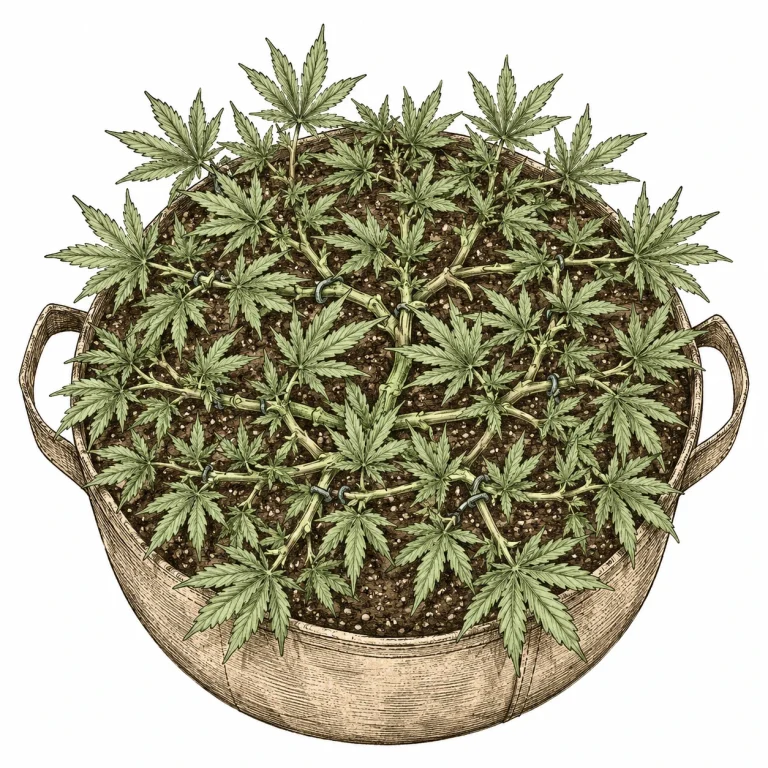
Topping really shines when you combine it with other growing techniques. The most common and effective combo is topping plus LST (low stress training). Once the two new main branches have grown out, you bend them outward with wire or string. The result is a flat, wide canopy that makes the most of your grow light. This combo is ideal for grow tents with limited height.
For ambitious growers, multiple toppings paired with SCROG (screen of green) netting is the gold standard. You stretch the trellis netting about 8 to 12 in (20 to 30 cm) above the pot and weave the shoots through the squares after each topping. This creates an even canopy of buds where every single cola gets maximum light. This method takes more planning and time, but it delivers the highest yields per square foot.
Another interesting combo is topping followed by lollipopping in the late vegetative stage. Topping multiplies the number of main colas up top, while lollipopping removes the lower shoots and leaves that barely get any light and only waste the plant’s energy. With this combo, all the energy from photosynthesis goes into the upper, well-lit colas. The result: fewer buds, but noticeably fatter and more resinous ones. Want to know which techniques fit your setup? Our big overview of all cannabis growing techniques covers it in detail.
- Topping + LST: ideal for short grow tents, flat canopy
- Topping + SCROG: maximum yield per square foot
- Topping + lollipopping: focuses all energy on the top colas
- Multiple toppings for exponentially more main branches
- Plan your combo before the first cut
A more advanced take on topping and clones is Monster Cropping. Want to improve light penetration even more? Combine topping with targeted defoliation.
Topping is often paired with supercropping for even more branching. If you overdo the cuts, it can turn into real training stress – watch for the warning signs.
Frequently Asked Questions
When can I top my cannabis plant?
Your plant should have at least four to five fully developed nodes and be actively growing. That usually means about three to five weeks after germination. Topping earlier than that can set your plant back for good.
How often can I top a cannabis plant?
With photoperiod strains, you can in theory top as often as your vegetative stage allows. Each topping doubles the number of main branches. Give your plant at least 10 to 14 days to recover between cuts. Experienced growers often top three or four times.
Can I top autoflowering strains?
Yes, but be very careful. Autoflowering strains run on a fixed schedule, so they have little time to recover. If you top at all, do it by day 20 to 25 after germination at the latest. Many growers skip topping on autos and go with LST instead, since it’s less stressful for the plant.
What’s the difference between topping and FIMing?
Topping removes the growing tip completely, which reliably gives you two new main branches. FIMing only takes off about 70 to 80 percent of the tip. That can produce three or four new shoots, but the results are harder to control. For symmetrical structures and techniques like mainlining, topping is the better choice.
How long does it take a plant to recover after topping?
Most healthy plants show the first signs of recovery after two to five days – the new side shoots start growing actively. During this time, keep all your conditions stable and avoid adding any other stress. Sick or weakened plants can recover more slowly or not at all.
What tools do I need for topping?
Sharp, sterile scissors or a scalpel work best. Disinfect your tool with isopropyl alcohol (70%) before every use. Dull blades crush the plant tissue and raise the risk of infection. One clean cut beats several attempts to fix it.
Can topping really boost your yield?
Yes, if you do it right. Topping gives you several even main colas instead of one tall one. Combined with LST or SCROG, it can significantly increase your yield per square foot, because the light gets spread more evenly across all bud sites.
As with any pruning, hygiene decides how well your plant recovers. For more on clean cutting techniques and how plants heal their wounds, check out the Bavarian State Institute for Viticulture and Horticulture (German).
Advanced techniques that build on topping: FIM (a gentler variation) and mainlining (for maximum symmetry and yield).
The Bottom Line
Topping is one of the most proven ways to boost your yield, both in indoor and outdoor growing. With the right prep, good timing from the 4th to 5th node and clean tools, you can top your plants safely and effectively. Topping really shines when you combine it with LST or a SCROG net: you get a dense, even canopy with lots of equal-sized colas. Once you’ve got the basics down, topping will likely become a regular part of your grow routine.
