

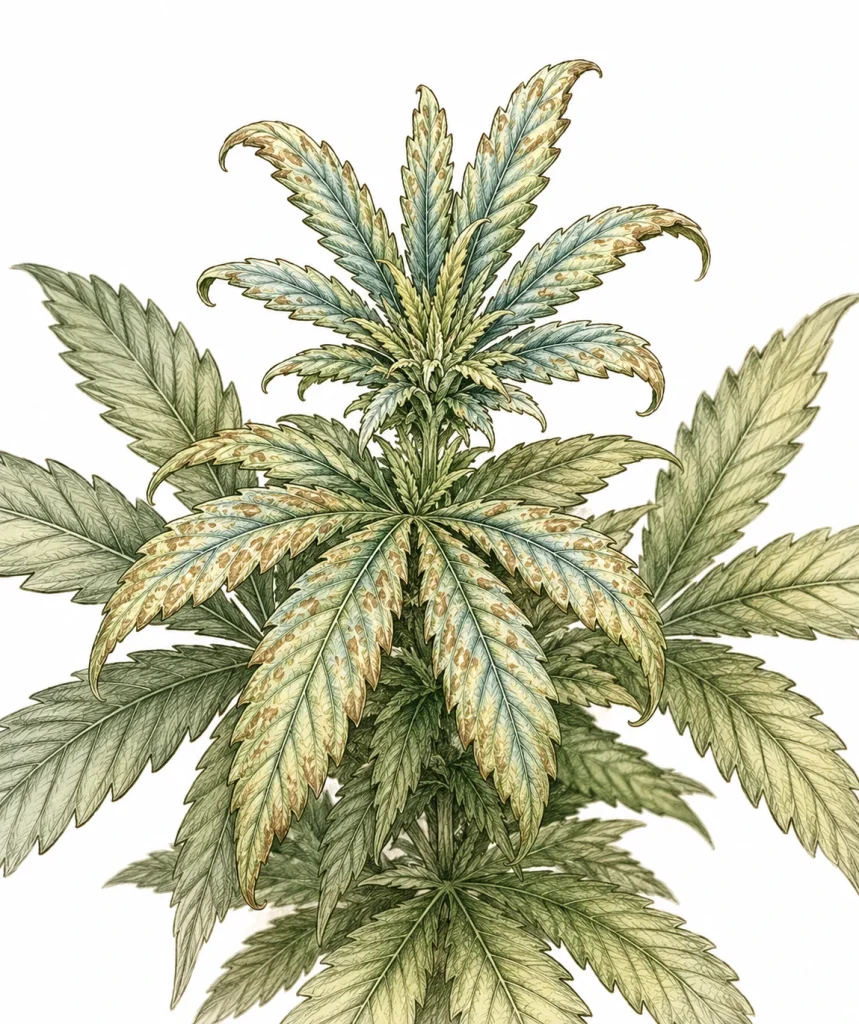
Spotting copper deficiency in cannabis isn’t always easy. A shortage of this micronutrient often shows up late, and it’s easy to mistake for other problems. Copper plays a key role in photosynthesis, metabolism and the formation of chlorophyll in your cannabis plant. When your plant doesn’t get enough, the tissue of the youngest leaves suffers first, and the plant can’t reach its full potential. In this article, you’ll learn how to reliably spot the typical signs of copper deficiency, what usually causes it, and what you can do to get your plant back on track fast.
What Is Copper and Why Does Cannabis Need It?
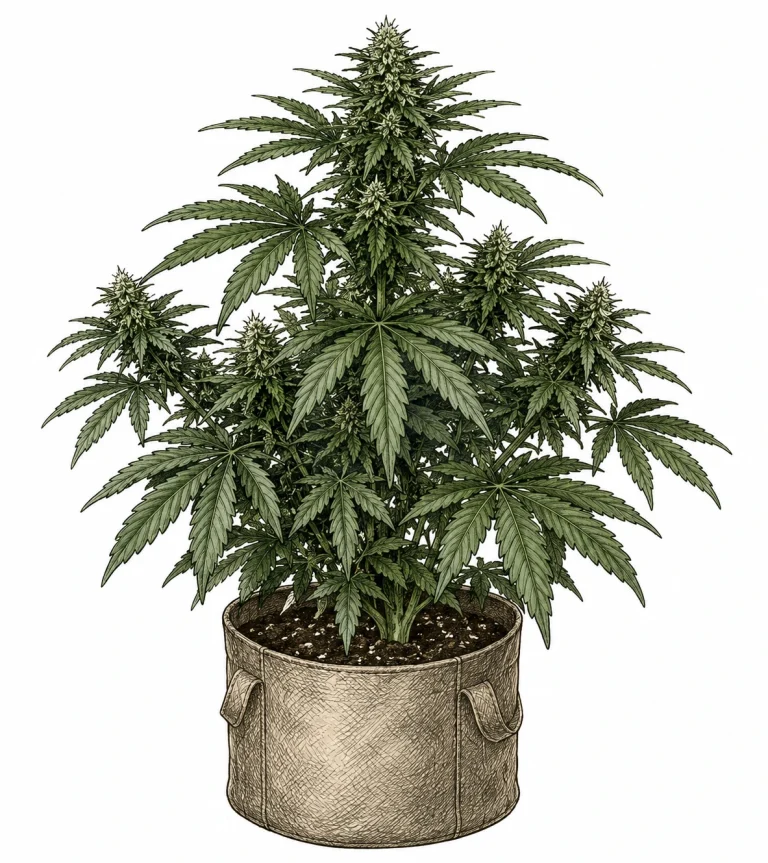
Copper is one of the micronutrients cannabis only needs in very small amounts. That doesn’t make it unimportant. Quite the opposite: copper is involved in a whole range of key biochemical processes your plant needs to grow at its best. It acts as a catalyst in enzyme systems, supports photosynthesis and helps with chlorophyll formation and protein synthesis.
Copper also helps your plant use nitrogen and carbohydrates, and it strengthens cell walls. That indirectly makes it important for resistance to pathogens and pests. Because cannabis only needs trace amounts of copper, a true deficiency is less common in practice than, say, a nitrogen or calcium deficiency. But when it does show up, take it seriously: an untreated copper deficiency can hold back growth for good. According to the Julius Kühn Institute (German), deficiency symptoms are likely once leaf levels drop below 5 mg of copper per kilogram. Light, humus-rich soils that hold copper poorly are hit the hardest.
One key point: copper is an immobile nutrient inside the plant. That means it can’t be moved from older leaves to new growth. So copper deficiency symptoms in cannabis show up mainly on young, freshly formed leaves and growing tips – not on the older, lower leaves the way mobile nutrients do.
- Copper is needed for enzyme systems and photosynthesis
- Supports chlorophyll formation and protein synthesis
- Strengthens cell walls and boosts disease resistance
- Immobile nutrient: symptoms show up on young leaves
- A true deficiency is rare, but serious when it happens
How to Spot Copper Deficiency in Cannabis: The Typical Symptoms
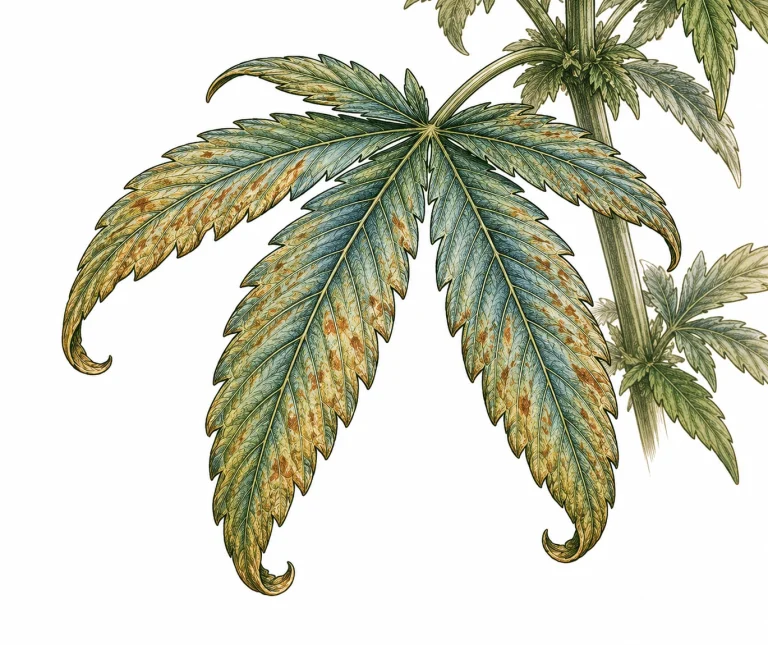
If you want to spot copper deficiency in cannabis, keep a close eye on the growing tips and young leaves. The first and most obvious symptom is an unusual blue-green or bluish sheen on the young leaves. They lose their normal vibrant green and look dull, almost metallic.
As the deficiency progresses, brownish or bronze spots and dead tissue (necrosis) appear, starting at the leaf edges and tips. The edges of affected leaves tend to bend down or curl – a classic sign growers call “clawing.” The leaves often feel leathery and stiff. On top of that, the growing tips can lose their natural direction and droop or twist.
In advanced stages, leaf tissue can die off early, especially along the edges. At the same time, overall growth may slow down. In the flowering stage, buds can open too early or stop developing prematurely. Keep in mind that none of these symptoms on its own clearly points to copper deficiency – always look at the big picture and rule out other causes like pH problems or other nutrient deficiencies. For a full diagnosis, check out the plant diagnosis overview on PlantClue.
A common problem when spotting copper deficiency is mixing it up with other deficiencies. Iron deficiency also causes yellowing on young leaves, but without the typical blue-green tint and without the curling. Magnesium deficiency, on the other hand, starts on the older leaves. If you’re not sure it’s really copper deficiency, it’s worth reading our in-depth article on micronutrient deficiencies in cannabis so you can rule out every possibility step by step.
- Blue-green or bluish, metallic-looking color on young leaves
- Brownish to bronze spots along leaf edges and tips
- Leaf edges curling or bending downward (clawing)
- Drooping or twisted shoot tips
- Slower overall plant growth
- In advanced stages: necrosis and early tissue die-off
- Symptoms show up first on young leaves and growing tips
Causes: Why Does Copper Deficiency Happen in Cannabis?
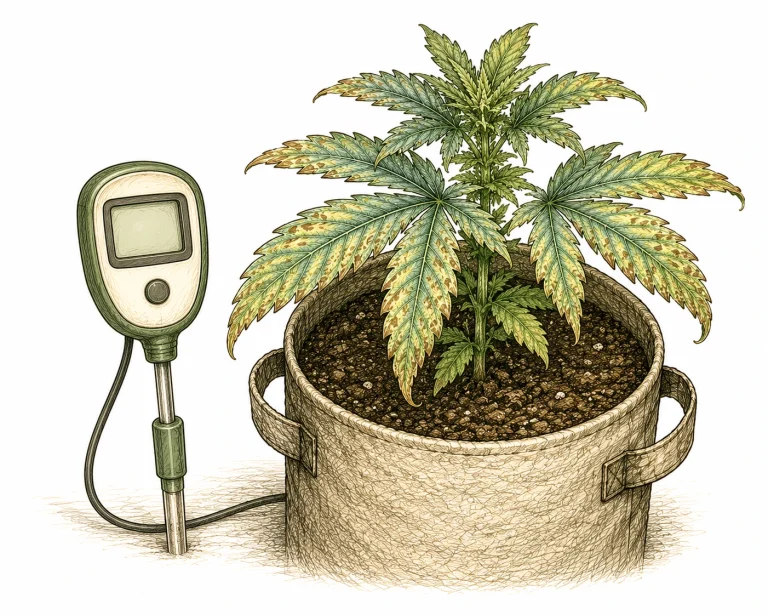
In most cases, copper deficiency in cannabis doesn’t happen because your growing medium or water actually lacks copper. Much more often, the real culprit is the wrong pH. Your plant’s roots can only take up copper within a certain pH range. In soil, the sweet spot is 6.0 to 7.0. In hydroponics, it’s 5.5 to 6.5. If your pH falls outside that window, the plant simply can’t absorb the copper that’s there. The copper is present, but it stays chemically locked out.
A pH that’s too high is the most common trigger for this kind of induced copper deficiency. At pH 7.5 or higher, copper becomes less and less soluble, and your roots can barely reach it. A very low pH below 5.5 can also get in the way of copper uptake. That’s why checking and correcting your pH should be step one whenever you suspect a deficiency. If you want to dial in your cannabis pH the right way, we’ve got a detailed guide for you.
Another common trigger is too much phosphorus in your growing medium or nutrient solution. Phosphorus and copper compete for uptake at the roots. So overdoing it with phosphorus-heavy nutrients can cause a copper deficiency even when there’s plenty of copper available. The same goes for too much zinc or iron, which can also block copper uptake.
Other possible causes include a true lack of copper in the medium, for example in heavily depleted soil or during very long grows without any nutrient top-ups. Poor aeration, compacted medium or soggy soil can also slow down nutrient uptake across the board and indirectly lead to copper deficiency symptoms. Want to make sure your medium is set up right? You’ll find helpful info in our guide to indoor growing for beginners.
- Wrong pH: the most common cause (ideal: 6.0–7.0 in soil, 5.5–6.5 in hydro)
- High pH locks out copper
- Too much phosphorus blocks copper uptake (nutrient competition)
- Too much zinc or iron can crowd out copper
- A true lack of copper in the medium (depleted soil)
- Compacted medium or waterlogged roots slow down nutrient uptake in general
- Water temperature too high or too low in hydroponics
How to Fix Copper Deficiency in Cannabis: Step by Step
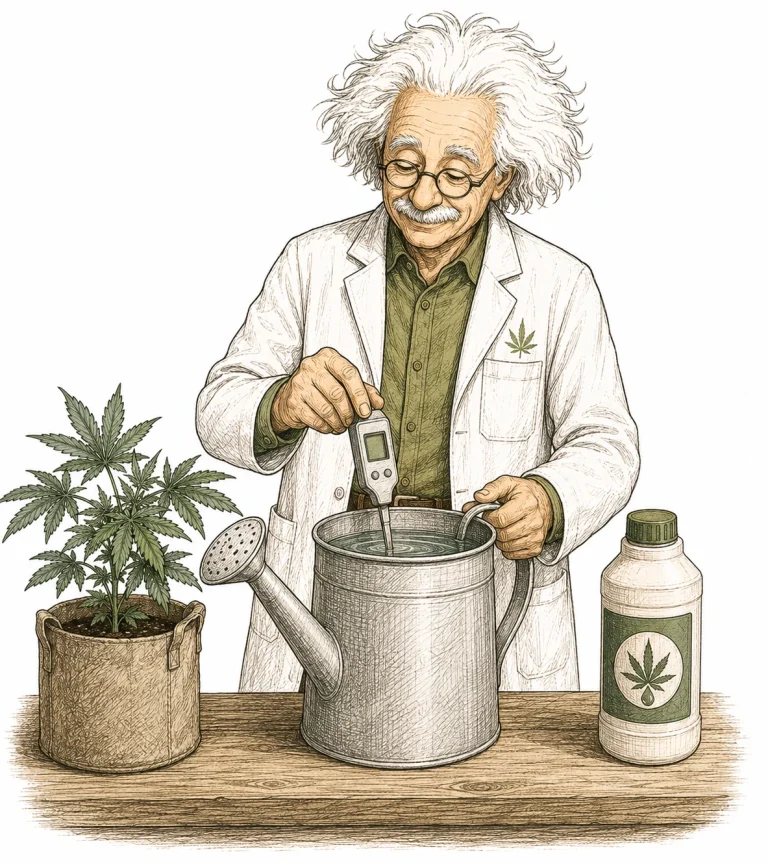
Before you start treating a suspected copper deficiency, it pays to work through it step by step. Always start by measuring the pH of your growing medium and your water. As mentioned above, the wrong pH is the most common cause, and fixing the pH alone often solves the problem, no extra copper nutrients needed. Use a calibrated digital pH meter if you can, since simple test strips are often too inaccurate.
If your pH is outside the ideal range, adjust it gradually. Lower it with pH Down (usually based on phosphoric or nitric acid) or raise it with pH Up (usually potassium hydroxide or potassium carbonate). Don’t change the pH too fast, since big swings can add even more stress to your plant. A good rule of thumb: shift it by no more than 0.5 points per watering.
If your pH is already in the ideal range, take a look at your feeding schedule next. Are you using a phosphorus-heavy nutrient? Then cutting back on phosphorus for a while can help improve copper uptake. Also check whether you might be overdoing other nutrients. Read our article on how to spot and fix nutrient burn in cannabis to make sure you don’t accidentally make things worse.
If these steps aren’t enough, you can add copper directly. Copper chelate nutrients work best because they offer especially good bioavailability. Chelates are organically bound metal compounds that are less affected by pH than simple mineral salts. Many high-quality cannabis micronutrient products already contain balanced amounts of copper, manganese, iron, zinc and other trace elements. When it comes to dosing, less is more. Start at half the recommended dose and watch how your plant responds.
Another option for an acute deficiency is foliar feeding. You spray a heavily diluted copper solution directly onto the leaves, which absorb the nutrient through their surface. This method works faster than feeding through the root zone, but it also leaves more room for error: concentrations that are too strong can burn the leaves. Always foliar feed during the dark period or under dimmed light so the leaves don’t burn under the lamp. Also keep in mind that copper toxicity can harm cannabis, especially the roots. Copper-based fungicides are an often underestimated source of excess copper, so always go easy on the dose.
- Step 1: Measure the pH and bring it into the optimal range (6.0–7.0 in soil)
- Step 2: Check your feeding schedule, especially phosphorus and zinc levels
- Step 3: For a true deficiency, use a copper chelate product
- Step 4: Start at half the dose and watch the response
- Optional: Foliar feed with a heavily diluted copper solution for an acute deficiency
- Always foliar feed during the dark period
- Caution: Copper toxicity can harm cannabis – never overdo it
How to Tell Copper Deficiency Apart from Other Problems
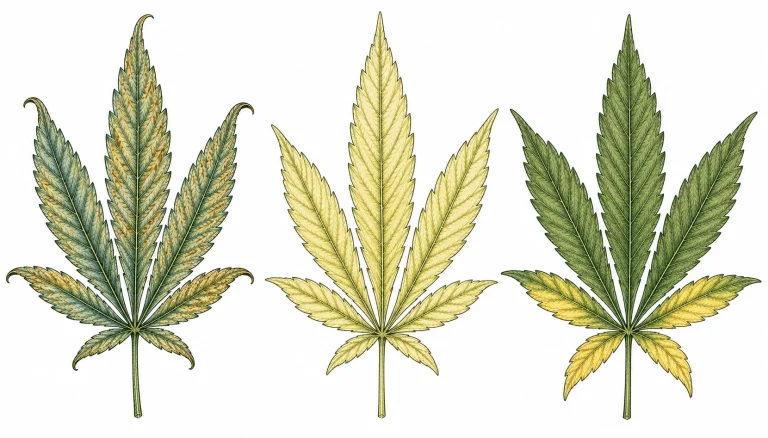
As mentioned earlier, spotting copper deficiency in cannabis is tricky because the symptoms are easy to confuse with other problems. The most important distinction is between copper deficiency and iron deficiency. Both affect young leaves, but iron deficiency typically shows up as even yellowing of the leaf blade while the veins stay green (interveinal chlorosis). Copper deficiency, on the other hand, shows that typical blue-green tint and curling leaf edges, which you won’t see with iron deficiency.
Magnesium deficiency is another common mix-up, as is molybdenum deficiency, which shows up as yellow-orange blotchy discoloration on older and middle leaves whose edges tend to curl up rather than down. Magnesium deficiency, however, always starts on older, lower leaves, because magnesium is a mobile nutrient that the plant moves from old leaves to new growth. So if you see problems working their way from the bottom up, magnesium deficiency is more likely than copper deficiency. Another common mistake: when leaves curl down, many growers first think of heat stress or overwatering. With copper deficiency, though, the curling comes with brownish edges and that typical dull, metallic leaf color.
Heat stress can also be mistaken for copper deficiency, since both can make leaves curl. Heat stress usually happens when temperatures run too high and often affects all leaves evenly, while copper deficiency targets the youngest shoots and leaves. If your plant shows yellow leaves, that’s your cue to dig deeper into the cause. If you see several deficiencies at once, a general pH problem may be blocking the uptake of multiple nutrients.
- Iron deficiency: even yellowing of young leaves, no blue tint, no curling
- Magnesium deficiency: starts on older leaves (mobile nutrient)
- Zinc deficiency: shows up in similar spots as copper, but with a different leaf shape and discoloration
- Heat stress: affects all leaves evenly, no bronze-colored necrosis
- Overwatering: overall drooping, no specific spots or discoloration
- Several deficiencies at once: often points to a pH problem as the root cause
Preventing Copper Deficiency: Protect Your Plant from Day One
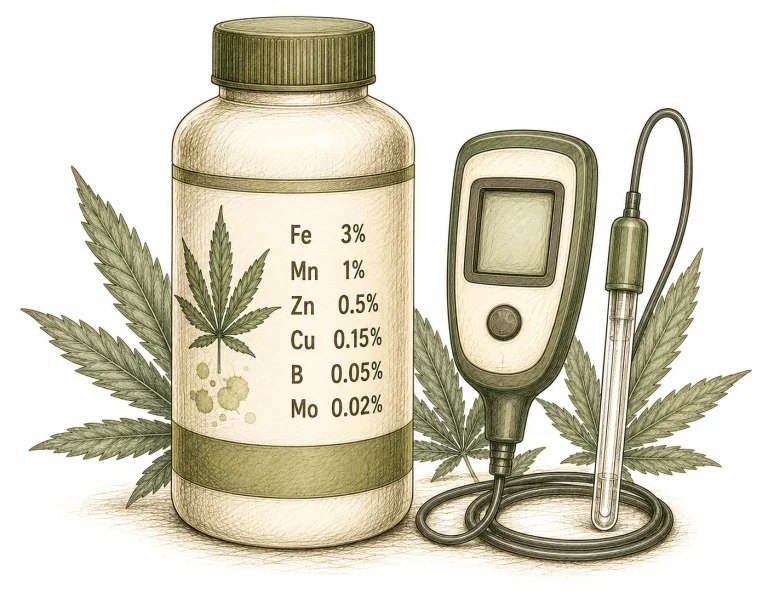
As with most nutrient problems, preventing copper deficiency is easier than treating it. Your most important preventive step is to consistently check and correct the pH of your growing medium and your water. Measure the pH regularly – ideally every second or third watering – and step in early if it drifts out of the optimal range. That’s why a well-calibrated pH meter is one of the best investments any grower can make.
Also choose a high-quality complete nutrient that contains all the key micronutrients, including copper, in a balanced ratio. Budget base nutrients often leave micronutrients out, which can lead to deficiencies during longer grow cycles or periods of vigorous growth. Pair a good base nutrient with a dedicated micronutrient supplement on a regular basis and you’re on the safe side. Avoid heavily overdoing phosphorus, because it can block copper uptake.
The quality of your growing medium matters just as much. Fresh, high-quality cannabis soil usually holds enough nutrients for the first four to six weeks, including trace elements like copper. After that, it’s time to start feeding. Also make sure your medium doesn’t get too compacted and stays well aerated, so the roots can do their job. Want to learn more about proper watering and keeping your medium in good shape? Check out our article on how to water cannabis the right way.
Finally, keep a close eye on your plants. Copper deficiency usually develops slowly, and if you step in early, it’s easy to correct before any lasting damage sets in. Take regular photos of your plants so you can spot changes over time. If you notice new leaves looking duller and more blue-green than usual, that’s an early warning sign worth checking out.
- Check pH at least every second watering
- Use a high-quality complete nutrient with balanced micronutrients
- Avoid overdoing phosphorus, since it blocks copper uptake
- Use a quality growing medium and replace your soil regularly
- Keep your medium well aerated
- Watch your plants closely and document early changes
- Make a calibrated pH meter part of your basic gear
Other micronutrient deficiencies such as boron deficiency, manganese deficiency or zinc deficiency can cause similar growth problems on young shoots – looking at each one’s key symptoms helps you tell them apart.
Frequently Asked Questions
How can I spot copper deficiency in cannabis at a glance?
The most obvious signs are a blue-green or bluish, metallic tint on young leaves, combined with leaf edges curling downward and bronze spots on the leaf tips. Since copper is an immobile nutrient, symptoms always show up first on the newest leaves and growing tips, not on the older lower leaves.
What’s the most common cause of copper deficiency in cannabis?
In most cases, there’s no real shortage of copper at all – the wrong pH is blocking uptake. When pH climbs above 7.0 in soil, copper becomes unavailable to the roots. So your first step should always be to check and correct your pH.
Can I fix copper deficiency with home remedies?
Home remedies for copper deficiency aren’t a great idea, because the dose is hard to control. Your best bet is a dedicated copper chelate supplement or a complete micronutrient product that contains all trace elements in balanced amounts. Always dial in your pH first – often that’s the only fix you need.
How fast will my plant recover from copper deficiency?
Leaves that are already damaged won’t fully recover and may keep brown spots or dead tissue. New leaves, however, should come in normal and healthy once the treatment works. You’ll usually see the first improvements on new growth after seven to fourteen days.
Is copper deficiency or copper toxicity more dangerous for cannabis?
Surprisingly, copper toxicity is far more dangerous than a deficiency. At higher concentrations, copper is toxic to plants, especially to the roots. Too much copper stunts root development, blocks the uptake of other nutrients and can even kill the plant. That’s why you should always dose sparingly and start with half the recommended amount.
Can I fix copper deficiency in cannabis with a foliar spray?
Yes. With an acute copper deficiency, foliar feeding can be a useful extra step because the leaves absorb the nutrient directly. Use a heavily diluted solution and always spray during the dark period or with the lights off to avoid burning the leaves. Keep in mind that foliar feeding doesn’t replace fixing your pH, which is usually the real cause.
Looking for nutrients to correct the deficiency? Check out our recommended gear.
Bottom Line
Spotting copper deficiency in cannabis takes a trained eye on your plant’s young leaves and growing tips. The typical blue-green discoloration, curled leaf edges and bronze dead spots are clear warning signs you shouldn’t ignore. Most of the time, the wrong pH is the real culprit, so a simple pH correction can be enough to solve the problem. With regular checks, a solid feeding schedule and a quality growing medium, you can usually avoid copper deficiency completely.
