

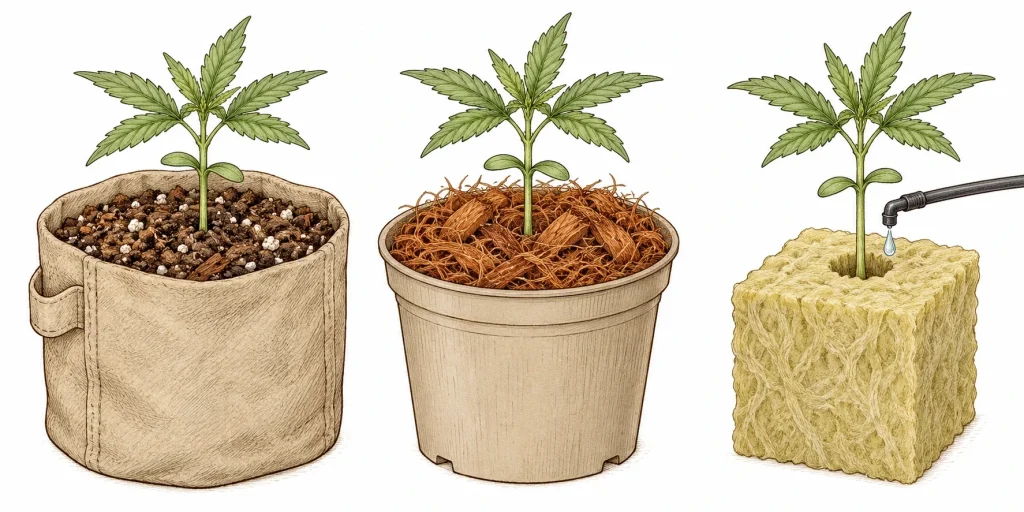
Picking the right growing medium has a huge impact on your plants’ growth, health and yield. That’s why a solid cannabis growing medium comparison is a must for every grower. Coco coir, peat-based mix and rockwool are the three most popular media for indoor growing. They differ a lot in structure, water retention, nutrient supply and handling. Each one has its own strengths and weaknesses, and how much they matter depends on your experience, your setup and your goals. In this guide, you get an honest, hands-on comparison of all three, so you can pick the one that fits you best.
Cannabis Growing Medium Comparison: What Makes a Good Medium?
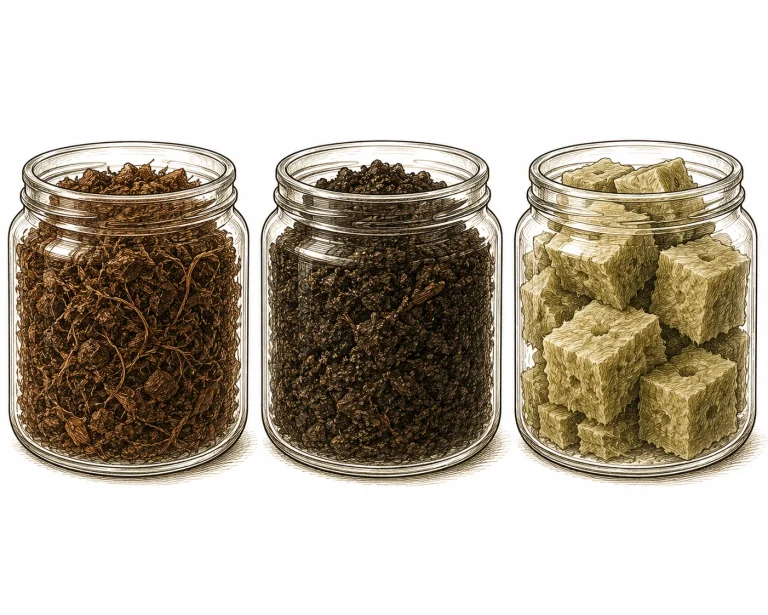
Before we dig into the three media, it helps to know what a cannabis growing medium actually needs to do. It’s not just something for the roots to hold on to. It directly affects how water, oxygen and nutrients reach your plant. The ideal medium is airy enough to keep the roots well oxygenated, holds enough water without getting waterlogged, and lets you control feeding precisely.
Three core factors matter most: water-holding capacity (how long the medium stays moist), air-to-water ratio (how much pore space there is compared to water), and pH buffering (how strongly the medium shifts or stabilizes your pH). On top of that come practical points like availability, cost, sustainability and how much work it takes day to day. Once you learn how to water cannabis the right way, you’ll quickly see that the medium plays a central role, because every medium reacts differently to watering intervals and watering amounts. Understanding these differences is the foundation for every other decision in your grow.
- Water-holding capacity: How long does the medium stay moist?
- Air-to-water ratio: Enough oxygen for healthy roots
- pH behavior: Does the medium buffer pH or stay neutral?
- Nutrient content: Does it come pre-fertilized or inert?
- Handling: How easy is it to work with every day?
- Sustainability: Can you reuse it, or is it single-use?
Coco Coir in the Cannabis Growing Medium Comparison: Pros and Cons
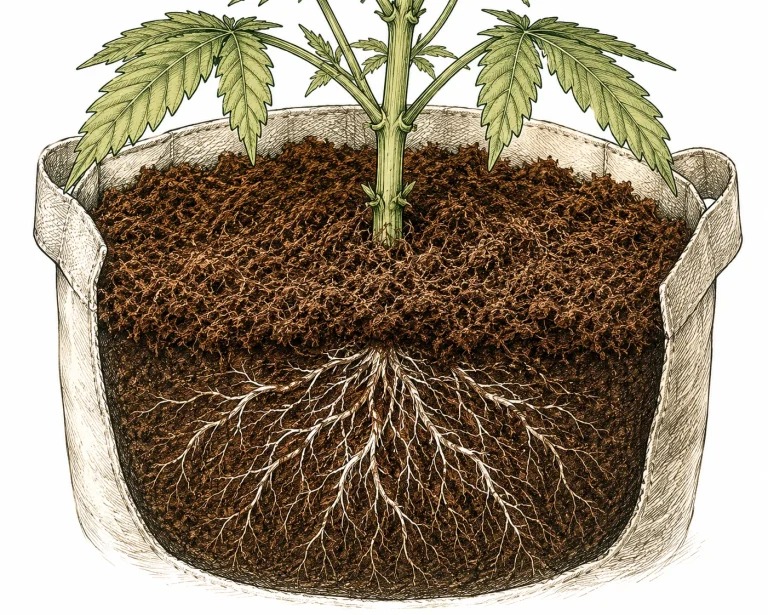
Coco coir is made from coconut husk fibers and is now one of the most popular cannabis growing media of all. The reason is a unique mix of good water retention and excellent aeration. Coco can soak up to nine times its own weight in water, yet it releases that water slowly and evenly without suffocating the roots. That makes it a lot more forgiving than pure hydro or rockwool setups, but more responsive than heavy peat-based mixes.
Ad / affiliate link: Recommended coco coir for growing cannabis: Check out coco coir on Amazon →
Coco is an inert medium. That means it contains no nutrients on its own and gives you full control over feeding. At the same time, coco has a natural cation exchange capacity, so it tends to hold on to calcium and magnesium. If you switch to coco, add a Cal-Mag supplement to your feeding schedule. Calcium deficiency in cannabis is actually one of the most common problems in coco when feeding isn’t adjusted. Keep the pH in coco between 5.5 and 6.2, which means checking it regularly.
In terms of sustainability, coco is a renewable resource and a byproduct of coconut processing. After a harvest, you can treat it with enzymes and reuse it, which cuts your running costs. In a head-to-head cannabis growing medium comparison, coco really shines in semi-hydro setups, fast growth and flexible feeding control. For beginners, it’s a good choice with a catch: all that control also means more responsibility when you feed. If you want to buy coco coir (German), our product comparison helps you choose.
- Pros: Excellent air-to-water ratio, inert, reusable, sustainable
- Pros: Fast growth thanks to great root oxygenation
- Pros: Easy to combine with hydro systems
- Cons: Holds on to calcium and magnesium – Cal-Mag needed
- Cons: No nutrient buffer – feeding mistakes show up fast
- Cons: May need rinsing and pH adjustment before use
Peat-Based Mix in the Cannabis Growing Medium Comparison: A Closer Look at the Classic
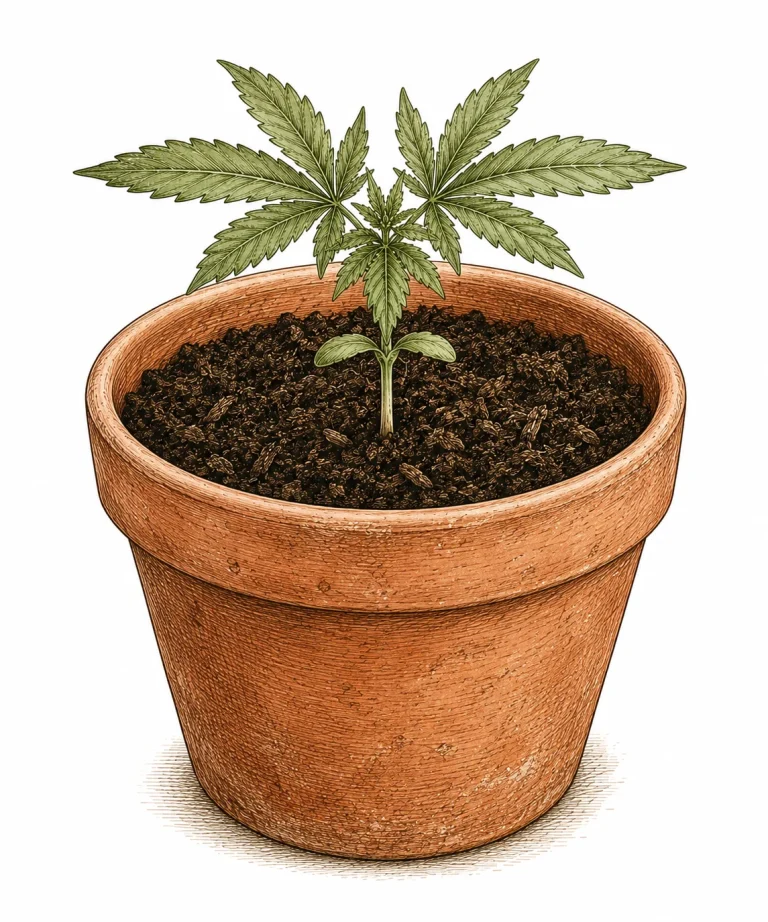
Peat-based soil is the classic growing medium and the first choice for many beginners. You’ll often find it as regular potting soil or as a special cannabis soil at grow shops. Peat forms from dead plant material in bogs and is naturally rich in organic matter. Commercial peat-based cannabis mixes often already contain perlite, starter nutrients and pH buffers, which makes them extra beginner-friendly. Your plant has food from day one. A pre-fertilized (“hot”) soil can carry your plant through the first four to six weeks without any extra nutrients.
Ad / affiliate link: Recommended peat-based cannabis soil: Cannabis soil on Amazon →
The biggest plus of peat-based soil is its natural buffering. It can absorb small feeding mistakes, and pH stays more stable than in coco coir (coco) or rockwool. In short, the soil “forgives” a lot of beginner slip-ups. But peat also has clear downsides. It compacts over time, which can cut off oxygen to the roots. If you water too often, you can quickly end up with waterlogged soil and root problems down the line. Peat is also tough on the environment. Harvesting peat bogs eats up resources and harms the climate, so many eco-minded growers switch to peat-free alternatives. According to the Bavarian Garden Academy (LWG Bayern), peat harvesting releases large amounts of greenhouse gases. That’s a key reason why experts in the cannabis growing medium comparison increasingly prefer coco or peat-free soils.
In the Cannabis Plant Diagnosis hub, we often see problems tied directly to picking the wrong growing medium. Heavy, pre-soaked peat soil in pots that are too big is a classic trigger for overwatering. The ideal pH range for peat-based soil is 6.0 to 7.0, the typical range for soil. Despite its limits, peat is still the easiest choice for beginners. Just make sure you use a quality brand-name mix and loosen it up with perlite at a 70:30 ratio. Want to know which ready-made brand-name soils work well? Check out our comparison on buying cannabis soil (German).
- Pros: Beginner-friendly, pre-fertilized, good pH buffer
- Pros: Easy to find, affordable, lots of specialized cannabis mixes
- Pros: Often comes with natural soil life already in it
- Cons: Compacts over time – higher risk of waterlogging
- Cons: Not eco-friendly – peat harvesting hurts the climate
- Cons: Less precise nutrient control than coco or rockwool
- Cons: Can’t be reused without thorough reconditioning
Rockwool in the Cannabis Growing Medium Comparison: A Pro Hydro Medium With Clear Rules
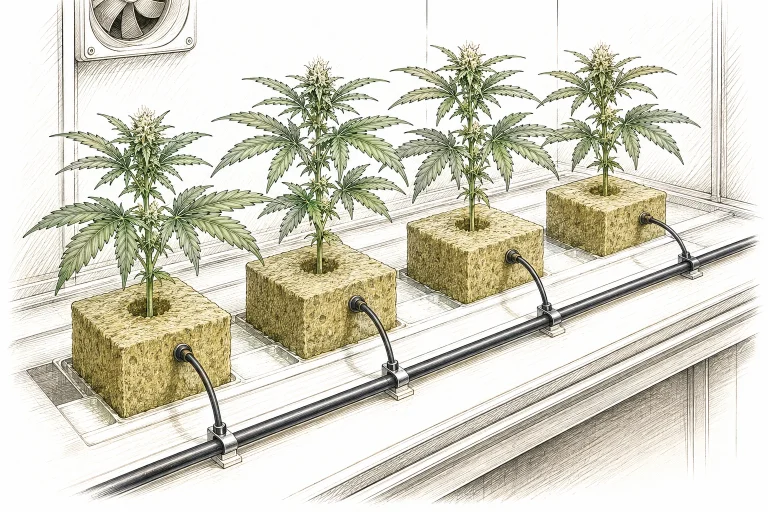
Rockwool (also called stone wool or mineral wool) is a completely inert medium. It’s made from molten volcanic rock or industrial slag that gets spun into fibers. It contains zero nutrients and has no cation exchange capacity. That means you, the grower, have 100 % control over every single nutrient parameter. Rockwool comes in cubes (German), blocks and slabs, and it’s the go-to medium for professional hydroponics systems. Ad / affiliate link: Rockwool cubes on Amazon → Its even structure lets you calculate water volume and nutrient solution precisely.
pH is a big deal in any cannabis growing medium comparison. Fresh rockwool is strongly alkaline, with a pH of up to 8.0. You must soak it in a pH-adjusted solution (pH 5.5) before use. During the grow, you need to keep your nutrient solution strictly between pH 5.5 and 6.5. Any drift can quickly lead to nutrient lockout. If you haven’t spent much time learning how to dial in pH for cannabis, rockwool can push you to your limits fast. That’s why we recommend it for experienced growers who already know their way around hydroponics.
In the hands of an experienced grower, rockwool can deliver outstanding results. Thanks to great root oxygenation, plants can grow extremely fast. You can adjust feeding down to the second, and your harvests are easy to repeat. On the flip side, rockwool isn’t biodegradable and is hard to dispose of. After use, it simply ends up as waste. For your health, always wear gloves and a mask when handling it, because the fine fibers can irritate your skin and airways.
- Pros: Completely inert – maximum control over nutrients
- Pros: Excellent oxygen supply to the roots
- Pros: Ideal for hydroponics systems and professional grows
- Pros: Uniform structure for precise nutrient solution calculations
- Cons: Has to be pH-adjusted before use
- Cons: Not biodegradable – disposal can be a problem
- Cons: Only suited to experienced growers with basic pH/EC know-how
- Cons: You need protective gear when handling it (the fibers irritate skin and airways)
Cannabis Growing Medium Comparison: Side-by-Side Table and Decision Guide
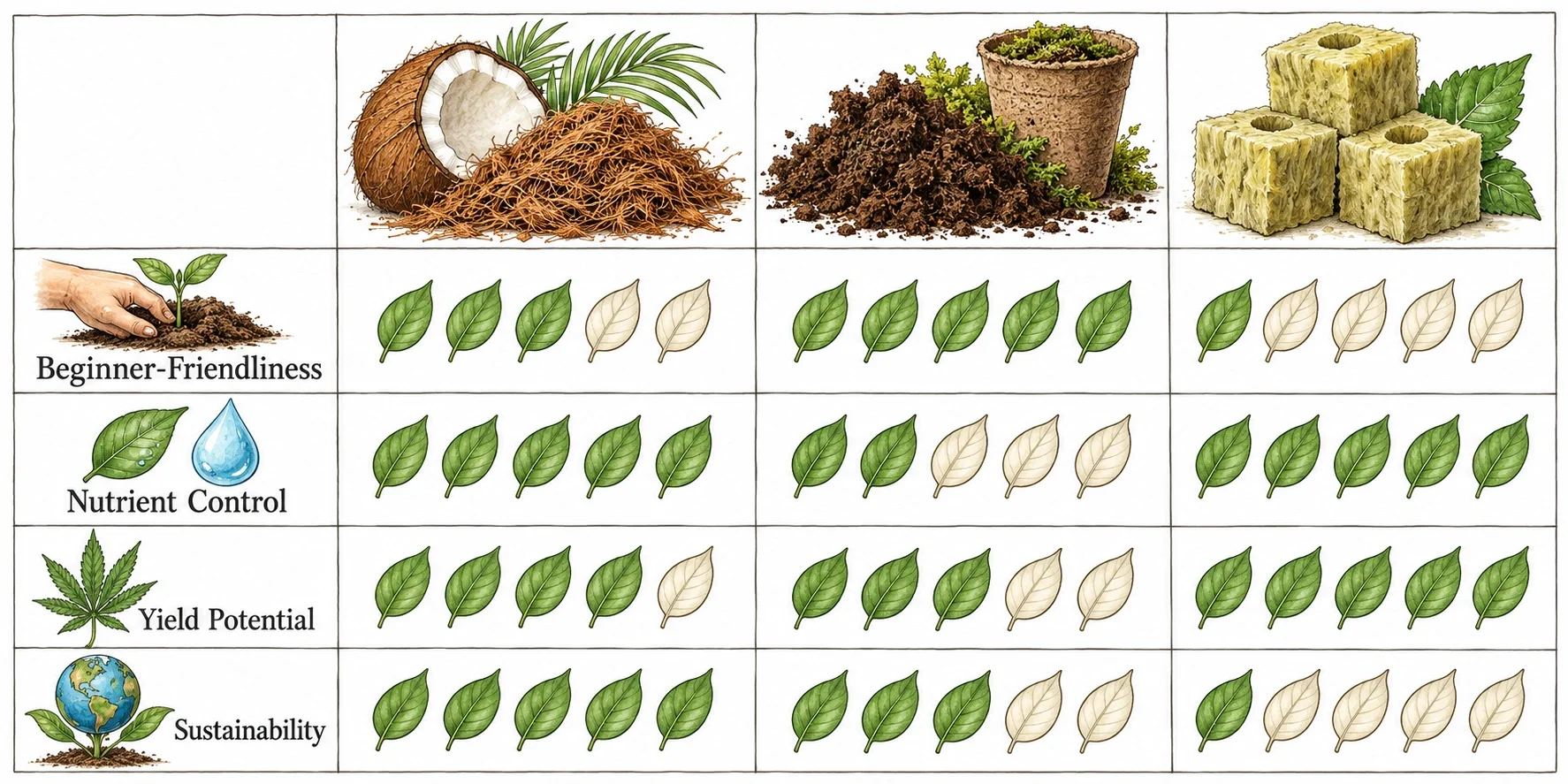
To put the three media side by side, here’s the hands-on overview: coco coir scores highest for yield potential, flexibility and sustainability. It combines the control of a hydro setup with the buffering tolerance you’d expect from organic systems. Peat-based mix wins on beginner-friendliness and availability – it needs less daily attention and forgives small mistakes. Rockwool delivers the highest yield potential in the hands of pros, but it takes the most technical effort and is the most questionable from an environmental point of view.
These questions can help you decide: How much experience do you have with nutrient solutions? Are you running a hydroponics system or watering by hand? How much does sustainability matter to you? Do you plan to reuse your growing medium? If you’re just starting your first indoor cannabis grow, a pre-fertilized peat mix combined with perlite is usually your safest bet. More experienced growers who want to dial things in more precisely often switch to coco. Rockwool is the pick if you run a closed hydroponics system and already have experience with EC and pH control.
Another common mistake is looking at the growing medium in isolation. Your medium always works together with your watering schedule, your feeding strategy and your water source. Nutrient burn in cannabis, for example, shows up right away on inert coco or rockwool because there’s no buffer – on pre-fertilized peat, the same mistake may only show up after a delay. Knowing this helps you read symptoms correctly and faster.
- Beginners: peat mix > coco > rockwool
- Maximum yield: rockwool > coco > peat
- Sustainability: coco > peat > rockwool
- Nutrient control: rockwool = coco > peat
- Cost (upfront): peat < coco < rockwool
- Reusability: coco > rockwool (limited) > peat (no)
- pH handling: peat (easy) > coco (medium) > rockwool (demanding)
Cannabis Growing Medium Comparison: Mixes and Hybrid Approaches
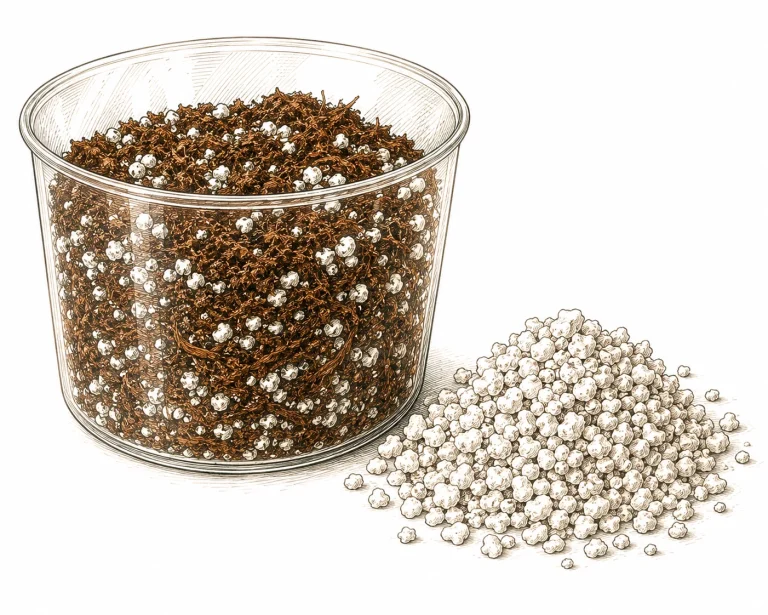
In practice, comparing growing media shows one thing: many experienced growers don’t use a pure medium – they use targeted mixes. The most popular combo is coco coir with 20–30 % perlite. It improves drainage even more and helps keep the roots from getting waterlogged, even if you water generously. Which perlite and clay pebbles you can buy for this (German) is covered on a separate page. Ad / affiliate link: Perlite on Amazon → Peat mix is also often loosened up with perlite – a ratio of 70 % peat to 30 % perlite is a proven standard. With rockwool, on the other hand, mixes aren’t common, because the uniform fiber structure of the slabs and cubes is the foundation of the whole system.
Another interesting hybrid approach: start in peat-based soil during germination, then do a transplant into coco at the start of the vegetative stage. That way, seedlings benefit from the gentle, buffered environment of soil, while the mature plant gets maximum oxygen at the roots in the more responsive coco. This method takes some getting used to when it comes to pH adjustment and nutrient dosing – a good reference is our guide to yellow cannabis leaves and their causes, since switching media can temporarily cause deficiencies.
If you’re into organic growing and want conditions as close to nature as possible, you can use a peat-based mix as the foundation for a living soil setup. You work in compost, worm castings, bokashi and microorganisms to build a living soil ecosystem. This approach is the opposite of rockwool or coco. Instead of maximum control, it’s about a complex system and biological synergy. Whichever way you go, the key is consistency and a solid understanding of how everything in your setup works together.
- Coco + 20–30 % perlite: The classic pro mix for great drainage
- Peat + 30 % perlite: Beginner-friendly, lower risk of waterlogged roots
- Peat for germination → coco in veg: A gentle transition that gives you more control
- Peat-based living soil: For organic growing with biological synergy
- Rockwool usually stays pure: Mixes are uncommon and not needed
- 50/50 coco-peat mix: A solid middle ground for semi-hydro beginners
Common Growing Medium Mistakes and How to Avoid Them
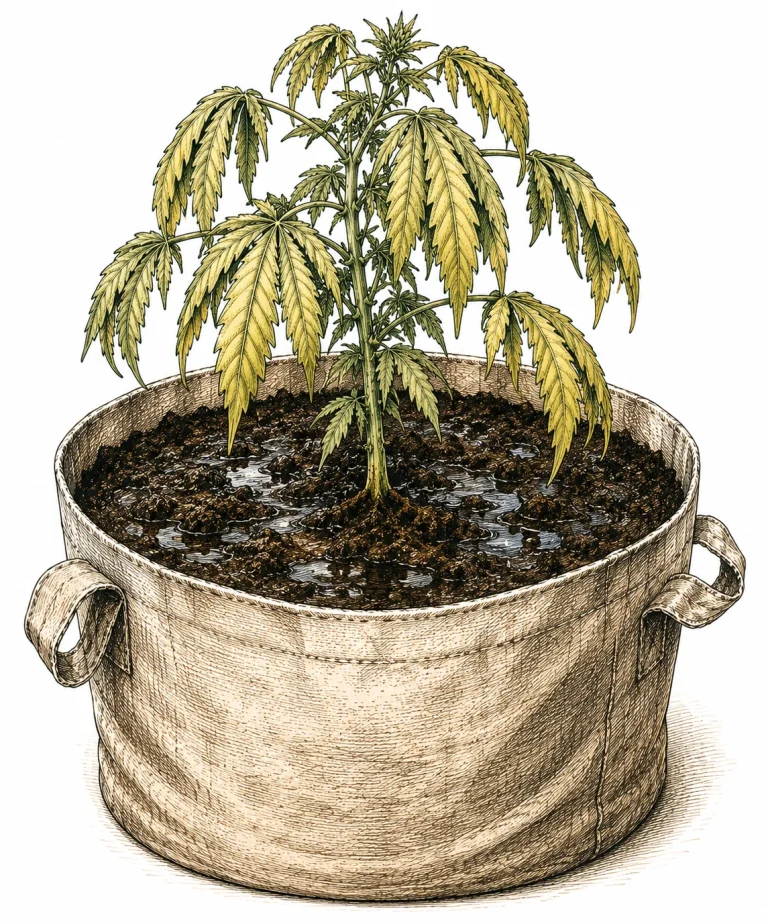
No matter which medium you pick in this cannabis growing medium comparison, some mistakes show up again and again. The most common one is a pot that’s too big for the plant. With too much medium, it dries out too slowly. The root zone stays wet all the time, and that can lead to a lack of oxygen and root rot. If problems keep coming back, check out the cannabis nutrient deficiency overview, since waterlogged medium can make existing deficiencies worse. Rule of thumb: Start seedlings in small 16–32 oz (0.5–1 L) pots and only transplant once the roots have filled the current pot.
Another classic mistake is the pH of your feed. Lots of growers mix their nutrients and forget to measure and adjust the pH afterward. The result can be nutrient lockout, which shows up faster or slower depending on the medium. In rockwool and coco, these problems can appear within a few days. In buffered peat, it sometimes takes weeks. That’s why regular readings with a reliable pH meter aren’t an optional extra. They’re essential, whatever medium you grow in.
Finally, many growers underestimate how much your watering schedule depends on the medium. Coco, for example, should be watered more often and in smaller amounts than peat. With big plants, that can mean several times a day. Rockwool, on the other hand, is very sensitive to both overwatering and underwatering. If you match your watering schedule to your medium and check the root zone regularly, you set the stage for healthy, high-yielding plants. In any medium, consistency and close observation are what make the difference.
- Pot too big: Medium doesn’t dry out → root rot and lack of oxygen
- pH not checked before watering → nutrient lockout, deficiency symptoms
- Rockwool not pre-soaked → pH too high, plant struggles to get going
- Coco fed without Cal-Mag → calcium and magnesium deficiency
- Watering coco too rarely → drought stress even though there seems to be enough water
- Compacted medium that was never loosened → poor drainage, waterlogged peat
Frequently Asked Questions
What’s the best growing medium for beginner cannabis growers?
In this cannabis growing medium comparison, the top pick for beginners is a pre-fertilized peat-based mix with 30 % perlite. It already contains nutrients for the first few weeks, buffers small feeding mistakes and is easy to find. Coco is a good second choice if you’re ready to work with nutrient solutions. Save rockwool for later, once you have some experience with pH and EC control.
Do I need to prep rockwool before using it?
Yes, definitely. Fresh rockwool is highly alkaline, with a pH of up to 8.0. Before first use, soak it for at least 24 h in a pH-adjusted nutrient solution at pH 5.5. Without this prep, your plant can hardly take up nutrients, and deficiency symptoms can show up very quickly.
Why do I keep getting calcium deficiency in coco?
Coco has a natural cation exchange charge, so it tends to hold on to calcium and makes less of it available to your plant. That’s why you should always add a Cal-Mag supplement (calcium-magnesium) to your nutrient solution when growing in coco. Start from week one, not just once symptoms appear. Ad / affiliate link: Cal-Mag supplement on Amazon →
Can I reuse coco coir?
Yes, you can reuse coco. After harvest, pull out the old root mass first, then flush the coco with an enzyme product to break down dead organic matter. After that, flush it through with clean, pH-adjusted water. Peat-based mixes aren’t a good fit for full reuse, because they compact and lose their structure.
Which growing medium gives you the biggest yield?
In professional setups, rockwool paired with a closed hydroponics system can deliver the highest yields, because you get maximum control over feeding and oxygen supply. Coco comes in second and gives you excellent results with a lot less effort. A peat-based mix can produce good yields too, but it’s harder to dial in precisely, and you’ll see it less often in commercial grows.
What’s the best pH for coco, peat and rockwool?
For coco coir, keep the pH of your nutrient solution between 5.5 and 6.2. In a peat-based mix, the sweet spot is 6.0 to 7.0, since organic media have a wider natural buffering range. Rockwool needs the tightest range: 5.5 to 6.5, ideally around 5.8 to 6.0. Whatever medium you use, check your pH regularly.
If you’d rather mix your own growing medium than buy it ready-made, our article Mixing your own growing medium shows you proven recipes for every need.
Want to know which growing media we actually recommend? Check out our Recommended Gear page.
Bottom Line
When it comes to cannabis growing media, there’s no universal “best medium” – the right choice depends on your experience, your grow system and your goals. Beginners play it safest with a quality peat-based mix plus perlite, while experienced growers can get the most precise results in coco or rockwool. What really matters isn’t just the medium itself, but how it works together with your watering strategy, nutrient dosing and pH control. Get those dialed in, and you can grow healthy, high-yielding plants in any of the three.
