

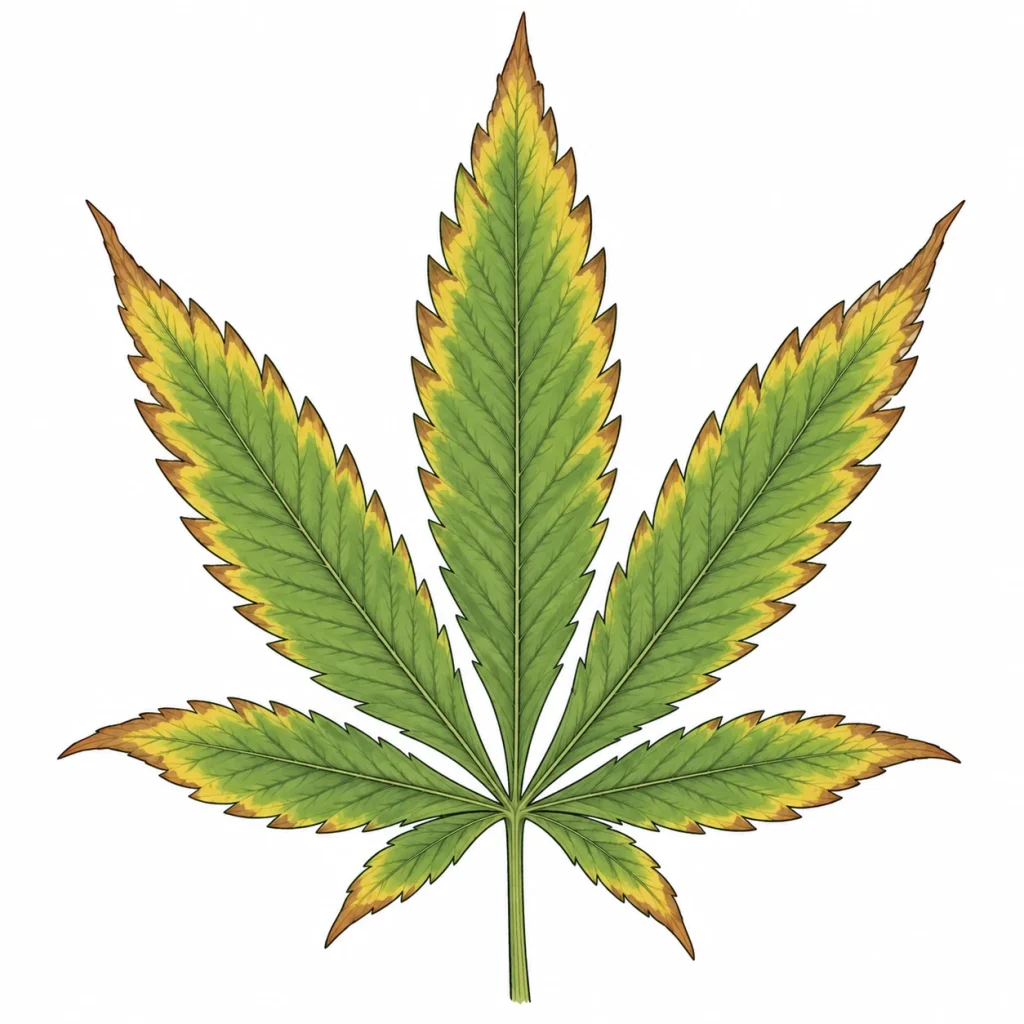
A lot of growers underestimate boron toxicity in cannabis. Boron is one of the micronutrients, so it rarely gets much attention. But too much boron can seriously damage your plants and, in the worst case, put your whole harvest at risk. The good news: if you spot the typical symptoms early and act fast, you can keep the damage in check. This article covers what you need to know about boron toxicity in cannabis, from a reliable diagnosis to targeted treatment.
What Is Boron and What Does It Do for Cannabis?
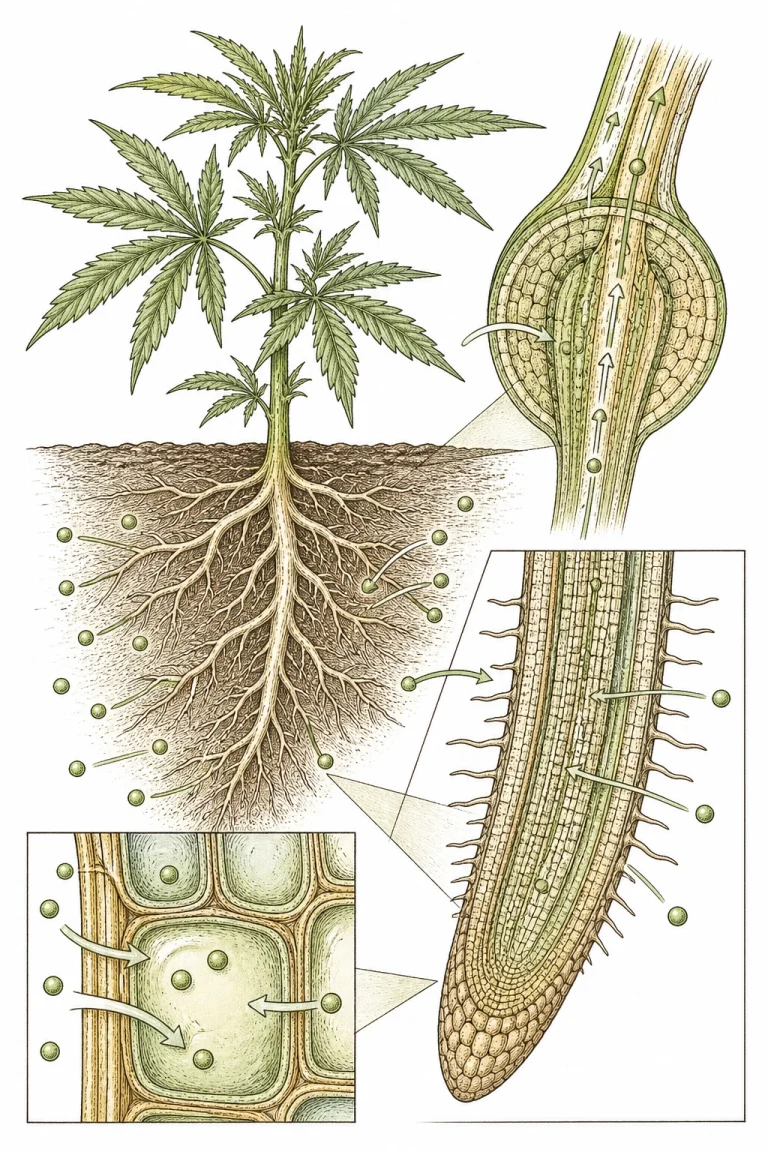
Boron is an essential micronutrient that cannabis needs in very small amounts. It plays a key role in cell division, cell wall formation and moving sugars through the plant. Boron also helps the plant take up and use calcium, which makes it an important player in your feeding balance. Because cannabis needs only tiny amounts of boron, the gap between deficiency and toxicity is fairly narrow.
That narrow range is exactly why boron can get out of balance so quickly. Even a small overdose in your nutrient solution or growing medium can trigger boron toxicity. This happens most often when growers combine premixed nutrients with a high boron content, use hard tap water or add soil amendments that already contain boron. So take a close look at what’s actually in your nutrients.
- Plants need only trace amounts of boron, so even a small excess can become toxic
- Boron supports cell division, cell wall formation and sugar transport
- The window between enough boron and boron toxicity is narrow
- Boron interacts with calcium, so precise dosing matters
How to Spot Boron Toxicity in Cannabis: The Typical Symptoms
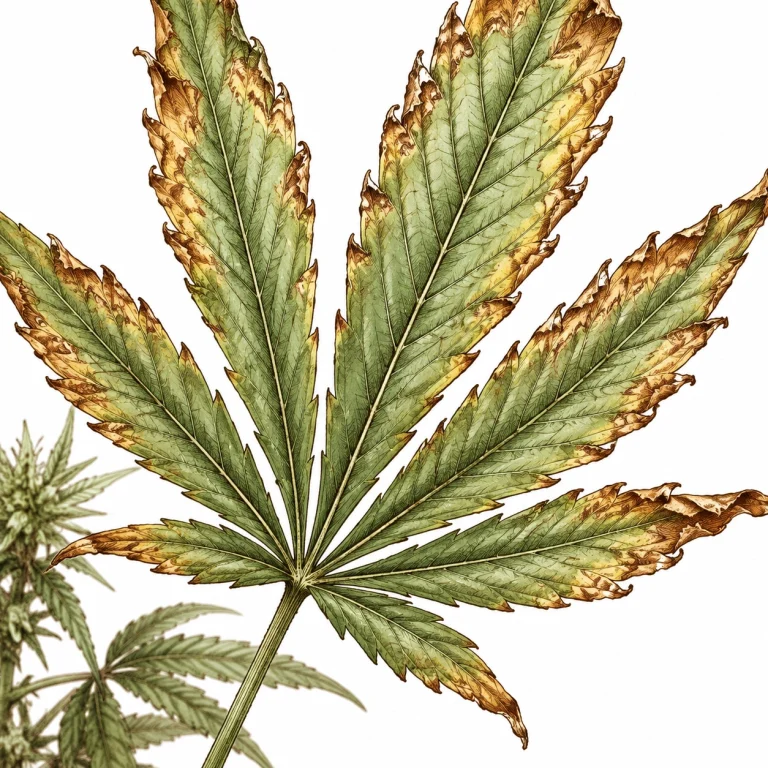
Boron toxicity in cannabis shows up mainly on the older, lower leaves. That’s because boron barely moves once it’s in the plant tissue, so excess boron builds up where it was first stored. The first signs are brown or necrotic spots on the leaf tips and edges that slowly spread toward the middle of the leaf. At first, this can look a lot like potassium deficiency or wind burn, but it has its own distinct pattern.
As boron toxicity progresses, the affected leaves get more and more brittle. The brown, dead patches keep spreading and large areas of leaf tissue die off. Affected leaves often look slightly wavy or curl downward. In severe cases, overall growth can stall: the plant looks stressed and develops much more slowly. New shoots can come in deformed, since boron directly affects cell division.
Another telltale sign: the discoloration starts at the edge and tip of the leaf blade, while the rest of the leaf stays green at first. This “tip burn” or “edge burn” is one of the most reliable ways to identify it. Compared to calcium deficiency in cannabis, which also damages leaves, boron toxicity lacks the typical spots in the middle of the leaf. Instead, the damage is concentrated along the edges.
- Brown, necrotic leaf tips and edges (tip burn / edge burn)
- Symptoms start on older, lower leaves
- Leaves get brittle and slightly deformed
- Stunted growth and deformed new shoots in severe cases
- Dead patches slowly spread toward the middle of the leaf
Boron Toxicity vs. Other Problems: How to Tell Them Apart
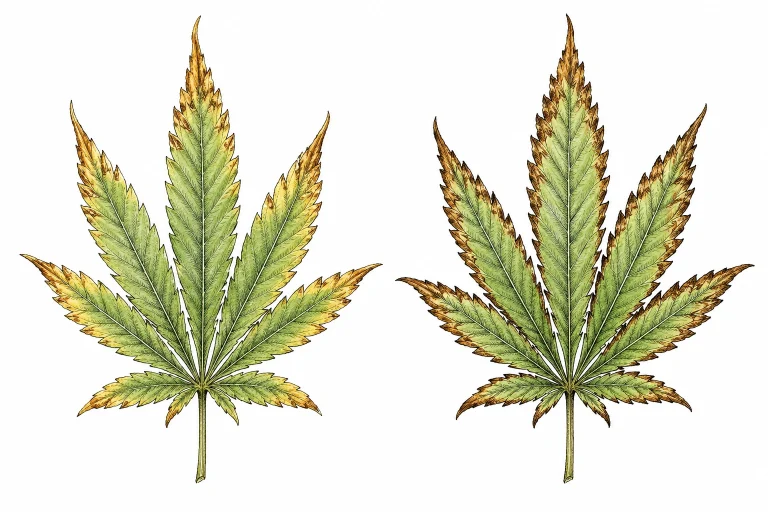
Boron toxicity symptoms are easy to mix up with other problems. The most common mix-ups are potassium deficiency, wind burn, general nutrient burn and salt stress. The key difference is the damage pattern: with boron toxicity, the damage mainly hits the edges and tips of older leaves, starts gradually and spreads evenly. Cannabis nutrient burn, on the other hand, often shows up more suddenly, affects the whole leaf and appears more often on young plants too.
Wind burn or heat stress usually shows up on the leaves closest to the light or the fan, so it follows a spatial pattern inside your grow tent. Boron toxicity, on the other hand, shows up evenly across the plant, no matter where it sits in your grow. If you’re not sure, check out the complete Cannabis Plant Diagnosis Hub. It helps you rule out different problems step by step.
Another helpful tip: test your water. Hard tap water often already contains meaningful amounts of boron. If you also use nutrients with boron, the excess can build up fast. Measure the EC (electrical conductivity) of your nutrient solution and compare it with the recommended values for your plant’s current stage. Very high EC readings combined with dead, crispy edges on older leaves strongly point to salt buildup or a specific micronutrient toxicity.
- Damage on the edges and tips of older leaves is typical of boron toxicity
- No link to the position of the light or fan (unlike heat stress)
- Slow, even progression (unlike acute nutrient burn)
- Check hard tap water, an often overlooked source of boron
- Check your EC and your nutrient ingredients
Causes of Boron Toxicity in Cannabis at a Glance
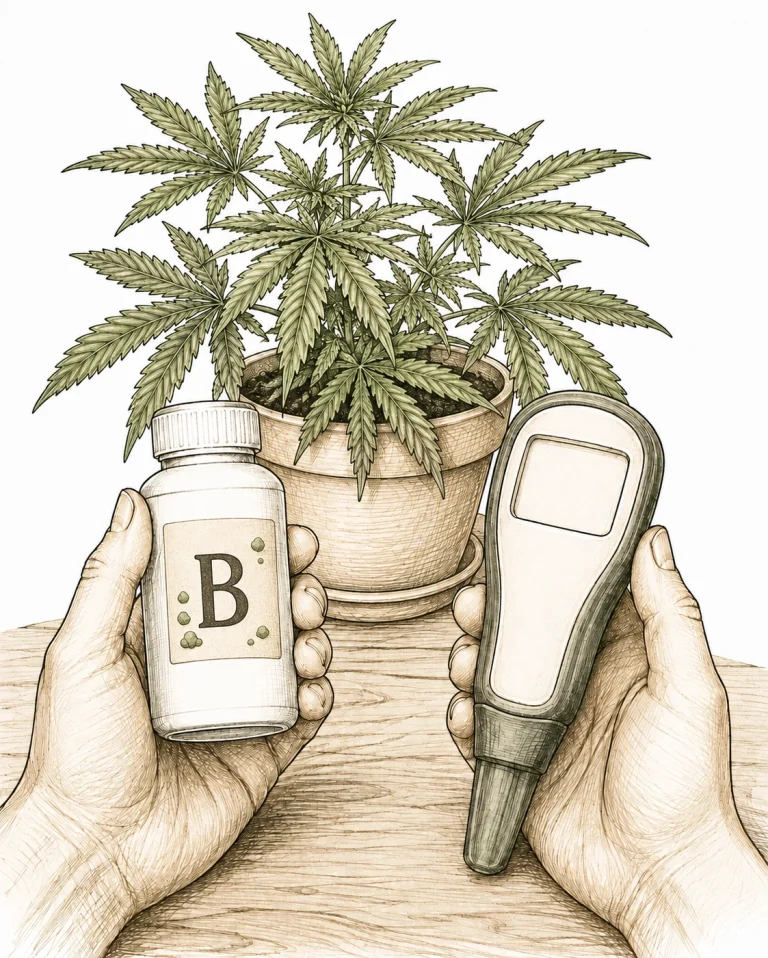
The most common cause of boron toxicity is mixing several nutrients and growing media that all already contain boron. If you run a base nutrient, a soil amendment and a seaweed extract at the same time, you can hit toxic boron levels without even noticing. So always read the exact nutrient label on every product you use, and pay special attention to the boron content.
Another common trigger is hard tap water. In many areas, tap water contains measurable amounts of boron. That’s safe to drink, but combined with a feeding schedule it can add a real extra load. It’s a good idea to ask your local water utility for the boron content of your tap water, or to use reverse osmosis (RO) water if you want precise control over your nutrient solution. Managing your water properly matters for many other parts of growing too, as you can read in How to Water Cannabis the Right Way.
A pH that stays off for a long time can also indirectly contribute to functional boron toxicity. At very low pH (below 5.5 in hydroponics or below 6.0 in soil), plants take up boron much more easily. If you’re also feeding enough boron, that can quickly lead to an oversupply. Keeping your pH dialed in is an important safeguard. You’ll find everything you need in the article on pH for Cannabis.
- Combining several nutrients and growing media that contain boron
- Hard tap water with natural boron content
- Low pH strongly increases boron availability
- Overdosing a boron supplement or trace element mix
- Soil amendments (e.g. some composts) with high boron content
Treating Boron Toxicity in Cannabis: Quick Fixes and Long-Term Strategies
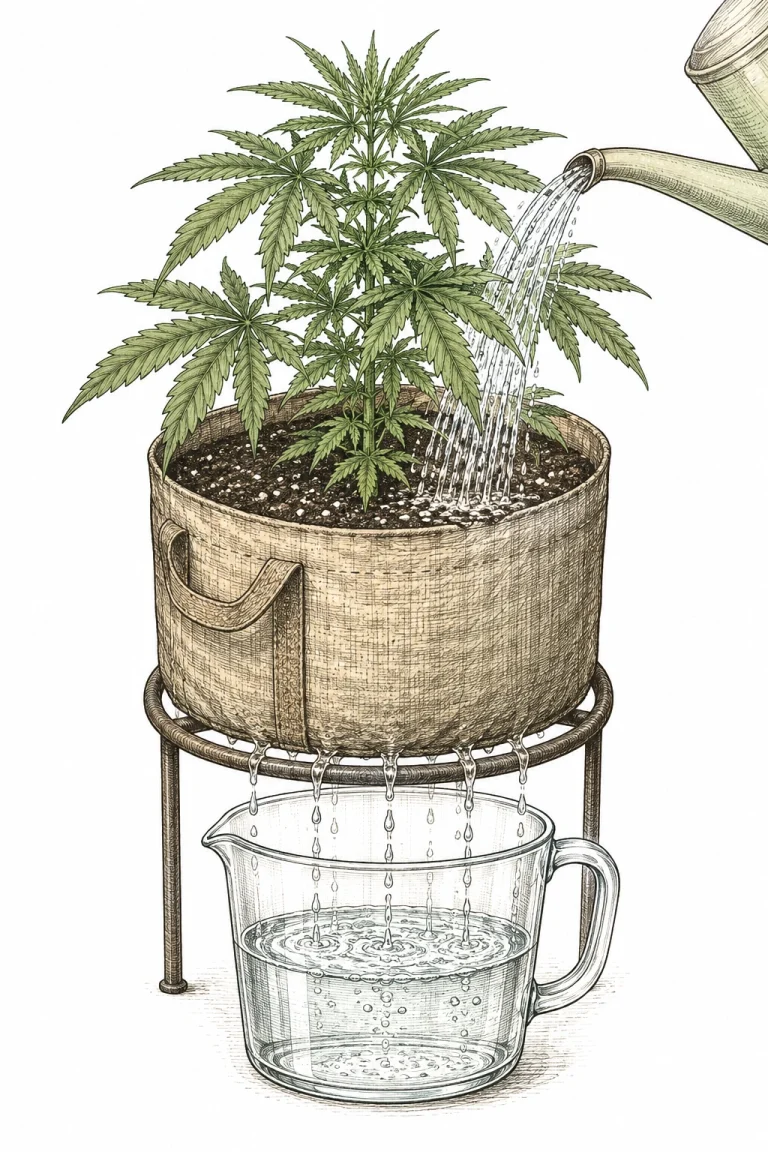
If you’ve spotted boron toxicity in your cannabis plants, act fast. The first and most important step is to thoroughly flush the growing medium with clean, unfed water. This “flushing” washes excess salts and micronutrients, including boron, out of the medium. Use two to three times the pot volume in water, and make sure the water has a pH of about 6.0 to 6.5 (soil).
After flushing, wait until the medium has dried out enough before you start feeding again at a much lower strength. Start with a balanced base nutrient that is boron-free or low in boron, and only add other products slowly after a few days of watching your plants. Remove badly damaged leaves, since dead tissue won’t recover. Those leaves just cost the plant energy it doesn’t need to spend.
Long term, the key is to find the exact source of boron and remove it. Make a complete list of all your nutrients and growing medium components and check the boron content of each one. If you can, switch to RO water or filtered water with a known mineral profile. Also check your pH and EC regularly so you keep tighter control over nutrient uptake. Yellow leaves that show up after treatment can have many causes. For a full overview, read Yellow Cannabis Leaves: All the Causes at a Glance.
- Flush your growing medium thoroughly with pH-balanced water
- Cut back hard on feeding and switch to boron-free products
- Remove badly damaged leaves
- Check every nutrient product for boron content and trim your lineup
- Switch to RO (reverse osmosis) water or water with a known mineral profile
- Check pH and EC (electrical conductivity) regularly
How to Spot Boron Toxicity in Cannabis: Prevention and Correct Dosing
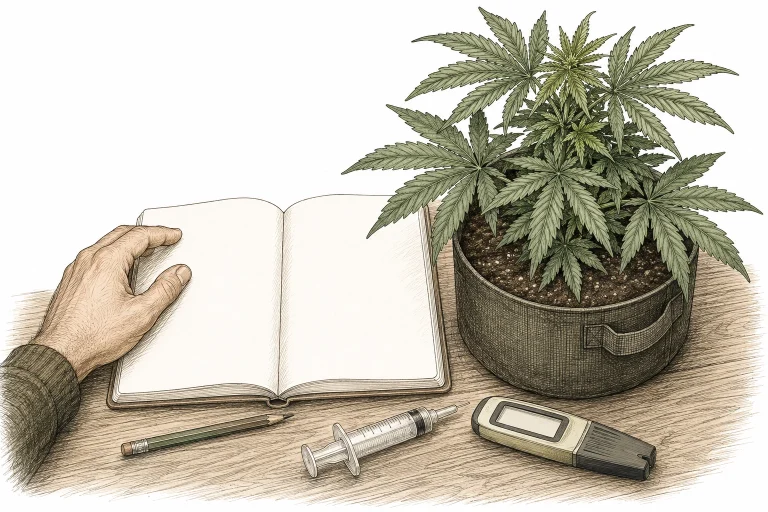
Your best defense against boron toxicity is a well-planned, documented feeding schedule. Write down which products you use, how much, and how often. And always check the combined boron content of everything you mix together. Many growers underestimate how fast micronutrients from different sources add up. Trace element supplements, foliar sprays and boron-containing growing media in particular can quickly push the total past the safe range.
Measuring the EC and pH of your nutrient solution regularly is a must. An EC that runs too high is often the first warning sign, before you see any visual symptoms. Pair these readings with a weekly visual check of your plants – especially the older, lower leaves, where boron toxicity tends to show up first. Acting early can keep the damage from spreading to the whole plant.
If you grow in hydroponics or in coco coir, stay extra alert. These systems have no natural buffer against nutrient excesses. In soil, natural microbial activity can even out some imbalances – in inert systems, dosing mistakes hit your plants directly and fast. Want to set up your grow the right way? Our complete indoor cannabis grow guide covers all the basics on choosing a growing medium, feeding and environmental settings.
The Chamber of Agriculture of North Rhine-Westphalia (Landwirtschaftskammer NRW) also explains in its basics on needs-based fertilization why precise feeding matched to what a crop actually needs is key to a healthy nutrient balance.
- Write down your feeding schedule and add up the boron content
- Measure EC and pH regularly – a high EC is an early warning sign
- Check the lower, older leaves once a week
- Dose with extra precision in hydro and coco setups
- Track every boron source (water, growing medium, nutrients)
Other micronutrients can cause similar symptoms when overdosed – learn more in our article on zinc toxicity in cannabis.
Frequently Asked Questions
How can I reliably identify boron toxicity in cannabis?
Boron toxicity usually shows up as brown, dead (necrotic) spots on the tips and edges of older, lower leaves. Affected leaves turn brittle and break easily, and the damage slowly creeps toward the center of the leaf. In severe cases, you may see stunted growth and deformed new shoots.
Can a plant recover from boron toxicity on its own?
No. Tissue that has already died (brown necrotic spots) won’t come back. But after treatment – especially after flushing the growing medium and adjusting your feeding schedule – the plant can put out new, healthy growth. You can remove the damaged leaves.
How much boron does cannabis need per day?
Cannabis needs only tiny amounts of boron – typically around 2 to 19 mg per gallon (0.5 to 5 mg per liter) of nutrient solution, depending on your system and growth stage. Most balanced commercial nutrients already contain enough boron, so you usually don’t need to supplement it.
Is hard tap water a common cause of boron toxicity?
Yes. In many areas, hard tap water contains measurable amounts of boron. Combined with boron-containing nutrients, levels can quickly climb into the toxic range. For precise control, check your local water quality report or switch to RO (reverse osmosis) water.
How long does it take a plant to recover from boron toxicity?
After a successful flush and a corrected feeding schedule, you’ll usually see the first signs of recovery – healthy new growth – within 5 to 10 days. How fast the plant fully bounces back depends on how severe the damage is and what growth stage it’s in.
Can I mistake boron toxicity for a deficiency?
Yes, the symptoms can look alike. Boron toxicity shows up as dead, crispy edges on older leaves, while a boron deficiency tends to stunt growth at the shoot tips and on young leaves. Location is the key clue: damage on older leaves usually points to toxicity, damage on new leaves usually points to a deficiency.
To keep an eye on your nutrient levels going forward, an EC meter from our recommended gear makes it easy.
The Bottom Line
Cannabis boron toxicity is a classic micronutrient problem. It usually builds up by accident from several sources at once and shows up as brown, dead edges on older leaves. With a targeted flush, a lighter feeding schedule and consistent pH and EC checks, you can get it under control. Long term, a well-documented feeding schedule and knowing every boron source in your setup help keep it from coming back. Catch it early and act fast – those are your best tools.
