

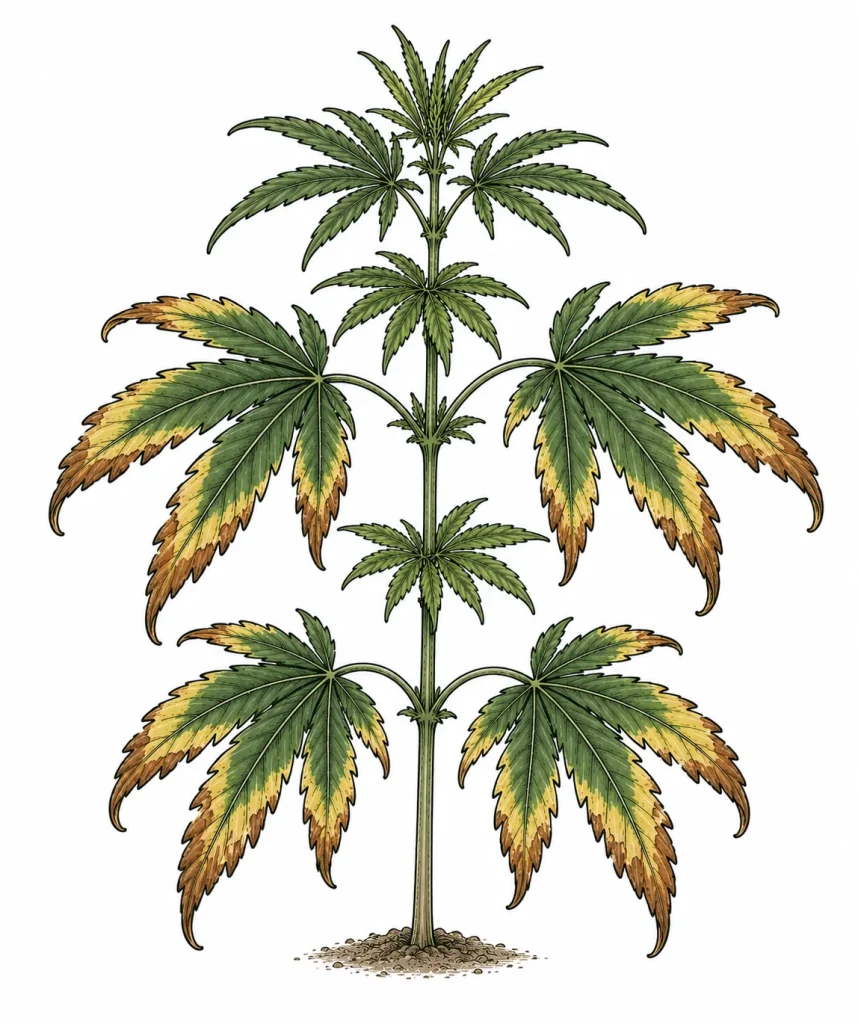
Spotting cannabis potassium deficiency is a key skill for every grower, because potassium is one of the three most important macronutrients your plant needs and it drives countless vital processes. Without enough potassium, cannabis can’t photosynthesize properly, move water around or build up stress resistance — the plant gets weaker week by week. The tricky part: the first symptoms are often mistaken for other deficiencies, so valuable time gets lost. In this article, you’ll learn how to reliably identify a potassium deficiency, track down the cause and save your plant. You’ll find all other diagnosis topics on the PlantClue Plant Diagnosis overview.
What is potassium and why does cannabis need it?
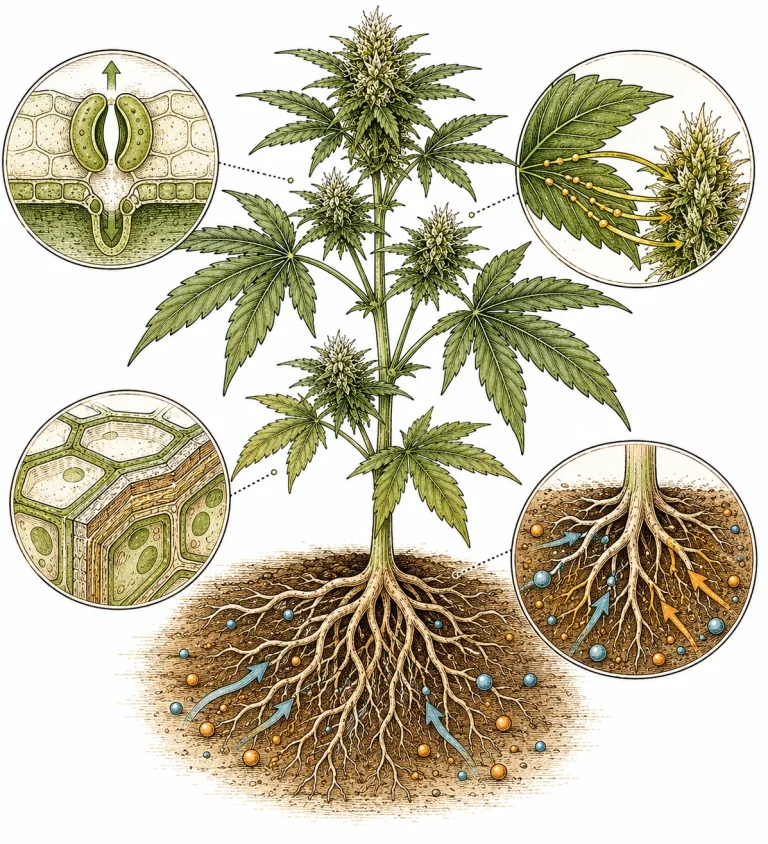
Alongside nitrogen and phosphorus, potassium is the third major macronutrient in the classic NPK trio. Its chemical symbol is K, which is why nutrient labels always list the potassium content as “K.” Cannabis needs this element in every growth stage, but demand rises sharply in the flowering stage.
Potassium takes on a wide range of vital tasks in the plant. It controls the opening and closing of the stomata — the tiny pores in the leaves through which water vapor and CO2 are exchanged. Without working stomata, the whole photosynthesis process collapses. Potassium is also involved in transporting sugars and starch inside the plant and strengthens the cell walls, giving the plant mechanical stability and resistance to pathogens.
In the flowering stage, adequate potassium levels are especially critical, because the plant is moving huge amounts of sugars and other assimilates into the buds during this time. If there’s too little potassium, bud size and resin production take a noticeable hit. That’s why many experienced growers dose potassium especially carefully in late flower — a balancing act between too little and too much.
- Regulates the stomata and with them transpiration and CO2 uptake
- Supports the transport of sugars and starch within the plant
- Strengthens cell walls and improves disease resistance
- Activates more than 60 enzymes in plant metabolism
- Increases bud weight and resin production in the flowering stage
- Improves water-use efficiency under drought stress
How to spot cannabis potassium deficiency: typical symptoms in detail
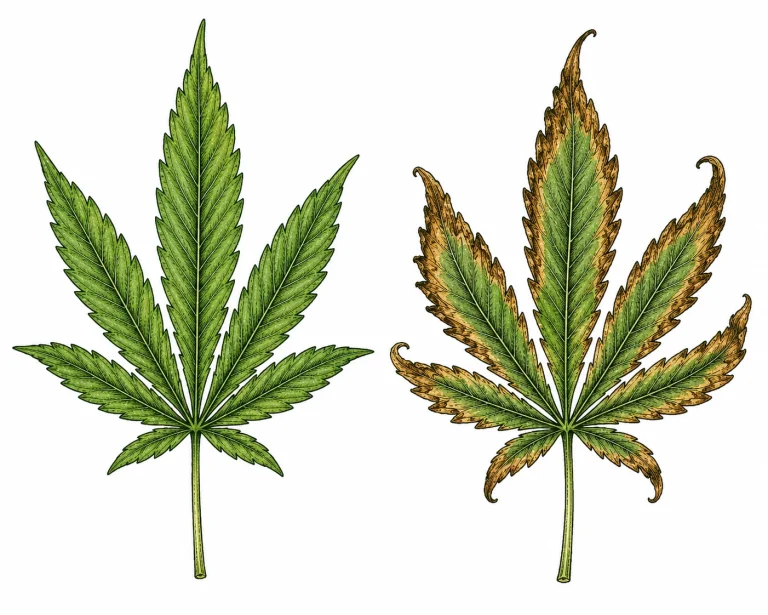
The most important sign of a potassium deficiency is that the symptoms show up on the older, lower leaves first. That’s because potassium is a mobile nutrient: as soon as supply runs short, the plant moves potassium out of old leaves and into new growth. This relocation principle is central to diagnosis and helps you tell a potassium deficiency apart from an iron deficiency — iron deficiency tends to show up on the young, upper leaves instead.
The most obvious symptom is brown, burnt-looking leaf edges and tips. This necrosis typically starts at the leaf tips, then spreads along the edges and, in advanced stages, can take over the entire leaf. The affected areas feel dry and brittle, almost scorched. Along with this, some leaves show slight yellowing between the veins, but it’s much less pronounced than with a typical magnesium deficiency.
Another symptom to watch for: cannabis plants with a potassium deficiency often look weaker and less vigorous overall. The stems may turn slightly reddish, and the leaves tend to curl a little or bend downward. In advanced stages, whole leaves turn yellow-brown and drop off. If you notice all of this, be sure to also read our article on the causes of yellow cannabis leaves to rule out confusion with other problems.
- Brown, necrotic leaf edges and tips — starting on older leaves
- Symptoms move from the bottom up (mobile nutrient)
- Slight yellowing between the veins (less intense than with magnesium deficiency)
- Reddish to purple discoloration of the stems possible
- Leaves curl slightly or bend downward
- Slower growth and reduced vigor overall
- In flower: smaller buds, lower resin production
Potassium deficiency or something else? How to tell for sure
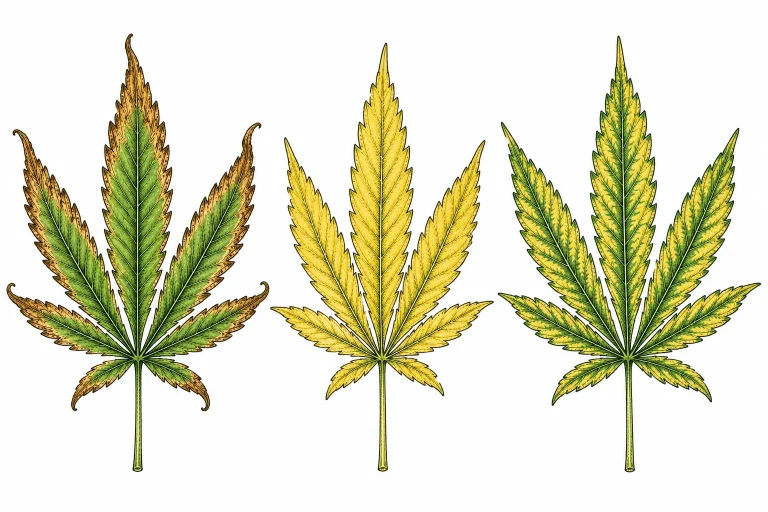
Brown leaf edges and necrosis aren’t an exclusive sign of potassium deficiency — wind burn, heat stress, salt buildup or an excess of other nutrients can look very similar. That’s why a systematic differential diagnosis is essential. The key question is always: where do the symptoms appear first, and what do the accompanying signs look like? For a complete overview of all deficiencies, check out our cannabis nutrient deficiency chart.
With a nitrogen deficiency, the leaves yellow evenly from the bottom up, without the typical brown necrosis on the edges. A magnesium deficiency creates a characteristic pattern of yellowed leaf tissue with veins that stay green (interveinal chlorosis), which is often sharply defined. A potassium deficiency, on the other hand, mainly produces that scorched look on the edges and tips, combined with a dull, slightly brownish overall appearance of the older leaves.
A common pitfall is a so-called induced potassium deficiency: the soil or growing medium actually contains enough potassium, but the wrong pH prevents the roots from taking it up. In soil, the pH should be between 6.0 and 7.0; in hydroponic systems, between 5.5 and 6.5. An excess of sodium, calcium or ammonium can also block potassium uptake, because these ions compete for the same transport channels in the roots. Read our in-depth article on how to set the right pH for cannabis.
- Potassium deficiency: brown necrosis on leaf edges and tips, starts at the bottom
- Nitrogen deficiency: even yellowing from the bottom up, hardly any necrosis
- Magnesium deficiency: interveinal chlorosis, veins stay green
- Heat stress: similar look, but evenly distributed, no vein pattern
- pH problems: potassium is there but can’t be absorbed — check your pH!
- Salt stress from nutrient burn can mimic necrosis
Causes of potassium deficiency in cannabis
The most common reason for a potassium deficiency is simply too little potassium in the growing medium or nutrient solution. This often happens when growers use only a base medium without proper feeding, or when they use a nutrient with a very low K content. Especially in the flowering stage, many beginners overlook how sharply potassium demand rises — this is where bloom nutrients with a higher K content make sense.
The wrong pH is the second most common cause. As mentioned above, uptake can get blocked when the pH is too low or too high. Heavy rinsing of the growing medium (flushing) can also trigger a short-term potassium deficiency if you don’t start feeding again right afterward. The same goes for very sandy or light soils, which can barely hold on to potassium and wash it out quickly.
Too much nitrogen or an oversupply of calcium and magnesium can also inhibit potassium uptake. This antagonism principle is well documented in plant nutrition: when one ion is present in excess, it blocks the uptake of the competing ion. So if you’re too generous with Cal-Mag supplements, you can trigger a secondary potassium deficiency — even when the soil actually contains enough potassium. Learn more in our article on cannabis nutrient burn.
Environmental factors play a role too: very cold root zone temperatures below 59 °F (15 °C) slow down nutrient uptake considerably, and waterlogged or overly wet soil damages the roots to the point where they can no longer absorb nutrients efficiently. To learn how to water correctly and avoid waterlogging, read our guide on how to water cannabis plants.
- Too little potassium in the growing medium or nutrients
- Wrong pH prevents potassium uptake at the roots
- Antagonism: an excess of calcium, magnesium or sodium blocks potassium
- Flushing too heavily without feeding afterward
- Very light, sandy soils with low potassium-holding capacity
- Cold root zone temperatures below 59 °F (15 °C) reduce uptake efficiency
- Root damage from waterlogging or overwatering
How to fix cannabis potassium deficiency: step-by-step guide
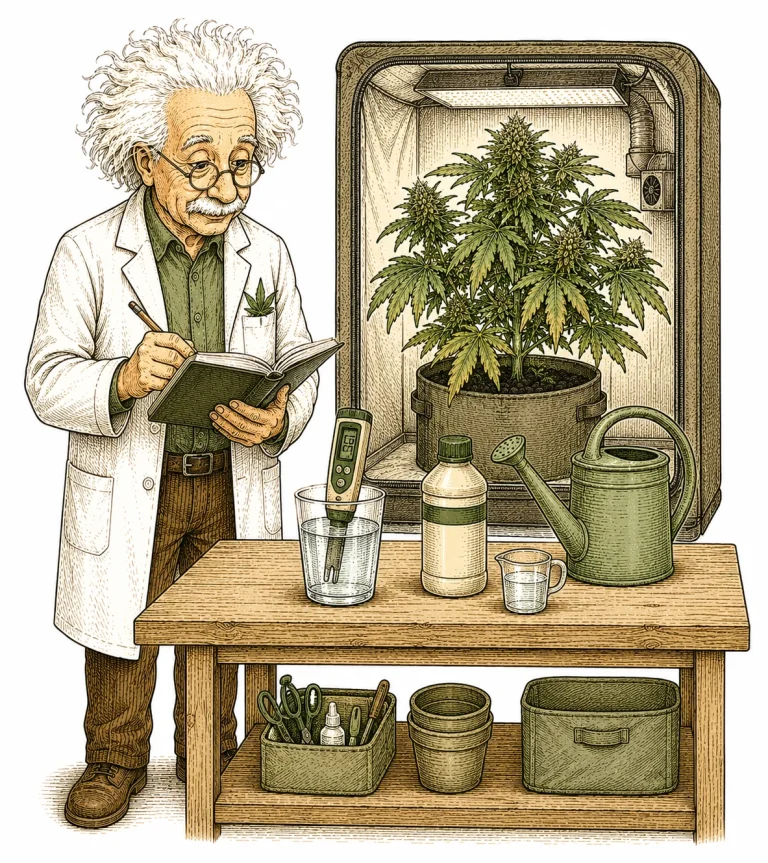
Once you’ve diagnosed a potassium deficiency, acting fast matters — especially if you’re already in the flowering stage. The first and most important step is always to check the pH of your growing medium and your water. Use an accurate pH meter and correct the pH if needed: soil 6.0–7.0, coco 5.8–6.3, hydroponics 5.5–6.5. Only when the pH is right can the plant take up nutrients at all.
Once the pH is correct, increase the potassium supply gradually. Don’t jump straight to double the nutrient dose — that can cause stress and lock out other nutrients. Instead, raise the potassium dose by 20–30 percent over your previous level and watch how the plant responds over three to five days. Potassium-rich single-nutrient fertilizers such as potassium sulfate (K2SO4) are excellent for targeted corrections.
For quick first aid, you can use foliar feeding: dissolve a small amount of potassium sulfate or a potassium-rich foliar fertilizer in water (pH 6.0–6.5) and spray it directly onto the leaves. The plant absorbs the nutrients within a few hours without having to take them up through the roots. This method is ideal as a bridge while you tackle the problem in the root zone.
If waterlogging or overwatering is the cause, no amount of clever feeding will help — you need to fix the soil conditions first. Let the growing medium dry out until the top 1–2 inches (3–5 cm) are dry before you water again. Improve drainage if necessary and make sure excess water can drain out through the drainage holes.
- Step 1: Measure the pH and correct it to the right range
- Step 2: Raise the potassium supply — increase it gradually by 20–30 percent
- Step 3: For an acute deficiency, foliar feed with a potassium sulfate solution (pH 6.0–6.5)
- Step 4: Check for antagonists — cut back on calcium/magnesium supplements if needed
- Step 5: Check your watering habits and rule out waterlogging
- Step 6: Watch the plant for 5–7 days; new leaves should grow in healthy
- Leaves that are already damaged won’t recover — judge progress by the new leaves
Preventing cannabis potassium deficiency: the best prevention measures
If you never let a potassium deficiency develop in the first place, you save yourself a lot of stress. The most important rule: always use a complete nutrient line matched to the current growth stage. Many quality cannabis nutrient sets include separate products for the vegetative stage and the flowering stage — the bloom nutrient usually has a much higher K content. Stick to the recommended dosages and only adjust them with care.
Check the pH regularly — at least once a week, ideally every second time you water. A stable pH is the foundation of a trouble-free nutrient supply. Use calibrated meters and check both your input water and the pH of the runoff. Big differences between input and runoff pH point to salt buildup in the growing medium, which should be flushed out.
When choosing a growing medium, look for a good cation exchange capacity (CEC). Media with a high share of organic materials such as compost, worm castings or perlite can buffer potassium better and release it slowly as needed. If you rely on organic feeding — for example with wood ash, banana peel extract or organic potassium products — you benefit from a naturally more stable nutrient supply that’s harder to throw off balance.
- Use stage-appropriate nutrients: bloom nutrients with a higher K content in flower
- Check the pH regularly and keep it in the target range
- Measure the runoff pH regularly to catch salt buildup early
- Choose growing media with a good cation exchange capacity
- Adjust your watering rhythm: don’t water too much or too little
- Keep an eye on antagonists: don’t overdo calcium or magnesium
- Check the lower leaves regularly — that’s where a deficiency shows up first
Potassium deficiency in the flowering stage: special features and risks
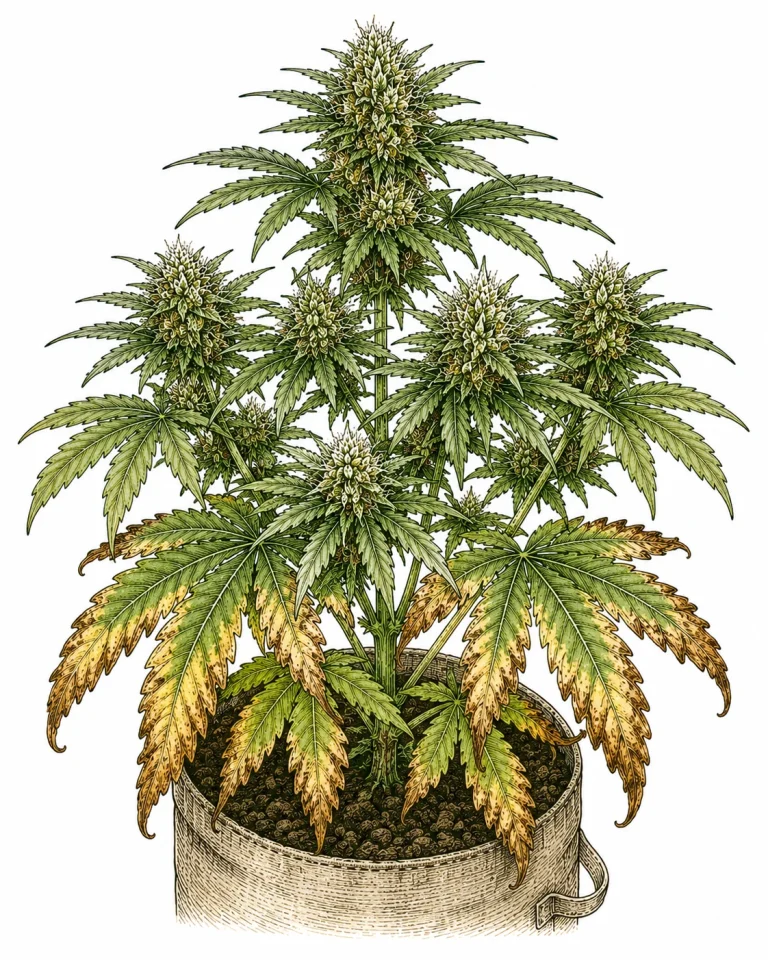
In the flowering stage, a potassium deficiency is especially dangerous, because potassium directly affects the size and quality of your buds. The plant shifts all its resources to flower production — if potassium is missing, bud development suffers first. You’ll harvest smaller, less resinous buds, and the terpene profile may change. In short: a potassium deficiency in flower costs you yield and quality.
Potassium demand peaks in late flower in particular (weeks 6–8 for typical phenotypes). At the same time, many growers recommend flushing during this stage — rinsing the growing medium with plain water to remove salts. That’s where the risk lies: flushing too aggressively can drastically lower potassium levels. If you flush, do it gently and give the plant one last light feeding before switching completely to plain water.
Another pitfall in flower is increased antagonism from calcium-magnesium supplements (Cal-Mag), which many growers add across the board. In the flowering stage, when potassium demand is already high, too much Cal-Mag can block potassium uptake to the point where deficiency symptoms appear — even when there’s enough potassium in the growing medium. Cut Cal-Mag back to the necessary minimum in the second half of flower and fine-tune the potassium share instead.
- Potassium demand rises sharply in the flowering stage — adjust your nutrients
- Potassium deficiency in flower reduces bud weight and resin production
- Flushing in late flower can lower potassium in the short term — be careful
- Too much Cal-Mag in flower can block potassium uptake
- Visually check the lower leaves every 2–3 days
- Keep the target pH especially stable in the flowering stage (±0.2 tolerance)
Because potassium works closely with the other macronutrients, it’s worth looking at phosphorus deficiency and the cannabis NPK chart if the symptoms aren’t clear. If the deficiency appears together with calcium or magnesium symptoms, also check out Cal-Mag deficiency.
Frequently asked questions
How fast does my cannabis plant respond to treatment for potassium deficiency?
Once you’ve corrected the pH and increased the potassium supply, new leaves should grow in healthy and symptom-free within five to seven days. Leaves that already have brown necrosis won’t regenerate — so keep your eye on the new growth. With foliar feeding, the plant can respond even faster, often after just two to three days.
Can I use wood ash or banana peel powder for potassium deficiency?
Yes, both organic amendments contain significant amounts of potassium. Wood ash has a K2O content of roughly five to ten percent, and banana peel powder contains potassium and phosphorus. However, these amendments work more slowly than mineral nutrients and also raise the pH of the growing medium, which can be helpful in acidic soil but problematic in neutral or alkaline soil. So always dose organic potassium corrections carefully.
Why does my plant have a potassium deficiency even though I feed regularly?
The most common problem is the wrong pH, which blocks uptake even though enough potassium is available. Antagonism from too much calcium, magnesium or sodium can also be the cause. Check the pH first, then see whether other nutrients are present in excess. Root damage from waterlogging can also prevent uptake.
What’s the difference between a true potassium deficiency and a potassium deficiency caused by pH lockout?
With a true potassium deficiency, there simply isn’t enough potassium in the growing medium. With pH lockout, there’s enough potassium, but the plant can’t take it up because the pH is off. The symptoms look identical — which is why you should always check the pH first before adding more nutrients. Adding more nutrients during a pH lockout often makes the problem even worse.
How is potassium deficiency different from nitrogen deficiency in cannabis?
With a nitrogen deficiency, the leaves yellow evenly from the bottom up, without distinct brown edges or necrosis. The plant looks paler overall and grows more slowly. A potassium deficiency, on the other hand, causes characteristic brown, burnt-looking leaf edges and tips, while the centers of the leaves stay green longer. A potassium deficiency can also turn the stems reddish, which is unusual with a nitrogen deficiency.
Can autoflowering cannabis get a potassium deficiency too?
Yes, autoflowering strains are just as prone to potassium deficiency as photoperiod strains. Since autoflowers are especially sensitive to pH swings and overfeeding, regular checks are even more important. As a rule, feed autoflowers a little more conservatively and check the pH especially carefully.
You’ll find more information on nutrient uptake and pH optimization from the Julius Kühn Institute – Soil Fertility (German) as well as in the practical recommendations of the Bavarian State Institute for Viticulture and Horticulture (LWG) (German).
You’ll find suitable nutrients to correct the deficiency in a targeted way in our Recommended Gear.
Conclusion
Spotting a cannabis potassium deficiency isn’t hard once you know where to look: brown, necrotic leaf edges on the older, lower leaves are the classic warning sign. The first step toward fixing it is always checking the pH, because without the right pH, even the best nutrients won’t help. With a targeted potassium supply, adjusted watering habits and regular checks on your plant, you can reliably get a potassium deficiency under control and save your harvest. Keep an especially close eye on the flowering stage — that’s when potassium demand is highest and a deficiency hits yield and quality hardest.
