

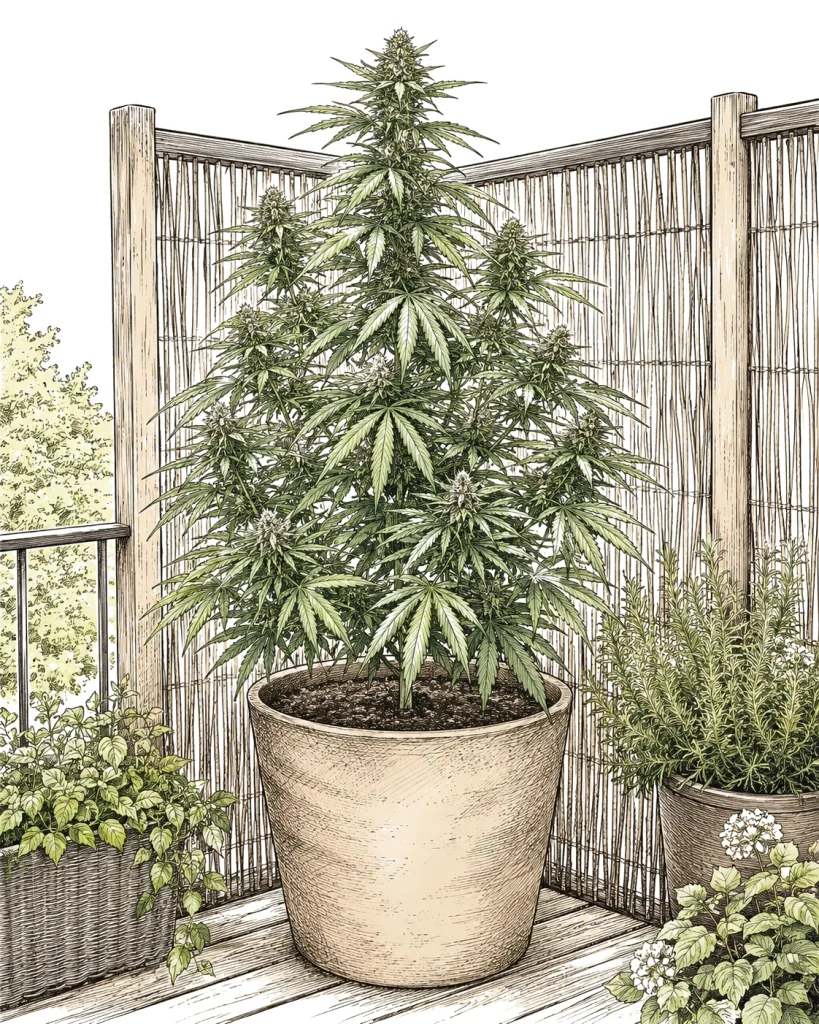
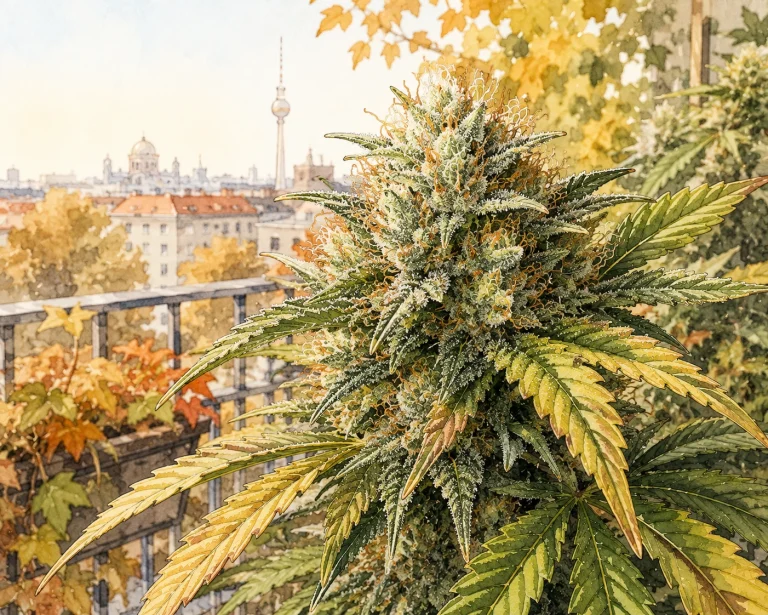
Growing cannabis on your balcony can be a real option for many home growers. With the right know-how, it can be surprisingly successful. Even in a tiny space, you can grow healthy, productive plants if you follow a few key rules. In this guide, PlantClue walks you through everything you need to grow cannabis on a balcony: picking the right strain, choosing the best soil, and avoiding the most common mistakes. No backyard needed. By the end of this article, you’ll know exactly what your balcony can do and how to pull a solid harvest from even the smallest space. Check the cannabis laws where you live before growing.
This guide is made for balcony grows: limited space, rented apartments, keeping things low-key. If you have a backyard or a big patio, start with our outdoor growing guide. There you’ll find tips on picking a spot, planning your season and everything else for a bigger outdoor grow.
This guide is made for balcony grows: limited space, rented apartments, keeping things low-key. If you have a backyard or a big patio, check out our outdoor growing guide. There you’ll find tips on picking a spot, planning your season and everything else for a bigger outdoor grow.
Growing Cannabis on Your Balcony: Check the Rules First
Before you set up your first pot, check the cannabis laws where you live. Rules on home growing can vary a lot from place to place, including how many plants you can grow, where they can be and who can see them. Knowing your local rules up front can save you a lot of trouble later.
Keeping your plants out of public view is a smart move either way. If you rent, also check whether your lease or building rules limit growing plants on your balcony. Landlords handle this very differently. A privacy screen made of bamboo, opaque balcony panels or simply some tall companion plants can solve the problem in most cases. It’s cheap and looks good, too.
- Check the cannabis laws where you live before growing
- Keep plants out of public view
- Keep plants out of reach of kids
- Check your lease and building rules first
- A privacy screen is an easy, affordable fix
The Best Strains for Growing Cannabis on a Balcony
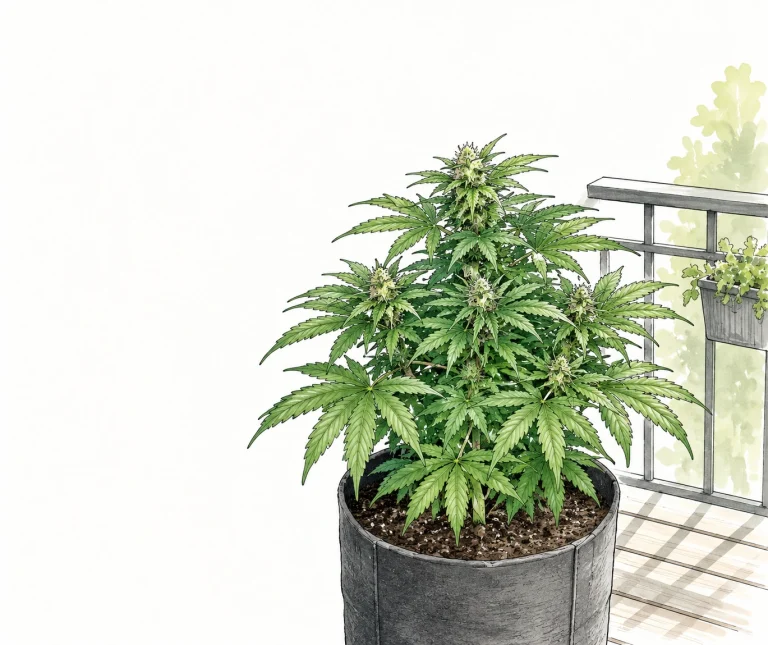
Picking the right strain is key for a balcony grow, because space and light are limited. For most balcony growers, autoflowering strains are the top pick. They stay compact, flower no matter the light cycle and are often ready to harvest in 70 to 90 days. Popular autoflowers like “Royal Dwarf”, “Northern Lights Auto” or “Easy Bud” rarely grow taller than 24 to 31 in (60 to 80 cm). That’s perfect for an average balcony.
If you prefer feminized photoperiod strains, go for compact, indica-dominant hybrids. They respond to the natural change in daylight in late summer and do well on balconies with at least 6 hours of direct sun. In regions with short summers and early frosts, strains with a short flowering stage of 8 weeks or less have the best chance of finishing before the first fall frost. Sativa-dominant strains with long flowering times are usually a poor fit for balconies in cooler climates.
Ruderalis crosses like “Cream Caramel Auto” or Fast Buds lines handle less-than-ideal conditions especially well, such as swinging temperatures and less light. That’s a big plus on balconies that don’t get sun all day. You’ll find more on tough strains for cooler climates in our article on outdoor cannabis strains.
- Autoflowering strains: compact, fast, independent of the light cycle
- Feminized indica hybrids: great for balconies with lots of direct sun
- In short seasons, pick strains with a flowering stage of 8 weeks or less
- Ruderalis crosses handle changing conditions especially well
- Sativa strains with long flowering times are a poor fit for cooler climates
The Right Pot and the Best Soil for Your Balcony Grow
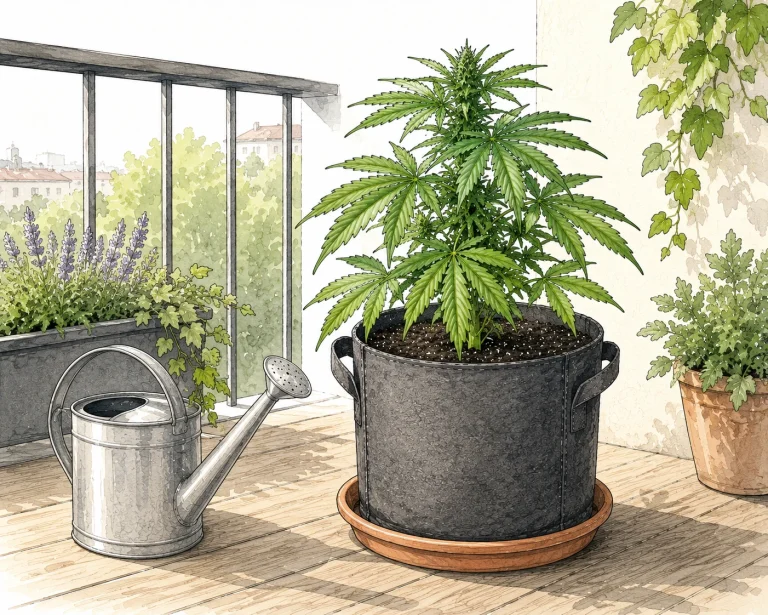
On a balcony, you have no choice but to grow in containers, and the right pot can make a big difference to your plant’s health and yield. Fabric pots (fabric pots (German)) are the go-to choice for balcony growers. They drain well, so the roots don’t get waterlogged, they let air reach the roots from every side, and they’re lightweight. A full-size autoflower does well in a 3 to 4 gal (11 to 15 L) pot. Larger photoperiod strains need at least 5 gal (18 to 20 L).
Your soil should drain well and be light and rich in nutrients. Here’s a proven mix for balcony grows: 60 % quality cannabis soil or potting soil, 20 % perlite for better drainage and aeration, and 20 % coco coir to hold water. Pre-mixed cannabis soils from a grow shop are already dialed in. Most of them also contain enough nutrients for the first 4 to 6 weeks, which makes getting started a lot easier for beginners.
Make sure your pots have drainage holes. Set them on saucers, and empty the saucers after watering. Overwatering is one of the most common mistakes when growing cannabis on a balcony. It can lead to root rot and nutrient problems. Cannabis likes a soil pH between 6.0 and 7.0. Our in-depth guide to pH for cannabis shows you how to get it right.
- Fabric pots: best drainage and root aeration
- 3–4 gal (11–15 L) for autoflowers, 5 gal (18–20 L) for photoperiod strains
- Mix: 60% soil, 20% perlite, 20% coco coir
- Keep your soil pH between 6.0 and 7.0
- Avoid waterlogged roots by emptying the saucers after watering
Light, Location and Microclimate: How to Find the Best Spot
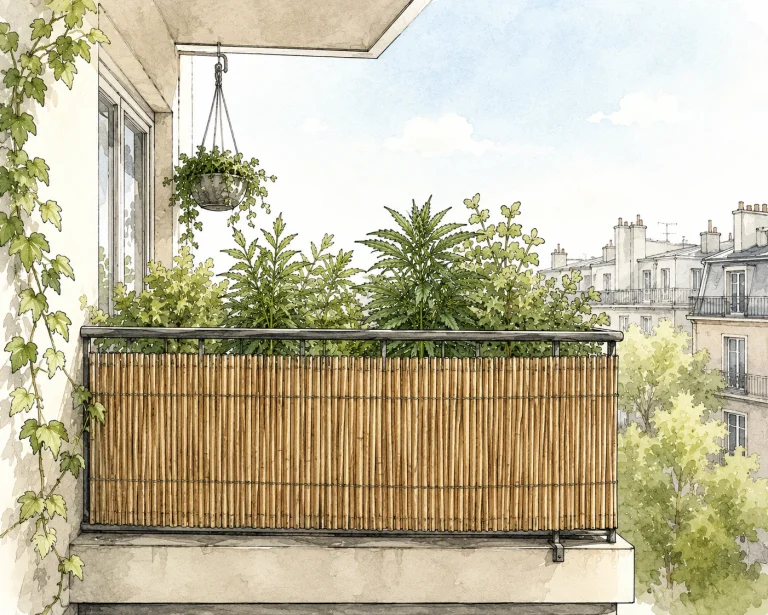
Light is the most important factor for a successful balcony grow. Ideally, cannabis needs at least 6 hours of direct sun a day, and 8 to 10 hours is even better. South- and west-facing balconies work best. East-facing balconies can still work, with some limits. North-facing balconies without direct sun are only an option for autoflowering strains, and you should expect a much smaller yield.
The microclimate on a balcony is very different from an open garden. Heat builds up between concrete walls, wind gusts can get strong, and the swing between day and night temperatures is bigger on higher floors. Don’t place your plants right up against a concrete wall, because the reflected heat can burn the leaves. Use the middle of the balcony instead, or hang the pots on the balcony railing if it can safely hold the weight.
Below 59 °F (15 °C), growth slows down a lot, and below 50 °F (10 °C) your plants risk cold damage. In many regions, the outdoor season starts reliably once nighttime frost is unlikely, and the exact timing varies a lot by region. Check the last frost date where you live. You can start earlier if you bring your plants inside at night. On the other hand, heat above 86 °F (30 °C) can cause sunburn and heat stress. On days like that, a shade cloth for a few hours can help.
- Your plants need at least 6 hours of direct sun a day
- South- and west-facing balconies work best
- Keep plants away from concrete walls, because reflected heat can burn leaves
- Temperatures below 59 °F (15 °C) slow down growth
- Move plants outside for good after your local last frost date (check NOAA or Environment and Climate Change Canada tables), and bring them in at night before that
How to Water and Feed Cannabis on Your Balcony
Watering is where most balcony grows go wrong. Wind and sun dry out pots on a balcony much faster than in a garden. In the heat of summer, you may need to water every day. The easiest way to check is to lift the pot. If it feels light, it’s time to water. You can also stick a finger 1 to 1.5 in (3 to 4 cm) into the soil. If it still feels moist at that depth, wait another day. For a detailed walkthrough, check out our guide on how to water cannabis the right way.
Feeding on a balcony follows the same rule as everywhere else: less is more. Start with half the dose the manufacturer recommends, and only go higher if your plants clearly need it. In the vegetative stage, cannabis mainly needs nitrogen (N). In the flowering stage, it needs less N and more phosphorus (P) and potassium (K). Ready-made cannabis nutrients from a grow shop are the safest choice for beginners, because they’re already matched to what the plant needs.
Nutrient burn shows up as burnt leaf tips, dark green discoloration or curling leaves. If you spot these symptoms, stop feeding right away and flush the soil with pH-neutral water. A nutrient deficiency, on the other hand, often shows up as yellowing. Our article on cannabis nutrient burn shows you how to spot and fix nutrient burn fast.
- Pots on a balcony dry out faster, so check them every day
- Lift the pot or do the finger test: two easy ways to check moisture
- Always start nutrients at half strength
- Veg: more N. Flowering: more P and K
- Burnt leaf tips = a sign of nutrient burn
Common Problems With a Balcony Cannabis Grow and How to Fix Them
Even on a balcony, problems can pop up. Some of the most common are pests like spider mites and aphids, which city climates tend to favor. Check the undersides of the leaves regularly. Early signs are tiny dots, sticky residue or fine webbing. Organic options like neem oil or insecticidal soap work well in the early stages without harming your plant. As prevention, you can set cannabis companion plants like basil or marigolds in their own containers next to your plant.
Fungal diseases like powdery mildew and bud rot (botrytis, gray mold) are a real risk on cramped balconies with poor airflow. Don’t crowd your pots together, and remove dead or sick leaves regularly. In fall, when humidity rises and temperatures drop, the risk of bud rot during the flowering stage is especially high, so protect your plants with a rain cover. You’ll find all the common outdoor cannabis problems at a glance in our Plant Diagnosis overview.
Nutrient deficiencies are another common stumbling block, especially in small pots that get flushed out quickly. A calcium deficiency shows up as brown spots on the leaves, a nitrogen deficiency as yellowing that moves from the bottom up. If you catch the symptoms early, you can correct course fast. Got yellow leaves? Our diagnosis article on causes of yellow cannabis leaves can help.
- Spider mites and aphids: check leaf undersides every week
- Use neem oil or insecticidal soap at the first sign of pests
- Powdery mildew and bud rot: good airflow is your best defense
- Use a rain cover in fall to help prevent mold
- Deficiencies are more common in small pots, so feed regularly
Privacy, Discretion and Staying on the Safe Side With a Balcony Grow
Check the cannabis laws where you live before growing. Either way, it pays to keep things discreet, out of respect for your neighbors and the people around you. Opaque bamboo balcony screens, plastic privacy mats or naturally growing climbers like hops or ivy are simple, affordable fixes that look good, too.
Make sure your plants don’t grow above the railing where they can be seen from the street or neighboring buildings. Autoflowering strains usually stay under 31 in (80 cm) and are easier to keep low-profile. If you grow photoperiod strains that can get taller, LST (low stress training), meaning gently bending and tying down the branches, lets you steer growth sideways and keep plant height in check.
If you rent: ideally, talk to your landlord and check the rules that apply where you live before you start growing. An open conversation is often better than a surprise. Most leases don’t say anything specific about growing plants on a balcony, but it’s always better to play it safe.
- Use bamboo screens or plastic mats for privacy
- Don’t let plants grow above the balcony railing
- LST (low stress training) keeps taller strains in check
- Use climbing plants as a natural privacy screen
- When in doubt, talk to your landlord or get legal advice
Harvesting and Post-Harvest Care for Your Balcony Cannabis Grow
Harvest timing makes or breaks the quality of your final product. Take a close look at the trichomes with a magnifier or a cheap jeweler’s loupe: clear trichomes mean it’s too early, milky trichomes signal peak ripeness, and amber trichomes point to a later, more body-heavy effect. On a balcony in a cool northern climate, harvesting a little early is usually safer than harvesting late, because fall brings rain and cold, and the risk of mold goes up.
After the harvest comes drying. Hang the branches upside down in a dark, well-ventilated spot at 59 to 68 °F (15 to 20 °C) and 45 to 55 % relative humidity. Drying usually takes 7 to 14 days. Then it’s time for curing in glass jars: for the first two weeks, open the jars once a day for 15 to 30 minutes to let moisture escape and keep mold away. A good cure can noticeably improve aroma, flavor and effect.
A typical balcony grow with one autoflower in a 4 gal (15 L) pot can yield 30 to 80 g of dried bud under good conditions. That’s a realistic and rewarding amount for a home grower. If you want to understand the whole process from harvest to curing in detail, PlantClue has a complete step-by-step guide.
- Check trichomes with a magnifier: milky = peak ripeness
- Harvest a bit early rather than late – the mold risk in a wet fall is real
- Drying: 59–68 °F (15–20 °C), 45–55 % humidity, 7–14 days
- Curing in glass jars: burp them daily for the first two weeks
- Expected yield from one autoflower: 30–80 g dried
For classic outdoor growing in your backyard, check out the full walkthrough in our Outdoor Guide.
Frequently Asked Questions
Can I grow cannabis on my balcony?
Check the cannabis laws where you live before growing. On a practical level, it’s smart to keep your plants out of view of neighbors and passersby and out of reach of kids. If you rent, read your lease and building rules first.
Which strains are best for growing cannabis on a balcony?
Autoflowering strains are the best pick for most balcony growers: they stay compact (under 31 in / 80 cm), flower regardless of the light cycle and finish in 70 to 90 days. Good options include ‘Royal Dwarf’, ‘Northern Lights Auto’ or ‘Easy Bud’. If you go with photoperiod strains, choose indica hybrids with a short flowering time.
How much light does cannabis need on a balcony?
Cannabis needs at least 6 hours of direct sunlight a day, ideally 8 to 10 hours. South- and west-facing balconies work best. East-facing balconies can work, with some limits. North-facing balconies without direct sun tend to give much weaker results and only really make sense with autoflowering strains.
How big should the pots be for a balcony grow?
For autoflowering strains, 3 to 4 gal (11 to 15 L) is plenty. For bigger photoperiod strains, plan on at least 5 gal (18 to 20 L). Fabric pots are the top choice because they help prevent waterlogged roots and give the root zone great airflow.
When should I start my cannabis balcony grow?
The safe outdoor window starts once there’s no more risk of night frost – look up your local last frost date using NOAA Climate Normals (US) or Environment and Climate Change Canada’s frost-date tables, since it varies a lot by region. You can start autoflowering strains earlier if you bring the plants inside at night. Late starts up to the end of June still work with autoflowers, because they flower regardless of the light cycle.
How much yield can I expect from one balcony plant?
A healthy autoflower in a 4 gal (15 L) pot on a sunny balcony can realistically yield 30 to 80 grams of dried bud. With ideal conditions and bigger photoperiod plants, you can get more. The actual amount depends heavily on the strain, hours of sun, pot size and care.
Do I need to protect my balcony plant from rain?
In the vegetative stage, rain usually isn’t a problem. Shortly before and during flowering, use a simple rain cover when you get long stretches of rain and high humidity, since the risk of bud rot (botrytis, gray mold) can rise sharply otherwise. A pop-up polyethylene canopy or a basic garden greenhouse is often all you need.
Can I also grow cannabis in my yard or a community garden?
The rules for backyards and shared spaces can vary a lot, so check the cannabis laws where you live before growing. A community garden plot often comes with its own rules, and many garden associations ban growing cannabis outright – ask before you plant. If you have more space than a balcony, you’ll find detailed tips on picking a spot and planning your season in our Cannabis Outdoor Grow Guide.
Bottom Line
Growing cannabis on a balcony can be a really rewarding option for many growers – even in the tiniest space. Check the cannabis laws where you live before growing. With the right strain, a big enough pot, a good growing medium and consistent care, healthy plants with a solid yield are well within reach. The most common mistakes – watering wrong, nutrient burn and no privacy screen – are easy to avoid with a little prep. Happy growing on your balcony! Stay curious, check on your plants every day, and you’ll quickly get a feel for what they need.
