

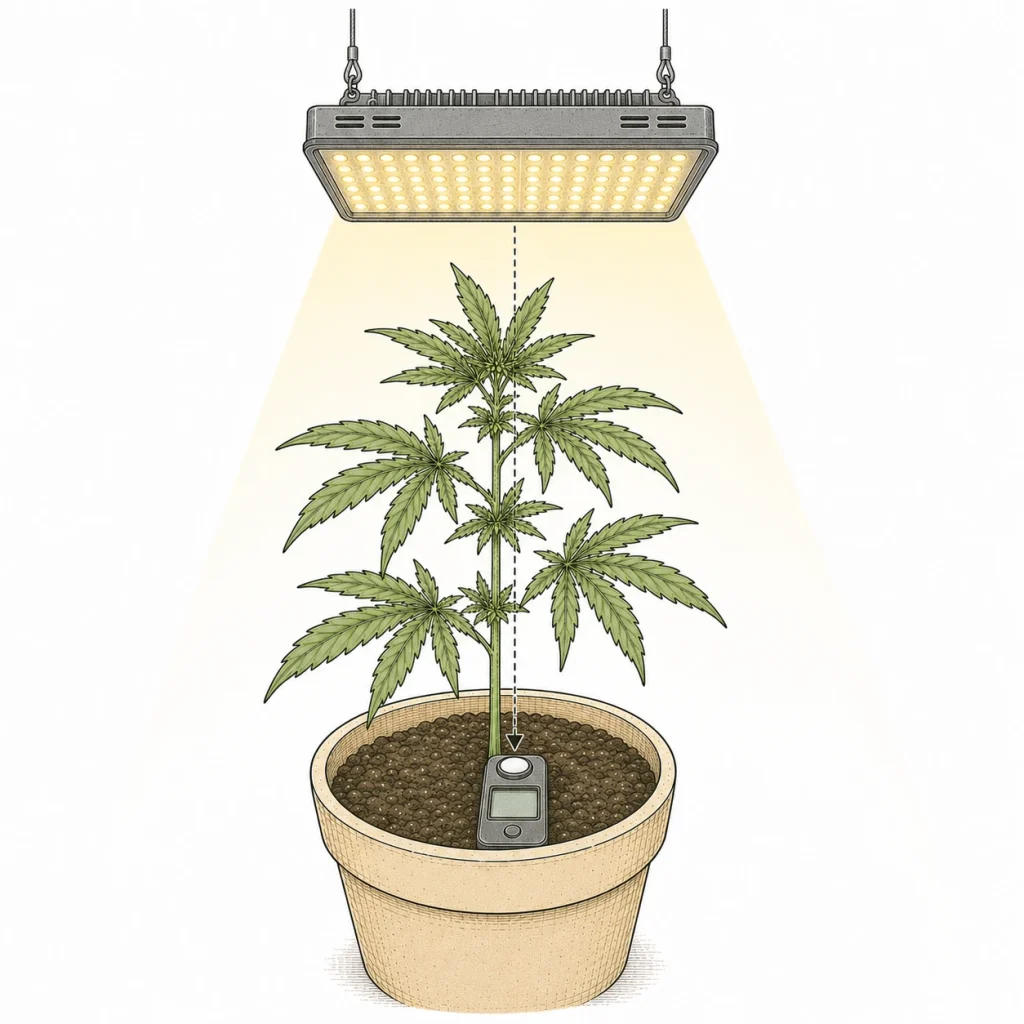
If you really want to optimize your cannabis grow, there’s no way around measuring PPFD. PPFD stands for photosynthetic photon flux density and describes how many light photons per second actually reach the leaf surface — the light your plant’s photosynthesis runs on. Many growers rely on lux readings or the manufacturer’s claims for their lights, but miss the crucial information: how much usable light is my plant really getting? If you want to dig deeper into light spectra, you’ll find all the background in our light spectrum guide — and in this article, we explain everything you need to know about PAR (photosynthetically active radiation), PPFD, DLI (daily light integral) and measuring them correctly so your next grow delivers truly top results.
What exactly does PPFD mean when growing cannabis?
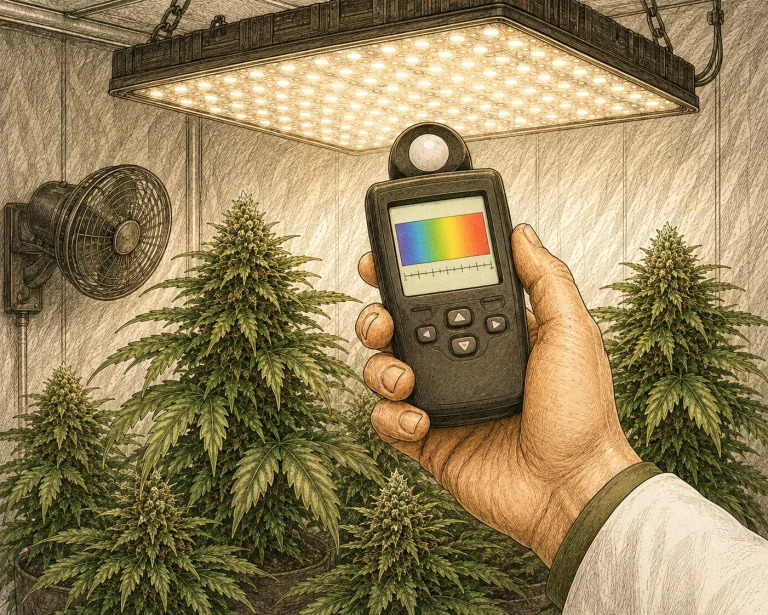
PPFD for cannabis stands for photosynthetic photon flux density and is given in µmol/m²/s (micromoles per square meter per second). This number tells you how many photosynthetically active photons hit one square meter (about 10.8 sq ft) of your canopy every second. That makes PPFD the key measurement for the actual light output your cannabis plant can use for growth and bud development.
Important to understand: not all light is equally useful to the plant. Cannabis mainly uses light in the 400 to 700 nanometer wavelength range — this range is called PAR (photosynthetically active radiation). Lux, on the other hand, is a unit based on the human eye and therefore says little about what plants can use. A warm white light can produce a lot of lux but deliver relatively few PAR photons. That’s why PPFD is far more relevant for your grow than lux. Background information on light use in crops is available from the Bavarian State Institute for Viticulture and Horticulture (LWG, German source).
The difference between PPF and PPFD is also important: PPF (photosynthetic photon flux) describes the total amount of light a lamp emits, measured in µmol/s. PPFD, on the other hand, measures what actually arrives on a given area. A light with a high PPF can still produce a low PPFD if it hangs too far away or the reflector is inefficient. In practice, PPFD is what counts — measured at the height of your plant tops.
- PPFD = actual amount of light on the leaf surface in µmol/m²/s
- PAR range: 400–700 nm wavelength — what cannabis uses for photosynthesis
- Lux measures brightness for the human eye, not usefulness for plants
- PPF = total light output of the lamp, PPFD = what reaches the plant
- Light distance, reflectors and room geometry strongly affect PPFD
Ideal PPFD for cannabis: vegetative stage vs. flowering
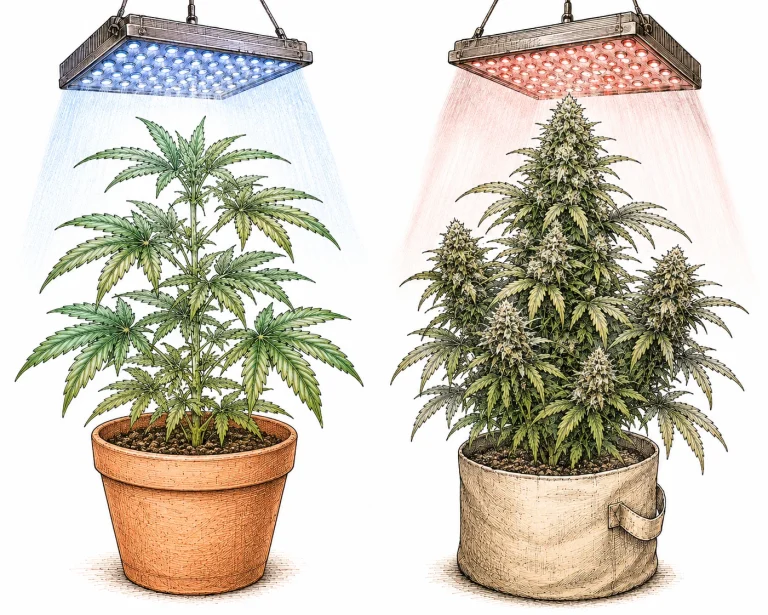
Cannabis needs different PPFD levels depending on the growth stage. During germination and the early seedling stage, 200–400 µmol/m²/s is ideal — more would stress the delicate young plants. Once your plant enters the vegetative stage proper, you can raise the PPFD to 400–600 µmol/m²/s. Many indoor growers stay safely in this range and get stable, vigorous growth.
In the flowering stage demand rises significantly. For maximum bud development and high cannabinoid production, values between 600 and 900 µmol/m²/s are ideal. Advanced growers with CO₂ supplementation can even use values up to 1,200–1,500 µmol/m²/s without stressing the plants. Without added CO₂, most strains reach light saturation at around 1,000–1,100 µmol/m²/s — more light then brings no extra yield but puts heat stress on the plant.
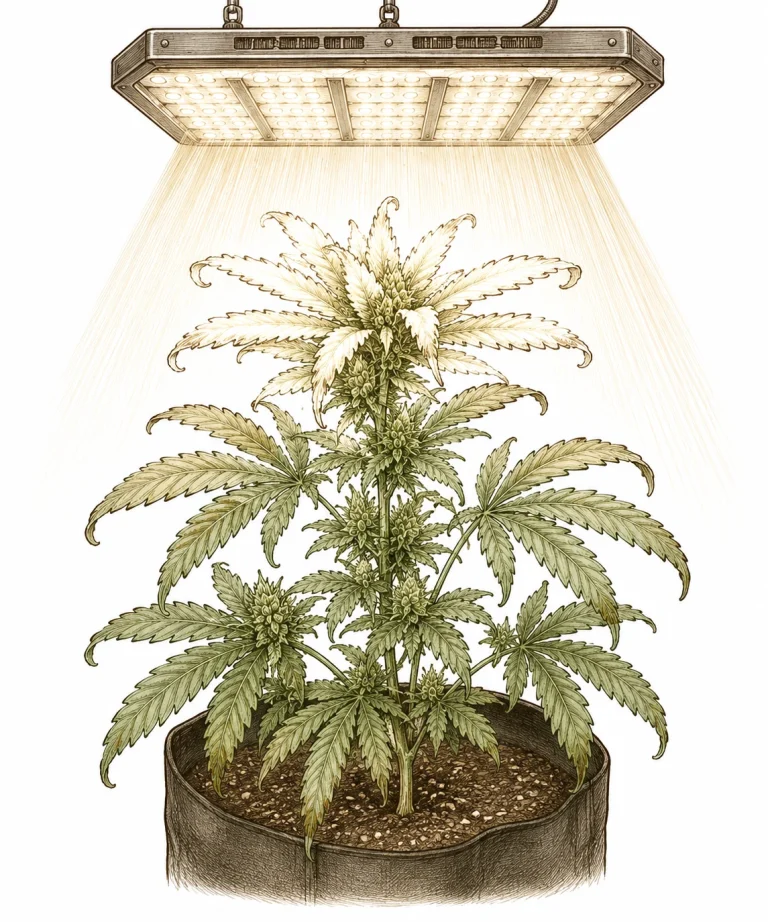
A common beginner mistake is hanging the light too close and causing light stress. Symptoms like bleached white leaf tips, leaves curling upward and burnt areas in the canopy point to PPFD values that are too high. If you see signs like these, raise the light gradually until the plant recovers. The Plant Diagnosis overview on PlantClue helps you reliably tell light stress apart from other problems like nutrient deficiencies.
- Germination/seedling: 200–400 µmol/m²/s — start gently
- Vegetative stage: 400–600 µmol/m²/s — vigorous growth
- Flowering without CO₂: 600–900 µmol/m²/s — ideal bud development
- Flowering with CO₂: up to 1,200–1,500 µmol/m²/s usable
- Light saturation without CO₂ at about 1,000–1,100 µmol/m²/s
- Symptoms of too much PPFD: bleached leaves, heat stress, leaves curling upward
DLI for your cannabis grow: the daily light integral explained
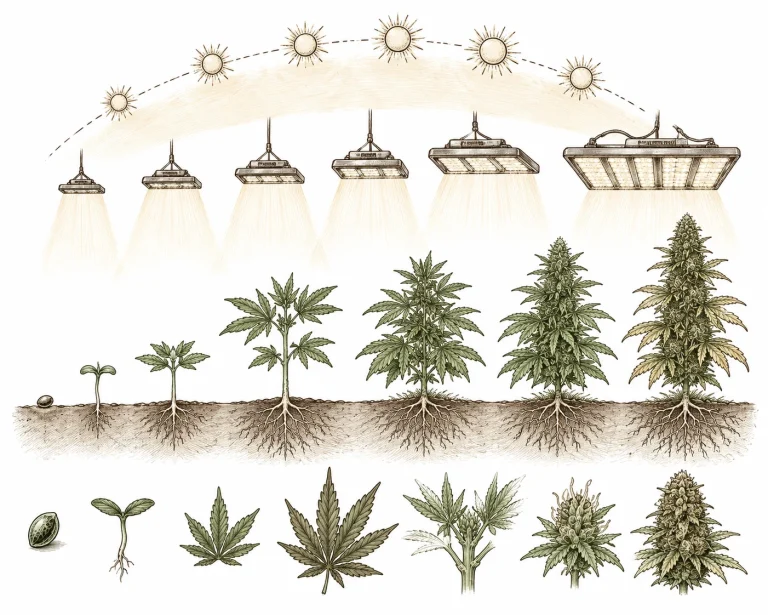
DLI stands for daily light integral — the total light dose per day. While PPFD is a snapshot (how much light is hitting the plant right now), DLI describes the total amount of light a plant accumulates over the entire day. DLI is measured in mol/m²/d (moles per square meter per day). This value is especially important because cannabis plants respond to their total light intake — not just the momentary value.
The calculation is simple: DLI = PPFD × light hours × 0.0036. With a PPFD of 600 µmol/m²/s and an 18-hour light period, you get a DLI of 600 × 18 × 0.0036 = 38.88 mol/m²/d. In the vegetative stage, DLI values of 25–40 mol/m²/d are ideal. For a quick calculation, use our free DLI Calculator. In the flowering stage, aim for 35–55 mol/m²/d on a 12-hour light cycle — which means you tend to need a higher PPFD in flowering to reach the same daily light dose.
DLI also helps you combine light hours and intensity in a targeted way. If your light isn’t intense enough, you can extend the light hours slightly in veg to reach your DLI target. Conversely, a powerful LED with shorter light hours lets you save electricity without underfeeding the plant with light. This understanding gives you much more control over your grow than just setting a timer.
- DLI = total light dose per day in mol/m²/d
- Formula: PPFD × light hours × 0.0036
- Target DLI in the vegetative stage: 25–40 mol/m²/d
- Target DLI in the flowering stage: 35–55 mol/m²/d
- DLI lets you optimize light intensity and duration together
- Low PPFD can be partly offset with longer light hours
Measuring PPFD for cannabis: how to measure correctly with a PAR meter
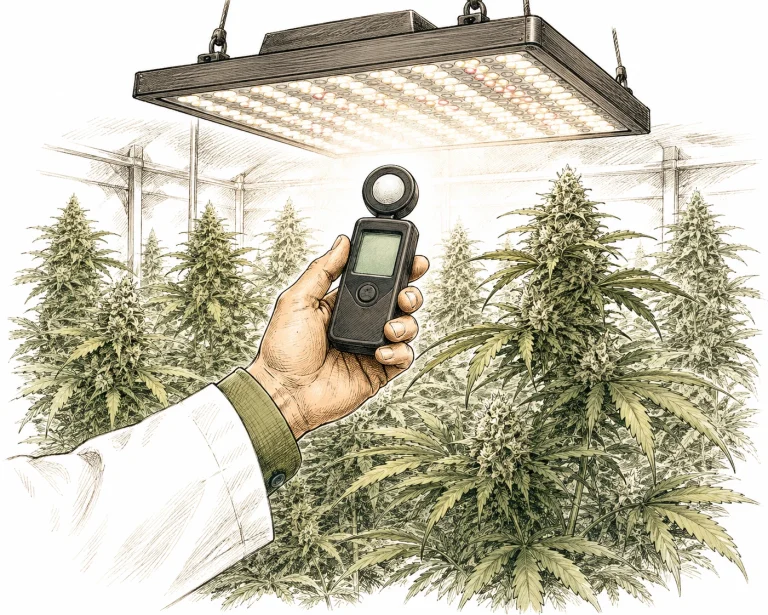
To measure PPFD accurately, you need a PAR meter, also called a quantum meter. Budget meters are fairly affordable, while professional models like the Apogee MQ-500 cost considerably more and deliver very accurate readings across the entire PAR range. Smartphone apps that use the front camera can roughly estimate PPFD, but because of how camera sensors work, they aren’t suitable for precise measurements. For a serious grow, investing in a real PAR meter pays off.
When measuring, always measure at canopy height, where the tops of your plants are growing. Take grid measurements: mentally divide your grow area into a 3×3 or 5×5 grid and measure every point. That way, you don’t just see the average but also hotspots (areas that are too intense) and dark zones (under-lit edges). The goal is an even PPFD across the entire canopy — not just a high peak value in the center.
Change the light height systematically and measure again until you find the ideal distance for the PPFD values you want. Write down the values and the matching light height — that gives you a solid baseline for future grows so you can reproduce your settings. Clean records are the key to reproducible results. You’ll find more tips on setting up your grow environment in our beginner’s guide to growing cannabis indoors.
- Use a PAR meter (quantum meter) for accurate PPFD readings
- Entry-level meters are affordable; pro models cost considerably more
- Always measure at canopy height, not at the level of the light
- Take grid measurements: 3×3 or 5×5 points across the grow area
- Identify and even out hotspots and dark zones
- Adjust the light height systematically and record the values
- Smartphone apps aren’t suitable for precise measurements
Converting lux to PPFD: rules of thumb and limits
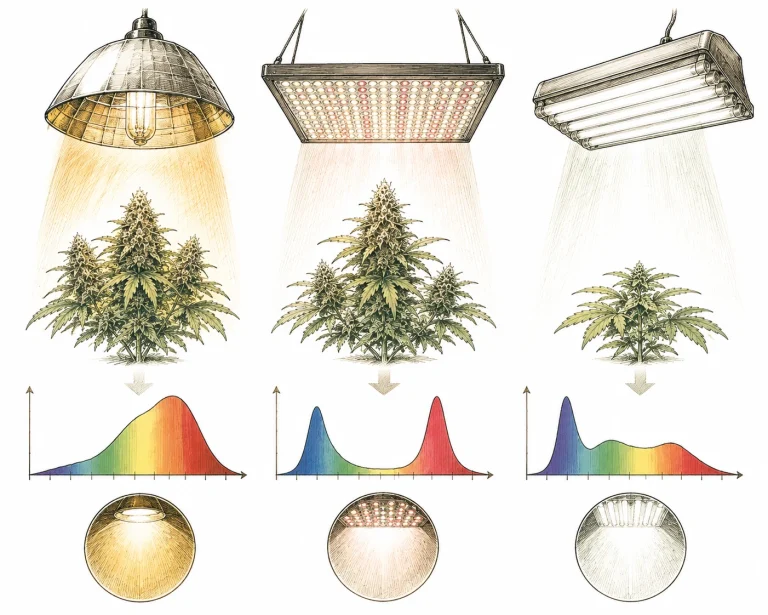
Many growers don’t have a PAR meter but do have a simple lux meter or a lux app. The good news: there are conversion factors you can use to estimate a rough PPFD value. For HPS lights, a typical conversion factor is about 0.014 (µmol/m²/s per lux). For white full-spectrum LEDs, the factor is between 0.013 and 0.020, depending on the spectrum. That means at 50,000 lux under an HPS light, you get roughly 700 µmol/m²/s PPFD — a plausible flowering value.
The problem is that this conversion isn’t very accurate. The factor varies considerably depending on the lighting technology and the spectral composition. LED lights with a strong red or blue component can deliver significantly more PPFD than warm white lights at the same lux value. Lux conversion is acceptable as a rough guide but unreliable for professional optimization. If you really want your grow under control, you won’t get around a real PAR meter in the long run.
If you don’t have a PAR meter yet, you can go by the manufacturer’s proven light height recommendations and use your plants as a biological indicator. Healthy, rich green leaves, fast growth and no signs of burning are positive signals. If, on the other hand, you notice signs like drooping cannabis leaves or chlorosis — the wrong light intensity (too little or too much) could also play a role, alongside the classic nutrient and watering problems.
- HPS conversion factor: about 0.014 µmol/m²/s per lux
- Full-spectrum LED factor: 0.013–0.020 depending on the spectrum
- 50,000 lux HPS ≈ 700 µmol/m²/s PPFD (rough estimate)
- Conversion is imprecise — the spectrum strongly affects the factor
- A PAR meter is essential for professional optimization
- Use plant responses as a biological indicator until you have a PAR meter
Common mistakes when measuring PPFD for cannabis
One of the most common mistakes is relying on manufacturer specs without measuring yourself. Many LED manufacturers state PPFD values for ideal conditions — often only for the center of the light’s footprint and under reflection conditions that don’t exist in a real grow. The reality in your grow tent can differ considerably depending on reflective film, room size and hanging height. Measure for yourself and trust your data.
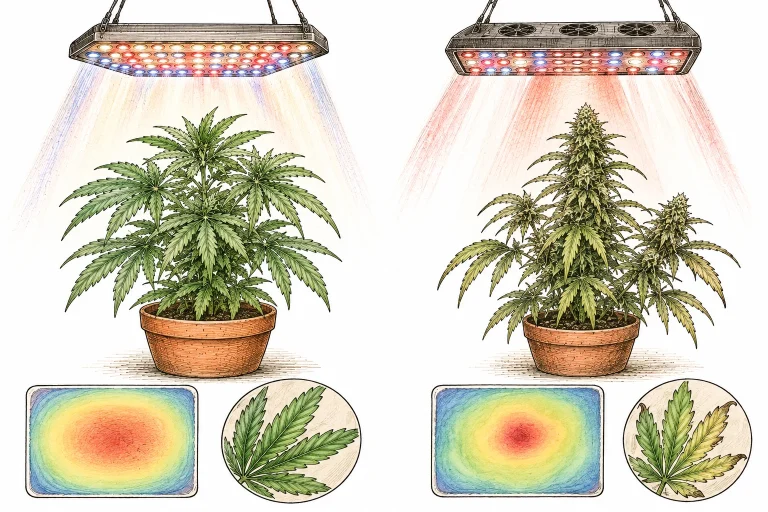
Another typical mistake is ignoring light uniformity. Even if the average of your readings is ideal, the edges can be below 300 µmol/m²/s, and corner plants can yield significantly less. Rotate your plants regularly, make the most of reflectors and reflective sheeting, or SCROG-train your canopy evenly under the light. An even PPFD across the entire area noticeably increases your total yield.
Finally, many growers neglect how light interacts with other environmental factors. High PPFD values significantly increase the plant’s transpiration and nutrient demand. If you turn up the light intensity, you also need to check whether watering intervals, nutrient strength and VPD (vapor pressure deficit) are still right — our VPD Calculator helps you with that. Too much light without adjusting the water supply can quickly lead to nutrient deficiencies like calcium deficiency because the plant uses a particularly large amount of calcium under high light stress.
- Never trust manufacturer specs blindly — always measure yourself
- Watch light uniformity: grid measurements reveal weak spots
- Edges and corner positions are often significantly under-lit
- More light = more transpiration = higher water demand
- Raising PPFD requires adjusting watering and nutrients
- VPD (vapor pressure deficit) is especially important at high light intensity
LED grow lights and PPFD: compare efficiency like a pro
When buying a new LED light, PPFD is the most important spec — but not without context. When it comes to PPFD for your cannabis grow, look at efficiency in µmol/J (micromoles per joule), meaning how many photons are produced per joule of energy used. Modern high-performance LEDs reach values of 2.5 to 3.0 µmol/J or more. Cheap no-name LEDs often only manage 1.5–2.0 µmol/J, which means you use significantly more electricity and produce more waste heat for the same PPFD.
PPFD maps are an important buying criterion. Reputable manufacturers publish PPFD distribution maps that show how evenly the light is spread over a defined area. Make sure the edge values don’t deviate too much from the center values. A ratio of at least 70–75% (edge value to average) is considered good. Lights with a very high average PPFD but poor uniformity deliver worse results in practice than lights with a slightly lower but more even PPFD.
Also keep in mind that PPFD drops sharply with increasing distance — typically according to the inverse square law. If you move the light twice as far away from the plant, the PPFD drops to about a quarter. At the same time, uniformity improves. For large canopies, it often makes more sense to spread several smaller lights evenly than to hang a single very powerful light in the center. For more information on setting up your complete lighting system, we also recommend our article on how to spot cannabis nutrient burn — because more light also means higher nutrient demand and the risk of accidentally overfeeding.
- Compare efficiency in µmol/J: aim for >2.5 µmol/J with modern LEDs
- Ask the manufacturer for PPFD maps and check them
- Uniformity: edge values should reach at least 70–75% of the average
- Inverse square law: double the distance = a quarter of the PPFD
- Several smaller lights are often better than one big center light
- Higher PPFD requires higher nutrient doses — avoid nutrient burn
Frequently asked questions
What’s the difference between PPFD, PAR and lux?
PAR (photosynthetically active radiation) is the wavelength range of 400–700 nm that plants use for photosynthesis. PPFD (photosynthetic photon flux density) measures how many PAR photons land on one square meter per second — in µmol/m²/s. Lux, on the other hand, is a unit of brightness as perceived by the human eye and doesn’t take into account whether the light is useful to plants. For growing cannabis, PPFD is the most meaningful measurement.
What PPFD do I need in the flowering stage?
In the flowering stage without added CO₂, values between 600 and 900 µmol/m²/s are ideal. Most strains reach light saturation at around 1,000–1,100 µmol/m²/s. With CO₂ supplementation, values up to 1,500 µmol/m²/s can be used. DLI (daily light integral) also matters: the target in flowering is 35–55 mol/m²/d with a 12-hour light period.
Can I convert lux to PPFD?
Yes, but only approximately. For HPS lights, a conversion factor of about 0.014 µmol/m²/s per lux applies. For full-spectrum LEDs, it’s between 0.013 and 0.020, depending on the spectrum. So 50,000 lux under HPS equals roughly 700 µmol/m²/s PPFD. However, this conversion is imprecise and should only be used as a rough guide. For precise results, you need a real PAR meter.
How do I measure PPFD correctly in a grow tent?
Use a PAR meter (quantum meter) and measure at canopy height, where the tops of your plants are growing. Take grid measurements — divide your grow tent into a 3×3 or 5×5 grid and measure each point. This shows you hotspots and under-lit edges. Then adjust the light height until you get an even distribution with the PPFD average you want. Without a PAR meter, you can use our PPFD Calculator to estimate guideline values for your cannabis grow.
What happens if the PPFD is too high?
PPFD values that are too high cause light stress. Typical symptoms are bleached or white, burnt leaf tips and upper leaves, leaf edges curling upward, stunted growth and, in the worst case, necrotic (dead) tissue. Without CO₂ supplementation, most strains reach light saturation at around 1,000–1,100 µmol/m²/s — beyond that, more light does damage without increasing yield.
What is DLI and why does it matter for cannabis?
DLI (daily light integral) is the total amount of light a plant accumulates per day, measured in mol/m²/d. The formula is: PPFD × light hours × 0.0036. While PPFD is a snapshot, DLI describes the actual daily light dose. Cannabis needs 25–40 mol/m²/d in veg and 35–55 mol/m²/d in flowering. DLI helps you balance light intensity and light duration in the best possible way.
We show you which LED grow lights have proven themselves in practice on our Recommended Gear page.
Conclusion
Measuring PPFD isn’t a luxury for advanced growers — it’s a basic tool for every grower who wants to reach their full potential. If you understand PPFD, DLI and PAR and measure regularly, you have a solid foundation for top yields and healthy plants at every stage of the grow. A PAR meter pays for itself after just a few grows — through better harvests, fewer plant problems and lower electricity use thanks to precise light settings. Start optimizing your grow based on data today, and you’ll see the difference in your plants very quickly.
