

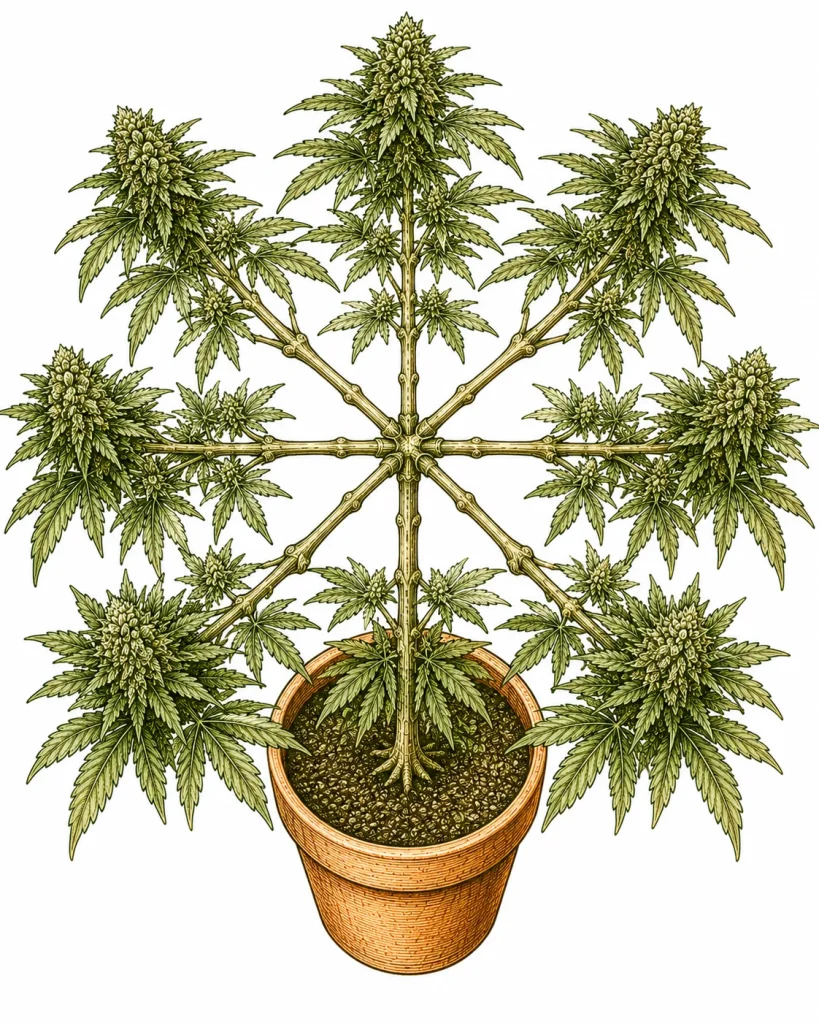
Cannabis mainlining (manifolding) is one of the most effective training techniques for indoor growers who want to turn a single plant into an even network of powerful main branches. With targeted topping and bending, you build a so-called manifold: a branched base structure that gives every branch the exact same share of nutrients and light. According to the Bavarian State Institute for Viticulture and Horticulture (LWG), an even shoot structure measurably improves how well the whole plant uses light. The result is several equal colas instead of one dominant main top, and that can noticeably boost your total yield. In this article, you’ll learn the right step-by-step approach, common mistakes and how to fit the method into your grow cycle.
What Is Cannabis Mainlining (Manifolding) and How Does It Work?
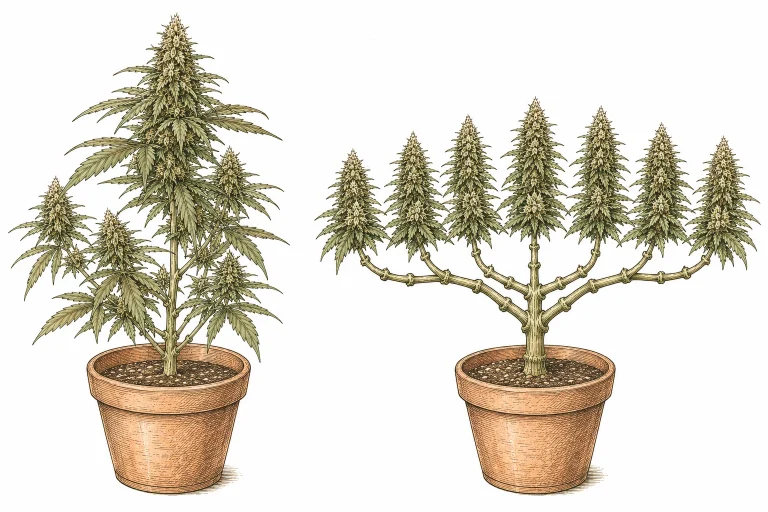
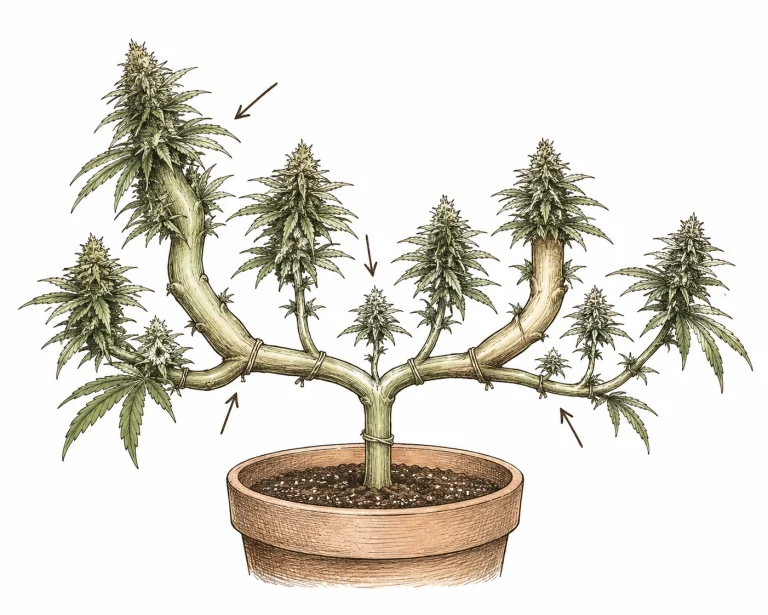
Cannabis mainlining combines topping with low stress training (LST) to create a symmetrical base structure, also known as a “manifold.” The idea is simple: you top the main stem early and then bend and tie down the two new branches evenly. With more rounds of topping, those two main branches turn into four, then eight and, in theory, up to sixteen equal branches. Each one has a direct, unobstructed path to the root zone.
The name “mainlining” comes from the idea of a main line, and that’s exactly how the technique works: all nutrients flow evenly through one central distribution structure to every single branch. No branch gets favored, no branch gets left behind. That way, all growth tips develop in sync, which gives you an even canopy when you flip to flowering. The technique was developed and popularized in the grow community by a grower known as “Nugbuckets,” who worked out the concept step by step and documented it.
Compared to other high stress techniques like supercropping or topping alone, mainlining gives you a structure you can plan ahead and repeat. You decide from the start how many main branches you want. Most growers go for eight, since that’s a good balance between training effort and extra yield. More than eight branches is possible, but it can stretch out the vegetative stage (veg) quite a bit and needs more space and time.
- Cannabis mainlining = topping + LST, combined and applied symmetrically
- Goal: even nutrient distribution to all growth tips
- Classic target: 8 equal main branches (3 rounds of topping)
- Popularized by community grower “Nugbuckets”
- Result: an even canopy with several same-size colas
Requirements: Which Plants Work Best for Cannabis Mainlining?
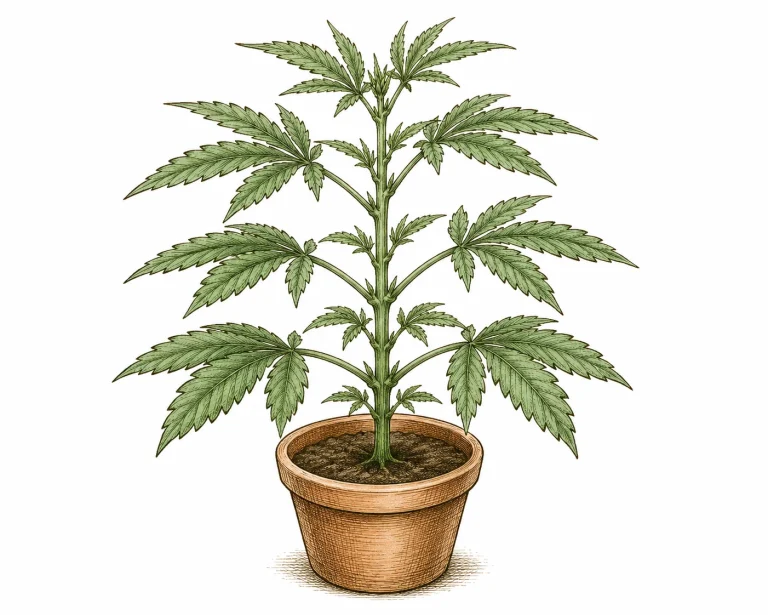
Not every cannabis plant is equally suited for mainlining. In general, you should go with photoperiod strains, because the technique needs plenty of time in veg. Autoflowers follow an internal clock and start flowering no matter what your light cycle is. That often doesn’t leave enough time to finish all the topping and recovery phases before flowering kicks in. If you’re new to manifolding, vigorous indica-dominant hybrids are a great pick: they bounce back quickly after cuts and build strong branches.
Your plant should have at least five or six nodes by the time you top it for the first time. Topping too early can weaken the plant for no good reason. Topping too late makes the later training steps harder, because the branches are already woody and less flexible. Make sure your plant is healthy and stress-free before you start training. Fix any nutrient deficiencies, overwatering or off pH before you begin mainlining. A stressed plant can recover much more slowly after HST (high stress training).
Your growing medium and pot size matter a lot, too. Since mainlining extends veg, bigger final pots of about 3 to 4 gal (11–15 L) are a good choice. That gives the roots enough room to support the larger plant structure. If you keep your nutrient management balanced and check your pH consistently, you lay the best foundation for a successful manifold.
- Go with photoperiod strains – autoflowers are only partly suited for this
- Wait until the 5th or 6th node before your first topping
- Your plant should be healthy and stress-free before you start training
- Pot size: at least 3 gal (11 L) for enough root space
- Indica hybrids bounce back especially fast after cuts
Step by Step: How to Mainline and Manifold Cannabis the Right Way
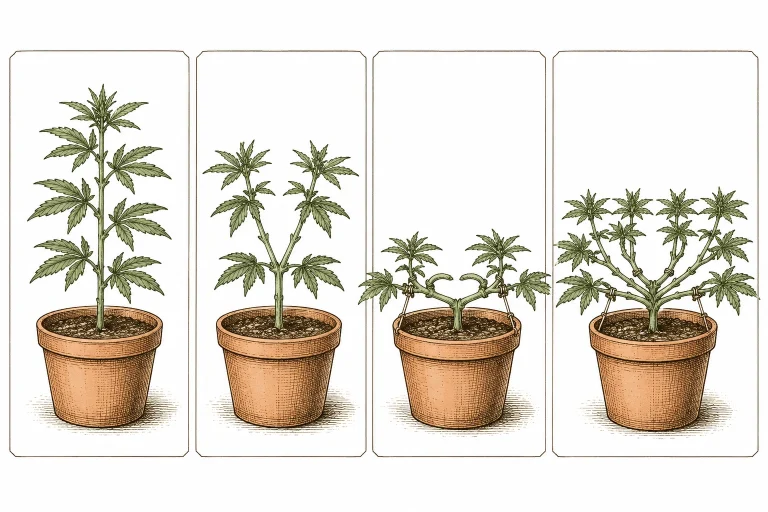
Step 1 – First topping at the 5th or 6th node: Cut the main stem right above the third node. At the same time, remove every growth tip below the third node completely. You now have two main shoots growing out of the third node. This symmetry is the heart of the manifold. It makes sure both branches sit exactly the same distance from the root zone, so they get the same supply of water and nutrients. Use only clean, sharp tools and disinfect the cut to prevent infections.
Step 2 – LST and building symmetry: Once the two main branches have grown about 1–2 in (3–5 cm), gently bend them outward and tie them down horizontally to the rim of the pot with plant ties or plant clips (German). Both branches should sit at the same height and point in opposite directions. This horizontal position pushes the side shoots underneath to grow and is key to an even manifold. After this step, give your plant at least five to seven days to recover before you move on.
Step 3 – Second topping for four branches: When each bent branch has formed two to three new nodes, top both branches again. Now you have four equal growth tips. Again, remove all lower side shoots growing below the new topping point. Tie the four new branches outward evenly. After another recovery period of at least five days, you can go ahead with the third topping.
Step 4 – Third topping for eight branches: Same routine as the rounds before. Top all four branches and you get eight equal growth tips. This is the classic “8-point manifold,” the foundation for eight evenly sized colas. After this third topping, the final build-up phase in veg begins: your plant fills out the canopy, all eight tips grow upward evenly, and if needed you can do some light defoliation to let more light through. Only once all eight tips have reached the same height is your plant ready to flip to flower.
Step 5 – Flipping to flower: As soon as the canopy is even and all eight shoots are at a similar stage, switch to a 12/12 light cycle. During the first two weeks of flowering (the flower stretch), you can still shape the plant lightly with LST. From week three of flower on, further training isn’t recommended, since it can disrupt bud development.
- 1st topping: at the 5th–6th node, remove all lower shoots
- LST after every topping: bend branches outward and horizontal
- Recovery time between steps: at least 5–7 days
- 2nd topping: gives you 4 equal branches
- 3rd topping: gives you 8 equal branches – the classic manifold
- Only flip to flower once the canopy is even
Cannabis Mainlining and Manifolding: Common Mistakes and How to Avoid Them
The most common mainlining mistake is impatience. Many growers don’t wait long enough between topping rounds, which can keep the plant under constant stress. A plant that hasn’t fully recovered may grow more slowly, develop weaker branches and be more vulnerable to pests and diseases. Plan for at least five to seven days of recovery – longer for younger or weaker plants. You can tell your plant has recovered when the new growth tips push strongly upward and the leaves look lush green and firm.
Another typical mistake is uneven topping. If you don’t cut at exactly the right spot or don’t consistently remove the lower side shoots, you can end up with branches of different thickness and length. That undermines the whole idea of mainlining. After every step, check that all unwanted shoots are really gone and that the remaining branches are bent evenly and tied down at the same height. Quick visual checks every two to three days help you spot and fix asymmetry early.
Pots that are too small often cause unexpected nutrient problems during mainlining, and these can show up as yellow leaves. The longer veg training means your plant builds a lot more biomass than an untrained plant, so the roots need room to match. A rootbound plant can run into nutrient lockout, which slows growth and, in the worst case, can wipe out weeks of work. You can transplant during training, just not right after a topping step. Stacking stress on stress almost always works against you.
An off pH is one of the most common hidden saboteurs in mainlining. Deficiencies caused by a pH outside the ideal range can drag out recovery times and delay building your manifold. Mainlining puts your plant through several stress phases in a row, so a stable feeding base matters even more. Check the pH of your water and your growing medium regularly. If you run into watering problems, it’s not just your plant that suffers. Your training loses precision too.
- Give your plant enough recovery time between topping rounds
- Always remove every unwanted side shoot, no exceptions
- Choose a pot big enough for the extra root growth
- Keep pH steady in the ideal range (6.0-7.0 in soil)
- Don’t transplant right after a topping step
Cannabis Mainlining Manifold vs. Other Training Techniques
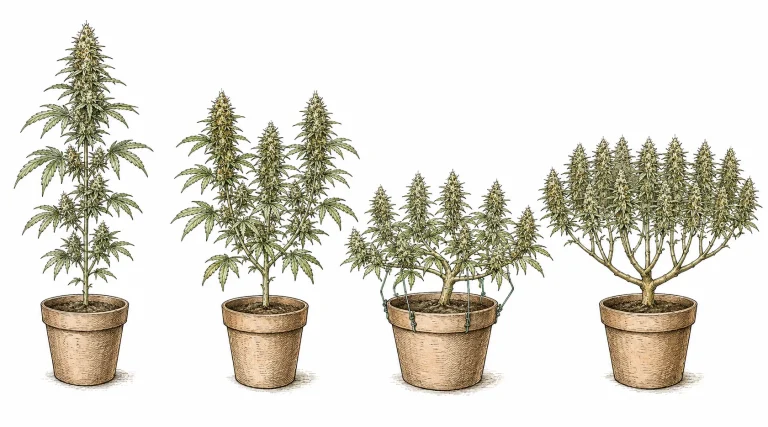
Mainlining isn’t the only way to boost a cannabis plant’s yield, but it’s one of the most structured and predictable. Compared to topping alone, mainlining gives you more even results. It doesn’t just multiply your growth tips, it also makes sure every tip gets the same supply. Topping without LST often leaves some branches more dominant than others. With mainlining, consistent symmetry work keeps that from happening.
Compared to SCROG (screen of green), mainlining has one big advantage: you don’t need a physical screen. The canopy comes from the plant’s own structure, which makes care and handling easier. In a SCROG, you weave shoots through trellis netting and move them into place by hand. That takes ongoing attention through the whole vegetative stage. Mainlining, on the other hand, asks for focused work in clear steps, and between them your plant can mostly grow undisturbed.
Combining mainlining and SCROG is an advanced option for experienced growers. You build the manifold first, then guide the eight main branches through a SCROG screen to fine-tune the canopy even further. This maximizes light use and can push yield per plant higher. But it takes experience, space and planning. If you already know the technique, you’ll find a deeper look at the pros and cons of different methods in our overview of growing techniques.
FIMing is another topping variation that sometimes comes up with mainlining. The difference: FIMing only removes about 75% of the shoot, which in theory gives you four new shoots instead of two. In practice, FIMing is less precise than classic topping and often produces uneven results. That’s the exact opposite of what you want in mainlining. So for manifolding, most experienced growers recommend classic topping with sharp scissors.
- Mainlining vs. topping: more symmetry through active structure work
- Mainlining vs. SCROG: no screen work needed, a more structured process
- Mainlining + SCROG can be combined for maximum yield
- FIMing isn’t recommended for manifolding – too unpredictable
- Mainlining extends veg, but can clearly boost the quality of your yield
Timeline and Care: How Long Does Cannabis Mainlining Take Before Flowering?
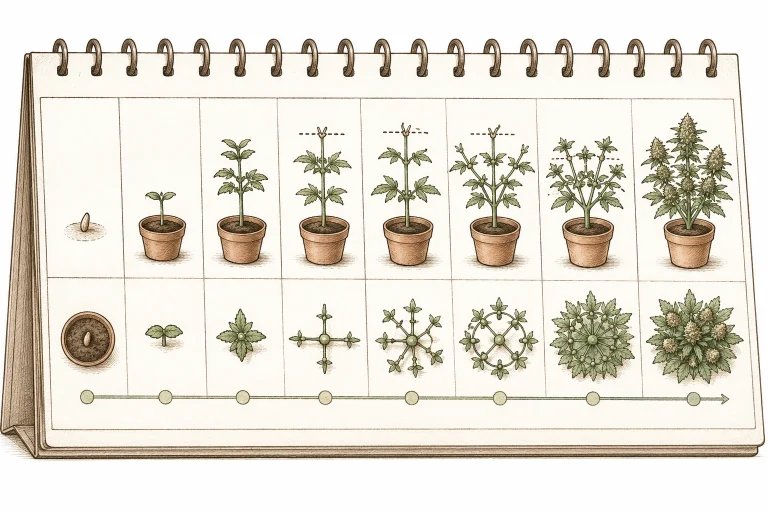
Here’s a realistic timeline for a classic 8-cola manifold: About two to three weeks after germination, your plant reaches the fifth or sixth node and is ready for the first topping. After seven days of recovery and another five to seven days of growth, you do the second topping. The same goes for the third. Add up all the recovery and growth breaks, and building an 8-cola manifold usually takes four to six weeks after the first topping. That adds up to a vegetative stage of at least seven to eight weeks in total.
Care during mainlining isn’t fundamentally different from normal veg care. What matters most is a stable environment: an ideal temperature between 72 and 82 °F (22–28 °C), relative humidity (RH) of 55 to 70 percent and a steady 18/6 light cycle. Match your nutrients to the growth stage. In the vegetative stage, the focus is on nitrogen. Be careful not to overfeed, because too much nitrogen can slow down recovery after each cut.
After the third topping, the so-called “fill-out phase” begins: the eight main shoots grow upward and fill the canopy. During this phase, light defoliation (selectively removing large fan leaves that block light) can improve light penetration. Only flip to flower once all eight shoots have reached a similar height and thickness. An uneven canopy at the start of flowering can also mean an uneven yield at harvest.
If you plan your grow well from the start, mainlining fits nicely into a tight overall schedule. From germination with a dialed-in setup, a full indoor cycle with an 8-cola manifold and a typical flowering time of eight to ten weeks takes about 16 to 20 weeks in total. That’s longer than an untrained grow, but for most growers the quality and size of the harvest more than make up for the extra effort.
- First topping: about 2-3 weeks after germination
- Full training build: 4-6 weeks after the first topping
- Total veg stage with mainlining: 7-8 weeks
- Ideal veg conditions: 72-82 °F (22-28 °C), 55-70% RH, 18/6 light cycle
- Full grow cycle with manifolding: 16-20 weeks
Cannabis Mainlining Manifold for Beginners: Is This Technique Right for You?
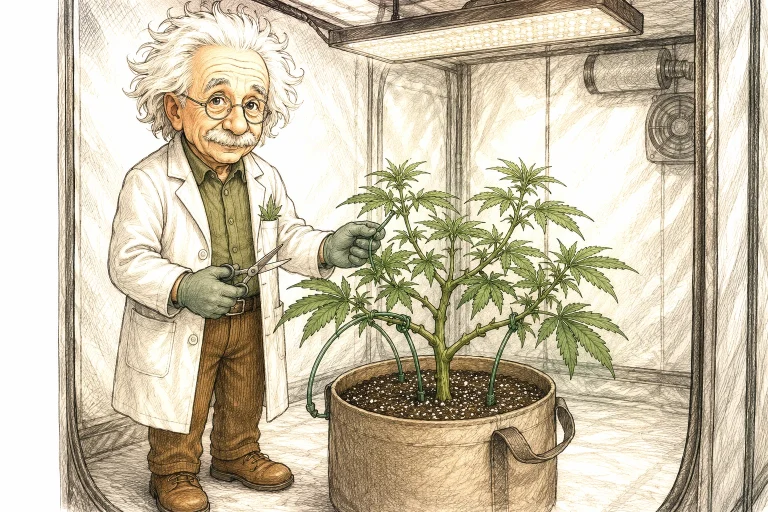
Mainlining is considered an advanced technique, but with the right prep, motivated beginners can learn it too. The key difference from experienced growers is knowing how to read your plant’s stress signals and how to judge recovery times. If you’ve already finished one full grow without training and you’ve got the basics of plant care down, you’re well prepared for your first mainlining run. Ideally, start with a hardy, well-known strain and just one plant, so you can watch and learn the process at your own pace.
If you’re brand new, we recommend you first get comfortable with the basics of indoor cannabis growing and maybe start with simple LST (low stress training) before you try mainlining. The concept is simpler, it’s less stressful for the plant and there’s more room for mistakes. Once you know how your plants react to bending and cutting, you’ll feel a lot more confident when you mainline.
A common beginner mistake with mainlining is misjudging the plant’s size. Many newcomers start training too late. When the plant is already too big, the branches have turned woody and can crack when you bend them. Others start too early and put the young plant under stress it can’t handle yet. The rule of thumb “fifth to sixth node” is a reliable anchor you can check with a quick look at your plant. Count the node pairs from the bottom up, and you’ve found your starting point.
- Recommended for beginners with at least one finished grow
- Learn LST first, then try mainlining
- Start with a hardy strain and just one plant
- Rule of thumb: first cut at the 5th-6th node – easy to check
- Sharp, sterilized tools are a must
Frequently Asked Questions
At Which Node Should I Start Cannabis Mainlining?
Do your first topping for mainlining at the fifth or sixth node. Topping too early can weaken the plant. Too late, and the branches may already be woody and less flexible. Count the node pairs from the bottom up and cut right above the third node.
Can I Mainline Autoflowering Strains?
It’s possible, but not recommended. Autoflowers start flowering on their own internal schedule and often don’t leave enough time for all the training steps and recovery periods. Photoperiod strains, where you control the length of the vegetative stage, are a much better fit for mainlining.
How Many Colas Does a Classic 8-Cola Manifold Produce?
A classic 8-cola manifold (three rounds of topping) gives you eight equal main branches, and each one develops its own main cola. That means eight buds of roughly the same size, which usually gives you a much more even yield than an untrained plant with one dominant cola.
How Long Does Mainlining Take and When Can I Flip to Flower?
Building an 8-cola manifold takes about four to six weeks after the first topping. That puts your total vegetative stage at seven to eight weeks minimum. Only flip to flower once all eight shoots have reached an even height and thickness.
What’s the difference between mainlining and manifolding?
They’re the same technique. “Mainlining” is the more popular name in the grow community. “Manifolding” refers to the structure you build: the manifold. Most growers use the two terms interchangeably.
Can I combine mainlining with a SCROG?
Yes. Experienced growers love this combo. First you build the manifold. Then you weave the eight main branches through a SCROG net. That squeezes even more out of your light and can boost your yield further. If you’re new to training, though, master one technique before you combine them.
What tools do I need for mainlining cannabis?
You’ll need sharp, sterilized scissors or a scalpel for the topping cuts. For the LST steps, grab some plant wire, soft plant clips or plant yo-yos. Gloves are a good idea to help prevent infections. Isopropyl alcohol to sterilize your cutting tools is a must.
The Bottom Line
Mainlining (manifolding) is one of the most structured and productive training techniques you can use as an indoor grower. Consistent topping and LST create a symmetrical manifold that feeds every growing tip evenly and builds a flat, even canopy. The extra work in veg pays off with several same-size colas and a noticeably bigger total yield. With sharp tools, plenty of patience and a solid grow setup, mainlining is a rewarding next step even for motivated beginners.
