

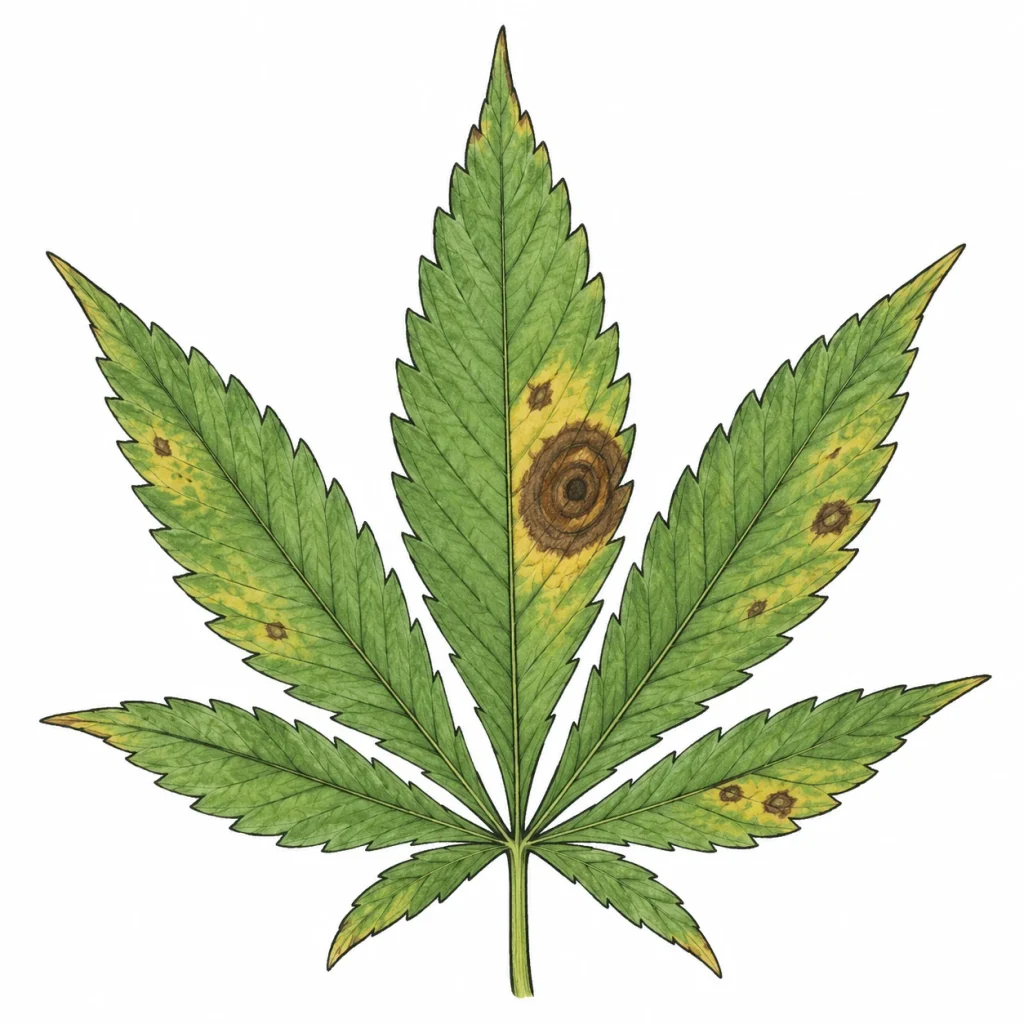
Learning to spot Alternaria leaf spots on cannabis is one of the most important skills you can build as a home grower. This fungus can spread quietly and fast, long before the damage becomes obvious. Alternaria is one of the most dangerous leaf fungi in cannabis growing because, under the wrong conditions, it can take over entire plants within a few days. The telltale sign is dark brown to black spots with concentric rings. At first they look like harmless dry patches, but they can grow quickly. If you read the signs early and act fast, you can save your plant and protect your harvest. This article shows you how.
What Is Alternaria and Why Does It Attack Cannabis?
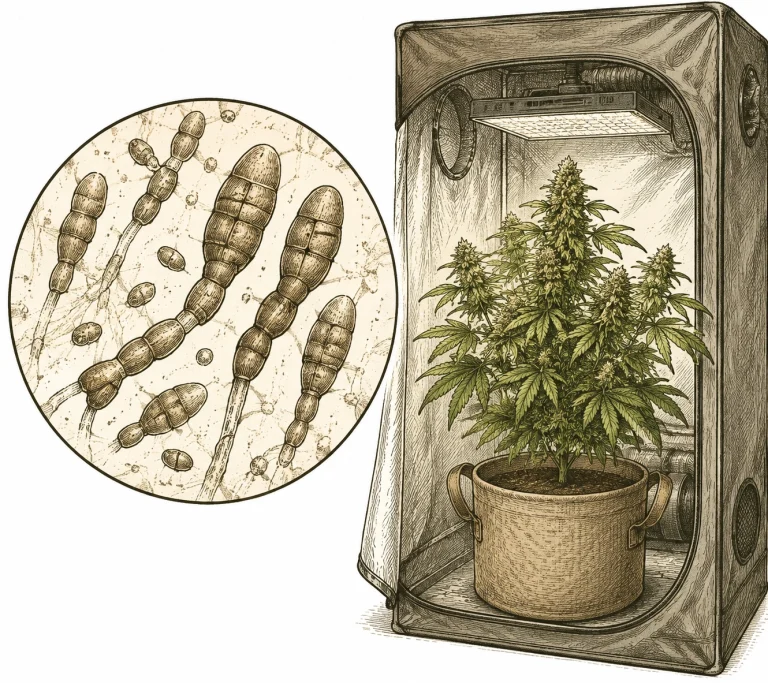
Alternaria is a genus of mold fungi found all over the world in soil, on plant debris and in the air. Several species, including Alternaria alternata and Alternaria brassicicola, can infect cannabis plants. The fungus is an opportunistic pathogen: it prefers to attack weakened, stressed or already damaged plant tissue. Healthy, well-fed plants growing in good conditions are much more resistant.
The infection usually starts with spores carried by air, water or contaminated tools. Plants are most at risk when their defenses are already under pressure, for example from a nutrient deficiency, the wrong pH or constantly high humidity (relative humidity, RH). To spread fast, Alternaria needs temperatures between 68 and 86 °F (20–30 °C) and an RH above 80%. Under these conditions, a single infected spot can grow to several times its original size within 48 hours.
For indoor growers, Alternaria is especially sneaky because a grow tent can become a perfect home for fungi if you neglect ventilation and humidity control. Outdoor plants are vulnerable too, especially during damp fall weeks right before harvest. In both cases, acting early is key. The fungus doesn’t stop at the leaves. It can spread to stems, buds and even roots.
- Alternaria alternata and Alternaria brassicicola are the most common species on cannabis
- Opportunistic pathogen: prefers stressed or damaged plant parts
- Ideal conditions for the fungus: 68–86 °F (20–30 °C) and over 80% RH
- Spreads through air, splashing water, tools or contaminated soil
- Can spread fast: from one leaf to the whole plant within days
How to Spot Alternaria Leaf Spots on Cannabis: What the Symptoms Look Like
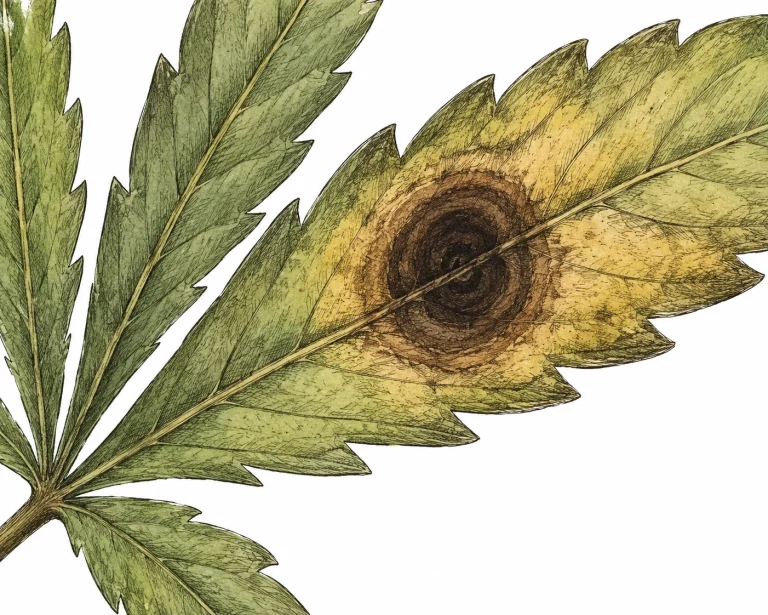
The key symptom of an Alternaria infection is leaf spots with a typical bullseye pattern: concentric rings in dark brown, black and yellowish tones. These rings form because the fungus grows in bursts, and every new growth wave leaves another ring behind. Early on, the spots look small and dry, almost like heat damage or water splash marks. Only when you look closely or use a magnifier can you see the ring structure that gives Alternaria away.
As the infection progresses, the spots get bigger and start to merge. The leaf surface around each spot turns yellowish, a sign that the surrounding tissue is dying. In high humidity, you may see a dark, velvety spore powder on the spots. That means the fungus is actively producing spores. Infected leaves curl up, turn brittle and eventually drop. Unlike other fungal diseases such as bud rot (botrytis), Alternaria doesn’t form fluffy, cotton-like mold. The spots stay dry with clear edges.
The infection often starts on the lower, older leaves, which get less airflow and stay damp longer. From there, the fungus works its way up. Stems and leaf stalks can develop dark brown lesions, which disrupt water transport and can cause sudden wilting. In the worst case, Alternaria spreads to the buds and ruins your harvest. That’s why you shouldn’t mistake this fungal disease for a simple calcium deficiency, which can cause similar spots but never shows a ring structure.
- Dark brown to black spots with concentric rings (bullseye pattern)
- Yellowish discoloration of the leaf tissue around the spots
- Dark, velvety spore powder visible in high humidity
- Infected leaves curl up, turn brittle and drop
- Usually starts on lower leaves with poor airflow
- No fluffy, cotton-like growth like bud rot (botrytis): the spots stay dry
How to Tell Alternaria Apart from Other Fungal Diseases and Deficiencies
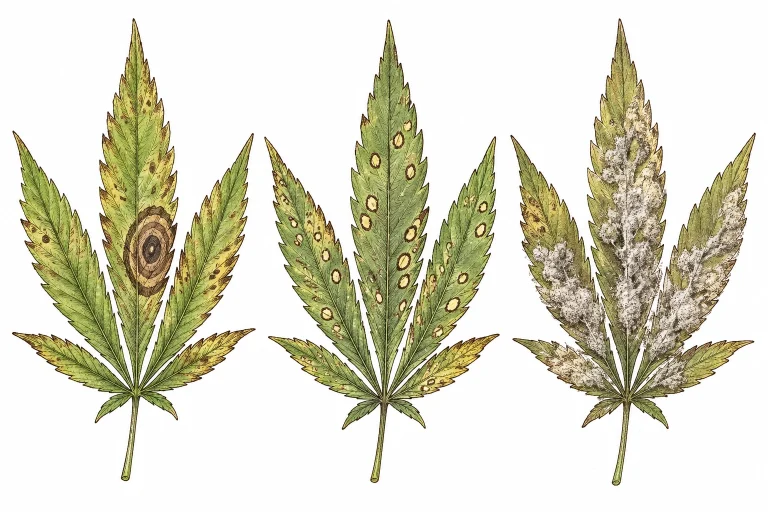
Getting the diagnosis right matters, because the wrong treatment can easily make things worse. Alternaria and septoria both cause leaf spots, but they look quite different. Septoria spots are smaller, round to oval, with a pale yellow to whitish center and a dark brown edge. They don’t have the concentric rings that are typical of Alternaria. Septoria also tends to hit the lower leaves first, but it spreads more slowly. Not sure which one you’re dealing with? Our article on septoria leaf spot on cannabis has a detailed side-by-side comparison.
Bud rot (botrytis, gray mold) looks completely different: a whitish-gray, fuzzy mold layer on leaves and buds that releases a cloud of spores when you touch it. There’s no ring pattern here. Cladosporium, on the other hand, leaves black to olive-green, rather blotchy patches, also without rings. Calcium deficiency causes rusty brown to copper-colored spots. They don’t have rings either, and they usually show up on young leaves first, while Alternaria prefers the older, lower leaves.
Here’s a quick way to tell them apart: moisten the spot slightly and look at it through a 10x loupe. Alternaria shows a clear zoned pattern made of several rings. If you also find a dark, powdery, velvety spore layer on the underside of the leaf, the diagnosis is pretty much confirmed. Still unsure? Run a full check with our Cannabis Plant Diagnosis Hub, which rules out other diseases step by step.
- Septoria: smaller spots, pale center, no ring pattern
- Bud rot (botrytis): gray, fuzzy mold layer, no ringed spots
- Cladosporium: black/olive-green patches, blotchy, no rings
- Calcium deficiency: rusty brown spots without rings, young leaves first
- Alternaria: concentric rings + velvety spore layer = diagnosis confirmed
- A 10x loupe and a little moisture make it much easier to tell them apart
Causes: Why Does Alternaria Show Up in Your Grow?
The most common cause of Alternaria is humidity that stays too high for too long, combined with poor airflow. When moist air sits on the leaves for hours, it forms the thin film of moisture that Alternaria spores need to germinate. The riskiest times are the flowering stage and the last few weeks before harvest, when plants are dense and bushy and air barely moves inside the canopy. A dehumidifier in your grow tent and good fans aren’t optional extras here. They’re a must.
Another big risk factor is plant stress from mistakes in how you run your grow. Nutrient deficiencies, especially calcium deficiency, weaken leaf tissue and make it easier for fungi to get in. A pH that’s off can also block the uptake of key defense nutrients like calcium and magnesium, which lowers your plant’s resistance to fungi. Too much nitrogen leads to soft, overly lush tissue that’s basically an open buffet for fungi.
Small wounds from training techniques like LST (low stress training), topping or FIM can give Alternaria spores a way in. Contaminated soil, old plant debris in your grow room and unsanitized tools are other common sources. Outdoors, damp fall nights and big temperature swings favor an infection, so check outdoor plants extra closely in the last few weeks before harvest.
- Constantly high humidity (above 60–70 % RH during flowering)
- Poor air circulation and plants packed too tightly
- Nutrient deficiencies (especially calcium and magnesium)
- Wrong pH blocks nutrient uptake and weakens fungal resistance
- Too much nitrogen → soft, vulnerable tissue
- Small wounds that let spores in
- Contaminated tools, soil or plant debris
How to Spot Alternaria Leaf Spots on Cannabis and Treat Them Fast
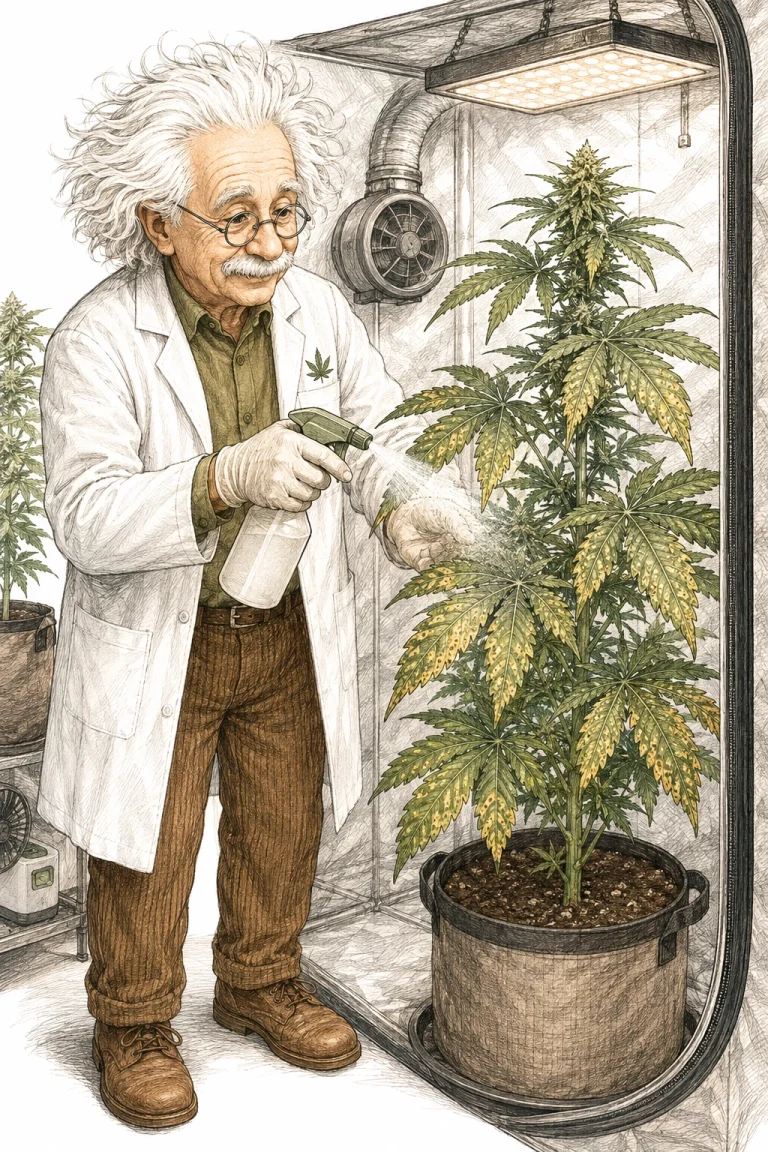
Once you’ve spotted Alternaria, every hour counts. Remove all infected leaves right away, and remove them completely. Don’t rip them off. Cut them cleanly with sanitized scissors. Put the material straight into a sealed bag and get it out of your grow room. Avoid pulling the leaves through the canopy, because spores can drop onto healthy leaves along the way. After this cleanup, lower the humidity immediately. Your target during flowering: below 50 % RH.
A proven organic fix is a sodium bicarbonate spray: about 1 teaspoon (5 g) of baking soda per quart (1 L) of water, plus a few drops of liquid soap so it sticks to the leaves. The spray shifts the pH on the leaf surface and slows fungal growth. With light to moderate infections, you can get good results by spraying several times, every two to three days. Organic fungicides based on Bacillus subtilis are another solid option. This soil bacterium actively fights fungal spores and is suitable for use on cannabis plants.
If the infection is severe or organic products aren’t enough, you can consider copper-based products (e.g., copper oxychloride). Only use them in the vegetative stage, though, never shortly before harvest. Important: always treat the whole plant, including areas that look healthy, because invisible mycelium may already have spread. Make sure you’re watering your cannabis plants the right way so you don’t splash water onto the leaves, since splashing helps Alternaria spread.
- Remove infected leaves right away with disinfected scissors and dispose of them safely
- Drop humidity below 50 % immediately
- Sodium bicarbonate spray (about 1 tsp per quart, 5 g/L) as a fast organic fix
- Bacillus subtilis products for organic fungus control
- Treat the whole plant, not just the visibly infected areas
- Copper products only in the vegetative stage, never shortly before harvest
- Always avoid splashing water onto leaves
How to Prevent Alternaria for Good: Indoor and Outdoor Growing
Long-term prevention starts with climate control. For indoor growing, the right humidity for each stage is key: seedlings 65–70 %, vegetative stage 50–70 %, flowering stage 40–50 %, and below 40 % in the last two weeks. A quality hygrometer always shows you the current reading. Combine that with a strong exhaust system and several circulation fans that keep the air moving, and you create an environment where Alternaria has a hard time getting a foothold. Our complete indoor growing guide gives you all the key numbers for the perfect grow setup.
Plant care and growing technique matter just as much. Regularly defoliate the lower, shaded leaves that get less airflow, because they’re usually the first to be hit by Alternaria. Targeted leaf work can boost airflow through your canopy a lot. Always use disinfected tools and dip your blades in isopropyl alcohol after every cut. Never reuse contaminated growing medium or soil from last season.
The plant protection guidance from the Bavarian State Institute for Viticulture and Horticulture (LWG) also shows how much good growing practices and hygiene can lower the risk of fungal diseases.
On the nutrient side, balanced feeding strengthens your cannabis plants’ natural resistance to fungi. Silica supplements have proven effective at strengthening cell walls so plants can better fend off fungal invaders. Check the pH of your growing medium and your water regularly so your plants can take up all nutrients properly. Well-fed plants growing in ideal conditions tend to be much more resistant to Alternaria and other fungal diseases.
- Keep humidity right for each stage: below 50 % in the flowering stage
- Strong ventilation and several circulation fans in your grow space
- Regular defoliation of the lower leaves for better airflow
- Disinfect tools with isopropyl alcohol after every cut
- Never reuse contaminated growing medium
- Silica supplements to strengthen cell walls and fungal resistance
- Balanced nutrients and the correct pH as your foundation
Anthracnose can cause similar leaf spots too. Look for the telltale concentric rings, which are typical of Alternaria.
Frequently Asked Questions
Can I still save a cannabis plant with Alternaria?
Yes, if you catch it early. Remove all infected leaves right away, lower the humidity and treat the plant with a bicarbonate spray or Bacillus subtilis products. If you act early, most plants make a full recovery.
What do Alternaria leaf spots look like, in one sentence?
Alternaria leaf spots are dark brown to black, round and show a typical concentric ring pattern, like a target, on a yellowed patch of leaf.
Is Alternaria a threat to my harvest?
Yes. In severe cases, Alternaria can spread to the buds and ruin your harvest. Especially in the last weeks before harvest, check your plants daily and keep the humidity consistently low.
What humidity works best to prevent Alternaria?
In the flowering stage, keep relative humidity (RH) at 45–55 %. In the last 1–2 weeks before harvest, you can optionally drop it to 35–45 %. Combined with good airflow, this is the most effective way to prevent Alternaria and other fungal diseases.
Can I use copper fungicides against Alternaria on cannabis plants?
Copper products like copper oxychloride can be used during the vegetative stage and work well against Alternaria. Skip them in the flowering stage and right before harvest, because residue can stay on the buds.
How is Alternaria different from Septoria on cannabis?
Septoria spots are smaller, with a pale yellow to white center and a dark brown edge, but no concentric rings. Alternaria spots show several rings and can grow a velvety layer of spores when humidity is high.
Similar leaf spot diseases compared: Cladosporium, Bacterial Leaf Spot and Septoria Leaf Spot — all three cause small, spotty lesions, but with different patterns and causes.
The Bottom Line
Spotting Alternaria leaf spots on cannabis is the first and most important step to stop this sneaky fungal disease in time. The bullseye pattern of concentric rings on dark brown spots is the telltale sign – catch it early and you’re in good shape. Removing infected leaves right away, lowering the humidity and using biological fungicides make up an effective first-aid trio. In the long run, steady climate control, balanced feeding and regular plant care keep your cannabis plants protected from another outbreak.
