

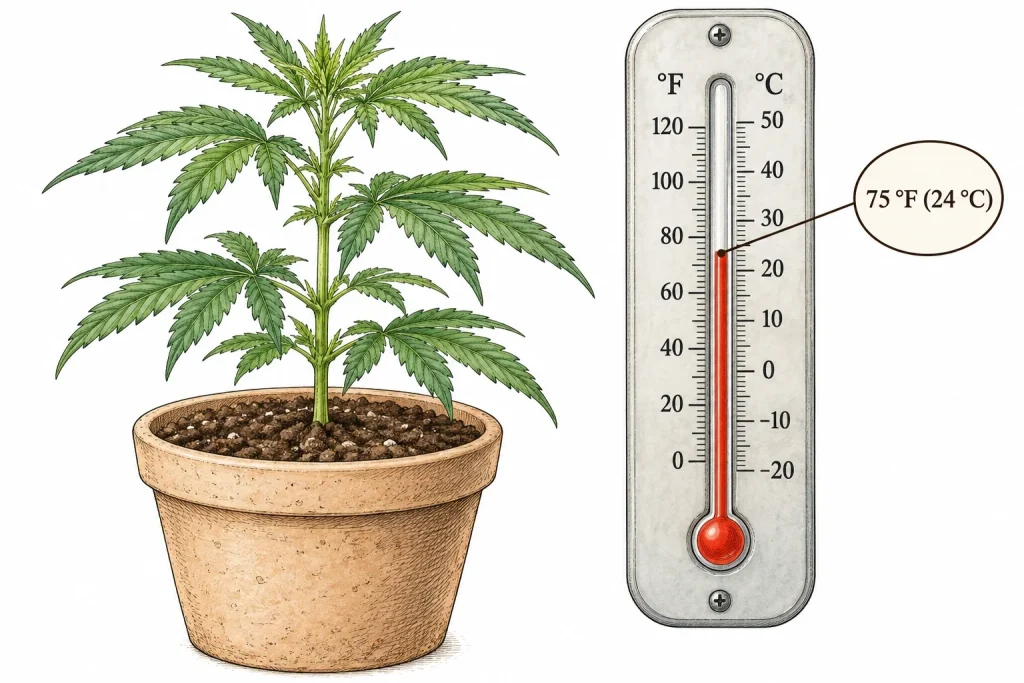
Dialing in your cannabis temperature lays the groundwork for healthy growth, dense buds and a big harvest. Too hot, too cold or big temperature swings are some of the most common stressors in an indoor grow, and they often go unnoticed until the damage is already visible. In this article, you’ll learn which temperature ranges work best in each growth stage, how to spot heat stress and cold damage early, and which simple steps keep your climate stable for the long haul. With the right know-how, you can give your plants exactly what they need to reach their full potential.
Why the Right Cannabis Temperature Matters So Much
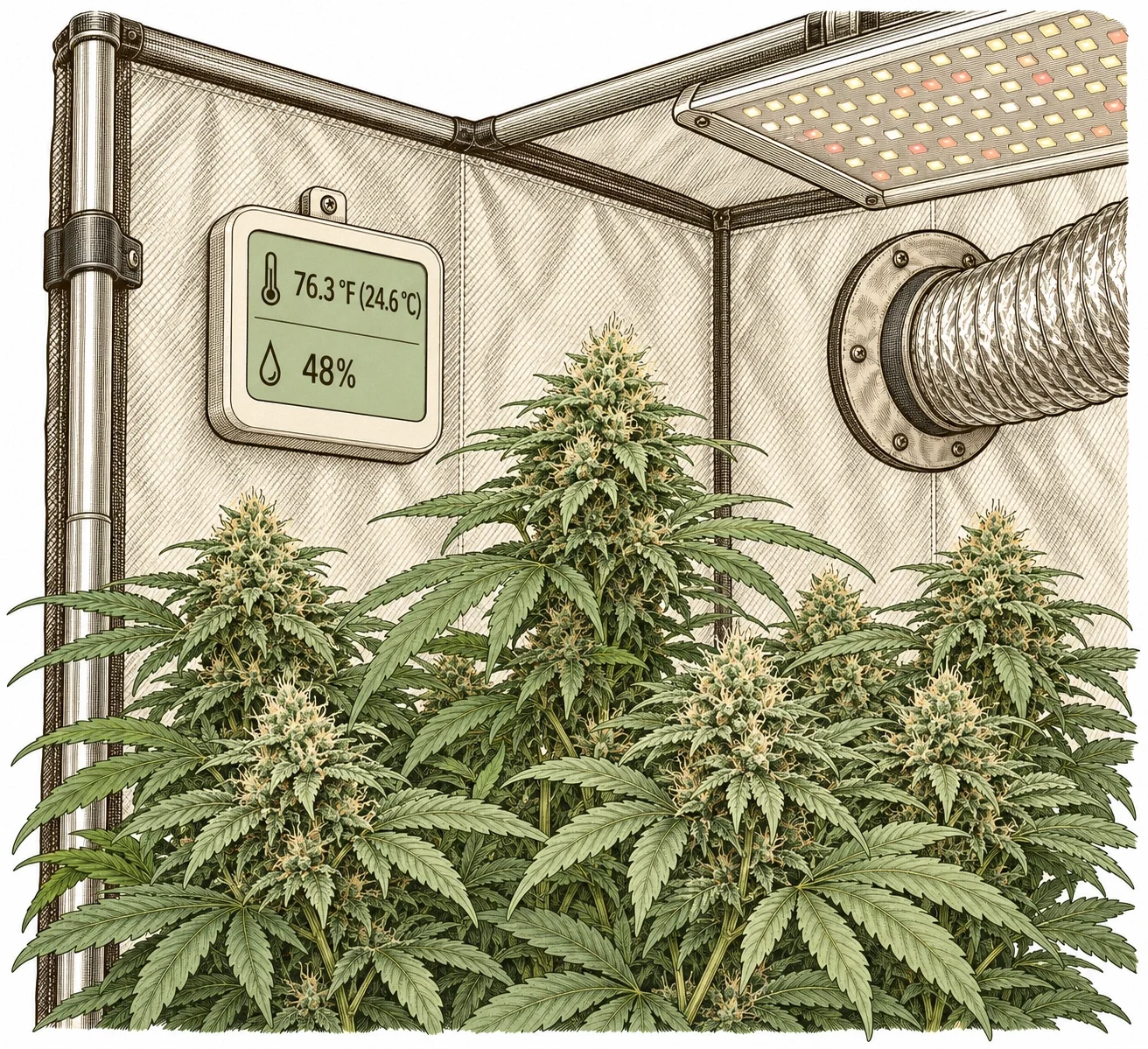
Cannabis is an adaptable plant, but it has clear comfort zones. Temperature directly affects its metabolism: photosynthesis, nutrient uptake, transpiration and terpene production all run best within narrow temperature windows. When it gets too hot, the stomata open too wide, the plant loses too much water and gas exchange gets thrown off balance. When it’s too cold, metabolism slows down, nutrients are absorbed less efficiently and growth can stall noticeably.
On top of that, the wrong temperatures often trigger follow-up problems. Heat stress weakens the plant’s defenses and makes it more vulnerable to mold, spider mites and nutrient issues. Cold during the dark period can slow root activity so much that even a perfectly dialed-in nutrient solution barely gets taken up. Once you understand these connections, you can often fix problems before they even start. That’s why stable climate control isn’t an optional upgrade – it’s a basic requirement for a successful grow.
- Photosynthesis only runs efficiently within a narrow temperature window
- Temperatures that are too high encourage heat stress, mold and pests
- Temperatures that are too low slow root activity and nutrient uptake
- Keep day-to-night temperature swings under control
- Stable temperatures reduce stress and can boost both yield and quality
Ideal Temperature Ranges: Dialing In Cannabis Temperature by Growth Stage
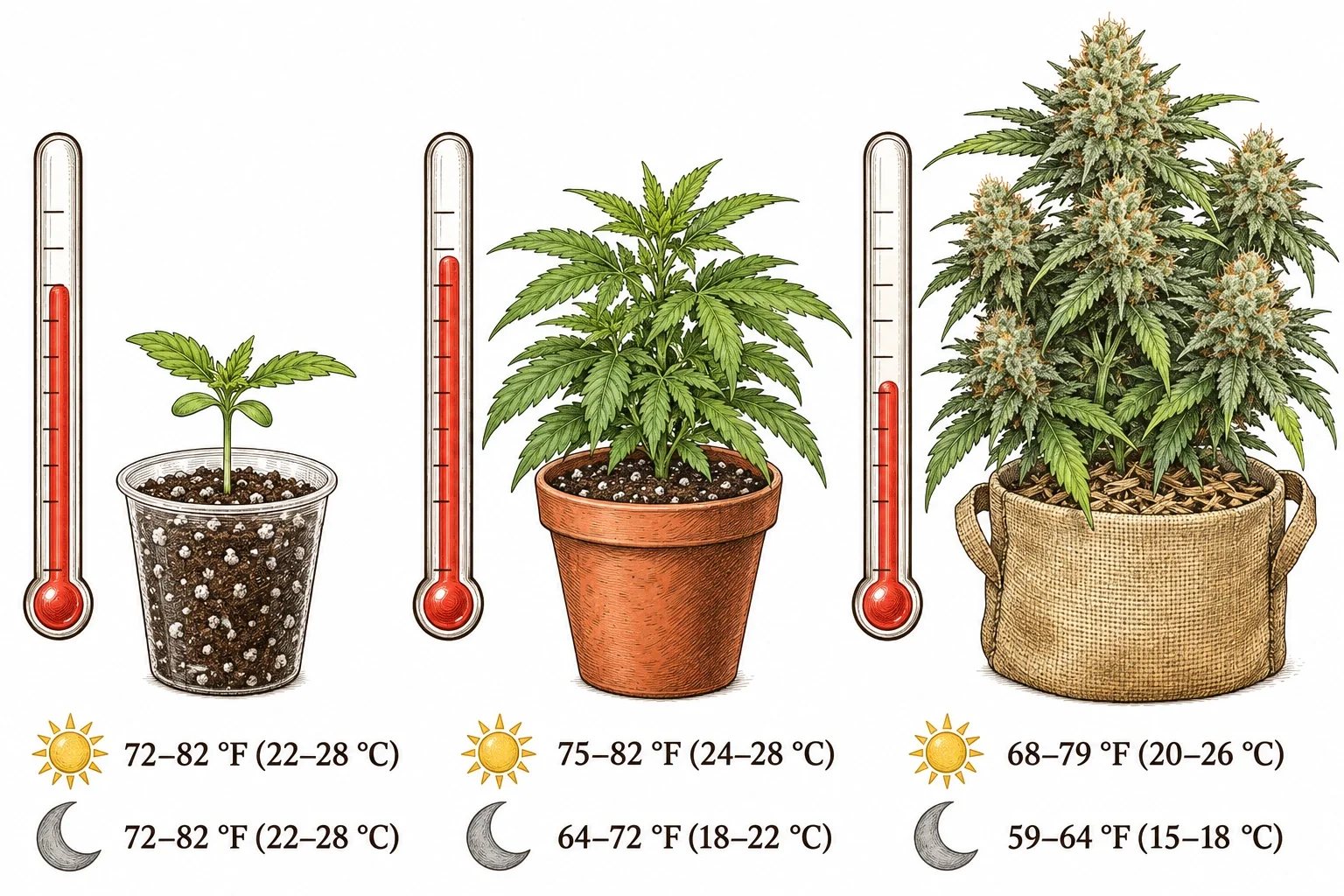
The ideal temperature for cannabis isn’t the same in every stage. During germination, seeds prefer a warm, moist environment between 72 and 82 °F (22–28 °C). Once seedlings develop their first leaves, a steady room temperature of 72 to 79 °F (22–26 °C) is ideal. Young plants are still sensitive to swings at this stage, so try to keep the temperature as stable as possible.
In the vegetative stage, things can run a little warmer. Many growers report their best results with daytime temperatures between 75 and 82 °F (24–28 °C). At night, a slight drop to 64 to 72 °F (18–22 °C) helps mimic the natural day-night rhythm. A day-night difference of more than 14 to 18 °F (8–10 °C) can cause unwanted reactions, including slower growth or, in some cases, hermaphrodite traits.
During the flowering stage, the ideal temperature window drops slightly. Daytime temperatures between 68 and 79 °F (20–26 °C) are considered ideal. In the last two to three weeks before harvest, some strains benefit from slightly cooler nights between 59 and 64 °F (15–18 °C), since this can boost terpene production and bring out stronger aromas and colors. Temperatures that are too low in this stage can delay ripening, though, so a light touch is key.
Autoflowering strains follow similar guidelines, but they’re generally a bit more tolerant of slight temperature swings. Still, autos grow best in a stable, controlled climate too. If you measure and log consistently, after a few grows you’ll get a good feel for how your specific strain reacts to temperature changes.
- Germination: 72 to 82 °F (22–28 °C), high humidity
- Vegetative stage, day: 75 to 82 °F (24–28 °C)
- Vegetative stage, night: 64 to 72 °F (18–22 °C)
- Flowering stage, day: 68 to 79 °F (20–26 °C)
- Flowering stage, night (final weeks): 59 to 64 °F (15–18 °C) to boost terpenes
- Day-to-night temperature difference: 14 to 18 °F (8–10 °C) max
How to Spot and Fix Heat Stress in Cannabis
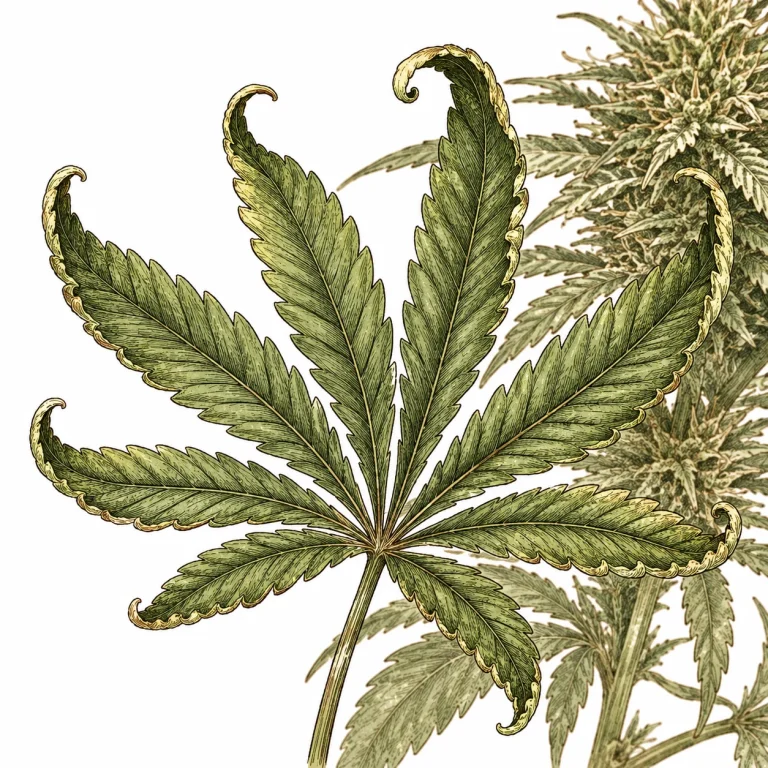
Heat stress from cannabis temperatures that run too high is one of the most common problems in indoor growing. It shows up most in summer or when your ventilation is undersized. The classic sign is leaves curling upward, often with the edges folding inward. Affected plants can look droopy even though the soil is still moist, because transpiration is outpacing water uptake. Leaves sitting right under the light sometimes show burn spots or bleach out.
Most cannabis strains start showing visible stress at around 84–86 °F (29–30 °C). Above 95 °F (35 °C), enzymes and chloroplasts can take permanent damage that holds back growth for good. Heat is especially rough during the flowering stage: it can make terpenes evaporate and slow down bud development. Buds may stretch out, get airy and lose density.
If you spot heat stress, check the distance between your light and the canopy first and raise the light if needed. An extra oscillating fan improves air circulation and helps keep hot air from pooling right above the leaves. If you can, run your exhaust harder during the cooler hours of the day or at night. In extreme cases, flipping your schedule can help: run the lights at night, when it’s usually cooler.
- Leaves curling upward: the first sign of heat stress
- Bleached spots or burns on leaves close to the light
- Droopy plant despite moist soil: transpiration is outpacing water uptake
- From 86 °F (30 °C): visible stress; from 95 °F (35 °C): permanent damage possible
- Position fans, raise the light, dial in your ventilation
Avoid Cold Stress: How to Protect Your Plants From Low Temperatures
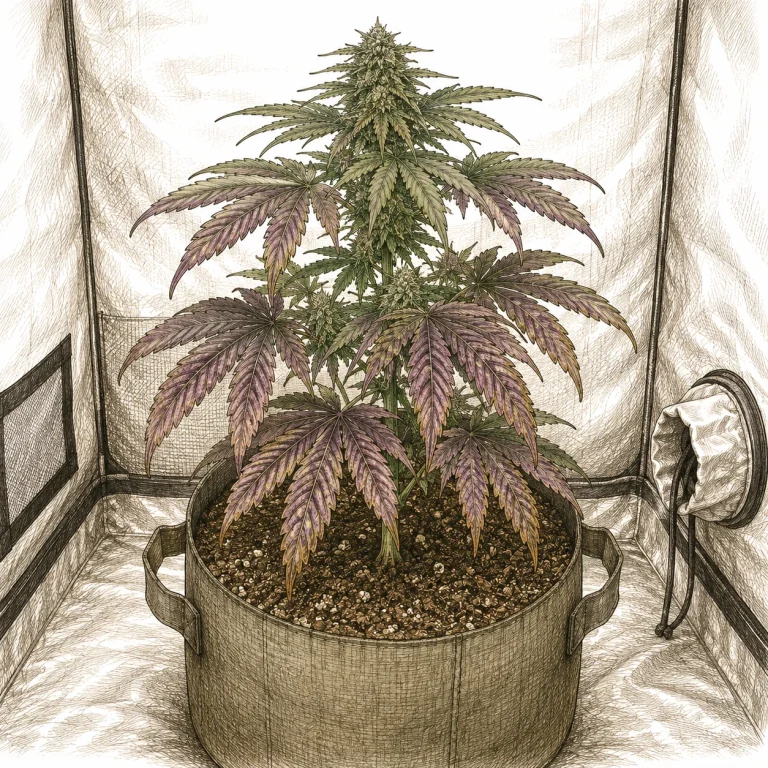
Cold stress from cannabis temperatures that run too low often gets overlooked compared to heat stress. It’s most common in winter or when your intake pulls in too much cold outside air. Below 59 °F (15 °C), root activity can slow down so much that the plant barely takes up water and nutrients. The result looks a lot like a deficiency: leaves turn yellow, growth slows and the whole plant looks weak and vulnerable.
A typical visual sign of cold stress is purple or red leaves and stems. That color comes from anthocyanins the plant builds up as a protective response. Some growers mistake this for a genetic trait. But if the color shows up suddenly and isn’t typical for your strain, check your temperature right away. Cold combined with moisture is dangerous too: low temps plus high humidity create ideal conditions for bud rot (botrytis), which can wipe out buds in no time. Bavaria’s state horticulture institute (LWG) recommends paying extra attention to good air circulation in cold, damp conditions.
Fighting cold stress starts with the right spot. Don’t set your grow tent directly on a cold concrete floor. An insulation mat or a pallet under the pot can keep the root zone noticeably warmer. Heat mats made for growing plants are a cheap option for extra-cold stretches. For starting seedlings, we compare models with a thermostat in our seedling starter kit comparison (German). During the dark period, shutting off all ventilation for a few hours can help you hold on to the leftover heat from your lights. Just keep an eye on your humidity while you do it.
- Below 59 °F (15 °C): root activity crashes and deficiency symptoms appear
- Recognize purple or red leaves as a sign of cold stress
- Cold, damp conditions strongly favor bud rot (botrytis)
- Don’t set your grow tent directly on concrete, use an insulation mat
- Use heat mats for the root zone during extra-cold periods
- Cut back nighttime ventilation to hold on to stored heat
Dial In Your Cannabis Temperature With the Right Gear and Meters
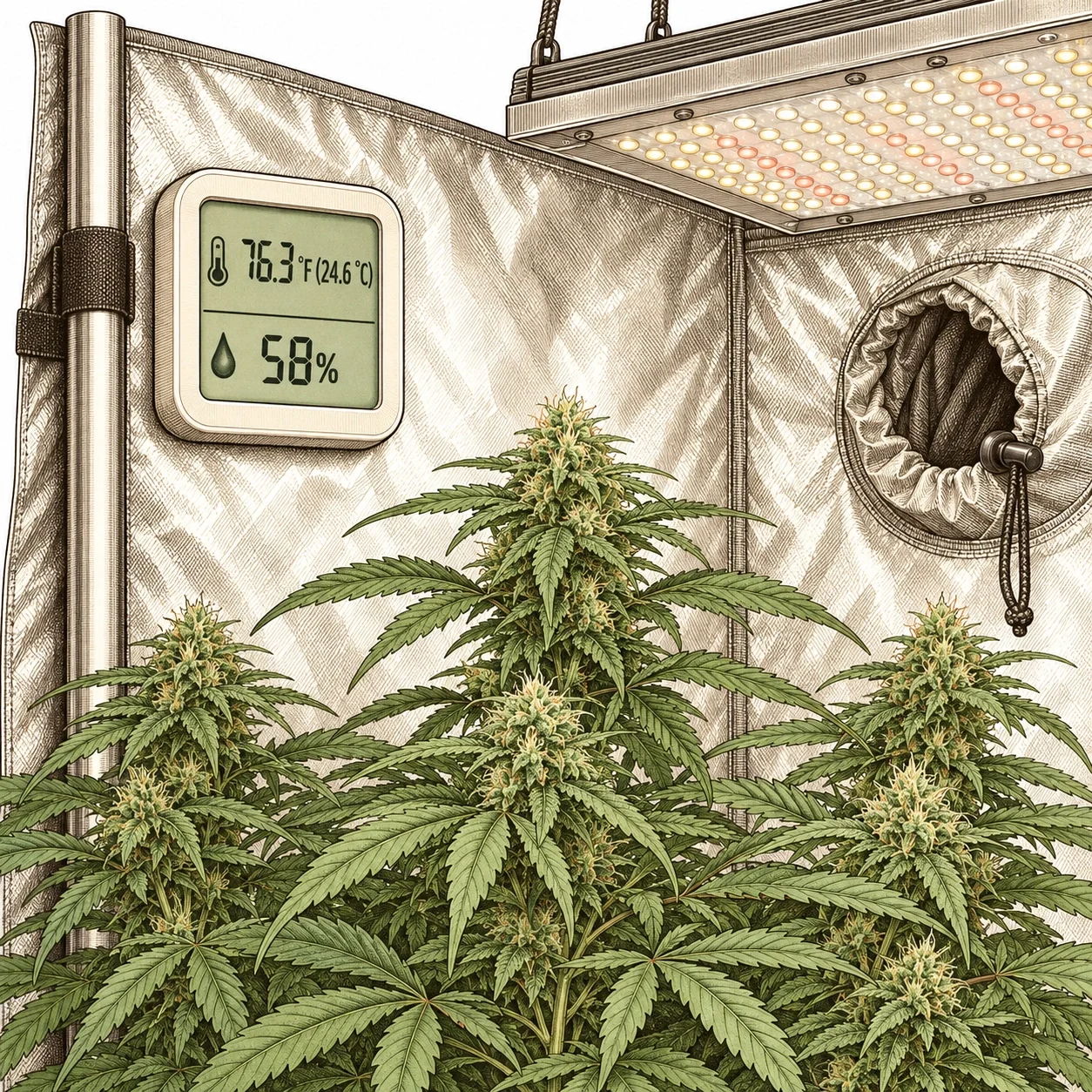
Without reliable measuring gear, you can’t really dial in your cannabis temperature. A digital thermometer-hygrometer combo (German) is the bare minimum, and it usually costs only about $10 to $20. Models with a min/max display are especially useful because they show you the extremes your grow hit overnight or while you were away. Place at least one sensor at canopy height and another one near the floor so you can see the temperature gradient in your grow.
If you want to track several spots or log data over time, go for Wi-Fi sensors. They send temperature and humidity to your phone in real time. Some models let you set alerts that ping you when values go above or below your limits. That keeps you in control, even when you’re not home.
For active climate control, exhaust fans with a temperature controller or a thermo-controller are a great pick. You’ll find good options in our exhaust fans for grow tents comparison. These controllers ramp up ventilation automatically once the temperature passes a set point. Pair one with a properly sized carbon filter and a matching intake fan, and you get a self-regulating setup that runs without your input most of the time. For heating, tube heaters or small ceramic heaters work well, and you can run them on a thermostat too. Keep in mind that LED grow lights put out much less heat than HPS lamps. That makes climate control a lot easier in summer, but it also means less free heat in winter.
- Digital thermo-hygrometer with min/max function as your basic gear
- At least two measuring points: canopy and floor level
- Wi-Fi sensors with an app for remote monitoring and alerts
- Exhaust fan with thermostat for automatic temperature control
- Heating mats and ceramic heaters on a thermostat for cold spells
- LED instead of HPS: less heat, easier climate control
Cannabis Temperature and Humidity: How VPD Ties Them Together
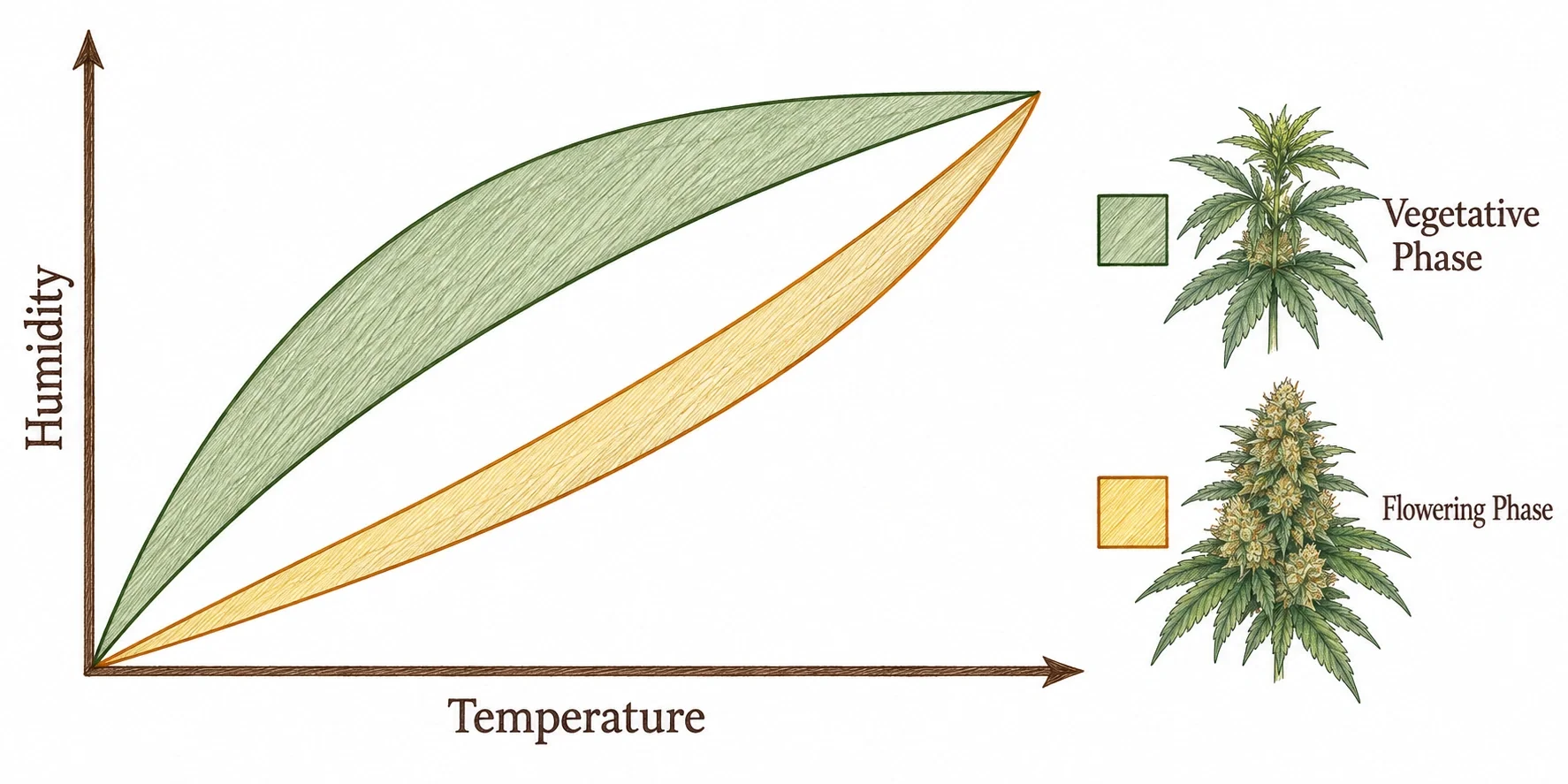
When it comes to growing cannabis, temperature and humidity go hand in hand. VPD (vapor pressure deficit) describes how much more water vapor the air can hold at a given temperature and humidity. Cannabis uses this value to regulate its transpiration, and with it, its nutrient uptake. If your VPD is too low, the air is already close to saturated and the plant barely transpires, which can invite mold. If your VPD is too high, your plants can suffer from drought stress.
For the vegetative stage, a VPD of 0.8 to 1.2 kPa is recommended. You hit that at about 75 °F (24 °C) with roughly 60 to 70% relative humidity (RH). In the flowering stage, VPD should rise to 1.2 to 1.6 kPa. In practice, that means lowering humidity to 40 to 55% as temperatures climb. If you manage temperature and humidity together, you’ll get much more stable growing conditions than if you only watch one of them.
Use our VPD Calculator to find your ideal value right away. In practice, this means: when you raise the temperature in your grow, you’ll usually need to adjust the humidity too, to keep VPD in the target range. It works the other way as well: if you run a heater in winter and the air gets dry, a humidifier helps keep your VPD from climbing too high. Looking at your climate as a whole is what separates a grow that “kind of works” from one that’s truly dialed in.
- VPD describes the balance between temperature and humidity
- Vegetative stage: VPD 0.8 to 1.2 kPa, about 60 to 70% humidity
- Flowering stage: VPD 1.2 to 1.6 kPa, about 40 to 55% humidity
- VPD too low: higher mold risk from saturated air
- VPD too high: drought stress, transpiration overloads the plant
- Always check and control temperature and humidity together
Common Mistakes When Dialing In Cannabis Temperature (and How to Avoid Them)
One of the most common mistakes when dialing in cannabis temperature is trusting your gut instead of your readings. “Feels warm” is no solid basis for climate decisions, especially since even a difference of 5 to 9 °F (3 to 5 °C) can have a noticeable effect on your plants. Get a reliable meter and check your readings regularly, especially during the first few hours after lights on, when the temperature peaks.
Another common mistake is not keeping an eye on nighttime temps. A lot of growers only dial in the day cycle because that’s when they’re around. But the night matters just as much. If it cools down too much, root activity slows, and if condensation settles on your buds overnight, mold is just a matter of time. A thermo-hygrometer with a data logger shows you what really happens while you’re away.
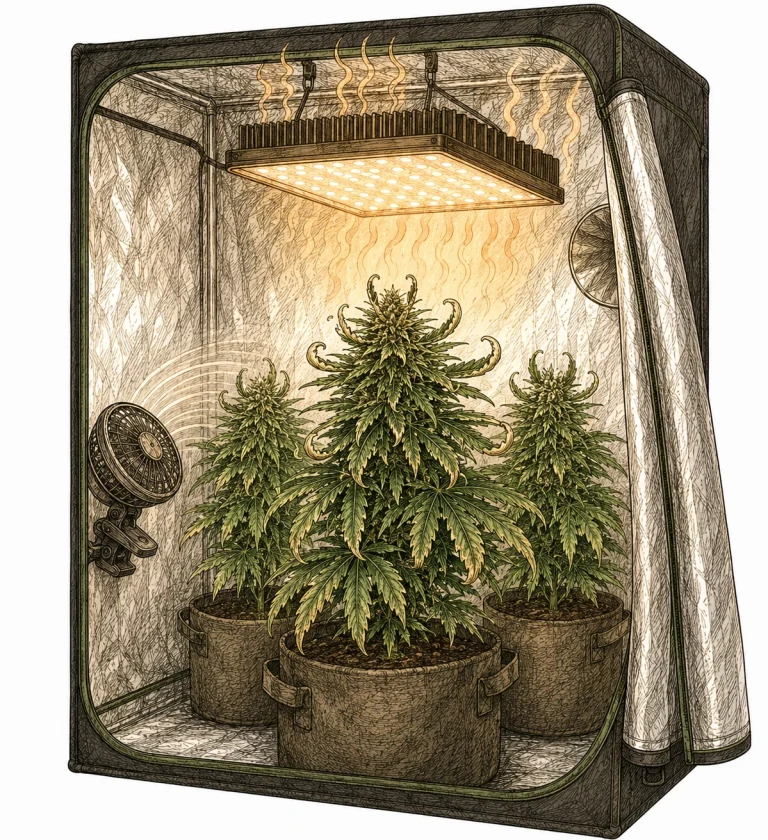
Many beginners also underestimate how much heat their lights put out. LED grow lights do give off less radiant heat than HPS, but your space still warms up, especially in poorly ventilated tents. Check the distance between your light and the canopy regularly, and make sure your exhaust and intake move air efficiently. An undersized exhaust fan is one of the most common causes of temps that run too hot all the time. Rule of thumb: plan for at least 60 CFM (100 m³/h) of air exchange for every 10.8 sq ft (1 m²) of floor space.
Finally, when it comes to cannabis temperature, root zone temperature often gets overlooked. If the root zone is too cold, perfect air temps won’t help much. The ideal growing medium temperature is between 64 and 72 °F (18–22 °C). Pots sitting on a cold floor, cold water or overly chilled nutrient solution can chill the root zone even when the air in your tent is warm enough. Watch this often-missed factor closely, especially in winter.
- Never trust how it feels, always measure with a thermometer
- Check nighttime temps just as closely as daytime temps
- Use a thermo-hygrometer with a data logger to see what happens while you’re away
- Check your light distance regularly, even with LEDs
- Size your exhaust fan properly: at least 60 CFM (100 m³/h) per 10.8 sq ft (1 m²)
- Keep your growing medium between 64 and 72 °F (18–22 °C)
- Don’t use water that’s too cold, aim for room temperature
Temperature is closely tied to other climate factors: CO2 enrichment lets your plants handle higher temps, your light type (LED vs. HPS) affects how much heat builds up, and good ventilation helps prevent hot spots. If your temps still swing a lot, also check for drafts or use a dehumidifier to keep your overall climate more stable.
Frequently Asked Questions
What’s the best temperature for cannabis in a grow tent?
The ideal cannabis temperature in the vegetative stage is 75 to 82 °F (24–28 °C) during the day and 64 to 72 °F (18–22 °C) at night. In the flowering stage, aim for 68 to 79 °F (20–26 °C) during the day with slightly cooler nights. The difference between day and night shouldn’t be more than 18 °F (10 °C).
At what temperature does cannabis get heat stress?
The first signs of stress often show up at around 84 to 86 °F (29–30 °C). Above 95 °F (35 °C), irreversible damage to enzymes and chloroplasts can occur. Plants are more sensitive in the flowering stage, because high temps can make terpenes evaporate and lower bud quality.
What happens if your grow room gets too cold at night?
If the temperature drops below 59 °F (15 °C) at night, root activity can slow down sharply. Your plants take up hardly any nutrients or water. Typical symptoms are yellowing, slower growth and purple discoloration on the leaves. Cold, damp conditions also encourage mold, especially bud rot (botrytis, gray mold) during flowering.
How can I lower the temperature in my grow tent?
To bring your cannabis temperature down, try these steps: check your exhaust fan and upgrade to a stronger one if needed, raise your light, and add extra fans for air circulation. Another option is to shift your schedule so the lights run during the cooler nighttime hours.
What is VPD and why does it matter for growing cannabis?
VPD stands for vapor pressure deficit and is directly linked to cannabis temperature. It describes the relationship between temperature and humidity (relative humidity, RH) and directly affects your plant’s transpiration. In the vegetative stage, VPD should be around 0.8 to 1.2 kPa, and in the flowering stage around 1.2 to 1.6 kPa. If you manage VPD instead of tweaking temperature or humidity on their own, you’ll get much more stable results.
What temperature does cannabis need for germination?
Cannabis seeds germinate best at 72 to 82 °F (22 to 28 °C). Steady warmth, for example from a heat mat under your germination medium, can noticeably boost your germination rate. Temperatures below 64 °F (18 °C) or above 86 °F (30 °C) can slow germination down or even damage the seeds.
Unexpected seeds in your buds can also be caused by stress — learn more in our article Cannabis Seeds in Buds.
The Bottom Line
Dialing in your cannabis temperature isn’t a one-time job. It’s an ongoing process, and every growth stage brings new demands. Know the key values, use the right measuring gear and look at temperature together with humidity, and you lay the groundwork for healthy plants and big yields. Heat stress and cold damage are easy to prevent with simple tools, as long as you catch early what your plants are telling you. Invest in reliable sensors and properly sized climate control. It’s the smartest money you can spend on your whole grow setup. If you still spot problems with your plants, our Plant Diagnosis Tool can help you out.
