

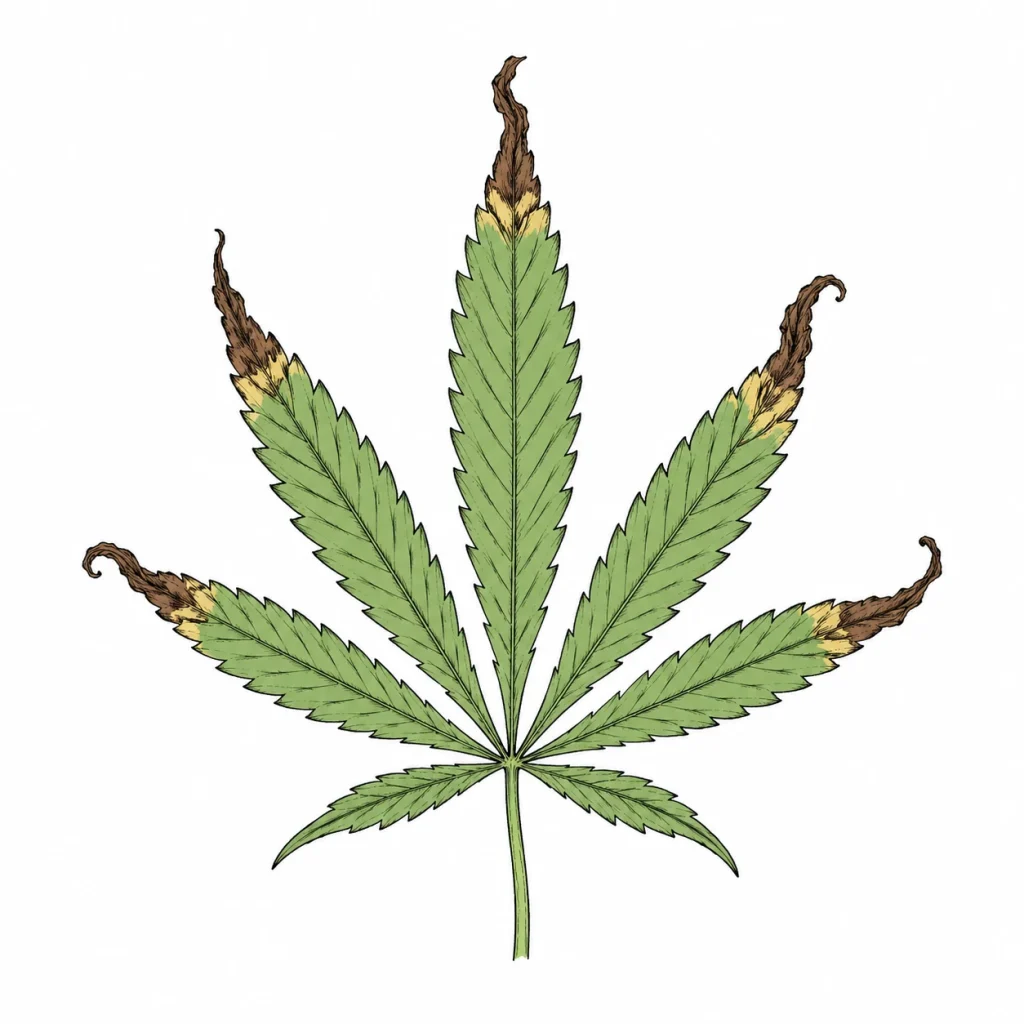
Brown leaf tips on cannabis are one of the most common problems home growers report, and there’s almost always a clear, fixable cause behind them. Whether it’s nutrient burn, the wrong pH, heat stress or simply too much wind from a fan: brown leaf tips are an early warning sign from your plant that you should take seriously. In this article, you’ll learn how to narrow down the cause in just a few minutes and which steps will reliably save your plant. Keep reading and you’ll never be left scratching your head over brown tips again.
Cannabis brown leaf tips: what exactly is happening inside the plant?
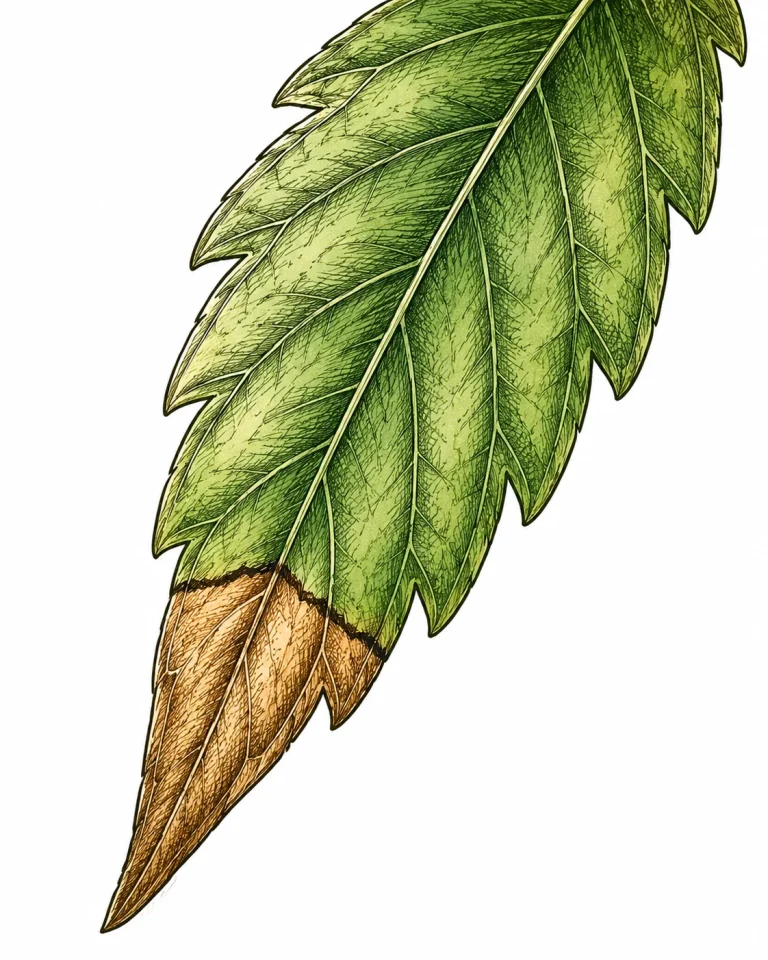
Brown leaf tips appear when cells at the outermost parts of the leaf start dying. These edges are the last to be supplied with water and nutrients, and the first to be hit by problems, because excess salts from overfeeding build up right at these leaf ends, where the plant concentrates excess substances through transpiration. The tissue dries out, loses its chlorophyll structure and turns brown to blackish brown. Sometimes it stays at the tips, sometimes the discoloration spreads along the entire leaf edges.
For the diagnosis, it’s important to tell the symptoms apart: if only the very last few millimeters are brown, that points to mild stress. If the tips are purely yellow instead of brown and burnt, there’s usually a different cause (more on that in our article on cannabis yellow leaf tips). If the discoloration reaches an inch or more (several centimeters) into the leaf and the leaf also shows yellow spots or necrosis, there’s usually a more serious problem. Also watch whether new leaves are affected too. That tells you whether the problem is still active or already under control. In the Plant Diagnosis overview on PlantClue you’ll find a structured overview of all common symptoms and their possible causes.
Another important point: brown leaf tips and brown leaf edges can point to several problems at once. It’s not unusual for the wrong pH and a slight nutrient excess to occur together. That’s why you should always work systematically and not stop at the first thing you find.
- Brown tips = dead tissue caused by stress or nutrient problems
- Spreading along the edges points to a more serious cause
- New leaves affected = the problem is still active
- Several causes can be present at the same time
The 7 most common causes of brown leaf tips on cannabis
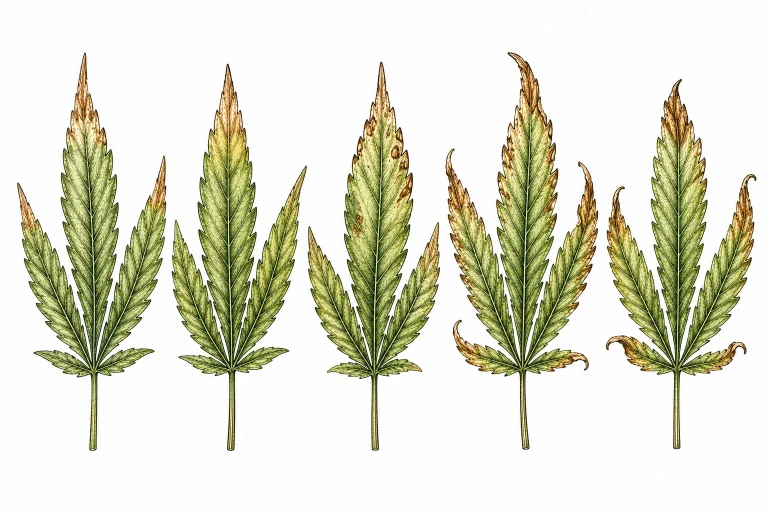
Nutrient burn is by far the most common cause of brown leaf tips on cannabis. When there are too many soluble salts in the growing medium, osmotic stress sets in: the roots can no longer take up water, and the leaf tissue dries out from the tips. This is also called “nutrient burn” or “nute burn.” It typically starts at the tips of the lowest or oldest leaves and works its way up. In how to spot and fix cannabis nutrient burn fast you’ll find a detailed description of all the accompanying symptoms.
The wrong pH blocks nutrient uptake, even if you’ve technically fed enough. At a pH below 6.0 or above 6.8 in the growing medium, certain elements become insoluble for the roots. This leads to deficiency symptoms that can also show up as brown tips and edges. Always check your pH in the runoff after watering. Everything you need to know about adjusting it is explained in how to adjust pH for cannabis and avoid mistakes.
Heat stress is a common culprit, especially in summer and in indoor grows with poor ventilation. Temperatures above 82 °F (28 °C) right at the leaf surface cause the plant to transpire more water than it can take up. The leaf tips, which are farthest from the veins, dry out first. Keep the temperature in your grow tent between 68 and 79 °F (20 and 26 °C).
Wind burn happens when a fan blows too hard and too directly on the plants. The constant mechanical stress and the increased water loss through evaporation cause the leaf tips to dry out and turn brown. The symptom looks similar to heat stress but also shows up at optimal temperatures. Always aim your fans so they move the air in the room without blowing directly on the leaves.
Calcium deficiency can also cause brown spots and dead leaf edges. Calcium is an important building block of cell walls, and when it’s lacking, cells collapse, especially in fast-growing areas. The symptom often starts on young leaves and shows up as brown spots that develop into necrosis. How to spot and fix calcium deficiency in cannabis explains how to tell this problem apart from other causes.
Overwatered plants also develop brown leaf tips, because waterlogged soil keeps the roots from getting enough oxygen. Anaerobic conditions damage the fine roots, and the plant can’t move enough fluid even though there’s plenty of water in the pot. It sounds paradoxical, but it’s a common mistake. In How to water cannabis: mistakes beginners should avoid you’ll learn how to find the right watering schedule.
Air that’s too dry (low relative humidity) is a problem especially in the vegetative stage. If the relative humidity drops below 40%, the plants transpire heavily and lose moisture through the leaf tips first. In the vegetative stage, humidity should be between 50 and 70%, and in flowering between 40 and 50%.
- Nutrient burn: starts on older leaves, tips first
- Wrong pH: blocks nutrient uptake despite sufficient feeding
- Heat stress: temperatures above 82 °F (28 °C) at the leaf surface
- Wind burn: airflow from the fan that’s too strong and too direct
- Calcium deficiency: brown spots and necrosis, often on young leaves
- Overwatering: roots without oxygen, water unavailable despite a full pot
- Air too dry: humidity below 40% in the veg stage
Cannabis brown leaf tips from nutrient burn: how to spot it and what to do
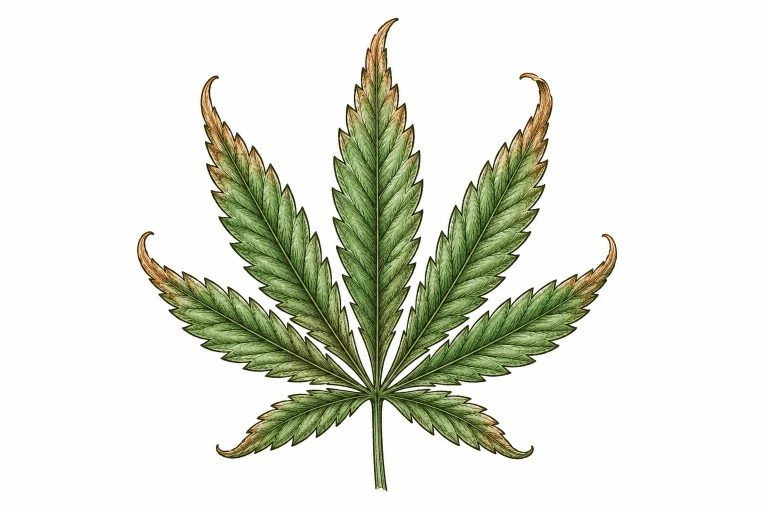
Among home growers, nutrient burn is the number one cause of brown leaf tips. The symptom is distinctive: the tips curl slightly up or down, turn yellowish and then brown, while the rest of the leaf looks dark green and healthy. Unlike with a deficiency, the leaf is very dark, which is an important way to tell them apart.
What should you do about nutrient burn? First, run a gallon or more (several liters) of clean, pH-adjusted water through the pot, also known as “flushing.” This washes excess salts out of the growing medium. After that, skip two to three feedings and watch the plant. New leaves should grow in healthy. Then reduce your nutrient dose to 50–70% of the recommended amount and only increase it again once the plant clearly shows it needs more.
Important: leaf tips that are already brown won’t recover. The damage is irreversible. But once the problem is identified and fixed, the plant keeps growing healthy, and the old leaves with brown tips remain the only visible sign of the problem. Remove badly damaged leaves if they’ve lost more than half of their surface.
- Dark green leaves with brown tips = classic nutrient burn
- Fix: flush the growing medium with pH-adjusted water
- Skip 2–3 feedings
- Permanently reduce your nutrient dose to 50–70%
- Brown areas won’t recover; new growth shows whether the problem is fixed
Diagnosis checklist: step by step to the right cause
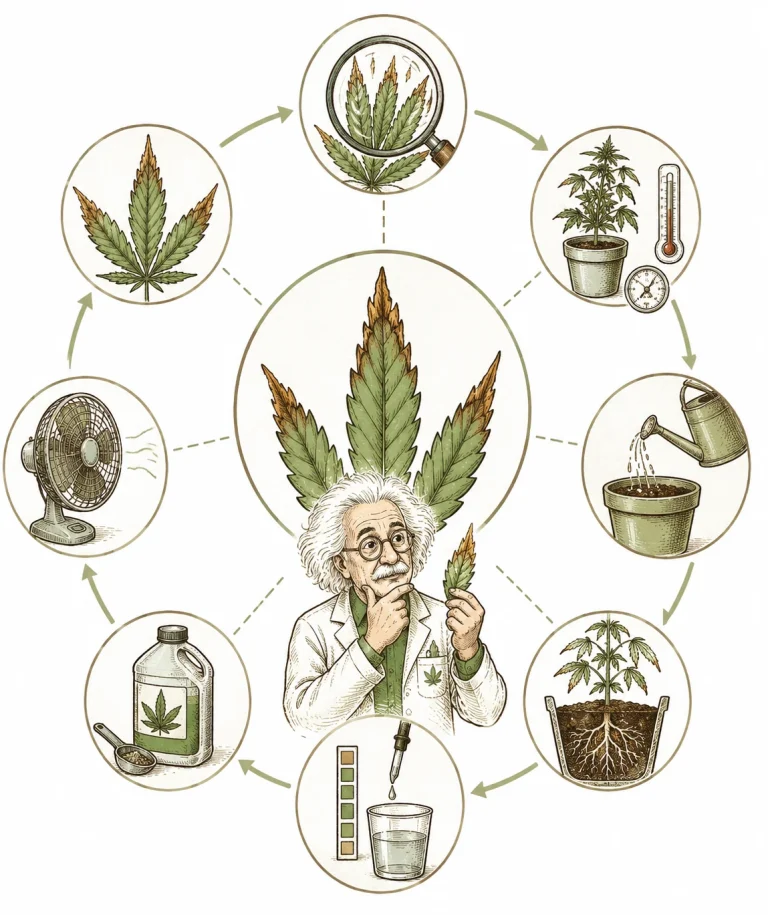
So you’re not just guessing, let’s go through the diagnosis systematically. Always start with the measurable factors before you react with nutrients or other interventions. The wrong intervention can make the problem worse.
Step 1: Measure the pH of the runoff after your next watering. Is it between 6.0 and 6.8 (soil) or 5.5 and 6.5 (coco/hydro)? If not, that’s your first starting point. Step 2: Check your nutrient dose and compare it with the manufacturer’s recommendations. Are you going over the recommended amount? Step 3: Measure the temperature directly under the lamp and at the leaf surface. Step 4: Watch your fans: are they blowing directly on the plants? Step 5: Measure the relative humidity. Step 6: Check the moisture of the growing medium: is the pot still heavy when it’s time to water?
Only once you’ve checked off these six points can you respond in a targeted way. In many cases, you’ll already find the answer with the pH or the nutrient dose. If you’re in the green on every one of these points, take another close look at the leaves: are the tips the only damage, or are there also spots, discoloration or deformed leaves? That would point to a mineral problem like calcium deficiency.
- Step 1: Measure the runoff pH
- Step 2: Compare your nutrient dose with the manufacturer’s recommendation
- Step 3: Check the temperature under the lamp and at the leaf surface
- Step 4: Check your fan placement
- Step 5: Measure the relative humidity
- Step 6: Check the moisture of the growing medium and the pot weight
How to fix cannabis brown leaf tips caused by heat stress and wind burn
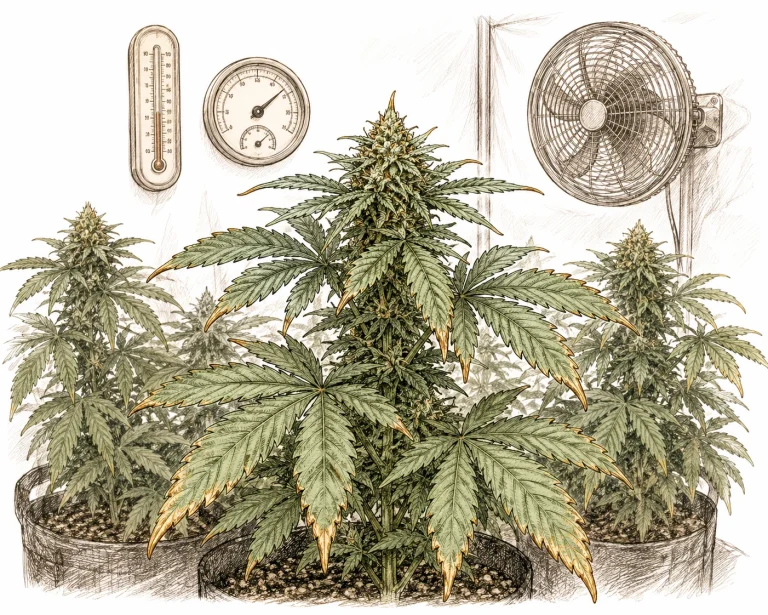
Heat stress and wind burn look very similar at first glance, but they have different causes and call for slightly different measures. With heat stress, the leaves often fold upward (tacoing), the leaf tips turn brown and the plant looks stressed overall. With wind burn, the leaves often look somewhat deformed and the brown tips appear evenly on the sides facing the airflow.
What helps against heat stress: hang the lamp higher or reduce its intensity, install an additional exhaust system or use a bigger exhaust fan, and lower the room temperature if possible. An exhaust system that exchanges the entire air volume of the tent every two to three minutes is the foundation of a good indoor grow.
To fix wind burn, reposition your fans: aim them at the tent walls or the ceiling so they circulate the air without blowing directly on the plants. Oscillating fans (that swing back and forth) are also a good solution, since they don’t create a constant airflow on one spot.
- Heat stress: leaves fold upward (tacoing)
- Wind burn: even brown tips on the side facing the airflow
- Against heat: raise the lamp, increase exhaust, lower the room temperature
- Against wind burn: reposition fans, use oscillating models
Cannabis brown leaf tips in flowering: what to keep in mind
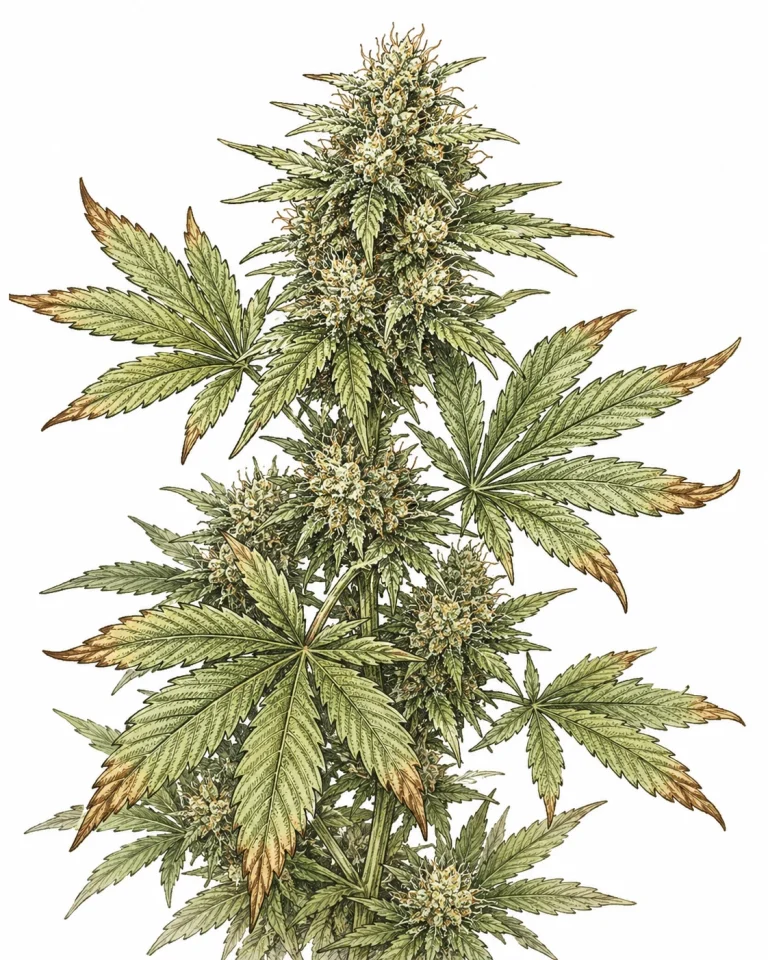
In the flowering stage , brown leaf tips are more common and need to be assessed more carefully. Natural yellowing and dying of the lower fan leaves toward the end of flowering is completely normal: the plant moves nutrients from old leaves into the buds. But if leaves in the upper areas or the small sugar leaves around the buds show brown tips, that’s not normal senescence and should be taken seriously.
Especially in the last two to three weeks before harvest, many growers do a “flush”: they stop feeding and give only pH-adjusted water. This can also trigger brown leaf tips or make existing ones worse, but it’s often intentional. If you see brown tips during this phase and know you’ve already switched to plain water, it’s no cause for alarm.
In flowering, pay special attention to humidity: if it’s above 50%, the risk of bud rot (botrytis, gray mold) goes up. Brown spots that feel soft and show grayish-white mycelium aren’t a nutrient problem but a serious fungal problem that requires immediate action.
- Yellowing of lower leaves at the end of flowering is normal (senescence)
- Brown tips on upper leaves or sugar leaves are a problem
- Flush phase: brown tips from nutrient withdrawal are often intentional
- Soft brown spots with mycelium = bud rot, act immediately!
Prevention: how to avoid cannabis brown leaf tips for good
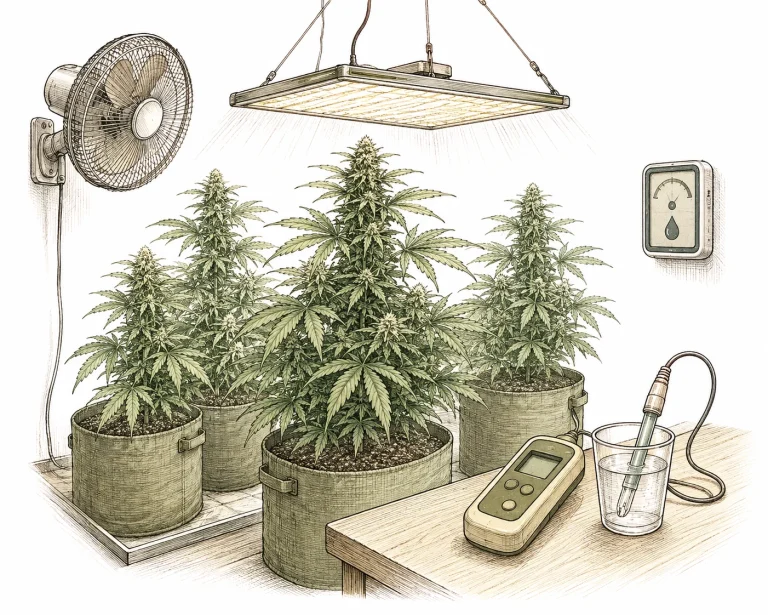
The best treatment is, of course, prevention. With a clear routine and a bit of practice, you can avoid brown leaf tips completely in most cases. The foundation: measure consistently. A pH meter and an EC meter aren’t optional extras but basic equipment for every serious home grower. You’ll find an overview of all deficiencies in our cannabis deficiency overview.
Always start low when feeding and work your way up. The rule of thumb “start low, go slow” reliably prevents nutrient burn. Check your plants daily: new symptoms often show up on one or two leaves before they spread. The earlier you step in, the easier the correction.
Keep a simple grow journal. Write down the pH, temperature, humidity and nutrient dose every time you water. When a problem comes up, you can trace back your entries and pinpoint exactly when something changed. That makes diagnosis dramatically easier and helps you get everything right from the start on your next grow.
- A pH meter and an EC meter are must-have equipment
- Always start feeding low: “start low, go slow”
- Check your plants daily
- Keep a grow journal for easy troubleshooting
- Monitor temperature and humidity continuously
If the tips are more yellow than brown, read our article on yellow leaf tips. If irregular spots are spread across the whole leaf, take a look at spotted leaves.
Frequently asked questions
Do brown leaf tips on cannabis recover?
No, leaf tissue that’s already dead and brown won’t recover. The affected areas stay brown. What matters, though, is that new growth comes in healthy once you’ve fixed the cause. You can remove badly damaged leaves if they’ve lost more than 50% of their surface.
Cannabis brown leaf tips: how fast do I need to react?
The sooner, the better. If only the very last few millimeters are affected, you still have some time for a thorough diagnosis. If the symptom spreads an inch or more (several centimeters) into the leaf or new leaves are already coming in with brown tips, you should step in within 24 to 48 hours.
Can brown leaf tips point to pests?
Brown leaf tips aren’t a typical direct sign of pests. Pests like spider mites or thrips tend to leave silvery dots, stippling or silver patterns on the leaf. Brown tips on their own almost always come down to environmental factors, nutrient problems or the wrong pH.
My pH is correct, but the leaf tips are still brown. What now?
If the pH is right, check your nutrient dose and the EC in the growing medium next. With a correct pH, mild nutrient burn is often the cause. Also: heat stress and wind burn can occur regardless of the pH. Go through the diagnosis checklist in this article step by step.
Brown leaf tips on only a few leaves: is that bad?
If only a few lower or middle leaves are affected and new leaves grow in healthy, the symptom is probably due to a problem that’s already fixed or mild. Keep watching the plant. If the damage spreads to new leaves, act right away.
How do I tell nutrient burn from calcium deficiency when the leaf tips are brown?
With nutrient burn, the leaves are typically very dark green, and the brown tips appear evenly at the ends of the leaves. With calcium deficiency, you’re more likely to see brown spots and necrosis across the whole leaf surface, often starting on young leaves. With nutrient burn, older leaves are usually affected first.
Can potassium deficiency also cause brown leaf tips on cannabis?
Yes, along with nutrient burn, advanced potassium deficiency is one of the most common causes of brown leaf edges and tips. Unlike with nutrient burn, the edges usually turn yellowish first before they become brown and brittle, while the center of the leaf stays green at first. In how to spot and fix potassium deficiency in cannabis you’ll learn how to reliably tell it apart from nutrient burn and other deficiencies.
Conclusion
Brown leaf tips on cannabis are a common but very manageable problem that you can get under control with a clear diagnosis and targeted measures. The most common causes (nutrient burn, the wrong pH, heat and wind burn) can all be identified and fixed with simple measurements. Brown spots on the leaf won’t disappear, but new leaves grow back healthy once the problem is solved. With consistent monitoring and a grow journal, you’ll hardly see this symptom by your next harvest.
