

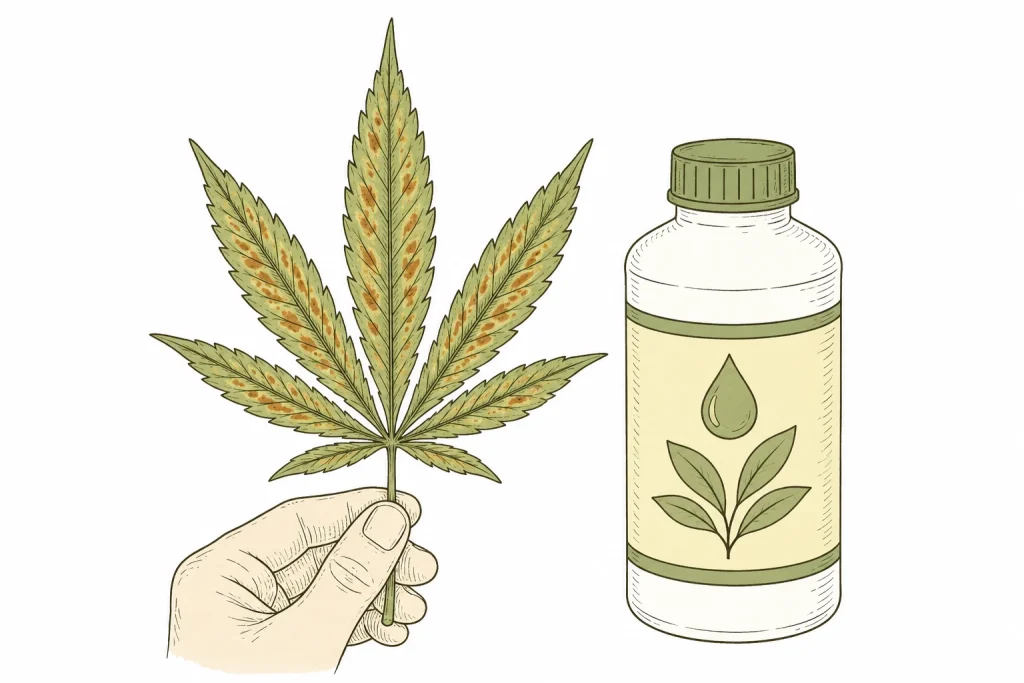
Being able to spot a cal mag deficiency in cannabis is one of the most important skills for any grower, because calcium and magnesium are among the most common sources of trouble in indoor growing. The two nutrients work closely together and affect cell structure, chlorophyll production and the transport of other minerals in the plant. If you identify the typical symptoms early, you can step in before your yield takes lasting damage. This article explains step by step how to reliably diagnose a Cal-Mag deficiency, what causes it and how to fix it for good.
What is Cal-Mag and why does cannabis need these nutrients?
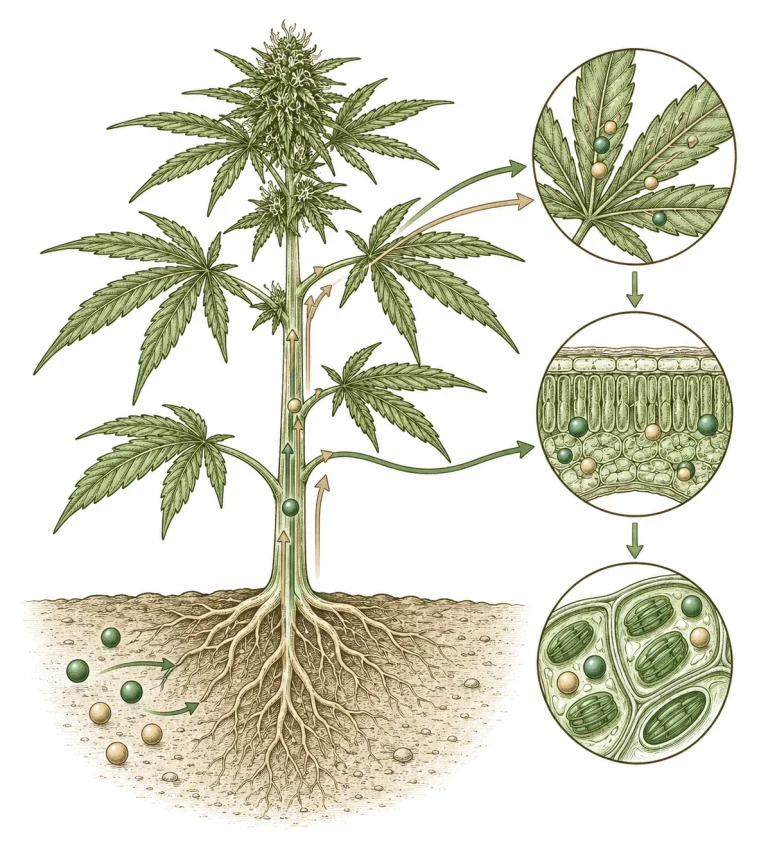
Cal-Mag is short for a combination of calcium (Ca) and magnesium (Mg), two secondary nutrients that are essential for healthy plant growth. Calcium strengthens cell walls, promotes root development and helps transport other nutrients. Without enough calcium, cells become unstable, tissue collapses and new shoot tips die off.
Magnesium is a central building block of the chlorophyll molecule and therefore directly drives photosynthesis in the plant. Magnesium also activates numerous enzymes and supports phosphorus uptake. That’s why a magnesium deficiency shows up especially quickly as disrupted leaf color. Because the two nutrients work together in many processes, deficiencies often appear together — which is why the term Cal-Mag deficiency is so common in the grower community.
For a complete overview of all nutrient problems, take a look at the Plant Diagnosis hub, which sums up all deficiencies and care mistakes in a structured way.
- Calcium: cell wall stability, root growth, nutrient transport
- Magnesium: chlorophyll production, enzyme activation, phosphorus uptake
- Both nutrients work synergistically and are often supplemented together
- Cal-Mag deficiency is one of the most common nutrient deficiencies in indoor grows that use soft water
Spotting cannabis Cal-Mag deficiency: the typical symptoms
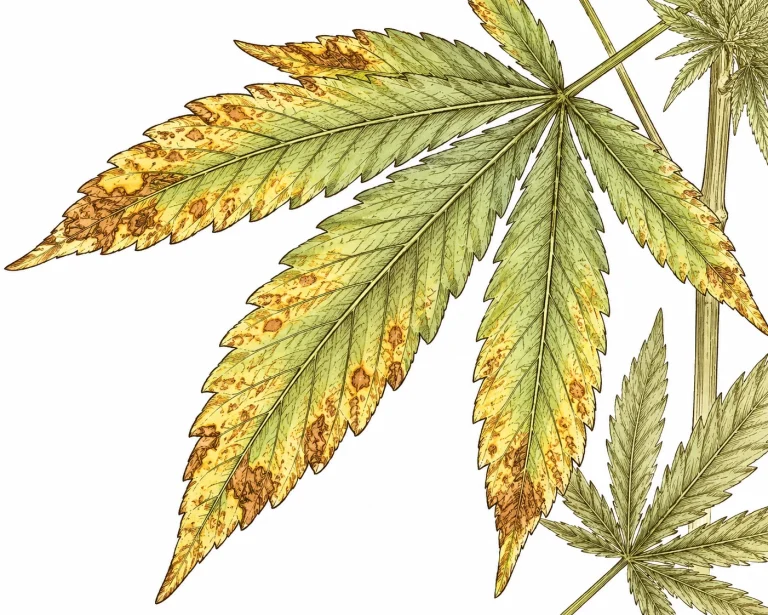
When you’re trying to spot a cannabis Cal-Mag deficiency, it’s important to tell calcium deficiency and magnesium deficiency apart, because they show up on different parts of the leaf. Calcium deficiency typically starts on the youngest leaves and shoot tips: the new leaves crinkle, look deformed and show small brown or rust-colored spots. The leaf edges can curl inward. In severe cases, growing points die off and the tissue turns glassy or necrotic.
Magnesium deficiency, on the other hand, shows up first on older, lower leaves, because magnesium is a mobile nutrient and the plant moves it from old leaves into new shoots. The most characteristic sign is interveinal chlorosis: the leaf veins stay green, while the tissue between them turns yellow and, in advanced stages, orange to brown. Yellow cannabis leaves with veins that stay green are therefore a key sign of magnesium deficiency.
A combined Cal-Mag deficiency often shows both symptom patterns at once: deformed young leaves and interveinal yellowing on older leaves. If you also suspect a calcium deficiency in cannabis specifically, it’s worth taking a closer look at the linked article, which covers calcium on its own and describes the symptoms in even more detail.
- Calcium deficiency: brown spots on young leaves, crinkling shoot tips
- Magnesium deficiency: interveinal yellowing (veins stay green) on old leaves
- Necrotic spots with a rusty brown color, often irregularly scattered
- Leaves look fragile, brittle or glassy
- Slower growth and weak bud development in advanced stages
- Both symptoms can appear at the same time and make each other worse
Common causes of Cal-Mag deficiency in cannabis
The most common cause of a Cal-Mag deficiency when growing cannabis is using soft water. Reverse osmosis water (RO water) or very soft tap water contains hardly any dissolved minerals, including calcium and magnesium. If you water with RO water or very soft tap water without adding a Cal-Mag supplement, you’re risking a deficiency sooner or later.
The wrong pH is the second most common cause. Even if there’s enough calcium and magnesium in the growing medium or nutrient solution, the plant can’t take them up when the pH is outside the optimal range. In soil, calcium is ideally taken up at a pH between 6.2 and 7.0, magnesium between 6.0 and 7.0. In hydroponics, the optimal values are a bit lower. For detailed guidance on where to measure and how to correct, read the article on cannabis pH.
Your growing medium plays a role too: coco coir (German) is naturally low in calcium and magnesium and always needs active Cal-Mag supplementation. On top of that, an excess of potassium or ammonium can block magnesium uptake, because these ions compete for the same transport sites. Excessively high EC levels from overfeeding can also disrupt nutrient uptake.
Other, less common causes are root temperatures that are too low (below 64 °F (18 °C)), poor root aeration or waterlogged growing medium. All of these factors impair root function and with it the uptake of minerals overall.
- Soft water or RO water without Cal-Mag supplementation
- Wrong pH: lockout at a pH below 5.8 or above 7.0
- Coco growing media: naturally low in calcium and magnesium
- Ion competition from too much potassium or ammonium
- Overfeeding with a high EC blocks mineral uptake
- Cold root temperatures below 64 °F (18 °C) slow down nutrient uptake
How to fix Cal-Mag deficiency: step-by-step first aid
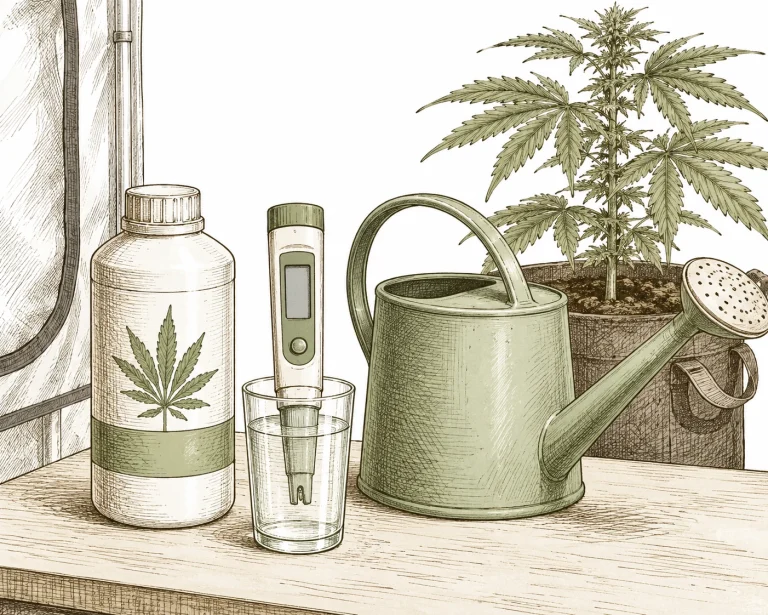
Once you’ve diagnosed a Cal-Mag deficiency, you need to act fast. The first step is always checking the pH: measure the pH of your water and your runoff. If the pH is outside the optimal range, correct it first before you start adding Cal-Mag. A Cal-Mag supplement won’t do anything if the pH is preventing uptake. Knowing how to water cannabis plants correctly, including the right pH, is the foundation of every successful treatment.
Step two is adding a Cal-Mag supplement. The most common products on the market are liquid Cal-Mag supplements such as CaliMagic from General Hydroponics, Plant Magic CalMag or Plagron CalMag Pro. If you’re looking to buy Cal-Mag (German) products, BioBizz CalMag is included in our cannabis nutrient comparison. Depending on the product, the dose is between 4 and 19 ml per gallon (1 to 5 ml per liter). Start with a lower dose and increase it if needed so you don’t risk overfeeding. With an acute deficiency, foliar feeding can relieve the symptoms even faster: dissolve Cal-Mag in distilled water (about 4–8 ml per gallon, 1–2 ml/L) and spray the leaf undersides during the dark period or under dimmed light.
Step three: check the new leaves after 5 to 7 days. Older leaves that are already damaged won’t fully recover, but new shoots should come in healthy and symptom-free. If new leaves keep showing symptoms, check the pH and the dose again and rule out other causes such as cannabis nutrient burn — it can also cause nutrient lockout.
- Measure the pH and correct it to 6.0–6.8 (soil) or 5.8–6.2 (hydro/coco)
- Dose liquid Cal-Mag according to the manufacturer’s instructions, start low
- For an acute deficiency: foliar feed with a diluted Cal-Mag spray
- After 5–7 days, check that new leaves are symptom-free
- Check your water’s EC before and after adding Cal-Mag
- In coco, supplement Cal-Mag with every feeding as a rule
Spotting cannabis Cal-Mag deficiency and preventing it long term
If you want to prevent Cal-Mag problems for good, plan a Cal-Mag supplement as a fixed part of your feeding strategy, especially if you use RO water or coco. When mixing your nutrient solution, add Cal-Mag to the water first, before any other nutrients, because calcium can precipitate with certain phosphorus and sulfur compounds.
Regular pH checks are the best prevention. If you measure your runoff pH once a week, you’ll catch drift early, before deficiency symptoms become visible. You should also monitor the EC of your nutrient solution to detect nutrient buildup or depletion in the growing medium. Structurally, choosing a calcium-rich growing medium or adding dolomite lime to soil mixes helps build a long-term buffer for calcium and magnesium.
Keep the growth stage in mind too: in the flowering stage calcium demand rises sharply, because building thick calyxes and resin glands takes a lot of calcium. Adjust your Cal-Mag dose accordingly and watch your plants regularly. An experienced grower spots the start of a Cal-Mag deficiency before the first necrosis appears — an old leaf yellowing early or slightly wavy young shoots are the first quiet warning signs.
- Always use Cal-Mag as a standard additive with RO water and coco
- Add Cal-Mag to the water first, then other nutrients
- Check runoff pH and EC weekly
- Dolomite lime in soil mixes for a long-term Ca/Mg buffer
- Increase the Cal-Mag dose in the flowering stage
- Early warning signs: slightly wavy young shoots, first yellowing on old leaves
Cal-Mag deficiency vs. other deficiencies: how to tell them apart
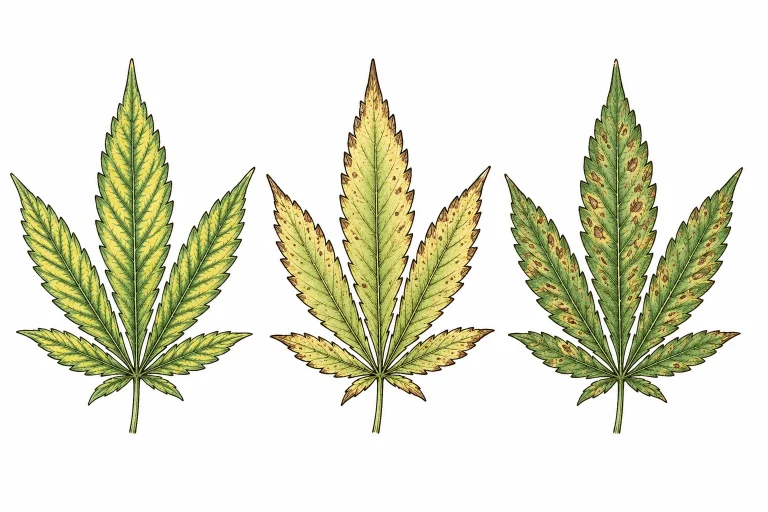
A Cal-Mag deficiency is often confused with other nutrient deficiencies, because several deficiencies look similar on the leaves. Iron deficiency (Fe) also shows interveinal chlorosis, but it starts on the youngest leaves, not the oldest. If the yellowish stripes between green veins appear first on fresh shoot tips, that points more toward iron deficiency. Magnesium deficiency, on the other hand, always starts at the bottom.
Nitrogen deficiency shows up as even yellowing of all the lower leaves, without the veins staying green. The leaf changes evenly from light green to yellow. With magnesium deficiency, on the other hand, the vein pattern stays clearly visible. Phosphorus deficiency often shows up as purple or dark red discoloration on leaf stems and leaf undersides, not as yellowing. For a comprehensive look at all possible causes of leaf changes, see our article on the causes of yellow cannabis leaves.
For a reliable diagnosis, use this rule of thumb: do the symptoms appear at the top (young leaves)? Then it’s more likely a calcium, iron or zinc deficiency. Do the symptoms appear at the bottom (old leaves)? Then mobile nutrients are affected: magnesium, nitrogen, phosphorus or potassium. A photo of the affected plant parts helps enormously with the diagnosis.
- Iron deficiency: interveinal chlorosis on young leaves (top)
- Magnesium deficiency: interveinal chlorosis on old leaves (bottom)
- Nitrogen deficiency: even yellowing without green veins
- Phosphorus deficiency: purple discoloration, no yellow
- Calcium deficiency: brown spots and deformities on shoot tips
- Where the symptoms appear (top vs. bottom) is the key diagnostic feature
How closely calcium is tied to the plant’s water uptake is also explained by the North Rhine-Westphalia Chamber of Agriculture (German): calcium moves into the plant mainly with the flow of water, which is why irregular watering can make a deficiency even worse.
An imbalance also often shows up as potassium deficiency, because potassium, calcium and magnesium compete for the same uptake pathways.
Frequently asked questions
How often should I give Cal-Mag?
With RO water or coco, Cal-Mag is recommended with every feeding. With regular tap water in soil, once a week or every other watering is often enough. Go by the hardness of your water: if it’s below about 180 ppm total hardness as CaCO3 (10 °dH, German degrees of hardness), you should supplement Cal-Mag regularly.
Can I give too much Cal-Mag?
Yes. Overdosing calcium can block the uptake of other cations, especially magnesium, potassium and iron. Calcium excess shows up as loose, chalky deposits on the leaves and can lead to secondary deficiencies. Stick to the manufacturer’s recommended dose and check the EC regularly.
Which Cal-Mag product is the best?
Proven products include CaliMagic from General Hydroponics, Plagron CalMag Pro, Canna CalMag Agent and Plant Magic CalMag. What matters is the ratio of calcium to magnesium, which is about 3:1 to 4:1 in most products. Choose a liquid product for easy dosing and always add it to the water as the first mineral.
Will leaves that are already damaged recover?
No. Necrotic or heavily yellowed leaves won’t fully recover. The goal of treatment is to stop the deficiency from progressing and make sure new leaves come in symptom-free. Leaves that are already damaged can be plucked off once they’re completely dead.
Why does Cal-Mag deficiency show up especially often in autoflowering strains?
Autoflowering strains have a shorter life cycle and move through the vegetative and flowering stages very quickly. That gives deficiencies less time to even out. On top of that, many growers feed autos lower nutrient doses, which sometimes leads to Cal-Mag being underestimated. In principle, the same requirements apply as for photoperiod strains.
Can Cal-Mag deficiency develop during flowering even though everything was fine before?
Yes, that’s actually common. In the flowering stage, calcium demand rises sharply, because resin glands and calyxes need calcium to build up. At the same time, many growers don’t adjust their Cal-Mag dose, even though demand is rising. Increase Cal-Mag at the latest when flowering starts and watch your plants closely.
We feature a reliable Cal-Mag supplement to fix this on our Recommended Gear page.
Conclusion
Spotting a cannabis Cal-Mag deficiency isn’t hard once you know what to look for: interveinal yellowing on old leaves points to magnesium, brown spots on young shoots to calcium. The most common causes are soft water, the wrong pH and coco without supplementation. With a targeted Cal-Mag dose and the right pH, you can stop the deficiency quickly and prevent it for good. If you measure regularly, supplement preventively and watch your plants closely, you’ll rarely run into Cal-Mag problems in the first place.
